Munich Personal RePEc Archive
Estimation of Dynamic Stochastic
Frontier Model using Likelihood-based
Approaches
Lai, Hung-pin and Kumbhakar, Subal C.
Department of Economics, National Chung Cheng University,
Taiwan, Department of Economics, SUNY Binghamton,
Binghamton, NY
10 April 2018
Online at
https://mpra.ub.uni-muenchen.de/87830/
Estimation of Dynamic Stochastic Frontier Model using Likelihood-based
Approaches
Hung-pin Lai* and
Subal C Kumbhakar**
April 2018
Abstract
Almost all the existing panel stochastic frontier models treat technical efficiency as static. Consequently there is no mechanism by which an inefficient producer can improve its efficiency over time. The main objective of this paper is to propose a panel stochastic frontier model that allows the dynamic adjustment of persistent technical inefficiency. The model also includes transient inefficiency which is assumed to be heteroscedastic. We consider three likelihood-based approaches to estimate the model: the full maximum likelihood (FML), pairwise composite likelihood (PCL) and quasi-maximum likelihood (QML) approaches. Moreover, we provide Monte Carlo simulation results to examine and compare the finite sample performances of the three above-mentioned likelihood-based estimators. Finally, we provide an empirical application to the dynamic model.
Keywords: Technical inefficiency, panel data, copula, full maximum likelihood estimation, pairwise composite likelihood estimation, quasi-maximum likelihood estimation
JEL Classification No: C33, C51, L23
* Department of Economics, National Chung Cheng University, Taiwan. Email: [email protected]
2
1. Introduction
In almost all panel stochastic frontier (SF) models, the inefficiency component is usually
assumed to be independent across time and fails to capture the dynamics of its adjustment process
over time. Although consideration of such dynamic models is necessary, inference in such models is
relatively complicated, particularly for the likelihood-based approach. This paper contributes in this
direction. We consider a panel SF model with dynamic technical inefficiency that follows a
first-order autoregressive (AR(1)) process and propose to estimate the model using three
likelihood-based approaches.
The earlier SF panel models (Pitt and Lee, 1981; Schmidt and Sickles, 1984; Kumbhakar, 1987;
among others) treated technical inefficiency as time invariant. Although subsequent researchers
allowed the inefficiency to vary over time, they assumed the inefficiency to be a deterministic
function of time (Cornwell et al. 1990; Kumbhakar, 1990; Battese and Coelli, 1992; Lee and Schmidt,
1993; Kumbhakar and Wang, 2005). Another feature of the time-varying panel SF model is that it
permits separating technical efficiency from technology change. For instance, studies by Kumar and
Russell (2002) and Kumbhakar and Wang (2005) treated economic growth convergence as countries’
movements toward the world production frontier. The former uses a nonparametric approach, while
the latter assumes that both the technology and technology inefficiency are systematic functions of
time. However, none of the aforementioned studies are formulated in a dynamic framework with the
specification that inefficiency is a stochastic time-series process perhaps due to the difficulty in
formulating the likelihood function of the dynamic stochastic frontier (DSF) model.
The DSF model proposed by Ahn et al. (2000) is the first to incorporate the dynamic structure in
the technical inefficiency, where the inefficiency evolves over time following a first order
auto-regressive process. Although firms that are relatively inefficient in one time period will try to
reduce their inefficiency over time, they will probably be inefficient in other time periods also
(Amsler et al. (2014)). Therefore, one may expect the inefficiencies to be positively correlated over
time. The nature of the dynamic inefficiency is captured by an AR(1) process, which allows the
inefficiency in the current period to be influenced by its past levels of inefficiency.
The DSF model under investigation in this paper is more closely related to the model proposed
by Ahn et al. (2000). Here, we make AR(1) assumption on the inefficiency term in order to
incorporate the dynamics of the technical inefficiency. The main difference is that we include the
heterogeneity (determinants) in the inefficiency component, which follows a heteroscedastic half
normal distribution. On the contrary, Ahn et al. (2000) assume that the heterogeneity comes from the
3
moments approach to estimate the model and here we propose using the likelihood-based approach
which helps us to estimate firm-specific inefficiency – not just the long-run inefficiency. With the
dynamic panel setting, we are also able to investigate how the evolution of the production technology
and technical inefficiency over time.
Due to the complexity of the likelihood function, Ahn et al. (2000) suggest using the
generalized method of moments (GMM) approach to estimate their DSF model. Although the GMM
approach gives estimates of firm-specific long-run inefficiency, it cannot provide estimates of both
short-run and long-run inefficiency, and therefore the evolution of inefficiency over time. Later on,
Tsionas (2006) and Emvalomatis (2012) also reconsider the DSF models with different settings in
the dynamics of the inefficiency. Both Tsionas (2006) and Emvalomatis (2012) suggest estimating
their models by the Bayesian approach. Here we suggest non-Bayesian approaches to the DSF
models.
Since our objective in this paper is to provide the likelihood-based approaches to estimate a
DSF model that retains the general setting of the inefficiency, we do not compare our proposed
estimator with the other existing estimators, such as the Bayesian estimators with different
assumptions on the inefficiency distribution. In particular, our main focus is on the full maximum
likelihood (FML), par-wise composite likelihood (PCL), and quasi-maximum likelihood (QML)
estimation methods, where the last two approaches provide different alternatives to the FML
approach when the true joint probability function is difficult to evaluate or the time span of the
observed data is long.
The rest of the paper is organized as follows. Section 2 briefly reviews and discusses some
relevant literatures and introduces the DSF model. In section 3 we discuss the likelihood-based FML,
PCL and QML estimation methods and the estimators of the (in)efficiency in section 3. We present
some Monte Carlo simulation results and compare the finite sample performance of these estimators
in section 4. We provide an empirical application using unbalanced panel data of the Taiwan hotel
industry to illustrate the working of our model in section 5. Section 6 concludes the paper.
2. The dynamic stochastic frontier model
2.1. Review of the dynamic stochastic frontier models
In this section, weprovide a brief review of the DSF models. Let be the log of output and
be the 1 log of input vector, where 1, … , denotes the firm and 1, … ,
4
, (1)
where is the time-varying component of technology, ~ . . . 0, is the symmetric
stochastic error, and 0 represents the one-sided stochastic technical inefficiency. The
time-varying component of the technology can be described by a deterministic function of time
and is common to all firms. The model can be further generalized by allowing to be
non-separable. Below we discuss some results from the previous studies. The main differences
between these models lie on the econometric specifications about the random components and
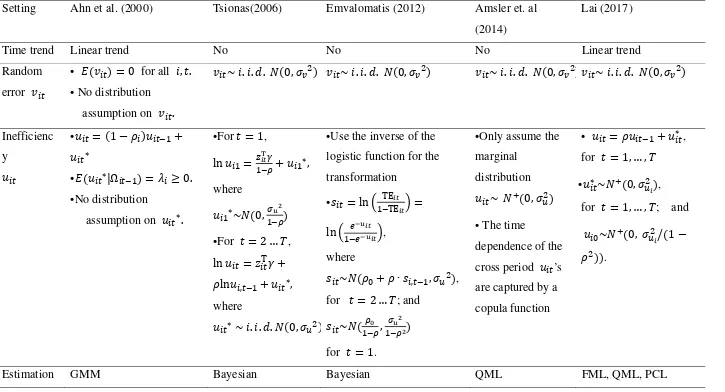
. We summarize the main assumptions of these models in Table 1.
The model specification of Ahn et al. (2000) is more general than the other models in Table 1 in
the sense that they do not impose any distributional assumption on and , and they also allow
the AR coefficient to be firm-specific. They suggest using firm dummies for the AR coefficients.
The main drawback in doing this is that the number of parameters will increase with the number of
firms. Thus the model is likely to suffer from the incidental parameter problem. They estimate the
model by the GMM approach, which is less efficient compared to the standard ML estimation but
more robust to the distribution misspecification. Their distribution free approach has another
shortcoming with respect to predicting the technical efficiencies (TE). The model can only predict
long-run inefficiency which in their model is firm-specific. However, it is not possible to predict
observation-specific inefficiency, and therefore one cannot estimate the temporal pattern of
inefficiency for each firm. Further, in reality firm efficiencies may systematically differ across firms,
so we need a model that produces not only magnitudes of these inefficiencies but can also explain
their systematic differences in terms of some covariates. We do this in our model.
Tsionas (2006) and Emvalomatis (2012) also consider DSF models with different settings of
the dynamics of the inefficiency. The former assumes the logarithm of inefficiency, ln( ), to follow
an AR(1) process and the latter assumes the logarithm of the ratio of the technical efficiency (TE)
index to the inefficiency index, i.e., ln(TE/(1-TE)), to follow an AR(1) process. Moreover,
Emvalomatis (2012) separates the time-invariant unobserved heterogeneity from a first-order
autoregressive inefficiency and suggests estimating the model using a Bayesian correlated
random-effects approach in which a distribution for the unit-specific effects is specified. The main
common characteristic of these two models is that they both apply some kinds of transformations to
the inefficiency term so that the transformed inefficiency term follows an AR(1) process with a
normal stochastic error while keeping the inefficiency positive in the meantime. The joint
distribution of the transformed inefficiencies is simply a multivariate normal distribution, which
5
the cross-period composite errors in the DSF model is almost intractable after the transformation.
Therefore, both Tsionas (2006) and Emvalomatis (2012) apply the Bayesian approach to estimate the
model. That is, because of the complexity in deriving the likelihood function, they both used
Bayesian MCMC approach.
In addition to the above models that directly specify the dynamic adjustment process of the
technical (in)efficiency, Amsler et al. (2014) suggest using a copula function to capture the time
dependence of the panel SF models. With a correctly specified marginal distribution and an
appropriately chosen copula function, one may approximate the true joint pdf and estimate the
parameters by the quasi-maximum likelihood approach, which seems to be the easiest one to
implement from the practical point of view. However, the loss of efficiency in the QML approach
compared with the FML estimation has not yet been investigated in the SF studies.
2.2. The proposed model
In this paper, we consider the DSF model specified in equation (1). For simplicity, we assume
that the technical innovation is linear in time, t. Although t can be included in the vector, we
assume that is a linear function of time as in Ahn et al. (2000), i.e.,
. (2)
The technical inefficiency component is assumed to be dynamic and follows an autoregressive
(AR) process of order one, i.e.,
∗, 1, … , , (3)
where is the AR(1) coefficient and ∗ is a nonnegative random noise. We restrict the coefficient
to be bounded between 0 and 1 so that 0 for all , . The restriction 0 1 implies
that the inefficiency component must be positively correlated with the previous inefficiency
component. The standard SF model corresponds to the special case when 0. If 1, then (3)
suggests that the inefficiency level is equal to the sum of all past inefficiency levels ∗, and
therefore would explode. Therefore, a firm with 1 cannot survive in the long-run in a
competitive industry.
The inefficiency component in equation (3) is decomposed into two components. At time ,
a firm faces the persistent inefficiency, which comes from the previous period’s inefficiency.
The persistent inefficiency the firm needs to deal with in the current period is . The
6
in period is ∗. To incorporate the heterogeneity in the inefficiency, we assume that the
transient inefficiency component follows a half normal distribution with firm-specific variance, viz.,
∗~ 0, , for 1, … , , (4a)
and
~ 0, / 1 . (4b)
Moreover, ∗ and ∗ are independent of each other for a given . In order to accommodate
determinants of inefficiency, we specify
exp , (5)
where is the 1 vector of exogenous firm-specific time-invariant variables that are viewed
as the determinants of the firm-specific transient inefficiency. With the dynamic specification in (3)
and (4), we are able to estimate the persistent and transient inefficiencies as well as the long-run
inefficiency, the expected value of which is E ∗ / 1 2/ / 1 . As in the Ahn
et al. (2000) model, the long-run inefficiency is firm-specific and its variation across firms can be
explained by the variables. The expected value of overall inefficiency is E E
E ∗ E 1 , where E ∗ is the expected value of long-run inefficiency. Thus, the expected value of the overall inefficiency is the weighted average of the
expected values of persistent and long-run inefficiency.
3. Estimation
For estimation we transform the model which is considered in the next subsection. This is followed
by estimation methods of the transformed model.
3.1 The transformed model
The complete setting of the panel SF model includes equations (1)-(5). Since the inefficiency
component follows an AR(1) process, the cross-period correlation between the composite errors
comes from ′ but not ′ . To eliminate this autocorrelation in , we apply the
quasi-difference transformation to (1), subtracting by , and obtain the transformed model
1 1 , (6)
7
, then the composite error can also be represented as
, (7)
which has the representation of a moving averaging (MA) process of order 1. In order to implement
the maximum likelihood method to estimate the model, it is necessary to derive the joint distribution
of , … , for each .1
Since in the transformed model (6), the autocorrelation between s only comes from s, not
from s, the marginal distribution of the composite error is simply a combination of two
normal and one half-normal random variables. Let . , … , and ∗.
∗ , … , ∗ be 1 1 and 1 vectors. Then the vector of the composite errors
. , … , can be written as
. Q . ∗. ∗. ∗., (8)
where ∗. Q . is a 1 vector and
Q
1 0 0 ⋯ 0
0 1 0 ⋯ 0
⋮ ⋱ ⋱ ⋮
⋮ ⋱ ⋱ 0
0 ⋯ ⋯ 0 1
(9)
is a 1 matrix. We call the matrix Q the quasi-difference transformation matrix.
3.2 The full maximum likelihood (FML) estimator
Below we discuss the derivation of the likelihood function of the transformed model in (6). Let
∙; , Ξ and Φ ∙; , Ξ be the probability density function (pdf) and cumulative distribution function (cdf) of a T-dimensional normal distribution with mean and variance matrix Ξ. Let
denote a identity matrix and be a 1 vector of zeros. With the distributional
assumptions on . and ∗., we are able to derive the joint distribution of .. The main results are
summarized in Theorem 1.
1 Note that to avoid the endogeneity problem due to the presence of lagged dependent variable in (6) we consider the
8
Theorem 1: Under the model specified in (1)-(5), if ~ . . . 0, , ∗~ 0, , and
∗, the vector of the composite errors
. of the transformed model in (6)
has the closed skew normal (CSN)2distribution, i.e.,
. ~ , , Σ , Σ , , Σ ,
where Σ QQ is a matrix, Q is defined in (9) and exp . The
corresponding joint pdf of . is
. .; 2 .; , Σ Φ Σ .; , σ Σ , (10)
where , , , , , denotes the vector of parameters.
In the appendix we provide the proof and details about the CSN random vector. With the joint
pdf of . in (10), we are able to write down the full log-likelihood function of the transformed
model
ln ∑ ln . .; . (11)
The FML estimator is defined as
arg max ∈ ln , (12)
where Θ denotes the parameter space. Under the usual regularity conditions3,
√ ~ , ,
where is the dimension of and E .; is the Hessian matrix. Empirically, one
can estimate the variance of from the inverse of the Hessian matrix, i.e.,
ar ∑ .; , (13)
where ̂. is the predicted residual vector of the transformed model.
It is worth mentioning that evaluation of equation (10) involves a numerical integration of
dimension , which has no closed form and usually relies on Gaussian quadrature or a simulation
approach to evaluate its function value. If the number of periods is large, the numerical
integration would be difficult and the approximation error is almost intractable. Below we discuss
2
See the Appendix for the definition of the closed skew-normal distribution.
9
two alternative approaches, where the first one is based on the likelihood function of the paired
composite errors of (8) and the second is based on the approximated joint pdf of the 1 vector
of the composite errors.
3.3 The composite likelihood (CL) estimator
Following the suggestions of Arnold and Strauss (1991) and Renard et al. (2004), here we
consider the CL (which is also referred to as the pseudo likelihood in the literatures) method to
simplify the computations. A CL consists of a combination of valid likelihood objects and is usually
related to small subsets of data. The merit of the CL method is that it reduces the computational
complexity so that it is possible to deal with high dimensional and complex models. We illustrate the
main idea of the CL approach below.
Let f (Y; ) be a density function, then the usual ML estimator is obtained by maximizing the
full likelihood f (Y; ) over .If Y can be partitioned into three pieces, say Ya, Yb, and Yc, where Yb
or Yc may be an empty set, then the conditional density f(Ya|Yb; ) or the marginal density if Ybis an
empty set, continues to depend on at least part of the true parameter . Given a collection of such
partitions, the conditional densities can be multiplied together to yield a composite likelihood, whose
maximum over can be referred to as the composite ML estimator (see Cox and Reid (2004) and
Mardia et. al (2009)). The CL approach suggests that one may replace the joint likelihood function by
any suitable product of conditional or marginal densities. More discussions on the consistency and
asymptotic normality of the CL estimator can be found in Arnold and Strauss (1991) and Renard et al.
(2004).
For the transformed model in (6), the composite likelihood function is much easier to evaluate
than the full likelihood function. However, the convenience may come at a cost of losing efficiency
since the cross-period sample information is not fully incorporated. Since how much efficiency we
lose due to using the pairwise composite likelihood (PCL) approach is not clear, we will investigate
this issue by comparing the finite sample performance of the PCL and FML estimators using Monte
Carlo simulations later in section 4.
Below we illustrate the CL approach to estimate the transformed model and focus our
discussion on the pairwise composite likelihood approach. Recall that ∗, so
the composite errors have an MA(1) representation due to the quasi-difference transformation. The
10
Corr .
1 ∗ 0 ⋯ 0
∗ 1 ∗ 0
0 ∗ ⋱ ⋮
⋮ ⋱ ∗
0 0 ⋯ ∗ 1
, (14)
where the correlation coefficient ∗ is due to the correlation between the ∗ s,
which are normal random variables. It is worth mentioning that the pair ( , ) is independent if
| | 1 and thus their joint pdf is the product of their marginal pdfs. The joint pdf of an arbitrary pair , has the following two forms
, , ; , ; , if |, ; , if | | 1;| 1; (15)
where , ; is the product of the marginal pdfs of and when | | 1, and
, ; is the joint pdf of two consecutive ’s. Both of the marginal pdf and joint pdf can be treated as special cases of Theorem 1 when 1 and 2, respectively. We summarize the
main results in Corollaries 1 and 2 below.
Corollary 1: Suppose ∗~ 0, ∗ and ∗~ 0, , where ∗ 1 and ∗ and
∗ are independent of each other. Define ∗ ∗. Then has the following closed
skew-normal distribution
~ , 0, ∗ ,
∗ , 0,
∗
∗ , (16)
which has the pdf
;
∗ ∗ Φ ∗ ∗
. (17)
Equation (17) gives the marginal pdf of . It follows from (14) and (17) that when the lag
difference | | 1, the joint pdf of and is
, ; ; ; , (18)
where ; is given in (17).
For 2, … , 1, define , as a 2 1 vector of the composite errors from
consecutive periods. In a manner similar to (8), can be represented as
11
where , , , ∗ ∗, ∗ , ∗ ∗, ∗ and
Q 0 1 01 . (20)
Note that since Var and ∗~ , , , each element in and ∗ is
independent across time. The joint pdf of is given in Corollary 2.
Corollary 2: Under the same assumption of Theorem 1, the 2 1 vector defined in (19) has
the following closed skew-normal distribution,
~ , , Σ , Σ , , Σ , (21)
where Σ Q Q is a matrix and Q is defined in (20). The corresponding joint
pdf of is
; 4 ; 0, Σ Φ Σ ; 0, Σ . (22)
By Corollary 2, we have , ; ; . Therefore, it follows from (18) and (22) that the
pairwise composite log-likelihood function for all combinations of possible pairs for the firm is
ln ∑ ∑ ln , , ;
∑ ln , ; ∑ ∑ ln , ; , (23)
where the summation contains 1 /2 factors. It follows that the pairwise composite
log-likelihood for the whole sample is
ln ∑ ln . (24)
The maximum PCL estimator is defined as
arg max ∈ ln .
According to Varin and Vidoni (2005), under the usual regularity conditions the PCL estimator is
consistent and asymptotically normally distributed, i.e.,
√ ~ , ,
where E and E . Empirically, and
12
∑
and
∑ .
Therefore, it follows that the variance of can be estimated by
∑ ∑
∑ . (25)
3.4 The quasi-maximum likelihood (QML) estimator
In addition to the aforementioned FML and PCL estimations, we also use the QML approach to
estimate the transformed model in (6). According to the Sklar’s theorem (Sklar, 1959, and Schweizer
and Sklar, 1983), the joint distribution of . can be constructed with the given marginal distribution
of , denoted as ; , for 1, … , and an appropriate copula function ∙ , which binds
the marginal distributions with the given dependent structure. In this case, we have correctly
specified the marginal model under the assumptions, and have approximated a joint distribution
based on the copula function.
Recall that the composite error of the transformed model is ∗ ∗. Corollary 1 shows
that the marginal distribution of follows a closed skew-normal distribution (CSN), which has the
pdf given in equation (16) and has the cdf given by
2Φ 0 ; 00 , ∗ 1 . (26)
The correlation coefficient matrix for i.is given by (14).
According to Sklar’s theorem, the joint distribution of . can be written as
, … , ; ; , … , ; ; , (27)
where is the parameter of the copula function. The corresponding probability density function is
, … , ; ; , … , ; ; ; … ; , (28)
where ∙ ∙
; … ; .
13
comes from the correlation between ∗ and ∗ , which are normally distributed. In other words,
if ∗ and ∗ were independent of each other, then and would be also independent.
Therefore, we may conjecture that the correlation of ; and ; also comes from ∗ and ∗ and expect that their correlation matrix has a similar structure to (14).
In order to impose the prior information about the correlation structure, we use the Gaussian
copula to construct the quasi-likelihood function. The Gaussian copula implies a symmetric
correlation structure on its marginals, and its variance-covariance matrix has a similar structure as
that of the original vector . in (14). More specifically, the correlation matrix Λ of the Gaussian
copula should have the structure
Λ
1 0 ⋯ 0
1 0
0 ⋱ ⋮
⋮ ⋱
0 0 ⋯ 1
, (29)
where is the correlation coefficient between and . We expect that and ∗ should have a one-to-one correspondence, i.e., ∗ . However, the explicit form of the
function ∙ is complicated and almost intractable. We, therefore, use a series polynomial4of ∗ to approximate the true . In order to ensure that is bounded between 1 and 1, we assume
∗ ∑ ∗
∑ ∗ , (30)
where is the order of the polynomial function of ∗. Therefore, under the Gaussian copula
specification we have the quasi-joint distribution
; , … , ; ; Λ Φ Φ ; , … , Φ ; ; Λ , where Φ ∙ is the cumulative distribution function (cdf) of a -variate standard normal
distribution and Φ ∙ is the cdf of a univariate standard normal distribution. The corresponding
Gaussian copula density is
; , … , ; ; Λ | | / exp Λ , (31)
where Φ ; , … , Φ ; . According to (28), the log quasi-likelihood
function is
ln ∑ ln
∑ ln , … , ; ,
4 By the Weierstrass approximation theorem, every continuous function defined on a closed interval can be uniformly
14
∑ ln |Λ | Λ ∑ ln ; . (32)
The corresponding quasi-maximum likelihood (QML) estimator can then be defined as
arg max ∈ ln .
Since the quasi-likelihood function is an approximation of the true likelihood function, the sandwich
standard error is suggested. The remaining statistical inference is quite standard in the QML
literatures.
3.5 Prediction of the technical (in)efficiency
Once the ML, PCL or QML estimator for the parameters is obtained, we proceed to predict the
technical efficiency (TE) index and technical inefficiency. In order to predict the TE, it is necessary
to find the conditional expectation TE E |Ω . Under the specification of (3), the TE index
is predicted from
TE E |Ω , (33)
where Ω denotes the information set available at time . Since the inefficiency term follows
an AR(1) process, the iterative substitution suggests
∗
∑ ∗ , (34)
which has a moving average representation. Under the independence assumption of ∗ and ∗ for
all , (34) suggests that
E |Ω E exp ∑ ∗ ∙ exp |Ω
∏ E exp ∗ |Ω ∙ E exp
∏ E exp ∗ | ∙ E exp , (35)
where the second equality is due to the prediction of exp ∗ |Ω , which requires only the
information of at the current period. In other words,
E exp ∗ |Ω E exp ∗ |Ω , for any 0.
Theorem 2:Let the composite error ∗ ∗, where ∗ , ~ . . . 0, ,
15
1 , then the moment generating function of ∗ given is
∗ | E ∗| exp Φ /Φ (36)
and
∗ | 0 E ∗| . (37)
Further, the moment generating function of 0 is
2 ∙ exp ∙ Φ (38)
with the first moment
. (39)
Using equations (34)-(39), we are able to derive the predictors of TE and technical inefficiency.
We summarize them in Corollary 3.
Corollary 3: Let , for 0, 1, … , . Under the same assumption of Theorem 1, the
predictor of TE index E |Ω is
TE 2exp ∑
∏ Φ . (40)
Similarly, it follows from (25) and (28) that the predictor of technical inefficiency E |Ω is
E |Ω ∑ . (41)
Equations (40) and (41) provide the predictors of TE and the technical inefficiency.
Empirically, one replaces the parameters by their FML, PCL or QML estimates in the formulae
above. Moreover, under the AR(1) setting ∗, the long-run inefficiency is
lim → E
∗
. (42)
Now ∗~ 0, implies that E ∗ . Therefore, the long-run inefficiency can be
16
lim → E , (43)
which can be predicted by replacing the parameters with their estimates.
4. The Monte Carlo experiment
In this section, we conduct some Monte Carlo experiments to examine the finite sample
performances of the FML, PCL and QML estimators and also investigate how much efficiency we
lose due to adopting the composite likelihood or quasi-likelihood instead of the full likelihood
method.
In our experiments, we estimate a DSF model with heteroscedastic using FML, PCL and
QML methods. The data-generating process (DGP) is specified as
, , ,
where ∗ follows an AR(1) process. The exogenous variables are drawn from
normal distributions, , ~ 5, 1.5 and , ~ 3,1 . The two random components are
~ . . . 0, and ∗~ 0, , where exp and the exogenous variable is drawn from ~ 0, 2 . The parameters in the data generating process are 0.3,
0.2, 1, 0.5, 0.1, 0.5 and 0.1.
Moreover, we set the AR(1) coefficient as
0.35, 0.7
and consider various combinations of and
25, 50, 100 and 5, 10, 15 .
We compare the performance of the FML and PCL and QML estimators using the relative
biases (RBias) and relative MSEs (RMSEs), which are defined as
RBias , RBias , RBias
and
RMSE , RMSE , RMSE ,
where , and denote the FML, PCL and QML estimators for the parameter ,
17
that of the FML estimator . The relative efficiency of PCL and FML estimators is evaluated by
the RMSE. RMSE 1 suggests that the FML estimator is more efficient than the PCL estimator.
The programs are written in Stata 14.0. For the FML estimation, the numerical integration of the
multivariate normal cdf is evaluated using Stata’s Geweke-Hajivassiliou-Keane (GHK) simulator
(Geweke (1989), Hajivassiliou and McFadden (1998), and Keane (1994)), which is applicable if the
dimension of the cdf is 20 or less. In our experiment, the maximum dimension of the normal cdf we
evaluated is 14 since the maximum in the untransformed model is 15. We use linear
approximation in the QML estimation, so 2 in (30) and thus ∗ ∗∗ .
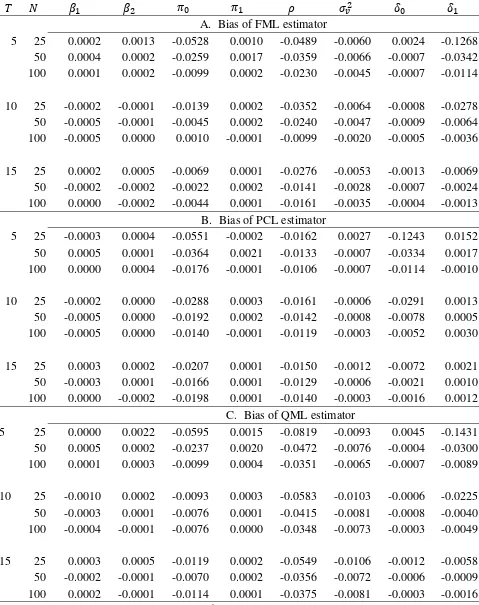
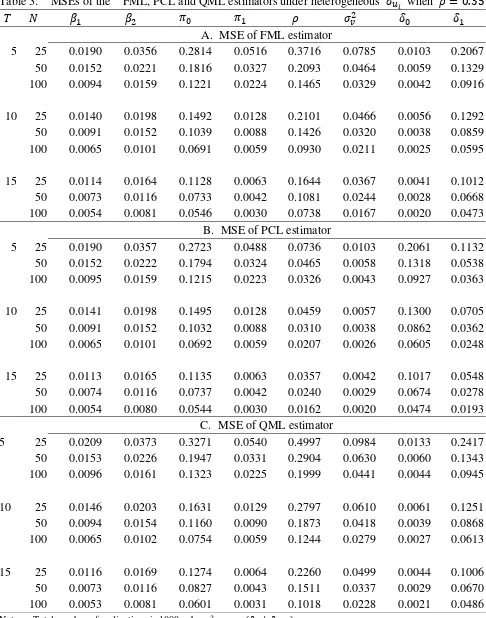
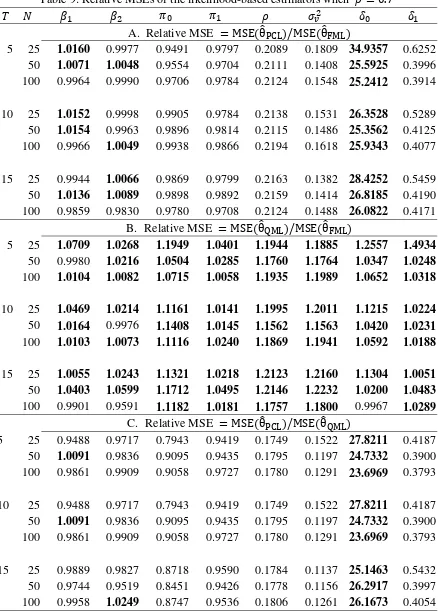
We report the biases, MSEs, the RBias and RMSEs when 0.35 in Tables 2-5, and the
results when 0.7 are reported in Tables 6-9. As shown in Tables 2 and 3, all biases and MSEs
of the QML, PCL and FML estimators are in small magnitudes. In particular, all MSEs of the three
estimators decrease when we increase or T, but the pattern of biases is not so clear.
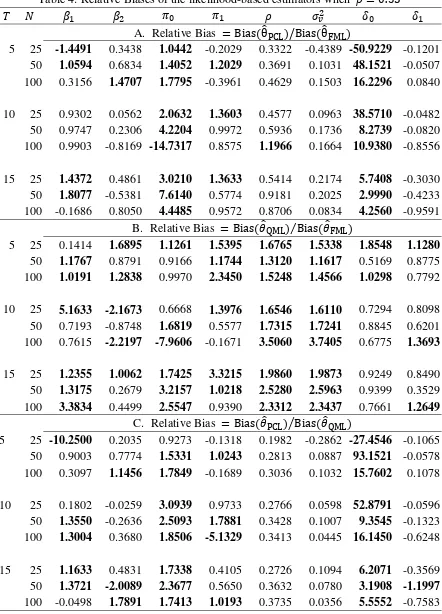
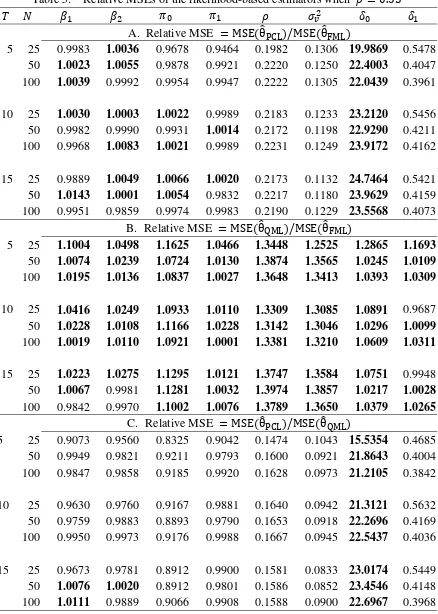
Tables 3 and 4 provide some comparisons of the three estimators in terms of RBias and RMSE.
The RBiases and RMSEs are marked in bold if they have values greater than 1. Panel A of Table 4
compares the biases of PCL and FML estimators. Among the eight parameters in our model, the PCL
estimators of and tend to have relatively larger biases than those of FML estimators when
the sample is small. This may be due to the cross period information not being fully incorporated in
the objective function. plays the role of the intercept term in the transformed model in (6), thus
underestimation of will be accompanied by underestimation of the intercept in
exp , and vice versa. There are 27 out of the 72 RBiases5 (about 37.5% of the parameters in all cases) that are greater than 1, which indicates that the PCL estimator works as well as the FML
estimator, on average.
Panel B of Table 4 compares the biases of the QML and FML estimators. About 63.9%
( 46/72) of the QML parameters have larger biases than the FML estimators, which is not a
surprising result. In the QML estimation, only the marginal pdf is correctly specified and the
cross-period dependence is imposed into the likelihood function by a copula function. However, if
we further compare the values of RBiases in panel A and B, we find that almost all the RBiases in
panel B have values less than 3, but this is not the case for panel A. This suggests that the Gaussian
copula can effectively capture the cross-period dependence. The results in panel C are quite
consistent with our findings from panels A and B. The QML estimators of and also have
18
smaller biases than the PCL estimator, but this is not necessarily true for the remaining parameters.
Panel A of Table 5 shows the RMSEs of the PCL and FML estimators. We found that only the
RMSEs of are relatively large and all the other RMSEs are less than 1.007, which also indicates
the PCL estimation has good performance in terms of RMSEs. In panel B, only 5 out of 72
parameters are less than 1, which shows the QML is not as efficient as the FML estimator; however,
all RMSES are quite close to one. Together with our findings from the RBiases in panel B of Table 4,
we conclude that the loss of efficiency in QML estimation does not seem to be a serious problem.
Panel C compares the PCL and QML estimation. Only the RMSEs of and three parameters have
values greater than 1, which also suggests that the PCL estimator of is less efficient than both the
FML and QML estimators, but this is not necessarily true for the remaining parameters.
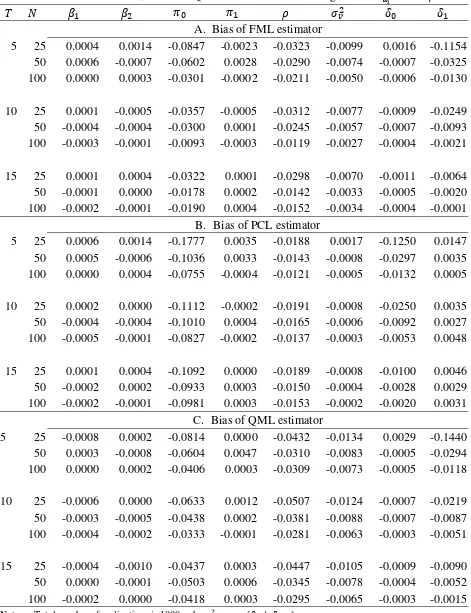
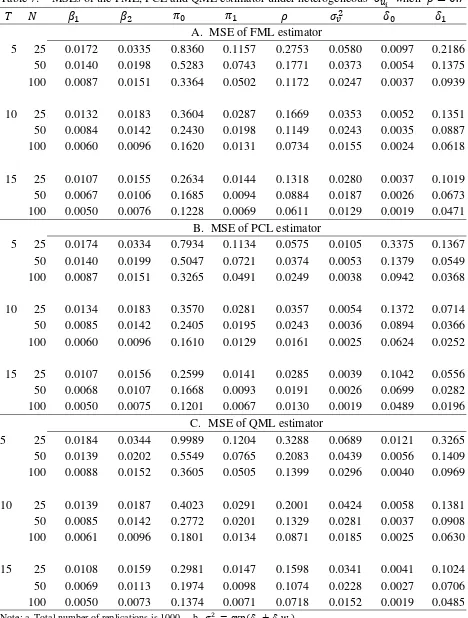
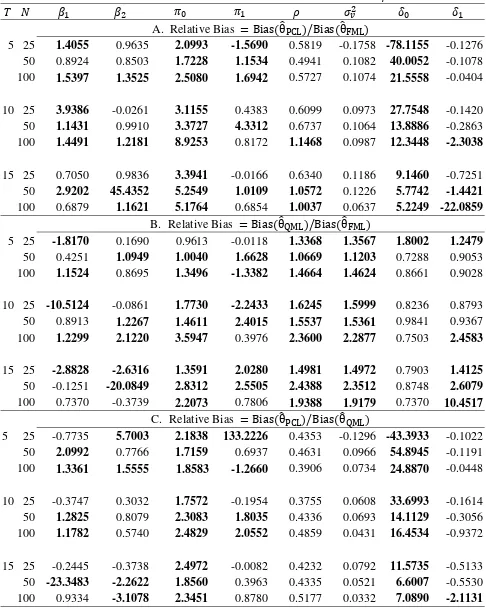
Tables 6-9 summarize the results of our Monte Carlo experiments when 0.7. The objective
of Tables 6-9 is to check whether our findings from previous simulations change when the AR(1)
coefficient is higher, that is, when the persistency of the inefficiency is larger. We found that the
magnitudes of biases are also small and have a decreasing tendency as the sample sizes increase.
Moreover, all MSEs decrease quickly as N and T increase. The pattern is similar to what we found in
Tables 2-5.
All of the above three likelihood-based estimators have some advantages compared with each
other and there exist some tradeoffs in the FML, PCL and QML estimators. From the theoretical
point of view, one may expect that the FML estimation is the most efficient and performs uniformly
better than the other two approaches since it fully utilizes the sample information and its estimator is
obtained from the true joint pdf of the sample. However, our simulation does not provide significant
evidence showing that the FML estimator is uniformly better (in terms of biases and MSEs of all
parameters) than the other two estimators. We suspect that this may be due to the approximation
error of the numerical integration of the multivariate normal cdf in equation (10). Unfortunately, we
cannot trace the approximation error of the numerical integration in our simulation. On the contrary,
for the PCL approach we only need to evaluate a bivariate normal cdf, which simplifies the
numerical computation. The likelihood function of PCL estimation comes from the paired sample;
the joint pdf is correctly specified but the cross period information is not fully incorporated into the
objective function. The main advantage of the PCL estimator is that we only need to deal with two
dimensional integration no matter how long the time span is. The FML and PCL estimator are
19
For the QML method, we only need to evaluate the marginal pdf of the transformed model,
where the cross-period information is incorporated into the likelihood function through the copula
function. Therefore, the QML has a smaller computational burden than the other two, but the cost is
that we only obtain the approximated likelihood function, instead of the true one. Moreover, if the
product copula is used, then we have a composite marginal likelihood (Chandler and Bate, 2007),
which permits inference only on marginal parameters. In this case, the information about the
cross-period dependence is not incorporated.
Based on the simulation results, we conclude that both PCL and QML estimators are reliable in
terms of bias and RMSE. The loss of efficiency does not seem to be serious in our simulation results.
We also conclude that the FML is the most efficient approach, PCL ranks second and QML ranks
third. As a rule of thumb, when the time span of the sample is not large or the likelihood function is
not too complicated, the FML estimation is recommended for an empirical study. However, when the
time span is moderately long in the sense that the multivariate normal cdf is difficult to evaluate, we
may adapt the PCL estimation instead. The QML estimation may be used when the time span is
extremely long in the sense that there are too many paired combinations of the sample (i.e.,
lim → combinations) that need to be considered.
5. Empirical Application
In this section, we apply the DSF model to a study of the hotel industry in Taiwan, that
focuses on estimating the production technology. The data comes from the annual report of the
Taiwan Tourism Bureau at the Ministry of Transportations and Communications. This unbalanced
panel data, including 63 international grand hotels from 2006-2013, provides 475 sample
observations for the empirical study. The output for each hotel is measured in total revenue (Y),
while the inputs include the total number of workers (L), the total number of rooms (K), and other
expenses (Other), which includes utilities, materials, and maintenance fees. All revenues and other
expenses are measured in thousand New Taiwan (NT) dollars. In addition to these input and output
variables, we use a time trend (to capture technical change that shifts the production function over
time) in the production function and a dummy variable that indicates whether the hotel is leagued
with foreign hotels as the firm specific determinant of . We define time, t = 1,...,8, for years
2006,...,2013. The summary statistics of the variables are reported in Table 10.
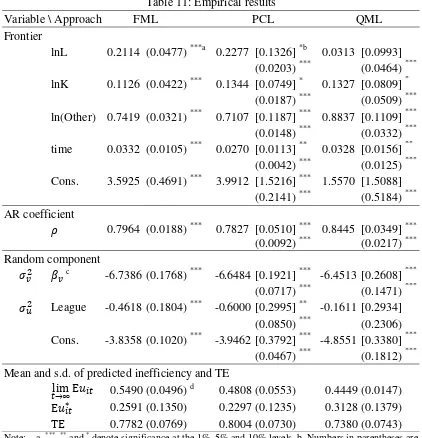
The upper panel of Table 11 reports the estimates of the parameters for the model in (1)-(5).
20
estimates are. The numbers in parentheses are the standard errors of the FML, PCL and QML
estimators and computed using the inverse of the negative Hessian matrix. The numbers in brackets
are the standard errors of the PCL and QML estimators and are computed using (25) and the
sandwich formula. Therefore, the standard errors in parentheses are valid only for the FML, and the
correct standard errors of the PCL and QML estimators are in brackets. The coefficients of inputs are
interpreted as elasticity (percentage increase in revenue output for a 1% change in L, K and Other,
respectively), and are all positive as expected. The returns to scale, measured by the sum of the input
elasticities, are about 1.0659, 1.0728 and 1.0477 for the FML, PCL and QML estimations,
respectively. The coefficient of time (when multiplied by 100) shows the percentage change in
revenue over time, holding input quantities unchanged. It is interpreted as technical change. Thus, a
value of 0.0332 by the FML estimation means technical progress of 3.32% per annum and, similarly,
for the PCL and QML it is 2.7% and 3.28%, respectively.
The negative coefficient of League in suggests that hotels leagued with foreign hotels are
more efficient. Our estimates of the AR coefficient (ρ) for the FML, PCL and QML estimations are
0.794, 0.7827 and 0.8445, which suggest technical inefficiency is highly persistent in the hotel
industry data. Our findings here also indicate the importance to incorporate the dynamics of
inefficiency into the model when conducting empirical analysis using panel data.
The bottom panel of Table 11 provides summary statistics of the predictions of the long-run
inefficiency, transient inefficiency and efficiency score of the three approaches. For the FML
estimation, the long-run and transient inefficiency are found to be 0.549 and 0.259, on average. The
gap between the transient and long-run inefficiency is about 0.29, which is consistent with our
previous finding of the high persistence inefficiency. The mean efficiency score is about 0.7782. The
predictions of efficiency from the PCL estimation are closer to those of the FML than those from the
QML.
6. Conclusion
In this paper, we proposed a panel SF model with a dynamic adjustment of the heteroscedastic
inefficiency. In addition to the full maximum likelihood estimation, we propose two other
likelihood-based approaches, viz., the pairwise composite likelihood function and the
quasi-maximum likelihood function, as alternatives to the FML estimation. In the PCL method, we
focus on the lower dimension of the joint distribution and formulate the pairwise composite
likelihood by considering all possible pairs of the subsample. Alternatively, in the QML method we
21
dependence by using a copula function. These two alternatives are applicable when the true
likelihood function is difficult to evaluate or the time span of the observed data is long. We compare
the finite sample performance of the PCL, QML and FML estimators from the Monte Carlo
simulations and find that the PCL and QML estimators perform quite well in our finite sample
experiments. The issue of efficiency loss does not seem to be a serious problem.
In our present model dynamic stochastic frontier model, we did not include the firm-specific
random/fixed effect in the frontier part. However, it is a straightforward extension of our model to
include the random effects. The aforementioned three likelihood-based approaches can be easily
combined with the simulated likelihood approach, which integrates out the random effects by
simulation. On the other hand, if the fixed effects are included in the model, such as in Belotti and
Ilardi (2017)6, then one may need to apply either first difference or within transformation first to eliminate the fixed effect. We leave these extensions for the future.
6
22
References
Ahn, S. C., D.H. Good and R. C. Sickles. (2000). "Estimation of long-run inefficiency levels: a
dynamic frontier approach." Econometric Reviews, 19(4): 461-492.
Amsler, C., A. Prokhorov, and P. Schmidt. (2014). Using copulas to model time dependence in
stochastic frontier models." Econometric Reviews, 33(5–6):497–522.
Arnold, B. C. and D. Strauss (1991). "Pseudolikelihood estimation: some examples." Sankhyā: The
Indian Journal of Statistics, Series B. 53(2): 233-243.
Battese, G. E. and T. J. Coelli (1992). "Frontier production functions, technical efficiency and panel
data: with application to paddy farmers in India." Journal of Productivity Analysis. 3: 153-169.
Belotti, F. and G. Ilardi (2017). "Consistent inference in fixed-effects stochastic frontier models."
Journal of Econometrics,forthcoming.
Chandler, R. E. and Bate, S. (2007), "Inference for clustered data using theindependence
log-likelihood", Biometrika, 94(1), 167-183.
Cornwell, C., P. Schmidt, and R. Sickles. (1990). "Production frontiers with cross-sectional and
time-series variation in efficiency levels." Journal of Econometrics,46: 185-200.
Cox, D. R. and N. Reid (2004). "A note on pseudolikelihood constructed from marginal densities."
Biometrika. 91(3): 729-737.
Emvalomatis, G. (2012). "Adjustment and unobserved heterogeneity in dynamic stochastic frontier
models." Journal of Productivity Analysis. 37: 7-16.
Filippini, M., and Greene, W.H., (2016), “Persistent and Transient Productive Inefficiency: A
Maximum Simulated Likelihood Approach." Journal of Productivity Analysis, 45:187-196.
Geweke, J. (1989), “Bayesian inference in econometric models using Monte Carlo integration”.
Econometrica. 57: 1317–1339.
González-Farías, G, J. A. Dominguez-Molina, and A.K. Gupta (2004). "The closed skew normal
distribution." In Skew-elliptical distribution and their applications: A journey beyond normality.
M.G. Genton (ed), Chapman and Hall/CRC Press.
Hajivassiliou, V., and D. McFadden (1998). The method of simulated scores for the estimation of
LDV models. Econometrica, 66: 863–896.
Keane, M. P. (1994). A computationally practical simulation estimator for panel data. Econometrica,
62: 95–116.
Kumar, S. and R. R. Russell (2002). "Technological change, technological catch-up, and capital
deepening: relative contributions to growth and convergence." American Economic Review.
92(3): 527-548.
23
production and profit frontiers." Journal of Econometrics, 34(3): 335-348.
Kumbhakar, S. C. (1990). "Production frontiers, panel data, and time-varying Technical
inefficiency." Journal of Econometrics. 46(1-2): 201-211.
Kumbhakar, S. C. and H.-J. Wang (2005). "Estimation of growth convergence using a stochastic
production frontier approach." Economics Letters. 88: 300-305.
Lee, Y. and P. Schmidt (1993). "A production frontier model with flexible temporal variation in
technical efficiency." The Measurement of Productive Efficiency: Techniques and
Applications,Oxford University Press.
Mardia, K. V., et al. (2009). "Maximum likelihood estimation using composite likelihoods for closed
exponential families." Biometrika. 96(4): 975-982.
Pitt, M. M. and L.-F. Lee (1981). "The measurement and sources of technical inefficiency in the
Indonesian weaving industry." Journal of Development Economics. 9: 43-64.
Renard, D., et al. (2004). "A pairwise likelihood approach to estimation in multilevel probit models."
Computational Statistics & data. 44(4): 649-667.
Schmidt, P. and R. C. Sickles (1984). "Production frontiers and panel data." Journal of Business &
Economic Statistics. 2(4): 367-374.
Schweizer, B. and A. Sklar (1983), Probability Metric Spaces, Elsevier Science, New York.
Sklar, A. (1959), “Fonctions de Répartition à n Dimensions et Leurs Marges,” Publications de
l’Institut de Statistique de L’Université de Paris, 8: 229-31.
Tsionas, E. G. (2006). "Inference in Dynamic Stochastic frontier models." Journal of Applied
Econometrics, 21: 669-676.
Varin, C. and P. Vidoni (2005)."A note on composite likelihood inference and model selection. "
24
Appendix:
Definition: Consider 1, 1, ∈ , ∈ , an arbitrary matrix Γ, positive
matrices ΣandΔof dimensions and , respectively. A p-dimensional closed skew-normal
random vector with parameters , Σ, Γ, , Δ, denoted as ~ , , Σ, Γ, , Δ , has the
probability density function
, , Σ Φ Γ ; , Δ , (a1)
and the cumulative distribution function
, Φ 0 ; , ΣΓΣ Δ ΓΣΓΣΓ , (a2)
where ∈ , and Φ 0; , Δ ΓΣΓ . Moreover, the moment generating function (mgf) of
is
; ,
; , e , where ∈ . (a3)
More details about the closed skew-normal distribution may be referred to Gonzalez-Farias,
Dominguez-Molina and Gupta (hereafter GDG, 2004).
Proof of Theorem 1:
Let Σ QQ , Σ and Σ Σ Σ . The mgf’s of ∗. and ∗. are
∗ ∗⋅
and
∗ ∗⋅ ∙ ; ,
; , .
Therefore, the mgf of . is
. ∗∙ ∙ ∗∙ ∙ ; ,
; , .
By the definition of CSN, the parameters in equation (a3) are , Σ Σ Σ Σ , and
. Moreover, ΓΣ Σ implies Γ Σ Σ and ∆ ΓΣΓ Σ implies ∆ Σ
Σ Σ Σ . Therefore, we have
25 and a further simplification gives
, , Σ , Σ , , Σ . Q.E.D.
Proof of Theorem 2:
Let 1 / 1 and / 1 . Then the
condition distribution7 of ∗| is
∗|
√ exp ∗
1 Φ ,
where ∗ ∗ is defined in (6). The conditional moment generating function of ∗| is
∗ ∗ ∙ ∗| ∗,
√ exp
∗ ∗
/Φ ,
exp √ exp ∗ ∗ /Φ ,
exp 1 Φ 0; , /Φ ,
exp 1 Φ /Φ ,
exp Φ /Φ .
Let , where 0,1 … , then ∗
exp Φ /Φ .
∗ 0 ∗| .
Moreover, the moment generating function of 0 is
2 ∙ exp ∙ Φ
and its first moment is
7
26 .
Using (25), we obtain the results.
Table 1: Econometric specifications of the dynamic stochastic frontier models
Setting Ahn et al. (2000) Tsionas(2006) Emvalomatis (2012) Amsler et. al
(2014)
Lai (2017)
Time trend Linear trend No No No Linear trend
Random
error
• 0 for all , .
• No distribution
assumption on .
~ . . . 0, ~ . . . 0, ~ . . . 0, ~ . . . 0,
Inefficienc
y
• 1
∗
• ∗|Ω 0.
•No distribution
assumption on ∗.
•For 1,
ln ∗,
where
∗~ 0,
•For 2 … ,
ln
ln , ∗, where
∗ ~ . . . 0,
•Use the inverse of the
logistic function for the
transformation
• ln
ln ,
where
~ ∙ , , ,
for 2 … ; and
~ ,
for 1.
•Only assume the
marginal
distribution
~ 0,
• The time
dependence of the
cross period ’s
are captured by a
copula function
• ∗,
for 1, … ,
• ∗~ 0, ,
for 1, … , ; and
~ 0, / 1
.
28
Table 2: Biases of the FML, PCL and QML estimators under heterogeneous when 0.35
A. Bias of FML estimator
5 25 0.0002 0.0013 -0.0528 0.0010 -0.0489 -0.0060 0.0024 -0.1268 50 0.0004 0.0002 -0.0259 0.0017 -0.0359 -0.0066 -0.0007 -0.0342 100 0.0001 0.0002 -0.0099 0.0002 -0.0230 -0.0045 -0.0007 -0.0114
10 25 -0.0002 -0.0001 -0.0139 0.0002 -0.0352 -0.0064 -0.0008 -0.0278 50 -0.0005 -0.0001 -0.0045 0.0002 -0.0240 -0.0047 -0.0009 -0.0064 100 -0.0005 0.0000 0.0010 -0.0001 -0.0099 -0.0020 -0.0005 -0.0036
15 25 0.0002 0.0005 -0.0069 0.0001 -0.0276 -0.0053 -0.0013 -0.0069 50 -0.0002 -0.0002 -0.0022 0.0002 -0.0141 -0.0028 -0.0007 -0.0024 100 0.0000 -0.0002 -0.0044 0.0001 -0.0161 -0.0035 -0.0004 -0.0013
B. Bias of PCL estimator
5 25 -0.0003 0.0004 -0.0551 -0.0002 -0.0162 0.0027 -0.1243 0.0152 50 0.0005 0.0001 -0.0364 0.0021 -0.0133 -0.0007 -0.0334 0.0017 100 0.0000 0.0004 -0.0176 -0.0001 -0.0106 -0.0007 -0.0114 -0.0010
10 25 -0.0002 0.0000 -0.0288 0.0003 -0.0161 -0.0006 -0.0291 0.0013 50 -0.0005 0.0000 -0.0192 0.0002 -0.0142 -0.0008 -0.0078 0.0005 100 -0.0005 0.0000 -0.0140 -0.0001 -0.0119 -0.0003 -0.0052 0.0030
15 25 0.0003 0.0002 -0.0207 0.0001 -0.0150 -0.0012 -0.0072 0.0021 50 -0.0003 0.0001 -0.0166 0.0001 -0.0129 -0.0006 -0.0021 0.0010 100 0.0000 -0.0002 -0.0198 0.0001 -0.0140 -0.0003 -0.0016 0.0012
C. Bias of QML estimator
5 25 0.0000 0.0022 -0.0595 0.0015 -0.0819 -0.0093 0.0045 -0.1431 50 0.0005 0.0002 -0.0237 0.0020 -0.0472 -0.0076 -0.0004 -0.0300 100 0.0001 0.0003 -0.0099 0.0004 -0.0351 -0.0065 -0.0007 -0.0089
10 25 -0.0010 0.0002 -0.0093 0.0003 -0.0583 -0.0103 -0.0006 -0.0225 50 -0.0003 0.0001 -0.0076 0.0001 -0.0415 -0.0081 -0.0008 -0.0040 100 -0.0004 -0.0001 -0.0076 0.0000 -0.0348 -0.0073 -0.0003 -0.0049
29
Table 3: MSEs of the FML, PCL and QML estimators under heterogeneous when 0.35
A. MSE of FML estimator
5 25 0.0190 0.0356 0.2814 0.0516 0.3716 0.0785 0.0103 0.2067 50 0.0152 0.0221 0.1816 0.0327 0.2093 0.0464 0.0059 0.1329 100 0.0094 0.0159 0.1221 0.0224 0.1465 0.0329 0.0042 0.0916
10 25 0.0140 0.0198 0.1492 0.0128 0.2101 0.0466 0.0056 0.1292 50 0.0091 0.0152 0.1039 0.0088 0.1426 0.0320 0.0038 0.0859 100 0.0065 0.0101 0.0691 0.0059 0.0930 0.0211 0.0025 0.0595
15 25 0.0114 0.0164 0.1128 0.0063 0.1644 0.0367 0.0041 0.1012 50 0.0073 0.0116 0.0733 0.0042 0.1081 0.0244 0.0028 0.0668 100 0.0054 0.0081 0.0546 0.0030 0.0738 0.0167 0.0020 0.0473
B. MSE of PCL estimator
5 25 0.0190 0.0357 0.2723 0.0488 0.0736 0.0103 0.2061 0.1132 50 0.0152 0.0222 0.1794 0.0324 0.0465 0.0058 0.1318 0.0538 100 0.0095 0.0159 0.1215 0.0223 0.0326 0.0043 0.0927 0.0363
10 25 0.0141 0.0198 0.1495 0.0128 0.0459 0.0057 0.1300 0.0705 50 0.0091 0.0152 0.1032 0.0088 0.0310 0.0038 0.0862 0.0362 100 0.0065 0.0101 0.0692 0.0059 0.0207 0.0026 0.0605 0.0248
15 25 0.0113 0.0165 0.1135 0.0063 0.0357 0.0042 0.1017 0.0548 50 0.0074 0.0116 0.0737 0.0042 0.0240 0.0029 0.0674 0.0278 100 0.0054 0.0080 0.0544 0.0030 0.0162 0.0020 0.0474 0.0193
C. MSE of QML estimator
5 25 0.0209 0.0373 0.3271 0.0540 0.4997 0.0984 0.0133 0.2417 50 0.0153 0.0226 0.1947 0.0331 0.2904 0.0630 0.0060 0.1343 100 0.0096 0.0161 0.1323 0.0225 0.1999 0.0441 0.0044 0.0945
10 25 0.0146 0.0203 0.1631 0.0129 0.2797 0.0610 0.0061 0.1251 50 0.0094 0.0154 0.1160 0.0090 0.1873 0.0418 0.0039 0.0868 100 0.0065 0.0102 0.0754 0.0059 0.1244 0.0279 0.0027 0.0613
30
Table 4: Relative Biases of the likelihood-based estimators when 0.35
A. Relative Bias Bias θ /Bias θ
5 25 -1.4491 0.3438 1.0442 -0.2029 0.3322 -0.4389 -50.9229 -0.1201
50 1.0594 0.6834 1.4052 1.2029 0.3691 0.1031 48.1521 -0.0507
100 0.3156 1.4707 1.7795 -0.3961 0.4629 0.1503 16.2296 0.0840
10 25 0.9302 0.0562 2.0632 1.3603 0.4577 0.0963 38.5710 -0.0482 50 0.9747 0.2306 4.2204 0.9972 0.5936 0.1736 8.2739 -0.0820 100 0.9903 -0.8169 -14.7317 0.8575 1.1966 0.1664 10.9380 -0.8556
15 25 1.4372 0.4861 3.0210 1.3633 0.5414 0.2174 5.7408 -0.3030
50 1.8077 -0.5381 7.6140 0.5774 0.9181 0.2025 2.9990 -0.4233
100 -0.1686 0.8050 4.4485 0.9572 0.8706 0.0834 4.2560 -0.9591 B. Relative Bias Bias ⁄Bias
5 25 0.1414 1.6895 1.1261 1.5395 1.6765 1.5338 1.8548 1.1280
50 1.1767 0.8791 0.9166 1.1744 1.3120 1.1617 0.5169 0.8775
100 1.0191 1.2838 0.9970 2.3450 1.5248 1.4566 1.0298 0.7792
10 25 5.1633 -2.1673 0.6668 1.3976 1.6546 1.6110 0.7294 0.8098 50 0.7193 -0.8748 1.6819 0.5577 1.7315 1.7241 0.8845 0.6201 100 0.7615 -2.2197 -7.9606 -0.1671 3.5060 3.7405 0.6775 1.3693
15 25 1.2355 1.0062 1.7425 3.3215 1.9860 1.9873 0.9249 0.8490
50 1.3175 0.2679 3.2157 1.0218 2.5280 2.5963 0.9399 0.3529
100 3.3834 0.4499 2.5547 0.9390 2.3312 2.3437 0.7661 1.2649
C. Relative Bias Bias Bias
5 25 -10.2500 0.2035 0.9273 -0.1318 0.1982 -0.2862 -27.4546 -0.1065 50 0.9003 0.7774 1.5331 1.0243 0.2813 0.0887 93.1521 -0.0578 100 0.3097 1.1456 1.7849 -0.1689 0.3036 0.1032 15.7602 0.1078
10 25 0.1802 -0.0259 3.0939 0.9733 0.2766 0.0598 52.8791 -0.0596
50 1.3550 -0.2636 2.5093 1.7881 0.3428 0.1007 9.3545 -0.1323
100 1.3004 0.3680 1.8506 -5.1329 0.3413 0.0445 16.1450 -0.6248
15 25 1.1633 0.4831 1.7338 0.4105 0.2726 0.1094 6.2071 -0.3569
50 1.3721 -2.0089 2.3677 0.5650 0.3632 0.0780 3.1908 -1.1997
31
Table 5: Relative MSEs of the likelihood-based estimators when 0.35
A. Relative MSE MSE θ /MSE θ
5 25 0.9983 1.0036 0.9678 0.9464 0.1982 0.1306 19.9869 0.5478
50 1.0023 1.0055 0.9878 0.9921 0.2220 0.1250 22.4003 0.4047
100 1.0039 0.9992 0.9954 0.9947 0.2222 0.1305 22.0439 0.3961
10 25 1.0030 1.0003 1.0022 0.9989 0.2183 0.1233 23.2120 0.5456 50 0.9982 0.9990 0.9931 1.0014 0.2172 0.1198 22.9290 0.4211 100 0.9968 1.0083 1.0021 0.9989 0.2231 0.1249 23.9172 0.4162
15 25 0.9889 1.0049 1.0066 1.0020 0.2173 0.1132 24.7464 0.5421
50 1.0143 1.0001 1.0054 0.9832 0.2217 0.1180 23.9629 0.4159
100 0.9951 0.9859 0.9974 0.9983 0.2190 0.1229 23.5568 0.4073 B. Relative MSE MSE θ /MSE θ
5 25 1.1004 1.0498 1.1625 1.0466 1.3448 1.2525 1.2865 1.1693
50 1.0074 1.0239 1.0724 1.0130 1.3874 1.3565 1.0245 1.0109
100 1.0195 1.0136 1.0837 1.0027 1.3648 1.3413 1.0393 1.0309
10 25 1.0416 1.0249 1.0933 1.0110 1.3309 1.3085 1.0891 0.9687
50 1.0228 1.0108 1.1166 1.0228 1.3142 1.3046 1.0296 1.0099
100 1.0019 1.0110 1.0921 1.0001 1.3381 1.3210 1.0609 1.0311
15 25 1.0223 1.0275 1.1295 1.0121 1.3747 1.3584 1.0751 0.9948
50 1.0067 0.9981 1.1281 1.0032 1.3974 1.3857 1.0217 1.0028
100 0.9842 0.9970 1.1002 1.0076 1.3789 1.3650 1.0379 1.0265
C. Relative MSE MSE θ /MSE θ
5 25 0.9073 0.9560 0.8325 0.9042 0.1474 0.1043 15.5354 0.4685 50 0.9949 0.9821 0.9211 0.9793 0.1600 0.0921 21.8643 0.4004 100 0.9847 0.9858 0.9185 0.9920 0.1628 0.0973 21.2105 0.3842
10 25 0.9630 0.9760 0.9167 0.9881 0.1640 0.0942 21.3121 0.5632 50 0.9759 0.9883 0.8893 0.9790 0.1653 0.0918 22.2696 0.4169 100 0.9950 0.9973 0.9176 0.9988 0.1667 0.0945 22.5437 0.4036
15 25 0.9673 0.9781 0.8912 0.9900 0.1581 0.0833 23.0174 0.5449
50 1.0076 1.0020 0.8912 0.9801 0.1586 0.0852 23.4546 0.4148
32
Table 6: Biases of the FML, PCL and QML estimator under heterogeneous when 0.7
A. Bias of FML estimator
5 25 0.0004 0.0014 -0.0847 -0.0023 -0.0323 -0.0099 0.0016 -0.1154 50 0.0006 -0.0007 -0.0602 0.0028 -0.0290 -0.0074 -0.0007 -0.0325 100 0.0000 0.0003 -0.0301 -0.0002 -0.0211 -0.0050 -0.0006 -0.0130
10 25 0.0001 -0.0005 -0.0357 -0.0005 -0.0312 -0.0077 -0.0009 -0.0249 50 -0.0004 -0.0004 -0.0300 0.0001 -0.0245 -0.0057 -0.0007 -0.0093 100 -0.0003 -0.0001 -0.0093 -0.0003 -0.0119 -0.0027 -0.0004 -0.0021
15 25 0.0001 0.0004 -0.0322 0.0001 -0.0298 -0.0070 -0.0011 -0.0064 50 -0.0001 0.0000 -0.0178 0.0002 -0.0142 -0.0033 -0.0005 -0.0020 100 -0.0002 -0.0001 -0.0190 0.0004 -0.0152 -0.0034 -0.0004 -0.0001
B. Bias of PCL estimator
5 25 0.0006 0.0014 -0.1777 0.0035 -0.0188 0.0017 -0.1250 0.0147 50 0.0005 -0.0006 -0.1036 0.0033 -0.0143 -0.0008 -0.0297 0.0035 100 0.0000 0.0004 -0.0755 -0.0004 -0.0121 -0.0005 -0.0132 0.0005
10 25 0.0002 0.0000 -0.1112 -0.0002 -0.0191 -0.0008 -0.0250 0.0035 50 -0.0004 -0.0004 -0.1010 0.0004 -0.0165 -0.0006 -0.0092 0.0027 100 -0.0005 -0.0001 -0.0827 -0.0002 -0.0137 -0.0003 -0.0053 0.0048
15 25 0.0001 0.0004 -0.1092 0.0000 -0.0189 -0.0008 -0.0100 0.0046 50 -0.0002 0.0002 -0.0933 0.0003 -0.0150 -0.0004 -0.0028 0.0029 100 -0.0002 -0.0001 -0.0981 0.0003 -0.0153 -0.0002 -0.0020 0.0031
C. Bias of QML estimator
5 25 -0.0008 0.0002 -0.0814 0.0000 -0.0432 -0.0134 0.0029 -0.1440 50 0.0003 -0.0008 -0.0604 0.0047 -0.0310 -0.0083 -0.0005 -0.0294 100 0.0000 0.0002 -0.0406 0.0003 -0.0309 -0.0073 -0.0005 -0.0118
10 25 -0.0006 0.0000 -0.0633 0.0012 -0.0507 -0.0124 -0.0007 -0.0219 50 -0.0003 -0.0005 -0.0438 0.0002 -0.0381 -0.0088 -0.0007 -0.0087 100 -0.0004 -0.0002 -0.0333 -0.0001 -0.0281 -0.0063 -0.0003 -0.0051
33
Table 7: MSEs of the FML, PCL and QML estimator under heterogeneous when 0.7
A. MSE of FML estimator
5 25 0.0172 0.0335 0.8360 0.1157 0.2753 0.0580 0.0097 0.2186 50 0.0140 0.0198 0.5283 0.0743 0.1771 0.0373 0.0054 0.1375 100 0.0087 0.0151 0.3364 0.0502 0.1172 0.0247 0.0037 0.0939
10 25 0.0132 0.0183 0.3604 0.0287 0.1669 0.0353 0.0052 0.1351 50 0.0084 0.0142 0.2430 0.0198 0.1149 0.0243 0.0035 0.0887 100 0.0060 0.0096 0.1620 0.0131 0.0734 0.0155 0.0024 0.0618
15 25 0.0107 0.0155 0.2634 0.0144 0.1318 0.0280 0.0037 0.1019 50 0.0067 0.0106 0.1685 0.0094 0.0884 0.0187 0.0026 0.0673 100 0.0050 0.0076 0.1228 0.0069 0.0611 0.0129 0.0019 0.0471
B. MSE of PCL estimator
5 25 0.0174 0.0334 0.7934 0.1134 0.0575 0.0105 0.3375 0.1367 50 0.0140 0.0199 0.5047 0.0721 0.0374 0.0053 0.1379 0.0549 100 0.0087 0.0151 0.3265 0.0491 0.0249 0.0038 0.0942 0.0368
10 25 0.0134 0.0183 0.3570 0.0281 0.0357 0.0054 0.1372 0.0714 50 0.0085 0.0142 0.2405 0.0195 0.0243 0.0036 0.0894 0.0366 100 0.0060 0.0096 0.1610 0.0129 0.0161 0.0025 0.0624 0.0252
15 25 0.0107 0.0156 0.2599 0.0141 0.0285 0.0039 0.1042 0.0556 50 0.0068 0.0107 0.1668 0.0093 0.0191 0.0026 0.0699 0.0282 100 0.0050 0.0075 0.1201 0.0067 0.0130 0.0019 0.0489 0.0196
C. MSE of QML estimator
5 25 0.0184 0.0344 0.9989 0.1204 0.3288 0.0689 0.0121 0.3265 50 0.0139 0.0202 0.5549 0.0765 0.2083 0.0439 0.0056 0.1409 100 0.0088 0.0152 0.3605 0.0505 0.1399 0.0296 0.0040 0.0969
10 25 0.0139 0.0187 0.4023 0.0291 0.2001 0.0424 0.0058 0.1381 50 0.0085 0.0142 0.2772 0.0201 0.1329 0.0281 0.0037 0.0908 100 0.0061 0.0096 0.1801 0.0134 0.0871 0.0185 0.0025 0.0630
34
Table 8: Relative Biases of the likelihood-based estimators when 0.7
A. Relative Bias Bias θ /Bias θ
5 25 1.4055 0.9635 2.0993 -1.5690 0.5819 -0.1758 -78.1155 -0.1276 50 0.8924 0.8503 1.7228 1.1534 0.4941 0.1082 40.0052 -0.1078
100 1.5397 1.3525 2.5080 1.6942 0.5727 0.1074 21.5558 -0.0404
10 25 3.9386 -0.0261 3.1155 0.4383 0.6099 0.0973 27.7548 -0.1420
50 1.1431 0.9910 3.3727 4.3312 0.6737 0.1064 13.8886 -0.2863
100 1.4491 1.2181 8.9253 0.8172 1.1468 0.0987 12.3448 -2.3038
15 25 0.7050 0.9836 3.3941 -0.0166 0.6340 0.1186 9.1460 -0.7251
50 2.9202 45.4352 5.2549 1.0109 1.0572 0.1226 5.7742 -1.4421
100 0.6879 1.1621 5.1764 0.6854 1.0037 0.0637 5.2249 -22.0859
B. Relative Bias Bias θ /Bias θ
5 25 -1.8170 0.1690 0.9613 -0.0118 1.3368 1.3567 1.8002 1.2479
50 0.4251 1.0949 1.0040 1.6628 1.0669 1.1203 0.7288 0.9053
100 1.1524 0.8695 1.3496 -1.3382 1.4664 1.4624 0.8661 0.9028
10 25 -10.5124 -0.0861 1.7730 -2.2433 1.6245 1.5999 0.8236 0.8793 50 0.8913 1.2267 1.4611 2.4015 1.5537 1.5361 0.9841 0.9367
100 1.2299 2.1220 3.5947 0.3976 2.3600 2.2877 0.7503 2.4583
15 25 -2.8828 -2.6316 1.3591 2.0280 1.4981 1.4972 0.7903 1.4125
50 -0.1251 -20.0849 2.8312 2.5505 2.4388 2.3512 0.8748 2.6079
100 0.7370 -0.3739 2.2073 0.7806 1.9388 1.9179 0.7370 10.4517
C. Relative Bias Bias θ /Bias θ
5 25 -0.7735 5.7003 2.1838 133.2226 0.4353 -0.1296 -43.3933 -0.1022
50 2.0992 0.7766 1.7159 0.6937 0.4631 0.0966 54.8945 -0.1191
100 1.3361 1.5555 1.8583 -1.2660 0.3906 0.0734 24.8870 -0.0448
10 25 -0.3747 0.3032 1.7572 -0.1954 0.3755 0.0608 33.6993 -0.1614
50 1.2825 0.8079 2.3083 1.8035 0.4336 0.0693 14.1129 -0.3056
100 1.1782 0.5740 2.4829 2.0552 0.4859 0.0431 16.4534 -0.9372
15 25 -0.2445 -0.3738 2.4972 -0.0082 0.4232 0.0792 11.5735 -0.5133
50 -23.3483 -2.2622 1.8560 0.3963 0.4335 0.0521 6.6007 -0.5530
100 0.9334 -3.1078 2.3451 0.8780 0.5177 0.0332 7.0890 -2.1131
35
Table 9: Relative MSEs of the likelihood-based estimators when 0.7
A. Relative MSE MSE θ /MSE θ
5 25 1.0160 0.9977 0.9491 0.9797 0.2089 0.1809 34.9357 0.6252
50 1.0071 1.0048 0.9554 0.9704 0.2111 0.1408 25.5925 0.3996
100 0.9964 0.9990 0.9706 0.9784 0.2124 0.1548 25.2412 0.3914
10 25 1.0152 0.9998 0.9905 0.9784 0.2138 0.1531 26.3528 0.5289
50 1.0154 0.9963 0.9896 0.9814 0.2115 0.1486 25.3562 0.4125
100 0.9966 1.0049 0.9938 0.9866 0.2194 0.1618 25.9343 0.4077
15 25 0.9944 1.0066 0.9869 0.9799 0.2163 0.1382 28.4252 0.5459
50 1.0136 1.0089 0.9898 0.9892 0.2159 0.1414 26.8185 0.4190
100 0.9859 0.9830 0.9780 0.9708 0.2124 0.1488 26.0822 0.4171 B. Relative MSE MSE θ /MSE θ
5 25 1.0709 1.0268 1.1949 1.0401 1.1944 1.1885 1.2557 1.4934
50 0.9980 1.0216 1.0504 1.0285 1.1760 1.1764 1.0347 1.0248
100 1.0104 1.0082 1.0715 1.0058 1.1935 1.1989 1.0652 1.0318
10 25 1.0469 1.0214 1.1161 1.0141 1.1995 1.2011 1.1215 1.0224
50 1.0164 0.9976 1.1408 1.0145 1.1562 1.1563 1.0420 1.0231
100 1.0103 1.0073 1.1116 1.0240 1.1869 1.1941 1.0592 1.0188
15 25 1.0055 1.0243 1.1321 1.0218 1.2123 1.2160 1.1304 1.0051
50 1.0403 1.0599 1.1712 1.0495 1.2146 1.2232 1.0200 1.0483
100 0.9901 0.9591 1.1182 1.0181 1.1757 1.1800 0.9967 1.0289
C. Relative MSE MSE θ /MSE θ
5 25 0.9488 0.9717 0.7943 0.9419 0.1749 0.1522 27.8211 0.4187
50 1.0091 0.9836 0.9095 0.9435 0.1795 0.1197 24.7332 0.3900
100 0.9861 0.9909 0.9058 0.9727 0.1780 0.1291 23.6969 0.3793
10 25 0.9488 0.9717 0.7943 0.9419 0.1749 0.1522 27.8211 0.4187
50 1.0091 0.9836 0.9095 0.9435 0.1795 0.1197 24.7332 0.3900
100 0.9861 0.9909 0.9058 0.9727 0.1780 0.1291 23.6969 0.3793