Proceedings of the 57th Annual Meeting of the Association for Computational Linguistics, pages 4356–4365 4356
AutoML strategy based on grammatical evolution: A case study about
knowledge discovery from text
Suilan Estevez-Velarde1,Yoan Guti´errez2,Andr´es Montoyo3, andYudivi´an Almeida-Cruz1
1School of Math and Computer Science, University of Havana, Cuba
{sestevez,yudy}@matcom.uh.cu
2University Institute for Computing Research (IUII), University of Alicante, Spain 3Department of Languages and Computing Systems, University of Alicante, Spain
{ygutierrez,montoyo}@dlsi.ua.es
Abstract
The process of extracting knowledge from natural language text poses a complex prob-lem that requires both a combination of ma-chine learning techniques and proper feature selection. Recent advances in Automatic Ma-chine Learning (AutoML) provide effective tools to explore large sets of algorithms, hyper-parameters and features to find out the most suitable combination of them. This paper proposes a novel AutoML strategy based on probabilistic grammatical evolution, which is evaluated on the health domain by facing the knowledge discovery challenge in Spanish text documents. Our approach achieves state-of-the-art results and provides interesting insights into the best combination of parameters and algorithms to use when dealing with this chal-lenge. Source code is provided for the research community.
1 Introduction
In recent years there has been a large increase in the amount of technical documents produced by the scientific community. These documents form part of a large corpora of knowledge (e.g., re-search papers and encyclopedias) mostly accessi-ble through text-based search engines. However, to better exploit this knowledge (i.e., not just re-covering text fragments or URLs) in automated processes, it is necessary to process the text and extract the pieces of information in a semantic for-mat useful for machine analysis. The challenge of automatically extracting useful knowledge from text sources is studied by research areas such as knowledge discovery (Gonzalez et al.,2015), on-tology learning (Cimiano et al.,2009) and learning by reading (Barker et al.,2007).
One of the most useful representation for dis-covering knowledge in natural language sentences is using Subject-Verb-Object triplets (
Estevez-Velarde et al., 2018). This structure is ubiqui-tous in many human languages (Crystal, 1997), and as such, it has been used as the base for knowledge extraction in several systems (Mitchell et al., 2018). In a similar line, Giunchiglia and Fumagalli (2017) propose the use of objects, ac-tions and funcac-tions as main components for repre-senting common knowledge. Additionally, other relations with a specific meaning are often used in ontologies to represent taxonomies (i.e., is-a) or composition (i.e.,part-of). Hence, combining objects and actions with a small set of specific semantic relations allows the representation of a broad range of domains with a simple computa-tional structure.
Specifically in the health domain, research in knowledge discovery techniques has steadily in-creased motivated by the potential impact in the quality of human life. Even though the amount of medical knowledge published in natural lan-guage is considerable, it is still an open chal-lenge the design of computational systems that can make effective use of this knowledge, for exam-ple, to improve diagnosis and aid in medical deci-sion making (Gonzalez et al., 2015). In this con-text, the shared campaign TASS 2018 eHealth-KD (Mart´ınez-C´amara et al., 2018) proposes a new evaluation scenario where health documents in Spanish language must be processed to extract Subject-Action-Target triplets along with other se-mantic relations. This scenario presents a general-purpose semantic structure, hence, systems de-signed for the automatic extraction of knowledge are potentially reusable in multiple domains.
such as combining different subtasks. Besides, each algorithm implemented involves parameters that need to be manually tuned to find their op-timal values, which increases the experimentation time considerably. This extensive experimentation could be better handled by means of Automated Machine Learning (AutoML) strategies.
AutoML is a recent strategy used for the auto-matic selection of the best combinations of algo-rithmic pipelines. The AutoML process is based on the definition of a solution space where all the possible pipelines are represented, and a timization process to explore this space. The op-timization process is typically implemented us-ing two common approaches: Bayesian (Hutter et al.,2019) and Evolutionary Optimization (Chen et al.,2018). Some of the most popular examples of AutoML techniques based on Bayesian Opti-mization are Auto-Weka (Thornton et al., 2013), Auto-Sklearn (Feurer et al.,2015) and Hyperopt-Sklearn (Komer et al.,2014). Among the Evolu-tionary Optimization approaches, two of the most relevant are TPOT (Olson and Moore,2016) and RECIPE (de S´a et al., 2017). In case of neu-ral networks, a common approach is Neuneu-ral Ar-chitecture Search (Zoph and Le, 2016) (NAS), were frameworks such as Auto-Keras are used (Jin et al.,2018). NAS methods can be based both on Bayesian and Evolutionary Optimization.
Current AutoML approaches are oriented to-wards dealing with black-box classification or re-gression problems. In the eHealth-KD challenge context, the selection of which algorithms and hyper-parameters to use for each subtask can be framed as a classic AutoML problem. However, there are additional high-level decisions, such as whether to solve subtasks sequentially or com-bined, that cannot be easily represented in tradi-tional AutoML frameworks. This research pro-poses a novel AutoML strategy based on prob-abilistic grammatical evolution (Kim and Ahn,
2015) designed for knowledge discovery from text. Our approach performs an intelligent search among several possible pipelines, incrementally learning the characteristics that produce the best performance. As a case study, we apply our pro-posal to the eHealth-KD challenge, and achieve state-of-the-art results in one of the evaluation sce-narios proposed. However, this approach can be extended to other machine learning scenarios. Fur-thermore, the source code of our proposal, with the
example application to the eHealth-KD challenge and additional examples in several different prob-lems is provided for the research community1.
This paper is organized as follows. Section 2
presents a brief description of the eHealth-KD challenge. Section 3 describes the main ap-proaches submitted for the eHealth-KD challenge in the TASS 2018 workshop. Section4introduces the main contribution of the research, which is an automatic optimization procedure for dealing with the eHealth Knowledge Discovery challenge. Section 5 presents the main experimental results obtained in comparison with relevant alternatives. Finally, Section6presents an in-depth analysis of the optimization process and interesting insights, and Section 7 presents the main conclusions and future lines of research.
2 Challenge description
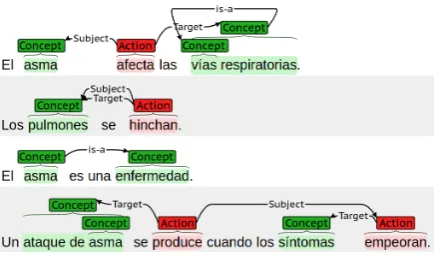
[image:2.595.308.526.548.676.2]The eHealth-KD challenge represents a knowl-edge discovery task in the domain of health-related documents written in Spanish language, as part of the TASS 2018 workshop ( Mart´ınez-C´amara et al., 2018). The overall purpose of the task is the identification of two types of textual en-tities (conceptsandactions) and six semantic rela-tions among them (subject, target, is-a, same-as, property-of andpart-of). Figure1shows a visual representation of these elements and its semantic annotation model in a set of example sentences. The task is subdivided into three subtasks, namely, the identification of relevant key phrases, the clas-sification of these into concepts or actions, and the identification of the corresponding relations.
Figure 1: Example of the TASS 2018 Task 3 challenge, taken fromMart´ınez-C´amara et al.(2018) and modified to fit. This represents an example written in Spanish language
1https://github.com/
According to this subdivision in subtasks, a standardF1 metric is used to evaluate the overall
performance of an extraction system. This met-ric is defined as a micro-average between correct, incorrect, missing and spurious key phrases, their classes, and the relations between them. Further-more, the challenge defines three evaluation sce-narios in which different subtasks are considered. However, for the purpose of this research, we fo-cus on Scenario 1, which considers all three sub-tasks and is thus the most complete and challeng-ing.
3 Related works
A total of 6 researchers submitted their approaches in the eHealth-KD challenge, of which 5 evaluate in Scenario 1. However, one of these participants did not submit a description paper, hence, it will not be considered in this research. This section briefly describes the main characteristics of the systems designed by the remaining 5 researchers.
In terms of representation, most of the ap-proaches presented rely on natural language pro-cessing features. Medina and Turmo(2018) and
Palatresi and Hontoria (2018) employ Freeling to extract syntactic and morphological features.
Zavala et al. (2018) trains a BI-LSTM model to encode the morphological and syntactic features for later use with a shallow classifier. These ap-proaches also rely on word embeddings (either
Glove or Word2Vec) as additional semantic
fea-tures. L´opez-Ubeda et al. (2018), on the other hand, uses a custom entity detector also based on syntactic and morphological features.
With respect to machine learning, two ap-proaches use deep learning techniques, specifi-cally convolutional neural networks (Medina and Turmo, 2018; Suarez-Paniagua et al., 2018). In contrast, other approaches apply a CRF classifier for solving subtasks A and B (Palatresi and Honto-ria,2018;Zavala et al.,2018), and shallow classi-fiers (logistic regression) for solving subtask C. Fi-nally,L´opez-Ubeda et al.(2018) uses hand-crafted rules with syntactic and knowledge-based charac-teristics for subtask B.
Even though the challenge is originally de-fined as a sequence of three subtasks, several ap-proaches opted for combining subtasks, recogniz-ing important correlations between them. For ex-ample,Zavala et al.(2018) andPalatresi and Hon-toria (2018) frame subtask A and B as an entity
tagging problem, and apply standard sequence-based models. In contrast, Medina and Turmo
(2018) solves simultaneously subtasks B and C, noting that there is a high correlation between en-tity classes and the possible relations.
Given this variety of approaches, it is interesting to explore automatically a wide range of algorithm combinations for the eHealth-KD challenge in or-der to find out the combination of strategies that obtains the best results.
4 AutoML strategy for knowledge discovery from text
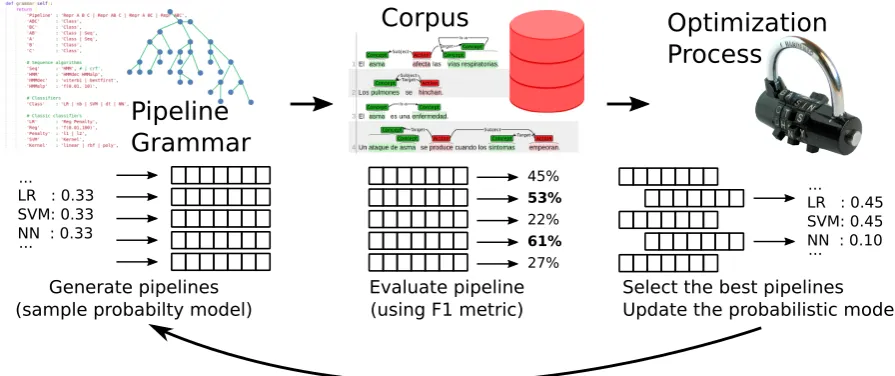
Our proposal is based on AutoML, using the metaheuristic grammatical evolution (O’Neill and Ryan, 2001) for defining and exploring the space of solution for dealing with the Scenario 1 of the eHealth-KD challenge. However, the optimiza-tion process is different to the tradioptimiza-tional matical evolution formulation because our gram-mar involves both discrete and continuous param-eters. Instead, we propose a modified version of probabilistic grammatical evolution (Kim and Ahn,2015). The proposal is described by dividing the process into two stages: (I) the definition of a grammar specific for the eHealth-KD challenge (see section4.1) and (II) the design of an optimiza-tion process, based on this grammar, for obtaining the best (i.e., optimal) pipeline (see section4.2). Figure2shows a visual representation of the com-plete AutoML process designed in this research.
4.1 Definition of the space of solutions
In this stage we define a grammar that takes into considerations the solutions of the eHealth-KD challenge for the edition TASS-2018. This gram-mar includes a source code representation that cor-responds to different pipelines designed for this task and therefore defines the solutions space for the optimization process. Figure3 shows an ex-tract of the grammar, as defined in the source code for the experimentation. The complete grammar and associated source code can be browsed on-line2.
The grammar defines Pipeline, which con-sists of a representation phase (Repr) where text is preprocessed, cleaned and vectorized; and three classification phases, one for each subtask. The
2https://github.com/
Corpus
Optimization
Process
Pipeline
Grammar
Generate pipelines (sample probabilty model)
Evaluate pipeline (using F1 metric)
Select the best pipelines Update the probabilistic model LR : 0.33
SVM: 0.33 NN : 0.33 ...
...
45%
22%
61%
27%
53% LR : 0.45
SVM: 0.45 NN : 0.10 ...
[image:4.595.76.524.63.251.2]...
Figure 2: Visual representation of the AutoML process defined. A probabilistic grammar is sampled to obtain po-tential pipelines, which are evaluated in the eHealth-KD corpus. An optimization process selects the best pipelines and updates the probabilistic model. This iterative process converges towards the best performing pipelines.
classification phases can be performed sequen-tially (i.e., first subtask A, then B and then C), or some of the subtasks can be performed jointly. Hence, the complete pipeline can be performed in four different ways, according to how subtasks are handled. The representation phase consists of six steps: (1) a preprocessing step (Prep) where ac-cents and punctuation symbols are optionally re-moved; (2) a tokenization step (Token); (3) a step (MulWords) where single tokens are com-bined into multi-word tokens using several strate-gies; (4) a semantic step (SemFeat) where pos-tag and dependency features are optionally added; (5) another preprocessing step (PosPrep) where stopwords are optionally removed and stemming is optionally applied; and (6) a final step (Embed) where text is represented as bag-of-words or us-ing an embeddus-ing, i.e.,word2vec(Mikolov et al.,
2013).
Each classification subtask in turn can be solved using one of several classifiers. Five differ-ent classifiers are considered: logistic regression (LR), SVM, multinomial Naive Bayes (NB), de-cision trees (DT) and a restricted subset of neu-ral networks (NN). For shallow classifiers, hyper-parameters are also considered, such as regular-ization strength in logistic regression or kernel type in SVM. Additionally, for subtask A a hid-den Markov model is added as a sixth classifier with corresponding hyperparameters. In the case of neural networks, three different architectures are allowed: either a convolutional layer (CVL),
a recurrent layer (RL), or fully connected dense layers (DL), followed by a final dense layer (FL). In all cases, hyperparameters such as dropout rate (Drop), number of layers, and layer sizes are al-lowed to vary. In the case of convolutional layers, also filter sizes are considered.
The complete grammar involves 78 produc-tions, and defines a total of 349,479,936 ≈ 228 different possible pipelines without considering continuous hyperparameter values.
4.2 Optimization process
The optimization process is based on probabilis-tic grammaprobabilis-tical evolution (Kim and Ahn, 2015), where each decision (production in the grammar) is represented as a probability distribution. Ini-tially all decisions (i.e., classifications algorithms, pre-processing steps, etc.) have an uniform prob-ability to be chosen. However, during the op-timization process these probability distributions are updated towards selecting the top performing pipelines. The update is performed according to the following rule:
θt+1 = (1−α)·θt+α·θ∗t (1)
Pipeline := Repr A B C | Repr AB C | Repr A BC | Repr ABC A := Class | Seq
B := Class
C := Class
# Representation
Repr := Prep Token MulWords SemFeat PosPrep Embed
# Classic classifiers
Class := LR | SVM | NB | DT | NN LR := Reg Penalty
Reg := f(0.01,100) Penalty := l1 | l2 SVM := Kernel
Kernel := linear | rbf | poly
# Neural networks
[image:5.595.73.263.60.287.2]NN := Drop CVL DL FL | Drop RL DL FL | Drop DL FL ....
Figure 3: Extract of the 78 productions of the grammar defined for the TASS 2018 eHealth-KD challenge. For simplicity, only the top productions and some example productions of classifiers and their hyperparameters are shown.
The probability model θt defines a joint prob-ability for all the productions of the grammar at iteration t. Productions that correspond to dis-crete choices (e.g. Penalty := l1 | l2) are modelled with a discrete uniform dis-tribution. Productions that correspond to integer or real hyperparameter values (e.g.,
Reg := f(0.01,100)) are modelled as a uni-form distribution parameterized by a mean and a standard deviation, which are initialized according to the grammar definition.
After each iteration of the optimization process, the probability model is updated by interpolat-ing between the current model θt and a marginal model θ∗t using the parameter α. The update rule (eq. 1) is applied at each production of the grammar. Discrete uniform distributions are up-dated by interpolating the probability vectors and renormalizing. Integer and real hyperparameters are updated by interpolating the mean and stan-dard deviation. The marginal probability model θ∗t is computed from a selection of the top n pipelines, in terms of F1 score. Each production
inθt∗is assigned a probability distribution inferred from the sample of the actual productions used in the topnpipelines.
This process allows a more intelligent search in the space of all possible pipelines, guided by the
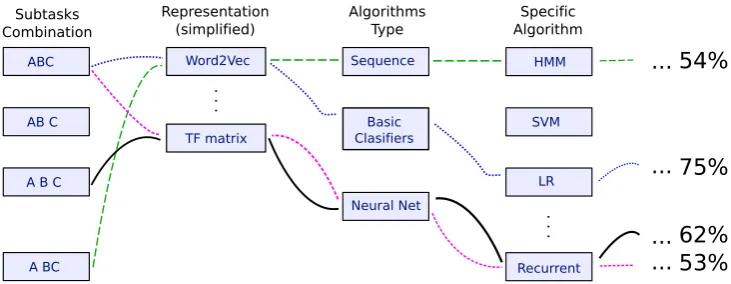
structure of the defined grammar. Even though the space of all possible pipelines is exponentially large (with respect to the size of the grammar), grammatical evolution can sample from this solu-tion space to obtain a broad view and iteratively focus on the most promising regions, i.e., the sub-sets of pipelines with the best performance. Fig-ure4shows a simplified representation of this op-timization process, illustrating that some specific pipelines have a different performance. Notice that whole details (i.e., representation complexity and hyperparameter selection) are not displayed in this illustration due to space limitation.
5 Experimental results
The algorithm described in Section4 was imple-mented and executed for a total of 60 genera-tions. Each generation consisted of50 pipelines, with a selection of the best10, and a learning fac-tor α = 0.05. In total, 3000 different pipelines were evaluated in257hours of computation time, which resulted in an average evaluation time of 5.17minutes per pipeline. A timeout of 10 min-utes was used to stop the evaluation of very long pipelines. These incomplete pipelines are given a fitness of 0, which makes the optimization al-gorithm eventually steer away from them. The total number of generations was adjusted accord-ing to computational constraints. The optimiza-tion process was monitored regularly and stopped after a sufficient computation time in which little to no improvement was observed, which indicated a convergence of the probability model.
The evaluation was performed in the eHealth-KD corpus (Piad-Morffis et al.,2019a), using the training and development collections for training and the test collection for evaluation. Thus, the training data is comprised of 844 sentences re-sulting in a total of 9540annotations among key phrases and relations. The test data is comprised of100sentences (for Scenario 1) with1100total annotations. After 60 generations, the best per-forming pipeline (actually found in generation18) achieved aF1 score of0.754in Scenario 1 of the
eHealth-KD challenge. This represents a1% ab-solute improvement from the top result presented in the eHealth-KD challenge, and a 4.2% abso-lute improvement over the average result of the top 3 alternatives (F1 = 0.711). Table 1 shows
ABC Word2Vec
TF matrix
Sequence
Basic Clasifiers
Neural Net
HMM
SVM
LR
Recurrent
. .
.
AB C
A B C
A BC
. .
.
54%
62% 75%
53% ...
...
... ...
Subtasks Combination
Representation (simplified)
Algorithms Type
[image:6.595.116.482.60.202.2]Specific Algorithm
Figure 4: Simplified representation of the optimization process. For clarity, details such as hyperparameter selec-tion for each algorithm are not displayed. Performance percentages are illustrative only, not actual values.
Approach F1(Scenario 1)
Zavala et al.(2018) 0.744
L´opez-Ubeda et al.(2018) 0.710
Palatresi and Hontoria(2018) 0.681
Suarez-Paniagua et al.(2018) 0.310
Our proposal 0.754
Table 1: Comparison of approaches in the eHealth-KD challenge. Only researchers that participated in Sce-nario 1 are considered.
Finally, the best pipeline found was composed by the following strategies: the three subtasks were performed sequentially, using shallow clas-sifiers in each. For subtask A, the classifier se-lected was SVM with an RBF kernel, while for subtask B, a Logistic Regression with L2
penal-ization was used, and for subtask C a Decision Tree (ID3) was selected. In terms of representa-tion, the optimizer selected one-hot encoding with bi-grams using stemming and with pos-tagging as an additional syntactic feature. Figure5 summa-rizes the structure of the final pipeline selected.
Unfortunately it is not possible to compare our results with other AutoML techniques directly, since existing AutoML approaches are designed to deal with black-box machine learning problems where the input is a feature matrix (see Section1). In the eHealth-KD scenario, there are several high-level decisions, such as selecting whether sub-tasks are performed sequentially or in combined, or which preprocessing steps to apply, that are necessary before obtaining a suitable feature ma-trix. Hence, these decisions cannot be modeled with existing AutoML techniques. For this reason, even though part of the eHealth-KD problem can
Pipeline:
Representation: Preprocessing:
Remove Punctuation: no Strip Accents: no Multi-Words:
- Strategy: postag - N-grams: 2
Semantic Features: PosTag: yes Dependencies: no Postprocessing:
Stopwords: no Stemming: yes Embedding: none Subtask A:
SVM:
Kernel: RBF Subtask B:
Logistic Regression: Regularization: 40.93 Penalty: L2
Subtask C: Decision Tree
Figure 5: Summarized representation of the best pipeline discovered.
be solved using alternative AutoML approaches, another part of the challenge would require ex-ternal tools or a custom implementation. In fu-ture work, we will explore other machine learning problems where a comparison with alternative Au-toML techniques is possible.
6 Discussion
pre-sented in the eHealth-KD challenge. However, this pipeline is simpler than most of the presented approaches, since it involves only shallow classi-fiers and basic NLP techniques. Furthermore, this pipeline was obtained automatically, without any human input after the initial definition of the gram-mar. This makes our strategy easier to extend to other knowledge discovery tasks, and potentially other machine learning scenarios, simply by defin-ing a suitable grammar and providdefin-ing the corre-sponding implementation. To support this state-ment, even though this research focuses on the eHealth-KD dataset, we provide open source im-plementations in several different machine learn-ing problems3.
6.1 Analysis of the optimization process
The optimization process shows a significant im-provement in the solutions’ average fitness. Fig-ure 6 shows the evolution of the average fitness (in terms of F1 as defined by the eHealth-KD
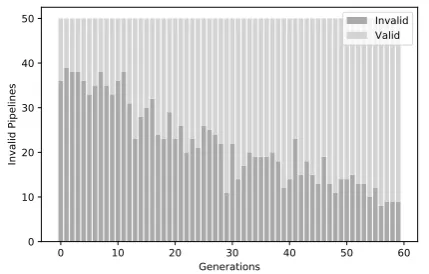
challenge, Scenario 1) and the fitness of the best pipeline in each generation. This behavior illus-trates that the optimization process improves over time. The relatively low average fitness on the first generations is due to invalid pipelines, which are given a fitness score of 0. Invalid pipelines were generated by some combinations of incom-patible decisions, mainly for implementation re-strictions, or when the timeout was reached. For example, some classification algorithms require dense matrices, which are incompatible with the use of sparse bag-of-word representations (one-hot encoding). These restrictions are very broad and complex to be fully represented in the gram-mar, since many of them are context-sensitive and depend on which selections were made in differ-ent parts of the grammar. In these cases, the computational implementation results in a runtime exception during the evaluation of the pipeline. Since this exception cannot be predicted before-hand, when it occurs the optimization code catches the exception and instead returns the lowest possi-ble fitness (F1 = 0).
However, even though invalid pipelines pose an issue in the first generations, as the optimiza-tion process continues, the influence of invalid pipelines decreases gradually. This effect can be observed in the population average fitness, which
3https://github.com/
knowledge-learning/hp-optimization/blob/ master/hpopt/examples
0 10 20 30 40 50 60 Generations
0.0 0.2 0.4 0.6 0.8 1.0
F1
[image:7.595.310.523.65.202.2]Best Average Average (std)
Figure 6: Evolution of the best and average fitness of pipelines in each generation.
0 10 20 30 40 50 60 Generations
0 10 20 30 40 50
Invalid Pipelines
Invalid Valid
Figure 7: Proportion of invalid vs valid pipelines found in each generation.
increases steadily. Furthermore, the standard de-viation of the fitness (gray area in Figure6) shows a steady behaviour across all generations. This in-dicates that both the best and worst pipelines (with respect to fitness) are improving. Hence, the opti-mization procedure actually learns to avoid invalid pipelines. To further support this observation, Fig-ure7shows the number of invalid pipelines (with a score of0) in each generation. The steady reduc-tion of invalid pipelines in each generareduc-tion is an evidence that the optimization process eventually converges towards solutions that represent mostly valid pipelines.
6.2 Analysis of feature relevance
[image:7.595.309.524.258.395.2]con-sidering all the productions of the grammar (i.e., algorithms and hyperparameter values) that are used in one specific pipeline. As an example, if one specific pipeline applies stopword removal, then a featurePosPrep.StopW=yes is gener-ated. Our grammar involves a total of 242such features, which account all possible decisions for each pipeline.
The relevance of each feature can be esti-mated by fitting a linear regression to predict the F1 score of the evaluated pipelines, only the 1667 valid pipelines. In this case, the estima-tion involves a coefficient of determinaestima-tionR2 = 0.763, meaning that these 242 features are in-deed a good indicator of a pipelineF1 score. The
weights computed by the linear regression indi-cate the absolute improvement that each feature provides. For example, considering stopwords removal (i.e., PosPrep.StopW=yes) with a computed weight of0.001, pipelines where stop-words removal are active obtain a0.1%higherF1
score on average than the rest of pipelines where this feature is non-active. This specific case indi-cates that stopword removal is slightly beneficial, but not crucial in obtaining a highF1score.
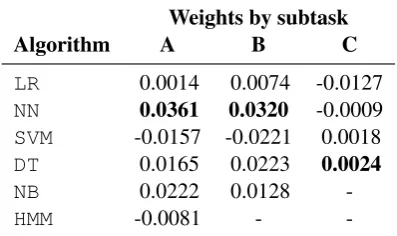
Table2shows the weight assigned to each clas-sifier in each task. These weights are correlated with the average performance of all the pipelines that use a given classifier. For space restrictions it is not possible to report the weights associated to each hyperparameter of each classifier. Since ev-ery classifier includes multiple hyperparameters, the performance of two specific pipelines using the same classifier can vary widely. For exam-ple, on average, pipelines using the classifier SVM achieve a lower score than pipelines using neural networks. Nevertheless, the best pipeline found uses SVM in subtask A (see Figure5) outperform-ing the rest due to the specific hyperparameters in-volved in that pipeline. Hence, even though neural networks are assigned a relative high weight they are not selected for the best pipeline.
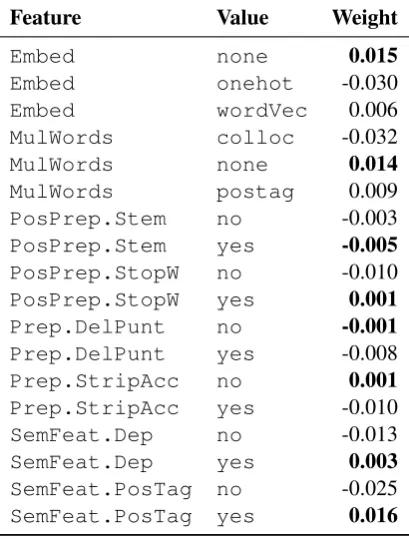
Similarly, table 3 show a subset of the fea-tures corresponding to the representation phase and their corresponding weights. Interestingly, it is also the case that some features present in the best pipeline do not show the largest weights.
As explained before, it is important to highlight that not necessarily the top performing pipeline found by the optimization algorithm will be com-posed by top weighted features. The performance
Weights by subtask
Algorithm A B C
LR 0.0014 0.0074 -0.0127
NN 0.0361 0.0320 -0.0009
SVM -0.0157 -0.0221 0.0018
DT 0.0165 0.0223 0.0024
NB 0.0222 0.0128
-HMM -0.0081 -
-Table 2: Relevance of the classification algorithms in each subtask. The top weight in each subtask is high-lighted. Missing values correspond to combinations that were not evaluated in any valid pipeline.
of a pipeline will depend, in general, of complex interactions between its components that are not completely captured in a simple linear regression model. However, there is a large correlation be-tween feature weights and pipeline performance, as demonstrated by the coefficient of determina-tion (R2= 0.763) of the regression. Since the per-formance of a specific pipeline depends heavily on the values of the hyperparameters, a deeper anal-ysis is necessary to estimate the impact of each algorithm in each step of the pipelines, taking into account the actual values of hyperparameters used. In future work, we will explore using this type of analysis to warm-start the probabilistic model.
7 Conclusions and future work
This paper presents an Automatic Machine Learn-ing strategy based on probabilistic grammatical evolution to extract knowledge from health doc-uments in Spanish language. Our proposal in-volves an optimization process which explores a large space of possible pipelines and chooses the best performing ones automatically. The evalu-ation was performed on a complex scenario of the TASS 2018 eHealth-KD challenge, where the best pipeline discovered improves over the state-of-the-art by combining features, decisions and strategies from different authors. In addition, the data gathered during the optimization provided insights about the optimal settings to deal with the challenge faced. These results show that an AutoML strategy based on grammatical evolu-tion is effective for optimizing machine learning pipelines to solve knowledge discovery challenges from natural language text.
[image:8.595.317.516.64.182.2]is-Feature Value Weight
Embed none 0.015
Embed onehot -0.030
Embed wordVec 0.006
MulWords colloc -0.032
MulWords none 0.014
MulWords postag 0.009
PosPrep.Stem no -0.003
PosPrep.Stem yes -0.005
PosPrep.StopW no -0.010
PosPrep.StopW yes 0.001
Prep.DelPunt no -0.001
Prep.DelPunt yes -0.008
Prep.StripAcc no 0.001
Prep.StripAcc yes -0.010
SemFeat.Dep no -0.013
SemFeat.Dep yes 0.003
SemFeat.PosTag no -0.025
[image:9.595.79.284.64.334.2]SemFeat.PosTag yes 0.016
Table 3: Relevance of the representation features. The top weight for each feature is highlighted.
sue of invalid pipelines and improve the perfor-mance of the optimization process. This knowl-edge can be in the form of explicit rules that guar-antee the validity of the pipelines sampled from the grammar; and in the form of statistical in-formation extracted from similar challenges that helps pre-defining a probabilistic model. Another issue to research will be the use of regression mod-els to estimate the expected fitness of a pipeline given its features, as illustrated in Section6. This addition would support meta-learning algorithms, allowing to reduce the optimization time and in-crease its performance by learning from past exe-cutions. Finally, by modifying the grammar, this strategy can be extensible to other machine learn-ing challenges. Therefore, we plan to explore this line of research in the future, to compare our pro-posal with other AutoML frameworks in standard benchmarks.
Acknowledgments.
This research has been supported by a Carolina Foundation grant in agreement with University of Alicante and University of Havana. Moreover, it has also been partially funded by both afore-mentioned universities, the Generalitat Valenciana and the Spanish Government through the projects
PROMETEU/2018/089, RTI2018-094653-B-C22 and RTI2018-094649-B-I00.
References
Ken Barker, Bhalchandra Agashe, Shaw Yi Chaw, James Fan, Noah Friedland, Michael Glass, Jerry Hobbs, Eduard Hovy, David Israel, Doo Soon Kim, et al. 2007. Learning by reading: A prototype sys-tem, performance baseline and lessons learned. In
AAAI, volume 7, pages 280–286.
Boyuan Chen, Harvey Wu, Warren Mo, Ishanu Chat-topadhyay, and Hod Lipson. 2018. Autostacker: A compositional evolutionary learning system. In Pro-ceedings of the Genetic and Evolutionary
Computa-tion Conference, GECCO ’18, pages 402–409, New
York, NY, USA. ACM.
Philipp Cimiano, Alexander M¨adche, Steffen Staab, and Johanna V¨olker. 2009. Ontology Learning, page 245–267. Springer Berlin Heidelberg, Berlin, Hei-delberg.
David Crystal. 1997. The cambridge encyclopedia. Cambridge University Press New York.
S Estevez-Velarde, Y Gutierrez, A Montoyo, A Piad-Morffis, R Munoz, and Y Almeida-Cruz. 2018. Gathering object interactions as semantic knowl-edge. In Proceedings on the International
Con-ference on Artificial Intelligence (ICAI), pages
363–369. The Steering Committee of The World Congress in Computer Science, Computer . . . .
Matthias Feurer, Aaron Klein, Katharina Eggensperger, Jost Springenberg, Manuel Blum, and Frank Hut-ter. 2015. Efficient and Robust Automated Machine Learning. In C. Cortes, N. D. Lawrence, D. D. Lee, M. Sugiyama, and R. Garnett, editors, Advances
in Neural Information Processing Systems 28, page
2962–2970. Curran Associates, Inc.
Fausto Giunchiglia and Mattia Fumagalli. 2017. Tele-ologies: Objects, actions and functions. In
Concep-tual Modeling, pages 520–534, Cham. Springer
In-ternational Publishing.
Graciela H Gonzalez, Tasnia Tahsin, Britton C Goodale, Anna C Greene, and Casey S Greene. 2015. Recent advances and emerging applications in text and data mining for biomedical discovery.
Briefings in bioinformatics, 17(1):33–42.
Frank Hutter, Lars Kotthoff, and Joaquin Vanschoren. 2019. Automatic machine learning: methods, sys-tems, challenges.Challenges in Machine Learning.
Haifeng Jin, Qingquan Song, and Xia Hu. 2018. Ef-ficient neural architecture search with network mor-phism.CoRR, abs/1806.10282.
18th Asia Pacific Symposium on Intelligent and
Evo-lutionary Systems - Volume 2, page 1–12, Cham.
Springer International Publishing.
Brent Komer, James Bergstra, and Chris Eliasmith. 2014. Hyperopt-sklearn: automatic hyperparameter configuration for scikit-learn. InICML workshop on
AutoML, pages 2825–2830.
Pilar L´opez-Ubeda, Manuel Carlos D´ıaz-Galiano, Mar´ıa Teresa Mart´ın-Valdivia, and L. Alfonso Urena-Lopez. 2018.Sinai en tass 2018 task 3. clasi-ficando acciones y conceptos con umls en medline.
In Proceedings of TASS 2018: Workshop on
Se-mantic Analysis at SEPLN (TASS 2018) co-located
with 34nd SEPLN Conference (SEPLN 2018),
vol-ume 2172 of CEUR Workshop Proceedings, pages 83–88. CEUR-WS.org.
Eugenio Mart´ınez-C´amara, Yudivi´an Almeida-Cruz, Manuel Carlos D´ıaz-Galiano, Suilan Est´evez-Velarde, Migue´ı A Garc´ıa-Cumbreras, Manuel Garc´ıa-Vega, Yoan Guti´errez, Arturo Montejo-R´aez, Andr´es Montoyo, Rafael Mu˜noz, Alejandro Piad-Morffis, and Julio Villena-Rom´an. 2018. Overview of TASS 2018: Opinions, Health and Emotions Re-sumen de TASS 2018: Opiniones, Salud y Emo-ciones.CEUR Workshop Proceedings, 2172:13–27.
Salvador Medina and Jordi Turmo. 2018. Joint clas-sification of key-phrases and relations in electronic health documents. In Proceedings of TASS 2018: Workshop on Semantic Analysis at SEPLN (TASS 2018) co-located with 34nd SEPLN Conference
(SE-PLN 2018), volume 2172 ofCEUR Workshop
Pro-ceedings, pages 83–88. CEUR-WS.org.
Tomas Mikolov, Ilya Sutskever, Kai Chen, Greg S Cor-rado, and Jeff Dean. 2013. Distributed Representa-tions of Words and Phrases and their Composition-ality. In C. J. C. Burges, L. Bottou, M. Welling, Z. Ghahramani, and K. Q. Weinberger, editors, Ad-vances in Neural Information Processing Systems 26, page 3111–3119. Curran Associates, Inc.
T. Mitchell, W. Cohen, E. Hruschka, P. Talukdar, B. Yang, J. Betteridge, A. Carlson, B. Dalvi, M. Gardner, B. Kisiel, J. Krishnamurthy, N. Lao, K. Mazaitis, T. Mohamed, N. Nakashole, E. Pla-tanios, A. Ritter, M. Samadi, B. Settles, R. Wang, D. Wijaya, A. Gupta, X. Chen, A. Saparov, M. Greaves, and J. Welling. 2018. Never-ending learning.Commun. ACM, 61(5):103–115.
Randal S. Olson and Jason H. Moore. 2016. Tpot: A tree-based pipeline optimization tool for automating machine learning. InProceedings of the Workshop
on Automatic Machine Learning, volume 64 of
Pro-ceedings of Machine Learning Research, pages 66–
74, New York, New York, USA. PMLR.
M. O’Neill and C. Ryan. 2001. Grammatical
evolu-tion.IEEE Transactions on Evolutionary
Computa-tion, 5(4):349–358.
Jorge Vivaldi Palatresi and Horacio Rodr´ıguez Honto-ria. 2018. Medical knowledge discovery by combin-ing multiple techniques and resources. In Proceed-ings of TASS 2018: Workshop on Semantic Anal-ysis at SEPLN (TASS 2018) co-located with 34nd
SEPLN Conference (SEPLN 2018), volume 2172 of
CEUR Workshop Proceedings, pages 83–88.
CEUR-WS.org.
Alejandro Piad-Morffis, Yoan Guti´errez, and Rafael Mu˜noz. 2019a. A corpus to support ehealth knowl-edge discovery technologies. Journal of biomedical informatics, 94:103172.
Alejandro Piad-Morffis, Yoan Guti´errez, Suilan Est´evez-Velarde, Yudivi´an Almeida-Cruz, Andr´es Montoyo, and Rafael Mu˜noz. 2019b. Analysis of ehealth knowledge discovery systems in the tass 2018 workshop. Procesamiento del Lenguaje Natural, 62(1).
V´ıctor Suarez-Paniagua, Isabel Segura-Bedmar, and Paloma Mart´ınez. 2018. Labda at tass-2018 task 3: Convolutional neural networks for relation classifi-cation in spanish ehealth documents. InTASS 2018 – Taller de An´alisis Sem´antico en la SEPLN.
Alex G. C. de S´a, Walter Jos´e G. S. Pinto, Luiz Otavio V. B. Oliveira, and Gisele L. Pappa. 2017. RECIPE: A Grammar-Based Framework for Automatically Evolving Classification Pipelines. In Genetic
Pro-gramming, page 246–261, Cham. Springer
Interna-tional Publishing.
Chris Thornton, Frank Hutter, Holger H. Hoos, and Kevin Leyton-Brown. 2013. Auto-weka: Combined selection and hyperparameter optimization of clas-sification algorithms. In Proceedings of the 19th ACM SIGKDD International Conference on
Knowl-edge Discovery and Data Mining, KDD ’13, pages
847–855, New York, NY, USA. ACM.
Renzo M. Rivera Zavala, Paloma Mart´ınez, and Isabel Segura-Bedmar. 2018. A hybrid bi-lstm-crf model for knowledge recognition from ehealth documents.
In Proceedings of TASS 2018: Workshop on
Se-mantic Analysis at SEPLN (TASS 2018) co-located
with 34nd SEPLN Conference (SEPLN 2018),
vol-ume 2172 of CEUR Workshop Proceedings, pages 83–88. CEUR-WS.org.