Munich Personal RePEc Archive
Economic Self-Operation of Microgrids
By Gravitational Emulation Local Search
Algorithm
Khazaei, Ehsan and Jamaledini, Ashkan and Soltani, Ali
Electrical and Computer Engineering Department, Sazeh Sazan
Power Company, Iran, Electrical and Computer Engineering
Department, Sazeh Sazan Power Company, Iran, Electrical and
Computer Engineering Department, Sazeh Sazan Power Company,
Iran
2019
Online at
https://mpra.ub.uni-muenchen.de/95895/
Economic Self-Operation of Microgrids By
Gravitational Emulation Local Search
Algorithm
Ehsan Khazaei, Ashkan Jamaledini, Ali Soltani
Electrical and Computer Engineering Department, Sazeh Sazan Power Company, Iran
Abstract: Islanded microgrid (MG) is a microgrid which is disconnected from the main
network and therefore it is safe and has lead to one of the most important challenges in
the power system operation. In the case of higher price in the market, the islanded MG
offers a lower operational cost. On the other hand, the nonlinear attribute of optimal
operation of the islanded MG has made difficulties in using such systems. To overcome
this obstacle, a new heuristic method known as the Gravitational Emulation Local
Search Algorithm (GELSA) is proposed in this paper in order to solve the problem. The
efficiency of the technique is examined on a modified IEEE 30 bus test network.
I. INTRODUCTION
Microgrid (MG) is the accumulation of the load and distributed energy resources in which
the generators satisfy the power demand requested inside the small network. This
capability leads to significant economic and technical advantages [1-5]. A few
advantages of these systems involve closeness to costumers, less transmission lien,
higher reliability, higher resiliency, lower operation cost, etc. Despite all the advantages,
complicated problem. Among advanced methods of optimization like Taguchi, grey,
grey-fuzzy, and grey-adaptive neuro fuzzy inference system–integrated approach [6-9]. This
paper presents a new technique for optimal energy management of islanded MG. In this
study, the small grid is disconnected from the main network and consequently, the
generation units only provide the load demand of the small network. As a result, in this
mode, power exchange with the main grid is blocked.
A number of researchers have implemented evolutionary algorithms, e.g., CDOA, GA,
PSO, and TLABO to study energy management of islanded MG [8-11]. Moreover, some
literature has widely studied efficient control of MG operation [12-15]. References [16-20]
have investigated utilization of electric vehicles (EVs), MG superconductivity, and MG
security. Function of an islanded MG is a nonlinear problem and seems hard to solve.
Another important factor in solving nonlinear problems is the convergence speed.
Therefore, in this paper a new method known as the gravitational emulation local search
(GELS) algorithm is developed and presented in order to find a solution for nonlinear
problem of optimization of MG systems [16-19].
II. MATHEMATICAL FORMULATIONS OF THE PROBLEM
A. Objective function
Objective function for this problem of minimizing the operational cost is defined as:
𝑚𝑖𝑛 ∑ [𝐶∀𝑖 𝑖𝑃𝑖𝑡𝐼𝑖𝑡+ 𝑆𝑈𝑖𝑡 + 𝑆𝐷𝑖𝑡] (1)
whsere:
I is Binary variable {0,1}
B. Constraints
The constraint imposed on this problem are the following items.
The limit on capacity of each generation unit is:
𝑃𝑖𝑡,𝑚𝑖𝑛 ≤ 𝑃𝑖𝑡 ≤ 𝑃𝑖𝑡,𝑚𝑎𝑥 (2)
Also the limit on ramp up and down of each generation unit are:
𝑃𝑖𝑡 − 𝑃𝑖(𝑡−1) ≤ 𝑅𝑈𝑖 (3)
𝑃𝑖(𝑡−1)− 𝑃𝑖𝑡 ≤ 𝑅𝐷𝑖 (4)
where:
𝑅𝑈𝑖 , 𝑅𝑈𝑖 are ramp up and ramp down of the ith unit
Finally, the limited up and down time of each generation unit is considered as:
𝑇(𝑜𝑛)𝑖𝑡 ≥ 𝑈𝑇𝑖(𝐼𝑖𝑡− 𝐼𝑖(𝑡−1) (5)
𝑇(𝑜𝑓𝑓)𝑖𝑡 ≥ 𝐷𝑇𝑖(𝐼𝑖(𝑡−1)− 𝐼𝑖𝑡 (6)
where:
𝑈𝑇𝑖, 𝐷𝑇𝑖 are minimum up and down rates of the ith unit
𝑇(𝑜𝑛), 𝑇(𝑜𝑓𝑓) are number of successive on and off hours
III.GRAVITATIONAL EMULATION LOCAL SEARCH ALGORITHM
As mentioned, the proposed problem is a mixed-integer linear programming (MILP)
problem, which is hard to solve by the mathematical models. Also, the optimal solution
is not assuring by solving the problem by the mathematical approach. To this end, in
the paper, a new evolutionary algorithm known as the gravitational emulation local
search (GELS) a is adapted to solve the problem. More detail regarding this algorithm
can be found in [20]. It should be noted that evolutionary methods are used widely in
IV. RESULTS
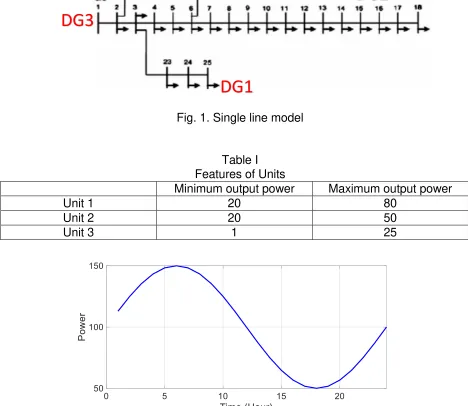
To show the economic merit of the proposed technique, the modified IEEE 30 bus test
system is selected and tested, as shown in Fig. 1. The system has 3 distributed
generators (DGs) as explained in Table I. Also, the 24-hours load demand is shown in
[image:5.612.66.534.261.667.2]Fig. 2.
Fig. 1. Single line model
Table I Features of Units
Minimum output power Maximum output power
Unit 1 20 80
Unit 2 20 50
Unit 3 1 25
Fig. 2. 24-hour load demand
DG1
DG2
The DGs output is shown in Fig. 3, where the output of the DGs are based on their
[image:6.612.102.502.138.329.2]economic price. That means cheapest units are more active than others.
Fig. 3. The output power of Units
Table II shows the total operation cost of the proposed problem under difference
algorithms. The proposed technique has higher speed and lower operation cost.
Table II Operation cost
Operation cost ($) Computational Time (second)
PSO 5432.1 14.2
GA 5532.5 11.8
Proposed method 5114.7 8.7
V. CONCLUSION
In this paper a new heurist technique, known as the GELSA has been developed for
solving MILP microgrid operation. The results have been compare with the PSO and GA.
perspective, the proposed method has lower operation cost. This method can be easily
adaptable in the power industrial grids as it has a very high speed and accuracy.
Reference
[1] Zhang, Yan, Fanlin Meng, Rui Wang, Behzad Kazemtabrizi, and Jianmai Shi. "Uncertainty-resistant Stochastic MPC Approach for Optimal Operation of CHP Microgrid." Energy(2019).
[2] Chen, Yahong, Changhong Deng, Weiwei Yao, Ning Liang, Pei Xia, Peng Cao, Yiwang Dong et al. "Impacts of stochastic forecast errors of renewable energy generation and load demands on microgrid operation." Renewable Energy 133 (2019): 442-461.
[3] Pourbehzadi, Motahareh, Taher Niknam, Jamshid Aghaei, Geev Mokryani, Miadreza Shafie-khah, and João PS Catalão. "Optimal operation of hybrid AC/DC microgrids
under uncertainty of renewable energy resources: A comprehensive
review." International Journal of Electrical Power & Energy Systems 109 (2019): 139-159.
[4] Tsikalakis, Antonis G., and Nikos D. Hatziargyriou. "Centralized control for optimizing microgrids operation." In 2011 IEEE power and energy society general meeting, pp. 1-8. IEEE, 2011.
[5] Dimeas, Aris L., and Nikos D. Hatziargyriou. "Operation of a multiagent system for microgrid control." IEEE Transactions on Power systems 20, no. 3 (2005): 1447-1455.
[6] Reza Bagherian Azhiri, Jalal Fathi Sola, Ramin Mehdizad Tekiyeh, Farid Javidpour, Abolfaz Salmani Bideskan, “Analyzing of joint strength, impact energy, and angular
distortion of the ABS friction stir welded joints reinforced by nanosilica addition”, The
International Journal of Advanced Manufacturing Technology, February 2019,
Volume 100, Issue 9–12, pp 2269–2282.
[7] Reza Bagherian Azhiri, Abolfazl Salmani Bideskan, Farid Javidpour, Ramin Mehdizad Tekiyeh, “Study on material removal rate, surface quality, and residual stress of AISI D2 tool steel in electrical discharge machining in presence of ultrasonic vibration effect”, The International Journal of Advanced Manufacturing
Technology, April 2019, Volume 101, Issue 9–12, pp 2849–2860
[9] Basak, Prasenjit, A. K. Saha, S. Chowdhury, and S. P. Chowdhury. "Microgrid: Control techniques and modeling." In 2009 44th International Universities Power Engineering Conference (UPEC), pp. 1-5. IEEE, 2009.
[10] Tajalli, Seyede Zahra, Seyed Ali Mohammad Tajalli, Abdollah Kavousi-Fard, Taher Niknam, Morteza Dabbaghjamanesh, and Shahab Mehraeen. "A Secure Distributed Cloud-Fog Based Framework for Economic Operation of Microgrids." In 2019 IEEE Texas Power and Energy Conference (TPEC), pp. 1-6. IEEE, 2019.
[11] Dabbaghjamanesh, Morteza. "Stochastic Energy Management of Reconfigurable Power Grids in the Presence of Renewable Energy by Considering Practical Limitations." (2019).
[12] Taherzadeh, Erfan, Shahram Javadi, and Morteza Dabbaghjamanesh. "New Optimal Power Management Strategy for Series Plug-In Hybrid Electric Vehicles." International Journal of Automotive Technology 19, no. 6 (2018): 1061-1069.
[13] Sayed, Gehad Ismail, Aboul Ella Hassanien, and Ahmad Taher Azar. "Feature selection via a novel chaotic crow search algorithm." Neural Computing and Applications 31, no. 1 (2019): 171-188.
[14] Dabbaghjamanesh, Morteza, Boyu Wang, Shahab Mehraeen, Jie Zhang, and Abdollah Kavousi-Fard. "Networked Microgrid Security and Privacy Enhancement By the Blockchain-enabled Internet of Things Approach." In 2019 IEEE Green Technologies Conference (GreenTech), pp. 1-5. IEEE, 2019.
[15] Dabbaghjamanesh, Morteza, Boyu Wang, Abdollah Kavousi-Fard, Shahab Mehraeen, Nikos D. Hatziargyriou, Dimitris Trakas, and Farzad Ferdowsi. "A Novel Two-Stage Multi-Layer Constrained Spectral Clustering Strategy for Intentional Islanding of Power Grids." IEEE Transactions on Power Delivery (2019).
[16] Wang, Boyu, Morteza Dabbaghjamanesh, Abdollah Kavousi Fard, and Shahab Mehraeen. "Cybersecurity Enhancement of Power Trading Within the Networked Microgrids Based on Blockchain and Directed Acylic Graph Approach." IEEE Transactions on Industry Applications (2019).
[17] Saberi, Hossein, Shahab Mehraeen, and Boyu Wang. "Stability improvement of microgrids using a novel reduced UPFC structure via nonlinear optimal control." In 2018 IEEE Applied Power Electronics Conference and Exposition (APEC), pp. 3294-3300. IEEE, 2018.
[18] Kavousi-Fard, Abdollah, Morteza Dabbaghjamanesh, Jie Zhang, and Omid Avatefipour. "Superconducting Fault Current Limiter Allocation in Reconfigurable Smart Grids." arXiv preprint arXiv:1905.02324 (2019).
[20] Barzegar, Behnam, Amir Masoud Rahmani, Kamran Zamanifar, and Azadeh Divsalar. "Gravitational emulation local search algorithm for advanced reservation and scheduling in grid computing systems." In 2009 Fourth International Conference on Computer Sciences and Convergence Information Technology, pp. 1240-1245. IEEE, 2009.
[21] Liu, Nian, Qifang Chen, Jie Liu, Xinyi Lu, Peng Li, Jinyong Lei, and Jianhua Zhang. "A heuristic operation strategy for commercial building microgrids containing EVs and PV system." IEEE Transactions on Industrial Electronics 62, no. 4 (2014): 2560-2570.
[22] Parisio, Alessandra, Evangelos Rikos, and Luigi Glielmo. "A model predictive control approach to microgrid operation optimization." IEEE Transactions on Control Systems Technology 22, no. 5 (2014): 1813-1827.