1213
A Compact and Language-Sensitive Multilingual Translation Method
Yining Wang1,2, Long Zhou1,2, Jiajun Zhang1,2∗, Feifei Zhai4, Jingfang Xu4 and Chengqing Zong1,2,3
1National Laboratory of Pattern Recognition, CASIA, Beijing, China 2University of Chinese Academy of Sciences, Beijing, China
3CAS Center for Excellence in Brain Science and Intelligence Technology, Beijing, China 4Sogou Inc., Beijing, China
{yining.wang, long.zhou, jjzhang, cqzong}@nlpr.ia.ac.cn {zhaifeifei,xujingfang}@sogou-inc.com
Abstract
Multilingual neural machine translation
(Multi-NMT) with one encoder-decoder
model has made remarkable progress due to its simple deployment. However, this multi-lingual translation paradigm does not make full use of language commonality and param-eter sharing between encoder and decoder. Furthermore, this kind of paradigm cannot outperform the individual models trained on bilingual corpus in most cases. In this paper, we propose a compact and language-sensitive method for multilingual translation. To maximize parameter sharing, we first present a universal representor to replace both encoder and decoder models. To make the representor sensitive for specific languages, we further introduce language-sensitive embedding, attention, and discriminator with the ability to enhance model performance. We verify our methods on various translation scenarios, including one-to-many, many-to-many and
zero-shot. Extensive experiments demon-strate that our proposed methods remarkably outperform strong standard multilingual translation systems on WMT and IWSLT datasets. Moreover, we find that our model is especially helpful in low-resource and zero-shot translation scenarios.
1 Introduction
Encoder-decoder based sequence-to-sequence ar-chitecture (Kalchbrenner and Blunsom, 2013;
Sutskever et al., 2014; Zhang and Zong, 2015;
Vaswani et al., 2017; Gehring et al., 2017) fa-cilitates the development of multilingual neural machine translation (Multi-NMT) (Dong et al., 2015;Luong et al.,2016;Firat et al.,2016;
John-son et al., 2017; Gu et al., 2018). The
domi-∗Jiajun Zhang is the corresponding author and the work
is done while Yining Wang is doing research intern at Sogou Inc.
N
La ng-S ens i Emb ed din g La ng-Sens i at tent ion Discr imn at or
M Sr c N Tg t Enc oder Deco der Shar ing
Rep res en to r
N
Lang-Sensi Embedding
Lang-Sensi Attention
Lang-Sensi Discrimnator
M Src N Tgt
Encoder Sharing Decoder
[image:1.595.312.523.239.373.2]Representor
Figure 1: Our proposed compact representor, replacing encoder and decoder, can perform multilingual trans-lation from M source languages to N target languages. We also introduce three specific modules consisting of language-sensitive embedding, language-sensitive at-tention, and language-sensitive discriminator.
nant paradigm of Multi-NMT contains one en-coder to represent multiple languages and one de-coder to generate output tokens of separate lan-guages (Johnson et al.,2017;Ha et al.,2016). This paradigm is widely used in Multi-NMT systems due to simple implementation and convenient de-ployment.
structures but use different parameters, the com-monality of languages cannot be fully exploited in this paradigm. A natural question arises that why not share the parameters between encoder and de-coder on multilingual translation scenario?
To address these issues, we present a compact and language-sensitive method in this work, as shown in Figure 1. We first propose a unified representor by tying encoder and decoder weights in Multi-NMT model, which can not only re-duce parameters but also make full use of lan-guage commonality and universal representation. To enhance the model ability to distinguish dif-ferent languages, we further introduce language-sensitive embedding, attention, and discriminator. We conduct extensive experiments to verify the effectiveness of our proposed model on vari-ous Multi-NMT tasks including one-to-many and many-to-many which is further divided into bal-anced, unbalanced and zero-shot. Experimen-tal results demonstrate that our model can sig-nificantly outperform the strong standard base-line multilingual systems and achieve even better performance than individually trained models on most of the language pairs.
Specifically, our contributions are three-fold in this work:
(1) We present a universal representor to replace encoder and decoder, leading to a compact transla-tion model, which fully explores the commonality between languages.
(2) We introduce language-sensitive embed-ding, attention, and discriminator which augment the ability of Multi-NMT model in distinguishing different languages.
(3) Extensive experiments demonstrate the su-periority of our proposed method on various trans-lation tasks including one-to-many, many-to-many and zero-shot scenarios. Moreover, for many-to-many using unbalance translation pairs, we can achieve the new state-of-the-art results on IWSLT-15 English-Vietnamese. For zero-shot translation, our methods can achieve even better results than individually trained models with the parallel cor-pus.
2 Background
In this section, we will introduce the background of the encoder-decoder (Sutskever et al., 2014;
Cho et al., 2014) framework and
self-attention-based Transformer (Vaswani et al.,2017).
2.1 Encoder-Decoder Framework
Given a set of sentence pairs D = {(x,y)}, the encoder fenc with parameters θenc maps an
input sequence x = (x1,x2,· · ·,xn) to a se-quence of continuous representations henc =
(henc1 ,henc2 ,· · ·,hencn ) whose size varies concern-ing the source sentence length. The decoder
fdec with θdec generates an output sequence y =
(y1,y2,· · ·,ym) by computing P(yt|y<t) as
fol-lows:
P(yt|y<t)=softmax(f(hdec,ct)) (1) where hdec is a sequence of continuous represen-tations for the decoder andctis the context vector
which can be calculated as follows:
ct= n
Õ
i=1
ai,thenci (2)
whereai,t is attention weight:
ai,t=softmax(ei,t)=
expei,t
Ín
j=1expej,t
(3)
whereei,t is a similarity score between the source
and target representations. The parameters of cal-culating cross-attention weightai,t are denoted as θattn.
The encoder and decoder are trained to maxi-mize the conditional probability of target sequence given a source sequence:
Lt(D;θ)=
|D|
Õ
d=1 M
Õ
t=1
logP(yt|y<t,x;θenc, θdec, θattn) (4)
whereMis target sentence length. For simplicity, we do not specifydin this formula.
Both the encoder and decoder can be imple-mented by the different basic neural models struc-tures, such as RNN (LSTM/GRU) (Sutskever et al., 2014; Cho et al., 2014), CNN (Gehring et al., 2017), and self-attention (Vaswani et al., 2017). Our proposed method can be applied to any encoder-decoder architecture. Considering the ex-cellent translation performance of self-attention based Transformer (Vaswani et al.,2017), we im-plement our method based on this architecture.
2.2 Transformer Network
feed-forward network. For the decoder model, be-sides the above two basic blocks, a multi-head cross-attention follows multi-head self-attention. In this block, the calculation method of similar-ity scoreet in Equation3is a little different from
Luong et al.(2015) andBahdanau et al.(2015):
ei,t=
1
√
dm
Wkhenci ∗Wqhdect (5)
wheredmis the dimension of hidden units,Wkand
Wq are parameters of this cross-attention block, which are denoted asθattnin Equation4.
All the basic blocks are associated with resid-ual connections, followed by layer normalization (Ba et al.,2016). Since the Transformer network contains no recurrence, positional embeddings are used in the model to make use of sequence or-der. More details regarding the architecture can be found inVaswani et al.(2017).
2.3 Multilingual Translation
In contrast to NMT models, multilingual models perform the multi-task paradigm with some de-gree of parameter sharing, in which models are jointly trained on multiple language pairs. We mainly focus on mainstream multilingual transla-tion method proposed by Johnson et al. (2017), which has a unified encoder-decoder framework with a shared attention module for multiple lan-guage pairs. They decompose the probability of the target sequences into the products of per token probabilities in all translation forms:
Lm−t(D;θ)= L
Õ
l=1
|Dl| Õ
d=1 M
Õ
t=1
logP(ylt|xl,y<lt;θenc, θdec, θattn)
(6) where L is the number of translation pairs and
P(ylt|xl,yl<t;θ)denotes the translation probability oft-th word of thed-th sentence inl-th translation pair. Note that the translation process for all target languages uses the same parameter setθ.
3 Our Method
In this section, we introduce our compact and language-sensitive method for multilingual trans-lation, which can compress the model by a repre-sentor and improve model ability with language-sensitive modules.
3.1 A Compact Representor
In Multi-NMT model, the encoder and decoder are two key components, which play analogous
Embeddings Multi-head Self-Attention
Residual&Norm N
Softmax
Linear Output Probabilities
Language-Sensitive Discriminator
+ Position Embdding
lang-1 lang-2 ... lang-n lang-1 lang-2 ... lang-n
lang-1 lang-2 ... lang-n
src tgt
Language-Sensitive Embedding
+ + + + + +
Representor
Residual&Norm Feed Forward
Residual&Norm Multi-head Language-Sensitive
[image:3.595.311.519.64.316.2]Cross-Attention
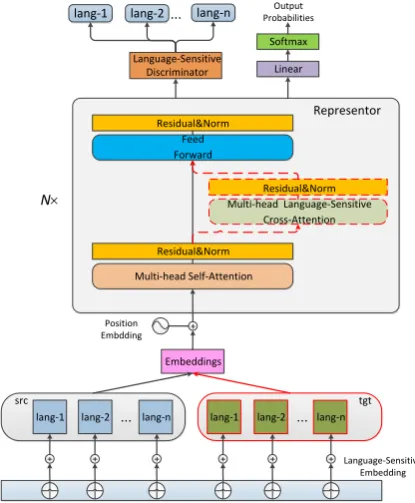
Figure 2: The framework of Multi-NMT using our compact and language-sensitive method.
roles and have a similar structure in each layer. We argue that encoder and decoder can share the same parameters if necessary. Thus, we introduce a representor to replace both encoder and decoder by sharing weight parameters of the self-attention block, feed-forward block and the normalization block, as shown in Figure2. The representor pa-rameters are denotedθrep. Therefore, the objective
function (Equation6) becomes:
Lm−t(D;θ)= L
Õ
l=1
|Dl| Õ
d=1 M
Õ
t=1
logP(ytl|xl,yl<t;θrep, θattn) (7)
This representor (θrep) coordinates the semantic
presentation of multiple languages in a closely re-lated universal level, which also increases the uti-lization of commonality for different languages.
3.2 Language-Sensitive Modules
The compact representor maximizes the sharing of parameters and makes full use of language com-monality. However, it lacks the ability to discrimi-nate different languages. In our method, we intro-duce three language-sensitive modules to enhance our model as follows:
upon subword units like BPE (Sennrich et al.,
2016b) and wordpiece (Wu et al., 2016;
Schus-ter and Nakajima, 2012). However, it remains
under-exploited which kind of embedding shar-ing is best for Multi-NMT. We divide the sharshar-ing manners into four categories including language-based manner (LB, different languages have sep-arate input embeddings),direction-based manner (DB, languages in source side and target side have different input embeddings), representor-based manner (RB, shared input embeddings for all languages) and three-way weight tying man-ner (TWWT) proposed inPress and Wolf(2017), in which the output embedding of the target side is also shared besides representor-based sharing. We compare these four sharing manners for Multi-NMT in our experiments, and we will discuss the results in Section5.
Considering the last three sharing manners can-not model a sense of which language a token be-longs to, we propose a new language-sensitive em-bedding in our method to specify different lan-guages explicitly. Similar to the position embed-dings described in Section2, this kind of embed-ding is added to the embedembed-ding of each token for corresponding language, which can indicate the translation direction on the source side and guide the generation process for target languages. This embedding is denoted as Elang ∈ R|K|∗dmodel,
where |K| is the number of languages involved,
anddmodelis the dimension of hidden states in our
model. Note that this embedding can be learned during training.
2)Language-Sensitive Attention: In NMT ar-chitecture, cross-attention only appearing in the decoder network locates the most-relevant source part when generating each token in target lan-guage. For Multi-NMT, we introduce three dif-ferent ways to design the cross-attention mecha-nism, consisting ofi)shared-attention,ii) hybrid-attention, and iii)) language-sensitive attention
utilized in our method.
i): In our proposed compact representor, we share self-attention block between encoder and de-coder. For the shared-attention, we make a fur-ther step to share parameters of cross-attention and self-attention, which can be regarded as coordina-tion of informacoordina-tion from both the source side and target side.
ii): Different from the above attention mech-anism, the hybrid-attention utilizes independent
cross-attention modules but it is shared for all translation tasks.
iii): In the language-sensitive attention, it al-lows the model to select the cross-attention param-eters associated with specific translation tasks dy-namically.
In our paper, we investigate these three atten-tion mechanisms. We argue that both the shared and hybrid mechanisms tend to be confused to ex-tract information from different source languages when decoding multiple source languages with different word orders. Thus, we mainly focus on languages-sensitive attention in our method. To this end, we use multiple sets of parameters
θattnto represent cross-attention modules of
differ-ent translation tasks. However,language-sensitive attention does not support zero-shot translation because there is no explicit training set for this specific translation task. Therefore, we employ
hybrid-attention mechanism in our zero-shot ex-periments.
3)Language-Sensitive Discriminator: In our method, the representor which shares encoder and decoder makes full use of language common-ality, but it weakens the model ability to dis-tinguish different languages. Hence we intro-duce a new language-sensitive discriminator to strengthen model representation.
In NMT framework, the hidden states on the top layer can be viewed as a fine-grained abstrac-tion (Anastasopoulos and Chiang,2018). For this language-sensitive module, we first employ a neu-ral model fdison the top layer of reprensentorhreptop,
and the output of this model is a language judg-ment scorePlang.
hdis= fdis(htoprep)
Plang(d)=softmax(Wdis∗hdisd +bdis)
(8)
wherePlang(d)is language judgment score for
sen-tence pair d,Wdis, bdisare parameters, which are denoted asθdis. We test two different types of
neu-ral models for fdis, including convolutional
net-work with max pooling layer and two-layer feed-forward network.
And then, we obtain an discriminant objective function as follows:
Ldis(θdis)= Õ k∈K
|D|
Õ
d=1
I{gd=k} ∗logPlang(d) (9)
whereI{·}is indicator function, andgdbelongs to
Finally, we incorporate the language-sensitive discriminator into our Multi-NMT model, and it can be optimized through an end-to-end manner for all translation language pairs D with the fol-lowing objective function.
L(D;θ)=L(D;θrep, θattn, θdis)
=(1−λ)Lm−t(θrep, θattn)+λLdis(θdis)
(10)
where λ is learned or pre-defined weight to bal-ance the translation task and language judgment task.
4 Experimental Settings
4.1 Data
In this section, we describe the datasets using in our experiments on one-to-many and many-to-many multilingual translation scenarios.
One-to-Many: For this translation scenario, we perform to-two, to-three, and one-to-four multilingual translation on the combi-nation of WMT-141 (English-to-German, briefly En→De), WMT-172datasets (English-to-Latvian, briefly En→Lv) and WMT-183 (English-to-Finnish, English-to-Chinese without UN part4, briefly En→Fi and En→Zh) datasets.
Many-to-Many: For many-to-many transla-tion, we test our methods on IWSLT-175 trans-lation datasets, including English, Italian, Roma-nian, Dutch (briefly, En, It, Ro, Nl). In order to perform zero-shot translation, we discard some particular language pairs. We also evaluate our method on the unbalanced training corpus. To this end, we construct the training corpus using resource-rich En-De, En-Fi in WMT datasets and low-resource English-Vietnamese (briefly, En-Vi) in IWSLT-156.
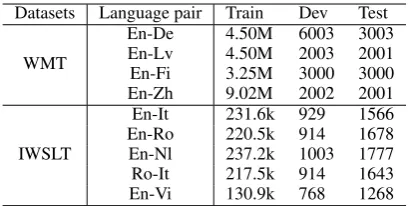
The statistical information of all the datasets is detailed in Table1.
4.2 Training Details
We implement our compact and language-sensitive method for Multi-NMT based on the ten-sor2tensor7 library. We use wordpiece method (Wu et al.,2016;Schuster and Nakajima,2012) to
1http://www.statmt.org/wmt14/translation-task.html
2http://www.statmt.org/wmt17/translation-task.html
3http://www.statmt.org/wmt18/translation-task.html
4https://cms.unov.org/UNCorpus/
5https://sites.google.com/site/iwsltevaluation2017
6https://sites.google.com/site/iwsltevaluation2015 7https://github.com/tensorflow/tensor2tensor
Datasets Language pair Train Dev Test
WMT
En-De 4.50M 6003 3003
En-Lv 4.50M 2003 2001
En-Fi 3.25M 3000 3000
En-Zh 9.02M 2002 2001
IWSLT
En-It 231.6k 929 1566
En-Ro 220.5k 914 1678
En-Nl 237.2k 1003 1777
Ro-It 217.5k 914 1643
[image:5.595.314.519.61.164.2]En-Vi 130.9k 768 1268
Table 1: The statistics of all the datasets including WMT and IWSLT tasks.
encode the combination of both source side sen-tences and target side sensen-tences. The vocabulary size is 37,000 for both sides. We train our mod-els using configurationtransformer base adopted
by Vaswani et al. (2017), which contains a
6-layer encoder and a 6-6-layer decoder with 512-dimensional hidden representations. Each mini-batch contains roughly 3,072 source and 3,072 tar-get tokens, which belongs to one translation di-rection. We use Adam optimizer (Kingma and Ba,2014) with β1=0.9, β2=0.98, and=10−9. For
evaluation, we use beam search with a beam size ofk =4and length penaltyα=0.6. All our meth-ods are trained and tested on a single Nvidia P40 GPU.
5 Results and Analysis
In this section, we discuss the results of our exper-iments about our compact and language-sensitive method on Multi-NMT. The translation perfor-mance is evaluated by character-level BLEU5 for En→Zh translation and case-sensitive BLEU4 (Papineni et al., 2002) for other translation tasks. In our experiments, the models trained on individ-ual language pair are denoted byNMT Baselines, and the baseline Multi-NMT models are denoted byMulti-NMT Baselines.
5.1 One-to-Many Translation
5.1.1 Main Results
The main results on the one-to-many translation scenario, including one-to-two, one-to-three and one-to-four translation tasks are reported in Ta-ble 2. We present a typical Multi-NMT
adopt-ingJohnson et al.(2017) method on Transformer
as our Multi-NMT baselines model. Obviously,
Task Tgt NMT Baselines
Multi-NMT Baselines Johnson et al.(2017)
Three-Stgy
Wang et al.(2018) Rep+Emb
Rep+Emb +Attn
Rep+Emb +Attn+Dis
One-to-Two
De 27.50 27.26 27.35 26.60 26.96 27.74
Lv 16.28 16.32 16.38 15.37 15.87 16.79
De 27.50 27.88 27.89 26.96 27.32 27.96
Fi 16.83 16.47 16.70 15.78 16.58 16.89
De 27.50 26.80 26.99 26.08 26.68 27.45
Zh 26.04 25.54 25.78 24.48 25.33 26.17
One-to-Three
De 27.50 25.44 25.55 24.82 25.45 26.06
Zh 26.04 24.87 25.63 24.12 24.93 26.12
Fi 16.83 16.86 16.97 16.06 16.78 17.12
De 27.50 25.98 26.12 24.88 25.80 26.42
Lv 16.28 14.88 15.44 14.51 15.58 16.31
Fi 16.83 16.94 17.05 16.15 16.79 17.22
One-to-Four
De 27.50 23.59 22.88 22.88 23.58 24.08
Lv 16.28 15.57 16.02 15.00 16.21 16.57
Zh 26.04 25.24 25.83 24.15 25.27 26.29
[image:6.595.73.530.60.245.2]Fi 16.83 13.45 14.12 12.99 14.11 15.03
Table 2: Translation performance on one-to-two, one-to-three and one-to-four translation tasks. Repdenotes our proposed representor.Emb,Attn, andDisrepresent our proposed language-sensitive methods to address multilin-gual translation. Note that the source language of all our experiments is English.
100 100 100
41
27.3
20.5 29.8
19.2 14.5 35.2
22.5 18.7 35.4
22.6 18.8
0 20 40 60 80 100 120
one-to-two one-to-three one-to-four Indiv Baselines Rep+Emb Rep+Emb+Attn Rep+Emb+Attn+Dis
Number of Parameters per Language Pair (M)
[image:6.595.317.516.311.412.2]Tasks
Figure 3: The comparison of model scale among indi-vidually trained system, baselines Multi-NMT system and our methods. Y-axis represents the model parame-ters per language pair, which is calculated by averaging model parameters on all translation tasks involved.
With respect to our proposed method, it is clear that our compact method consistently outperforms the baseline systems. Compared with another strong one-to-many translation modelThree-Stgy
proposed by Wang et al. (2018), our compact method can achieve better results as well. More-over, our method can perform even better than in-dividually trained systems in most cases (eleven out of sixteen cases). The results demonstrate the effectiveness of our method.
5.1.2 Model Size
Besides improving the translation results, we also compress the model size by introducing the rep-resentor. We investigate the scale of parameters used on average in each translation direction. We compare three models, includingNMT Baselines
model,Multi-NMT Baselinesmodel, and our com-pact Multi-NMT model. As shown in Figure3, all
Src→Tgt Emb
Manners Size Tgt-1 Tgt-2
En→De/Lv
LB 139M 26.58 15.76
DB 100M 27.22 16.26
RB 82M 27.26 16.32
TWWT 63M 26.82 16.02
En→De/Zh
LB 139M 27.34 25.61
DB 100M 27.15 25.22
RB 82M 27.22 25.38
TWWT 63M 26.91 24.99
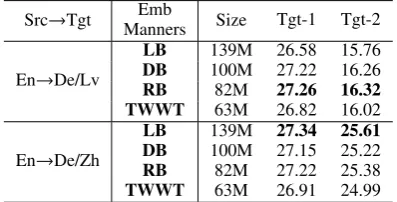
Table 3: Size (number of parameters) and BLEU scores of various embedding sharing manners. LB,DB,RB,
TWWT denote language-based manner,
direction-based manner, representor-direction-based manner, and three-way weight tying manner separately, as mentioned in Section3.2. Tgt-1 and Tgt-2 mean the results of the first (De) and the second (Lv/Zh) target language.
the multilingual translation models reduce the pa-rameters. Compared with Multi-NMT Baselines, we can observe that our method further reduces the model size of Multi-NMT. Considering Ta-ble 2 and Figure 3 together, we note that even though our proposed method in one-to-four trans-lation task only uses 18.8% parameters of NMT Baselines, we can achieve better performance on En→Zh and En→Lv.
5.1.3 Discussion of Language-Sensitive Modules
Table 2 shows that our proposed language-sensitive modules are complementary with each other. In this subsection, we will analyze each module in detail.
[image:6.595.75.287.311.409.2]man-0.01 0.03 0.05 0.07 0.09 22.4
22.6 22.8 23.2 23.4
BLEU Score
22.57
22.76
23.19
23.07
22.67 22.63
22.91
23.35
23.19
22.74 CNN on En-De
FFN on En-De
23.0
0.01 0.03 0.05 0.07 0.09
22.2 22.4 22.6 22.8 23.0
BLEU Score
22.21 22.37
22.97
22.78
22.43
22.15
22.28
22.72
22.56
22.24 CNN on En-Lv
[image:7.595.95.503.65.221.2]FFN on En-Lv
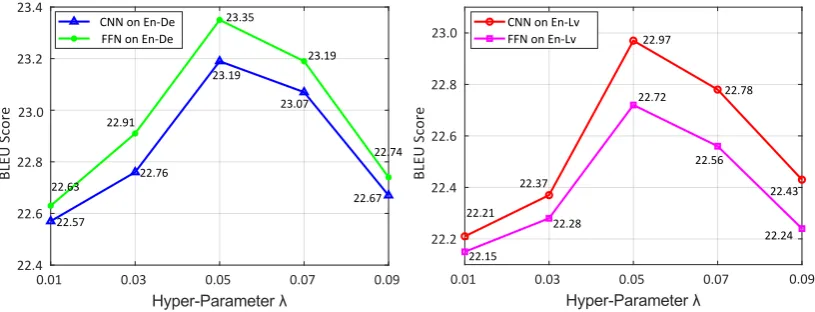
Figure 4: The comparison of two neural models with different hyper-parameterλ. CNN and FFN denote convolu-tion network and feed-forward network, respectively.
ners for Multi-NMT are divided into four cat-egories. We show the results of these sharing manners in Table 3. To make a fair compari-son, we sample 4.5M sentence pairs from En-Zh dataset. As shown in this table, our representor-based sharing manner consistently outperforms both the direction-based manner and three-way weight tying manner. Furthermore, even though the representor-based manner has about 40% fewer parameters than the language-based man-ner, it achieves comparable or even better per-formance. We find that language-based sharing manner is unstable because it achieves the highest BLEU score on Multi-NMT of similar languages (En→De/Zh), but the worst quality on dissimilar languages (En→De/Lv). Taking into account of translation quality and stability, we choose to use representor-based sharing manner in our method.
As described in Section 3.2, our proposed language-sensitive embedding is added to the in-put embedding of each token, which is unlike convention Multi-NMT method adding a special token into source side sentences or vocabularies (Johnson et al., 2017; Ha et al., 2016). There exists a question, is this kind of embeddings es-sential in our representor? To make a verifica-tion, we do the ablation study without this module. We observe that Multi-NMT model does not con-verge during training, which demonstrates these language-sensitive embeddings play a significant role in our model.
Language-Sensitive Attention: We present three types of cross-attention mechanisms in Section 3.2. We adopt shared-attention and
language-sensitive attention for Rep+Emb and
Rep+Emb+Attnseparately. Comparing these two methods in Table2, Rep+Emb+Attnmethod out-performs Rep+Emb method in all cases, which demonstrates the language-sensitive is useful for multiple language pairs with different word order. We also conduct the experiment of our representor with the hybrid-attention mechanism. Since this method has similar performance with Rep+Emb
but is larger in size, we ignore its results here.
Language-Sensitive Discriminator: In sec-tion 3.2, we employ two different types of the neural model as a language-sensitive discrimina-tor, and there is a hyper-parameter λ in Equa-tion 10. We present the effect of convolutional network and feed-forward network with different hyper-parameters on development datasets in Fig-ure 4. Considering that distinguishing between languages is only an auxiliary task in Multi-NMT, we set the maximum ofλto be 0.1. As shown in Figure4, when we adopt the convolution network as our discriminator withλ= 0.05, our language-sensitive method performs best. We also conduct the experiments in which the hyper-parameter λ is learnable. The experiment results are similar to the best settings mentioned above both on En→De (23.35 vs. 23.19) and En→Lv (22.97 vs. 22.72). For simplicity, all our experiments listed in Table2 and4adopt convolution network as the language-sensitive discriminator withλ=0.05.
5.2 Many-to-Many Translation
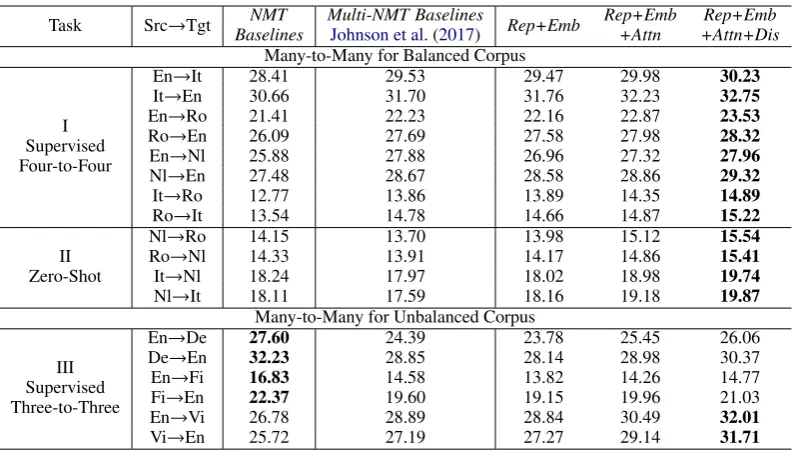
Task Src→Tgt NMT Baselines
Multi-NMT Baselines
Johnson et al.(2017) Rep+Emb
Rep+Emb +Attn
Rep+Emb +Attn+Dis Many-to-Many for Balanced Corpus
I Supervised Four-to-Four
En→It 28.41 29.53 29.47 29.98 30.23
It→En 30.66 31.70 31.76 32.23 32.75
En→Ro 21.41 22.23 22.16 22.87 23.53
Ro→En 26.09 27.69 27.58 27.98 28.32
En→Nl 25.88 27.88 26.96 27.32 27.96
Nl→En 27.48 28.67 28.58 28.86 29.32
It→Ro 12.77 13.86 13.89 14.35 14.89
Ro→It 13.54 14.78 14.66 14.87 15.22
II Zero-Shot
Nl→Ro 14.15 13.70 13.98 15.12 15.54
Ro→Nl 14.33 13.91 14.17 14.86 15.41
It→Nl 18.24 17.97 18.02 18.98 19.74
Nl→It 18.11 17.59 18.16 19.18 19.87
Many-to-Many for Unbalanced Corpus
III Supervised Three-to-Three
En→De 27.60 24.39 23.78 25.45 26.06
De→En 32.23 28.85 28.14 28.98 30.37
En→Fi 16.83 14.58 13.82 14.26 14.77
Fi→En 22.37 19.60 19.15 19.96 21.03
En→Vi 26.78 28.89 28.84 30.49 32.01
[image:8.595.101.502.60.286.2]Vi→En 25.72 27.19 27.27 29.14 31.71
Table 4: Translation performance under the many-to-many scenario, consisting of supervised four-to-four and zero-shot translation on the balanced corpus, and supervised three-to-three on the unbalanced corpus. Note that we do not use the Nl-Ro and It-Nl language pairs in our many-to-many translation task for the balanced corpus.
5.2.1 Results of Balanced Corpus
In part I of Table 4, our compact and language-sensitive method (Rep+Emb+Attn+Dis) performs consistently better than correspondingMulti-NMT Baselines, and it can achieve the improvements up to 1.30 BELU points (23.53 vs. 22.23 on En→Ro). Although Rep+Emb method dramati-cally reduces the model parameters, it performs on par with Multi-NMT Baselines. Compared with
NMT Baselinesmodel, our method also achieves better results, which is nearly 2 BLEU points on average. Experimental results on our bal-anced corpus demonstrate that our method is ro-bust and valid under the many-to-many translation scenario.
5.2.2 Results of Unbalanced Corpus
For unbalanced corpus, our method can achieve better results than Multi-NMT Baselines as well, as shown in part III of Table 4. Moreover, from the last two lines of this part, we can observe that compared with NMT Baselines, the transla-tion quality of En↔Vi can achieve the improve-ments up to 5.23/5.99 BLEU points (32.01/31.71 vs. 26.78/25.72), both of which are new state-of-the-art on these translation tasks to the best of our knowledge. The results show that our method is more effective in low-resource language pairs, es-pecially for the unbalanced corpus.
5.2.3 Zero-Shot Results
Part II in Table4shows the performance of zero-shot translation. Note that we conduct experi-ments of this translation scenario using hybrid-attentionmechanism. Compared withMulti-NMT Baselines, our compact and language-sensitive method performs significantly better with the im-provement as large as 2.28 BLEU points on Nl→It. Note that the training datasets do not con-tain parallel data for Nl-Ro and It-Nl.
It is interesting to figure out the translation performance of Nl↔Ro and It↔Nl when bilin-gual training corpus is available. We conduct ex-periments of NMT Baselineson Nl-Ro and It-Nl with all sentence pairs in IWSLT-17 (about 200k), which is similar to other training pairs in our bal-anced corpus. As shown in part II, Multi-NMT Baselinesunderperform theNMT Baselineson all cases. However, our method performs better than
NMT Baselines, and it achieves the improvement up to 1.76 BLEU points on Nl→It translation task.
6 Related Work
Our work is related to two lines of research, and we describe each of them as follows:
ex-plored. Due to the benefit of compactness, multi-lingual translation has been extensively studied in Dong et al.(2015),Luong et al.(2016) and John-son et al. (2017). Owing to excellent translation performance and ease of use, many researchers (Blackwood et al.,2018;Lakew et al.,2018) have conducted translation based on the framework of Johnson et al.(2017) andHa et al. (2016). Zhou et al.(2019) propose to perform decoding in two translation directions synchronously, which can be applied on different target languages and is a new research area for Multi-NMT. In our method, we present a compact method for Multi-NMT, which can not only compress the model but also yield su-perior performance.
Low-Resource and Zero-Shot NMT: Many researchers have explored low-resource NMT us-ing transfer learnus-ing (Zoph et al., 2016;
Neu-big and Hu, 2018) and data augmenting (
Sen-nrich et al., 2016a; Zhang and Zong, 2016) ap-proaches. For zero-shot translation, Cheng et al. (2017) andChen et al.(2017) utilize a pivot-based method, which bridges the gap between source-to-pivot and pivot-to-target two steps. Multilin-gual translation is another direction to deal with both low-resource and zero-shot translation. Gu et al. (2018) enable sharing of lexical and sen-tence representation across multiple languages, es-pecially for extremely low-resource Multi-NMT. Firat et al.(2016),Lakew et al.(2017), and
John-son et al. (2017) propose to make use of
multi-linguality in Multi-NMT to address the zero-shot problem. In this work, we propose a method for Multi-NMT to boost the accuracy of the multi-lingual translation, which better fits on both low-resource scenario and zero-shot scenario.
7 Conclusion
In this paper, we have proposed a compact and language-sensitive method for multilingual trans-lation. We first introduce a representor for replac-ing both encoder and decoder so as to fully ex-plore the commonality among languages. Based on the representor architecture, we then propose three language-specific modules dealing with em-bedding, attention and language discrimination re-spectively, in order to enhance the multilanguage translation model with the ability of distinguish-ing among different languages. The empirical ex-periments demonstrate that our proposed methods can outperform strong standard multilingual
trans-lation systems on one-to-many and many-to-many translation tasks. Moreover, our method is proved to be especially helpful in the low-resource and zero-shot translation scenarios.
Acknowledgments
The research work descried in this paper has been supported by the National Key Research and De-velopment Program of China under Grant No. 2016QY02D0303 and the Natural Science Foun-dation of China under Grant No. U1836221 and 61673380. The research work in this paper has also been supported by Beijing Advanced Inno-vation Center for Language Resources and So-gou Inc. We would like to thank Yang Zhao and Yuchen Liu for their invaluable discussions on this paper.
References
Antonios Anastasopoulos and David Chiang. 2018. Tied multitask learning for neural speech translation.
In Proceedings of NAACL 2018, pages 82–91.
Jimmy Lei Ba, Jamie Ryan Kiros, and Geoffrey E Hin-ton. 2016. Layer normalization. arXiv preprint arXiv:1607.06450.
Dzmitry Bahdanau, Kyunghyun Cho, and Yoshua Ben-gio. 2015. Neural machine translation by jointly learning to align and translate. In Proceedings of ICLR 2015.
Graeme Blackwood, Miguel Ballesteros, and Todd Ward. 2018. Multilingual neural machine transla-tion with task-specific attentransla-tion. In Proceedings of COLING 2018, pages 3112–3122.
Yun Chen, Yong Cheng, Yang Liu, and Li Victor, O.K. 2017. A teacher-student framework for zero-resource neural machine translation.In Proceedings of ACL 2017, pages 1925–1935.
Yong Cheng, Qian Yang, Yang Liu, Maosong Sun, and Wei Xu. 2017. Joint training for pivot-based neu-ral machine translation. Proceedings of IJCAI 2017, pages 3974–3980.
Kyunghyun Cho, Bart van Merri¨enboer Caglar Gul-cehre, Dzmitry Bahdanau, Fethi Bougares Holger
Schwenk, and Yoshua Bengio. 2014. Learning
phrase representations using rnn encoder–decoder for statistical machine translation. In Proceedings of EMNLP 2014, pages 1724–1734.
Orhan Firat, Kyunghyun Cho, and Yoshua Bengio.
2016. Multi-way, multilingual neural machine
translation with a shared attention mechanism. In Proceedings of NAACL 2016, pages 866–875.
Jonas Gehring, Michael Auli, David Grangier, De-nis Yarats, and Yann N. Dauphin. 2017. Convolu-tional sequence to sequence learning. arXiv preprint arXiv:1601.03317.
Jiatao Gu, Hany Hassan, Jacob Devlin, and Victor OK Li. 2018. Universal neural machine translation for extremely low resource languages. In Proceedings of NAACL 2018, pages 344–354.
Thanh-Le Ha, Jan Niehues, and Alexander Waibel. 2016. Toward multilingual neural machine trans-lation with universal encoder and decoder. In Pro-ceedings of IWSLT 2016.
Tianyu He, Xu Tan, Yingce Xia, Di He, Tao Qin, Zhibo Chen, and Tie-Yan Liu. 2018. Layer-wise coordi-nation between encoder and decoder for neural ma-chine translation. In Proceedings of NIPS 2018, pages 7944–7954.
Melvin Johnson, Mike Schuster, Quoc V. Le, Maxim Krikun, Yonghui Wu, Zhifeng Chen, Nikhil Thorat, Fernanda Vi´egas, Martin Wattenberg, Greg Corrado, Macduff Hughes, and Jeffrey Dean. 2017. Google’s multilingual neural machine translation system: En-abling zero-shot translation. Transactions of the As-sociation for Computational Linguistics, 5:339–351.
Nal Kalchbrenner and Phil Blunsom. 2013. Recurrent continuous translation models. In Proceedings of EMNLP 2013, pages 1700–1709.
Yoon Kim and Alexander M. Rush. 2016. Sequence-level knowledge distillation. In Proceedings of EMNLP 2016, pages 1317–1327.
Diederik P Kingma and Jimmy Ba. 2014. Adam: A method for stochastic optimization. arXiv preprint arXiv:1412.6980.
Surafel M Lakew, ADG Mattia, and F Marcello. 2017. Multilingual neural machine translation for low re-source languages. CLiC-it.
Surafel Melaku Lakew, Mauro Cettolo, and Marcello Federico. 2018. A comparison of transformer and recurrent neural networks on multilingual neural machine translation. In Proceedings of COLING 2018, pages 641–652.
Yichao Lu, Phillip Keung, Faisal Ladhak, Vikas Bhard-waj, Shaonan Zhang, and Jason Sun. 2018. A neural interlingua for multilingual machine translation. In Proceedings of WMT 2018, pages 84–92.
Minh-Thang Luong, Quoc V Le, Ilya Sutskever, Oriol Vinyals, and Lukasz Kaiser. 2016. Multi-task se-quence to sese-quence learning. In Proceedings of ICLR 2016.
Minh-Thang Luong, Hieu Pham, and Christopher D Manning. 2015. Effective approaches to attention-based neural machine translation. In Proceedings of EMNLP, pages 1412–1421.
Graham Neubig and Junjie Hu. 2018. Rapid adaptation of neural machine translation to new languages. In Proceedings of EMNLP 2018, pages 875–880.
Kishore Papineni, Salim Roukos, Todd Ward, and Wei-Jing Zhu. 2002. Bleu: a method for automatic eval-uation of machine translation. In Proceedings of ACL, pages 311–318.
Emmanouil Antonios Platanios, Mrinmaya Sachan, Graham Neubig, and Tom Mitchell. 2018. Contex-tual parameter generation for universal neural ma-chine translation. In Proceedings of EMNLP 2018, pages 425–435.
Ofir Press and Lior Wolf. 2017. Using the output em-bedding to improve language models. In Proceed-ings of EACL 2017, pages 157–163.
Mike Schuster and Kaisuke Nakajima. 2012. Japanese and korean voice search. In Proceedings of ICASSP 2012.
Abigail See, Minh-Thang Luong, and Christopher D.
Manning. 2016. Compression of neural machine
translation models via pruning. In Proceedings of SIGNLL 2016, pages 291–301.
Rico Sennrich, Barry Haddow, and Alexandra Birch. 2016a. Improving neural machine translation mod-els with monolingual data. In Proceedings of ACL 2016, pages 86–96.
Rico Sennrich, Barry Haddow, and Alexandra Birch. 2016b. Neural machine translation of rare words with subword units. In Proceedings of ACL 2016, pages 1715–1725.
Ilya Sutskever, Oriol Vinyals, and Quoc V Le. 2014. Sequence to sequence learning with neural net-works. In Proceedings of NIPS, pages 3104–3112.
Ashish Vaswani, Noam Shazeer, Niki Parmar, Jakob Uszkoreit, Llion Jones, Aidan N. Gomez, and Łukasz Kaiser. 2017. Attention is all you need. In Proceedings of NIPS, pages 30–34.
Yining Wang, Jiajun Zhang, Feifei Zhai, Jingfang Xu, and Chengqing Zong. 2018. Three strategies to im-prove one-to-many multilingual translation. In Pro-ceedings of EMNLP 2018, pages 2955–2960.
Yonghui Wu, Mike Schuster, Zhifeng Chen, Quoc V Le, Mohammad Norouzi, Wolfgang Macherey,
Maxim Krikun, Yuan Cao, Qin Gao, Klaus
Macherey, et al. 2016. Google’s neural
Jiajun Zhang and Chengqing Zong. 2015. Deep neu-ral networks in machine translation: An overview.
IEEE Intelligent Systems, 30(5):16–25.
Jiajun Zhang and Chengqing Zong. 2016. Exploit-ing source-side monolExploit-ingual data in neural machine translation. In Proceedings of EMNLP, pages 1535– 1545.
Long Zhou, Yuchen Liu, Jiajun Zhang, Chengqing
Zong, and Guoping Huang. 2018.
Language-independent representor for neural machine transla-tion. arXiv preprint arXiv:1811.00258.
Long Zhou, Jiajun Zhang, and Chengqing Zong. 2019. Synchronous bidirectional neural machine transla-tion. Transactions of the Association for Compu-tational Linguistics, 7:91–105.
Barret Zoph and Kevin Knight. 2016. Multi-source neural translation. In Proceedings of NAACL 2016, pages 30–34.