Proceedings of the 57th Annual Meeting of the Association for Computational Linguistics, pages 6323–6330 6323
Why Didn’t You Listen to Me? Comparing User Control of
Human-in-the-Loop Topic Models
Varun Kumar∗ Amazon Alexa Cambridge, MA [email protected]
Alison Smith-Renner University of Maryland
College Park, MD [email protected]
Leah Findlater University of Washington
Seattle, Washington [email protected]
Kevin Seppi
Brigham Young University Provo, UT
Jordan Boyd-Graber University of Maryland
College Park, MD [email protected]
Abstract
To address the lack of comparative evalua-tion of Human-in-the-Loop Topic Modeling (HLTM) systems, we implement and evaluate three contrasting HLTMmodeling approaches using simulation experiments. These ap-proaches extend previously proposed frame-works, including constraints and informed prior-based methods. Users should have a sense of control inHLTMsystems, so we pro-pose acontrolmetric to measure whether re-finement operations’ results match users’ ex-pectations. Informed prior-based methods pro-vide better control than constraints, but con-straints yield higher quality topics.
1 Human-in-the-Loop Topic Modeling
Topic models help explore large, unstructured text corpora by automatically discovering the topics discussed in the documents (Blei et al., 2003). However, generated topic models are not perfect; they may contain incoherent or loosely connected topics (Chang et al., 2009; Mimno et al., 2011; Boyd-Graber et al.,2014).
Human-in-the-Loop Topic Modeling (HLTM) addresses these issues by incorporating human knowledge into the modeling process. Existing HLTM systems expose topic models as their topic words and documents, and users provide feedback to improve the models using varied refinement op-erations, such as adding words to topics, merg-ing topics, or removmerg-ing documents (Smith et al., 2018; Wang et al., 2019). Systems also vary in how they incorporate feedback, such as
“must-∗
Work performed at University of Maryland, College Park
link” and “cannot-link” constraints ( Andrzejew-ski et al., 2009; Hu et al., 2014), informed pri-ors (Smith et al.,2018), or document labels (Yang et al., 2015). However, evaluations of these sys-tems are either not comparative (Choo et al., 2013;Lee et al., 2017) or compare against non-interactive models (Hoque and Carenini,2015;Hu et al., 2014) or for only a limited set of refine-ments (Yang et al.,2015;Xie et al.,2015). Evalu-ations are thus silent on whichHLTM system best supports users in improving topic models: they ig-nore whether refinements are applied correctly or how they compare with other approaches. More-over, comparative evaluations can be difficult be-cause existing HLTM systems support diverse re-finement operations with little overlap.
We also introduce metrics to assess the de-gree to which HLTM systems listen to users— user control—a key user interface design princi-ple for human-in-the-loop systems (Amershi et al., 2014;Du et al.,2017). In general, informed pri-ors provide more control while constraints pro-duce higher quality topics.
This paper provides three contributions: (1) im-plementation of an HLTM system using informed priors and variational inference, (2) experimental comparison of three HLTM systems, and (3) met-rics to evaluate user control inHLTMsystems.
2 Human Feedback and LDA
We briefly describe Latent Dirichlet Alloca-tion (Blei et al., 2003, LDA) and outline the ex-perimental conditions and our implementation.
2.1 LDAInference
LDA is generative, modeling documents as mix-tures ofktopics where each topic is a multinomial distribution,φz, over the vocabulary,V. Each doc-umentdis an admixture of topics θd. Each word indexed by i in documentd is generated by first sampling a topic assignmentzd,i fromθdand then sampling a word from the corresponding topicφzi.
Collapsed Gibbs sampling (Griffiths and Steyvers, 2004) and variational Expectation-Maximization (Blei et al., 2003, EM) are two popular inference methods to compute the posterior, p(z, φ, θ|w, α, β). Gibbs sampling iteratively samples a topic assignment, zd,i = t given an observed token wd,i in document dand other topic assignments,z−d,n, with probability
P(zd,i =t|z−d,n, w)∝(nd,t+α)
nw,t+β nt+V β
(1)
Here, nd,t is the count topic t is in document d, nw,tis the count of tokenwin topict, andntis the marginal count of tokens assigned to topict. Al-ternatively, variational EM approximates the pos-terior using a tractable family of distributions by first defining a mean field variational distribution
q(z, φ, θ|λ, γ, π) =
K Y
k=1
q(φk|λk) D Y
d=1
q(θd|γd)
Nd
Y
n=1
q(zdn|πdn) (2)
where γd, πd are local parameters of the distri-bution q for document d, and λ is a global pa-rameter. Inference minimizes the KL divergence
between the variational distribution and true pos-terior. While there are many LDA variants for specific applications (Boyd-Graber et al., 2017), we focus on models that interactively refine initial topic clustering.
2.2 HLTMModeling Approaches
To investigate adherence to user feedback and topic quality improvements, we compare HLTM systems, based on three modeling approaches. Each of these approaches incorporate user feed-back by firstforgettingwhat the model learned be-fore, by unassigning words from topics (Hu et al., 2014), and then injecting new information based on user feedback into the model.
We compare two existing techniques for inject-ingnew information: (1) asymmetric priors (or formed priors), which are used extensively for in-jecting knowledge into topic models (Fan et al., 2017;Zhai et al.,2012;Plepl´e,2013;Smith et al., 2018;Wang et al.,2019) by modifying Dirichlet parameters, α and β, and (2) constraints (Yang et al.,2015), in which knowledge sourcemis in-corporated as a potential function fm(z, m, d) of the hidden topiczof word typewin documentd. While other frameworks exist (Foulds et al.,2015; Andrzejewski et al., 2009; Hu et al., 2014; Xie et al.,2015;Roberts et al.,2014), we focus on in-formed priors and constraints, as these are flexible to support the refinement operations preferred by users and reasonably fast enough to support “rapid interaction cycles” required for effective interac-tive systems (Amershi et al.,2014).
Informed priors using Gibbs sampling ( info-gibbs) forgets topic-word assignmentsziand in-jects new information by modifying Dirichlet pa-rameters,αandβ. Smith et al.(2018) implement seven refinements for this approach. We extend their work with a create topic refinement.
Informed priors using variational inference (info-vb) forgets topic-word assignments for a word w in topic t by resetting the value ofλt,w. This approach manipulates priors,αandβ, to in-corporate new knowledge likeinfo-gibbs. We de-fine and implement seven user-preferred refine-ment operations for this approach.
Constraints using Gibbs sampling (const-gibbs)
forgets topic assignments like in info-gibbs, but instead of prior manipulation, injects new infor-mation into the model using potential functions, fm(z, m, d) (Yang et al., 2015). We define and implement sevenuser-preferredrefinement opera-tions for this approach.
2.3 Refinement Implementations
Our three systems support the following seven refinements that users request in HLTM systems (Musialek et al.,2016;Lee et al.,2017):
Remove word w from topic t. For all three systems, first forget all w’s tokens wi from t. Then, for info-gibbs and info-vb, assign a very small prior1 to w in t. Forconst-gibbs, add a constraint2 fm(z, w, d), such that fm(z, w, d) = log()ifz=tandw=x, else assign0.
Add word w to topic t. For all three systems, first forgetwfrom all other topics. Then, for info-gibbs andinfo-vb, increase the prior ofwintby the difference between the topic-word counts ofw and topic's top wordwˆ int. Forconst-gibbs, add a constraintfm(z, w, d), such thatfm(z, w, d)= 0 ifz=tandw=x, else assignlog().
Remove document dfrom topict. For all mod-els, first forget the topic assignment for all words in the documentd. Then, forinfo-gibbsand info-vb, overwrite the previous prior value with a very small prior , tot in αd. For const-gibbs, add a constraint fm(z, w, d), such that fm(z, w, d) = log()ifz=tandd=x, else assign0.
1
We use= 10−8
2We uselog()to make it a soft constraint. Replacing it
with -∞will make it a hard constraint.
Merge topics t1 andt2 into a single topic, t1. Forinfo-gibbsandconst-gibbs, assignt1 to all to-kens previously assigned tot2. This effectively re-moves t2 and updatest1, which should represent botht1 andt2. Forinfo-vb, add counts fromλt2 to λt1 and remove row from λ corresponding to t2.
Split topic tgiven seed wordssinto two topics, tn, containings, andt, withouts. For each vocab-ulary word, move a fraction of probability mass fromttotnas proposed by (Plepl´e,2013). Then, forinfo-gibbsandinfo-vb, assign a high prior for all s intn. Following Fan et al., we use 100 as the high prior. Forconst-gibbs, tos totn, add a constraintfm(z, w, d), such that fm(z, w, d) = 0 ifz=tnandw=wi ∈s, else assignlog().
Change word order , such that w2 is higher than w1 in topic t. In info-gibbs, increase the prior ofw2 intby the topic word counts’ differ-ence nw1,t -nw2,t. In info-vb, increase the prior
by λt,w1 −λt,w2. For const-gibbs, compute the ratior between the topic word counts’ difference nw1,t −nw2,t and the counts of wordw2, which
have any topic except t, nw2,x,x6=t. Then, add a
constraintfm(z, w, d), such that fm(z, w, d) = 0 if z = t and w = w2, else assign δ where δ= log()ifr >1elseδ= 1.0−r.
Create topic tn, given seed words,s. First for-get the topic assignment for alls. Then, for info-gibbs andinfo-vb, assign a high prior to s. For const-gibbs, to assign s to tn, add a constraint fm(z, w, d), such thatfm(z, w, d) = 0ifz = tn andw=wi ∈s, else assignlog().
3 Measuring Control
Prior work in interactive systems emphasizes the importance of doing what users ask, that is, end user control(Shneiderman,2010;Amershi et al., 2014). However,HLTM, which must balance mod-eling the data well and fulfilling users’ desires, can frustrate users when refinements are not ap-plied as expected (Smith et al., 2018). Evalua-tion metrics such as topic coherence, perplexity, and log-likelihood measure how well topics model data, but are not sufficient to measure whether user feedback is incorporated as expected. Therefore, we propose new controlmetrics to measure how well models reflect users’ refinement intentions.
rM1
wt denote the rank of a word w in topic t in
model M1. After applying a word-level refine-ment, the rank of w in the updated model M2, isrM2
wt . For word-level refinements, such as add
word, remove word, and change word order, compute control as the ratio of the actual rank change, the absolute difference (rM1
wt −r
M2
wt ), and
the expected rank change. A score of1.0indicates that the model perfectly applied the refinement, while a negative score indicates the model did the opposite of what was desired. For remove doc-ument, use the same definition asremove word
except consider a topic as a ranked document list. Forcreate topic, computecontrolas the ratio of the number of seed words in the created topic out of the total number of provided seed words. For
merge topics,controlis defined as the ratio of the number of words in the merged topic which came from either of the parent topics, and the total num-ber of words shown to a user. Forsplit topic, con-trolis the average of the controlscores of parent topic and child topic, computed using thecontrol definition forcreate topic.
4 HLTMSystem Comparison
To compare how the three HLTM systems model data and adhere to user feedback (i.e., provide con-trol), we need user data; however, real user in-teraction is expensive to obtain. So, we simu-late a range of user behavior with these systems: users that aim to improve topics, “good users”, and those that behave unexpectedly, “random users”.
The simulations use a data set of7000news ar-ticles,500articles each for fourteen different news categories, such as business, law, and money, col-lected using the GuardianAPI.3
4.1 Simulated Users
The “random user” refines randomly. For exam-ple, remove document, deletes a randomly se-lected document from a randomly sese-lected topic.
Our “good user” reflects a realistic user behav-ior pattern: identify a mixed category topic and ap-ply refinements to focus the topic on its most dom-inant category. Thus the “good user”—with access to true document categories—first chooses a topic associated with multiple categories of documents and determines the dominant category of the top documents for the topic. Then, refinement opera-tions push the topic to the dominant category. For
3https://open-platform.theguardian.com
example, the “good user” may remove a document which does not belong to the dominant category. Additional simulation are found in AppendixA.
4.2 Method
We train forty initialLDAmodels, twenty with ten topics and twenty with twenty topics for the news articles, resulting in models with less and more topics than the true number of categories.
For each of the three HLTM systems and each of the seven refinement types, we randomly select one of the pre-trained models. The create and split topic refinement types select from the models with ten topics, ensuring that topics have overlapping categories, while the others select from the mod-els with twenty topics. We then apply a refinement as dictated by the simulated user. For the “ran-dom user”, we ran“ran-domly select refinement param-eters, such as topic and word (Appendix A.1), and for the “good user”, we choose topic and refine-ment parameters intending to improve the topics (Appendix A.2). We apply the refinement (Sec-tion 2.3) and run inference until the model con-verges or reaches a threshold of twenty Gibbs sam-pling and threeEMiterations. We compute control (Section3) of the refinement and change in topic coherence usingNPMIderived from Wikipedia for the top twenty topic words (Lau et al.,2014). We repeat this process100times for each refinement type, simulated user, andHLTMsystem.
5 Informed Priors Listen to Users, while Constraints Produce Coherent Topics
Table1shows the per-refinement control and co-herence deltas for the three different HLTM sys-tems. As detailed in AppendixB, Kruskal-Wallis tests show that HLTM systems have significantly different (p < .05) control scores for all refine-ments for the “good user” and for all butremove word for the “random user.” Coherence deltas were also significantly different for all refinements except add word, where const-gibbs yields con-sistently higher coherence improvements than the other conditions aside fromremove document.
const-gibbs info-gibbs info-vb
CRand CGood QGood∗ CRand CGood QGood∗ CRand CGood QGood∗
remove w 1.0 (0.0) 1.0 (0.0) 5.4 (9.7) 1.0 (0.0) 1.0 (0.0) 3.0 (8.9) 1.0 (0.0) 1.0, (0.0) 1.2 (5.0)
remove d 1.0 (0.0) 1.0 (0.0) -1.7 (10.8) 1.0 (0.0) 1.0 (0.0) .8 (4.5) .72 (.4) .85 (.25) -6.0 (13.2)
merge t .97 (.05) 1.0 (0.0) 6.3 (8.7) .96 (.05) 1.0 (0.0) -.43 (9.3) .99 (.02) .99 (.02) 1.4 (9.8)
add w .82 (.29) .86 (.24) 3.0 (9.4) 1.0 (0.0) .98 (.03) 3.1 (6.4) .98 (.04) .98 (.02) 1.7 (5.6)
create t .08 (.10) .81 (.13) -6.6 (13.7) .98 (.11) .98 (.04) -11 (10.4) 1.0 (0.0) 1.0 (0.0) -13.0 (8.4)
split t .91 (.09) .79 (.19) 1.9 (17.9) .93 (.06) .87 (.19) -7.9 (13.5) 1.0 (0.0) .93 (.16) -1.6 (8)
reorder w .41 (.53) .19 (.20) 1.6 (7) 1.19 (.46) .56 (.24) -1.0 (5.5) 1.02 (.27) .44 (.24) -1.0 (5.1)
Table 1: Simulation results, reported asmean (SD): control with the random (CRand) and good (CGood)users,
and coherence deltas (QGood) for the good user (we omit coherence for the random user as the goal there is not to
improve the topics).∗values reported as E-04.
such as add word and create topic. On the other hand, const-gibbs supports defining token and document-level constraints, which ensure al-most perfect control for refinements that require restricting certain words or documents, such as re-move wordandremove document.
Additionally, comparing good and random users, all systems provide similar control except for const-gibbs for create topic: .81 for good (CGood) compared to .08 for random (CRand). This is because const-gibbs is limited by the un-derlying data and cannot generate topics contain-ing random, unrelated seed words, lowercontain-ing con-trol for the “random user.” Informed prior models, however, inflate priors to adhere to user feedback, regardless of whether it aligns with the underlying data, so these methods provide higher control even for random input. Finally, for change word or-der, all three systems lack control. As topic mod-els are probabilistic modmod-els, it is therefore difficult to maintain the exact user provided word order.
5.1 Why Informed Priors Offer Control
Informed priors provide higher control than con-straints for refinements that require promoting words, such as add word and create topic. To understand the difference between these two feed-back techniques, we conduct an additional simu-lation to compareconst-gibbs andinfo-gibbs: we generate an initial topic model of10topics and ap-plyadd wordrefinements to explore varied con-trol of the feedback techniques.
The initial model includes a law topic with the top ten words: “court, law, justice, rights, le-gal, case, police, human, public, courts”. A user wants to add the word “injustice”, initially ranked at1035th position, to this topic using both
const-gibbs andinfo-gibbs models. While const-gibbs improves the ranking of the added word to 631,
info-gibbs puts this word at the first position in the updated topic. Theconst-gibbssystem tries to push tokens of “injustice” to thelawtopic; how-ever, there just are not enough occurrences to put it in the first ten words. Even assigning all its occur-rences to the law topic cannot improve its ranking further. On the other hand,info-gibbscan increase the prior for “injustice” enough to put the word in the top of the topic list; until overruled by data info-gibbs, can use high priors to incorporate user feedback, resulting in higher control.
6 Conclusion
Informed prior models provide an effective way to incorporate different feedback into topic mod-els, improvinguser control and topic coherence, while constraints yield higher quality topics, but with less control. While we simulate user behav-ior for good and random users, future work should compare these systems with end users, as well as compare end user ratings of control with our pro-posed automated metrics.
Interactive models—by design—are balancing user insight with the truth of the data (and thus the world). An important question for future models, especially interactive ones, is how to signal to the user when their desires do not comport with real-ity. In such cases, control may not be a desired property of interactive systems.
Acknowledgements
References
Saleema Amershi, Maya Cakmak, William Bradley Knox, and Todd Kulesza. 2014. Power to the peo-ple: The role of humans in interactive machine learning.AI Magazine, 35(4):105–120.
David Andrzejewski, Xiaojin Zhu, and Mark Craven. 2009. Incorporating domain knowledge into topic modeling via Dirichlet forest priors. InProceedings of the International Conference of Machine Learn-ing.
David M Blei, Andrew Y Ng, and Michael I Jordan. 2003. Latent Dirichlet allocation. Journal of ma-chine Learning research, 3(Jan):993–1022.
Jordan Boyd-Graber, Yuening Hu, and David Mimno. 2017. Applications of Topic Models, volume 11 of Foundations and Trends in Information Retrieval. NOW Publishers.
Jordan Boyd-Graber, David Mimno, David Newman, Edoardo M Airoldi, David Blei, and Elena A Ero-sheva. 2014. Care and feeding of topic models: Problems, diagnostics, and improvements. Hand-book of mixed membership models and their appli-cations, pages 3–34.
Jonathan Chang, Jordan L Boyd-Graber, Sean Gerrish, Chong Wang, and David M Blei. 2009. Reading tea leaves: How humans interpret topic models. In Proceedings of Advances in Neural Information Pro-cessing Systems.
Jaegul Choo, Changhyun Lee, Chandan K Reddy, and Haesun Park. 2013. Utopian: User-driven topic modeling based on interactive nonnegative matrix factorization. IEEE transactions on visualization and computer graphics, 19(12):1992–2001.
Fan Du, Catherine Plaisant, Neil Spring, and Ben Shneiderman. 2017. Finding similar people to guide life choices: Challenge, design, and evaluation. In Proceedings of the 2017 CHI Conference on Human Factors in Computing Systems.
Angela Fan, Finale Doshi-Velez, and Luke Miratrix. 2017. Prior matters: simple and general methods for evaluating and improving topic quality in topic modeling. arXiv preprint arXiv:1701.03227.
James Foulds, Shachi Kumar, and Lise Getoor. 2015. Latent topic networks: A versatile probabilistic pro-gramming framework for topic models. In Pro-ceedings of the International Conference of Machine Learning.
Thomas L Griffiths and Mark Steyvers. 2004. Find-ing scientific topics. Proceedings of the National academy of Sciences, 101(suppl 1):5228–5235.
Enamul Hoque and Giuseppe Carenini. 2015. Con-visit: Interactive topic modeling for exploring asyn-chronous online conversations. In International Conference on Intelligent User Interfaces. ACM.
Yuening Hu, Jordan Boyd-Graber, Brianna Satinoff, and Alison Smith. 2014. Interactive topic modeling. Machine learning, 95(3).
Jey Han Lau, David Newman, and Timothy Baldwin. 2014. Machine reading tea leaves: Automatically evaluating topic coherence and topic model qual-ity. Proceedings of the Conference of the European Chapter of the Association for Computational Lin-guistics, pages 530–539.
Tak Yeon Lee, Smith Alison, Kevin Seppi, Niklas Elmqvist, Jordan Boyd-Graber, and Leah Findlater. 2017. The human touch: How non-expert users per-ceive, interpret, and fix topic models. International Journal of Human-Computer Studies.
David Mimno, Hanna M Wallach, Edmund Talley, Miriam Leenders, and Andrew McCallum. 2011. Optimizing semantic coherence in topic models. In Proceedings of Empirical Methods in Natural Lan-guage Processing. Association for Computational Linguistics.
Chris Musialek, Philip Resnik, and S Andrew Stavisky. 2016. Using text analytic techniques to create ef-ficiencies in analyzing qualitative data: A compari-son between traditional content analysis and a topic modeling approach. American Association for Pub-lic Opinion Research.
Quentin Plepl´e. 2013. Interactive topic modeling. Master’s thesis, UC San Diego.
Margaret E Roberts, Brandon M Stewart, Dustin Tingley, Christopher Lucas, Jetson Leder-Luis, Shana Kushner Gadarian, Bethany Albertson, and David G Rand. 2014. Structural topic models for open-ended survey responses. American Journal of Political Science, 58(4):1064–1082.
Ben Shneiderman. 2010.Designing the user interface: strategies for effective human-computer interaction. Pearson Education India.
Alison Smith, Varun Kumar, Jordan Boyd-Graber, Kevin Seppi, and Leah Findlater. 2018. Closing the loop: User-centered design and evaluation of a human-in-the-loop topic modeling system. In Inter-national Conference on Intelligent User Interfaces. ACM.
Jun Wang, Changsheng Zhao, Junfu Xiang, and Kanji Uchino. 2019. Interactive topic model with en-hanced interpretability. InIUI Workshops.
Pengtao Xie, Diyi Yang, and Eric P Xing. 2015. In-corporating word correlation knowledge into topic modeling. In Conference of the North American Chapter of the Association for Computational Lin-guistics.
Ke Zhai, Jordan L. Boyd-Graber, Nima Asadi, and Mo-hamad L. Alkhouja. 2012. Mr. LDA: a flexible large scale topic modeling package using variational in-ference in mapreduce. In Proceedings of the 21st International Conference on World Wide Web.
A Simulation Details
To simulate the behavior of the “random user” and “good user” for the threeHLTMsystems, we train
40 initial LDA models,20 with10 topics and20
with 20 topics for the news articles, resulting in models with less and more topics than the true number of categories.
A.1 Random User Simulation
To simulate random user behavior, for each of the three systems and for each of the seven re-finement types, we randomly select a pre-trained LDA model from the pool of models with20 top-ics. Then, we apply a refinement of that refine-ment type to the selected model. We randomly select refinement specific parameters, such as can-didate topic, word to be added, and document to be deleted. We run inference until the model con-verges or reaches a limit. For Gibbs sampling models,info-gibbsandconst-gibbs, we use20 iter-ations as limit and for the variational model, info-vb, we use3EM iterations as the limit. After ap-plying the refinement, we compute thecontroland coherence given the updated and initial model. We perform this100times for each of the refinement types andHLTMsystems.
A.2 Good User Simulation
For each category c of the 14 categories of the Guardian news dataset (art & design, business, ed-ucation, environment, fashion, film, football, law, money, music, politics, science, sports, technol-ogy), we compute the most important words inc, Sc, using a Logistic regression classifier. We use Scas a list of representative words for categoryc. Given a labeled corpus, we randomly choose one of the pre-trained models. When applying cre-ate or split topic refinement types, we select from the models with 10 topics, ensuring that topics have overlapping categories. While applying all other refinement types, we select from the models with20topics. We then simulate good user behav-ior for each of the refinement types as follows:
1. Add word: Randomly select a topic t from those where the top20 documents are from
more than one category. Then, find the cor-responding labeled category c by analyzing top 20 documents in the selected category. To improve the topic coherence oft, add top ranked words (from one to five words) from Sc, which are not already in the top words of t.
2. Remove word: Randomly select a topic t from those where top20documents are from more than one category. Then, find the corre-sponding labeled categorycby analyzing top
20 documents in the selected category. For selected topict, remove words which are not part ofSc.
3. Change word order: Randomly select a topic t among all topics. Then, find the corre-sponding labeled categorycby analyzing top
20documents in the selected category. Then, find words between index10to20, which are at higher rank inSc. Promote such words to a higher rank using change word order.
4. Remove document: Randomly select a topict from those where top20documents are from more than one category. Then, find the corre-sponding labeled categorycby analyzing top
20 documents in the selected category. For selected topict, delete documents (from one to five documents), which are not inc.
5. Merge topics: Randomly choose a topic pair to merge which represents a common cate-goryc.
6. Create topic: Randomly select a category c which is not a dominant category in any of the topics. Create a topic by providing top10
words as seed words fromSc.
7. Split topic: Randomly select a topic from those which have documents from two dif-ferent categories,c1 andc2. Split the top20 words in that topic into two lists using the representative words fromSc1andSc2. Then, split the topic using one of the lists.
B Kruskal Wallis Tests
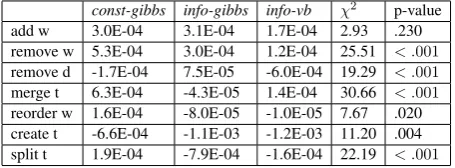
coherence. The means reported here repeat what is provided in the main paper, but with the additional χ2 andp values output from the Kruskal Wallis tests;p < .05is considered to be significant.
Because control values are not comparable across the seven user-preferred refinements, we conducted separate Kruskal Wallis tests for each refinement. The results include control for the simulated good user (Table 3) and for the sim-ulated random user (Table 2), as well as quality improvements (coherence) for the simulated good user (Table4).
const-gibbs info-gibbs info-vb χ2 p-value add w 0.82 1.00 0.99 249.35 < .001
remove w 1.00 1.00 1.00 0.42 .810
[image:8.595.70.299.412.498.2]remove d 1.00 1.00 0.72 27.12 < .001 merge t 0.97 0.96 0.99 31.24 < .001 reorder w 0.41 1.19 1.03 113.52 < .001 create t 0.08 0.98 1.00 277.23 < .001 split t 0.91 0.93 1.00 119.47 < .001
Table 2: Average control provided by the threeHLTM systems for sevenuser-preferredrefinements and sim-ulated random user behavior. Kruskal-Wallis tests (p < .05) show significant differences between the systems for all refinements except remove word.
const-gibbs info-gibbs info-vb χ2 p-value
add w 0.86 0.98 0.98 13.02 .001
remove w 0.99 0.99 0.99 6.22 .045
remove d 0.99 0.99 0.85 163.73 < .001 merge t 1.00 1.00 0.99 22.76 < .001 reorder w 0.19 0.56 0.44 103.44 < .001 create t 0.82 0.98 1.00 191.82 < .001 split t 0.77 0.87 0.93 81.71 < .001
Table 3: Average control provided by the threeHLTM systems for sevenuser-preferredrefinements and sim-ulated good user behavior. Kruskal-Wallis tests (p < .05) show significant differences between the systems for all refinements.
const-gibbs info-gibbs info-vb χ2 p-value add w 3.0E-04 3.1E-04 1.7E-04 2.93 .230 remove w 5.3E-04 3.0E-04 1.2E-04 25.51 < .001 remove d -1.7E-04 7.5E-05 -6.0E-04 19.29 < .001 merge t 6.3E-04 -4.3E-05 1.4E-04 30.66 < .001 reorder w 1.6E-04 -8.0E-05 -1.0E-05 7.67 .020 create t -6.6E-04 -1.1E-03 -1.2E-03 11.20 .004 split t 1.9E-04 -7.9E-04 -1.6E-04 22.19 < .001
[image:8.595.71.299.590.674.2]