Proceedings of the 7th Workshop on Balto-Slavic Natural Language Processing, pages 75–82, 75
BSNLP2019 Shared Task Submission:
Multisource Neural NER Transfer
Tatiana Tsygankova, Stephen Mayhew, Dan Roth
University of Pennsylvania Philadelphia, PA, 19104
{ttasya, mayhew, danroth}@seas.upenn.edu
Abstract
This paper describes the Cognitive Computa-tion (CogComp) Group’s submissions to the multilingual named entity recognition shared task at the Balto-Slavic Natural Language Pro-cessing (BSNLP) Workshop (Piskorski et al., 2019). The final model submitted is a multi-source neural NER system with multilingual BERT embeddings, trained on the concate-nation of training data in various Slavic lan-guages (as well as English). The perfor-mance of our system on the official testing data suggests that multi-source approaches con-sistently outperform single-source approaches for this task, even with the noise of mismatch-ing tagsets.
1 Introduction
This paper describes the Cognitive Computation (CogComp) Group’s submission to the shared task of the Balto-Slavic Natural Language Process-ing (BSNLP) Workshop at ACL 2019 (Piskorski et al., 2019). This shared task centers around multilingual named entity recognition (NER) in Slavic languages, and is composed of recognition, lemmatization, and entity linking subtasks. The niche focus of this task on Slavic languages makes it both interesting and challenging. The languages used in the shared task (Bulgarian, Czech, Pol-ish, and Russian) belong to the same language family and share complex grammatical and mor-phological features which may be understudied in an English-focused research community. Further, they encompass both Latin and Cyrillic scripts, complicating the multilingual nature of the prob-lem. In addition to the language specific chal-lenges, there are varying sizes of training data, somewhat non-standard named entity types (mak-ing find(mak-ing additional data challeng(mak-ing), and dif-fering domains – the training and test sets are com-posed of newswire documents collected around
domain-specific topics, with different topics in train and test.
This year’s shared task is the second edition of the multilingual named entity recognition task on Slavic languages organized for the BSNLP work-shop. A similar shared task was previously held in 2017 (BSNLP2017), and was composed of the same subtasks, but was evaluated on seven Slavic languages. It had a slightly different format, in that training data was not provided to the partici-pants, so the majority of the submissions relied on cross-lingual or rule-based approaches.
Our overarching research goal for this project was to experiment with multisource neural NER transfer, leveraging recent advances in multilin-gual contextual embeddings (Devlin et al.,2019). Ultimately, we aimed to maximize parameter-sharing by training a single model on the concate-nation of training data from sources (languages). Such multi-source systems have seen success in machine translation (Zoph and Knight,2016), and to some extent in non-neural NER systems (May-hew et al., 2017), and neural systems (Rahimi et al.,2019). Given that training data is available in this iteration of the shared task, we purposefully chose to not include rule-based components into our model in order to focus on getting the most out of the given training data.
2 Related Work
The first shared task in Balto-slavic NLP was held in 2017, and reported in Piskorski et al. (2017). The task was somewhat different from the 2019 task in that training data was not pro-vided to participants. Approaches submitted to this task included a model based on parallel pro-jection (Mayfield et al., 2017) and a model with language-specific features trained on found data (Marci´nczuk et al., 2017). There has also been follow-up work on this dataset using cross-lingual embeddings (Sharoff,2018).
Named Entity Recognition (NER), the task of detecting and classifying named entities in text, has been studied for many years. Early models proposed were averaged perceptron (Ratinov and Roth,2009), and conditional random field (Man-ning et al.,2014). In recent years, neural models have proved successful, with the BiLSTM-CRF model dominant (Chiu and Nichols, 2016; Lam-ple et al., 2016). A further increase in perfor-mance has come with contextual embeddings (De-vlin et al., 2019;Peters et al.,2018;Akbik et al., 2018), which are based on large language models trained over massive corpora.
Of particular interest is the multilingual BERT model (Devlin et al.,2019), which is trained over the concatenation of the Wikipedias in over 100 languages.1 Although BERT is not trained with explicit cross-lingual objectives, it has been shown to have emergent cross-lingual properties, as well as language identification capabilities (Wu and Dredze,2019).
Several models have been proposed for multi-source learning, in which multiple languages are used to train a model, including for machine trans-lation (Zoph and Knight, 2016; Johnson et al., 2017; Currey and Heafield, 2018), and NER (T¨ackstr¨om, 2012; Tsai et al., 2016; Mayhew et al.,2017;Rahimi et al.,2019).
3 Task
We first describe the details of the shared task, in-cluding the data, the evaluation metrics, and the subtasks.
3.1 Data
The BSNLP 2019 training set contained four Slavic languages: Bulgarian, Czech, Polish and
1github.com/google-research/bert/blob/ master/multilingual.md
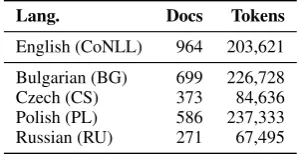
Lang. Docs Tokens
English (CoNLL) 964 203,621
Bulgarian (BG) 699 226,728
Czech (CS) 373 84,636
Polish (PL) 586 237,333
[image:2.595.341.491.63.140.2]Russian (RU) 271 67,495
Table 1: Training data sizes in CoNLL and BSNLP19 datasets. Of the BSNLP19 sets, the largest (Polish) is nearly 3 times the size of the smallest (Russian).
Tag Total Unique Ratio
PER 9986 2851 3.5
LOC 9563 1540 6.2
ORG 8520 1923 4.4
EVT 2601 235 11.0
PRO 1699 739 2.3
Table 2: Entity distribution statistics across all lan-guages in the BSNLP19 training set, where the “Ratio” column refers to the proportion of the “Total” number of entity type annotations to the “Unique” annotations.
Russian. Of these, Czech and Polish are written in Latin script, and Russian and Bulgarian are writ-ten in Cyrillic script, a property that we will later explore in our experiments. Table1 summarizes the size of the datasets. There is a large disparity in the amount of training data by language, with the largest (Polish), containing almost 3 times as many tokens as the smallest (Russian). The train-ing data is in the form of newswire articles and contains document-level annotations of five differ-ent differ-entity types: persons (PER), locations (LOC), organizations (ORG), events (EVT) and products (PRO). In document-level supervision, the entity annotations are given for each document as a list of unique surface forms of entities and their corre-sponding tags, but with no span information. Al-though this is quite different from the token-level annotations used more commonly for NER data, we argue later that it’s possible to convert between the two formats in a (mostly) lossless fashion.
the training data contains a small variety of dis-tinct surface forms labeled as “EVT”, which could lead to potential overfitting to these entities. Given that the test set used for evaluation of our mod-els contains news articles surrounding two distinct topics (containing documents about Nord Stream, an offshore gas pipeline in Russia, and Ryanair, an Irish low-cost airline), it’s also likely that the small number of unique entities could lead to poor domain generalization results for those tags.
3.2 Evaluation Metrics
Since the shared task annotations are created on the document level, the evaluation metrics are somewhat different from standard NER. They are similarly based on precision, recall, and F1 mea-sure of retrieved entities, but are based on match-ing surface forms between sets of entities instead of matching spans. When matching surface forms, two types of evaluation are used. These are de-scribed in the official documentation2as:
• Relaxed evaluation: an entity mentioned in a given document is considered to be ex-tracted correctly if the system response in-cludes at least one annotation of a named mention of this entity (regardless whether the extracted mention is base form); This is eval-uated in two ways:
– Partial match: partial matches count. – Exact match: full string must match.
• Strict evaluation: the system response should include exactly one annotation for each unique form of a named mention of an entity that is referred to in a given document, i.e., capturing and listing all variants of an entity is required. There is no partial score given for this metric.
In our analysis below, we chose to report Strict evaluation as being the most similar to the span-based F1 commonly used in NER.
3.3 Subtasks
Within this shared task there are three distinct sub-tasks: Recognition, Lemmatization, and Linking. We focus only on the Recognition task.
4 Experimental Setup
4.1 Annotation Conversion
Given that the annotations for the training data were provided at the document-level, we decided
2bsnlp.cs.helsinki.fi/shared_task.html
to simply convert these to token-level annotations in order to use standard token-level NER tools. We performed the conversion by traversing each of the annotated entities in the list of document-level an-notations and extrapolating the named entity tags to matching surface level forms in the original document. For example, if the list of document-level annotations for some documentXcontained an annotation for “Brexit” as event (EVT), we would tag all instances of “Brexit” in document
X as event at the token-level, and assign “O” to everything that does not have an annotation.
This conversion is susceptible to two types of annotation errors: tagging a token as a named en-tity when it should be tagged as “O”, and tagging a token as an incorrect named entity type.
Although we have no sure way of estimating the error from the first type aside from inspection, experience suggests that such situations are rela-tively rare in Slavic languages.3 For example, an entity likeNunzio Galantino(a person) is virtually always a person.
As for the second type of error, we found that only 15 documents contained a surface form with multiple entity tags. We decided that this small number of errors is insignificant, and would add very little noise.
For the official evaluation, we made token-level predictions on the test data and converted them to the document level submission format.
4.2 Additional Data
In our experiments, we included two additional datasets – the testing data from the previous it-eration of the BSNLP Multilingual NER Shared Task composed of document-level annotations for 7 Balto-Slavic languages, and the English CoNLL 2003 data. What made the use of these datasets challenging was that both were labeled with the CoNLL 2003 entity types – PER, LOC, ORG and MISC – a set not identical to that of the BSNLP19 data. In theory, such a mismatch would be pro-hibitive, since it would result in unwanted MISC tags, and missed EVT and PRO tags in our output. However, in our preliminary experiments, we were surprised to learn that tagset mismatch across lan-guages seemed to not be a problem (see more dis-cussion of this phenomenon in Section6). Models trained on data with MISC tags occasionally
pro-3This may be more of a problem in Semitic languages, for
duced MISC tags in the output (less than 10 times in the test data), but we simply removed these pre-dictions at post-processing time.
We hypothesized that the model is able to asso-ciate language with tagset, and accordingly only used BSNLP 2017 languages that were not present in our training set, that is: Croatian, Slovak, Slovene, and Ukrainian.
4.3 Preliminary Experiments
In our preliminary experiments, we created a de-velopment set to measure the relative improve-ment of each idea. Given that our training set was composed of documents surrounding two distinct topics, our initial approach was to create a multi-topic validation split, where the development set contained documents from both topics. However, our models reached nearly perfect scores on this split due to the small variation of entities within a given topic. This split was not representative of the official test set evaluation, since the testing data contains entirely new topics, and a lot more gener-alization would be needed. To better imitate test-ing conditions, we split the traintest-ing data by topic, using one topic for training, and the other for de-velopment. Our preliminary experiments (not re-ported here) showed that using off-the-shelf multi-lingual FastText embeddings4(Joulin et al.,2018) resulted in significantly worse performance than BERT, and so omitted them from our submissions.
4.4 Model
For our model, we use a standard BiLSTM-CRF (Lample et al., 2016) implemented in Al-lenNLP (Gardner et al., 2018). The model used character embeddings with a single layer Con-volutional Neural Network (CNN) with 128 fil-ters, and word embeddings from multilingual BERT (Devlin et al., 2019). We used the bert-base-multilingual-cased model from huggingface5 which uses a shared wordpiece vocabulary among all languages, meaning that we can share mod-els even across Cyrillic and Latin scripts. We did not fine-tune BERT during training, but learned a scalar mix of the 12 layers. For each word, we use the first wordpiece to be representative of the entire word, as done inDevlin et al.(2019).
4
fasttext.cc/docs/en/aligned-vectors. html
5github.com/huggingface/ pytorch-pretrained-BERT
5 Results
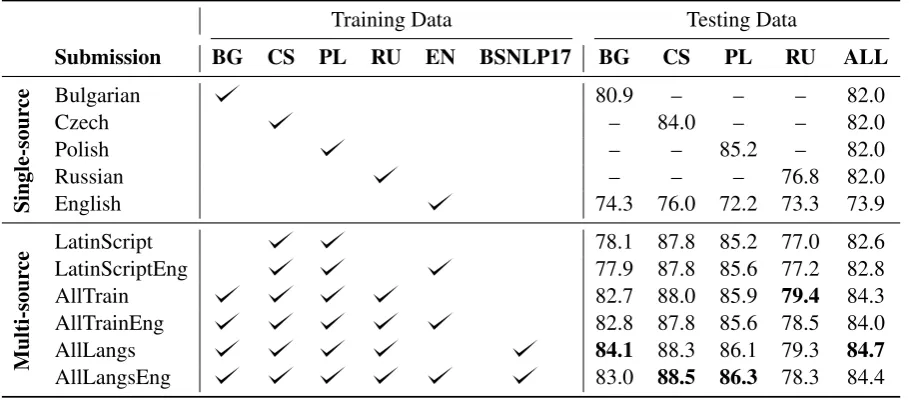
Our main results are shown in Table3, as F1 scores from the Strict evaluation (results from all metrics can be seen in the Appendix). We made a total of 8 submissions to the shared task, with each row in the table denoting a separate submission, with the exception of the first 4 rows. Those together composed one submission, since we tested each single-source model only on the same target lan-guage. Each submission in the table is also given a name (e.g. LatinScript) that is descriptive of the training data used. The columns are divided into two sections: training data on the left, and testing data on the right, both separated into various lan-guages. The checkmarks denote which datasets were included in training. The rows of the ta-ble are divided into two sections, with the upper section representing single-source systems (using only one language in training), and the lower sec-tion representing multi-source models.
BSNLP17 training corpus refers to the testing data from the BSNLP shared task in 2017, as de-scribed in Section4.2. ENrefers to the CoNLL 2003 English training set.
6 Analysis
There are several interesting lessons in our results. First, multi-source training with BERT is a suc-cess, as evidenced by the 2.7 F1 improvement be-tween the single-source experiments and the best experiment (AllLangs).
Surprisingly, these results hold even in the face of tagset mismatches. Recall from Section 4.2 that English CoNLL (EN) and the BSNLP17 datasets use a tagset somewhat different from the BSNLP19 test data. Despite this, we see an over-all improvement from AllTrain (which does not use additional data from the BSNLP17 languages) toAllLangs(which does), and similarly from All-TrainEng to AllLangsEng. We believe that two factors contributed to this success:
Training Data Testing Data
Submission BG CS PL RU EN BSNLP17 BG CS PL RU ALL
Single-sour
ce Bulgarian 80.9 – – – 82.0
Czech – 84.0 – – 82.0
Polish – – 85.2 – 82.0
Russian – – – 76.8 82.0
English 74.3 76.0 72.2 73.3 73.9
Multi-sour
ce
LatinScript 78.1 87.8 85.2 77.0 82.6
LatinScriptEng 77.9 87.8 85.6 77.2 82.8
AllTrain 82.7 88.0 85.9 79.4 84.3
AllTrainEng 82.8 87.8 85.6 78.5 84.0
AllLangs 84.1 88.3 86.1 79.3 84.7
AllLangsEng 83.0 88.5 86.3 78.3 84.4
Table 3: Official results on the Recognition task of BSNLP19, measured as F1 with Strict evaluation. The training languages used are: Bulgarian (BG), Czech (CS), Polish (PL), Russian (RU), English (EN, CoNLL2003) and the BSNLP17 languages (Croatian, Slovak, Slovene and Ukrainian). The top section of the table shows single-source experiments, in which each model is trained on a single language. The bottom section shows multi-single-source experiments. The rightmost column,ALL, is a micro-average of the test results over the 4 test languages.
Method PER LOC ORG PRO EVT
P. AllTrain 90.9 94.1 90.6 77.6 48.1
P. AllLangsEng 92.3 95.1 90.9 75.2 32.7
R. AllTrain 94.2 97.8 89.2 54.2 27.8
R. AllLangsEng 95.8 97.7 86.8 60.6 31.5
[image:5.595.73.528.63.263.2]F1. AllTrain 92.5 95.9 89.9 63.9 35.3 F1. AllLangsEng 94.0 96.3 88.9 67.1 32.1
Table 4: Precision (P), Recall (R), and F1 scores by tag across all languages. AllTrainis the largest set of training data that uses solely the target tagset, and Al-lLangsEngincludes training data with the tagset with MISC and without PRO or EVT.
data with the divergent tagset, the recall on EVT and PRO actually improves.
Factor 2.The power of multilingual BERT. We know that multilingual BERT can detect language (Wu and Dredze,2019), and we hypothesize that multilingual BERT is able to associate language with tagset.
While we show that multi-source training data helps, our results also show that choosing the right languages for inclusion is important. Naturally, scores are better if the target language is present in the training data, with the exception of Single-source Russian compared with LatinScript Rus-sian. This could be attributed to the fact that there is relatively little Russian training data, and the model is powerful enough that a large amount of Polish and Czech data is better than a small
amount Russian data. Even so, scores further im-prove when Russian is added again (AllTrain).
Finally, there are some interesting observations on the model trained only on English data. It per-forms well both across tagsets, and across scripts (on Bulgarian and Russian). Although one might expect that this approach would perform best on Latin script languages, such a correlation is not present. Further, scores across languages are within 4 points of each other, compared to individ-ual monolingindivid-ual systems that range over 10 points.
7 Conclusion
This paper has described our submission the BSNLP19 shared task on named entity recogni-tion. Our approach is based on multi-source neu-ral NER transfer, with experiments contrasting single-source and cross-lingual approaches. We found that using more data almost always helps, at least when in the same family.
Acknowledgement
[image:5.595.72.294.352.445.2]References
Alan Akbik, Duncan Blythe, and Roland Vollgraf. 2018. Contextual string embeddings for sequence labeling. InProceedings of the 27th International Conference on Computational Linguistics, pages 1638–1649, Santa Fe, New Mexico, USA. Associ-ation for ComputAssoci-ational Linguistics.
Jason P.C. Chiu and Eric Nichols. 2016. Named entity recognition with bidirectional LSTM-CNNs. Trans-actions of the Association for Computational Lin-guistics, 4:357–370.
Anna Currey and Kenneth Heafield. 2018. Multi-source syntactic neural machine translation. In Pro-ceedings of the 2018 Conference on Empirical Meth-ods in Natural Language Processing, pages 2961– 2966, Brussels, Belgium. Association for Computa-tional Linguistics.
Jacob Devlin, Ming-Wei Chang, Kenton Lee, and Kristina Toutanova. 2019. BERT: Pre-training of deep bidirectional transformers for language under-standing. In Proceedings of the 2019 Conference of the North American Chapter of the Association for Computational Linguistics: Human Language Technologies, Volume 1 (Long and Short Papers), pages 4171–4186, Minneapolis, Minnesota. Associ-ation for ComputAssoci-ational Linguistics.
Matt Gardner, Joel Grus, Mark Neumann, Oyvind Tafjord, Pradeep Dasigi, Nelson F. Liu, Matthew Pe-ters, Michael Schmitz, and Luke Zettlemoyer. 2018. AllenNLP: A deep semantic natural language pro-cessing platform. InProceedings of Workshop for NLP Open Source Software (NLP-OSS), pages 1– 6, Melbourne, Australia. Association for Computa-tional Linguistics.
Melvin Johnson, Mike Schuster, Quoc V. Le, Maxim Krikun, Yonghui Wu, Zhifeng Chen, Nikhil Thorat, Fernanda Vi´egas, Martin Wattenberg, Greg Corrado, Macduff Hughes, and Jeffrey Dean. 2017. Google’s multilingual neural machine translation system: En-abling zero-shot translation.Transactions of the As-sociation for Computational Linguistics, 5:339–351.
Armand Joulin, Piotr Bojanowski, Tomas Mikolov, Herv´e J´egou, and Edouard Grave. 2018. Loss in translation: Learning bilingual word mapping with a retrieval criterion. InProceedings of the 2018 Con-ference on Empirical Methods in Natural Language Processing, pages 2979–2984, Brussels, Belgium. Association for Computational Linguistics.
Guillaume Lample, Miguel Ballesteros, Sandeep Sub-ramanian, Kazuya Kawakami, and Chris Dyer. 2016. Neural architectures for named entity recognition. InProceedings of the 2016 Conference of the North American Chapter of the Association for Computa-tional Linguistics: Human Language Technologies, pages 260–270, San Diego, California. Association for Computational Linguistics.
Christopher Manning, Mihai Surdeanu, John Bauer, Jenny Finkel, Steven Bethard, and David McClosky. 2014. The Stanford CoreNLP natural language pro-cessing toolkit. In Proceedings of 52nd Annual Meeting of the Association for Computational Lin-guistics: System Demonstrations, pages 55–60, Bal-timore, Maryland. Association for Computational Linguistics.
Michał Marci´nczuk, Jan Koco´n, and Marcin Oleksy. 2017. Liner2 — a generic framework for named entity recognition. InProceedings of the 6th Work-shop on Balto-Slavic Natural Language Processing, pages 86–91, Valencia, Spain. Association for Com-putational Linguistics.
James Mayfield, Paul McNamee, and Cash Costello. 2017. Language-independent named entity analysis using parallel projection and rule-based disambigua-tion. InProceedings of the 6th Workshop on Balto-Slavic Natural Language Processing, pages 92–96, Valencia, Spain. Association for Computational Lin-guistics.
Stephen Mayhew, Chen-Tse Tsai, and Dan Roth. 2017. Cheap translation for cross-lingual named entity recognition. InProceedings of the 2017 Conference on Empirical Methods in Natural Language Pro-cessing, pages 2536–2545, Copenhagen, Denmark. Association for Computational Linguistics.
Matthew Peters, Mark Neumann, Mohit Iyyer, Matt Gardner, Christopher Clark, Kenton Lee, and Luke Zettlemoyer. 2018. Deep contextualized word rep-resentations. In Proceedings of the 2018 Confer-ence of the North American Chapter of the Associ-ation for ComputAssoci-ational Linguistics: Human Lan-guage Technologies, Volume 1 (Long Papers), pages 2227–2237, New Orleans, Louisiana. Association for Computational Linguistics.
Jakub Piskorski, Laska Laskova, Michał Marci´nczuk, Lidia Pivovarova, Pavel Pˇrib´aˇn, Josef Steinberger, and Roman Yangarber. 2019. The second cross-lingual challenge on recognition, classification, lemmatization, and linking of named entities across Slavic languages. InProceedings of the 7th Work-shop on Balto-Slavic Natural Language Processing, Florence, Italy. Association for Computational Lin-guistics.
Jakub Piskorski, Lidia Pivovarova, Jan ˇSnajder, Josef Steinberger, and Roman Yangarber. 2017. The first cross-lingual challenge on recognition, normaliza-tion, and matching of named entities in Slavic lan-guages. In Proceedings of the 6th Workshop on Balto-Slavic Natural Language Processing, pages 76–85, Valencia, Spain. Association for Computa-tional Linguistics.
Lev Ratinov and Dan Roth. 2009. Design chal-lenges and misconceptions in named entity recog-nition. In Proceedings of the Thirteenth Confer-ence on Computational Natural Language Learning (CoNLL-2009), pages 147–155, Boulder, Colorado. Association for Computational Linguistics.
Serge Sharoff. 2018.Language adaptation experiments via cross-lingual embeddings for related languages. InProceedings of the 11th Language Resources and Evaluation Conference, Miyazaki, Japan. European Language Resource Association.
Oscar T¨ackstr¨om. 2012. Nudging the envelope of di-rect transfer methods for multilingual named en-tity recognition. In Proceedings of the NAACL-HLT Workshop on the Induction of Linguistic Struc-ture, pages 55–63, Montr´eal, Canada. Association for Computational Linguistics.
Chen-Tse Tsai, Stephen Mayhew, and Dan Roth. 2016. Cross-lingual named entity recognition via wikifi-cation. In Proceedings of The 20th SIGNLL Con-ference on Computational Natural Language Learn-ing, pages 219–228, Berlin, Germany. Association for Computational Linguistics.
Shijie Wu and Mark Dredze. 2019. Beto, Bentz, Becas: The surprising cross-lingual effectiveness of BERT.
arXiv preprint arXiv:1904.09077.
A Detailed Results
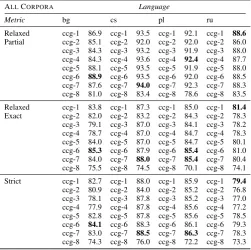
The full summary of our results with all submis-sions and all evaluation metrics is shown in Table 6. Table1has the key that maps between submis-sion ID and name used in the main paper.
Model Submission Key
Bulgarian ccg-2
Czech ccg-2
Polish ccg-2
Russian ccg-2
English ccg-8
LatinScript ccg-3
LatinScriptEng ccg-4
AllTrain ccg-1
AllTrainEng ccg-5
AllLangs ccg-6
AllLangsEng ccg-7
Table 5: Key matching the descriptive submission names used throughout the paper with the submission numbers referenced in our results section.
ALLCORPORA Language
Metric bg cs pl ru Relaxed ccg-1 86.9 ccg-1 93.5 ccg-1 92.1 ccg-1 88.6
Partial ccg-2 85.1 ccg-2 92.0 ccg-2 92.0 ccg-2 86.0 ccg-3 84.3 ccg-3 93.2 ccg-3 91.9 ccg-3 88.0 ccg-4 84.3 ccg-4 93.6 ccg-4 92.4 ccg-4 87.7 ccg-5 88.1 ccg-5 93.5 ccg-5 91.9 ccg-5 88.0 ccg-6 88.9 ccg-6 93.5 ccg-6 92.0 ccg-6 88.5 ccg-7 87.6 ccg-7 94.0 ccg-7 92.3 ccg-7 88.3 ccg-8 81.0 ccg-8 83.4 ccg-8 78.6 ccg-8 83.5 Relaxed ccg-1 83.8 ccg-1 87.3 ccg-1 85.0 ccg-1 81.4
Exact ccg-2 82.0 ccg-2 83.2 ccg-2 84.3 ccg-2 78.3 ccg-3 79.1 ccg-3 87.0 ccg-3 84.1 ccg-3 78.2 ccg-4 78.7 ccg-4 87.0 ccg-4 84.7 ccg-4 78.3 ccg-5 84.0 ccg-5 87.0 ccg-5 84.7 ccg-5 80.1 ccg-6 85.3 ccg-6 87.9 ccg-6 85.4 ccg-6 81.0 ccg-7 84.0 ccg-7 88.0 ccg-7 85.4 ccg-7 80.4 ccg-8 75.5 ccg-8 74.5 ccg-8 70.1 ccg-8 74.1 Strict ccg-1 82.7 ccg-1 88.0 ccg-1 85.9 ccg-1 79.4
[image:8.595.110.252.151.287.2]ccg-2 80.9 ccg-2 84.0 ccg-2 85.2 ccg-2 76.8 ccg-3 78.1 ccg-3 87.8 ccg-3 85.2 ccg-3 77.0 ccg-4 77.9 ccg-4 87.8 ccg-4 85.6 ccg-4 77.2 ccg-5 82.8 ccg-5 87.8 ccg-5 85.6 ccg-5 78.5 ccg-6 84.1 ccg-6 88.3 ccg-6 86.1 ccg-6 79.3 ccg-7 83.0 ccg-7 88.5 ccg-7 86.3 ccg-7 78.3 ccg-8 74.3 ccg-8 76.0 ccg-8 72.2 ccg-8 73.3
[image:8.595.74.326.357.607.2]