152
Learning to Automatically Generate Fill-In-The-Blank Quizzes
Edison Marrese-Taylor, Ai Nakajima, Yutaka Matsuo Graduate School of Engineering
The University of Tokyo
emarrese,ainakajima,[email protected]
Ono Yuichi
Center for Education of Global Communication University of Tsukuba
Abstract
In this paper we formalize the prob-lem automatic fill-in-the-blank question generation using two standard NLP ma-chine learning schemes, proposing con-crete deep learning models for each. We present an empirical study based on data obtained from a language learning plat-form showing that both of our proposed settings offer promising results.
1 Introduction
With the advent of the Web 2.0, regular users were able to share, remix and distribute content very easily. As a result of this process, the Web be-came a rich interconnected set of heterogeneous data sources. Being in a standard format, it is suit-able for many tasks involving knowledge extrac-tion and representaextrac-tion. For example, efforts have been made to design games with the purpose of semi-automating a wide range of knowledge trans-fer tasks, such as educational quizzes, by leverag-ing on this kind of data.
In particular, quizzes based on multiple choice questions (MCQs) have been proved efficient to judge students knowledge. However, manual con-struction of such questions often results a time-consuming and labor-intensive task.
Fill-in-the-blank questions, where a sentence is given with one or more blanks in it, either with or without alternatives to fill in those blanks, have gained research attention recently. In this kind of question, as opposed to MCQs, there is no need to generate a WH style question derived from text. This means that the target sentence could simply be picked from a document on a corresponding topic of interest which results easier to automate.
Fill-in-the-blank questions in its multiple-choice answer version, often referred to as cloze
questions (CQ), are commonly used for evaluat-ing proficiency of language learners, includevaluat-ing of-ficial tests such as TOEIC and TOEFL (Sakaguchi et al., 2013). They have also been used to test students knowledge of English in using the cor-rect verbs (Sumita et al.,2005), prepositions (Lee and Seneff,2007) and adjectives (Lin et al.,2007). Pino et al.(2008) andSmith et al.(2010) generated questions to evaluate students vocabulary.
The main problem in CQ generation is that it is generally not easy to come up with appropri-ate distractors —incorrect options— without rich experience. Existing approaches are mostly based on domain-specific templates, whose elaboration relies on experts. Lately, approaches based on discriminative methods, which rely on annotated training data, have also appeared. Ultimately, these settings prevent end-users from participating in the elaboration process, limiting the diversity and variation of quizzes that the system may offer.
2 Related Work
The problem of fill-in-the-blank question genera-tion has been studied in the past by several authors. Perhaps the earlies approach is by Sumita et al. (2005), who proposed a cloze question generation system which focuses on distractor generation us-ing search engines to automatically measure En-glish proficiency. In the same research line, we also find the work ofLee and Seneff(2007),Lin et al.(2007) andPino et al.(2008). In this context, the work ofGoto et al.(2009) probably represents the first effort in applying machine learning tech-niques for multiple-choice cloze question genera-tion. The authors propose an approach that uses conditional random fields (Lafferty et al., 2001) based on hand-crafted features such as word POS tags.
More recent approaches also focus on the prob-lem of distractor selection or generation but apply it to different domains. For example,Narendra and Agarwal (2013), present a system which adopts a semi-structured approach to generate CQs by making use of a knowledge base extracted from a Cricket portal. On the other hand,Lin et al.(2015) present a generic semi-automatic system for quiz generation using linked data and textual descrip-tions of RDF resources. The system seems to be the first that can be controlled by difficulty level. Authors tested it using an on-line dataset about wildlife provided by the BBC.Kumar et al.(2015) present an approach automatic for CQs generation for student self-assessment.
Finally, the work of Sakaguchi et al. (2013) presents a discriminative approach based on SVM classifiers for distractor generation and selection using a large-scale language learners corpus. The SVM classifier works at the word level and takes a sentence in which the target word appears, choos-ing a verb as the best distractor given the context. Again, the SVM is based on human-engineered features such as n-grams, lemmas and dependency tags.
Compared to approaches above, our take is dif-ferent since we work on fill-in-the-blank ques-tion generaques-tion without multiple-choice answers. Therefore, our problem focuses on word selection —the word to blank— given a sentence, rather than on distractor generation. To the best of our knowledge, our system is also the first to use rep-resentation learning for this task.
3 Proposed Approach
We formalize the problem of automatic fill-on-the-blanks quiz generation using two different per-spectives. These are designed to match with specific machine learning schemes that are well-defined in the literature. In both cases. we con-sider a training corpus ofN pairs(Sn, Cn), n =
1. . . N whereSn = s1, . . . , sL(Sn)is a sequence
ofL(Sn)tokens andCn ∈ [1, L(Sn)]is an index that indicates the position that should be blanked insideSn.
This setting allows us to train from examples of single blank-annotated sentences. In this way, in order to obtain a sentence with several blanks, multiple passes over the model are required. This approach works in a way analogous to humans, where blanks are provided one at a time.
3.1 AQG as Sequence Labeling
Firstly, we model the AQG as a sequence label-ing problem. Formally, for an embedded input sequenceSn = s1, . . . , sL(n) we build the
corre-sponding label sequence by simply creating a one-hot vector of size L(Sn) for the given class Cn. This vector can be seen as a sequence of binary classes,Yn =y1, . . . , yL(n), where only one item
(the one in position Cn) belongs to the positive class. Given this setting, the conditional proba-bility of an output label is modeled as follows:
p(y|s)∝
n
Y
i=1 ˆ
yi (1)
ˆ
yi=H(yi−1, yi, si) (2)
Where, in our, case, functionHis modeled using a bidirectional LSTM (Hochreiter and Schmidhu-ber,1997). Each predicted label distributionyˆtis then calculated using the following formulas.
~hi=LST Mf w(~hi−1, xi) (3)
~h
i=LST Mbw( i~h+1, xi) (4)
ˆ
yi= softmax([~hi; i])~h (5)
The loss function is the average cross entropy for the mini-batch. Figure1summarizes the pro-posed model.
L(θ) =−1
n
n
X
i=1
yilog ˆyi+ (1−yi) log(1−yˆi)
h(1) h(2) h(3) h(4)
dog barking
The is
BLANK O
[image:3.595.121.243.69.223.2]O O NN
Figure 1: Our sequence labeling model based on an LSTM for AQG.
3.2 AQG as Sequence Classification
In this case, since the output of the model is a po-sition in the input sequence Sn, the size of out-put dictionary for Cn is variable and depends on
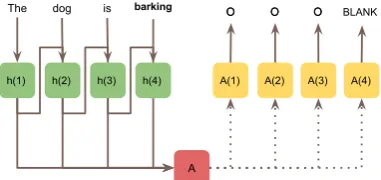
Sn. Regular sequence classification models use a softmax distribution over a fixed output dictionary to compute p(Cn|Sn) and therefore are not suit-able for our case. Therefore, we propose to use an attention-based approach that allows us to have a variable size dictionary for the output softmax, in a way akin to Pointer Networks (Vinyals et al., 2015). More formally, given an embedded input vector sequenceSn=s1, ..., sL(n), we use a
bidi-rectional LSTM to first obtain a dense representa-tion of each input token.
~hi=LST Mf w(~hi−1, xi) (7)
~h
i= ~LST Mbw( i~h+1, xi) (8)
hi = [~hi; i~h] (9)
We later use pooling techniques including max
andmeanto obtain a summarized representation
¯
h of the input sequence, or simply take the last
hidden state as a drop-in replacement to do so. Af-ter this, we add a global content-based attention layer, which we use to to compare that summa-rized vector to each hidden statehi. Concretely,
u=v|W[hi; ¯h] (10)
p(Cn|Pn) =sof tmax(u) (11)
Where W and v are learnable parameters of the model, and the softmax normalizes the vector u
to be an output distribution over a dictionary of size L(Sn). Figure 2 summarizes the proposed
model graphically. Then, for a given sentenceCk, the goal of our model is to predict the most likely positionC? ∈ [1, L(Sn)]of the next word to be blanked.
h(1) h(2) h(3) h(4) A(1) A(2) A(3) A(4)
dog barking The is
A
BLANK
[image:3.595.321.512.132.222.2]O O O O O O
Figure 2: Our sequence classification model, based on an LSTM for AQG.
4 Empirical Study
Although the hand-crafted rule-based system cur-rently used in our language learning platform of-fers us good results in general, we are interested in developing a more flexible approach that is easier to tailor depending on the case. In particular, in an adaptive learning setting where the goal is re-source allocation according to the unique needs of each learner, rule-based methods for AQG appear to have insufficient flexibility and adaptability to accurately model the features of each learner or teacher.
With this point in mind, this section presents an empirical study using state-of-the-art Deep Learn-ing approaches for the problem of AQG. In par-ticular, the objective is to test to what extent our prosed models are able to encode the behavior of the rule-based system. Ultimately, we hope that these can be used for a smooth transition from the current human-engineered feature-based system to a fully user-experience-based regime.
In Natural Language Processing, deep models have succeeded in large part because they learn and use their own continuous numeric representa-tional systems for words and sentences. In particu-lar, distributed representations (Hinton,1984) ap-plied to words (Mikolov et al.,2013) have meant a major breakthrough. All our models start with random word embeddings, we leave the usage of other pre-trained vectors for future work.
300,000 sentences, from which roughly 1.5 mil-lion single-quiz question training examples were derived. We split this dataset using the regular 70/10/20 partition for training, validation and test-ing.
As the system required the input sentences to be tokenized and makes use of features such as word pos-tags and such, the sentences in our dataset are processed using CoreNLP (Manning et al.,2014). We also extract user-specific and quiz-specific in-formation, including word-level learning records of the user, such as the number of times the learner made a mistake on that word, or whether the learner looked up the word in the dictionary. In this study, however, we restrain our model to only look at word embeddings as input.
We use the same data pre-processing for all of our models. We build the vocabulary using the train partition of our dataset with a minimum fre-quency of 1. We do not keep cases and obtain an unknown vocabulary of size 2,029, and a total vo-cabulary size of 66,431 tokens.
4.1 Sequence Labeling
We use a 2-layer bidirectional LSTM, which we train using Adam Kingma and Ba (2014) with a learning rate of0.001, clipping the gradient of our parameters to a maximum norm of 5. We use a word embedding size and hidden state size of 300 and add dropout (Srivastava et al.,2014) be-fore and after the LSTM, using a drop probability of 0.2. We train our model for up to 10 epochs. Training lasts for about 3 hours.
For evaluation, as accuracy would be extremely unbalanced given the nature of the blanking scheme —there is only one positive-class example on each sentence— we use Precision, Recall and F1-Score over the positive class for development and evaluation. Table1summarizes our obtained results.
Set Loss Prec. Recall F1-Score
Valid 0.0037 88.35 88.81 88.58 Test 0.0037 88.56 88.34 88.80
Table 1: Results of the seq. labeling approach.
4.2 Sequence Classification
In this case, we again use use a 2-layer bidirec-tional LSTM, which we train using Adam with a learning rate of 0.001, also clipping the gradient
of our parameters to a maximum norm of 5. Even with these limits, convergence is faster than in the previous model, so we only trained the the classi-fier for up to 5 epochs. Again we use a word em-bedding and hidden state of 300, and add dropout with drop probability of 0.2 before and after the LSTM. Our results for different pooling strategies showed no noticeable performance difference in preliminary experiments, so we report results us-ing the last hidden state.
For development and evaluation we used accu-racy over the validation and test set, respectively. Table2below summarizes our obtained result, we can see that model was able to obtain a maximum accuracy of approximately 89% on the validation and testing sets.
Set Loss Accuracy
Valid 101.80 89.17 Test 102.30 89.31
Table 2: Results of the seq. classification ap-proach.
5 Conclusions
In this paper we have formalized the problem of automatic fill-on-the-blanks quiz generation us-ing two well-defined learnus-ing schemes: sequence classification and sequence labeling. We have also proposed concrete architectures based on LSTMs to tackle the problem in both cases.
We have presented an empirical study in which we test the proposed architectures in the context of a language learning platform. Our results show that both the0 proposed training schemes seem to offer fairly good results, with an Accuracy/F1-score of nearly 90%. We think this sets a clear future research direction, showing that it is possi-ble to transition from a heavily hand-crafted ap-proach for AQG to a learning-based apap-proach on the base of examples derived from the platform on unlabeled data. This is specially important in the context of adaptive learning, where the goal is to effectively provide an tailored and flexible experi-ence in terms of style and difficulty
References
Takuya Goto, Tomoko Kojiri, Toyohide Watanabe, To-moharu Iwata, and Takeshi Yamada. 2009. An au-tomatic generation of multiple-choice cloze ques-tions based on statistical learning. InProceedings of the 17th International Conference on Computers in Education, pages 415–422. Asia-Pacific Society for Computers in Education.
Geoffrey E Hinton. 1984. Distributed representations.
Sepp Hochreiter and J¨urgen Schmidhuber. 1997. Long short-term memory. Neural computation, 9(8):1735–1780.
Diederik P. Kingma and Jimmy Ba. 2014. Adam: A method for stochastic optimization.CoRR.
G. Kumar, R. E. Banchs, and L. F. D’Haro. 2015. Au-tomatic fill-the-blank question generator for student self-assessment. In2015 IEEE Frontiers in Educa-tion Conference (FIE), pages 1–3.
John D. Lafferty, Andrew McCallum, and Fernando C. N. Pereira. 2001. Conditional Random Fields: Probabilistic Models for Segmenting and Label-ing Sequence Data. In Proceedings of the Eigh-teenth International Conference on Machine Learn-ing, ICML ’01, pages 282–289, San Francisco, CA, USA. Morgan Kaufmann Publishers Inc.
John Lee and Stephanie Seneff. 2007. Automatic gen-eration of cloze items for prepositions. In Eighth Annual Conference of the International Speech Communication Association.
Chenghua Lin, Dong Liu, Wei Pang, and Zhe Wang. 2015. Sherlock: A Semi-automatic Framework for Quiz Generation Using a Hybrid Semantic Similar-ity Measure.Cognitive Computation, 7(6):667–679.
Yi-Chien Lin, Li-Chun Sung, and Meng Chang Chen. 2007. An automatic multiple-choice question gen-eration scheme for english adjective understanding. InWorkshop on Modeling, Management and Gener-ation of Problems/Questions in eLearning, the 15th International Conference on Computers in Educa-tion (ICCE 2007), pages 137–142.
Christopher D. Manning, Mihai Surdeanu, John Bauer, Jenny Finkel, Steven J. Bethard, and David Mc-Closky. 2014. The Stanford CoreNLP natural lan-guage processing toolkit. InAssociation for Compu-tational Linguistics (ACL) System Demonstrations.
Tomas Mikolov, Ilya Sutskever, Kai Chen, Greg S Cor-rado, and Jeff Dean. 2013. Distributed Representa-tions of Words and Phrases and their Composition-ality. InAdvances in Neural Information Processing Systems 26. Curran Associates, Inc.
Ai Nakajima and Kiyoshi Tomimatsu. 2013. New po-tential of e-learning by re-utilizing open content on-line. InInternational Conference on Human Inter-face and the Management of Information.
Annamaneni Narendra and Manish Agarwal. 2013. Automatic cloze-questions generation. In Proceed-ings of the International Conference Recent Ad-vances in Natural Language Processing RANLP 2013, pages 511–515.
Yuichi Ono and Ai Nakajima. Automatic quiz genera-tor and use of open educational web videos for en-glish as general academic purpose. InProceedings of the 23rd International Conference on Computers in Education, pages 559–568. Asia-Pacific Society for Computers in Education.
Yuichi Ono, Ai Nakajima, and Manabu Ishihara. 2017. Motivational effects of a game-based automatic quiz generator using online educational resources for japanese efl learners. In Society for Information Technology and Teacher Education International Conference.
Juan Pino, Michael Heilman, and Maxine Eskenazi. 2008. A selection strategy to improve cloze ques-tion quality. InProceedings of the Workshop on In-telligent Tutoring Systems for Ill-Defined Domains. 9th International Conference on Intelligent Tutoring Systems, Montreal, Canada, pages 22–32.
Keisuke Sakaguchi, Yuki Arase, and Mamoru Ko-machi. 2013. Discriminative approach to fill-in-the-blank quiz generation for language learners. In Pro-ceedings of the 51st Annual Meeting of the Associa-tion for ComputaAssocia-tional Linguistics (Volume 2: Short Papers), volume 2, pages 238–242.
Simon Smith, P. V. S. Avinesh, and Adam Kilgar-riff. 2010. Gap-fill Tests for Language Learners: Corpus-Driven Item Generation.
Nitish Srivastava, Geoffrey Hinton, Alex Krizhevsky, Ilya Sutskever, and Ruslan Salakhutdinov. 2014. Dropout: A simple way to prevent neural networks from overfitting. The Journal of Machine Learning Research, 15(1):1929–1958.
Eiichiro Sumita, Fumiaki Sugaya, and Seiichi Ya-mamoto. 2005. Measuring Non-native Speakers’ Proficiency of English by Using a Test with Automatically-generated Fill-in-the-blank Ques-tions. In Proceedings of the Second Workshop on Building Educational Applications Using NLP, EdAppsNLP 05, pages 61–68, Stroudsburg, PA, USA. Association for Computational Linguistics.