C H R O M O S O M E I N W H E A T
L O T T I RI. S T E I N I T Z - S E A R S
A N DE. R. S E A R S 2 Genetics Bztilding, Uiziwrsity of Missouri, Columbia, Missouri
Received November 7. 1952
N E important concomitant of the now generally accepted partial chiasnia-
0 typy theory of crossing over is that every chiasma constitutes a crossover.
Unfortunately, as DARLINGTON (1937) points out, there has been very little opportunity to test this concept. Meiotic chromosomes of Drosophila are too small for an accurate determination of chiasma frequency, and maize is about the only other organism in which enough linkages have been established to insure that nearly the full genetic length of each chromosome is represented in the map. In maize DARLINGTON (1937) reported satisfactory agreement between the published map lengths of the various chromosomes and the values predicted on the basis of his own counts of chiasma frequency, and BEADLE
(1932) found a good correspondence between map length and the frequency of chiasmata in a particular segment of chromosome 9 of maize. I n both cases, however, the genetic and cytological data were derived from different experi- ments, and crossover values in maize are known to be variable. The experi- ments of OEHLKERS (1940) and ERNST (1938) showing similar effects of environmental changes on chiasma frequency and crossover frequency in Oeno- thera and Antirrhinum, respectively, argue strongly for a one-to-one corre- spondence between chiasmata and crossovers. COOPER (1944), on the other hand, has shown that some apparent chiasmata have no relation to crossing over but are merely
“conjunctive segments.”
The transmissible dicentric chromosome of wheat described by SEARS and CAMARA (1950, 1952) appears to provide an additional opportunity for testing the concept of chiasmata-crossover correspondence. This chromosome consists of a long arm, a main or strong centromere, an intercentromeric region, a second weak o r possibly defective centromere, and a minute arm (fig. 1 ) . The arm lengths have the approximate ratio 30 : 10 : 1. The secondary centromere is evidently inactive in bivalents during the first division of meiosis ; in other divisions it seems to behave like any other centromere.
When two dicentrics pair, a chiasma in the intercentromeric region, if it is a crossover, should lead to bridge formation at -41, as shown in figure 1.
Bridges of the type expected do occur, and their frequency is readily determi-
1
This work was supported in part by funds obtained under Bankhead-Jones Project S R F 2-95. Journal Paper No. 1326 of the Missouri Agricultural Experiment Station.
2
Senior Geneticist, Division of Cereal Crops and Diseases, Bureau of Plant Industry, Soils, and Agricultural Engineering, Agricultural Research Administration, U. S. Depart- ment of Agriculture ; and Research Associate, Field Crops Department, University of Missouri.
GENLTICS 38 : 244 May 1953.
CHIASMATA AND CROSSING OVER 245 nable. The frequency of chiasmata in the intercentromeric region at M I can also be determined with reasonable accuracy. Chiasmata in this region cannot be distinguished from tho& that may occur in the minute end piece, but this minute arm is so short that the number of chiasmata occurring there may be assumed to be negligible. Also, if two or more chiasmata occurred in the inter- centromeric region, it is doubtful that they could be distinguished from a single chiasma; but this region is short enough that two chiasmata there must be very infrequent. Furthermore, with two chiasmata, only the two- and four-strand doubles would fail to lead to bridges.
SEARS and C ~ M A R A (1952) found that the frequency of chiasmata in the intercentromeric region did not differ greatly from the number of bridges ob- served in anaphase I (13 percent). However, they used estimates rather than
- A FIGURE I.-Diagram of a pair of dicentric chromosomes with a chiasma in the inter-
centromeric region, at ( A ) pachytene and (B) anaphase I.
precise counts of chiasmata, and their preparations, which were made from spikes fixed entire, did not allow the analysis of a high proportion of cells.
In the spring of 1951 one plant with two dicentrics was grown. The anthers were fixed individually, and meiosis was studied in seven preparations, each of a single anther. I n the fall of 1951 five more plants with two dicentrics were' obtained, and a total of 43 single-anther preparations were studied. The results are presented in table 1. The data showed good homogeneity when tested for differences between plants, and the results may therefore be summed up as follows.
METAPHASE I
At metaphase I the dicentric chromosomes were unpaired in 21.1 percent
of the cells that were analyzed. In these they lay OE the plate as in figures
2 and 3 of SEARS and C ~ M A R A (1952). In 15 cells or 1.3 percent they were
paired but lay off the plate and acted like the above univalents, both centro-
meres being active (ibid., fig. 15). I n the remaining 880 cells (or 77.5 percent)
246
TABLE I
Meiotic behavior of a pair
ofdicentric chromosomes.
Metaphase I Anaphase I
Plant No. an- Paired, Xma in
Xmain Xma in
No. thers Unpaired but acting each shot long Unidenti- No Unclassi-
as uni- arm fied Bridge bridge fied
valents
only only1 7 8 0 19 1 34
.... 5
29....
2 6 19 2 22 0 30 181 13 107
9
3
7 30.
2 36 2 87 52 9 51 124
15
100 7 93 7 197 259 20 183 395 6 35 1 47 0 98 80 6 82 7
3 83 8 116 306 7 100 13
G
9
48Totals
50 240 15 300 18 562 87860
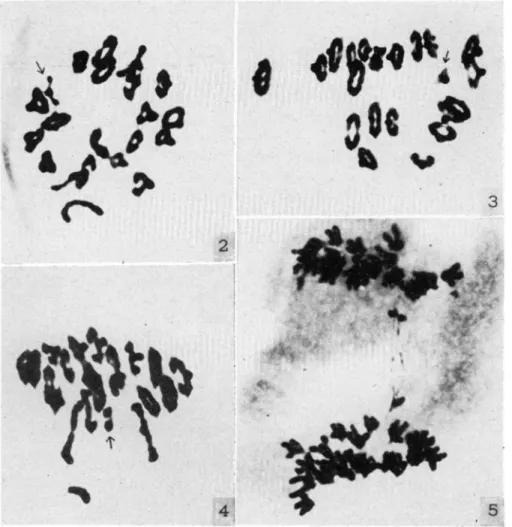
552 80the dicentrics were paired, lying on the plate with the appearance of a normal bivalent in as much as only the strong centromere appeared active. The di- cen'tric bivalent most frequently occurred as a rod' bivalent with one chiasma in the long arm, and was easily recognized by its typical shape (fig. 2 ) . Less frequently it was seen as a small ring bivalent with one chiasma in each arm (fig. 3 ) . Very rarely, in only 18 cells or 1.6 percent of the total, it had a single chiasma in the short arm (fig. 4 ) . Thus in 862 cells or 75.8 percent the di- centrics had a chiasma in the long arm, and in 28.0 percent of the total cells there was a chiasma in the short arm. As will be shown, this is a much higher frequency of short-arm chiasmata than would be expected from anaphase data.
The question therefore arises as to whether the 878 unanalyzed metaphases, amounting to 45 percent of the total, may have included an unduly high pro- portion of the cells without short-arm chiasmata. This is very unlikely ; in fact, the reverse is almost certainly true. Identification of dicentric ring bivalents was only possible in well-spread cells, where all 21 pairs could be studied and none discerned to be a dicentric rod bivalen't. O n the other hand, poorly spread cells were frequently classifiable if they contained a dicentric rod pair, because of the characteristic, easily recognizable appearance of this bivalent. Thus the unanalyzed metaphases consisted of the unfavorable cells less a considerable number in which the dicentric rod was identified. Since there is every reaslon to believe that the unfavorable cells were a random sample with respect to pairing behavior, it is very likely that the unanalyzed group had a higher pro- portion of bivalents with short-arm chiasmata than did the population as a whole.
ANAPHASE I
Anaphase I was studied and a count of dicentric bridges obtained (table 1).
The characteristics of the dicentric bridge permit easy identification ; it is
double, and frequen~tly the small knob or bump consisting of the minute end
can be seen (fig. 5 ) . It can be readily distinguished from the univalent di-
centric bridge that would be expected from about 1 percent of unpaired dicen-
trics (SEARS and C ~ M A R A 1952). Only about 0.4 percent of the anaphases in
this material would be expected to have such univalent bridges. Bridges con-
CHIASMATA AND CROSSING OVER 247 cerned with other chromosomes than the dicentrics occasionally occurred in this material, and some fragments also occurred. A few anaphases, about 12 percent of the total, too early for bridge determination, had to be excluded from the analysis.
FIGURES 2-4-First meiotic metaphase showing paired dicentrics. x 960. FIGURE 2.
-Bivalent with an interstitial chiasma in the long arm. FIGURE 3.-Ring bivalent with one chiasma in each arm. FIGURE 4.-Bivalent with a chiasma in the short arm.
FIGURE S.-First meiotic anaphase showing the double dicentric bridge. The knobs near the center presumably represent the minute arm beyond the secondary centromere.
x 960.
Only 60 cells, or 9.8 percent of the total 612 anaphases studied, had dicentric
bridges. This represents a great paucity of bridges as compared to the 28.0
percent chiasmata in the intercentromeric region that should result in such
bridges. This finding will be discussed in detail below.
248
A N A P H A S E I1
Both anaphase I and anaphase I1 were studied to check the possibility that a chiasma in the intercentronieric region might result in early breakage at the secondary centromere without bridge formation in anaphaSe I. Such breakage would give rise to derivative chromosomes lacking the secondary centromere and to fragments consisting mainly of the minute arm and the secondary centromere. No such derivative chromosomes or fragments were observed.
Fragments were found in six cells, but in several of these the dicentric was complete and unchanged. Apparently the occasional fragments found in this material were entirely unrelated to the dicentric chromosome.
Following its inclusion in a telophase I nucleus, each dicentric would be expected to behave as described by SEARS and C ~ M A R A (1950, 1952) for undivided univalent dicentrics, namely with both centromeres active but with the two centromeres of each chromatid usually directed toward the same pole.
This appeared to be the case, since in only 5 out of 62 second anaphases was the secondary centromere seen to pull (ineffectively) toward the opposite pole from the primary Centromere.
DISCUSSION
Although prophase analysis of bivalent dicentrics was not possible, meta- phase figures indicated that the two chromosomes had in almost all cases been paired throughout their length. Thus the secondary centromeres had presuma- bly been paired with each other ; yet these centromeres ordinarily showed no poleward activity during the first division. Fifteen bivalents were found in which the secondary Centromeres were active, but in each of these the second- aries had clearly not been paired with each other but with the corresponding primary centromere (cf. SEARS and C ~ M A R A 1952). Hence there was no ex- ception to the rule that the secondary centromeres showed no poleward activity during first division when they had been paired with each other.
Since there are secondary centromeres in rye (KATTERMANN 1939; PRAK-
KEN
and MUNTZING 1942) and maize (RHoaDES and VILKOMERSON 1942) which are only active at a particular stage of meiosis, the question might be raised whether the secondaries in the wheat material are actually capable of first-division activity. The wheat secondary centromere is clearly active at this stage in univalent dicentrics, however, and in the 15 exceptional bivalents just mentioned; so there seems little doubt that it is capable of activity in the ordi- nary bivalents also.
SO far as is known, the secondary centromeres behave normally at all other divisions, although they are weaker than the primary when opposed to it. I t appears, therefore, that the secondary centromere lacks something necessary to insure the separation of the two halves of a bivalent but not required at mitotic divisions. When a secondary pairs with a primary centromere, as it evidently does in a univalent dicentric, the primary is able to initiate not only its own poleward movement but also movement of the secondary centromere.
This evidence that something more is required of a centromere at meiosis than
CH I A SM A T A A N D CROSSING O V E R 249 at mitosis may be of significance in connection with problems of chromosome mechanics and the structure of the centromere. I t is possible that a study of the behavior of certain derivative chromosomes will provide further informa- tion of value in this regard.
It seems clear that the bridges observed are formed in the manner indicated in figure l-that is, by failure of chiasmata in the intercentromeric region to terminalize beyond the secondary centromeres. The bridges are double, as expected, and frequently a lump can be detected at the center of the bridge which finds ready interpretation as being the minute arm. Bridges formed in another way could occur here, in asmuch as SEARS and CAMARA (1950, 1952) suggest that the intercentromeric region may contain a reversed duplication.
Crossing over in this region reversely paired would result in bridges, but these would usually be single and would be accompanied by fragments.
T he data thus show a real discrepancy in the frequency of chiasmata in the intercentromeric region as compared with the frequency of anaphase bridges formed. As has already been pointed out, this discrepancy cannot be due to early breakage. The disjunction without bridge formation must come about in some other way.
The possibili8ty that most of the chiasmata counted as intercentromeric are in reality in the minute end beyond the secondary centromere, and therefore resolvable without bridge formation, has not been excluded. However, because of the small size of the minute end, this is believed to be unlikely. T h e rela- tively high frequency of such chiasmata necessary to account for the paucity of anaphase bridges would indicate a special preferential localization of chi- asmata in this end. I t seems unwarranted to postulate such localization, particu- larly since the relative frequencies of chiasmata in the long and short arm of this chromosome agree well with expectation based on their lengths.
If sister secondary centromeres could separate at AI, then terminalization of intercentromeric chiasmata could proceed, and there would be no bridges.
I n normal bivalents homologous centromeres pass to opposite poles at first
division, while sister centromeres do not separate until second division. In
univalents, on the other hand, sister centromeres separate at first division,
although considerably later than do the bivalent halves. The secondary centro-
meres under investigation resemble centromeres of univalents in that the un-
divided centromere shows no poleward activity. This suggests the possibility
of further resemblance, namely, in the separation of sister centromeres at the
first division. The Occurrence of bridges in 9.8 percent of first anaphases would
then be attributed to the secondary centromeres having been active in about
one-third of the bivalents with intercentromeric chiasmata, with consequent
failure of terminalization across these active centromeres. No such activity of
secondary centromeres was ever seen, but it could have occurred without being
detected in the bivalents with intercentromeric chiasmata, since these were
usually tightly paired. However, since activity of secondary. centromeres was
not seen in bivalents with only long-arm chiasmata, where it could scarcely
have gone unobserved, it probably did not occur in the bivalents with inter-
250
centromeric chiasmata either. The only obvious explanation for limitation of secondary cenitromere activity to the latter type of bivalent would be that activity of the secondaries might be a consequence of their pairing with each other. Although this pairing would favor chiasma formation in the neighboring intercentromeric region, there seems no reason to suppose that it would invari- ably result in chiasma formation in this short segment.
Thus there seems to be no satisfactory way of reconciling the present data with the theory that every chiasma represents a crossover. However, of the three possibilities suggested-namely, early breakage, localization of chiasmata in the minute arm, and premature separation of sister secondary centromeres- only early breakage has been entirely excluded. The data do not, therefore, constitute critical evidence against the partial chiasmatypy theory. They do suggest, however, the desirability of further work with this and similar material.
S U M M A R Y
A transmissible dicentric chromosome in wheat has centromeres of unequal strength. In plants with two dicentrics, these usually pair, and no activity of the weaker centromere can then be detected. In 28.0 percent of the cells at M I of microsporogenesis there apparently was a chiasma in the intercentromeric region. This should have led to an equivalent frequency of bridges at AI, according to the generally accepted theory that every chiasma represents a crossover, but only 9.8 percent of A I cells had bridges. This discrepancy is not considered as critical evidence against the theory, however, since other expla- nations are not entirely excluded.
LITERATURE CITED