Proceedings of the 57th Annual Meeting of the Association for Computational Linguistics, pages 2252–2262 2252
Token-level Dynamic Self-Attention Network for Multi-Passage Reading
Comprehension
Yimeng Zhuang, Huadong Wang
Samsung Research China - Beijing (SRC-B)
{ym.zhuang, huadong.wang}@samsung.com
Abstract
Multi-passage reading comprehension re-quires the ability to combine cross-passage in-formation and reason over multiple passages to infer the answer. In this paper, we introduce the Dynamic Self-attention Network (Dyn-SAN) for multi-passage reading comprehen-sion task, which processes cross-passage in-formation at token-level and meanwhile avoids substantial computational costs. The core module of the dynamic self-attention is a pro-posed gated token selection mechanism, which dynamically selects important tokens from a sequence. These chosen tokens will attend to each other via a self-attention mechanism to model long-range dependencies. Besides, con-volutional layers are combined with the dy-namic self-attention to enhance the model’s capacity of extracting local semantic. The experimental results show that the proposed DynSAN achieves new state-of-the-art perfor-mance on the SearchQA, Quasar-T and Wiki-Hop datasets. Further ablation study also val-idates the effectiveness of our model compo-nents.
1 Introduction
As a critical approach for evaluating the ability of an intelligent agent to understand natural lan-guage, reading comprehension (RC) is a chal-lenging research direction, attracting many re-searchers’ interest. In real application scenarios, such as web search, the passages may be multiple and extended, and may be comprised of relevant and irrelevant contents. It involves the problem of multi-passage reading comprehension.
In multi-passage setting, cross-passage infor-mation interaction is vital for modeling long-range dependencies, co-references between entities in different passages (Dhingra et al., 2018), cross-passage answer verification (Wang et al.,2018b), and multihop reasoning (Welbl et al., 2018), etc.
Great efforts have been made to develop mod-els for multi-passage task, such as Wang et al.
(2018b); Zhong et al. (2019); Dehghani et al.
(2019a); Dhingra et al. (2018); De Cao et al.
(2019); Song et al. (2018). The common prac-tice of these approaches is that all the embed-dings in a passage or a span are integrated into a single vector and the cross-passage information interactions are based on these coargrain se-mantic representations. However, it may cause potential issues. As is pointed out in Bahdanau et al. (2015); Cho et al. (2014), compressing all the necessary information into a single vector may lead to “sacrifice” some critical information due to the allocated capacity to remember other informa-tion. This problem is prevalent in Neural Machine Translation (NMT), the recent models, such as the Transformer (Vaswani et al., 2017), workaround this issue by decoding on toklevel context en-codings of the source text. As such, we hypothe-size that fine-grain representations may keep pre-cise semantic information, and may be beneficial to cross-passage information interactions in RC tasks. In this paper, we focus on an architecture which deals with the cross-passage information at token-level.
The proposed architecture is a variant of the Self-attention Network (SAN) (Vaswani et al.,
Our experiments verify this observation to a cer-tain extent. We expect that our model can auto-matically find out these important tokens. Thus we propose a gated token selection mechanism and equip it with the self-attention module.
We intend the model to achieve a balance in speed, memory, and accuracy. While the self-attention mechanism is widely used in end-to-end models to capture long-range dependency, it is in-trinsically inefficient in memory usage.Shen et al.
(2018b) elaborates the memory issue. The mem-ory required to store the attention matrix grows quadratically with the sequence length. Consid-ering real scenarios, such as web search, in which the retrieval system returns hundreds of articles, and each contains hundreds or thousands of words, thus applying self-attention on all tokens in the supporting passages is computationally expensive. Compared to recurrent neural networks, such as LSTM (Hochreiter and Schmidhuber,1997), SAN is highly parallelizable and usually faster on long sequence (Vaswani et al., 2017). The proposed method accomplishes necessary cross-passage in-formation interaction with a time/memory com-plexity linear in the length of the sequence and do not add much extra calculation burden.
Our contributions in this work are as follows: (1) We propose Dynamic Self-attention (DynSA) for information interaction in a long sequence. (2) Token-level cross-passage information inter-action is implemented through the application of the proposed DynSA at relatively less computa-tional costs. (3) Our Dynamic Self-attention Net-work (DynSAN) achieves new state-of-the-art per-formance compared with previously published re-sults on SearchQA, Quasar-T and WikiHop bench-marks.
2 Dynamic Self-attention Block
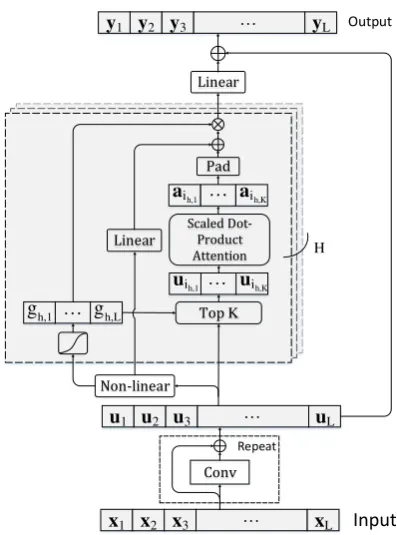
This section introduces the Dynamic Self-Attention Block (DynSA Block), which is central to the proposed architecture. The overall architec-ture is depicted in Figure1.
The core idea of this module is a gated token selection mechanism and a self-attention. We ex-pect that a gate can acquire the estimation of each token’s importance in an input sequence, and use this estimated importance to extract the most im-portant K tokens. Then we run a self-attention, instead of computing the full self-attention matrix over all the tokens, only the chosenK tokens are
x1 x2 x3 xL
Conv
u1 u2 u3 uL
Non-linear
g g Top K
ui ui Scaled Dot-Product Attention
Linear
y1 y2 y3 yL
ai ai
Output
Input Linear
H
Repeat
Pad
h,1 h,K h,1 h,K
[image:2.595.313.512.60.328.2]h,1 h,L
Figure 1: Architecture of the Dynamic Self-Attention Block.
taken into account. This module results in lower memory consumption and makes the self-attention focus on the active part of a long input sequence. The above idea is implemented through stacking two structures: a local encoder and a dynamic self-attention module.
2.1 Local Encoder
In the architecture, a local encoder is used to en-code local information, such as short-range con-text, which is useful for disambiguation. The rea-sons for the local encoder are that (1) only comput-ing self-attention over a few tokens among a long sequence may lead the self-attention to lose the ca-pability of modeling short-range context for every position in the sequence, and (2) after a position receives the attended information from long-range positions, the local encoder is needed to spread this information to its neighboring positions, and (3) previous works have proven that combining a local encoder with self-attention is beneficial in some tasks (Yu et al.,2018).
in-put matrix of an L-token sequence, and each to-ken embedding isD-dimensional. The output of a convolutional layer is calculated with a residual connection: Conv(LN(X)) +X, whereLN is the layer normalization (Ba et al., 2016), Conv
denotes a convolutional layer. For less computa-tional costs, we adopt depth-wise separable convo-lutions (Chollet,2017) throughout this paper. The local encoder consists of a stack of 2 convolutional layers.
2.2 Dynamic Self-attention
Since our self-attention is performed over a set of tokens which are determined dynamically, we call it Dynamic Self-Attention (DynSA). The DynSA is based on the hypothesis that the number of important tokens is much less than the sequence length in a long sequence. Here, to say a token is important means that the token contains the neces-sary information to enable the model to predict the answer, or the token is non-negligible for model-ing long-range semantic dependency. DynSA in-tends to find out the most important tokens by a token selection mechanism and then performs a self-attention only over these chosen tokens.
In DynSA, we use a gate to control how much of the output, which includes non-linear transfor-mations and attended vectors, to pass this layer. A large gate activation value implies that the corre-sponding output is important in this layer. Thus, we use the gate activation as the basis of token selection. Given the output of the local encoder
U ∈RD×L, the gate activation is computed via:
G=FG(FU(U)) (1)
where FU denotes a non-linear fully connected
layer, FG denotes an affine transformation with sigmoidactivation function. In our work, we al-low to use multi-head attention (Vaswani et al.,
2017). Equation 1 outputs G ∈ RH×L, which containsHheads. And we usegh ∈RL(theh-th
row inG) to represent the gate output of theh-th head. The elementgh,iingh is the gate activation
corresponding to the token at thei-th position. Then, in each head we select the top K to-kens according to their corresponding gate acti-vations in gh, in which K is a hyper-parameter.
In case of the actual sequence length being less than K, we select all the tokens. We get the chosen tokens’ embeddings Uh =
[uih,1,· · · ,uih,j,· · · ,uih,K] ∈ R
D×K, where
ih,j ∈ {1,2,· · · , L} is the position index of the
chosen token in the input sequence. We consider this as a gated token selection mechanism.
Scaled dot-product attention is adopted over the chosen tokens:
Ah = softmax( QhKhT
p
D/H)·Vh (2)
where Qh ∈ R
D
H×K, Kh ∈ R D
H×K, andVh ∈
RDH×Kare query, key, and value respectively, they are linear projections of the input Uh. Ah ∈ RDH×K is the attended output matrix of the h-th head.
Next, we pad those unchosen positions with zero embeddings to complete the sequence length. Having A∗h = Pad(Ah) ∈ R
D
H×L. The output of theh-th headZh ∈R
D
H×Lis calculated as fol-lows,
Zh = (Fh+A
∗
h)· gh
max(gh)
(3)
Fh =FHh(FU(U)) (4)
where FH
h is an affine layer. Equation 4
pro-duces a non-linear transformation Fh ∈ R
D H×L of the input embeddings. Since zero embeddings are padded at unchosen positions, by adding Fh
gradient vanishing can be avoided when updating the parameters of the gate in training phase. In Equation3, the maximum operation aims to select the maximum element in vectorgh, and the
divi-sion operation normalizes these elements so that the maximum activation is always one.
Finally, the output Y ∈ RD×L of a DynSA block is the fusion of all heads.
Y =FY([Z1;· · ·;ZH]) +U (5)
in which, FY denotes a linear projection, [·;·]is
the concatenation of the outputs of all heads. Optionally, we suggest adding a regularization on the gate activation to make it more sparse, so that those unimportant tokens’ activation values are almost zero and let the model generate more discriminative gate activation. Experiments show that the regularization can produce small gains in performance. Specifically, we jointly optimize the following regularization term when training the model.
L∗ =β· ||G||1 (6)
whereGrepresents the gate activation,|| · ||1
de-notes 1-norm.βis a small hyper-parameter, which is set to10−5
Question Passage 1 Passage M Highway
DynSA Block DynSA Block DynSA Block
Align Linear Align Linear
DynSA Block …… DynSA Block
Stacked DynSA Blocks Prediction Layer
Answer
……
Highway Highway
…… Word
Character Word
[image:4.595.107.491.62.269.2]Character
Figure 2: Architecture of Dynamic Self-Attention Network (DynSAN) for multi-passage reading comprehension.
3 Token-level Dynamic Self-attention Network
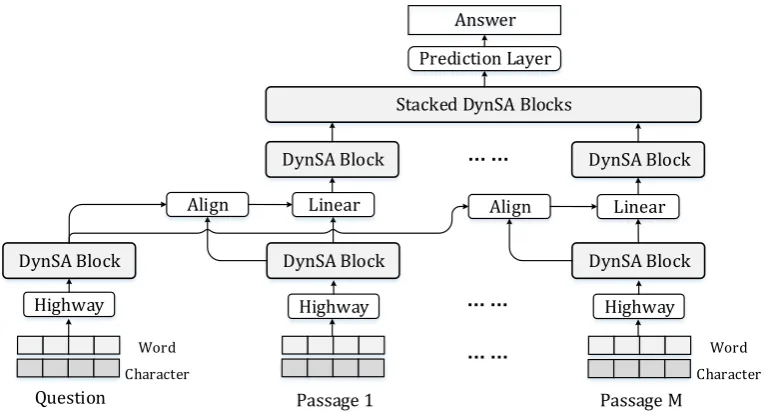
This section introduces the application of our proposed Dynamic Self-attention Network (Dyn-SAN) on the multi-passage RC task. Given a ques-tion andM passages, it requires the model to pre-dict a span from the passages to answer the ques-tion. Figure 2illustrates the architecture of Dyn-SAN.
3.1 Input Encoding
At the bottom of DynSAN, the input texts are first converted into distributional representations. We use the concatenation of word embeddings and character encodings for every single token. For word embedding, we adopt the pre-trained 300-dimensional fasttext Mikolov et al. (2018) word embeddings and fix them during training. Char-acter encodings are obtained by performing con-volution and max-pooling on 15-dimensional ran-domly initialized character embeddings following (Kim,2014). Character embeddings are trainable while word embeddings are fixed in the training phase. On top of the embeddings, we adopt a 2-layer highway network (Srivastava et al.,2015) for deep transformation. The output of the highway network is immediately mapped toDdimensions through a linear projection, and we add sinusoidal positional embeddings (Vaswani et al., 2017) to the vectors for each token to expose position in-formation to the model. Then, the vectors are fed into a layer of DynSA blocks. These DynSA Blocks are in charge of independently encoding
context information inside the question and every passage, in which the parameters of DynSA blocks are shared in the layer. We use DynSA rather than the full multi-head self-attention to avoid mas-sive memory consumption caused by exception-ally long passages.
3.2 Alignment
Alignment is a common and necessary step to gen-erate question-aware context vectors for each pas-sage, here, we adopt the strategy used inYu et al.
(2018), in which it includes a trilinear co-attention (Weissenborn et al., 2017) and a heuristic com-bination with query-to-context (Seo et al.,2017). Due to the limited space, we encourage reading the references for detailed descriptions and omit the repeated introduction. Then, the question-aware context vectors are projected into the standard di-mensionDthrough a linear layer and are encoded by a layer of DynSA blocks again to build seman-tic representations inside each passage further.
3.3 Cross-Passage Attention
coarse granularity (Dehghani et al., 2019a). For example, inDehghani et al.(2019a), each passage is encoded into a singular vector and self-attention is performed over these passage vectors. Instead of passage-level or block-level interaction (Shen et al.,2018b), in this work, we focus on modeling cross-passage long-range dependencies at token-level through a cross-passage attention layer. We expect that fine-grain self-attention may keep pre-cise semantic information.
This layer consists ofN stacked DynSA blocks. Specifically, as is shown in Figure2, we concate-nate the vector sequences of all passages end to end, and then stack N layers of DynSA blocks on top of this long vector sequence. If these pas-sages are given in order, for instance, the paspas-sages have been ranked by a search engine, we add a rank embedding to each passage before the con-catenation. The rank embeddings are randomly initialized, and the i-th rank embedding is added to every token vector in thei-th ranked passage.
3.4 Prediction Layer
The prediction layer is used to extract the answer span based on the output of previous layers. De-pend on the type of tasks, different architectures are chosen. In this work, we investigate extractive QA and multiple choice QA.
3.4.1 Extractive QA
Extractive QA is challenging since we have to extract the answer span from the passages with-out any given candidate answer. In this paper, we adopt the Hierarchical Answer Spans (HAS) model (Pang et al., 2019) to solve this problem. Details are included in Pang et al. (2019), and we do not repeat it here due to limited space. In our implementation, the differences toPang et al.
(2019) are that the start/end probability distribu-tion is calculated over all tokens as in Equadistribu-tion7, RNN is replaced with DynSA block, and the para-graph quality estimator mentioned in Pang et al.
(2019) is not used.
3.4.2 Multiple Choice QA
In this type of task, a list of candidate answers is provided. Here, we assumeS ∈RD×Las the out-put of the cross-passage attention layer, L repre-sents the total length of theM passages,qdenotes the question, andP = {p1,· · · , pM}denotes the
set of passages. We first convert the token vectors
into a probability distributionr ∈RLover all to-kens,
r= softmax(FS(S)) (7)
whereFSis a linear projection.
The probability of choosing a candidatecas the answer is computed via:
P(c|q, P) =X
i∈Tc
ri (8)
whereTc is a set of positions where the candidate c’s mentions appear. During training, we optimize the log-likelihood of choosing the correct answer’s probability.
4 Experiments
4.1 Datasets
We conduct experiments to study the performance of the proposed approach on three publicly avail-able multi-passage RC datasets.
SearchQA (Dunn et al., 2017) is an open do-main QA dataset including about 140k questions crawled from J! Archive, and about 50 web page snippets, which are retrieved from the Google search engine, as the supporting passages for each question. The authors of SearchQA have provided a processed version of this dataset, in which all words are lower-cased, and tokenization has been completed. Our experiments are based on this pro-cessed version.
Quasar-T(Dhingra et al.,2017) is an open do-main QA dataset including about 43k trivia ques-tions collected from various internet sources, and 100 supporting passages for each question. These supporting passages are given in an order ranked by a search engine.
WikiHop (Welbl et al., 2018) is a multiple choice QA dataset constructed using a structured knowledge base. One has to submit the model and work with the author to obtain the test score. For this dataset, a binary feature is concatenated with word embeddings and character embeddings to in-dicate whether a token is belong to any candidate answers.
Model SearchQA Quasar-T
EM F1 EM F1
DrQA 41.9 48.7 37.7 44.5
R3
49.0 55.3 35.3 41.7 TraCRNet 52.9 65.1 43.2 54.0 Shared-Norm 59.8 67.1 38.6 45.4 HAS-QA 62.7 68.7 43.2 48.9 DynSAN 64.2 70.3 48.0 54.8
Human 43.9 – 51.5 60.6
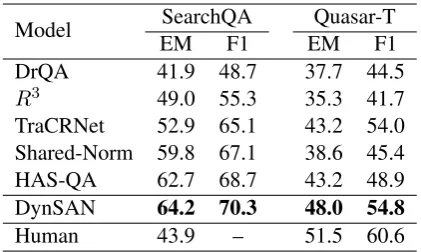
Table 1: Performance of DynSAN and competing ap-proaches on the test sets of two extractive QA tasks: SearchQA and Quasar-T. Competing approaches in-clude DrQA (Chen et al., 2017), R3
(Wang et al.,
2018a), TraCRNet (Dehghani et al.,2019a), Shared-Norm (Clark and Gardner, 2018), HAS-QA (Pang et al.,2019). Human performance is referenced from the dataset paper.
model. The averages/medians of the total length of the concatenation of all supporting passages for each question are around 1.9k/2k, 2.4k/2.4k, and 1.2k/1k in SearchQA, Quasar-T, and WikiHop re-spectively. Thus, we limit the maximum length not to exceed 5k tokens and discard a few exception-ally long cases. Tokenization is completed using spaCy1during preprocessing.
4.2 Experimental Setup
In the DynSAN, the kernel size is7for all convo-lutional layers, the standard dimensionD is128, the number of headsHis8, the number of chosen tokens K is 256. In the cross-passage attention layer, we stack N = 4 layers of DynSA blocks. The mini-batch size is set to 32. For regulariza-tion, we adopt dropout between every two layers and the dropout rate is 0.1. Adam (Kingma and Ba,2015) with learning rate0.001is used for tun-ing the model parameters. We use a learntun-ing rate warm-up scheme in which the learning rate in-creases linearly from 0 to 0.001 in the first 500
steps. The models for multi-passage reading com-prehension are trained on four 12GB K80 GPUs using synchronous SGD (Das et al., 2016). Ex-ponential moving average is adopted with a decay rate0.9999.
4.3 Main Results
The performance of our model and competing ap-proaches are summarized in Table1and Table2. For extractive QA, standard metrics are utilized:
1https://spacy.io
Model Dev Test
BiDAF (Seo et al.,2017) – 42.9 Coref GRU (Dhingra et al.,2018) 56.0 59.3 MHQA-GRN (Song et al.,2018) 62.8 65.4 Entity-GCN (De Cao et al.,2019) 64.8 67.6 CFC (Zhong et al.,2019) 66.4 70.6
DynSAN 70.1 71.4
[image:6.595.76.287.61.187.2]Human (Welbl et al.,2018) – 74.1
Table 2: Performance of DynSAN and competing ap-proaches on multiple choice QA dataset: WikiHop.
Exact Match (EM) and F1 score (Rajpurkar et al.,
2016). The scores are evaluated by the official script in Rajpurkar et al. (2016). For multiple choice QA, the performance is evaluated by the accuracy of choosing the correct answer. As we can see, the proposed model clearly outperforms all previously published approaches and achieves new state-of-the-art performances on the three datasets, which validates the effectiveness of the dynamic self-attention network for multi-passage RC. It is noteworthy that competing approaches use coarse-grain representations for cross-passage information interaction or omit cross-passage in-formation interaction entirely.
Ablation EM F1
Full architecture 64.2 70.3 (a)−Cross-passage attention 55.1 60.9 (b)−Self-attention 59.5 65.6 (c)−Convolutional layers 61.0 67.4 (d)−Gated token selection 60.5 66.6
(e) −Gate 59.9 66.0
[image:6.595.312.523.62.173.2](f)−Regularization(β= 0) 63.7 69.8 (g) Replace with Bi-BloSA 60.5 67.1 (h) +Convolutional layers 61.3 67.6
Table 3: Ablation study on SearchQA test set. “−”/“+” denotes removing/adding a model component, the in-dent in (e) and (h) means removing/adding a model component on the basis of the previous line.
4.4 Ablations
Question: Which vegetable is a Welsh emblem? Answer: leek Prediction: leek
Question: What gemstone was reputed to heal eye ailments? Answer: emerald Prediction: pearl
… A pungent vegetable is the national emblem of Wales ... … The leek (a vegetable) is a national emblem ...
… The vegetable called leek is also considered to … ... the reason why the daffodil is used as an emblem is ... ... Lochcarron of Scotland has a new Welsh Emblem ... ... air force emblem ferrari prancing ...
... pearl was used therapeutically to heal eye ailments ... ... The gemstone gets its name from its resemblance to the eye of a tiger ...
... Copper is used by medical science for many ailments ... ... Iris Agate: Use to heal burns ...
[image:7.595.73.528.65.150.2]... 9th December 2008 Crystal Healing ...
Figure 3: Case study on the Quasar-T dev set to show which tokens are selected as important tokens by the gated token selection mechanism in DynSA block. Important tokens are shaded.
remove all convolutional layers in DynSA blocks. In (d), we remove the gated token selection mech-anism in DynSA blocks; in other words, which
K tokens are selected is decided randomly rather than by the gate activation. Further, we remove the gate itself from (d) in (e). In (f), we re-move regularization on gate activation by setting
β = 0. In (g), we replace the DynSA block with Bi-BloSA (Shen et al.,2018b), which is proposed for long-sequence modeling but a block-level self-attention. The Bi-BloSA is implemented using the author’s open source code. On the basis of (g), we combine Bi-BloSA with convolutional layers in (h).
As is shown in Table3, cross-passage attention is most critical to the performance (almost 10%
drop), the results prove the necessity of formation interaction between passages. Since we setK = 256, and most singular passages are within256 to-kens, the DynSA models local context for every position before the concatenation of all passages. Therefore, removing convolutional layers does not degrade the model entirely in (c). Self-attention and convolutional layers account for 4.7% and
2.9%performance drop respectively, and it illus-trates that self-attention plays a more critical role than convolutional layers in modeling context in-formation. In (d), the performance reduces sig-nificantly, proving the effectiveness of the gated token selection mechanism in the proposed archi-tecture. Compare (e) to (d) and compare (f) to the full architecture, it is concluded that the gate it-self and the regularization also have slight benefits to the model. From (g) and (h), we learn that the token-level DynSA block outperforms the block-level Bi-BloSA by a large margin, verifying the superiority of fine-grain representation.
4.5 Qualitative Analysis
We conduct a case study to show which tokens are selected as important tokens by the gated token
se-Layer -1 se-Layer 0 se-Layer 1 se-Layer 2 se-Layer 3 se-Layer 4 0
20 40 60 80 100
Percentage (%)
62.9
18.7
97.0 99.4 98.3 93.5
2.2 16.4 0.6 0.1 0.3 1.1
34.9 64.9
2.4 0.5 1.4 5.4
0 g 1/3 1/3 < g 2/3 2/3 < g 1
(a)
Layer -1 Layer 0 Layer 1 Layer 2 Layer 3 Layer 4 0
500 1000 1500 2000 2500
Count 1079 2362
145 25 72 326
(b)
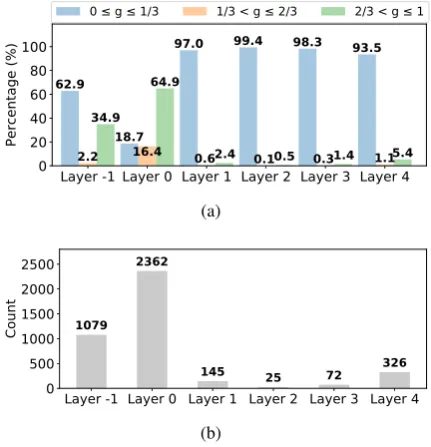
Figure 4: Quantitative analysis on the Quasar-T dev set. Layers are indexed from the bottom up, the DynSA blocks in the cross-passage attention layer are indexed from layer 1 to layer 4, the two DynSA blocks below the cross-passage attention layer are indexed as layer -1 and layer 0 respectively. (a) The distribution of the number of tokens of different activities in each layer. Tokens are classified into three categories according to its activity valueg. (b) The average amount of active tokens (g >0.01) in each layer.
[image:7.595.310.526.206.430.2]SQuAD 1.1 Speedup Memory |θ| EM/F1 Bi-LSTM 1.0x/1.0x 4305 1.3M 70.5/79.8 Full SAN 3.5x/2.5x 8748 1.9M 70.6/80.1 Bi-BloSAN 3.4x/2.3x 6414 1.9M 66.7/76.8 DynSAN 4.3x/3.3x 4341 1.9M 69.9/79.5
Table 4: The time cost and memory consumption on SQuAD. The time cost is shown through the speedup rate with respect to Bi-LSTM. Both the train-ing speedup rate and inference speedup rate are re-ported. The memory usage is measured in Megabyte. |θ| denotes the amount of trainable parameters in a model. Accuracy is measured by EM and F1.
while information interactions between cue words may be considered as multihop reasoning. We also observe that in a lot of mispredicted instances the correct answer never obtains large gate activations in cross-passage attention layers. Perhaps this is a reason for misprediction.
4.6 Quantitative Analysis
Figure4(a)illustrates the distribution of the num-ber of tokens of different activities in each layer. Token’s activity is defined as in subsection4.5. We also count the average number of active tokens on the Quasar-T dev set. We define a token is active when its activity is greater than0.01. Figure4(b)
reports the statistics. In general, the activity values tend to be polarized, i.e., either near zero or near one. It is probably caused by the normalization in Equation3and the regularization term in Equa-tion 6. Besides, the intra-passage DynSA blocks (layer -1 and layer 0) have more active tokens, while the cross-passage blocks have less. It ex-plains that more tokens take effect in understand-ing a sunderstand-ingle passage, while only a few important tokens are necessary for cross-passage informa-tion interacinforma-tion. The results verify our observainforma-tion mentioned in section1.
4.7 Time Cost & Memory Consumption
We also conduct experiments to show the com-putational costs of the proposed model and other baseline models. Specifically, we replace the DynSA blocks in Figure 2 with Bi-LSTM (Hochreiter and Schmidhuber, 1997), full SAN, and Bi-BloSAN (Shen et al.,2018b) respectively. Note that the full SAN refers to the model encoder block in QANet (Yu et al.,2018), which is a com-bination of global multi-head self-attention and lo-cal convolution. It is a strong baseline, and we use
4 5 6 7 8 log2(K)
55 60 65 70 75
EM/F1
66.4 66.9 68.5
69.7 70.3
60.2 61.0
62.5 63.5 64.2
SearchQA F1 SearchQA EM
(a)
10 20 30 40 50 #Passages
50 55 60 65 70 75
EM/F1
62.5
67.3 69.1 69.5
70.3
56.4
61.3 63.1 63.4
64.2
SearchQA F1 SearchQA EM
(b)
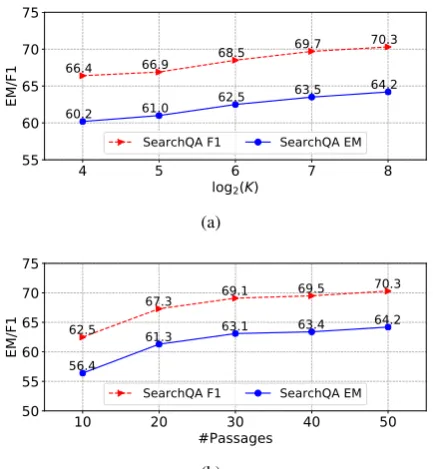
Figure 5: (a) Effects of choosing different values of the hyper-parameterKin token selection.Kis the number of chosen tokens, and is set to a power of 2. (b) Perfor-mance against the number of supporting passages.
it to show the situation of full self-attention over all tokens.
To avoid the long running time of Bi-LSTM and the out-of-memory issue of full SAN on multi-passage RC tasks, we select SQuAD 1.1 ( Ra-jpurkar et al., 2016) as the benchmark dataset. Since SQuAD is a single-passage RC task, we consider it as special multi-passage RC when the number of passagesM equals to1. In this experi-ment, topK = 32tokens are chosen in DynSAN. Models are trained on a single 12GB K80 GPU.
The results are shown in Table 4. Compared with the full SAN and Bi-LSTM, DynSAN has a slight accuracy drop while Bi-BloSAN degrades significantly. In terms of time cost and memory usage, DynSAN reaches 4.3x and 3.3x speedup and has a similar memory consumption to Bi-LSTM. Because of the characteristics of Bi-LSTM and the full SAN, as the sequence length increases, the advantage of DynSAN in speed and memory consumption would be more significant. Although DynSAN has a small accuracy drop to the full SAN, it seems that DynSAN is a relatively bal-anced model concerning speed, memory, and ac-curacy.
4.8 Model Analysis
[image:8.595.310.527.62.297.2] [image:8.595.75.285.63.131.2]effects of the token selection. As the number of chosen tokens increases, performance improves as expected. When the number of chosen tokens is large enough, the gain becomes marginal. The choice of this hyper-parameter has an impact on the balance in speed, memory, and accuracy.
Number of Passages Figure5(b) answers fol-lowing research question “How would the perfor-mance change with respect to the number of pas-sages?” As more supporting passages are taken into consideration, both F1 and EM performance of our model continuously increase. The results verify that those low-ranked passages play a criti-cal role in answering the questions.
5 Related Works
As far as multi-passage reading comprehension be concerned, a lot of powerful deep learning ap-proaches have been introduced to solve this prob-lem. De Cao et al.(2019);Song et al.(2018) in-troduce graph convolutional network (GCN) and graph recurrent network (GRN) into this task.
Dhingra et al.(2018) use co-reference annotations extracted from an external system to connect en-tity mentions for multihop reasoning.Zhong et al.
(2019) propose an ensemble approach for coarse-grain and fine-coarse-grain co-attention networks. Pang et al.(2019) propose a hierarchical answer spans model to tackle the problem of multiple answer spans. Clark and Gardner (2018) uses a shared-normalization objective to produce accurate per-passage confidence scores and marginalize the probability of an answer candidate over all pas-sages. While it outperforms most single-passage RC models by a large margin, it processes each passage independently omitting the multi-passage information interaction completely. InWang et al.
(2018b), cross-passage answer verification is def-initely proposed, in which all the word embed-dings in a passage are summed through attention mechanism to represent an answer candidate, and then each answer candidate attends to other can-didates to collect supportive information. In De-hghani et al. (2019a), multihop reasoning is im-plemented by a Universal Transformer (Dehghani et al.,2019b) which is mainly based on Multi-head Self-attention (Vaswani et al., 2017) and a transi-tion functransi-tion.
Our work is concerned with Self-attention Net-work (SAN) (Vaswani et al., 2017; Shen et al.,
2018a). For the first time, Vaswani et al. (2017)
explore the possibilities of completely replacing the recurrent neural network with self-attention to model context dependencies. Some papers pro-pose variants of self-attention mechanisms, such asShen et al.(2018c);Hu et al.(2018);Shaw et al.
(2018); Yang et al. (2019). Besides, Shen et al.
(2018b) explore reducing the computational com-plexity of self-attention.
6 Conclusion
In this paper, we proposed a new Dynamic Self-attention (DynSA) architecture, which dynami-cally determinates what tokens are important for constructing intra-passage or cross-passage token-level semantic representations. The proposed ap-proach has the advantages in remaining fine-grain semantic information meanwhile reaching a bal-ance between time, memory and accuracy. We showed the effectiveness of the proposed method in handling multi-passage reading comprehen-sion using three benchmark datasets including SearchQA, Quasar-T, and WikiHop. Experimen-tal results showed state-of-the-art performance.
Acknowledgments
We thank the anonymous reviewers for their valu-able comments, and Johannes Welbl for evaluating our model on the hidden WikiHop test dataset.
References
Jimmy Lei Ba, Jamie Ryan Kiros, and Geoffrey E Hin-ton. 2016. Layer normalization. arXiv preprint arXiv:1607.06450.
Dzmitry Bahdanau, Kyunghyun Cho, and Yoshua Ben-gio. 2015. Neural machine translation by jointly learning to align and translate. In3rd International Conference on Learning Representations, ICLR.
Danqi Chen, Adam Fisch, Jason Weston, and Antoine Bordes. 2017. Reading Wikipedia to answer open-domain questions. InProceedings of the 55th An-nual Meeting of the Association for Computational Linguistics (Volume 1: Long Papers), pages 1870– 1879, Vancouver, Canada. Association for Compu-tational Linguistics.
Franc¸ois Chollet. 2017. Xception: Deep learning with depthwise separable convolutions. InProceedings of the IEEE conference on computer vision and pat-tern recognition, pages 1251–1258.
Christopher Clark and Matt Gardner. 2018. Simple and effective multi-paragraph reading comprehen-sion. InProceedings of the 56th Annual Meeting of the Association for Computational Linguistics (Vol-ume 1: Long Papers), Melbourne, Australia. Asso-ciation for Computational Linguistics.
Dipankar Das, Sasikanth Avancha, Dheevatsa Mudi-gere, Karthikeyan Vaidynathan, Srinivas Sridha-ran, Dhiraj Kalamkar, Bharat Kaul, and Pradeep Dubey. 2016. Distributed deep learning using syn-chronous stochastic gradient descent. arXiv preprint arXiv:1602.06709.
Nicola De Cao, Wilker Aziz, and Ivan Titov. 2019. Question answering by reasoning across documents with graph convolutional networks. Conference of the North American Chapter of the Association for Computational Linguistics.
Mostafa Dehghani, Hosein Azarbonyad, Jaap Kamps, and Maarten de Rijke. 2019a. Learning to trans-form, combine, and reason in open-domain ques-tion answering. InProceedings of the Twelfth ACM International Conference on Web Search and Data Mining, pages 681–689. ACM.
Mostafa Dehghani, Stephan Gouws, Oriol Vinyals, Jakob Uszkoreit, and Łukasz Kaiser. 2019b. Uni-versal transformers. International Conference on Learning Representations.
Bhuwan Dhingra, Qiao Jin, Zhilin Yang, William Co-hen, and Ruslan Salakhutdinov. 2018. Neural mod-els for reasoning over multiple mentions using coref-erence. InProceedings of the 2018 Conference of the North American Chapter of the Association for Computational Linguistics: Human Language Tech-nologies, Volume 2 (Short Papers), pages 42–48, New Orleans, Louisiana. Association for Computa-tional Linguistics.
Bhuwan Dhingra, Kathryn Mazaitis, and William W Cohen. 2017. Quasar: Datasets for question an-swering by search and reading. arXiv preprint arXiv:1707.03904.
Matthew Dunn, Levent Sagun, Mike Higgins, V Ugur Guney, Volkan Cirik, and Kyunghyun Cho. 2017. Searchqa: A new q&a dataset augmented with context from a search engine. arXiv preprint arXiv:1704.05179.
Sepp Hochreiter and J¨urgen Schmidhuber. 1997. Long short-term memory. Neural computation, 9(8):1735–1780.
Minghao Hu, Yuxing Peng, Zhen Huang, Xipeng Qiu, Furu Wei, and Ming Zhou. 2018. Reinforced mnemonic reader for machine reading comprehen-sion. 27th International Joint Conference on Artifi-cial Intelligence.
Yoon Kim. 2014. Convolutional neural networks for sentence classification. In Proceedings of the 2014 Conference on Empirical Methods in Natural Language Processing (EMNLP), pages 1746–1751, Doha, Qatar. Association for Computational Lin-guistics.
Diederik P Kingma and Jimmy Ba. 2015. Adam: A method for stochastic optimization. International Conference on Learning Representations.
Tomas Mikolov, Edouard Grave, Piotr Bojanowski, Christian Puhrsch, and Armand Joulin. 2018. Ad-vances in pre-training distributed word representa-tions. InProceedings of the International Confer-ence on Language Resources and Evaluation (LREC 2018).
Liang Pang, Yanyan Lan, Jiafeng Guo, Jun Xu, Lixin Su, and Xueqi Cheng. 2019. Has-qa: Hierarchical answer spans model for open-domain question an-swering. AAAI Conference on Artificial Intelligence.
Pranav Rajpurkar, Jian Zhang, Konstantin Lopyrev, and Percy Liang. 2016. SQuAD: 100,000+ questions for machine comprehension of text. InProceedings of the 2016 Conference on Empirical Methods in Natu-ral Language Processing, pages 2383–2392, Austin, Texas. Association for Computational Linguistics.
Minjoon Seo, Aniruddha Kembhavi, Ali Farhadi, and Hannaneh Hajishirzi. 2017. Bidirectional atten-tion flow for machine comprehension.International Conference on Learning Representations.
Peter Shaw, Jakob Uszkoreit, and Ashish Vaswani. 2018. Self-attention with relative position represen-tations. In Proceedings of the 2018 Conference of the North American Chapter of the Association for Computational Linguistics: Human Language Tech-nologies, Volume 2 (Short Papers), pages 464–468, New Orleans, Louisiana. Association for Computa-tional Linguistics.
Tao Shen, Tianyi Zhou, Guodong Long, Jing Jiang, Shirui Pan, and Chengqi Zhang. 2018a. Disan: Di-rectional self-attention network for rnn/cnn-free lan-guage understanding. InThirty-Second AAAI Con-ference on Artificial Intelligence.
Tao Shen, Tianyi Zhou, Guodong Long, Jing Jiang, and Chengqi Zhang. 2018b. Bi-directional block self-attention for fast and memory-efficient sequence modeling. International Conference on Learning Representations.
Tao Shen, Tianyi Zhou, Guodong Long, Jing Jiang, and Chengqi Zhang. 2018c. Fast direc-tional self-attention mechanism. arXiv preprint arXiv:1805.00912.
Rupesh Kumar Srivastava, Klaus Greff, and J¨urgen Schmidhuber. 2015. Highway networks. arXiv preprint arXiv:1505.00387.
Ashish Vaswani, Noam Shazeer, Niki Parmar, Jakob Uszkoreit, Llion Jones, Aidan N Gomez, Łukasz Kaiser, and Illia Polosukhin. 2017. Attention is all you need. InAdvances in Neural Information Pro-cessing Systems, pages 5998–6008.
Shuohang Wang, Mo Yu, Xiaoxiao Guo, Zhiguo Wang, Tim Klinger, Wei Zhang, Shiyu Chang, Gerry Tesauro, Bowen Zhou, and Jing Jiang. 2018a. R 3: Reinforced ranker-reader for open-domain question answering. In Thirty-Second AAAI Conference on Artificial Intelligence.
Yizhong Wang, Kai Liu, Jing Liu, Wei He, Yajuan Lyu, Hua Wu, Sujian Li, and Haifeng Wang. 2018b. Multi-passage machine reading comprehension with cross-passage answer verification. In Proceedings of the 56th Annual Meeting of the Association for Computational Linguistics, ACL 2018, Melbourne, Australia, July 15-20, 2018, Volume 1: Long Papers, pages 1918–1927.
Dirk Weissenborn, Georg Wiese, and Laura Seiffe. 2017. Making neural QA as simple as possible but not simpler. In Proceedings of the 21st Confer-ence on Computational Natural Language Learning (CoNLL 2017), pages 271–280, Vancouver, Canada. Association for Computational Linguistics.
Johannes Welbl, Pontus Stenetorp, and Sebastian Riedel. 2018. Constructing datasets for multi-hop reading comprehension across documents. Transac-tions of the Association of Computational Linguis-tics, 6:287–302.
Baosong Yang, Longyue Wang, Derek F Wong, Lidia S Chao, and Zhaopeng Tu. 2019. Convolutional self-attention network. Proceedings of the 2019 Confer-ence of the North American Chapter of the Associ-ation for ComputAssoci-ational Linguistics: Human Lan-guage Technologies.
Adams Wei Yu, David Dohan, Minh-Thang Luong, Rui Zhao, Kai Chen, Mohammad Norouzi, and Quoc V Le. 2018. Qanet: Combining local convolution with global self-attention for reading comprehen-sion. International Conference on Learning Repre-sentations.