Proceedings of the 57th Annual Meeting of the Association for Computational Linguistics, pages 3286–3296 3286
Relational Word Embeddings
Jose Camacho-Collados Luis Espinosa-Anke Steven Schockaert
School of Computer Science and Informatics Cardiff University, United Kingdom
{camachocolladosj,espinosa-ankel,schockaerts1}@cardiff.ac.uk
Abstract
While word embeddings have been shown to implicitly encode various forms of attribu-tional knowledge, the extent to which they capture relational information is far more lim-ited. In previous work, this limitation has been addressed by incorporating relational knowl-edge from external knowlknowl-edge bases when learning the word embedding. Such strategies may not be optimal, however, as they are lim-ited by the coverage of available resources and conflate similarity with other forms of related-ness. As an alternative, in this paper we pro-pose to encode relational knowledge in a sep-arate word embedding, which is aimed to be complementary to a given standard word em-bedding. This relational word embedding is still learned from co-occurrence statistics, and can thus be used even when no external knowl-edge base is available. Our analysis shows that relational word vectors do indeed capture in-formation that is complementary to what is en-coded in standard word embeddings.
1 Introduction
Word embeddings are paramount to the success of current natural language processing (NLP) meth-ods. Apart from the fact that they provide a con-venient mechanism for encoding textual informa-tion in neural network models, their importance mainly stems from the remarkable amount of lin-guistic and semantic information that they capture. For instance, the vector representation of the word Parisimplicitly encodes that this word is a noun, and more specifically a capital city, and that it describes a location in France. This information arises because word embeddings are learned from co-occurrence counts, and properties such as be-ing a capital city are reflected in such statistics. However, the extent to which relational knowledge (e.g.Trumpwas the successor of Obama) can be learned in this way is limited.
Previous work has addressed this by incorporat-ing external knowledge graphs (Xu et al., 2014; Celikyilmaz et al., 2015) or relations extracted from text (Chen et al.,2016). However, the suc-cess of such approaches depends on the amount of available relational knowledge. Moreover, they only consider well-defined discrete relation types (e.g. is the capital of, or is a part of), whereas the appeal of vector space representations largely comes from their ability to capture subtle aspects of meaning that go beyond what can be expressed symbolically. For instance, the relationship be-tweenpopcornandcinemais intuitively clear, but it is more subtle than the assertion that “popcorn is located at cinema”, which is how ConceptNet (Speer et al.,2017), for example, encodes this re-lationship1.
In fact, regardless of how a word embedding is learned, if its primary aim is to capture similarity, there are inherent limitations on the kinds of re-lations they can capture. For instance, such word embeddings can only encode similarity preserving relations (i.e. similar entities have to be related to similar entities) and it is often difficult to encode thatwis in a particular relationship while prevent-ing the inference that words with similar vectors to w are also in this relationship; e.g. Bouraoui et al.(2018) found that both (Berlin,Germany) and (Moscow,Germany) were predicted to be instances of the capital-of relation due to the similarity of the word vectors for Berlin and Moscow. Fur-thermore, while the ability to capture word analo-gies (e.g. king-man+woman≈queen) emerged as a successful illustration of how word embeddings can encode some types of relational information (Mikolov et al.,2013b), the generalization of this interesting property has proven to be less success-ful than initially anticipated (Levy et al., 2014;
Linzen,2016;Rogers et al.,2017).
This suggests that relational information has to be encoded separately from standard similarity-centric word embeddings. One appealing strategy is to represent relational information by learning, for each pair of related words, a vector that en-codes how the words are related. This strategy was first adopted by Turney (2005), and has recently been revisited by a number of authors (Washio and Kato,2018a;Jameel et al., 2018;Espinosa Anke and Schockaert, 2018; Washio and Kato, 2018b; Joshi et al.,2019). However, in many applications, word vectors are easier to deal with than vector representations of word pairs.
The research question we consider in this pa-per is whether it is possible to learn word vectors that capture relational information. Our aim is for suchrelational word vectorsto be complementary to standard word vectors. To make relational in-formation available to NLP models, it then suffices to use a standard architecture and replace normal word vectors by concatenations of standard and relational word vectors. In particular, we show that such relational word vectors can be learned directly from a given set of relation vectors.
2 Related Work
Relation Vectors. A number of approaches have been proposed that are aimed at learning relation vectors for a given set of word pairs (a,b), based on sentences in which these word pairs co-occur. For instance, Turney(2005) introduced a method called Latent Relational Analysis (LRA), which relies on first identifying a set of sufficiently fre-quent lexical patterns and then constructs a ma-trix which encodes for each considered word pair (a,b) how frequently each pattern P appears in between a and b in sentences that contain both words. Relation vectors are then obtained us-ing sus-ingular value decomposition. More recently, Jameel et al.(2018) proposed an approach inspired by the GloVe word embedding model (Pennington et al.,2014) to learn relation vectors based on co-occurrence statistics between the target word pair
(a, b) and other words. Along similar lines, Es-pinosa Anke and Schockaert(2018) learn relation vectors based on the distribution of words occur-ring in sentences that contain aandbby averag-ing the word vectors of these co-occurraverag-ing words. Then, a conditional autoencoder is used to obtain lower-dimensional relation vectors.
Taking a slightly different approach, Washio and Kato (2018a) train a neural network to pre-dict dependency paths from a given word pair. Their approach uses standard word vectors as in-put, hence relational information is encoded im-plicitly in the weights of the neural network, rather than as relation vectors (although the output of this neural network, for a given word pair, can still be seen as a relation vector). An advantage of this approach, compared to methods that explic-itly construct relation vectors, is that evidence ob-tained for one word is essentially shared with sim-ilar words (i.e. words whose standard word vec-tor is similar). Among others, this means that their approach can in principle model relational knowledge for word pairs that never co-occur in the same sentence. A related approach, presented in (Washio and Kato,2018b), uses lexical patterns, as in the LRA method, and trains a neural network to predict vector encodings of these patterns from two given word vectors. In this case, the word vec-tors are updated together with the neural network and an LSTM to encode the patterns. Finally, sim-ilar approach is taken by the Pair2Vec method pro-posed in (Joshi et al., 2019), where the focus is on learning relation vectors that can be used for cross-sentence attention mechanisms in tasks such as question answering and textual entailment.
Despite the fact that such methods learn word vectors from which relation vectors can be pre-dicted, it is unclear to what extent these word vec-tors themselves capture relational knowledge. In particular, the aforementioned methods have thus far only been evaluated in settings that rely on the predicted relation vectors. Since these pre-dictions are made by relatively sophisticated neu-ral network architectures, it is possible that most of the relational knowledge is still captured in the weights of these networks, rather than in the word vectors. Another problem with these existing ap-proaches is that they are computationally very ex-pensive to train; e.g. the Pair2Vec model is re-ported to need 7-10 days of training on unspecified hardware2. In contrast, the approach we propose in this paper is computationally much simpler, while resulting in relational word vectors that en-code relational information more accurately than those of the Pair2Vec model in lexical semantics tasks, as we will see in Section5.
Knowledge-Enhanced Word Embeddings.
eral authors have tried to improve word embed-dings by incorporating external knowledge bases. For example, some authors have proposed models which combine the loss function of a word em-bedding model, to ensure that word vectors are predictive of their context words, with the loss function of a knowledge graph embedding model, to encourage the word vectors to additionally be predictive of a given set of relational facts (Xu et al.,2014;Celikyilmaz et al.,2015;Chen et al., 2016). Other authors have used knowledge bases in a more restricted way, by taking the fact that two words are linked to each other in a given knowledge graph as evidence that their word vec-tors should be similar (Faruqui et al.,2015;Speer et al.,2017). Finally, there has also been work that uses lexicons to learn word embeddings which are specialized towards certain types of lexical knowl-edge, such as hypernymy (Nguyen et al., 2017; Vulic and Mrksic, 2018), antonymy (Liu et al., 2015;Ono et al.,2015) or a combination of var-ious linguistic constraints (Mrkˇsi´c et al.,2017).
Our method differs in two important ways from these existing approaches. First, rather than rely-ing on an external knowledge base, or other forms of supervision, as in e.g. (Chen et al., 2016), our method is completely unsupervised, as our only input consists of a text corpus. Second, whereas existing work has focused on methods for improv-ing word embeddimprov-ings, our aim is to learn vec-tor representations that arecomplementaryto stan-dard word embeddings.
3 Model Description
We aim to learn representations that are comple-mentary to standard word vectors and are special-ized towards relational knowledge. To differenti-ate them from standard word vectors, they will be referred to as relational word vectors. We write ewfor the relational word vector representation of w. The main idea of our method is to first learn, for each pair of closely related wordswandv, a rela-tion vectorrwv that captures how these words are related, which we discuss in Section3.1. In Sec-tion 3.2 we then explain how we learn relational word vectors from these relation vectors.
3.1 Unsupervised Relation Vector Learning
Our goal here is to learn relation vectors for closely related words. For both the selection of the vocabulary and the method to learn relation
vec-tors we mainly follow the initialization method of Camacho-Collados et al.(2019, RELATIVEinit) ex-cept for an important difference explained below regarding the symmetry of the relations. Other re-lation embedding methods could be used as well, e.g., (Jameel et al.,2018;Washio and Kato,2018b; Espinosa Anke and Schockaert,2018;Joshi et al., 2019), but this method has the advantage of being highly efficient. In the following we describe this procedure for learning relation vectors: we first explain how a set of potentially related word pairs is selected, and then focus on how relation vectors rwvfor these word pairs can be learned.
Selecting Related Word Pairs. Starting from a vocabularyVcontaining the words of interest (e.g. all sufficiently frequent words), as a first step we need to choose a set R ⊆ V × V of potentially related words. For each of the word pairs in R
we will then learn a relation vector, as explained below. To select this set R, we only consider word pairs that co-occur in the same sentence in a given reference corpus. For all such word pairs, we then compute their strength of relatedness fol-lowing Levy et al. (2015a) by using a smoothed version of pointwise mutual information (PMI), where we use 0.5 as exponent factor. In particular, for each wordw ∈ V, the setRcontains all suf-ficiently frequently co-occurring pairs (w, v) for whichvis within the top-100 most closely related words tow, according to the following score:
PMI0.5(u, v) = log
nwv·s∗∗ nw∗·sv∗
(1)
wherenwvis the harmonically weighted3number
of times the wordswandvoccur in the same sen-tence within a distance of at most 10 words, and:
nw∗= X
u∈V
nwu; sv∗ =n0.5v∗; s∗∗= X
u∈V su∗
This smoothed variant of PMI has the advantage of being less biased towards infrequent (and thus typically less informative) words.
Learning Relation Vectors. In this paper, we will rely on word vector averaging for learning relation vectors, which has the advantage of be-ing much faster than other existbe-ing approaches, and thus allows us to consider a higher number of word pairs (or a larger corpus) within a fixed
3A co-occurrence in which there arekwords in between wandvthen receives a weight of 1
time budget. Word vector averaging has moreover proven surprisingly effective for learning relation vectors (Weston et al., 2013; Hashimoto et al., 2015;Fan et al.,2015;Espinosa Anke and Schock-aert,2018), as well as in related tasks such as sen-tence embedding (Wieting et al.,2016).
Specifically, to construct the relation vec-tor rwv capturing the relationship between the words w and v we proceed as follows. First, we compute a bag of words representation
{(w1, f1), ...,(wn, fn)}, wherefiis the number of
times the wordwioccurs in between the wordsw
andvin any given sentence in the corpus. The re-lation vectorrwv is then essentially computed as a weighted average:
rwv=norm
n
X
i=1
fi·wi
!
(2)
where we write wi for the vector representation ofwi in some given pre-trained word embedding,
andnorm(v) = kvvk.
In contrast to other approaches, we do not dif-ferentiate between sentences where woccurs be-fore v and sentences where v occurs before w. This means that our relation vectors are symmet-ric in the sense that rwv = rvw. This has the advantage of alleviating sparsity issues. While the directionality of many relations is important, the direction can often be recovered from other infor-mation we have about the wordswandv. For in-stance, knowing that w andv are in a capital-of relationship, it is trivial to derive that “vis the cap-ital ofw”, rather than the other way around, if we also know thatwis a country.
3.2 Learning Relational Word Vectors
The relation vectorsrwv capture relational infor-mation about the word pairs in R. The rela-tional word vectors will be induced from these relation vectors by encoding the requirement that ew andev should be predictive ofrwv, for each
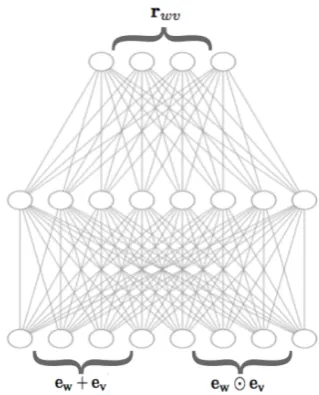
(w, v) ∈ R. To this end, we use a simple neu-ral network with one hidden layer,4 whose input is given by (ew+ev)⊕(ew ev), where we write ⊕ for vector concatenation and for the component-wise multiplication. Note that the in-put needs to be symmetric, given that our relation
4More complex architectures could be used, e.g., (Joshi
[image:4.595.336.496.64.262.2]et al.,2019), but in this case we decided to use a simple archi-tecture as the main aim of this paper is to encode all relational information into the word vectors, not in the network itself.
Figure 1: Relational word embedding architecture. At the bottom of the figure, the input layer is constructed from the relational word embeddingsewandev, which
are the vectors to be learnt. As shown at the top, we aim to predict the target relation vectorrwv.
vectors are symmetric, which makes the vector addition and component-wise multiplication two straightforward encoding choices. Figure 1 de-picts an overview of the architecture of our model. The network is defined as follows:
iwv = (ew+ev)⊕(ewev)
hwv =f(Xiwv+a)
owv =f(Yhwv+b)
(3)
for some activation functionf. We train this net-work to predict the relation vector rwv, by mini-mizing the following loss:
L= X
(w,v)∈R
owv−rwv
2
(4)
The relational word vectorsewcan be initialized using standard word embeddings trained on the same corpus.
4 Experimental Setting
In what follows, we detail the resources and train-ing details that we used to obtain the relational word vectors.
Corpus and Word Embeddings. We followed the setting ofJoshi et al.(2019) and used the En-glish Wikipedia5as input corpus. Multiwords (e.g. Manchester United) were grouped together as a
single token by following the same approach de-scribed inMikolov et al.(2013a). As word embed-dings, we used 300-dimensional FastText vectors (Bojanowski et al., 2017) trained on Wikipedia with standard hyperparameters. These embed-dings are used as input to construct the relation vectors rwv (see Section3.1),6 which are in turn
used to learn relational word embeddingsew (see
Section3.2). The FastText vectors are additionally used as our baseline word embedding model.
Word pair vocabulary. As our core vocabulary
V, we selected the 100,000most frequent words from Wikipedia. To construct the set of word pairs
R, for each word from V, we selected the 100
most closely related words (cf. Section3.1), con-sidering only consider word pairs that co-occur at least 25 times in the same sentence throughout the Wikipedia corpus. This process yielded relation vectors for 974,250 word pairs.
Training. To learn our relational word embed-dings we use the model described in Section3.2. The embedding layer is initialized with the stan-dard FastText 300-dimensional vectors trained on Wikipedia. The method was implemented in Py-Torch, employing standard hyperparameters, us-ing ReLU as the non-linear activation function f (Equation3). The hidden layer of the model was fixed to the same dimensionality as the embedding layer (i.e. 600). The stopping criterion was de-cided based on a small development set, by set-ting aside 1% of the relation vectors. Code to reproduce our experiments, as well as pre-trained models and details of the implementation such as other network hyperparameters, are available at
https://github.com/pedrada88/rwe.
5 Experimental Results
A natural way to assess the quality of word vectors is to test them in lexical semantics tasks. However, it should be noted that relational word vectors be-have differently from standard word vectors, and we should not expect the relational word vectors to be meaningful in unsupervised tasks such as semantic relatedness (Turney and Pantel, 2010). In particular, note that a high similarity between ew andev should mean that relationships which hold forw have a high probability of holding for v as well. Words which are related, but not
syn-6We based our implementation to learn relation
vec-tors on the code available at https://github.com/
pedrada88/relative
onymous, may thus have very dissimilar relational word vectors. Therefore, we test our proposed models on a number of different supervised tasks for which accurately capturing relational informa-tion is crucial to improve performance.
Comparison systems. Standard FastText vec-tors, which were used to construct the relation vectors, are used as our main baseline. In ad-dition, we also compare with the word embed-dings that were learned by the Pair2Vec system7 (see Section2). We furthermore report the results of two methods which leverage knowledge bases to enrich FastText word embeddings: Retrofitting (Faruqui et al., 2015) and Attract-Repel (Mrkˇsi´c et al., 2017). Retrofitting exploits semantic rela-tions from a knowledge base to re-arrange word vectors of related words such that they become closer to each other, whereas Attract-Repel makes use of different linguistic constraints to move word vectors closer together or further apart depend-ing on the constraint. For Retrofittdepend-ing we make use of WordNet (Fellbaum, 1998) as the input knowledge base, while for Attract-Repel we use the default configuration with all constraints from PPDB (Pavlick et al.,2015), WordNet and Babel-Net (Navigli and Ponzetto, 2012). All compari-son systems are 300-dimensional and trained on the same Wikipedia corpus.
5.1 Relation Classification
Given a pre-defined set of relation types and a pair of words, the relation classification task consists in selecting the relation type that best describes the relationship between the two words. As test sets we used DiffVec (Vylomova et al.,2016) and BLESS8 (Baroni and Lenci, 2011). The DiffVec dataset includes 12,458 word pairs, covering fif-teen relation types including hypernymy, cause-purpose or verb-noun derivations. On the other hand, BLESS includes semantic relations such as hypernymy, meronymy, and co-hyponymy.9 BLESS includes a train-test partition, with 13,258 and 6,629 word pairs, respectively. This task is treated as a multi-class classification problem
As a baseline model (Diff), we consider the usual representation of word pairs in terms of their vector differences (Fu et al., 2014; Roller et al.,
7
We used the pre-trained model of its official repository.
8
http://clic.cimec.unitn.it/distsem 9Note that both datasets exhibit overlap in a number of
Encoding Model Reference DiffVec BLESS
Acc. F1 Prec. Rec. Acc. F1 Prec. Rec.
Mult+Avg
RWE (This paper) 85.3 64.2 65.1 64.5 94.3 92.8 93.0 92.6 Pair2Vec (Joshi et al.,2019) 85.0 64.0 65.0 64.5 91.2 89.3 88.9 89.7 FastText (Bojanowski et al.,2017) 84.2 61.4 62.6 61.9 92.8 90.4 90.7 90.2 Retrofitting† (Faruqui et al.,2015) 86.1* 64.6* 66.6* 64.5* 90.6 88.3 88.1 88.6 Attract-Repel† (Mrkˇsi´c et al.,2017) 86.0* 64.6* 66.0* 65.2* 91.2 89.0 88.8 89.3
[image:6.595.77.524.64.178.2]Mult+Conc Pair2Vec (Joshi et al.,2019) 84.8 64.1 65.7 64.4 90.9 88.8 88.6 89.1 FastText (Bojanowski et al.,2017) 84.3 61.3 62.4 61.8 92.9 90.6 90.8 90.4 Diff (only) FastText (Bojanowski et al.,2017) 81.9 57.3 59.3 57.8 88.5 85.4 85.7 85.4
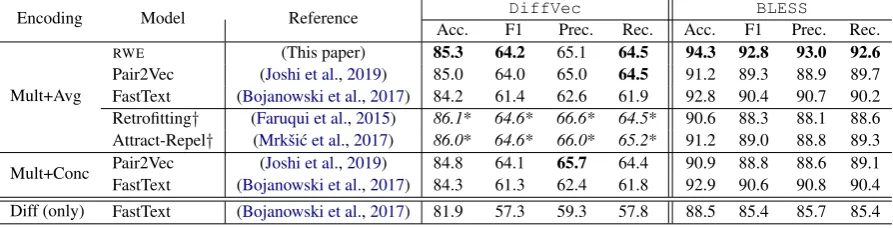
Table 1: Accuracy and macro-averaged F-Measure, precision and recall on BLESS and DiffVec. Models marked with†use external resources. The results with * indicate that WordNet was used for both the development of the model and the construction of the dataset. All models concatenate their encoded representations with the baseline vector difference of standard FastText word embeddings.
2014; Weeds et al., 2014), using FastText word embeddings. Since our goal is to show the com-plementarity of relational word embeddings with standard word vectors, for our method we con-catenate the difference wj −wi with the vectors ei+ej andei·ej (referred to as the Mult+Avg setting; our method is referred to as RWE). We use a similar representation for the other methods, simply replacing the relational word vectors by the corresponding vectors (but keeping the Fast-Text vector difference). We also consider a vari-ant in which the FastText vector difference is con-catenated with wi +wj andwi ·wj, which of-fers a more direct comparison with the other meth-ods. This goes in line with recent works that have shown how adding complementary features on top of the vector differences, e.g. multiplicative fea-tures (Vu and Shwartz, 2018), help improve the performance. Finally, for completeness, we also include variants where the average ei +ej is re-placed by the concatenationei⊕ej(referred to as Mult+Conc), which is the encoding considered in Joshi et al.(2019).
For these experiments we train a linear SVM classifier directly on the word pair encoding, per-forming a 10-fold cross-validation in the case of DiffVec, and using the train-test splits of BLESS.
Results Table 1 shows the results of our rela-tional word vectors, the standard FastText embed-dings and other baselines on the two relation clas-sification datasets (i.e. BLESS and DiffVec). Our model consistently outperforms the FastText em-beddings baseline and comparison systems, with the only exception being the precision score for DiffVec. Despite being completely unsupervised, it is also surprising that our model manages to outperform the knowledge-enhanced embeddings
of Retrofitting and Attract-Repel in the BLESS dataset. For DiffVec, let us recall that both these approaches have the unfair advantage of having had WordNet as source knowledge base, used both to construct the test set and to enhance the word embeddings. In general, the improvement ofRWE
over standard word embeddings suggests that our vectors capture relations in a way that is compati-ble to standard word vectors (which will be further discussed in Section6.2).
5.2 Lexical Feature Modelling
Standard word embedding models tend to cap-ture semantic similarity rather well (Baroni et al., 2014;Levy et al.,2015a). However, even though other kinds of lexical properties may also be en-coded (Gupta et al., 2015), they are not explic-itly modeled. Based on the hypothesis that rela-tional word embeddings should allow us to model such properties in a more consistent and transpar-ent fashion, we select the well-known McRae Fea-ture Norms benchmark (McRae et al., 2005) as testbed. This dataset10 is composed of 541 words (or concepts), each of them associated with one or more features. For example, ‘abearis ananimal’, or ‘a bowlis round’. As for the specifics of our evaluation, given that some features are only asso-ciated with a few words, we follow the setting of Rubinstein et al.(2015) and consider the eight fea-tures with the largest number of associated words. We carry out this evaluation by treating the task as a multi-class classification problem, where the labels are the word features. As in the previous task, we use a linear SVM classifier and perform 3-fold cross-validation. For each input word, the
10Downloaded fromhttps://sites.google.com/
Model McRae Feature Norms QVEC
Overall metal is small is large animal is edible wood is round is long
RWE 55.2 73.6 46.7 45.9 89.2 61.5 38.5 39.0 46.8 55.4
Pair2Vec 55.0 71.9 49.2 43.3 88.9 68.3 37.7 35.0 45.5 52.7 Retrofitting† 50.6 72.3 44.0 39.1 90.6 75.7 15.4 22.9 44.4 56.8* Attract-Repel† 50.4 73.2 44.4 33.3 88.9 71.8 31.1 24.2 35.9 55.9*
[image:7.595.77.521.61.152.2]FastText 54.6 72.7 48.4 45.2 87.5 63.2 33.3 39.0 47.8 54.6
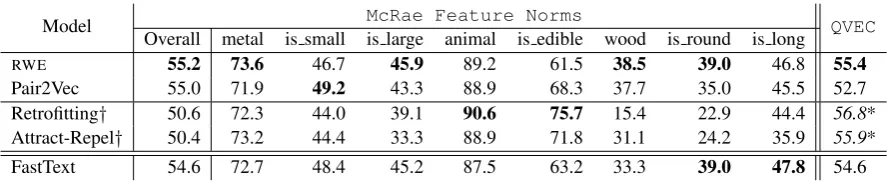
Table 2: Results on the McRae feature norms dataset (Macro F-Score) and QVEC (correlation score). Models marked with†use external resources. The results with * indicate that WordNet was used for both the development of the model and the construction of the dataset.
word embedding of the corresponding feature is fed to the classifier concatenated with its baseline FastText embedding.
Given that the McRae Feature Norms bench-mark is focused on nouns, we complement this experiment with a specific evaluation on verbs. To this end, we use the verb set of QVEC11(Tsvetkov et al.,2015), a dataset specifically aimed at mea-suring the degree to which word vectors capture semantic properties which has shown to strongly correlate with performance in downstream tasks such as text categorization and sentiment analy-sis. QVEC was proposed as an intrinsic evalua-tion benchmark for estimating the quality of word vectors, and in particular whether (and how much) they predict lexical properties, such as words be-longing to one of the fifteen verb supersenses con-tained in WordNet (Miller,1995). As is custom-ary in the literature, we compute Pearson cor-relation with respect to these predefined seman-tic properties, and measure how well a given set of word vectors is able to predict them, with higher being better. For this task we compare the 300-dimensional word embeddings of all models (without concatenating them with standard word embeddings), as the evaluation measure only as-sures a fair comparison for word embedding mod-els of the same dimensionality.
Results Table2shows the results on the McRae Feature Norms dataset12 and QVEC. In the case of the McRae Feature Norms dataset, our rela-tional word embeddings achieve the best overall results, although there is some variation for the in-dividual features. These results suggest that attri-butional information is encoded well in our rela-tional word embeddings. Interestingly, our results also suggest that Retrofitting and Attract-Repel,
11
https://github.com/ytsvetko/qvec 12Bothmetalandwoodcorrespond tomade ofrelations.
which use pairs of related words during training, may be too na¨ıve to capture the complex relation-ships proposed in these benchmarks. In fact, they perform considerably lower than the baseline Fast-Text model. On the other hand, Pair2Vec, which we recall is the most similar to our model, yields slightly better results than the FastText baseline, but still worse than our relational word embedding model. This is especially remarkable considering its much lower computational cost.
As far as the QVEC results are concerned, our method is only outperformed by Retrofitting and Attract-Repel. Nevertheless, the difference is min-imal, which is surprising given that these methods leverage the same WordNet resource which is used for the evaluation.
6 Analysis
To complement the evaluation of our relational word vectors on lexical semantics tasks, in this section we provide a qualitative analysis of their intrinsic properties.
6.1 Word Embeddings: Nearest Neighbours
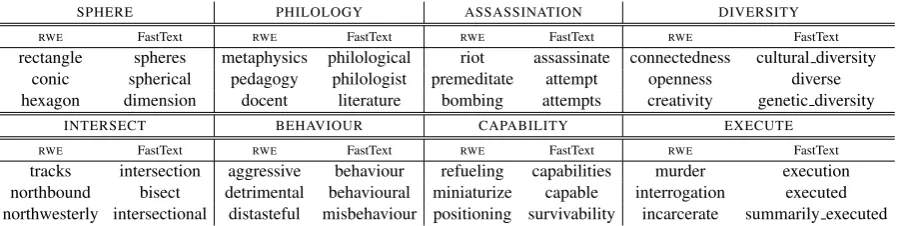
First, we provide an analysis based on the nearest neighbours of selected words in the vector space. Table4shows nearest neighbours of our relational word vectors and the standard FastText embed-dings.13 The table shows that our model captures some subtle properties, which are not normally en-coded in knowledge bases. For example, geomet-ric shapes are clustered together around thesphere vector, unlike in FastText, where more loosely re-lated words such as “dimension” are found. This trend can easily be observed as well in the philol-ogyandassassinationcases.
In the bottom row, we show cases where rela-tional information is somewhat confused with
col-13Recall from Section 4 that both were trained on
SPHERE PHILOLOGY ASSASSINATION DIVERSITY
RWE FastText RWE FastText RWE FastText RWE FastText
rectangle spheres metaphysics philological riot assassinate connectedness cultural diversity
conic spherical pedagogy philologist premeditate attempt openness diverse
hexagon dimension docent literature bombing attempts creativity genetic diversity
INTERSECT BEHAVIOUR CAPABILITY EXECUTE
RWE FastText RWE FastText RWE FastText RWE FastText
tracks intersection aggressive behaviour refueling capabilities murder execution
northbound bisect detrimental behavioural miniaturize capable interrogation executed
[image:8.595.76.526.63.176.2]northwesterly intersectional distasteful misbehaviour positioning survivability incarcerate summarily executed
Table 3: Nearest neighbours for selected words in our relational word embeddings (RWE) and FastText embeddings
locationality, leading to undesired clusters, such as intersect being close in the space with “tracks”, orbehaviour with “aggressive” or “detrimental”. These examples thus point towards a clear direc-tion for future work, in terms of explicitly differ-entiating collocations from other relationships.
6.2 Word Relation Encoding
Unsupervised learning of analogies has proven to be one of the strongest selling points of word em-bedding research. Simple vector arithmetic, or pairwise similarities (Levy et al., 2014), can be used to capture a surprisingly high number of se-mantic and syntactic relations. We are thus in-terested in exploring semantic clusters as they emerge when encoding relations using our rela-tional word vectors. Recall from Section3.2 that relations are encoded using addition and point-wise multiplication of word vectors.
Table 4shows, for a small number of selected word pairs, the top nearest neighbors that were unique to our 300-dimensional relational word vectors. Specifically, these pairs were not found among the top 50 nearest neighbors for the Fast-Text word vectors of the same dimensionality, us-ing the standard vector difference encodus-ing. Sim-ilarly, we also show the top nearest neighbors that were unique to the FastText word vector difference encoding. As can be observed, our relational word embeddings can capture interesting relationships which go beyond what is purely captured by sim-ilarity. For instance, for the pair “innocent-naive” our model includes similar relations such as vain-selfish, honest-hearted or cruel-selfishas nearest neighbours, compared with the nearest neighbours of standard FastText embeddings which are harder to interpret.
Interestingly, even though not explicitly en-coded in our model, the table shows some exam-ples that highlight one property that arises often,
which is the ability of our model to capture co-hyponyms as relations, e.g.,wrist-kneeand anger-despairas nearest neighbours of “shoulder-ankle” and “shock-grief”, respectively. Finally, one last advantage that we highlight is the fact that our model seems to perform implicit disambiguation by balancing a word’s meaning with its paired word. For example, the “oct-feb” relation vec-tor correctly brings together othermonth abbrevia-tionsin our space, whereas in the FastText model, its closest neighbour is ‘doppler-wheels’, a rela-tion which is clearly related to another sense of oct, namely its use as an acronym to refer to ‘opti-cal coherence tomography’ (a type of x-ray proce-dure that uses thedopplereffect principle).
6.3 Lexical Memorization
INNOCENT-NAIVE POLES-SWEDES SHOULDER-ANKLE
RWE FastText RWE FastText RWE FastText
vain-selfish murder-young lithuanians-germans polish-swedish wrist-knee oblique-ligament honest-hearted imprisonment-term germans-lithuanians poland-sweden thigh-knee pick-ankle injury cruel-selfish conspiracy-minded russians-lithuanians czechoslovakia-sweden neck-knee suffer-ankle injury
SHOCK-GRIEF STRENGTHEN-TROPICAL CYCLONE OCT-FEB
RWE FastText RWE FastText RWE FastText
[image:9.595.75.526.62.177.2]anger-despair overcome-sorrow intensify-tropical cyclone name-tropical cyclones aug-nov doppler-wheels anger-sorrow overcome-despair weaken-tropical storm bias-tropical cyclones sep-nov scanner-read anger-sadness moment-sadness intensify-tropical storm scheme-tropical cyclones nov-sep ultrasound-baby
Table 4: Three nearest neighbours for selected word pairs using our relational word vector’s relation encoding (RWE) and the standard vector difference encoding of FastText word embeddings. In each column only the word pairs which were on the top 50 NNs of the given model but not in the other are listed. Relations which include one word from the original pair were not considered.
Encoding Model r ρ
Mult+Avg
RWE 38.8 38.4
Pair2Vec 28.3 26.5
FastText 37.2 35.8
Retrofitting† 29.5* 28.9*
Attract-Repel† 29.7* 28.9*
Mult+Conc Pair2Vec 29.8 30.0
FastText 35.7 33.3
Diff (only) FastText 29.9 30.1
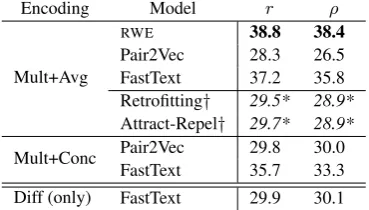
Table 5: Pearson (r) and Spearman (ρ) correlation on a subset of the HyperLex lexical split. Models marked with†use external resources. All models concatenate their encoded representations with the baseline vector difference of standard FastText word embeddings.
For these experiments we considered the same experimental setting as described in Section4. In this case we only considered the portion of the Hy-perLex training and test sets covered in our vocab-ulary14 and used an SVM regression model over the word-based encoded representations. Table5 shows the results for this experiment. Even though the results are low overall (noting e.g. that results for the random split are in some cases above 50% as reported in the literature), our model can clearly generalize better than other models. Interestingly, methods such as Retrofitting and Attract-Repel perform worse than the FastText vectors. This can be attributed to the fact that these models have been mainly tuned towards similarity, which is a feature that loses relevance in this setting. Like-wise, the relation-based embeddings of Pair2Vec do not help, probably due to the high-capacity of their model, which makes the word embeddings less informative.
14Recall from Section4that this vocabulary is shared by
all comparison systems.
7 Conclusions
We have introduced the notion of relational word vectors, and presented an unsupervised method for learning such representations. Parting ways from previous approaches where relational information was either encoded in terms of relation vectors (which are highly expressive but can be more dif-ficult to use in applications), represented by trans-forming standard word vectors (which capture re-lational information only in a limited way), or by taking advantage of external knowledge reposito-ries, we proposed to learn an unsupervised word embedding model that is tailored specifically to-wards modelling relations. Our model is intended to capture knowledge which is complementary to that of standard similarity-centric embeddings, and can thus be used in combination.
We tested the complementarity of our relational word vectors with standard FastText word embed-dings on several lexical semantic tasks, capturing different levels of relational knowledge. The eval-uation indicates that our proposed method indeed results in representations that capture relational knowledge in a more nuanced way. For future work, we would be interested in further explor-ing the behavior of neural architectures for NLP tasks which intuitively would benefit from hav-ing access to relational information, e.g., text clas-sification (Espinosa Anke and Schockaert, 2018; Camacho-Collados et al., 2019) and other guage understanding tasks such as natural lan-guage inference or reading comprehension, in the line ofJoshi et al.(2019).
[image:9.595.89.274.260.365.2]References
Marco Baroni, Georgiana Dinu, and Germ´an Kruszewski. 2014. Don’t count, predict! a systematic comparison of context-counting vs. context-predicting semantic vectors. InProceedings of the 52nd Annual Meeting of the Association for Computational Linguistics, pages 238–247.
Marco Baroni and Alessandro Lenci. 2011. How we blessed distributional semantic evaluation. InProc. GEMS Workshop, pages 1–10.
Piotr Bojanowski, Edouard Grave, Armand Joulin, and Tomas Mikolov. 2017. Enriching word vectors with subword information. Transactions of the Associa-tion for ComputaAssocia-tional Linguistics, 5.
Zied Bouraoui, Shoaib Jameel, and Steven Schockaert. 2018. Relation induction in word embeddings revis-ited. InProceedings of COLING, pages 1627–1637.
Jose Camacho-Collados, Luis Espinosa-Anke, Shoaib Jameel, and Steven Schockaert. 2019. A latent vari-able model for learning distributional relation vec-tors. InProceedings of IJCAI.
Asli Celikyilmaz, Dilek Hakkani-Tr, Panupong Pasu-pat, and Ruhi Sarikaya. 2015. Enriching word em-beddings using knowledge graph for semantic tag-ging in conversational dialog systems. In AAAI Spring Symposium.
Jiaqiang Chen, Niket Tandon, Charles Darwis Hari-man, and Gerard de Melo. 2016. Webbrain: Joint neural learning of large-scale commonsense knowl-edge. InProceedings of ISWC, pages 102–118.
Luis Espinosa Anke and Steven Schockaert. 2018. SeVeN: Augmenting word embeddings with unsu-pervised relation vectors. InProceedings of COL-ING, pages 2653–2665.
Miao Fan, Kai Cao, Yifan He, and Ralph Grishman. 2015. Jointly embedding relations and mentions for knowledge population. In Proceedings of RANLP, pages 186–191.
Manaal Faruqui, Jesse Dodge, Sujay Kumar Jauhar, Chris Dyer, Eduard H. Hovy, and Noah A. Smith. 2015. Retrofitting word vectors to semantic lexi-cons. InProceedings of NAACL, pages 1606–1615.
Christiane Fellbaum, editor. 1998. WordNet: An Elec-tronic Database. MIT Press, Cambridge, MA.
Ruiji Fu, Jiang Guo, Bing Qin, Wanxiang Che, Haifeng Wang, and Ting Liu. 2014. Learning semantic hier-archies via word embeddings. InProceedings of the 52nd Annual Meeting of the Association for Compu-tational Linguistics, pages 1199–1209.
Abhijeet Gupta, Gemma Boleda, Marco Baroni, and Sebastian Pad´o. 2015. Distributional vectors encode referential attributes. In Proceedings of EMNLP, pages 12–21.
Kazuma Hashimoto, Pontus Stenetorp, Makoto Miwa, and Yoshimasa Tsuruoka. 2015. Task-oriented learning of word embeddings for semantic relation classification. In Proceedings of CoNLL, pages 268–278.
Shoaib Jameel, Zied Bouraoui, and Steven Schockaert. 2018. Unsupervised learning of distributional rela-tion vectors. InProceedings of ACL, pages 23–33.
Mandar Joshi, Eunsol Choi, Omer Levy, Daniel S Weld, and Luke Zettlemoyer. 2019. pair2vec: Com-positional word-pair embeddings for cross-sentence inference. InProceedings of NAACL.
Omer Levy, Yoav Goldberg, and Ido Dagan. 2015a. Improving distributional similarity with lessons learned from word embeddings. Transactions of the Association for Computational Linguistics, 3:211– 225.
Omer Levy, Yoav Goldberg, and Israel Ramat-Gan. 2014. Linguistic regularities in sparse and explicit word representations. In Proceedings of CoNLL, pages 171–180.
Omer Levy, Steffen Remus, Chris Biemann, Ido Da-gan, and Israel Ramat-Gan. 2015b. Do supervised distributional methods really learn lexical inference relations? InProceedings of NAACL.
Tal Linzen. 2016. Issues in evaluating semantic spaces using word analogies. In Proceedings of the 1st Workshop on Evaluating Vector-Space Representa-tions for NLP, pages 13–18.
Quan Liu, Hui Jiang, Si Wei, Zhen-Hua Ling, and Yu Hu. 2015. Learning semantic word embeddings based on ordinal knowledge constraints. In Pro-ceedings of ACL, pages 1501–1511.
Ken McRae, George S Cree, Mark S Seidenberg, and Chris McNorgan. 2005. Semantic feature produc-tion norms for a large set of living and nonliving things. Behavior research methods, 37(4):547–559.
Tomas Mikolov, Ilya Sutskever, Kai Chen, Gregory S. Corrado, and Jeffrey Dean. 2013a. Distributed rep-resentations of words and phrases and their compo-sitionality. In Proceedings of NIPS, pages 3111– 3119.
Tomas Mikolov, Wen-tau Yih, and Geoffrey Zweig. 2013b. Linguistic regularities in continuous space word representations. InProceedings of the Annual Conference of the North American Chapter of the Association for Computational Linguistics: Human Language Technologies, pages 746–751.
George A Miller. 1995. WordNet: A lexical database for English. Communications of the ACM, 38(11):39–41.
monolingual and cross-lingual constraints. Transac-tions of the Association of Computational Linguis-tics, 5(1):309–324.
Roberto Navigli and Simone Paolo Ponzetto. 2012. Babelnet: The automatic construction, evaluation and application of a wide-coverage multilingual se-mantic network. Artificial Intelligence, 193:217– 250.
Kim Anh Nguyen, Maximilian K¨oper, Sabine Schulte im Walde, and Ngoc Thang Vu. 2017. Hierarchical embeddings for hypernymy detection and direction-ality. InProceedings of EMNLP, pages 233–243.
Masataka Ono, Makoto Miwa, and Yutaka Sasaki. 2015. Word embedding-based antonym detection using thesauri and distributional information. In
Proceedings of NAACL-HLT, pages 984–989.
Ellie Pavlick, Pushpendre Rastogi, Juri Ganitkevitch, Benjamin Van Durme, and Chris Callison-Burch. 2015. Ppdb 2.0: Better paraphrase ranking, fine-grained entailment relations, word embeddings, and style classification. InProceedings of the 53rd An-nual Meeting of the Association for Computational Linguistics and the 7th International Joint Confer-ence on Natural Language Processing (Volume 2: Short Papers), pages 425–430.
Jeffrey Pennington, Richard Socher, and Christo-pher D. Manning. 2014. GloVe: Global vectors for word representation. InProceedings of EMNLP, pages 1532–1543.
Anna Rogers, Aleksandr Drozd, and Bofang Li. 2017. The (too many) problems of analogical reasoning with word vectors. InProceedings of the 6th Joint Conference on Lexical and Computational Seman-tics (* SEM 2017), pages 135–148.
Stephen Roller, Katrin Erk, and Gemma Boleda. 2014. Inclusive yet selective: Supervised distributional hy-pernymy detection. In Proceedings of COLING, pages 1025–1036.
Dana Rubinstein, Effi Levi, Roy Schwartz, and Ari Rappoport. 2015. How well do distributional mod-els capture different types of semantic knowledge? InProceedings of ACL, pages 726–730.
Vered Shwartz, Yoav Goldberg, and Ido Dagan. 2016. Improving hypernymy detection with an integrated path-based and distributional method. In Proceed-ings of the 54th Annual Meeting of the Association for Computational Linguistics, pages 2389–2398.
Robyn Speer, Joshua Chin, and Catherine Havasi. 2017. Conceptnet 5.5: An open multilingual graph of general knowledge. In Proceedings of AAAI, pages 4444–4451.
Yulia Tsvetkov, Manaal Faruqui, Wang Ling, Guil-laume Lample, and Chris Dyer. 2015. Evaluation of word vector representations by subspace alignment. InProceedings of EMNLP, pages 2049–2054.
Peter D. Turney. 2005. Measuring semantic similarity by latent relational analysis. InProceedings of IJ-CAI, pages 1136–1141.
Peter D. Turney and P. Pantel. 2010. From frequency to meaning: Vector space models of semantics. Jour-nal of Artificial Intelligence Research, 37:141–188.
Tu Vu and Vered Shwartz. 2018. Integrating mul-tiplicative features into supervised distributional methods for lexical entailment. In Proceedings of the Seventh Joint Conference on Lexical and Com-putational Semantics, pages 160–166.
Ivan Vuli´c, Daniela Gerz, Douwe Kiela, Felix Hill, and Anna Korhonen. 2017. Hyperlex: A large-scale evaluation of graded lexical entailment. Computa-tional Linguistics, 43(4):781–835.
Ivan Vulic and Nikola Mrksic. 2018. Specialising word vectors for lexical entailment. In Proceedings of NAACL-HLT, pages 1134–1145.
Ekaterina Vylomova, Laura Rimell, Trevor Cohn, and Timothy Baldwin. 2016. Take and took, gaggle and goose, book and read: Evaluating the utility of vec-tor differences for lexical relation learning. In Pro-ceedings of ACL, pages 1671–1682.
Koki Washio and Tsuneaki Kato. 2018a. Filling miss-ing paths: Modelmiss-ing co-occurrences of word pairs and dependency paths for recognizing lexical se-mantic relations. InProceedings of the 2018 Con-ference of the North American Chapter of the Asso-ciation for Computational Linguistics: Human Lan-guage Technologies, pages 1123–1133.
Koki Washio and Tsuneaki Kato. 2018b. Neural latent relational analysis to capture lexical semantic rela-tions in a vector space. InProceedings of the 2018 Conference on Empirical Methods in Natural Lan-guage Processing, pages 594–600.
Julie Weeds, Daoud Clarke, Jeremy Reffin, David Weir, and Bill Keller. 2014. Learning to distinguish hy-pernyms and co-hyponyms. In Proceedings of the 25th International Conference on Computational Linguistics, pages 2249–2259.
Jason Weston, Antoine Bordes, Oksana Yakhnenko, and Nicolas Usunier. 2013. Connecting language and knowledge bases with embedding models for re-lation extraction. InProceedings of EMNLP, pages 1366–1371.
John Wieting, Mohit Bansal, Kevin Gimple, and Karen Livescu. 2016. Towards universal paraphrastic sen-tence embeddings. InProceedings of ICLR.