Minimum Bayes-risk System Combination
Jes ´us Gonz´alez-Rubio Instituto Tecnol´ogico de Inform´atica
U. Polit`ecnica de Val`encia 46022 Valencia, Spain [email protected]
Alfons Juan Francisco Casacuberta D. de Sistemas Inform´aticos y Computaci´on
U. Polit`ecnica de Val`encia 46022 Valencia, Spain {ajuan,fcn}@dsic.upv.es
Abstract
We presentminimum Bayes-risk system com-bination, a method that integrates consen-sus decoding and system combination into a unified multi-system minimum Bayes-risk (MBR) technique. Unlike other MBR meth-ods that re-rank translations of a single SMT system, MBR system combination uses the MBR decision rule and a linear combina-tion of the component systems’ probability distributions to search for the minimum risk translation among all the finite-length strings over the output vocabulary. We introduce ex-pected BLEU, an approximation to the BLEU score that allows to efficiently apply MBR in these conditions. MBR system combination is a general method that is independent of spe-cific SMT models, enabling us to combine systems with heterogeneous structure. Exper-iments show that our approach bring sig-nificant improvements to single-system-based MBR decoding and achieves comparable re-sults to different state-of-the-art system com-bination methods.
1 Introduction
Once statistical models are trained, a decoding ap-proach determines what translations are finally se-lected. Two parallel lines of research have shown consistent improvements over the max–derivation decoding objective, which selects the highest prob-ability derivation. Consensus decodingprocedures select translations for a single system with a mini-mum Bayes risk (MBR) (Kumar and Byrne, 2004).
System combination procedures, on the other hand, generate translations from the output of multiple component systems by combining the best frag-ments of these outputs (Frederking and Nirenburg,
1994). In this paper, we present minimum Bayes risk system combination, a technique that unifies these two approaches by learning a consensus trans-lation over multiple underlying component systems. MBR system combination operates directly on the outputs of the component models. We perform an MBR decoding using a linear combination of the component models’ probability distributions. In-stead of re-ranking the translations provided by the component systems, we search for the hypothesis with the minimum expected translation error among all the possible finite-length strings in the target lan-guage. By using a loss function based on BLEU (Pa-pineni et al., 2002), we avoid the hypothesis align-ment problem that is central to standard system com-bination approaches (Rosti et al., 2007). MBR sys-tem combination assumes only that each translation model can produce expectations ofn-gram counts; the latent derivation structures of the component sys-tems can differ arbitrary. This flexibility allows us to combine a great variety of SMT systems.
The key contributions of this paper are three: the usage of a linear combination of distributions within the MBR decoding, which allows multiple SMT models to be involved in, and makes the computa-tion of n-grams statistics to be more accurate; the decoding in an extended search space, which allows to find better hypotheses than the evidences pro-vided by the component models; and the use of an expected BLEU score instead of the sentence-wise BLEU, which allows to efficiently apply MBR de-coding in the huge search space under consideration. We evaluate in a multi-source translation task ob-taining improvements of up to+2.0BLEU abs. over the best single system max-derivation, and state-of-the-art performance in the system combination task of the ACL 2010 workshop on SMT.
2 Related Work
MBR system combination is a multi-system gener-alization of MBR decoding where the space of hy-potheses is not constrained to the space of evidences. We expand the space of hypotheses following some underlying ideas of system combination techniques.
2.1 Minimum Bayes risk
In SMT, MBR decoding allows to minimize the loss of the output for a single translation system. MBR is generally implemented by re-ranking anN -best list of translations produced by a first pass de-coder (Kumar and Byrne, 2004). Different tech-niques to widen the search space have been de-scribed (Tromble et al., 2008; DeNero et al., 2009; Kumar et al., 2009; Li et al., 2009). These works extend the traditional MBR algorithms based onN -best lists to work with lattices.
The use of MBR to combine the outputs of vari-ous MT systems has also been explored previvari-ously. Duan et al. (2010) present an MBR decoding that makes use of a mixture of different SMT systems to improve translation accuracy. Our technique differs in that we use a linear combination instead of a mix-ture, which avoids the problem of component sys-tems not sharing the same search space; perform the decoding in a search space larger than the outputs of the component models; and optimize an expected BLEU score instead of the linear approximation to it described in (Tromble et al., 2008).
DeNero et al. (2010) presentmodel combination, a multi-system lattice MBR decoding on the con-joined evidences spaces of the component systems. Our technique differs in that we perform the search in an extended search space not restricted to the pro-vided evidences, have fewer parameters to learn, and optimizes an expected BLEU score instead of the linear BLEU approximation.
Another MBR-related technique to combine the outputs of various MT systems was presented by Gonz´alez-Rubio and Casacuberta (2010). They use different median string (Fu, 1982) algorithms to combine various machine translation systems. Our approach differs in that we take into account the pos-terior distribution over translations instead of con-sidering each translation equally likely, optimize the expected BLEU score instead of a sentence-wise
measure such as the edit distance or the sentence-level BLEU, and take into account the quality dif-ferences by associating a tunable scaling factor to each system.
2.2 System Combination
System combination techniques in MT take as in-put the outin-puts{e1,· · · ,eN}ofN translation
sys-tems, where en is a structured translation object
(or N-best lists thereof), typically viewed as a se-quence of words. The dominant approach in the field chooses a primary translationepas a backbone,
then finds an alignmentanto the backbone for each
en. A new search space is constructed from these
backbone-aligned outputs and then a voting proce-dure of feature-based model predicts a final consen-sus translation (Rosti et al., 2007). MBR system combination entirely avoids this alignment prob-lem by considering hypotheses as n-gram occur-rence vectors rather than word sequences. MBR sys-tem combination performs the decoding in a larger search space and includes statistics from the compo-nents’ posteriors, whereas system combination tech-niques typically do not.
Despite these advantages, system combination may be more appropriate in some settings. In par-ticular, MBR system combination is designed pri-marily for statistical systems that generate N-best or lattice outputs. MBR system combination can in-tegrate non-statistical systems that generate either a single or an unweighted output. However, we would not expect the same strong performance from MBR system combination in these constrained settings.
3 Minimum Bayes risk Decoding
MBR decoding aims to find the candidate hypothesis that has the least expected loss under a probability model (Bickel and Doksum, 1977). We begin with a review of MBR for SMT.
proba-bility modelP(e|f), MBR decoding has the follow-ing form (Goel and Byrne, 2000; Kumar and Byrne, 2004):
ˆ
e= arg min e0∈E
R(e0) (1)
= arg min e0∈E
X
e∈E
P(e|f)· L(e,e0), (2)
where R(e0) denotes the Bayes risk of candidate translation e0 under loss function L, and E repre-sents the space of translations.
If the loss function between any two hypotheses can be bounded: L(e,e0) ≤ Lmax, the MBR
de-coder can be rewritten in term of a similarity func-tion S(e,e0) = Lmax− L(e,e0). In this case,
in-stead of minimizing the Bayes risk, we maximize the Bayes gainG(e0):
ˆ
e= arg max e0∈E
G(e0) (3)
= arg max e0∈E
X
e∈E
P(e|f)· S(e,e0). (4)
MBR decoding can use different spaces for hy-pothesis selection and gain computation (arg max
and summatory in Eq. (4)). Therefore, the MBR de-coder can be more generally written as follows:
ˆ
e= arg max e0∈E
h
X
e∈Ee
P(e|f)· S(e,e0), (5)
whereEhrefers to the hypotheses space form where
the translations are chosen andEerefers to the
evi-dences space that is used to compute the Bayes gain. We will investigate the expansion of the hypotheses space while keeping the evidences space as provided by the decoder.
4 MBR System Combination
MBR system combination is a multi-system gener-alization of MBR decoding. It uses the MBR de-cision rule on a linear combination of the probabil-ity distributions of the component systems. Unlike existing MBR decoding methods that re-rank trans-lation outputs, MBR system combination search for the minimum risk hypotheses on the complete set of finite-length hypotheses over the output vocabulary. We assume the component systems to be statistically independent and define the Bayes gain as a linear
combination of the Bayes gains of the components. Each system provides its own space of evidences
Dn(f)and its posterior distribution over translations
Pn(e|f). Given a sentencef in the source language,
MBR system combination is written as follows:
ˆ
e= arg max e0∈E
h
G(e0) (6)
≈arg max e0∈E
h
N
X
n=1
αn· Gn(e0) (7)
= arg max e0∈E
h
N
X
n=1 αn·
X
e∈Dn(f)
Pn(e|f)· S(e,e0), (8)
whereN is the total number of component systems, Ehrepresents the hypotheses space where the search
is performed, Gn(e0) is the Bayes gain of
hypothe-sise0 given by thenthcomponent system andαnis
a scaling factor introduced to take into account the differences in quality of the component models. It is worth mentioning that by using a linear combination instead of a mixture model, we avoid the problem of component systems not sharing the same search space (Duan et al., 2010).
MBR system combination parameters training and decoding in the extended hypotheses space are described below.
4.1 Model Training
We learn the scaling factors in Eq. (8) using min-imum error rate training (MERT) (Och, 2003). MERT maximizes the translation quality of ˆeon a held-out set, according to an evaluation metric that compares to a reference set. We used BLEU, choos-ing the scalchoos-ing factors to maximize BLEU score of the set of translations predicted by MBR sys-tem combination. We perform the maximization by means of the down-hill simplex algorithm (Nelder and Mead, 1965).
4.2 Model Decoding
Algorithm 1MBR system combination decoding.
Require: Initial hypothesise
Require: Vocabulary the evidencesΣ
1: ˆe←e 2: repeat 3: ecur←ˆe
4: forj= 1to|ecur|do
5: ˆes←ecur
6: fora∈Σdo
7: e0s←Substitute(ecur, a, j)
8: ifG(e0s)>G(ˆes)then
9: ˆes←e0s
10: ˆed←Delete(ecur, j)
11: ˆei ←ecur
12: fora∈Σdo
13: e0i←Insert(ecur, a, j)
14: ifG(e0i)>G(ˆei)then
15: ˆei ←e0i
16: ˆe←arg maxe0∈{e
cur,eˆs,ˆed,eˆi}G(e
0)
17: untilG(ˆe)6>G(ecur)
18: return ecur
Ensure: G(ecur)≥ G(e)
using the approximate median string (AMS) algo-rithm (Mart´ınez et al., 2000). AMS algoalgo-rithm per-form a search on a hypotheses space equal to the free monoidΣ∗ of the vocabulary of the evidences
Σ =V oc(Ee).
The AMS algorithm is shown in Algorithm 1. AMS starts with an initial hypothesisethat is mod-ified using edit operations until there is no improve-ment in the Bayes gain (Lines3–16). On each posi-tionj of the current solutionecur, we apply all the
possible single edit operations: substitution of the jthword of ecur by each wordain the vocabulary
(Lines5–9), deletion of thejth word ofecur (Line
10) and insertion of each wordain the vocabulary in thejthposition ofecur(Lines11–15). If the Bayes
gain of any of the new edited hypotheses is higher than the Bayes gain of the current hypothesis (Line
17), we repeat the loop with this new hypothesese,ˆ
in other case, we return the current hypothesis. AMS algorithm takes as input an initial hypothe-siseand the combined vocabulary of the evidences spaces Σ. Its output is a possibly new hypothesis whose Bayes gain is assured to be higher or equal than the Bayes gain of the initial hypothesis.
The complexity of the main loop (lines 2-17) is O(|ecur| · |Σ| ·CG), whereCG is the cost of
com-puting the gain of a hypothesis, and usually only a moderate number of iterations (< 10) is needed to converge (Mart´ınez et al., 2000).
5 Computing BLEU-based Gain
We are interested in performing MBR system com-bination under BLEU. BLEU behaves as a score function: its value ranges between 0 and 1 and a larger value reflects a higher similarity. Therefore, we rewrite the gain function G(·) using single evi-dence (or reference) BLEU (Papineni et al., 2002) as the similarity function:
Gn(e0) =
X
e∈Dn(f)
Pn(e|f)·BLEU(e,e0) (9)
BLEU=
4
Y
k=1
mk
ck
14
·mine1−rc,1.0
, (10)
whereris the length of the evidence,cthe length of the hypothesis, mk the number of n-gram matches
of sizek, and ck the count ofn-grams of sizekin
the hypothesis.
The evidences space Dn(f) may contain a huge
number of hypotheses1which often make impracti-cal to compute Eq. (9) directly. To avoid this prob-lem, Tromble et al. (2008) proposelinear BLEU, an approximation to the BLEU score to efficiently per-form MBR decoding when the search space is repre-sented with lattices. However, our hypotheses space is the full set of finite-length strings in the target vo-cabulary and can not be represented in a lattice.
In Eq. (9), we have one hypothesise0that is to be compared to a set of evidences e ∈ Dn(f) which
follow a probability distribution Pn(e|f). Instead
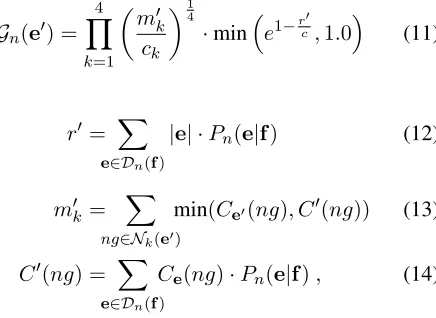
of computing the expected BLEU score by calcu-lating the BLEU score with respect to each of the evidences, our approach will be to use the expected n-gram counts and sentence length of the evidences to compute a single-reference BLEU score. We re-place the reference statistics (r andmnin Eq. (10))
by the expected statistics (r0andm0n) given the
pos-1For example, in a lattice the number of hypotheses may be
terior distributionPn(e|f)over the evidences:
Gn(e0) =
4
Y
k=1
m0k ck
14
·mine1−r
0
c,1.0
(11)
r0 = X e∈Dn(f)
|e| ·Pn(e|f) (12)
m0k= X
ng∈Nk(e0)
min(Ce0(ng), C0(ng)) (13)
C0(ng) = X e∈Dn(f)
Ce(ng)·Pn(e|f), (14)
whereNk(e0) is the set ofn-grams of sizekin the
hypothesis,Ce0(ng)is the count of then-gramngin
the hypothesis andC0(ng)is the expected count of ngin the evidences. To compute then-gram match-ings m0k, the count of each n-gram is truncated, if necessary, to not exceed the expected count for that n-gram in the evidences.
We have replaced a summation over a possibly ex-ponential number of items (e0 ∈ Dn(f)in Eq. (9))
with a summation over a polynomial number of n-grams that occur in the evidences2. Both, the ex-pected length of the evidencesr0 and their expected n-gram countsm0kcan be pre-computed efficiently fromN-best lists and translation lattices (Kumar et al., 2009; DeNero et al., 2010).
6 Experiments
We report results on a multi-source translation task. From the Europarl corpus released for the ACL 2006 workshop on MT (WMT2006), we se-lect those sentence pairs from the German–English (de–en), Spanish–English (es–en) and French– English (fr–en) sub-corpora that share the same En-glish translation. We obtain a multi-source corpus with German, Spanish and French as source lan-guages and English as target language. All the ex-periments were carried out with the lowercased and tokenized version of this corpus.
We report results using BLEU (Papineni et al., 2002) and translation edit rate (Snover et al., 2006) (TER). We measure statistical significance using
2IfD
n(f)is represented by a lattice, the number ofn-grams is polynomial in the number of edges in the lattice.
System dev test
BLEU TER BLEU TER
de→en MAX 25.3 60.5 25.6
∗ 60.3
MBR 25.1 60.7 25.4∗ 60.5
es→en MAX 30.9
∗ 53.3∗ 30.4∗ 53.9∗
MBR 31.0∗ 53.4∗ 30.4∗ 54.0∗
fr→en MAX 30.7
∗ 53.9∗ 30.8∗ 53.4∗
[image:5.612.314.538.59.177.2]MBR 30.7∗ 53.8∗ 30.9∗ 53.4∗
Table 1: Performance of base systems.
Approach dev test
BLEU TER BLEU TER Best MAX 30.9∗ 53.3∗ 30.8∗ 53.4∗ Best MBR 31.0∗ 53.4∗ 30.9∗ 53.4∗ MBR-SC 32.3 52.5 32.8 52.3
Table 2: Performance from best single system max-derivation decoding (Best MAX), the best single system minimum Bayes risk decoding (Best MBR) and mini-mum Bayes risk system combination (MBR-SC) combin-ing three systems.
95% confidence intervals computed using paired bootstrap re-sampling (Zhang and Vogel, 2004). In all table cells (except for Table 3) systems without statistically significant differences are marked with the same superscript.
6.1 Base Systems
We combine outputs from three systems, each one translating from one source language (German, Spanish or French) into English. Each individual system is a phrase-based system trained using the Moses toolkit (Koehn et al., 2007). The parame-ters of the systems were tuned using MERT (Och, 2003) to optimize BLEU on the development set. Each base system yields state-of-the-art perfor-mance, summarized in Table 1. For each system, we report the performance of max-derivation decod-ing (MAX) and1000-best3 MBR decoding (Kumar and Byrne, 2004).
6.2 Experimental Results
Table 2 compares MBR system combination (MBR-SC) to the best MAX and MBR systems. Both Best
3Ehling et al. (2007) studied up to10000-best and show that the
[image:5.612.79.297.87.246.2] [image:5.612.319.538.204.274.2]Setup BLEU TER
Best MBR 30.9 53.4
[image:6.612.73.299.59.173.2]MBR-SC Expected 30.9 53.5 MBR-SC E/Conjoin 32.4 52.1 MBR-SC E/C/evidences-best 30.9 53.5 MBR-SC E/C/hypotheses-best 31.8 52.5 MBR-SC E/C/Extended 32.7 52.3 MBR-SC E/C/Ex/MERT 32.8 52.3
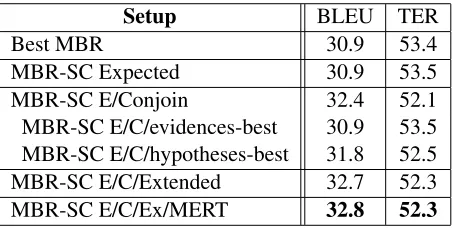
Table 3: Results on the test set for different setups of minimum Bayes risk system combination.
MBR and MBR-SC were computed on 1000-best lists. MBR-SC uses expected BLEU as gain func-tion using the conjoined evidences spaces of the three systems to compute expected BLEU statistics. It performs the search in the free monoid of the out-put vocabulary, and its model parameters were tuned using MERT on the development set. This is the standard setup for MBR system combination, and we refer to it as MBR-SC-E/C/Ex/MERT in Table 3. MBR system combination improves single Best MAX system by+2.0BLEU points in test, and al-ways improves over MBR. This improvement could arise due to multiple reasons: the expected BLEU gain, the larger evidences space, the extended hy-potheses space, or the MERT tuned scaling factor values. Table 3 teases apart these contributions.
We first apply MBR-SC to the best system (MBR-SC-Expected). Best MBR and MBR-SC-Expected differ only in the gain function: MBR uses sentence level BLEU while MBR-SC-Expected uses the ex-pected BLEU gain described in Section 5. MBR-SC-Expected performance is comparable to MBR decoding on the1000-best list from the single best system. The expected BLEU approximation per-forms as well as sentence-level BLEU and addition-ally requires less total computation.
We now extend the evidences space to the con-joined1000-best lists (SC-E/Conjoin). MBR-SC-E/Conjoin is much better than the best MBR on a single system. This implies that either the ex-pected BLEU statistics computed in the conjoined evidences space are stronger or the larger conjoined evidences spaces introduce better hypotheses.
When we restrict the BLEU statistics to be com-puted from only the best system’s evidences space
(MBR-SC-E/C/evidences-best), BLEU scores dra-matically decrease relative to MBR-SC-E/Conjoin. This implies that the expected BLEU statistics com-puted over the conjoined1000-best lists are stronger than the corresponding statistics from the single best system. On the other hand, if we restrict the search space to only the 1000-best list of the best sys-tem (MBR-SC-E/C/hypotheses-best), BLEU scores also decrease relative to MBR-SC-E/Conjoin. This implies that the conjoined search space also con-tains better hypotheses than the single best system’s search space.
These results validate our approach. The linear combination of the probability distributions in the conjoined evidences spaces allows to compute much stronger statistics for the expected BLEU gain and also contains some better hypotheses than the single best system’s search space does.
30.5 31 31.5 32 32.5 33
100 101 102 103
BLEU
[image:7.612.315.542.61.136.2]Number of hypotheses in the N-best lists Best MAX MBR-SC MBR-SC C/Extended MBR-SC Conjoin
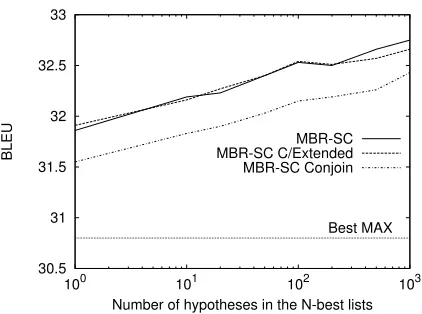
Figure 1: Performance of minimum Bayes risk system combination (MBR-SC) for different sizes of the evi-dences space in comparison to other MBR-SC setups.
MBR-SC-E/C/Ex/MERT is the standard setup for MBR system combination and, from now, on we will refer to it as MBR-SC.
We next evaluate performance of MBR system combination onN-best lists of increasing sizes, and compare it to SC-E/C/Extended and MBR-SC-E/Conjoin in the sameN-best lists. We list the results of the Best MAX system for comparison.
Results in Figure 1 confirm the conclusions ex-tracted from results displayed in Table 3. MBR-SC-Conjoin is consistently better than the Best MAX system, and differences in BLEU increase with the size of the evidences space. This implies that the linear combination of posterior probabilities al-low to compute stronger statistics for the expected BLEU gain, and, in addition, the larger the evi-dences space is, the stronger the computed statistics are. MBR-SC-C/Extended is also consistently better than MBR-SC-Conjoin with an almost constant im-provement of+0.4 BLEU points. This result show that the extended search space always contains bet-ter hypotheses than the conjoined evidences spaces; also confirms the soundness of Algorithm 1 that al-lows to reach them. Finally, MBR-SC also slightly improves MBR-SC-C/Extended. The optimization of the scaling factors allows only small improve-ments in BLEU.
Figure 2 display the MBR system combination translation and compare it to the max-derivation translations of the three component systems. Refer-ence translation is also listed for comparison.
MBR-MAX de→en i will return later .
MAX es→en i shall come back to that later . MAX fr→en i will return to this later . MBR-SC i will return to this point later . Reference i will return to this point later .
Figure 2: MBR system combination example.
SC adds word “point” to create a new translation equal to the reference. MBR-SC is able to detect that this is valuable word even though it does not appear in the max-derivation hypotheses.
6.3 Comparison to System Combination
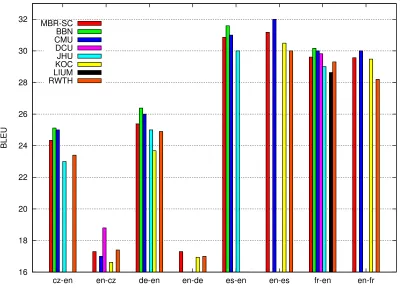
Figure 3 compares MBR system combination (MBR-SC) with state-of-the-art system combination techniques presented to the system combination task of the ACL 2010 workshop on MT (WMT2010). All system combination techniques build a “word sausage” from the outputs of the different compo-nent systems and choose a path trough the sausage with the highest score under different models. A de-scription of these systems can be found in (Callison-Burch et al., 2010).
In this task, the output of the component systems are single hypotheses or unweighted lists thereof. Therefore, we lack of the statistics of the com-ponents’ posteriors which is one of the main ad-vantages of MBR system combination over sys-tem combination techniques. However, we find that, even in these constrained setting, MBR system com-bination performance is similar to the best sys-tem combination techniques for all translation di-rections. These experiments validate our approach. MBR system combination yields state-of-the-art performance while avoiding the challenge of align-ing translation hypotheses.
7 Conclusion
[image:7.612.83.294.62.219.2]16 18 20 22 24 26 28 30 32
cz-en en-cz de-en en-de es-en en-es fr-en en-fr
BLEU
[image:8.612.108.508.67.356.2]MBR-SC BBN CMU DCU JHU KOC LIUM RWTH
Figure 3: Performance of minimum Bayes risk system combination (MBR-SC) for different language directions in comparison to the rest of system combination techniques presented in the WMT2010 system combination task.
strings in the output vocabulary. Component sys-tems can have varied decoding strategies; we only require that each system produce anN-best list (or a lattice) of translations. This flexibility allows the technique to be applied quite broadly. For instance, Leusch et al. (2010) generate intermediate transla-tions in several pivot languages, translate them sep-arately into the target language, and generate a con-sensus translation out of these using a system combi-nation technique. Likewise, these pivot translations could be combined via MBR system combination.
MBR system combination has two significant ad-vantages over current approaches to system combi-nation. First, it does not rely on hypothesis align-ment between outputs of individual systems. Align-ing translation hypotheses can be challengAlign-ing and has a substantial effect on combination perfor-mance (He et al., 2008). Instead of aligning the sen-tences, we view the sentences as vectors ofn-gram counts and compute the expected statistics of the BLEU score to compute the Bayes gain. Second, we do not need to pick a backbone system for
combina-tion. Choosing a backbone system can also be chal-lenging and also affects system combination per-formance (He and Toutanova, 2009). MBR system combination sidesteps this issue by working directly on the conjoined evidences space produced by the outputs of the component systems, and allows the consensus model to express system preferences via scaling factors.
Despite its simplicity, MBR system combination provides strong performance by leveraging different consensus, decoding and training techniques. It out-performs best MAX or MBR derivation on each of the component systems. In addition, it obtains state-of-the-art performance in a constrained setting better suited for dominant system combination techniques.
Acknowledgements
under grant 20091027 and the FPU scholarship AP2006-00691. Also supported by the Spanish MITyC under the erudito.com (TSI-020110-2009-439) project and by the Generalitat Valenciana under grant Prometeo/2009/014.
References
Peter J. Bickel and Kjell A Doksum. 1977. Mathe-matical statistics : basic ideas and selected topics. Holden-Day, San Francisco.
Chris Callison-Burch, Philipp Koehn, Christof Monz, Kay Peterson, Mark Przybocki, and Omar F. Zaidan. 2010. Findings of the 2010 joint workshop on sta-tistical machine translation and metrics for machine translation. InProceedings of the Joint Fifth Workshop on Statistical Machine Translation and MetricsMATR, pages 17–53, Morristown, NJ, USA. Association for Computational Linguistics.
John DeNero, David Chiang, and Kevin Knight. 2009. Fast consensus decoding over translation forests. In
Proceedings of the Joint Conference of the 47th An-nual Meeting of the ACL and the 4th International Joint Conference on Natural Language Processing of the AFNLP: Volume 2 - Volume 2, pages 567–575, Morristown, NJ, USA. Association for Computational Linguistics.
John DeNero, Shankar Kumar, Ciprian Chelba, and Franz Och. 2010. Model combination for machine trans-lation. InHuman Language Technologies: The 2010 Annual Conference of the North American Chapter of the Association for Computational Linguistics, pages 975–983, Morristown, NJ, USA. Association for Com-putational Linguistics.
Nan Duan, Mu Li, Dongdong Zhang, and Ming Zhou. 2010. Mixture model-based minimum bayes risk de-coding using multiple machine translation systems. In
Proceedings of the 23rd International Conference on Computational Linguistics (Coling 2010), pages 313– 321, Beijing, China, August. Coling 2010 Organizing Committee.
Nicola Ehling, Richard Zens, and Hermann Ney. 2007. Minimum bayes risk decoding for bleu. In Proceed-ings of the 45th Annual Meeting of the ACL on Inter-active Poster and Demonstration Sessions, pages 101– 104, Morristown, NJ, USA. Association for Computa-tional Linguistics.
Robert Frederking and Sergei Nirenburg. 1994. Three heads are better than one. InProceedings of the fourth conference on Applied natural language processing, pages 95–100, Morristown, NJ, USA. Association for Computational Linguistics.
K.S. Fu. 1982. Syntactic Pattern Recognition and Appli-cations. Prentice Hall.
Vaibhava Goel and William J. Byrne. 2000. Minimum bayes-risk automatic speech recognition. Computer Speech & Language, 14(2):115–135.
Jes´us Gonz´alez-Rubio and Francisco Casacuberta. 2010. On the use of median string for multi-source transla-tion. In In Proceedings of the International Confer-ence on Pattern Recognition (ICPR2010), pages 4328– 4331.
Xiaodong He and Kristina Toutanova. 2009. Joint opti-mization for machine translation system combination. In Proceedings of the 2009 Conference on Empirical Methods in Natural Language Processing: Volume 3 - Volume 3, pages 1202–1211, Morristown, NJ, USA. Association for Computational Linguistics.
Xiaodong He, Mei Yang, Jianfeng Gao, Patrick Nguyen, and Robert Moore. 2008. Indirect-hmm-based hy-pothesis alignment for combining outputs from ma-chine translation systems. InProceedings of the Con-ference on Empirical Methods in Natural Language Processing, pages 98–107, Morristown, NJ, USA. As-sociation for Computational Linguistics.
Philipp Koehn, Hieu Hoang, Alexandra Birch, Chris Callison-Burch, Marcello Federico, Nicola Bertoldi, Brooke Cowan, Wade Shen, Christine Moran, Richard Zens, Chris Dyer, Ondˇrej Bojar, Alexandra Con-stantin, and Evan Herbst. 2007. Moses: open source toolkit for statistical machine translation. In Proceed-ings of the 45th Annual Meeting of the ACL on Inter-active Poster and Demonstration Sessions, pages 177– 180, Morristown, NJ, USA. Association for Computa-tional Linguistics.
Shankar Kumar and William J. Byrne. 2004. Minimum bayes-risk decoding for statistical machine translation. InHLT-NAACL, pages 169–176.
Shankar Kumar, Wolfgang Macherey, Chris Dyer, and Franz Och. 2009. Efficient minimum error rate train-ing and minimum bayes-risk decodtrain-ing for translation hypergraphs and lattices. InProceedings of the Joint Conference of the 47th Annual Meeting of the ACL and the 4th International Joint Conference on Natural Lan-guage Processing of the AFNLP: Volume 1 - Volume 1, pages 163–171, Morristown, NJ, USA. Association for Computational Linguistics.
Gregor Leusch, Aur´elien Max, Josep Maria Crego, and Hermann Ney. 2010. Multi-pivot translation by sys-tem combination. InInternational Workshop on Spo-ken Language Translation, Paris, France, December. Zhifei Li, Jason Eisner, and Sanjeev Khudanpur. 2009.
Process-ing of the AFNLP: Volume 2 - Volume 2, pages 593– 601, Morristown, NJ, USA. Association for Computa-tional Linguistics.
C. D. Mart´ınez, A. Juan, and F. Casacuberta. 2000. Use of Median String for Classification. InProceedings of the 15th International Conference on Pattern Recog-nition, volume 2, pages 907–910, Barcelona (Spain), September.
John A. Nelder and Roger Mead. 1965. A Simplex Method for Function Minimization. The Computer Journal, 7(4):308–313, January.
Franz Josef Och and Hermann Ney. 2001. Statistical multi-source translation. In In Machine Translation Summit, pages 253–258.
Franz J. Och. 2003. Minimum error rate training in statistical machine translation. InProceedings of the 41st Annual Meeting on Association for Computa-tional Linguistics - Volume 1, pages 160–167, Morris-town, NJ, USA. Association for Computational Lin-guistics.
Kishore Papineni, Salim Roukos, Todd Ward, and Wei-Jing Zhu. 2002. BLEU: a method for automatic evaluation of machine translation. In Proceedings of the 40th Annual Meeting on Association for Compu-tational Linguistics, pages 311–318, Morristown, NJ, USA. Association for Computational Linguistics. Antti-Veikko Rosti, Necip Fazil Ayan, Bing Xiang,
Spy-ros Matsoukas, Richard Schwartz, and Bonnie Dorr. 2007. Combining outputs from multiple machine translation systems. In Human Language Technolo-gies 2007: The Conference of the North American Chapter of the Association for Computational Lin-guistics; Proceedings of the Main Conference, pages 228–235, Rochester, New York, April. Association for Computational Linguistics.
Matthew Snover, Bonnie Dorr, Richard Schwartz, Lin-nea Micciulla, and Ralph Weischedel. 2006. A study of translation error rate with targeted human annota-tion. InIn Proceedings of the Association for Machine Transaltion in the Americas.
Roy W. Tromble, Shankar Kumar, Franz Och, and Wolf-gang Macherey. 2008. Lattice minimum bayes-risk decoding for statistical machine translation. In Pro-ceedings of the Conference on Empirical Methods in Natural Language Processing, pages 620–629, Mor-ristown, NJ, USA. Association for Computational Lin-guistics.