A determination of fundamental constants using
HD
+ion and atomic hydrogen spectroscopy
data
Florin Lucian Constantin1,*
1Laboratoire PhLAM, CNRS UMR 8523, 59655 Villeneuve d’Ascq, France
Abstract. A determination of fundamental constants using HD+ ion
spectroscopy data is discussed from comparisons between precision measurements and accurate theoretical predictions by taking into account recent measurements and updated CODATA values of the fundamental constants. The deuteron-proton mass ratio is determined with an uncertainty of 10-9. The ratio between the HD+ reduced mass and the
electron mass is determined with an uncertainty of 7.3 × 10⁻¹⁰. The
Rydberg constant, the proton-electron mass ratio and the deuteron-electron mass ratio are consistently determined with 10-9, 10-6, and 10-6 level
uncertainties from an adjustment of the (v,L)=(0,0)→(0,1) and (v,L)=(0,2)→(8,3) HD+ ion transitions and of the
(n,l,j,f)=1S1/2f=1→2S1/2f=1 atomic hydrogen transition. The result of the
adjustment provides a test of the consistency of the two-body and three-body quantum electrodynamics energy level calculations for the atomic hydrogen and the HD+ ion.
1 Introduction
The comparison between the results of precision measurements with atoms and molecules and the predictions of the quantum electrodynamics (QED) allowed to test the validity of the theory and to determine the values of fundamental constants [1]. The hydrogen molecular ions are the simplest three-body quantum systems. Ab-initio calculations of their energy levels in their electronic ground state can be performed accurately. The frequencies of the fundamental rovibrational transitions of H2+ and HD+ ions can be predicted with an uncertainty by 8 × 10⁻¹² [2]. The determination of fundamental constants, especially of the proton-electron mass ratio, as it was proposed by [3], is performed through a comparison between experimental data and theoretical predictions. The experimental setups with hydrogen molecular ions maintained in radiofrequency traps and sympathetically cooled by laser-cooled Be+ ions provided accurate experimental data. Some HD+ transitions have been measured by Doppler spectroscopy : (v,L)=(0,2)→(4,3) with 2.3 × 10⁻⁹ uncertainty [4], (v,L)=(0,0)→(1,1) with 1.1 × 10⁻⁹
uncertainty [5] and (v,L)=(0,2)→(8,3) with 1.1 × 10⁻⁹ uncertainty [6, 7]. Recently, HD+ rotational spectroscopy in the Lamb-Dicke regime of the transition (v,L)=(0,0)→(0,1) pushed the uncertainty at 3 × 10⁻¹⁰ [8] and allowed a determination of the proton-electron mass ratio with an uncertainty at the 10-9 level.
This contribution addresses the determination of fundamental constants by exploiting HD+ spectroscopy data. On one hand, the values of theoretical frequencies of HD+ transitions have been recalculated recently [9] by using CODATA 2014 recommended values of fundamental constants [1] and by taking into consideration additional QED correction terms. This contribution proposes a determination of the deuteron-proton mass ratio from a comparison between calculated and experimental frequencies of HD+. On the other hand, the energy levels of atomic hydrogen and deuterium have been accurately predicted by two-body QED calculations (see, for example [1]) and some transitions have been very accurately measured. For example, the 1S-2S H transition have been measured with 4.2 × 10⁻¹⁵ uncertainty [10], the H-D isotopic shift of the 1S-2S transition with an uncertainty of 2.2 × 10⁻¹¹ [11] and the 1S-3S H transition with 4.4 × 10⁻¹² uncertainty [12]. This contribution demonstrates that a determination of several fundamental constants is possible by merging in an adjustment HD+ spectroscopy data and atomic hydrogen spectroscopy data. The agreement between the determined values of fundamental constants and the CODATA values can be interpreted as a check of the consistency of two-body and three-body QED calculations and of the validity of the experimental results.
2 Energy levels, sensitivities to constants, and
theory-spectroscopy data
The energy levels of HD+ ions may be expressed with three-body QED calculations as a series expansion [13-18] :
2 0 d fs d 2 0 p fs p de pe QED 2 de pe nr a r A a r A µ , µ α, F α µ , µ E R E (1)that depends on the Rydberg constant R∞, the proton-electron mass ratio µpe = mp/me, the deuteron-electron mass ratio µde = md/me, the fine-structure constant α, the proton radius rp, the deuteron radius rd, and the Bohr radius a0 = α/4πR∞. The first term is the nonrelativistic energy, the next term is a series expansion of relativistic and QED corrections expressed with α, Zp,dα (Zp,d is the nuclear charge of the proton or deuteron), and me/mp,d. The function FQED contains terms proportional with natural powers αp, with logarithmic expressions αplnq(Z
p,dα)-r depending on natural powers of p, q and r, and with natural powers (me/mp,d)k, respectively. The last two terms in Eq. (1) are the leading-order corrections for the finite-size of the proton and the deuteron. The dependence is proportional to the square of the ratio between the nuclear charge radius and the Bohr radius. The coefficients fs
d , p A are proportional with the squared density of the wavefunction at the electron-to-nucleus coalescence point.
The non-relativistic energy can be calculated by solving the three-body Schrödinger equation using a variational approach [13]. The accuracy of the calculations has been improved by taking into account relativistic and radiative corrections of orders R∞α2 and R∞α3, and, partially, of order R∞α4 as well as contributions arising from the finite-size structure of the proton and deuteron [14]. All corrections of order R∞α4 were estimated in [15] using the adiabatic approximation [16]. The accuracy was improved by taking into account corrections of order R∞α5 [17, 18], and second-order perturbation terms in the
adiabatic approximation and corrections of order R∞α6 [19], respectively. The recalculated frequencies of HD+ transitions [9] that are exploited in this contribution have a theoretical accuracy of about 8 × 10-12.
The sensitivity coefficient of a transition at frequency f to a constant c is :
0 0 0 c c f dcdf c K (2)
Here, the frequency f0 is calculated with the set of the recommended values of fundamental constants {c0} given by CODATA. The sensitivities to proton-electron mass ratio and deuteron-proton mass ratios have been derived in [13]. Here the sensitivities of rotational and rovibrational transitions to both nuclear-to-electron mass ratios are exploited. Referring to the electron mass instead to the proton mass is currently more interesting because the accuracy of the value of the electron mass has been improved in CODATA 2014. The approach requires to use new sensitivity coefficients, which are expressed using the chain rule for differential calculus :
pe pe pe dp de µ dp µ de µ dp µ pe µ pe lnµ lnf lnµ lnf lnµ lnf lnµ lnf lnµ lnf
(3)
At the first sight, Eq. (1) may be used to determine both µpe and µde, by combining measurements of different transitions of HD+, but that is not true. In fact, the non-relativistic HD+ rovibrational energies may be expressed solely in function of the ratio between the reduced mass and the electron mass µre µpeµde
µpeµde
using the adiabatic approximation [16]. Consequently, µre is the natural choice for a mass ratio that can be inferred from HD+ ions. The corresponding sensitivity coefficient is derived using the chain rule for differential calculus :dp µ pe re lnµ lnf dlnµ dlnf (4)
Atomic hydrogen and deuterium energy levels are expressed with two-body QED calculations as a sum of terms depending on the principal quantum number n, the orbital quantum number l and the total angular momentum quantum number j :
2 C d , p 4 d , p 3 e r 2 e NS 0 l 3 NS e r 2 r Z m m h 3 c m 2 E n E j , l, n m m n c R h j , l, n E (5)Herec is the speed of light in vacuum. The first term corresponds to the Bohr energy corrected for the finite mass of the nucleus with a term mr me mp,d
mp,dme
. Thesecond term corresponds to the fine structure energy. The contributions arise from the Dirac energy from which mass energy is subtracted, the relativistic recoil corrections, the one-photon electron self-energy, the hadronic and leptonic vacuum polarization, the two and three-photon corrections, the radiative recoil corrections, the self-energy of the nucleus and the higher-order finite nuclear size corrections, which are discussed in [1, 20, 21]. The last term corresponds to the leading order correction for the finite nuclear size, that is expressed on the last line of Eq. (5). Here C is the Compton wavelength divided by 2. The
previous formula is used here to calculate atomic hydrogen and deuterium energy levels using CODATA 2014 values of the fundamental constants. The uncertainties of the theoretical calculations are given in [1], Table XVI. The theoretical accuracy is determined by the two-loop QED corrections.
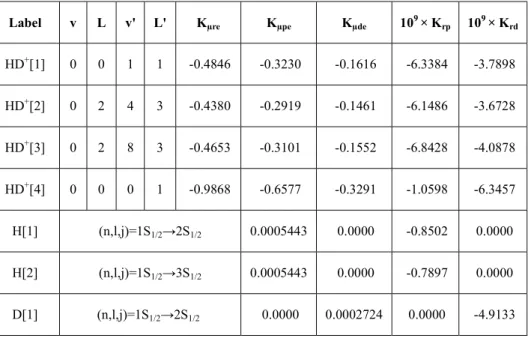
Table 1. Sensitivity coefficients to constants for selected HD+ ion,
atomic hydrogen, and deuterium transitions.
Label v L v' L' Kµre Kµpe Kµde 109 × Krp 109 × Krd
HD+[1] 0 0 1 1 -0.4846 -0.3230 -0.1616 -6.3384 -3.7898 HD+[2] 0 2 4 3 -0.4380 -0.2919 -0.1461 -6.1486 -3.6728 HD+[3] 0 2 8 3 -0.4653 -0.3101 -0.1552 -6.8428 -4.0878 HD+[4] 0 0 0 1 -0.9868 -0.6577 -0.3291 -1.0598 -6.3457 H[1] (n,l,j)=1S1/2→2S1/2 0.0005443 0.0000 -0.8502 0.0000 H[2] (n,l,j)=1S1/2→3S1/2 0.0005443 0.0000 -0.7897 0.0000 D[1] (n,l,j)=1S1/2→2S1/2 0.0000 0.0002724 0.0000 -4.9133 The sensitivity coefficients to different constants for some HD+ transitions that have been measured previously are calculated here by using Eq. (1-4) and shown in Table 1. The values of the sensitivity coefficients for the non-relativistic HD+ energy levels to µ
pe and µdp are taken from [13], that provides calculations up to v=4 level. The term F
QED brings a negligible contribution to the values of the sensitivity coefficients to µpe, µde, and µre, respectively. The sensitivity coefficients to α are not addressed here. The sensitivity coefficients to R∞ are assumed for all HD+ transitions to be equal to 1. The sensitivity coefficients to rp and rd are derived using finite-size correction parameters from [14]. The sensitivity coefficients for the (v,L)=(0,2)→(8,3) transition are obtained by extrapolation of calculations up to v=4 level using a polynomial dependence on v of the 4th degree. The value of the sensitivity to µpe calculated by extrapolation is higher by 24% than the value reported in [9]. In addition, the sensitivity coefficients to different constants for selected atomic hydrogen and deuterium transitions are calculated using Eq. (2,5) and shown also in Table 1. The sensitivity coefficients to R∞ are assumed to be equal to 1, because of the common factor mec2 in all terms of the two-body QED calculations. Note that the
sensitivities to µpe for the (n,l,j)=1S1/2→nS1/2 atomic hydrogen transitions have the same value, while the sensitivities to rp have different values.
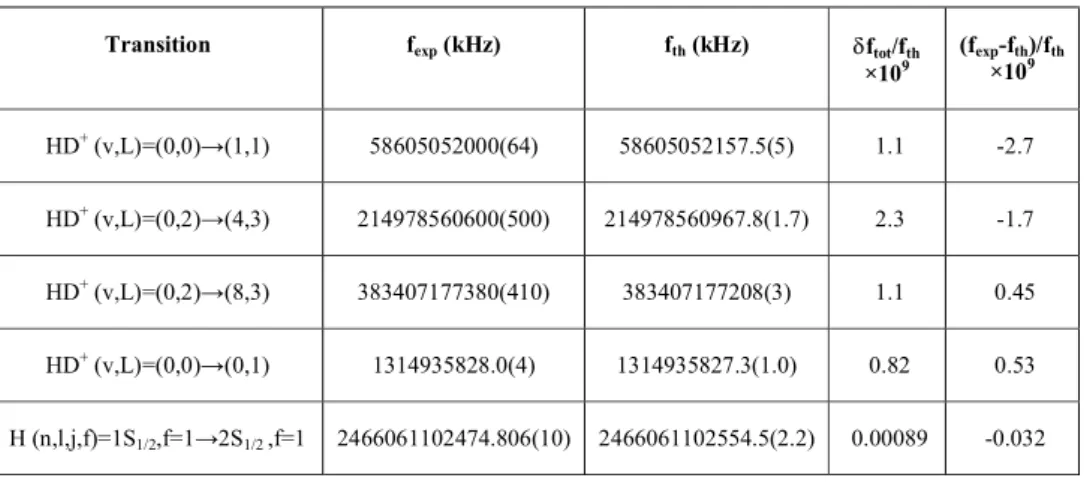
Table 2. Comparison between experimental and theoretical data. The uncertainties on the last digits are given in parentheses.
Transition fexp (kHz) fth (kHz) ftot/fth
×109 (fexp×10-fth9)/fth HD+ (v,L)=(0,0)→(1,1) 58605052000(64) 58605052157.5(5) 1.1 -2.7 HD+ (v,L)=(0,2)→(4,3) 214978560600(500) 214978560967.8(1.7) 2.3 -1.7 HD+ (v,L)=(0,2)→(8,3) 383407177380(410) 383407177208(3) 1.1 0.45 HD+ (v,L)=(0,0)→(0,1) 1314935828.0(4) 1314935827.3(1.0) 0.82 0.53 H (n,l,j,f)=1S1/2,f=1→2S1/2 ,f=1 2466061102474.806(10) 2466061102554.5(2.2) 0.00089 -0.032
Experimental frequencies for HD+ transitions measured previously are shown in Table 2, together with their absolute uncertainties. The contribution of the hyperfine structure is subtracted to yield the value of the rotational or rovibrational frequency. The experiments are described in [4-7]. The theoretical predictions for the frequencies of these HD+ transitions and their absolute uncertainties are taken from [8, 9] and shown in Table 2. For the transition (v,L)=(0,0)→(0,1), the experimental uncertainty is lower than the theoretical uncertainty. The fractional uncertainty for each transition, shown on the fourth column of Table 2, is the ratio between the quadratic sum of the theoretical and experimental uncertainties and the theoretical frequency. The last column of Table 2 gives the offsets between each experimental result and theoretical prediction, relative to the corresponding theoretical prediction. The transition (v,L)=(0,0)→(1,1) has an uncertainty of 1.1 × 10⁻⁹ and the largest relative offset of 2.3 × 10⁻⁹. The transition (v,L)=(0,0)→(0,1) has an offset of 0.53 × 10⁻⁹ and the smallest uncertainty of 0.81 × 10⁻⁹.
This contribution addresses the hyperfine component of the atomic hydrogen transition (n,l,j,f)=1S1/2f=1→2S1/2f=1, which has been measured with 10 Hz accuracy [10]. Linking the experimental frequency to the theoretical prediction allowed a determination of the Rydberg constant using the equation [21] :
kHz ) 17 ( 2294 310712 kHz ) 2 2 ( 2 22989501 4 3 kHz ) 10 ( 806 474 2466061102 . . . m cm R . e r (6)
The second line of the previous equation contains contributions from a R∞-driven gross structure term and from the difference between the corresponding fine structure and finite nuclear size theoretical energies. The third line corresponds to the difference between the corresponding hyperfine structure energies and is determined from measurements of 1S and 2S atomic hydrogen hyperfine intervals. Note that the theoretical values indicated in Eq. (6) are calculated [21] using a value of rp = 0.84087(39) fm provided by measurements in
muonic hydrogen [22], which differs significantly and is more precise than the value of rp provided by CODATA 2014. However, the binding energies of the 1S and 2S hyperfine states of the atomic hydrogen change by the same amount when rp is changed from the muonic hydrogen value to the CODATA value [21]. Data concerning the atomic hydrogen transition is reproduced on the last line of Table 2.
3 Results and discussion
The frequencies of the HD+ ion and of the atomic hydrogen and deuterium transitions depend on six fundamental constants: R∞, µpe, µde, α, rp, and rd. The values of R∞, α, rp, rd may be determined from other physical systems with an accuracy that is orders of magnitude better than the accuracy provided by HD+ ion spectroscopy results. These fundamental constants are fixed to their CODATA 2014 values [1] and the approach is focused on the determination of mass ratios.
A number of N1 transitions, for which the frequencies were measured and calculated, are used to determine a number of N2 fundamental constants using a least-squares adjustment similar to that of CODATA. The dependence of the transition frequencies on the constants is linearized and expressed in a matrix form Y = AX, where Y = {y1,y2,…,yN1} is a column of N1 elements yi = (fi−fi,0)/fi,0, and X = {x1,x2,…,xN2} is a column with N2 elements xj = (cj−cj,0)/cj,0. A is the N1 × N2 sensitivity matrix with elements aij = d(lnf0,i)/d(lnc0,j). The covariance matrix G of the solution Xˆ is expressed in terms of the covariance matrix of the input data V and the sensitivity matrix as :
G
ATV1A
1 (7)The covariance matrix of the input data V is constructed as follows : the uncertainty is the root-mean-square sum of the experimental and theoretical uncertainties and the covariances are given by the covariances of the predictions. It is assumed here that the experimental frequencies are not correlated and the correlation coefficients of the theoretical frequencies are equal to 1. The correlation arises from the uncalculated terms in the energy levels that are expressed in terms of a common factor arising, for example, from the overlapping of the electron wavefunction with the extended nuclear charge distribution. The solution of the least squares adjustment in the linear approximation is expressed as :
Xˆ GATV1Y (8)
Values for the reduced mass µre of the HD+ ion may be determined from adjustments of HD+ transitions, as it is shown in Table 3 (a). The accuracy of the determination is beyond the 10-9 level by using all measured HD+ rotational and rovibrational transitions. The results are exploited to determine a value of µdp using the accurate CODATA 2014 value for µde :
re de 2 re re 2 de de de dp dp re de dp µ µ µ δµ µ δµ µ µ δµ 1 µ µ µ (9)The second line of the last equation gives the accuracy of µdp determination, which is calculated using the uncertainty propagation law by assuming that µde and µre values are not correlated. The results of the adjustments are shown in Table 3 (b). The lowest uncertainty
of the determination of µdp is 1 × 10⁻⁹ and remains about the same value if all HD+ data or only the HD+ (v,L)=(0,0)→(0,1) rotational transition is adjusted. For comparison, the uncertainty of the determination of µpe using rovibrational HD+ transitions [9] is more than 2.5 times higher. The HD+ transition (v,L)=(0,0)→(1,1), with a discrepancy between the theoretical prediction and the measured frequency, leads to a higher ratio between the deviation between the determined µdp and the CODATA 2014 µdp value and the absolute uncertainty of the µdp.
Table 3. Determination of µre and µdp from HD+ ion spectroscopy data. The second column gives
the adjusted values of the constants with their uncertainties in parentheses. The quantity 1µ= (µ/µ) × 109 indicates the fractional uncertainty of the adjusted constant and the quantity
2µ= (µ - µC14)/µ is the ratio between the deviation of the value of the constant from the
corresponding value given by CODATA 2014 and the uncertainty of the adjusted constant. (a) Adj. µre 1µre 2µre HD+[1] 1223.8992357(28) 2.3 2.5 HD+[2] 1223.8992337(65) 5.3 0.74 HD+[3] 1223.8992277(28) 2.3 -0.42 HD+[4] 1223.8992283(10) 0.83 -0.65 HD+[3,4] 1223.89922820(96) 0.78 -0.75 HD+[1-4] 1223.89922908(90) 0.73 0.18 (b) Adj. µdp 1µdp 2µdp HD+[1] 1.9990074842(68) 3.4 -2.5 HD+[2] 1.999007489(16) 8.0 -0.74 HD+[3] 1.9990075037(69) 3.4 0.42 HD+[4] 1.9990075024(25) 1.2 0.65 HD+[3,4] 1.9990075026(23) 1.2 0.75 HD+[1-4] 1.9990075004(22) 1.1 -0.18
Merging all HD+ ion data and the atomic hydrogen data from Table 2 in an adjustment may allow conjoint determination of µpe and µde. The uncertainty of the determination is
(µpe, µde) = (1.5 × 10⁻⁹, 5.0 × 10⁻⁹). The adjustment leads to significant deviations between the adjusted values of the constants and the corresponding values given by CODATA 2014. The ratios between these deviations and the CODATA 2014 values of the corresponding constants, expressed as C14µ = (µ - µC14)/µC14, have the following values (C14µpe, C14µde) = (-6.1 × 10⁻⁸, 1.2 × 10⁻⁷). They are higher than the CODATA 2014 uncertainties of the corresponding constants. This inconsistency can be related to the calculation of the energy levels or to unevaluated systematic frequency shifts.
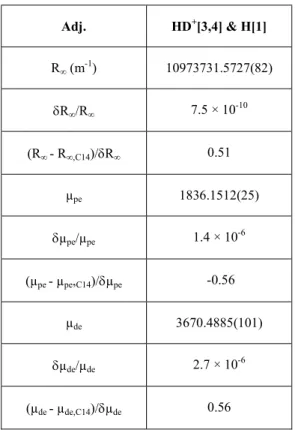
The Rydberg constant appears as a common factor in the expression of atomic hydrogen and HD+ ion energy levels, acting as a converter between two-body QED calculations and three-body QED calculations. The most accurate experimental data, that is the (v,L)=(0,0)→(0,1) and (v,L)=(0,2)→(8,3) HD+ transitions, and the atomic hydrogen (n,l,j,f)=1S1/2f=1→2S1/2f=1 transition, is exploited here for an adjustment of R∞, µpe, µde. The results are shown in Table 4. The deviations between the determined values of the constants and the corresponding CODATA 2014 values and the absolute uncertainties of the constants have the same order of magnitude. The uncertainties of the adjusted constants are (R∞, µpe, µde) = (7.5 × 10⁻¹⁰, 1.4 × 10⁻⁶, 2.7 × 10⁻⁶). The proton and deuteron radii are highly correlated to the Rydberg constant in the CODATA 2014 adjustment. The expected deviations induced on rp, rd by the change of the value of the Rydberg constant are smaller than the uncertainties of rp, rd, respectively. The result of this adjustment can be interpreted as a test of the consistency of the two-body and three-body QED energy level calculations in atoms and molecules.
Table 4. Determination of R∞, µpe and µde from HD+ ion and atomic H spectroscopy data. The lines of
the table give the adjusted value of each constant with the uncertainty on the last digits in parentheses, the fractional uncertainty, and the ratio between the deviation of the adjusted constant from its
CODATA 2014 value and the uncertainty of the adjusted constant, respectively. Adj. HD+[3,4] & H[1] R∞ (m-1) 10973731.5727(82) R∞/R∞ 7.5 × 10⁻¹⁰ (R∞ - R∞,C14)/R∞ 0.51 µpe 1836.1512(25) µpe/µpe 1.4 × 10⁻⁶ (µpe - µpe,C14)/µpe -0.56 µde 3670.4885(101) µde/µde 2.7 × 10⁻⁶ (µde - µde,C14)/µde 0.56
4 Conclusion
Determination of fundamental constants is discussed by exploiting comparisons between theoretical and experimental frequencies for HD+ ion and atomic hydrogen. The value of µdp is determined with an uncertainty of 1.1 × 10⁻⁹ by exploiting four HD+ rotational and rovibrational transitions. This uncertainty is 12 times higher than the uncertainty of the CODATA 2014 value of µdp. In addition, the dependence of the HD+ energy levels on the reduced mass is exploited for a determination of the ratio between the reduced mass and the electron mass with an uncertainty of 7.3 × 10⁻¹⁰. An adjustment of HD+ ion and atomic hydrogen data provides a determination of R
∞, µpe, µde with uncertainties of 7.5 × 10⁻¹⁰, 1.4 × 10⁻⁶, and 2.7 × 10⁻⁶, respectively. This adjustment may be interpreted as a consistency test of the values of CODATA 2014 fundamental constants and of the two-body and three-body QED energy level calculations. A further step would be to exploit two-photon spectroscopy of H2+ and HD+ to determine conjointly R∞, µpe, µde, rp and rd, as it was suggested in [22, 23]. This approach will provide new clues in the proton and deuteron radius puzzle [24] and will allow new tests of the quantum electrodynamics [25].
References
1. P.J. Mohr, D.B. Newell, B.N. Taylor, Rev. Mod. Phys. 88, 035009 (2016) 2. V.I. Korobov, L. Hilico, J.-Ph. Karr, Phys. Rev. Lett. 118, 233001 (2017)
3. W.H. Wing, G.A. Ruff, W.E. Lamb jr., J.J. Spezeski, Phys. Rev. Lett. 36, 1488 (1976) 4. J.C.J. Koelemeij, B. Roth, A. Wicht, I. Ernsting, S. Schiller, Phys. Rev. Lett. 98,
173002 (2007)
5. U. Bressel, A. Borodin, J. Shen, M. Hansen, I. Ernsting, S. Schiller, Phys. Rev. Lett. 108, 183003 (2012)
6. J. Biesheuvel, J.-Ph. Karr, L. Hilico, K.S.E. Eikema, W. Ubachs, J.C.J. Koelemeij, Nat. Commun. 7, 10385 (2016)
7. J. Biesheuvel, J.-Ph. Karr, L. Hilico, K.S.E. Eikema, W. Ubachs, J.C.J. Koelemeij, Appl. Phys. B 123, 23 (2017)
8. S. Alighanbari, M. Hansen, V.I. Korobov, S. Schiller, Nat. Phys. 18, 74 (2018)
9. S. Patra, J.-Ph. Karr, L. Hilico, M. Germann, V.I. Korobov, J.C.J. Koelemeij, J. Phys. B: At. Mol. Opt. Phys. 51, 024003 (2018)
10. C.G. Parthey et al, Phys. Rev. Lett. 107, 203001 (2011) 11. C.G. Parthey et al, Phys. Rev. Lett. 104, 233001 (2010)
12. O. Arnoult, F. Nez, L. Julien, F. Biraben, Eur. Phys. J. D 60, 243 (2010) 13. S. Schiller, V. Korobov, Phys. Rev. A 71, 032505 (2005)
14. V.I. Korobov, Phys. Rev. A 74, 052506 (2006) 15. V.I. Korobov, Phys. Rev. A 77, 022509 (2008)
16. C.A. Leach, R.E. Moss, Annu. Rev. Phys. Chem. 46, 55 (1995) 17. V.I. Korobov, L. Hilico, J.-Ph. Karr, Phys. Rev. A 89, 032511 (2014) 18. V.I. Korobov, L. Hilico, J.-Ph. Karr, Phys. Rev. Lett. 112, 103003 (2014)
19. V.I. Korobov, J.C.J. Koelemeij, L. Hilico, J.-Ph. Karr, Phys. Rev. Lett. 116, 053003 (2016)
20. M.I. Eides, H. Grotch, V. Shelyuto, Theory of light hydrogenlike atoms, in Springer Tracts in Modern Physics, vol. 222 (Springer, Berlin, 2006)
21. M. Horbatsch, E.A. Hessels, Phys. Rev. A 93, 022513 (2016)
22. R. Pohl et al, Nature 466, 213 (2010); A. Antognini et al, Science 339, 417 (2013) 23. J.-Ph. Karr, L. Hilico, J.C.J. Koelemeij, V.I. Korobov, Phys. Rev. A 94, 050501(R)
(2016)
25. R. Pohl et al, Metrologia 54, L1 (2017)