Effect of Initial Microstructure on Mg Scroll Forging
under Warm Forming Condition
Jonghun Yoon
+and Junghwan Lee
Korea Institute of Material Science, 797 Changwondaero, Changwon, Gyeongnam 642-831, Korea
Magnesium (Mg) alloys have attracted considerable interest for various applications, including those in the automotive and electronics industries, because of their high specific strength, excellent thermal conductivity, and recycling capability in comparison with commonly used aluminum alloys and steels for structural materials. One of the core parts in the compressor unit of an automobile is the scroll rotor, which is assembled with two scrolls, a rotating orbit scroll on thefixed scroll, to compress the refrigerant. In this study, we proposed a net-shape forging process and an apparatus with the back-pressure technique for the Mg scroll at a forging temperature of 350°C with an Mg6Al1Zn extruded billet. The optimum amount of back-pressure is calibrated byfinite element analysis using DEFORM-3D, which enhances the wrap height distribution in the Mg scroll uniformly. To elucidate the effect of the initial texture on the forgeability of the Mg scroll, twin-induced and dynamic recrystallization (DRX)-induced specimens are applied in Mg scroll forging, where the formability of the Mg scroll with the DRX-induced specimen is found to be noticeably improved in terms of the wrap height. [doi:10.2320/matertrans.M2013274]
(Received July 22, 2013; Accepted November 12, 2013; Published December 20, 2013)
Keywords: scroll rotor, magnesium alloy, warm forging, twin induced, dynamic recrystallization
1. Introduction
A scroll compressor, which is a device for compressing air or a refrigerant in air-conditioning equipment or an automobile supercharger, has attracted great interest from the viewpoint of replacing the small-capacity reciprocating compressor and rotary compressor because of its high efficiency, low vibration and noise, and low torque.13) A
scroll compressor uses two interleaving scrolls such as the
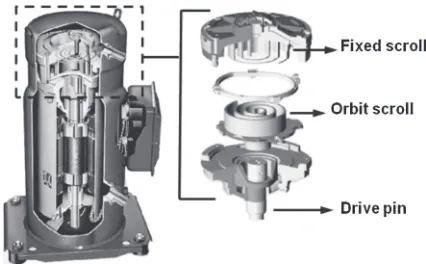
fixed and orbit scrolls to pressurize liquids and gases; the orbit scroll revolves around the fixed scroll eccentrically to trap and compress pockets of fluid between two scrolls. It not only provides volumetric efficiency, because a pair of scrolls operates in a small space, but also operates more quietly and reliably than conventional compressors because the gas compression processes in the scroll compressor are continuous. Figure 1 shows the schematic diagram of the compressor scroll.4)Because the orbit scroll revolves around the fixed scroll more than 10,000 times per minute, the decrease in the scroll weight remarkably enhances the compressor efficiency in terms of consuming electricity and increases the controllability of the scroll compressor.
The cast iron scroll has been replaced by a forged scroll with aluminum alloys to reduce the weight and improve the efficiency of the scroll compressor. Leeet al.5)manufactured
the orbit scroll with B390 material by direct squeeze casting. They investigated the sound casting temperature of 600°C in which many defects were found in the wrap at higher melt temperatures, because the solidified shell in the wrap hindered the furtherfilling of the melt at higher temperature. With massive demands for adopting scroll compressors into an automobile, it is essential to reduce the total weight of the scroll compressor with high compressor performance. When revolving, the orbit scroll is replaced by Mg alloys, which leads to a remarkable reduction in weight and a low moment of inertia.
It has been essential to make a uniform wrap height with high dimensional accuracy when applying the warm forging process for the Mg scroll, since it does not only require a lot of time for the mechanical machining for guaranteeing the
final dimension, but also consume a large amount of material to satisfy the minimum warp height as the non-uniformity of the wrap height increases.
There are various approaches to minimize the variation of the wrap height during the warm forging process. Yoshimura and Tanaka6)demonstrated precision forging with the
back-pressure method for an aluminum scroll, where they proposed 4080% deformation resistance of spiral wrap as a back-pressure during the warm forging process to prevent under-fill of the front end as well as wrinkles in the outer surface of spiral wraps. Mureet al.7)forged the Mg scroll by adopting the air vent in the mold, which enables a uniform height of the scroll vane. In this paper, a back-pressure is applied to the Mg billet for controlling material flow along the extruded direction, which tends to minimize the variation in wrap height.
In this paper, net-shape forging for the Mg scroll is introduced with the back-pressure method at the forging tem-perature of 350°C, which is simulated with the
DEFORM-Fig. 1 Schematic diagram of scroll compressor.4)
[image:1.595.320.533.337.469.2]pressure in advance. In order to verify the forging conditions and dimensional accuracy of the final product, Mg scrolls were forged at a 1000-ton press shop with Mg6Al1Zn alloy and then compared with the simulated results. The optimum forging conditions for the Mg scroll are proposed with the back-pressure method to induce uniform deformation in the wrap height during warm forging. To elucidate the effect of the initial texture of the Mg billet on the forgeability of the Mg scroll, twin-induced and recrystallized specimens are prepared and applied in the test experiment.
2. Mg Scroll Forging
Forging of a sound scroll requires uniform variation in warp height, which indicates the height of the scroll vane, as shown in Fig. 2, with a one-stage forging procedure. As the non-uniformity of the wrap height increases, it not only consumes a large amount of material to satisfy the minimum warp height but also requires a lot of time for the mechanical machining to guarantee the post-processing accuracy of the
final dimension. In this research, optimum back-pressure is applied against the materialflow direction during the forging process to minimize the non-uniformity of the wrap height.
Mg alloys have been fabricated under elevated temper-atures because of insufficient formability at room temperature due to a limited number of slip systems in the hexagonal close-packed (HCP) structure. In this research, the target temperature for the Mg scroll is maintained at around 350°C because the mechanical properties of the forged Mg scroll such as the yield and ultimate tensile strengths are considerably influenced by the forging temperature. The excess increase in the forging temperature degrades the mechanical properties and induces local ignition from the low incipient melting of Mg17Al12in AZ alloy. On the other hand,
it does not satisfy the minimum wrap height of the scroll at a forging temperature below 250°C owing to low formability, which induces local fracture during the forging test.
2.1 FE analysis of Mg scroll forging
Prior to the test experiment for the Mg scroll forging, a
finite element (FE) analysis is conducted to determine the amount of back-pressure for the net-shape Mg scroll with DEFORM-3D commercial software which is one of the effective rigid-plastic codes for numerical analysis of forging process with severe plastic deformation since the forging analysis such as the Mg scroll forging requires powerful remeshing function to make the convergence. Cylindrical
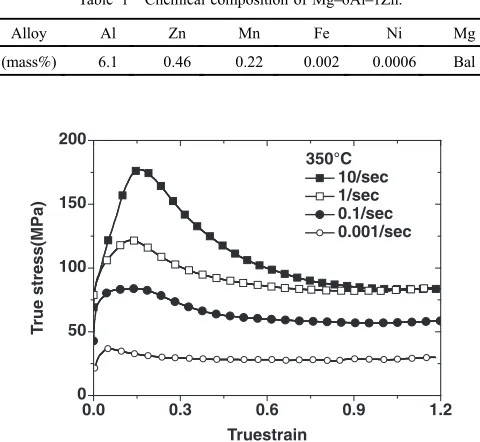
billets with a diameter of 87 mm and height of 14.9 mm are prepared as the initial specimens, which are sliced from the extruded round bar with Mg6Al1Zn alloy. Table 1 shows the chemical composition of Mg6Al1Zn alloy. Thermo-mechanical properties at the forming temperature of 350°C are obtained from the compression tests with a Gleeble3800 machine that maintains the temperature within «1°C and guarantees a constant strain rate during the test. These thermomechanical properties are then applied in the FE analysis. Figure 3 shows the flow curves of Mg6Al1Zn alloy depending on the strain rates from the Gleeble tests, which are applied to the DEFORM-3D with the piecewise linear data to take consideration of the strain rate effect during the forging analysis. The flow stress increases to a peak due to the dominance of work hardening in the initial stage of plastic deformation. When deformation exceeds the peak strain, the flow stress decreases at a rate that reduces with increasing strain as softening caused by the dynamic recrystallization (DRX) overtakes hardening caused by work hardening. Then, it shows a steady state owing to the equilibrium of work softening and work hardening.8,9)In the
current rigid-plastic formulations, flow curve softening originated from the dynamic recrystallization during warm forging condition is considered as the decrease offlow stress compared with theflow stress at the previous numerical step since the DEFORM-3D code is not able to keep trace of the texture evolution and recrystallization numerically.
To investigate the variation of the wrap height closely with respect to the increase in back-pressure, a three-dimensional full FE model is used in the simulation with 60,000 tetrahedron elements, in which the local remeshing technique with the maximum mesh size of 1 mm is adopted for enhancing the simulation accuracy during the analysis. At the
final punch stroke, the number of meshes reaches 140,000. Assuming the graphite lubricant in the forging test, the applied friction coefficient between the mold and billet is 0.15.
0.0 0.3 0.6 0.9 1.2
0 50
Truestrain
T
rue stress(MPa)
[image:2.595.110.229.70.173.2] [image:2.595.307.547.76.297.2]Figure 4 demonstrates the sequential forging process with respect to the increase in the punch stroke. A specific amount of back-pressure is applied on the top of the wrap using a pressure pad to impose a reaction force against materialflow, which induces uniform material flow into the die cavity and wrap height. Applying the back-pressure against the extruded material flow mainly acts on the wrap with higherflow rate than the other, which decelerates the rate of material flow. With these mechanisms, higher wrap height tends to be lower and the lower becomes higher since the volume constancy is reserved.
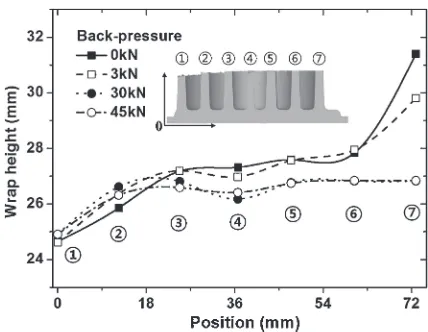
To calibrate the amount of back-pressure for the uniform wrap height, we increase it from 0 to 45 kN in the FE simulations. Figure 5 shows the deformed shapes on the sectional plane of the Mg scrolls according to the increase in back-pressure, where the deviation between the maximum and the minimum wrap heights decreases as the applied back-pressure increases. For the quantitative comparison, wrap height distributions are compared with each other for the increase in the back-pressure, as shown in Fig. 6. With a back-pressure of 30 kN, all wraps are extruded more than 25 mm uniformly with the same punch stroke of 7.9 mm. The effective back-pressure of 30 kN is applied in the test experiments for the Mg scrolls because the increase in the back-pressure results in an excessive punch load during the
tests, although it enhances the uniformity of the wrap heights. It is noted that the back-pressure technique is comparably effective in the warm forging to manufacture the net-shape Mg scroll because it is able to impose the back-pressure selectively on the different lengths of the wraps.
2.2 Mg scroll forging
With the calibrated back-pressure from the FE simulations, the Mg scrolls are warm-forged at 350°C in the 1000-ton press shop with cylindrical billets with a diameter of 87 mm and a height of 14.9 mm sliced from extruded Mg6Al1Zn rods. Initial billets are coated with the graphite to minimize the friction between the billet and die-set during the forging process. It takes 2 h to elevate the temperature of the die-set to 350°C by direct injecting flame with a gas torch. Simultaneously, the prepared initial billets are heated up to 350°C separately in the heating chamber next to the press-shop for guaranteeing the isothermal forging condition. Because the head speed of the 1000-ton press is up to 32 mm/s, the working time is less than 1 s after the initial specimen is transferred from the heating chamber to the die-set.
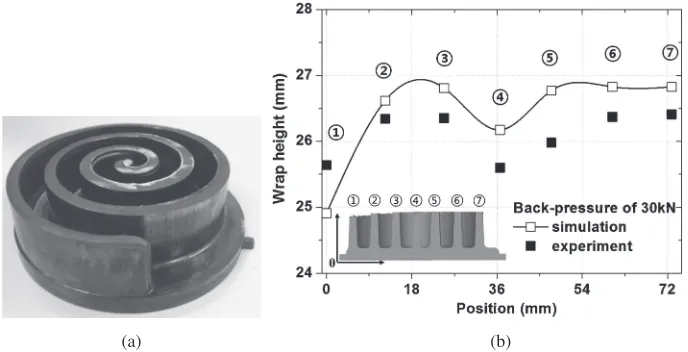
Figure 7 shows the comparison results of the wrap height distributions between the experiment and simulation in the forged Mg scrolls at 350°C. The results show noticeably good agreement, except for the wrap height at the position of 0 and 36 mm from the origin coordinate. In terms of microstructures during the warm forging with Mg alloys, grain size distribution tends to vary severely by DRX accompanied with grain growth and texture that are easily reoriented as the plastic strain increases. This affects the material properties and hardening or softening behavior of the initial material. Therefore, it is quite difficult to expect precise variations in wrap height distribution only from the FE simulation adopting the initial flow curves because the maximum plastic strain at the elevated temperature reaches 3.0 during the Mg scroll forging.
3. Effect of Initial Microstructure on Mg Scroll Forging
The initial microstructure, such as the grain size and twin distributions of Mg alloys, remarkably affects the hardening and softening behavior of the material in the warm forming
Fig. 4 Forging sequence as increase of punch stroke.
(a) (b)
(c) (d) (e)
Fig. 5 Simulation results according to the increase of back-pressure: (a) sectional plane; (b) without back-pressure; (c) 3 kN; (d) 30 kN; (e) 45 kN.
[image:3.595.319.533.67.233.2] [image:3.595.50.288.70.249.2] [image:3.595.50.289.290.440.2]conditions because it tends to cause rapid DRX- or twin-induced dynamic recrystallization (TDRX). Wang et al.10)
imposed a pre-strain into the initial billet in order to improve the microstructure by DRX, which enhances near-net-shape forming for AZ80 alloy wheels and AZ31 alloy brackets in the forging process. Changizian et al.11) investigated the effects of the temperature and strain rate on hot deformation behavior, which were expressed in terms of the Zener Hollomon equation. Peng et al.12) evaluated the mechanical
properties of MgGd based alloys such as the hardness and grain size distribution according to the heat treatment conditions and duration time. Hakamada et al.13)
demon-strated that the reduction in dendrite arm spacing in the casted Mg alloy is essential to induce uniform recrystallization because the second phases as well as grain boundaries provide sites for recrystallization. Chinoet al.14)investigated
microstructure and mechanical properties of the forged Mg alloy in which refined and homogeneous microstructure of pre-forging specimen provides good quality of the forged part. Hakamada et al.15) have tested mechanical properties of the forged MgCa alloy where the elongation increased largely since the stress concentration at second phase particles could be relaxed by diffusion. Matsumoto and Osakada16)proposed a new concept of billet design to reduce
the peak forging load in Mg forging, which were validated through finite element simulation and experiment using a servo-controlled press.
In this paper, three test specimens, induced-twin, DRX-induced, and heat-treated specimens, for the Mg scroll are prepared to investigate the effect of the initial microstructure on the forgeability and mechanical properties of the forged part. The Mg scrolls with different types of microstructures are evaluated by comparing the wrap height distributions and tensile test results at room temperature.
3.1 Preparation of initial specimens
To uniformly generate the twins in the initial billet, an axial strain of 0.06 is applied to the extruded AZ80 rods by simple upsetting at room temperature, as shown in Fig. 8(a). Under the forming temperature of 350°C, the DRX-induced specimen is prepared by simple upsetting with an axial strain of 0.6, where theflow stress reaches steady state owing to the equilibrium of work softening and work hardening from the DRX, as shown in Fig. 8(b).
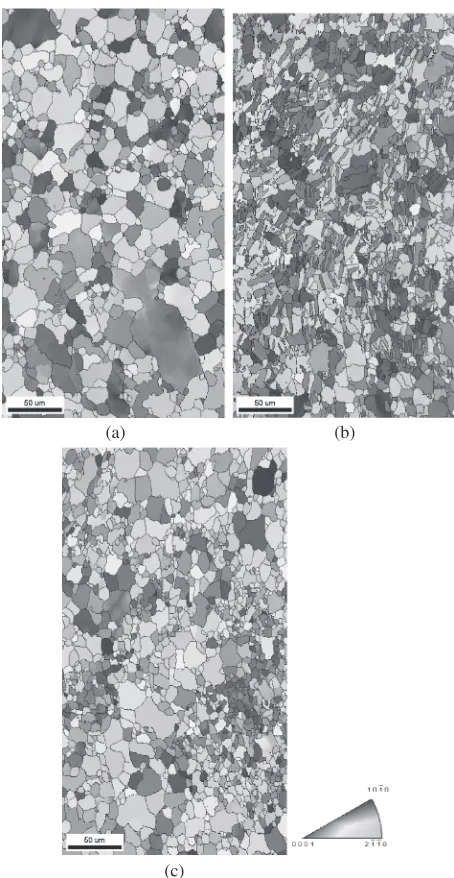
Figure 9 shows the comparison of the initial micro-structures with respect to the controlled initial billets with the EBSD experiments in which different colors for each grain indicate different crystallographic orientations defined in the inverse polefigure maps, and black boundaries indicate the high angle grain boundary having a misorientation greater than 15°. A large amount of the tensile twins with lenticular shape is investigated in the grains (Fig. 9(b)). Whilef1010g,
f2110g textures with blue and green colors are dominantly distributed in the as-extruded specimen, as shown in
(a) (b)
Fig. 7 Comparison of wrap height distributions for experiment with simulation results: (a) Mg scroll; (b) wrap height distribution.
0.00 0.03 0.06 0.09 0.12 0.15 0
100 200 300 400 500 600
Target strain of 0.06 for twin AZ61
Temperature: RT Strain rate: 0.001/sec
T
rue stress(MPa)
True strain
0.0 0.3 0.6 0.9 1.2 0
30 60 90 120
Target strain of 0.6 for DRX
AZ60
Temperature: 350°C Strain rate: 0.1/sec
T
rue stress(MPa)
True strain
(a) (b)
[image:4.595.127.471.70.246.2] [image:4.595.110.488.288.425.2]Fig. 9(a), f0001g texture with red color abruptly increases from the occurrence of the tensile twins by the simple upsetting at room temperature, as shown in Fig. 9(b). In the DRX-induced specimen, the average grain size decreases from 21.05 µm in the as-extruded billet to 13.0 µm due to the recrystallizedfine grains, as shown in Fig. 9(c). The prepared specimens, such as the twin-induced and DRX-induced specimens, are fabricated again with a diameter of 87 mm and length of 14.9 mm as the initial billet for the Mg scroll, which are applied to the warm forging process.
3.2 Effect of initial microstructures
Figure 10 shows the distributions of the wrap heights in the Mg scroll with respect to the initial microstructures, such as those of the twin-induced and DRX-induced specimens, which are compared with the wrap height in the as-extruded scroll. The formability of the DRX-induced specimen is highly improved compared with the as-extruded and DRX-induced specimens in terms of the wrap height. It not only
indicates that the minimum wrap height in thefinal Mg scroll is easily achieved with the same amount of the punch stroke but also increases the cycling time for manufacturing the Mg scroll when applying the DRX-induced specimen. The twin-induced specimen shows slightly increased wrap height compared to the as-extruded specimen except the one at the position of the origin (0 mm) where the wrap height does not reach 26 mm. It is noted that the formability of the twin-induced specimen is not improved comparably because it tends to induce local dynamic recrystallization in terms of the TDRX during Mg scroll forging. In contrast, the formability of the Mg scroll is enhanced noticeably when applying the DRX-induced specimen because it increases the fraction of the recrystallized grains uniformly.
In order to compare the mechanical properties of the forged Mg scroll at room temperature, we extracted a plate from the bottom of the scrolls, as shown in Fig. 11(a), and then, the tensile specimens were fabricated in the extracted plate, as shown in Fig. 11(b). It is difficult to conduct the tensile test directly with the forged Mg scroll because there is not enough room in it for obtaining tensile specimens. Figure 12 indicates the specific dimension of the sub-size tensile specimens with the gauge length of 20 mm and set-up for laser extensometer for accurate strain measuring during the quasi-static state (0.001/s).
The initial yield and ultimate tensile strength (YS, UTS) of the twin-induced scroll noticeably increase compared with the other scrolls, such as the as-extruded and DRX-induced scrolls, while it shows the shortest fracture elongation, as shown in Fig. 13. This is because there are few slip systems
(a) (b)
(c)
Fig. 9 Comparison of the initial microstructures in OIM maps: (a) as-extruded; (b) twin induced; (c) DRX induced.
0 18 36 54 72
25.0 25.5 26.0 26.5 27.0
W
rap height (mm)
Position (mm)
[image:5.595.55.282.67.506.2]back-pressure of 30kN As-extruded Twin induced DRX induced
Fig. 10 Wrap height distributions infinal Mg scrolls with respect to the initial textures.
[image:5.595.319.535.72.228.2](a) (b)
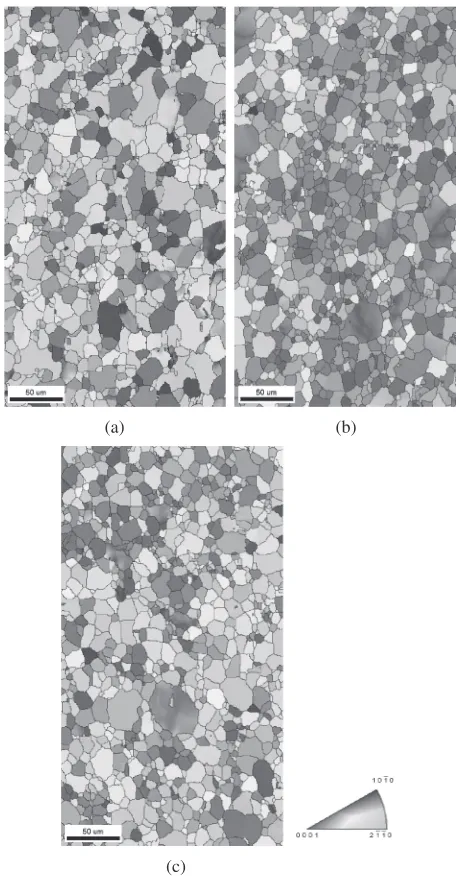
[image:5.595.306.547.280.378.2]to accomodate the plastic deformation sufficiently at room temperature. Furthermore, there are few grains to be rotated in the extrusion direction while accomodating the plastic deformation becuase most of the grains are already aligned to the axial direction of the initial billet from the twinning at the preparation stage of the initial billet for the twin-induced specimen. Figure 14 demonstrated microstructures of the as-forged Mg scrolls at the bottom plate (Fig. 11(a)) in which the basal texture becomes dominant when investigating the twin-induced scroll as shown in Fig. 14(b). It is because the induced tensile twins having lenticular shape in the initial specimen for Mg scroll tend to grow to spheroidal shape, which increase the fraction of the basal texture during the warm forging process. That is why the twin-inducd speciman shows higher YS and UTS compared with the as-extruded and DRX-induced specimens.
In the case of the Mg scroll with the DRX-induced specimen, there is a slight increase in the YS and UTS compared to the results of the scroll with the as-extruded specimen, while it demonstrates a smaller fracture elongation compared to the one with the as-extruded scroll, as shown in
[image:6.595.128.472.73.272.2](a) (b)
Fig. 12 Configuration of static tensile test: (a) specification of tensile specimen (mm); (b) setup for laser extensometer and universal testing machine (UTM).
0.00 0.03 0.06 0.09 0.12
0 70 140 210 280 350
Tensile tests results (0.001/sec, RT) as-extruded
DRX induced twin induced
Engineering stress(MPa)
[image:6.595.312.540.323.761.2]Engineering strain
Fig. 13 Comparison of the tensile test results of the forged Mg scroll according to the initial microstructures.
(a) (b)
(c)
[image:6.595.61.282.324.481.2]Fig. 13. It is expected that the fracture elongation in the DRX-induced scroll increases compared with the as-extruded specimen when the tensile test can be conducted at the other localized deformation area, such as the wrap where the DRX sufficiently tends to accelerate the grain recrystallization owing to a tremendous plastic strain. It is noted that the texture and grain structure changes in the initial specimens does not affect the punch load largely since there is no huge difference in punch loads around 250-ton.
4. Conclusions
In this study, a net-shape forging technique for an Mg scroll that can fulfill the lightweight design of an automobile compressor is proposed with Mg6Al1Zn alloy. In order to improve the material flow around the scroll wrap, back-pressure is directly applied to the back side of the Mg scroll, which enhances uniformity of the wrap height largely. In this paper, to calibrate the back-pressure for the uniform distribution of the wrap height, various back-pressures are applied in the FE simulations, and a back-pressure of 30 kN is determined as being optimum for the net-shape Mg scroll. With the calibrated back-pressure, warm forging tests for the Mg scroll are conducted in a 1000-ton press shop under a forming temperature of 350°C. It is noted that the experimental and simulation results show good agreement in terms of the wrap height distribution. To investigate the effect of the initial textures on the Mg scroll, twin-induced and DRX-induced specimens are prepared by simple upsetting at room temperature and 350°C, respectively. OIM maps guaranteed that the twins and recrystallized grains are uniformly distributed in the initial specimens at the preparation stage of the initial billet for the twin-induced and induced specimens. The formability of the DRX-induced specimen noticeably improved when comparing the warp height distributions with the other initial specimens. Thus, the cycling time for manufacturing the Mg scroll can be reduced when applying the DRX-induced specimen. Based on the results of tensile tests at room temperature, the twin-induced specimen enhances mechanical properties such as the yield and ultimate tensile strength of the Mg scroll.
According to the current research work, the following conclusions can be drawn:
(1) The warm forging process for Mg scroll has been demonstrated by applying the back-pressure, which enables the net-shape forging with magnesium alloy. (2) Finite element analysis for the Mg scroll are only able
to shows general tendency of wrap height distribution since there are excessive texture evolutions and dynamic recrystallization during warm forging con-dition.
(3) Initial texture and grain size of the Mg specimens dramatically influences on the forgeability and product quality, especially, in the warm forming condition. (4) In case of the DRX-induced specimen, uniform and
enhanced wrap height are investigated in the Mg scroll due to the increased forgeability.
REFERENCES
1) K. Tojo: U.S. Patent 4216661, (1980).
2) J. Caillat, R. Weatherston and J. Bush: U.S. Patent 4767293, (1988). 3) S. Etemad, D. Yannascoli and M. Hatzikazakis: U.S. Patent 4834633,
(1989).
4) C. Ancel, D. Gross and L. Guglielmi: Int. Compressor Eng. Conference 1490(2010) 111.
5) J. H. Lee, C. W. Won, S. S. Cho, B. S. Chun and S. W. Kim:Mater. Sci. Eng. A281(2000) 816.
6) H. Yoshimura and K. Tanaka:J. Mater. Process. Tech.98(2000) 196 204.
7) Y. Mure, K. Nakanishi, T. Matsuda and S. Kuwaharada: J. JSTP51
(2010) 136140.
8) J. Yoon, J. Lee and S. H. Park: Proc. 14th International Conference on Metal Forming 2012, Krakow, Poland, Steel Res. Int (2012) pp. 835 838.
9) J. Liu, Z. Cui and C. Li:Comput. Mater. Sci.41(2008) 375382.
10) Q. Wang, Z. Zhang, X. Zhang and J. Yu:Trans. Nonferrous Met. Soc. China18(2008) s205s208.
11) C. Lv, T. Liu, D. Liu, S. Jiang and W. Zeng:Mater. Des.33(2012) 529533.
12) Q. Peng, X. Hou, L. Wang, Y. Wu, Z. Cao and L. Wang:Mater. Des.30
(2009) 292296.
13) M. Hakamada, K. Shimizu, T. Yamashita, A. Watazu, N. Saito and H. Iwasaki:J. Mater. Sci.45(2010) 719724.
14) Y. Chino, M. Mabuchi, K. Shimojima, Y. Yamada, C. Wen, K. Miwa, M. Nakamura, T. Asahina, K. Higashi and T. Aizawa:Mater. Trans.42
(2001) 414417.
15) M. Hakamada, A. Watazu, N. Saito and H. Iwasaki:Mater. Trans.49
(2008) 554558.