Effects of Current Density on Elongation
of an Electropulsing Treated Zn-Al Based Alloy
S. To
1, Y. H. Zhu
1;*, W. B. Lee
1, X. M. Liu
2and Y. B. Jiang
31
Department of Industrial and Systems Engineering, The Hong Kong Polytechnic University, Hong Kong, P. R. China
2Hefei National Laboratory for Physical Science at Microscale, University of Science and Technology of China, P. R. China
3Graduate School at Shen Zhen, Tsinghua University, P. R. China
Effects of static electropulsing on microstructure and elongation of the ZA 22 alloy were studied by using scanning electron microscopy and transmission electron microscopy techniques. It was found that the current density of electropulsing treatment (EPT) was one of the factors that influenced microstructural changes and dislocation structure in the EPT alloy. The identity of the microstructure and the dislocation density played an important role in plastic elongation of the EPT alloy. The effects of the current density of electropulsing on elongation of the alloy were discussed from the point of view of microstructural evolution and dislocation dynamics. [doi:10.2320/matertrans.M2009280]
(Received August 10, 2009; Accepted September 3, 2009; Published October 21, 2009)
Keywords: electropulsing, tensile deformation, phase transformation, dislocation, elongation, zinc-aluminum alloys
1. Introduction
In our previous article,1) effects of current density on electropulsing-induced phase transformations in furnace cooled Zn-Al based alloy (ZA alloy) wire specimens were studied. It was reported that electropuilsing tremendously accelerated phase transformations in two stages: (a) trans-formations from supersaturated state approaching the final state, and (b) reverse transformations from the final state to a higher temperature state. The current density plays an important role in accelerating phase transformations of the alloys. With increasing current density, the speed of the phase transformations increased.
Understanding of effects of the electropulsing induced phase transformations on the plastic behaviors of the alloy is of practical significance. However, little has been done in this respect.
The present work studies in more details the electropulsing induced microstructural changes and their effects on plastic elongation of the alloy.
2. Experimental Procedures
As received Zn-Al based alloy wire of 1.5 mm in diam-eter was previously extruded, cold-drawn and tempered repeatedly. The nominal composition of the alloy was Zn75:3Al22:1Cu2:6 (in mass%). Before electropulsing treat-ment (EPT), the as received wire was solution treated at 350C for four days, then naturally cooled inside the furnace,
i.e. furnace cooled (FC) to the ambient temperature. The heat treated alloy wire was cut into pieces of 100 mm length and statically electropulsing-treated by various electric current intensities for 10 seconds. The measurement setup for electropulsing is reported in Ref. 1). A jet oil cooling system was used to cool and protect the surface of the wire specimen. The surface temperature of the specimen was 28C, which
was measured by a thermocouple. Various operation param-eters of the electropulsing, such as pulse frequency, the pulse
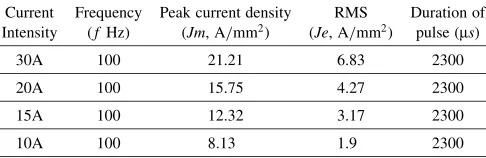
peak values, the root-mean-square (RMS), and the duration of pulse of the current of the specimen are listed in Table 1. After EPT, tensile tests were carried out at the ambient temperature (28C), using a CMT5105 universal testing
machine. A cross-speed, i.e. the deformation rate and the gage length were selected as 2 mm/min and 50 mm, respectively. The deformation rate was 4.7 times faster than the normal deformation rate of 0.42 mm/min for ZA alloys. Longitudinal cross-section of bulk parts and neck zones of both non-EPT and EPT wire specimens were polished and examined using scanning electron microscopy in the back-scattered electron mode (BSEM) in order to produce a medium resolution of atomic contrast among the various phases involved. Conventional transmission electron mi-croscopy (TEM) examination was carried out using JEM 2010 transmission electron microscope. Thin foil specimens were produced using ion-beam milling, and examined.
3. Results and Discussion
3.1 Tensile deformation
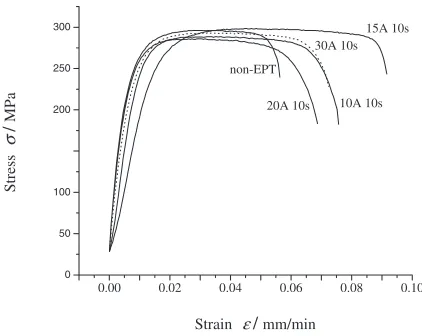
[image:1.595.305.548.327.406.2]The tensile stress and the resulting strain of the non-EPT, i.e. furnace cooled, and the 10A-, 15A-, 20A- and 30A- EPT wire specimens were measured and used to plot the stress-strain (S-S) curve, as shown in Fig. 1. The curve for 30A/ 10s-EPT specimen was drawn by a dotted line in order to distinguish from those S-S curves of other EPT specimens. The elongation at fracture was varied with different current intensity of EPT. The elongation and the ultimate tensile stress of the non-EPT specimen were measured as 4.5% and
Table 1 Operation parameters of the electropulsing. Current
Intensity
Frequency (f Hz)
Peak current density (Jm, A/mm2)
RMS (Je, A/mm2)
Duration of pulse (ms) 30A 100 21.21 6.83 2300 20A 100 15.75 4.27 2300 15A 100 12.32 3.17 2300
10A 100 8.13 1.9 2300
*Corresponding author, E-mail:[email protected]
298 MPa, respectively. The elongation of the 10A/10s-EPT specimen was increased to 6.4% and the corresponding ultimate tensile stress was 272 MPa. The 15A/10s-EPT specimen showed the maximum elongation and the ultimate tensile stress, 8.5% and 300 MPa, respectively. The elonga-tion of the 15A/10s-EPT specimen was increased by 188%, compared with that of the non-EPT specimen. In Fig. 1, it is also shown that the 15A/10s-EPT specimen was of the highest elastic modulus, i.e. the smallest slope of the straight line of the S-S curve at the early stage of tensile test among those EPT specimens.
Upon further increase in current intensity of EPT to 20A, the elongation decreased to 5.5%. Whilst the elongation of the 30A/10s-EPT specimen increased again to 6.4% with the ultimate tensile stress of 275 MPa, which was similar to that of 10A/10s-EPT specimen. From Fig. 1, it is seen that all the EPT specimens had higher elongations than that of the non-EPT specimen, and the non-EPT affected the ultimate tensile stress slightly. These imply that the EPT current intensity, which was corresponded to the current density in the present study, was critical to the elongation at fracture of the EPT specimens.
3.2 Microstructural evolution
3.2.1 Electropusling induced phase transformations
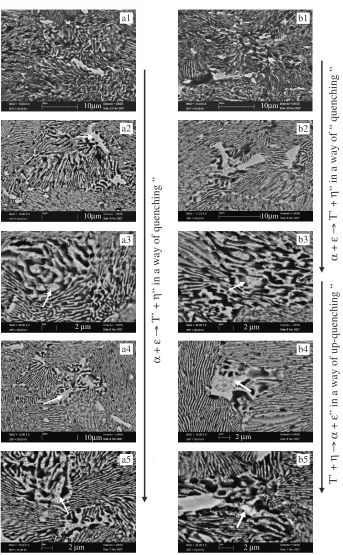
The BSEM images of the bulk parts and the neck zones of the tensile deformed non-EPT and EPT specimens are shown in Fig. 2. The microstructure of the bulk part of the non-EPT (i.e. FC) ZA alloy specimen consisted of two lamellar structures (i.e. coarse and fine lamellae) with the light imaged Zn-rich phases: bcc " (Zn4Cu) and hcp 0FC. The coarse lamellar was from the decomposition of a supersaturated Zn-rich0
sand the fine lamellar was from the decomposition of the supersaturated Al-rich0
s phase, as shown in Fig. 2(a). After 10A EPT for 10 s, the four-phase transformation:
þ"!T0þoccurred. As one of the products of a four
phase transformation: þ"!T0þ, a small amount of grey imaged T0precipitates was observed in the light imaged
"phase in the bulk part of the 10A/10s-EPT specimen, as
indicated by an arrow ‘‘!’’ in Fig. 2(a2). The 0FC had transformed to0
T. After 15A and 20A EPT for 10s, the grey
imaged T0 precipitates increased, as indicated by arrows in Fig. 2(a3) and (a4), respectively. The T0precipitates
increas-ed to maximum in the 30A/10s EPT specimen, as shown in Fig. 2(a5). In other words, the specimen approached to the final stable state.
In comparison with non-EPT, i.e. aging process, the four-phase transformationþ"!T0þ, occurred after ageing
at 170C for 52 h. It took at least 12 min in the 100C-tensile
deformation.2)Obviously the phase decomposition,þ"! T0þ, in the bulk parts of the deformed EPT specimens (where there was no external stress imposed on) i.e. the phase decomposition in the EPT-FC specimens was greatly accelerated with increasing current density of electropulsing. With addition of an external tensile stress, the phase transformations were even fastened in the ZA alloy speci-mens. Shown in Fig. 2(b1)–(b5) are BSEM images of the neck zone of the non-EPT and EPT ZA alloy specimens.1) The grey imaged T0phase precipitates increased apparently
in the light imaged"phase in the neck zone of the 10A/10s-EPT specimen Fig. 2(b2). In the neck zone of the 15A/10s-EPT specimen, T0 precipitates increased to maximum, as
shown in Fig. 2(b3). In this stage of phase transformation, i.e. the forward phase transformation, the supersaturated phases decomposed and approached to the final stable state in the neck zone of the FC ZA alloy specimen in the 15A/10s-EPT specimen under tensile stress. Upon increased current intensity, the T0 precipitates decreased with increasing
current intensity to 20A and 30A, as indicated by arrows in Fig. 2(b4) and (b5), respectively. A reverse phase trans-formation:T0þ!þ", occurred.1)
TEM examination confirmed that the reverse phase trans-formation: T0þ!þ", developed with increasing
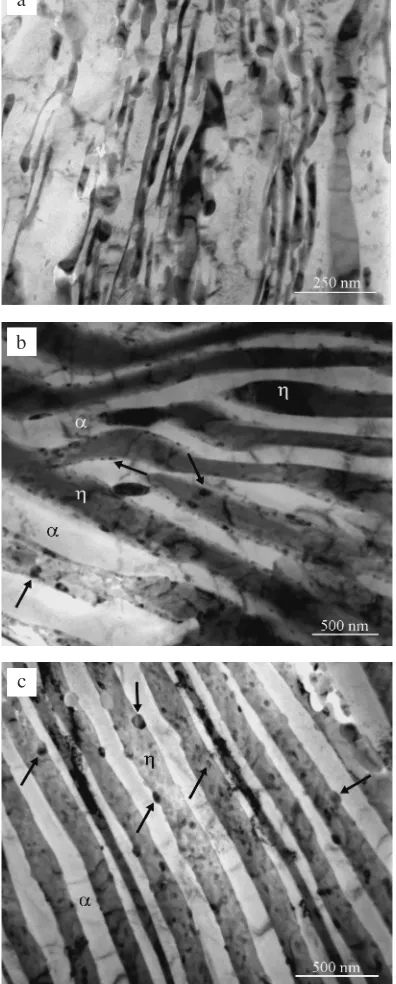
cur-rent density of EPT. Shown in Fig. 3 are The TEM bright field images of the neck zone of the 15A, 20A, 30A EPT specimens.1)In the neck zone of the 15A/10s-EPT specimen,
no"phase was observed, as shown in Fig. 3(a). In the neck
zone of the 20A/10s-EPT specimen, small precipitates of the
" phase formed at the phase boundaries, as indicated by
arrows in Fig. 3(b). The precipitation of the " phase well developed at the phase boundaries and inside thephase in the neck zone of the 30A/10s-EPT specimen, as indicated by arrows in Fig. 3(c). The precipitates of the " phase were identified by using TEM examination. Details of the TEM identification of the phases were reported in Ref. 1).
In combination of the results of BSEM and TEM, it is clear that in the neck zone of the tensile deformed EPT alloy specimens, the electropulsing tremendously accelerated the phase transformations in the ZA alloy sequentially in two ways of ‘‘quenching’’ i.e. the forward phase transformation:
þ"!T0þ, and ‘‘up-quenching’’ i.e. the reverse phase
transformation:T0þ!þ", as shown in Fig. 3,
respec-tively.
3.2.2 Microstructure identity
Chemical homogeneity and microstructural identity are important for reducing necking shrinkage in plastic defor-mation and enhancing elongation of the alloys. After repeated extrusion, cold-drawing and tempering, the FC ZA alloy wire specimens are chemically homogeneous. Thus the microstructure identity depends mainly on the electro-pulsing induced phase transformation.
0 50 100 200 250 300 non-EPT
20A 10s 10A 10s 30A 10s
15A 10s
Strain ε/ mm/min
Stress
σ
/
MPa
0.00 0.02 0.04 0.06 0.08 0.10
[image:2.595.63.274.71.239.2]The above mentioned forward phase transformation,
þ"!T0þ, in the bulk parts of ZA alloy occurred in
a way of ‘‘quenching’’, when the current intensity was increased until 30A. The T0 precipitates increased to
maximum. In comparison, in the neck zone of the EPT specimens, the forward phase transformation, þ"! T0þ, developed with increasing current intensity until 15A, and the T0 precipitates increased accordingly, as shown in Fig. 2(a). Upon further increasing current density to 20A and 30A, the reverse phase transformation,
T0þ!þ", occurred. The amount of the T0 phase
precipitates were decreased, as shown in Fig. 2(b). In both the bulk part and the neck zone of the 15A/10s EPT specimens, a better microstructure identity was obtained, shown in Fig. 2. The elongation at fracture increased to 8.5%, which was the highest compared with that of the 10A/10s, 20A/10s and 30A/10s EPT specimens, as shown in Fig. 1.
From the above microstructural evolution of the speci-mens, it can be seen that an adequate EPT provided a
α
+
ε
T’ +
η
“ in a way of quenching “
α
+
ε
T’ +
η
“ in a way of “ quenching “
T’ +
η
α
+
ε
” in a way of up-quenching “
2 µm
b5
2 µm
b3
10µm
b2
10µm
b1
2 µm
b4
10µm
a1
10µm
a2
2 µm
a3
10µm
a4
2 µm
a5
[image:3.595.127.470.64.619.2]favorable microstructure identity that enhanced the plastic elongation of the alloy.
3.3 Identity of dislocation
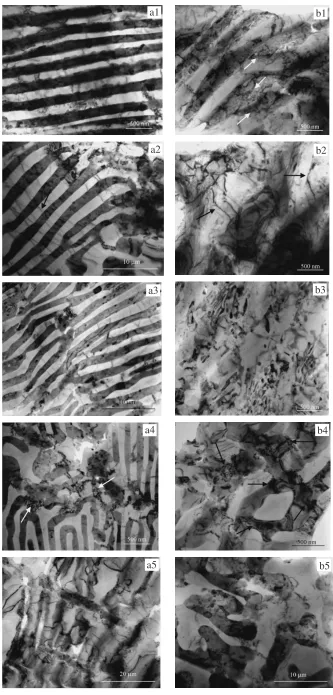
TEM observations revealed clearly the dislocation evolu-tion under EPTs with various current densities. TEM bright field images of the bulk parts and the neck zones of the tensile-deformed non-EPT (a) and 10A/10s, 15A/10s, 20A/ 10s and 30A/10s EPT (b) specimens are shown in Fig. 4. In the bulk part of the non-EPT specimen, there were some dislocation arrays and nodes, introduced from the previously cold-working in the original specimen, as shown in Fig. 4(a1). During tensile deformation, some of the
dis-location lines had piled up at the grain boundaries in the neck zone of the non-EPT alloy specimen, as indicated by arrows in Fig. 4(b1). The elongation at fracture was 5%.
Because of electron wind force, the electropulsing pushed defects, such as dislocation and atomic vacancies, toward the sub-grain boundaries, and accelerated the movement of both the dislocation and vacancies. Dislocation arrays and nodes decreased in both the bulk part and the neck zone of the 10A/10s EPT specimens, as shown in Fig. 4(a2) and (b2), respectively. The elongation at rupture increased to 6.5%.
Under 15A/10s EPT, amount of the dislocation lines were considerably reduced in the specimens, as shown in Fig. 4(a3) and (b3), respectively. The TEM bright image appeared clean and dislocation lines were rarely observed. That means that those piled up dislocations were annihilated adequately at the structural distorted grain boundaries. The identity of the dislocation between the grain boundaries and inside the grains in the specimen was improved. The plastic deformation ability of the specimens was remarkably enhanced. The elongation at rupture was increased to the maximum (8.5%).
In the 20A/10s EPT specimen, a higher current density resulted in accumulating more dislocation lines at the grain boundaries, and that made it difficult for those piled up dislocations to be annihilated adequately. In both the bulk part and the neck zone of the specimens, plenty of dislocation blocks were observed at the grain boundaries, as indicated by arrows in Fig. 4(a4) and (b4), respectively. The dislocation density at grain boundaries appeared higher than that located inside the grains. A high concentration of dislocations blocking at the grain boundaries prevented dislocations themselves from further moving, and resulted in increase in stress locally. The grain boundaries became unstable and easy to fracture. The elongation decreased to 5.5%.
In the 30A/10s EPT specimens, less dislocation blocks were observed, as shown in Figs. 4(a5) and (b5), respec-tively. Because of the EPT with the higher current density, the dislocation blocks were partly destroyed. The difference of the dislocation densities between the grain boundaries and inside the grains was decreased. Consequently, the elonga-tion at the fracture was improved back to 6.5%.
From the above dislocation evolution induced by EPT, it is reasonable to deduce that a better dislocation identity between the grain boundaries and inside the grains favors the enhancement of the plastic elongation of the EPT alloy.
It was interesting to notice that compared with the non-EPT, the static EPT increased the elongation of the speci-mens by 188%, while the dynamic EPT increased the elongation of the specimens by 437%.3) It is because the dynamic EPT is a process that combined both EPT and tensile deformation, and the difference in dislocation density resulted from tensile deformation is instantaneously reduced by electropulsing during dynamic EPT. The elongation of the dynamic EPT is much higher than that of the non-EPT specimens.
3.4 Elastic behaviors
Due to the above discussed effects of electropulsing on both the identities of microstructure and dislocation density, elastic behaviors were affected. From Fig. 1, the elastic a
b
c
[image:4.595.70.268.83.575.2]a1
a2
a3
a4
a5
b1
b2
b3
b4
b5
[image:5.595.130.463.69.764.2]modulus of the 15A/10s EPT specimen was the smallest among those alloy specimens being tested. According to the definition of the elastic modulus, E¼=". Under 15A/10s EPT, the identities of microstructure and dislocation were improved, the elongation of the alloy specimen enhanced. Consequently, the strain"(l=l) was increased and the stress
(F=A) for elastic deformation was reduced at the early stage of the tensile test. The elastic modulus, i.e. the slope of the straight line of the S-S curve at the early stage of tensile test was reduced, as shown in Fig. 1.
The observed elastic strain may be composed of the intrinsic elastic strain and the anelastic strain.4)In the present study, an adequate electropulsing favors reversible disloca-tion modisloca-tions. Meanwhile, the electropulsing induced precip-itation of the T0 phase via the four phase transformation may modify the dislocation pinning. Therefore, both the anelastic strain and the plastic elongation may be improved even under a higher deformation rate (such as work harden-ing rate or neckharden-ing rate).3)
3.5 Electropulsing kinetics
In addition to the identities of microstructure and dis-location density, the electropulsing parameters affect in a great deal the plastic elongation of the alloy.
In previous studies, it was reported that during passing of the electropulse through metallic systems, there was an impacting force of high-rate drift electrons as well as a mass of collisions between high-rate drift electrons and atomic nuclei.5–10)Under the impact of transient stress, the mobilized dislocations were moving very quickly, even at ultrasonic speeds.9)The transfer energy from the electrons to the atoms was much more effective than that in the traditional thermal and thermo-mechanical processes. From the point of view of thermodynamics, a process with a very high rate of increas-ing in supersaturation, i.e. the drivincreas-ing force for phase transformations is called ‘‘quenching’’. EPT is also a kind of quenching, called ‘‘electropulsing–quench’’, being distinct from ‘‘water–quench’’ which is used in conventional heat treatment.11)
It was proposed that the electropulsing effectively affected the sliding behaviors of the dislocation, and the activity of vacancies.12)As far as the diffusion–controlled phase trans-formations are concerned, it is anticipated that electron migration may be important when considering the influence of an electric current. The effects of the atomic diffusion flux, J, on both phase decomposition rate, and the motion and annihilation of dislocations and quench-in vacancies to the structural distorted grain boundaries are critical.
In the case of electropulsing,J, consists of two parts:Jtand Ja, whereJtis the flux of diffusion atoms due to the thermal effect, andJais the flux of the diffusion atoms owing to the athermal effect.13–15)
In the present study, the electropulsing was performed at about the ambient temperature. The jt is small and neglected. The atomic flux for the total duration of EPT is then written as
J¼Ja¼
2NDlZef jmptept
KT ;
16Þ ð1Þ
whereJais proportional to the parameters of electropulsing,
and substantially increases with the peak current density jm, frequency f, duration of each electropulse p and duration of EPTtept.
Therefore, current density is one of the factors that tremendously accelerate the evolution of both microstructure and dislocation.
4. Conclusions
(1) Under 15A/10s-static EPT, the elongation of Zn-Al based alloy was increased by 188%, compared with that of the non-EPT specimen.
(2) Under static EPT, the phase decomposition of the EPT-FC ZA alloy was greatly accelerated with increasing current density.
(3) In the tensile deformed EPT alloy specimens, the electropulsing tremendously accelerated phase trans-formations in the FC ZA 22 alloy in two ways consequently: a) þ"!T0þ, by ‘‘quenching’’
and b)T0þ!þ", by ‘‘up-quenching’’.
(4) The current density of EPT greatly affected identity of the microstructure, the dislocation density and the elastic behaviors of the alloy. Better identities of both microstructure and dislocation density favor the en-hancement of the plastic elongation of the EPT alloy.
Acknowledgements
The authors would like to express their thanks to The Research Grant Council of Hong Kong Special Administra-tion Region of the People’s Republic of China for providing financial support (Project No. PolyU 5316/09E) and Mr. J. M. N. Yueng for his assistance in the experimental work.
REFERENCES
1) S. To, Y. H. Zhu, W. B. Lee, X. M. Liu, Y. B. Jiang and G. Y. Tang: Appl. Phys. A96(2009) 939–944.
2) Y. H. Zhu: Mater. Trans.45(2004) 3083–3097.
3) Y. H. Zhu, S. To, W. B. Lee, X. M. Liu, Y. B. Jiang and G. Y. Tang: Mater. Sci. Eng. A501(2009) 125–132.
4) H. Mizubayashi, T. Usui and H. Tanimoto: J. Non-Crys. Solids312– 314(2002) 542–546.
5) F. R. Nabarro: Theory of crystal dislocation, (Clrendon Press, Oxford, 1976) 529.
6) A. F. Sprecher, S. L. Mamnna and H. Conrad: Acta Metall.34(1986) 1145–1162.
7) S. H. Xiao, Y. Z. Zhou, J. D. Guo, S. D. Wu, G. Yao, S. X. Li, G. H. He and B. L. Zhou: Mater. Sci. Eng. A332(2002) 351–355.
8) T. Hao, H. Tanimoto and H. Mizubayashi: Mater. Trans.46(2005) 2898–2907.
9) H. Mizubayashi, T. Takahashi, K. Nakamoto and H. Tanimoto: Mater. Trans.48(2007) 1665–1670.
10) P. Gumbsch and H. J. Gao: Science283(2007) 965–968.
11) Y. H. Zhu, S. To, W. B. Lee, X. M. Liu, Y. B. Jiang and G. Y. Tang: J. Mater. Res.24(2009) 2661–2669.
12) H. Conrad and A. F. Sprecher: Dislocation in solids, ed. by F. R. N. Nabarro (Elsevier, Amsterdam, 1989) 497.
13) Z. S. Xu, J. D. Guo, S. D. Wu, G. H. He and S. X. Li: Scr. Metall.22
(2002) 1–6.
14) F. Ding, G. Y. Tang, Z. H. Xu and S. Q. Tian: J. Mater. Sci. Technol.23
(2007) 160–163.
15) R. S. Qin and B. L. Zhou: Int. J. Non-equilib. Proc.11(1998) 77–86. 16) Y. B. Jiang, G. Y. Tang, C. H. Shek, Y. H. Zhu, L. Guan, S. N. Wang