A Discriminative Global Training Algorithm for Statistical MT
Christoph Tillmann IBM T.J. Watson Research Center
Yorktown Heights, N.Y. 10598 [email protected]
Tong Zhang Yahoo! Research New York City, N.Y. 10011 [email protected]
Abstract
This paper presents a novel training al-gorithm for a linearly-scored block se-quence translation model. The key com-ponent is a new procedure to directly op-timize the global scoring function used by a SMT decoder. No translation, language, or distortion model probabilities are used as in earlier work on SMT. Therefore our method, which employs less domain specific knowledge, is both simpler and more extensible than previous approaches. Moreover, the training procedure treats the decoder as a black-box, and thus can be used to optimize any decoding scheme. The training algorithm is evaluated on a standard Arabic-English translation task.
1 Introduction
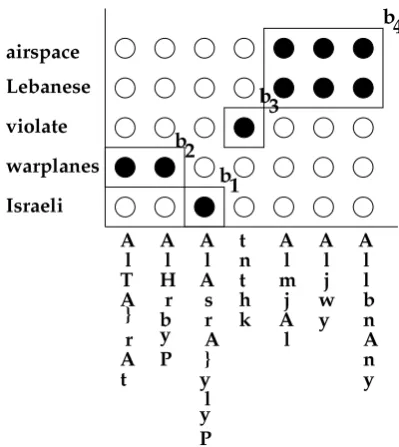
This paper presents a view of phrase-based SMT as a sequential process that generates block ori-entation sequences. A block is a pair of phrases which are translations of each other. For example, Figure 1 shows an Arabic-English translation ex-ample that uses four blocks. During decoding, we view translation as a block segmentation process, where the input sentence is segmented from left to right and the target sentence is generated from bottom to top, one block at a time. A monotone block sequence is generated except for the possi-bility to handle some local phrase re-ordering. In this local re-ordering model (Tillmann and Zhang, 2005; Kumar and Byrne, 2005) a block with orientation is generated relative to its
predeces-sor block
. During decoding, we maximize the score of a block orientation sequence
! "
#
$%
!
&$ !'
(
!
)
(+*
$
(
"
*
(
!
,
$
-.
(
!
(
$
(
-!
-.
"
"/
0
$%1
!
!
(
-(
!
2+3
(
!
(
!3
#-(
4
5
[image:1.595.313.513.244.468.2]6
Figure 1: An Arabic-English block translation ex-ample, where the Arabic words are romanized. The following orientation sequence is generated:
87:9
; 7=<
?> 7:9
@ 7=A
.
B ):
7
CED
FHGJIK
C
C
L CEM
N
(1)
where C
is a block, CEM
is its predecessor block, and
CPORQ
<
eft N
A
ight N
9
eutral NS
is a three-valued orientation component linked to the block
C
: a block is generated to the left or the right of its predecessor block CTM
, where the orientation
CEM
of the predecessor block is ignored. Here,U
is the number of blocks in the translation. We are interested in learning the weight vectorF from the
training data. K
C
C
L CEM
is a high-dimensional binary feature representation of the block orienta-tion pair
C
C
L CTM
. The block orientation
quence
V
is generated under the restriction that the concatenated source phrases of the blocks C
yield the input sentence. In modeling a block sequence, we emphasize adjacent block neighbors that have right or left orientation, since in the current exper-iments only local block swapping is handled (neu-tral orientation is used for ’detached’ blocks as de-scribed in (Tillmann and Zhang, 2005)).
This paper focuses on the discriminative train-ing of the weight vectorF used in Eq. 1. The
de-coding process is decomposed into local decision steps based on Eq. 1, but the model is trained in a global setting as shown below. The advantage of this approach is that it can easily handle tens of millions of features, e.g. up toWYX million features
for the experiments in this paper. Moreover, under this view, SMT becomes quite similar to sequen-tial natural language annotation problems such as part-of-speech tagging and shallow parsing, and the novel training algorithm presented in this pa-per is actually most similar to work on training al-gorithms presented for these task, e.g. the on-line training algorithm presented in (McDonald et al., 2005) and the perceptron training algorithm pre-sented in (Collins, 2002). The current approach does not use specialized probability features as in (Och, 2003) in any stage during decoder parame-ter training. Such probability features include lan-guage model, translation or distortion probabili-ties, which are commonly used in current SMT approaches1. We are able to achieve comparable performance to (Tillmann and Zhang, 2005). The novel algorithm differs computationally from ear-lier work in discriminative training algorithms for SMT (Och, 2003) as follows:
Z
No computationally expensive
9
-best lists are generated during training: for each input sentence a single block sequence is generated on each iteration over the training data.
Z
No additional development data set is neces-sary as the weight vectorF is trained on
bilin-gual training data only.
The paper is structured as follows: Section 2 presents the baseline block sequence model and the feature representation. Section 3 presents the discriminative training algorithm that learns
1A translation and distortion model is used in generating
the block set used in the experiments, but these translation probabilities are not used during decoding.
a good global ranking function used during de-coding. Section 4 presents results on a standard Arabic-English translation task. Finally, some dis-cussion and future work is presented in Section 5.
2 Block Sequence Model
This paper views phrase-based SMT as a block sequence generation process. Blocks are phrase pairs consisting of target and source phrases and local phrase re-ordering is handled by including so-called block orientation. Starting point for the block-based translation model is a block set, e.g. about [Y\]X million Arabic-English phrase pairs for
the experiments in this paper. This block set is used to decode training sentence to obtain block orientation sequences that are used in the discrim-inative parameter training. Nothing but the block set and the parallel training data is used to carry out the training. We use the block set described in (Al-Onaizan et al., 2004), the use of a different block set may effect translation results.
Rather than predicting local block neighbors as in (Tillmann and Zhang, 2005) , here the model pa-rameters are trained in a global setting. Starting with a simple model, the training data is decoded multiple times: the weight vectorF is trained to
discriminate block sequences with a high trans-lation score against block sequences with a high BLEU score 2. The high BLEU scoring block sequences are obtained as follows: the regular phrase-based decoder is modified in a way that it uses the BLEU score as optimization criterion (independent of any translation model). Here, searching for the highest BLEU scoring block se-quence is restricted to local re-ordering as is the model-based decoding (as shown in Fig. 1). The BLEU score is computed with respect to the sin-gle reference translation provided by the paral-lel training data. A block sequence with an av-erage BLEU score of about ^Y\]X?_ is obtained for
each training sentence 3. The ’true’ maximum BLEU block sequence as well as the high scoring
2
High scoring block sequences may contain translation er-rors that are quantified by a lower BLEU score.
3
block sequences are represented by high dimen-sional feature vectors using the binary features de-fined below and the translation process is handled as a multi-class classification problem in which each block sequence represents a possible class. The effect of this training procedure can be seen in Figure 2: each decoding step on the training data adds a high-scoring block sequence to the dis-criminative training and decoding performance on the training data is improved after each iteration (along with the test data decoding performance). A theoretical justification for the novel training procedure is given in Section 3.
We now define the feature components for the block bigram feature vectora
C
C
L CEM
in Eq. 1. Although the training algorithm can handle real-valued features as used in (Och, 2003; Tillmann and Zhang, 2005) the current paper intentionally excludes them. The current feature functions are similar to those used in common phrase-based translation systems: for them it has been shown that good translation performance can be achieved 4. A systematic analysis of the novel training
algo-rithm will allow us to include much more sophis-ticated features in future experiments, i.e. POS-based features, syntactic or hierarchical features (Chiang, 2005). The dimensionality of the fea-ture vectora
C
C
L CEM
depends on the number of binary features. For illustration purposes, the binary features are chosen such that they yield b
on the example block sequence in Fig. 1. There are phrase-based and word-based features:
K
'cNcNc
C
C
L CEM
7
7
b block
C
consists of target phrase ’violate’ and source phrase ’tnthk’
^ otherwise
K
'cNc
C
C
L CEM
7
7
b ’Lebanese’ is a word in the target
phrase of block C
and ’AllbnAny’ is a word in the source phrase
^ otherwise
The feature
K
'cNcNc
is a ’unigram’ phrase-based fea-ture capturing the identity of a block. Addi-tional phrase-based features include block orien-tation, target and source phrase bigram features. Word-based features are used as well, e.g. fea-ture K
'cNc
captures word-to-word translation
de-4On our test set, (Tillmann and Zhang, 2005) reports a
BLEU score ofd?e?f+g and (Ittycheriah and Roukos, 2005) re-ports a BLEU score ofhYg?fi .
pendencies similar to the use of Modelb
probabil-ities in (Koehn et al., 2003). Additionally, we use distortion features involving relative source word position and j -gram features for adjacent target
words. These features correspond to the use of a language model, but the weights for theses fea-tures are trained on the parallel training data only. For the most complex model, the number of fea-tures is aboutWYX million (ignoring all features that
occur only once).
3 Approximate Relevant Set Method
Throughout the section, we letk
7
. Each block sequencek
7
B
corresponds to a can-didate translation. In the training data where target translations are given, a BLEU scorelnmopk
can be calculated for each k
7
against the tar-get translations. In this set up, our goal is to find a weight vectorF such that the higher
?pk
is, the higher the corresponding BLEU score l8m]pk
should be. If we can find such a weight vector, then block decoding by searching for the high-est
pk
will lead to good translation with high BLEU score.
Formally, we denote a source sentence by q ,
and letrsq
be the set of possible candidate ori-ented block sequences k
7
that the de-coder can generate from q . For example, in a
monotone decoder, the set rtq
contains block sequences Q
B S
that cover the source sentence
q in the same order. For a decoder with
lo-cal re-ordering, the candidate set rPq
also in-cludes additional block sequences with re-ordered block configurations that the decoder can effi-ciently search. Therefore depending on the spe-cific implementation of the decoder, the set rPq
can be different. In general,rsq
is a subset of all possible oriented block sequencesQ
B
NS
that are consistent with input sentenceq .
Given a scoring function
I
and an input sen-tence q , we can assume that the decoder
imple-ments the following decoding rule:
u
kq
7=v?wyx{z|v?}
~o pk
\ (2)
Letq
\L\L\
q be a set of
9
training sentences. Each sentence q
C
is associated with a set rtq
C
of possible translation block sequences that are searchable by the decoder. Each translation block sequencek
O
rPq
C
induces a translation, which is then assigned a BLEU score lnmopk
goal
of the training is to find a weight vector F
such that for each training sentence q
C
, the corre-sponding decoder outputs u
k O rtq C which has the maximum BLEU score among allk
O
rPq
C
based on Eq. 2. In other words, if
u
k maximizes the
scoring function pk
, then u
k also maximizes the
BLEU metric.
Based on the description, a simple idea is to learn the BLEU score lnm]pk
for each candidate block sequence k . That is, we would like to
es-timateF such that pk
lnm]pk
. This can be achieved through least squares regression. It is easy to see that if we can find a weight vectorF
that approximateslnmopk
, then the decoding-rule in Eq. 2 automatically maximizes the BLEU score. However, it is usually difficult to estimate lnmopk
reliably based only on a linear combination of the feature vector as in Eq. 1. We note that a good de-coder does not necessarily employ a scoring func-tion that approximates the BLEU score. Instead, we only need to make sure that the top-ranked block sequence obtained by the decoder scoring function has a high BLEU score. To formulate this idea, we attempt to find a decoding parame-ter such that for each sentence q in the training
data, sequences in rPq
with the highest BLEU scores should get pk
scores higher than those with low BLEU scores.
Denote by rsq
a set of block sequences
in rtq
with the highest BLEU scores. Our de-coded result should lie in this set. We call them the “truth”. The set of the remaining sequences is rsq
r q
, which we shall refer to as the “alternatives”. We look for a weight vectorF that
minimize the following training criterion:
u F 7:v?wxz b 9 CED F
r q
C N rtq C N F ; (3) F r r 7 b ~Y zv?} ~' M F k k F k k 7: N pk
N lnm'pk N pk N lnmopk NN where
is a non-negative real-valued loss func-tion (whose specific choice is not critical for the purposes of this paper),and
^ is a
regular-ization parameter. In our experiments, results are obtained using the following convex loss
N L L 7 ¡¢ Nb N N ;£ (4)
where are BLEU scores, are
transla-tion scores, and N¤ £ 7 z|v?} N^ ¤
. We refer to this formulation as ’costMargin’ (cost-sensitive margin) method: for each training sentence ¥
the ’costMargin’
F
r q N
rtq N
between the ’true’ block sequence setr q
and the ’alterna-tive’ block sequence setrPq
is maximized. Note that due to the truth and alternative set up, we al-ways have §¦R
. This loss function gives an up-per bound of the error we will suffer if the order of
and
is wrongly predicted (that is, if we predict
P¨© instead of ¦
). It also has the property that if for the BLEU scoresHR
holds, then the loss value is small (proportional toª«
). A major contribution of this work is a proce-dure to solve Eq. 3 approximately. The main dif-ficulty is that the search space rsq
covered by the decoder can be extremely large. It cannot be enumerated for practical purposes. Our idea is to replace this large space by a small subspace
r +¬L q ® rsq
which we call relevant set. The possibility of this reduction is based on the follow-ing theoretical result.
Lemma 1 Let
F k k
be a non-negative con-tinuous piece-wise differentiable function of
F
, and let
u
F be a local solution of Eq. 3. Let
¯ C F k 7°zv?} ~±oY²' M oY²' F k k , and define r +¬L q C 7 Q k O rtq C ³µ´ k O
r q
C s.t. ¯ C u F k §¶ 7 ^¸· u F k k 7 ¯ C u F k NS \ Then u
F is a local solution of
z b 9 CED ¹ F
r q
C N r +¬L q C N « F ; \ (5) If
is a convex function ofF (as in our choice),
then we know that the global optimal solution re-mains the same if the whole decoding space r is
replaced by the relevant setr º¬L
. Each subspace r
º¬L q
C
will be significantly smaller than rsq
C
. This is because it only in-cludes those alternativesk
with score¹»
pk E
Table 1:Generic Approximate Relevant Set Method
for each data point q
initialize truthr
q
and alternativer +¬L
q
for each decoding iteration¼:½
7
b
ILILI
<
for each data pointq
select relevant pointsQ¾ kY¿
S
O
rsq
(*)
updater º¬L
q À
r
+¬L q
ÂÁ Q¾
kY¿
S
updateF by solving Eq. 5 approximately (**)
selectively pick the most important samples (often based on estimation uncertainty) for labeling in or-der to maximize classification performance (Lewis and Catlett, 1994). In the active learning setting, as long as we do well on the actively selected sam-ples, we do well on the whole sample space. In our case, as long as we do well on the relevant set, the decoder will perform well.
Since the relevant set depends on the decoder parameter F , and the decoder parameter is
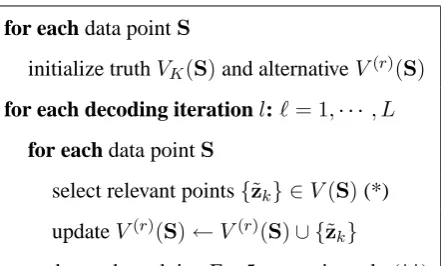
opti-mized on the relevant set, it is necessary to es-timate them jointly using an iterative algorithm. The basic idea is to start with a decoding parame-terF , and estimate the corresponding relevant set;
we then updateF based on the relevant set, and
it-erate this process. The procedure is outlined in Ta-ble 1. We intentionally leave the implementation details of the (*) step and (**) step open. More-over, in this general algorithm, we do not have to assume that pk
has the form of Eq. 1.
A natural question concerning the procedure is its convergence behavior. It can be shown that un-der mild assumptions, if we pick in (*) an alterna-tive ¾
kY¿
O
rtq
rPq
for eachk¿
O
rsq
(Ã
7
b
\L\L\
) such that
F
kY¿
¾
k¿
7 z|v?}
~±]
M
¡]
F
kY¿
k
N
(6)
then the procedure converges to the solution of Eq. 3. Moreover, the rate of convergence depends only on the property of the loss function, and not on the size of rPq
. This property is critical as it shows that as long as Eq. 6 can be computed efficiently, then the Approximate Relevant Set al-gorithm is efficient. Moreover, it gives a bound on the size of an approximate relevant set with a certain accuracy.5
5Due to the space limitation, we will not include a
for-The approximate solution of Eq. 5 in (**) can be implemented using stochastic gradient descent (SGD), where we may simply updateF as:
FÅÄÆF ÈÇÂÉ
F
kY¿
¾
k¿
\
The parameterÇʦ
^ is a fixed constant often
ferred to as learning rate. Again, convergence re-sults can be proved for this procedure. Due to the space limitation, we skip the formal statement as well as the corresponding analysis.
Up to this point, we have not assumed any spe-cific form of the decoder scoring function in our algorithm. Now consider Eq. 1 used in our model. We may express it as:
?pk
7
F
G
IYË pk
N
where
Ë
pk
7
CED
K
C
C
L CTM
. Using this feature representation and the loss function in Eq. 4, we obtain the following costMargin SGD update rule for each training data point andà :
FÅÄÌF
ÇÎÍ
lnm+¿ÏпNb
FHGJI Ïп
£
(7)
Í
lnmѿ
7
lnmopkY¿ Ò
lnm]
¾
kY¿ N
Ïο
7
Ë
pk¿ Ó
Ë
¾
kY¿
\
4 Experimental Results
We applied the novel discriminative training ap-proach to a standard Arabic-to-English translation task. The training data comes from UN news sources. Some punctuation tokenization and some number classing are carried out on the English and the Arabic training data. We show transla-tion results in terms of the automatic BLEU evalu-ation metric (Papineni et al., 2002) on the MT03 Arabic-English DARPA evaluation test set con-sisting ofÔYÔYW sentences withbYÔ¡ÕYÖY× Arabic words
with _ reference translations. In order to speed
up the parameter training the original training data is filtered according to the test set: all the Ara-bic substrings that occur in the test set are com-puted and the parallel training data is filtered to include only those training sentence pairs that con-tain at least one out of these phrases: the resulting pre-filtered training data contains about ÕYWY^
thou-sand sentence pairs (XY\]XYÕ million Arabic words
andÔY\]ÖYÔ million English words). The block set is
generated using a phrase-pair selection algorithm similar to (Koehn et al., 2003; Al-Onaizan et al., 2004), which includes some heuristic filtering to
increasephrase translation accuracy. Blocks that occur only once in the training data are included as well.
4.1 Practical Implementation Details
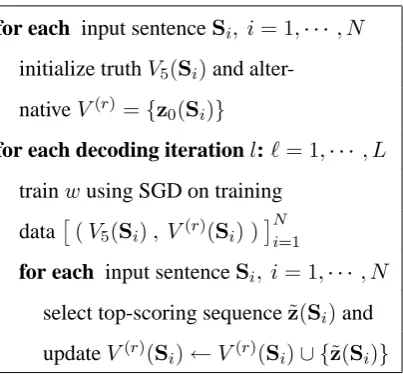
The training algorithm in Table 2 is adapted from Table 1. The training is carried out by running
<Ù7
WY^ times over the parallel training data, each time
decoding all the
9Ú7
ÕYWY^¡^Y^Y^ training sentences
and generating a single block translation sequence for each training sentence. The top five block se-quences rÛYq
C
with the highest BLEU score are computed up-front for all training sentence pairs
¥
C
and are stored separately as described in Sec-tion 2. The score-based decoding of the ÕYWY^¡^Y^Y^
training sentence pairs is carried out in parallel on
ÕYX¸Ô?_ -Bit Opteron machines. Here, the monotone
decoding is much faster than the decoding with block swapping: the monotone decoding takes less than ^Y\]X hours and the decoding with swapping
takes about an hour. Since the training starts with only the parallel training data and a block set, some initial block sequences have to be generated in order to initialize the global model training: for each input sentence a simple bag of blocks trans-lation is generated. For each input interval that is matched by some block , a single block is added to the bag-of-blocks translationk
c
q
. The order in which the blocks are generated is ignored. For this block set only block and word identity fea-tures are generated, i.e. feafea-tures of typeK
'cNcNc
and
K
'cNc
in Section 2. This step does not require the use of a decoder. The initial block sequence train-ing data contains only a strain-ingle alternative. The training procedure proceeds by iteratively decod-ing the traindecod-ing data. After each decoddecod-ing step, the resulting translation block sequences are stored on disc in binary format. A block sequence gener-ated at decoding step½
is used in all subsequent training steps ½?; , where ½;
¦
½
. The block se-quence training data after the ¼-th decoding step
is given as ÓrÛYq
C
Â
r
º¬ q
C
¡
CED
, where the size Ür
º¬ q
C
Ü of the relevant alternative set is
¼
b . Although in order to achieve fast
[image:6.595.320.522.96.283.2]conver-gence with a theoretical guarantee, we should use Eq. 6 to update the relevant set, in reality, this idea is difficult to implement because it requires a more costly decoding step. Therefore in Table 2, we adopt an approximation, where the relevant set is updated by adding the decoder output at each stage. In this way, we are able to treat the decoding
Table 2: Relevant set method: Ý = number of decoding iterations,Þ = number of training sentences.
for each input sentenceq
C
Îß
7
b
ILILI
9
initialize truthr
Û
q
C
and
alter-nativer +¬L
7
Q
k
c
q
C
NS
for each decoding iteration¼:½
7
b
ILILI
<
trainF using SGD on training
data Âr
Û
q
C
Ó
r
º¬L q
C
CED
for each input sentenceq
C
Ðß
7
b
ILILI
9
select top-scoring sequence¾ kàq
C
and
updater +¬L
q
C
¡À
r
+¬L q
C
ÓÁ Q¾
kq
C
NS
scheme as a black box. One way to approximate Eq. 6 is to generate multiple decoding outputs and pick the most relevant points based on Eq. 6. Since the U -best list generation is
computation-ally costly, only a single block sequence is gener-ated for each training sentence pair, reducing the memory requirements for the training algorithm as well. Although we are not able to rigorously prove fast convergence rate for this approximation, it works well in practice, as Figure 2 shows. Theo-retically this is because points achieving large val-ues in Eq. 6 tend to have higher chances to become the top-ranked decoder output as well. The SGD-based on-line training algorithm described in Sec-tion 3, is carried out after each decoding step to generate the weight vector F for the subsequent
decoding step. Since this training step is carried out on a single machine, it dominates the overall computation time. Since each iteration adds a sin-gle relevant alternative to the set r
º¬ q
C
, com-putation time increases with the number of train-ing iterations: the initial model is trained in a few minutes, while training the model after the WY^ -th
iteration takes up toX hours for the most complex
models.
Table 3 presents experimental results in terms of uncased BLEU6. Two re-ordering restrictions are tested, i.e. monotone decoding (’MON’), and lo-cal block re-ordering where neighbor blocks can be swapped (’SWAP’). The ’SWAP’ re-ordering uses the same features as the monotone models plus additional orientation-based and
distortion-6Translation performance in terms of cased BLEU is
Table 3: Translation results in terms of uncased BLEU on the training data (ÕYWY^¡^Y^Y^ sentences)
and the MT03 test data (670 sentences).
Re-ordering Features train test
b ’MON’ bleu ^Y\]X?_àÕ
-Õ phrase ^Y\]WYÖY× ^Y\]ÕYXYÔ
W word ^Y\_àÕYÖ ^Y\]W?_àb
_ both ^Y\_àÖYÖ ^Y\]WYXY[
X ’SWAP’ bleu ^Y\]XY[?_
-Ô phrase ^Y\_Y_àb ^Y\]ÕY[YX
Ö word ^Y\_àXYX ^Y\]WYXY[
× both ^Y\_àÖY[ ^Y\]WYÔYW
based features. Different feature sets include word-based features, phrase-based features, and the combination of both. For the results with word-based features, the decoder still generates phrase-to-phrase translations, but all the scoring is done on the word level. Line × shows a BLEU
score ofWYÔY\]W for the best performing system which
uses all word-based and phrase-based features 7. Line b and line X of Table 3 show the training
data averaged BLEU score obtained by searching for the highest BLEU scoring block sequence for each training sentence pair as described in Sec-tion 2. Allowing local block swapping in this search procedure yields a much improved BLEU score of ^Y\]XY[ . The experimental results show
that word-based models significantly outperform phrase-based models, the combination of word-based and phrase-word-based features performs better than those features types taken separately. Addi-tionally, swap-based re-ordering slightly improves performance over monotone decoding. For all experiments, the training BLEU score remains significantly lower than the maximum obtainable BLEU score shown in lineb and lineX . In this
re-spect, there is significant room for improvements in terms of feature functions and alternative set generation. The word-based models perform sur-prisingly well, i.e. the model in line Ö uses only
three feature types: model b features like
K
'cNc
in Section 2, distortion features, and target language m-gram features up to j
7
W . Training speed
varies depending on the feature types used: for the simplest model shown in lineÕ of Table 3, the
training takes about bYÕ hours, for the models
us-7With a margin of
âãiYfiäåh , the differences between the results in lineh , linee , and lineg are not statistically signifi-cant, but the other result differences are.
0 0.1 0.2 0.3 0.4 0.5 0.6
0 5 10 15 20 25 30
[image:7.595.76.285.114.243.2]’SWAP.TRAINING’ ’SWAP.TEST’
Figure 2: BLEU performance on the training set (upper graph; averaged BLEU with single refer-ence) and the test set (lower graph; BLEU with four references) as a function of the training iter-ation æ for the model corresponding to line × in
Table 3.
ing word-based features shown in lineW and lineÖ
training takes less thanÕ days. Finally, the training
for the most complex model in line× takes about
_ days.
Figure 2 shows the BLEU performance for the model corresponding to line × in Table 3 as a
function of the number of training iterations. By adding top scoring alternatives in the training al-gorithm in Table 2, the BLEU performance on the training data improves from about^Y\]ÕYÕ for the
ini-tial model to about ^Y\_à× for the best model after
WY^ iterations. After each training iteration the test
data is decoded as well. Here, the BLEU perfor-mance improves from^Y\]^Y× for the initial model to
about ^Y\]WYÔ for the final model (we do not include
the test data block sequences in the training). Ta-ble 3 shows a typical learning curve for the experi-ments in Table 3: the training BLEU score is much higher than the test set BLEU score despite the fact that the test set uses_ reference translations.
5 Discussion and Future Work
such as part-of-speech tagging or shallow parsing, both in modeling and parameter training. Unlike earlier approaches to SMT training, which either rely heavily on domain knowledge, or can only handle a small number of features, this approach treats the decoding process as a black box, and can optimize tens millions of parameters automat-ically, which makes it applicable to other problems as well. The choice of our formulation is convex, which ensures that we are able to find the global optimum even for large scale problems. The loss function in Eq. 4 may not be optimal, and us-ing different choices may lead to future improve-ments. Another important direction for perfor-mance improvement is to design methods that bet-ter approximate Eq. 6. Although at this stage the system performance is not yet better than previous approaches, good translation results are achieved on a standard translation task. While being similar to (Tillmann and Zhang, 2005), the current proce-dure is more automated with comparable perfor-mance. The latter approach requires a decompo-sition of the decoding scheme into local decision steps with the inherent difficulty acknowledged in (Tillmann and Zhang, 2005). Since such limitation is not present in the current model, improved re-sults may be obtained in the future. A perceptron-like algorithm that handles global features in the context of re-ranking is also presented in (Shen et al., 2004).
The computational requirements for the training algorithm in Table 2 can be significantly reduced. While the global training approach presented in this paper is simple, after bYX iterations or so, the
alternatives that are being added to the relevant set differ very little from each other, slowing down the training considerably such that the set of possi-ble block translationsrsq
might not be fully ex-plored. As mentioned in Section 2, the current ap-proach is still able to handle real-valued features, e.g. the language model probability. This is im-portant since the language model can be trained on a much larger monolingual corpus.
6 Acknowledgment
This work was partially supported by the GALE project under the DARPA contract No. HR0011-06-2-0001. The authors would like to thank the anonymous reviewers for their detailed criticism on this paper.
References
Yaser Al-Onaizan, Niyu Ge, Young-Suk Lee, Kishore Papineni, Fei Xia, and Christoph Tillmann. 2004.
IBM Site Report. In NIST 2004 MT Workshop,
Alexandria, VA, June. IBM.
Peter F. Brown, Vincent J. Della Pietra, Stephen A. Della Pietra, and Robert L. Mercer. 1993. The Mathematics of Statistical Machine Translation: Pa-rameter Estimation. CL, 19(2):263–311.
David Chiang. 2005. A hierarchical phrase-based
model for statistical machine translation. In Proc. of
ACL 2005), pages 263–270, Ann Arbor, Michigan,
June.
Michael Collins. 2002. Discriminative training meth-ods for hidden markov models: Theory and
ex-periments with perceptron algorithms. In Proc.
EMNLP’02, Philadelphia,PA.
A. Ittycheriah and S. Roukos. 2005. A Maximum
Entropy Word Aligner for Arabic-English MT. In
Proc. of HLT-EMNLP 06, pages 89–96, Vancouver,
British Columbia, Canada, October.
Philipp Koehn, Franz J. Och, and Daniel Marcu. 2003. Statistical phrase-based translation. In HLT-NAACL
2003: Main Proceedings, pages 127–133,
Edmon-ton, Alberta, Canada, May 27 - June 1.
Shankar Kumar and William Byrne. 2005.
Lo-cal phrase reordering models for statistiLo-cal machine translation. In Proc. of HLT-EMNLP 05, pages 161– 168, Vancouver, British Columbia, Canada, October.
D. Lewis and J. Catlett. 1994. Heterogeneous
un-certainty sampling for supervised learning. In
Pro-ceedings of the Eleventh International Conference on Machine Learning, pages 148–156.
Ryan McDonald, Koby Crammer, and Fernando Pereira. 2005. Online large-margin training of de-pendency parsers. In Proceedings of ACL’05, pages 91–98, Ann Arbor, Michigan, June.
Franz Josef Och. 2003. Minimum error rate training in statistical machine translation. In Proceedings of
ACL’03, pages 160–167, Sapporo, Japan.
Kishore Papineni, Salim Roukos, Todd Ward, and Wei-Jing Zhu. 2002. BLEU: a Method for Automatic Evaluation of machine translation. In In Proc. of
ACL’02, pages 311–318, Philadelphia, PA, July.
Libin Shen, Anoop Sarkar, and Franz-Josef Och. 2004. Discriminative Reranking of Machine Translation. In Proceedings of the Joint HLT and NAACL
Confer-ence (HLT 04), pages 177–184, Boston, MA, May.