Large Scale Acquisition of Paraphrases for Learning Surface Patterns
Rahul Bhagat∗
Information Sciences Institute University of Southern California
Marina del Rey, CA
Deepak Ravichandran
Google Inc.
1600 Amphitheatre Parkway Mountain View, CA
Abstract
Paraphrases have proved to be useful in many applications, including Machine Translation, Question Answering, Summarization, and In-formation Retrieval. Paraphrase acquisition methods that use a single monolingual corpus often produce only syntactic paraphrases. We present a method for obtaining surface para-phrases, using a 150GB (25 billion words) monolingual corpus. Our method achieves an accuracy of around70%on the paraphrase ac-quisition task. We further show that we can use these paraphrases to generate surface pat-terns for relation extraction. Our patpat-terns are much more precise than those obtained by us-ing a state of the art baseline and can extract relations with more than 80% precision for each of the test relations.
1 Introduction
Paraphrases are textual expressions that convey the same meaning using different surface words. For ex-ample consider the following sentences:
GoogleacquiredYouTube. (1) Googlecompleted the acquisition of YouTube. (2) Since they convey the same meaning, sentences (1)and(2)are sentence level paraphrases, and the phrases “acquired” and “completed the acquisition of” in (1) and (2) respectively are phrasal para-phrases.
Paraphrases provide a way to capture the vari-ability of language and hence play an important
∗Work done during an internship at Google Inc.
role in many natural language processing (NLP) ap-plications. For example, in question answering, paraphrases have been used to find multiple pat-terns that pinpoint the same answer (Ravichandran and Hovy, 2002); in statistical machine transla-tion, they have been used to find translations for unseen source language phrases (Callison-Burch et al., 2006); in multi-document summarization, they have been used to identify phrases from different sentences that express the same information (Barzi-lay et al., 1999); in information retrieval they have been used for query expansion (Anick and Tipirneni, 1999).
Learning paraphrases requires one to ensure iden-tity of meaning. Since there are no adequate se-mantic interpretation systems available today, para-phrase acquisition techniques use some other mech-anism as a kind of “pivot” to (help) ensure semantic identity. Each pivot mechanism selects phrases with similar meaning in a different characteristic way. A popular method, the so-called distributional simi-larity, is based on the dictum of Zelig Harris “you shall know the words by the company they keep”: given highly discriminating left and right contexts, only words with very similar meaning will be found to fit in between them. For paraphrasing, this has been often used tofind syntactic transformations in parse trees that preserve (semantic) meaning. An-other method is to use a bilingual dictionary or trans-lation table as pivot mechanism: all source language words or phrases that translate to a given foreign word/phrase are deemed to be paraphrases of one another. In this paper we call the paraphrases that contain only words as surface paraphrases and those
that contain paths in a syntax tree as syntactic para-phrases.
We here, present a method to acquire surface paraphrases from a single monolingual corpus. We use a large corpus (about 150GB) to overcome the data sparseness problem. To overcome the scalabil-ity problem, we pre-process the text with a simple parts-of-speech (POS) tagger and then apply locality sensitive hashing (LSH) (Charikar, 2002; Ravichan-dran et al., 2005) to speed up the remaining compu-tation for paraphrase acquisition. Our experiments show results to verify the following main claim:
Claim 1:Highly precise surface paraphrases can be obtained from a very large monolingual corpus.
With this result, we further show that these para-phrases can be used to obtain high precision surface patterns that enable the discovery of relations in a minimally supervised way. Surface patterns are tem-plates for extracting information from text. For ex-ample, if one wanted to extract a list of company ac-quisitions, “!ACQUIRER"acquired!ACQUIREE"” would be one surface pattern with “!ACQUIRER"” and “!ACQUIREE"” as the slots to be extracted. Thus we can claim:
Claim 2: These paraphrases can then be used for generating high precision surface patterns for rela-tion extracrela-tion.
2 Related Work
Most recent work in paraphrase acquisition is based on automatic acquisition. Barzilay and McKeown (2001) used a monolingual parallel corpus to obtain paraphrases. Bannard and Callison-Burch (2005) and Zhou et al. (2006) both employed a bilingual parallel corpus in which each foreign language word or phrase was a pivot to obtain source language para-phrases. Dolan et al. (2004) and Barzilay and Lee (2003) used comparable news articles to obtain sen-tence level paraphrases. All these approaches rely on the presence of parallel or comparable corpora and are thus limited by their availability and size.
Lin and Pantel (2001) and Szpektor et al. (2004) proposed methods to obtain entailment templates by using a single monolingual resource. While both dif-fer in their approaches, they both end upfinding syn-tactic paraphrases. Their methods cannot be used if
we cannot parse the data (either because of scale or data quality). Our approach on the other hand,finds surface paraphrases; it is more scalable and robust due to the use of simple POS tagging. Also, our use of locality sensitive hashing makes finding similar phrases in a large corpus feasible.
Another task related to our work is relation extrac-tion. Its aim is to extract instances of a given rela-tion. Hearst (1992) the pioneering paper in thefield used a small number of hand selected patterns to ex-tract instances of hyponymy relation. Berland and Charniak (1999) used a similar method for extract-ing instances of meronymy relation. Ravichandran and Hovy (2002) used seed instances of a relation to automatically obtain surface patterns by querying the web. But their method often finds patterns that are too general (e.g., XandY), resulting in low pre-cision extractions. Rosenfeld and Feldman (2006) present a somewhat similar web based method that uses a combination of seed instances and seed pat-terns to learn good quality surface patpat-terns. Both these methods differ from ours in that they learn relation patterns on the fly (from the web). Our method however, pre-computes paraphrases for a large set of surface patterns using distributional sim-ilarity over a large corpus and then obtains patterns for a relation by simplyfinding paraphrases (offline) for a few seed patterns. Using distributional simi-larity avoids the problem of obtaining overly gen-eral patterns and the pre-computation of paraphrases means that we can obtain the set of patterns for any relation instantaneously.
Romano et al. (2006) and Sekine (2006) used syn-tactic paraphrases to obtain patterns for extracting relations. While procedurally different, both meth-ods depend heavily on the performance of the syntax parser and require complex syntax tree matching to extract the relation instances. Our method on the other hand acquires surface patterns and thus avoids the dependence on a parser and syntactic matching. This also makes the extraction process scalable.
3 Acquiring Paraphrases
3.1 Distributional Similarity
Harris’s distributional hypothesis (Harris, 1954) has played an important role in lexical semantics. It states that words that appear in similar contexts tend to have similar meanings. In this paper, we apply the distributional hypothesis to phrases i.e. word n-grams.
For example, consider the phrase “acquired” of the form “X acquired Y”. Considering the con-text of this phrase, we might find {Google, eBay, Yahoo,...} in position X and {YouTube, Skype, Overture,...} in position Y. Now consider another phrase “completed the acquisition of”, again of the form “X completed the acquisition of Y”. For this phrase, we mightfind{Google, eBay, Hilton Hotel corp.,...}in positionXand{YouTube, Skype, Bally Entertainment Corp.,...} in position Y. Since the contexts of the two phrases are similar, our exten-sion of the distributional hypothesis would assume that “acquired” and “completed the acquisition of” have similar meanings.
3.2 Paraphrase Learning Model
Let p be a phrase (n-gram) of the form X p Y, whereX andY are the placeholders for words oc-curring on either side of p. Our first task is to find the set of phrases that are similar in meaning to p. Let P = {p1, p2, p3, ..., pl} be the set of all
phrases of the form X pi Y where pi ∈ P. Let
Si,X be the set of words that occur in positionX of
pi andSi,Y be the set of words that occur in
posi-tion Y ofpi. Let Vi be the vector representing pi
such that Vi = Si,X ∪ Si,Y. Each word f ∈ Vi
has an associated score that measures the strength of the association of the word f with phrase pi; as
do many others, we employ pointwise mutual infor-mation (Cover and Thomas, 1991) to measure this strength of association.
pmi(pi;f) = logPP(p(ip)iP,f()f) (1)
The probabilities in equation (1) are calculated by using the maximum likelihood estimate over our corpus.
Once we have the vectors for each phrasepi ∈P,
we canfind the paraphrases for eachpibyfinding its
nearest neighbors. We use cosine similarity, which
is a commonly used measure for finding similarity between two vectors.
If we have two phrases pi ∈ P andpj ∈P with
the corresponding vectors Vi and Vj constructed
as described above, the similarity between the two phrases is calculated as:
sim(pi;pj) = |VVi|∗|Vi!Vjj| (2)
Each word inVi(andVj) has with it an associated
flag which indicates weather the word came from Si,X orSi,Y. Hence for each phrase pi of the form
X pi Y, we have a corresponding phrase −pi that
has the formY piX. This is important tofind
cer-tain kinds of paraphrases. The following example will illustrate. Consider the sentences:
GoogleacquiredYouTube. (3) YouTubewas bought byGoogle. (4) From sentence(3), we obtain two phrases:
1. pi=acquiredwhich has the form “X acquiredY”
where “X= Google” and “Y = YouTube”
2. −pi=−acquiredwhich has the form “Y acquired
X” where “X= YouTube” and “Y = Google”
Similarly, from sentence(4)we obtain two phrases:
1. pj = was bought by which has the form “X was
bought by Y” where “X = YouTube” and “Y =
Google”
2. −pj = −was bought by which has the form “Y
was bought byX” where “X = Google” and “Y
= YouTube”
The switching ofXandY positions in(3)and(4) ensures that “acquired” and “−was bought by” are found to be paraphrases by the algorithm.
3.3 Locality Sensitive Hashing
As described in Section 3.2, wefind paraphrases of a phrase pi by finding its nearest neighbors based
on cosine similarity between the feature vector of pi and other phrases. To do this for all the phrases
To solve this problem, we make use of Local-ity Sensitive Hashing (LSH). The basic idea behind LSH is that a LSH function creates a fingerprint for each vector such that if two vectors are simi-lar, they are likely to have similarfingerprints. The LSH function we use here was proposed by Charikar (2002). It represents a d dimensional vector by a stream ofbbits (b&d) and has the property of pre-serving the cosine similarity between vectors, which is exactly what we want. Ravichandran et al. (2005) have shown that by using the LSH nearest neighbors calculation can be done inO(nd)time.1.
4 Learning Surface Patterns
Letrbe a target relation. Our task is tofind a set of surface patternsS={s1, s2, ..., sn}that express the
target relation. For example, consider the relationr = “acquisition”. We want tofind the set of patterns Sthat express this relation:
S = {!ACQUIRER" acquired !ACQUIREE",
!ACQUIRER" bought !ACQUIREE", !ACQUIREE"
was bought by!ACQUIRER",...}.
The remainder of the section describes our model for learning surface patterns for target relations.
4.1 Model Assumption
Paraphrases express the same meaning using differ-ent surface forms. So if one knew a pattern that ex-presses a target relation, one could build more pat-terns for that relation byfinding paraphrases for the surface phrase(s) in that pattern. This is the basic assumption of our model.
For example, consider the seed pattern “!ACQUIRER" acquired !ACQUIREE"” for the target relation “acquisition”. The surface phrase in the seed pattern is “acquired”. Our model then assumes that we can obtain more surface patterns for “acquisition” by replacing “acquired” in the seed pattern with its paraphrases i.e.{bought,−was bought by2,...}. The resulting surface patterns are:
1The details of the algorithm are omitted, but interested
readers are encouraged to read Charikar (2002) and Ravichan-dran et al. (2005)
2The “
−” in “−was bought by” indicates that the "ACQUIRER# and "ACQUIREE# arguments of the input phrase “acquired” need to be switched for the phrase “was bought by”.
{!ACQUIRER" bought !ACQUIREE", !ACQUIREE"
was bought by!ACQUIRER",...}
4.2 Surface Pattern Model
Letr be a target relation. Let SEED = {seed1,
seed2,...,seedn}be the set of seed patterns that
ex-press the target relation. For eachseedi ∈SEED,
we obtain the corresponding set of new patterns P ATi in two steps:
1. We find the surface phrase, pi, using a seed
andfind the corresponding set of paraphrases, Pi = {pi,1, pi,2, ..., pi,m}. Each paraphrase,
pi,j ∈Pi, has with it an associated score which
is similarity betweenpiandpi,j.
2. In seed pattern, seedi, we replace the
sur-face phrase, pi, with its paraphrases and
obtain the set of new patterns P ATi =
{pati,1, pati,2, ..., pati,m}. Each pattern has
with it an associated score, which is the same as the score of the paraphrase from which it was obtained3 . The patterns are ranked in the de-creasing order of their scores.
After we obtainP ATifor eachseedi ∈SEED,
we obtain the complete set of patterns, P AT, for the target relationras the union of all the individual pattern sets, i.e., P AT = P AT1 ∪P AT2 ∪...∪
P ATn.
5 Experimental Methodology
In this section, we describe experiments to validate the main claims of the paper. Wefirst describe para-phrase acquisition, we then summarize our method for learning surface patterns, andfinally describe the use of patterns for extracting relation instances.
5.1 Paraphrases
Finding surface variations in text requires a large corpus. The corpus needs to be orders of magnitude larger than that required for learning syntactic varia-tions, since surface phrases are sparser than syntac-tic phrases.
For our experiments, we used a corpus of about 150GB (25 billion words) obtained from Google News4. It consists of few years worth of news data.
3If a pattern is generated from more than one seed, we assign
it its average score.
We POS tagged the corpus using Tnt tagger (Brants, 2000) and collected all phrases (n-grams) in the cor-pus that contained at least one verb, and had a noun or a noun-noun compound on either side. We re-stricted the phrase length to at mostfive words.
We build a vector for each phrase as described in Section 3. To mitigate the problem of sparseness and co-reference to a certain extent, whenever we have a noun-noun compound in the X orY positions, we treat it as bag of words. For example, in the sen-tence “Google Inc. acquired YouTube”, “Google” and “Inc.” will be treated as separate features in the vector5.
Once we have constructed all the vectors, wefind the paraphrases for every phrase byfinding its near-est neighbors as described in Section 3. For our ex-periments, we set the number of random bits in the LSH function to3000, and the similarity cut-off be-tween vectors to 0.15. We eventually end up with a resource containing over2.5million phrases such that each phrase is connected to its paraphrases.
5.2 Surface Patterns
One claim of this paper is that we canfind good sur-face patterns for a target relation by starting with a seed pattern. To verify this, we study two target re-lations6:
1. Acquisition: We define this as the relation be-tween two companies such that one company acquired the other.
2. Birthplace: We define this as the relation be-tween a person and his/her birthplace.
For “acquisition” relation, we start with the sur-face patterns containing only the wordsbuyand ac-quire:
1. “!ACQUIRER" bought !ACQUIREE"” (and its variants, i.e.buy,buysandbuying)
2. “!ACQUIRER" acquired !ACQUIREE"” (and its variants, i.e.acquire,acquiresandacquiring)
5This adds some noise in the vectors, but we found that this
results in better paraphrases.
6Since we have to do all the annotations for evaluations on
our own, we restricted our experiments to only two commonly used relations.
This results in a total of eight seed patterns.
For “birthplace” relation, we start with two seed patterns:
1. “!PERSON"was born in!LOCATION"”
2. “!PERSON"was born at!LOCATION"”.
We find other surface patterns for each of these relations by replacing the surface words in the seed patterns by their paraphrases, as described in Sec-tion 4.
5.3 Relation Extraction
The purpose of learning surface patterns for a rela-tion is to extract instances of that relarela-tion. We use the surface patterns obtained for the relations “ ac-quisition” and “birthplace” to extract instances of these relations from the LDC North American News Corpus. This helps us to extrinsically evaluate the quality of the surface patterns.
6 Experimental Results
In this section, we present the results of the experi-ments and analyze them.
6.1 Baselines
It is hard to construct a baseline for comparing the quality of paraphrases, as there isn’t much work in extracting surface level paraphrases using a mono-lingual corpus. To overcome this, we show the effect of reduction in corpus size on the quality of para-phrases, and compare the results informally to the other methods that produce syntactic paraphrases.
To compare the quality of the extraction patterns, and relation instances, we use the method presented by Ravichandran and Hovy (2002) as the baseline. For each of the given relations, “acquisition” and “birthplace”, we use 10 seed instances, download the top1000results from the Google search engine for each instance, extract the sentences that contain the instances, and learn the set of baseline patterns for each relation. We then apply these patterns to the test corpus and extract the corresponding base-line instances.
6.2 Evaluation Criteria
Paraphrases
We estimate the quality of paraphrases by annotating a random sample as correct/incorrect and calculating the accuracy. However, estimating the recall is diffi-cult given that we do not have a complete set of para-phrases for the input para-phrases. Following Szpektor et al. (2004), instead of measuring recall, we calculate the average number of correct paraphrases per input phrase.
Surface Patterns
We can calculate the precision (P) of learned pat-terns for each relation by annotating the extracted patterns as correct/incorrect. However calculating the recall is a problem for the same reason as above. But we can calculate the relative recall (RR) of the system against the baseline and vice versa. The rela-tive recallRRS|Bof systemSwith respect to system Bcan be calculated as:
RRS|B= CS∩CB
CB
whereCSis the number of correct patterns found by
our system andCBis the number of correct patterns
found by the baseline.RRB|Scan be found in a sim-ilar way.
Relation Extraction
We estimate the precision (P) of the extracted in-stances by annotating a random sample of inin-stances as correct/incorrect. While calculating the true re-call here is not possible, even calculating the true relative recall of the system against the baseline is not possible as we can annotate only a small sam-ple. However, following Pantel et al. (2004), we as-sume that the recall of the baseline is1and estimate the relative recallRRS|B of the systemS with re-spect to the baseline B using their respective pre-cision scores PS and PB and number of instances
extracted by them|S|and|B|as:
RRS|B= PS∗|S|
PB∗|B|
6.3 Gold Standard
In this section, we describe the creation of gold stan-dard for the different tasks.
Paraphrases
We created the gold standard paraphrase test set by randomly selecting50phrases and their correspond-ing paraphrases from our collection of 2.5 million
phrases. For each test phrase, we asked two annota-tors to annotate its paraphrases as correct/incorrect. The annotators were instructed to look for strict paraphrases i.e. equivalent phrases that can be sub-stituted for each other.
To obtain the inter-annotator agreement, the two annotators annotated the test set separately. The kappa statistic (Siegal and Castellan Jr., 1988) was κ = 0.63. The interesting thing is that the anno-tators got this respectable kappa score without any prior training, which is hard to achieve when one annotates for a similar task like textual entailment.
Surface Patterns
For the target relations, we asked two annotators to annotate the patterns for each relation as either “pre-cise” or “vague”. The annotators annotated the sys-tem as well as the baseline outputs. We consider the “precise” patterns as correct and the “vague” as in-correct. The intuition is that applying the vague pat-terns for extracting target relation instances might
find some good instances, but will also find many
bad ones. For example, consider the following two patterns for the “acquisition” relation:
!ACQUIRER"acquired!ACQUIREE" (5)
!ACQUIRER"and!ACQUIREE" (6)
Example(5)is a precise pattern as it clearly identi-fies the “acquisition” relation while example (6)is a vague pattern because it is too general and says nothing about the “acquisition” relation. The kappa statistic between the two annotators for this task was κ= 0.72.
Relation Extraction
Annotator Accuracy Average # correct paraphrases
Annotator1 67.31% 4.2
Annotator2 74.27% 4.28
Table 1:Quality of paraphrases
are being distributed to approved a revision to the
have been distributed to unanimously approved a new are being handed out to approved an annual
were distributed to will consider adopting a −are handing out approved a revised will be distributed to all approved a new
Table 2:Example paraphrases
6.4 Result Summary
Table 1 shows the results of annotating the para-phrases test set. We do not have a baseline to compare against but we can analyze them in light of numbers reported previously for syntac-tic paraphrases. DIRT (Lin and Pantel, 2001) and TEASE (Szpektor et al., 2004) report accuracies of 50.1%and44.3%respectively compared to our av-erage accuracy across two annotators of 70.79%. The average number of paraphrases per phrase is however10.1and5.5for DIRT and TEASE respec-tively compared to our 4.2. One reason why this number is lower is that our test set contains com-pletely random phrases from our set (2.5 million phrases): some of these phrases are rare and have very few paraphrases. Table 2 shows some para-phrases generated by our system for the para-phrases “are being distributed to” and “approved a revision to the”.
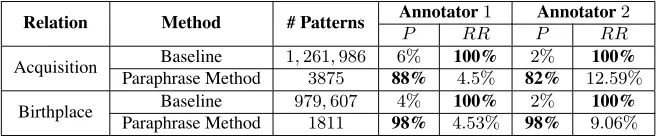
Table 3 shows the results on the quality of surface patterns for the two relations. It can be observed that our method outperforms the baseline by a wide margin in both precision and relative recall. Table 4 shows some example patterns learned by our system.
Table 5 shows the results of the quality of ex-tracted instances. Our system obtains very high pre-cision scores but suffers in relative recall given that the baseline with its very general patterns is likely
to find a huge number of instances (though a very
small portion of them are correct). Table 6 shows some example instances we extracted.
acquisition birthplace
Xagreed to buyY X, who was born inY X, which acquiredY X, was born inY X completed its acquisition
of Y Xwas raised inY
Xhas acquiredY Xwas born in NNNNainY
XpurchasedY X, born inY
aEach “N” here is a placeholder for a number from 0 to 9.
Table 4:Example extraction templates
acquisition birthplace
1. Huntington Bancshares Inc. agreed to acquire Re-liance Bank
1. Cyril Andrew Ponnam-perumawas born inGalle
2. Sony bought Columbia Pictures
2. Cookwas born in NNNN inDevonshire
3. Hanson Industries buys Kidde Inc.
3. Tansey was born in Cincinnati
4. Casino America inc. agreed to buyGrand Palais
4.Tsoiwas born in NNNN in Uzbekistan
5. Tidewater inc. acquired Hornbeck Offshore Services Inc.
5. Mrs. Totenbergwas born inSan Francisco
Table 6:Example instances
6.5 Discussion and Error Analysis
Relation Method # Patterns Annotator1 Annotator2
P RR P RR
Acquisition Baseline 160 55% 13.02% 60% 11.16%
Paraphrase Method 231 83.11% 28.40% 93.07% 25%
Birthplace Baseline 16 31.35% 15.38% 31.25% 15.38%
[image:8.612.128.488.63.131.2]Paraphrase Method 16 81.25% 40% 81.25% 40%
Table 3:Quality of Extraction Patterns
Relation Method # Patterns Annotator1 Annotator2
P RR P RR
Acquisition Baseline 1,261,986 6% 100% 2% 100%
Paraphrase Method 3875 88% 4.5% 82% 12.59%
Birthplace Baseline 979,607 4% 100% 2% 100%
Paraphrase Method 1811 98% 4.53% 98% 9.06%
Table 5:Quality of instances
parameters for working with smaller sized data, it is conceivable that we did notfind the ideal setting for them. So we consider these numbers to be a lower bound. But even then, these numbers clearly indi-cate the advantage of using more data.
We also manually inspected our paraphrases. We found that the problem of “antonyms” was some-what less pronounced due to our use of a large cor-pus, but they still were the major source of error. For example, our system finds the phrase “sell” as a paraphrase for “buy”. We need to deal with this problem separately in the future (may be as a post-processing step using a list of antonyms).
Moving to the task of relation extraction, we see from table 5 that our system has a much lower rel-ative recall compared to the baseline. This was ex-pected as the baseline method learns some very gen-eral patterns, which are likely to extract some good instances, even though they result in a huge hit to its precision. However, our system was able to ob-tain this performance using very few seeds. So an increase in the number of input seeds, is likely to in-crease the relative recall of the resource. The ques-tion however remains as to what good seeds might be. It is clear that it is much harder to come up with good seed patterns (that our system needs), than seed instances (that the baseline needs). But there are some obvious ways to overcome this problem. One way is to bootstrap. We can look at the paraphrases of the seed patterns and use them to obtain more pat-terns. Our initial experiments with this method using handpicked seeds showed good promise. However,
we need to investigate automating this approach. Another method is to use the good patterns from the baseline system and use them as seeds for our sys-tem. We plan to investigate this approach as well. One reason, why we have seen good preliminary re-sults using these approaches (for improving recall), we believe, is that the precision of the paraphrases is good. So either a seed doesn’t produce any new pat-terns or it produces good patpat-terns, thus keeping the precision of the system high while increasing rela-tive recall.
7 Conclusion
[image:8.612.142.472.164.234.2]References
P. G. Anick and S. Tipirneni. 1999. The paraphrase search assistant: terminological feedback for iterative information seeking. InACM SIGIR, pages 153–159. C. Bannard and C. Callison-Burch. 2005.
Paraphras-ing with bilParaphras-ingual parallel corpora. InAssociation for
Computational Linguistics, pages 597–604.
R. Barzilay and L. Lee. 2003. Learning to paraphrase: an unsupervised approach using multiple-sequence align-ment. InIn Proceedings North American Chapter of the Association for Computational Linguistics on
Hu-man Language Technology, pages 16–23.
R. Barzilay and K. R. McKeown. 2001. Extracting para-phrases from a parallel corpus. InIn Proceedings of
Association for Computational Linguistics, pages 50–
57.
R. Barzilay, K. R. McKeown, and M. Elhadad. 1999. Information fusion in the context of multi-document summarization. InAssociation for Computational
Lin-guistics, pages 550–557.
M. Berland and E. Charniak. 1999. Finding parts in very large corpora. In In Proceedings of Association for
Computational Linguistics, pages 57–64.
T. Brants. 2000. Tnt – a statistical part-of-speech tag-ger. InIn Proceedings of the Applied NLP Conference
(ANLP).
C. Callison-Burch, P. Koehn, and M. Osborne. 2006. Improved statistical machine translation using para-phrases. InHuman Language Technology Conference of the North American Chapter of the Association of
Computational Linguistics, pages 17–24.
M. S. Charikar. 2002. Similarity estimation techniques from rounding algorithms. In In Proceedings of the thiry-fourth annual ACM symposium on Theory of
computing, pages 380–388.
T.M. Cover and J.A. Thomas. 1991. Elements of
Infor-mation Theory. John Wiley & Sons.
B. Dolan, C. Quirk, and C. Brockett. 2004. Unsuper-vised construction of large paraphrase corpora: ex-ploiting massively parallel news sources. In In Pro-ceedings of the conference on Computational
Linguis-tics (COLING), pages 350–357.
Z. Harris. 1954. Distributional structure. Word, pages 10(23):146–162.
M. A. Hearst. 1992. Automatic acquisition of hyponyms from large text corpora. InProceedings of the
confer-ence on Computational linguistics, pages 539–545.
D. Lin and P. Pantel. 2001. Dirt: Discovery of infer-ence rules from text. InACM SIGKDD international
conference on Knowledge discovery and data mining,
pages 323–328.
P. Pantel, D. Ravichandran, and E.H. Hovy. 2004. To-wards terascale knowledge acquisition. InIn Proceed-ings of the conference on Computational Linguistics
(COLING), pages 771–778.
D. Ravichandran and E.H. Hovy. 2002. Learning sur-face text for a question answering system. In
Associ-ation for ComputAssoci-ational Linguistics (ACL),
Philadel-phia, PA.
D. Ravichandran, P. Pantel, and E.H. Hovy. 2005. Ran-domized algorithms and nlp: using locality sensitive hash function for high speed noun clustering. In In Proceedings of Association for Computational
Lin-guistics, pages 622–629.
L. Romano, M. Kouylekov, I. Szpektor, I. Dagan, and A. Lavelli. 2006. Investigating a generic paraphrase-based approach for relation extraction. InIn Proceed-ings of the European Chapter of the Association for
Computational Linguistics (EACL).
B. Rosenfeld and R. Feldman. 2006. Ures: an unsuper-vised web relation extraction system. InProceedings of the COLING/ACL on Main conference poster
ses-sions, pages 667–674.
S. Sekine. 2006. On-demand information extraction. In
In Proceedings of COLING/ACL, pages 731–738.
S. Siegal and N.J. Castellan Jr. 1988. Nonparametric
Statistics for the Behavioral Sciences. McGraw-Hill.
I. Szpektor, H. Tanev, I. Dagan, and B. Coppola. 2004. Scaling web-based acquisition of entailment relations.
In In Proceedings of Empirical Methods in Natural
Language Processing, pages 41–48.