U n s u p e r v i s e d D i s c o v e r y of Scenario-Level P a t t e r n s for
I n f o r m a t i o n E x t r a c t i o n
R o m a n Y a n g a r b e r R a l p h G r i s h m a n roman©as, nyu. edu grishman©cs, nyu. edu
C o u r a n t I n s t i t u t e of C o u r a n t I n s t i t u t e of M a t h e m a t i c a l Sciences M a t h e m a t i c a l Sciences
New York U n i v e r s i t y New York U n i v e r s i t y
P a s i T a p a n a i n e n )~ S i l j a H u t t u n e n $
tapanain©conexor, fi sihuttun~ling.helsinki, fi t C o n e x o r O y :~ U n i v e r s i t y of Helsinki Helsinki, F i n l a n d F i n l a n d
A b s t r a c t
Information Extraction (IE) systems are com- monly based on p a t t e r n matching. Adapting an IE system to a new scenario entails the construction of a new p a t t e r n base---a time- consuming and expensive process. We have implemented a system for finding patterns au- tomatically from un-annotated text. Starting with a small initial set of seed patterns proposed by the user, the system applies an incremental discovery procedure to identify new patterns. We present experiments with evaluations which show that the resulting patterns exhibit high precision and recall.
0 I n t r o d u c t i o n
T h e task of Information Extraction (I-E) is the selective extraction of meaning from free natural language text. I "Meaning" is under- stood here in terms of a fixed set of semantic
objects--entities, relationships among entities, and events in which entities participate. T h e semantic objects belong to a small number of
types, all having fixed regular structure, within a fixed and closely circumscribed subject do- main. T h e extracted objects are then stored in a relational database. In this paper, we use the nomenclature accepted in current IE literature; the term subject domain denotes a class of tex- tual documents to be processed, e.g., "business news," and scenario denotes t h e specific topic of interest within the domain, i.e., the set of facts to be extracted. One example of a sce- nario is "management succession," the topic of MUC-6 (the Sixth Message Understanding Con- ference); in this scenario the system seeks to identify events in which corporate managers left
1For general references on IE, cf., e.g., (Pazienza, 1997; muc, 1995; muc, 1993).
their posts or assumed new ones. We will con- sider this scenario in detail in a later section describing experiments.
IE systems today are commonly based on pat- tern matching. T h e patterns are regular ex- pressions, stored in a "pattern base" containing a general-purpose component and a substantial domain- and scenario-specific component.
Portability and performance are two major problem areas which are recognized as imped- ing widespread use of IE. This paper presents a novel approach, which addresses both of these problems by automatically discovering good patterns for a new scenario. T h e viability of our approach is tested and evaluated with an actual IE system.
In the next section we describe t h e problem in more detail in t h e context of our IE system; sec- tions 2 and 3 describe our algorithm for p a t t e r n discovery; section 4 describes our experimental results, followed by comparison with prior work and discussion, in section 5.
1 T h e I E S y s t e m
Our IE system, among others, contains a a back- end core engine, at the heart of which is a regular-e~xpression p a t t e r n matcher. T h e engine draws on a t t e n d a n t knowledge bases (KBs) of varying degrees of domain-specificity. T h e KB components are commonly factored out to make t h e systems portable to new scenarios. There are four customizable knowledge bases in our IE system: the Lexicon contains general dictionar- ies and scenario-specific terms; the concept base
groups terms into classes; the predicate base de- scribes the logical structure of events to be ex- tracted, and the pattern base contains patterns t h a t catch the events in text.
ing to new domains and scenarios. The system allows the
user
(i.e. scenario developer) to start with example sentences in text which contain events of interest, thecandidates,
and general- ize t h e m into patterns. However, the user is ultimately responsible forfinding
all the can- didates, which amounts to manually processing example sentences in a very large training cor- pus. Should s / h e fail to provide an example of a particular class of syntactic/semantic con- struction, the system has no hope of recovering the corresponding events. O u r experience has shown that (1) the process of discovering candi- dates is highly expensive, and (2) gaps in pat- terns directly translate into gaps in coverage.How can the system help automate the pro- cess of
discovering
new good candidates? The system should find examples of all common lin- guistic constructs relevant to a scenario. While there has been prior research on identifying the primary lexical patterns of a sub-language or corpus (Grishman et al., 1986; Riloff, 1996), the task here is more complex, since we are typi- cally not provided in advance with a sub-corpus of relevant passages; these passages must them- selves be found as part of the discovery process. T h e difficulty is that one of the best indications of the relevance of the passages is precisely the presence of these constructs. Because of this circularity, we propose to acquire the constructs and passagesin tandem.
2 S o l u t i o n
We outline our procedure for automatic ac- quisition of patterns; details are elaborated in later sections. The procedure is
unsupervised
in that it does not require the training corpus to be manually annotated with events of inter- est, nor a
pro-classified corpus
with relevance judgements, nor any feedback or intervention from the user 2. The idea is to combine IR-style document selection with aniterative relaxation
process; this is similar to techniques used else- where in NLP, and is inspired in large part, if remotely, by the work of (Kay and RSscheisen, 1993) on automatic alignment of sentences and words in a bilingual corpus. There, the reason- ing was: sentences that are translations of each
2however, it may be supervised after each iteration, where the user can answer yes/no questions to improve the quality of the results
other are good indicators that words they con- tain are translation pairs; conversely, words that are translation pairs indicate that the sentences which contain t h e m correspond to one another. In our context, we observe that documents that are relevant to the scenario will neces- sarily contain good patterns; conversely, good patterns are strong indicators of relevant docu- ments. T h e outline of our approach is as follows.
.
.
Given: (1) a large corpus of
un-annotated
and un-classified
documents in the domain;(2) an initial set of trusted scenario pat- terns, as chosen
ad hoc
by the u s e r - - t h eseed;
as will be seen, the seed can be quitesmall--two or three patterns seem to suf- fice. (3) an initial (possibly empty) set of concept classes
T h e pattern set induces a binary partition
(a
split)
on the corpus: on any document,either zero or more than zero patterns will match. Thus the universe of documents, U, is partitioned into the relevant sub-corpus, R, vs. the non-relevant sub-corpus, R = U - R, with respect to the given pattern set. Actually, the documents are assigned weights which are 1 for documents matched by the trusted seed, and 0 otherwise. 3 2. Search for new candidate patterns:
(a) Automatically convert e a c h sentence in the corpus,into a set of candidate patterns, 4
(b) Generalize each pattern by replacing each lexical item which is a member of a concept class by the class name. (c) Working from the relevant documents,
select those patterns whose distribu- tion is strongly correlated with other relevant documents (i.e., much more
3R represents the trusted t r u t h through the discovery iterations, since it was induced by the manually-selected seed.
densely distributed among the rele- vant documents than among the non- relevant ones). T h e idea is to consider those candidate patterns, p, which meet the
density,
criterion:IHnRI
IRI
- - > >
IHnUI
IUI
where H = H(p) is t h e set of docu- ments where p hits.
(d) Based on co-occurrence with the cho- sen patterns, extend the concept classes.
3. Optional:
Present the new candidates andclasses to the user for review, retaining those relevant to the scenario.
4. T h e new pattern set induces a new parti- tion on the corpus. With this pattern set, return to step 1. Repeat t h e procedure un- til no more patterns can be added.
3 M e t h o d o l o g y
3.1 P r e - p r o e e s s i n g : N o r m a l i z a t i o n Before applying the discovery procedure, we subject the corpus to several stages o f pre- processing. First, we apply a n a m e recognition module, and replace each name with a token describing its class, e.g.
C-Person, C-Company,
etc. We collapse together all numeric expres- sions, currency values, dates, etc., using a single token to designate each of these classes.
3.2 S y n t a c t i c A n a l y s i s
We then apply a parser to perform syntactic normalization to transform each clause into a common predicate-argument structure. We use the general-purpose dependency parser of En- glish, based on the FDG formalism (Tapanainen and J~rvinen, 1997) and developed by the Re- search Unit for Multilingual Language Technol- ogy at the University of Helsinki, and Conexor Oy. The parser (modified to understand the name labels attached in the previous step) is used for reducing such variants as passive and relative clauses to a tuple, consisting of several elements.
1. For each claus, the first element is the sub- ject, a "semantic" subject of a non-finite
sentence or agent of the passive. 5 2. T h e second element is the verb.
3. T h e third element is the object, certain object-like adverbs, subject of t h e passive or subject complement 6
4. T h e fourth element is a phrase which refers to t h e object or the subject. A typical example of such an argument is an object complement, such as
Com-
pany named John Smith
p r e s i d e n t . An-other instance is the so-called
copredica-
tire
(Nichols, 1978), in the parsing system(J~irvinen and Tapanainen, 1997). A co- predicative refers to a subject or an object, t h o u g h this distinction is typically difficult to resolve a u t o m a t i c a l l y /
Clausal tuples also contain a locative modifier, and a temporal modifier. We used a corpus of 5,963 articles from the Wall Street Journal, ran- domly chosen. T h e parsed articles yielded a to- tal of 250,000 clausal tuples, of which 135,000 were distinct.
3.3 G e n e r a l i z a t i o n a n d C o n c e p t C l a s s e s Because tuples may not repeat with sufficient frequency to obtain reliable statistics, each tu- ple is reduced to a set of pairs: e.g., a verb- object pair, a subject-object pair, etc. Each pair is used as a generalized p a t t e r n during the candidate selection stage. Once we have identified pairs which are relevant to t h e sce- nario, we use t h e m to construct or augment con- cept classes, by grouping together t h e missing roles, (for example, a class of verbs which oc- cur with a relevant subject-object pair:
"com-
pany
(hire/fire/expel...}person").
This is sim-ilar to work by several other groups which aims to induce semantic classes through syn- tactic co-occurrence analysis (Riloff and Jones, 1999; Pereira et al., 1993; Dagan et al., 1993; Hirschman et al., 1975), although in .our case the contexts are limited to selected patterns, relevant to the scenario.
SE.g., " J o h n sleeps", "John is appointed by
C o m p a n y " , "I saw a d o g which sleeps", "She asked J o h n to buy a car".
6E.g., " J o h n is appointed by Company", "John is the p r e s i d e n t of Company", "I saw a d o g which sleeps", The d o g which I saw sleeps.
3.4 P a t t e r n Discovery
Here we present the results from experiments we conducted on the MUC-6 scenario, "man- agement succession". T h e discovery procedure was seeded with a small pattern set, namely:
Subject
Verb
Direct Object
C-Company C-Appoint C-Person C-Person C-Resign
Documents are assigned relevance scores on a scale between 0 and 1. The seed patterns are accepted as ground truth; thus the docu- ments they match have relevance 1. On sub- sequent iterations, the newly accepted patterns are not trusted as absolutely. On iteration num- ber i q- 1, each pattern p is assigned a precision measure, based on the relevance of the docu- ments it matches:
Here
C-Company
andC-Person
denote se- mantic classes containing named entities of the corresponding semantic types.C-Appoirlt
de- notes a class of verbs, containing four verbs{ appoint, elect, promote, name}; C-Resign =
{ resign, depart, quit, step-down }.
During a single iteration, we compute the score s, L(p), for each candidate pattern p:
L(p)
= Pc(P)" log {H A R] (1)where R denotes the relevant subset, and H --
H(p)
the documents matching p, as above, and[gnR[
Pc(P)
-- Igl is the conditional probability ofrelevance. We further impose two
support
cri- teria: we distrust such frequent patterns where [ H A U{ > a[U[ as uninformative, and rare pat- terns for which [H A R[ < / 3 as noise. ° At the end of each iteration, the system selects the pat- tern with the highest score, L(p), and adds it to the seed set. The documents which the winning pattern hits are added to the relevant set. The pattern search is then restarted.3.5 R e - c o m p u t a t l o n o f D o c u m e n t
Relevance
The above is a simplification of the actual pro- cedure, in several important respects.
Only generalized patterns are considered for candidacy, with one or more slots filled with wild-cards. In computing the score of the gen- eralized pattern, we do not take into considera- tion
all
possible values of the wild-card role. We instead constrain the wild-card to those values which themselves in t u r n produce patterns with high scores. These values then become members of a new class, which is o u t p u t in tandem with the winning pattern 1°Ssimilarly to (Riloff, 1996)
° U denotes t h e universe of d o c u m e n t s . We used c~ = 0.i and ~--- 2.
1°The classes are c u r r e n t l y unused by subsequent iter- ations; this i m p o r t a n t issue is considered in future work.
Preci+l(p) =
{H(p){1
~
Reli(d)
(2)dEH(p)
where
Reli(d)
is the relevance of the document from the previous iteration, andH(p)
is the set of documents where p matched. More generally, if K is a classifier consisting of aset
of patterns, we can defineH(K)
as the set of documents whereall
of patterns p E K match, and the"cumulative" precision 11 of K as
Preci+l(K) =
1
~
Reli(d)
(3)IH(K)[
riCH(K)
Once the new winning pattern is accepted, the relevance scores of the documents are re- adjusted as follows. For each document d which is matched by some (non-empty) subset of the currently accepted patterns, we c a n view that subset of patterns as a classifier K d = {py}. These patterns determine the new relevance score of the document
Reli+l(d) =
max(Rel~(d),Prec~+l(Kd))
(4)This ensures that the relevance score grows monotonically, and only when there is sufficient positive evidence, as the patterns in effect vote "conjunctively" on the documents. The results which follow use this measure.
Thus in the formulas above, R is not sim- ply the count of the relevant documents, but is rather their
cumulative relevance.
T h e two formulas, (3) and (4), capture the mutual de- pendency of patterns and documents; this re- computation and growing of precision and rele- vance scores is at the heart of the procedure.11Of course, this m e a s u r e is defined only w h e n
4 R e s u l t s 1 An objective measure of goodness of a pattern o . 9 is not trivial to establish since the patterns can- not be used for extraction directly, without be- o . s ing properly incorporated into the knowledge base. Thus, the discovery procedure does not o . v lend itself easily to MUC-style evaluations, since
0 . 6 a pattern lacks information about which events it induces and which slots its arguments should
0 . 5 fill.
However, it is possible to apply some objec- o . a tive measures of performance. One way we eval- uated the system is by noting t h a t in addition o . to growing the pattern set, the procedure also grows the relevance of documents. T h e latter o . 2
can be objectively evaluated.
0 . 1 We used a test corpus of 100 MUC-6 formal- training documents (which were included in t h e o main development corpus of about 6000 docu- ments) plus another 150 documents picked at random from the main corpus and judged by hand. These judgements constituted the ground t r u t h and were used only for evaluation, (not in the discovery procedure).
4.1 T e x t F i l t e r i n g
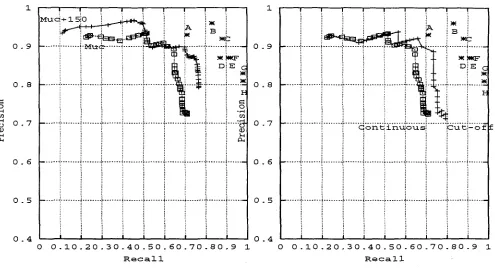
Figure 1 shows the recall/precision measures with respect to the test corpus of 250 docu- ments, over a span of 60 generations, starting with the seed set in table 3.4. T h e Seed pat- terns matched 184 of t h e 5963 documents, yield- ing an initial recall of .11 and precision of .93; by the last generation it searched through 982 documents with non-zero relevance, and ended with .80 precision and .78 recall. This facet of the discovery procedure is closely related to the MUC '%ext-filtering" sub-task, where the sys- tems are judged at the level of d o c u m e n t s rather than event slots. It is interesting to compare the results with other MUC-6 participants, shown anonymously in figure 2. Considering recall and precision separately, the discovery procedure at- tains values comparable to those achieved by some of the participants, all of which were ei- ther heavily-supervised or manually coded sys- tems. It is important to bear in mind that the discovery procedure had no benefit of training material, or any information beyond the seed pattern set.
I I I I I I
...i"{+X'N+~v i P ~ecis ion 'i
" " .... i . . ~ . i R e ~ a a - - - × - - -
[image:5.612.332.586.86.351.2]. . . ~ . . . ~ . . . ~ . . . ~ . . . ~ . . . ~ . . .
... iiiiiiiiiiiiiilEi ... ...
/...
. . . ~ . . . '." . . . ": . . . ~ . . . r . . . ~ . . . ! . . .
2111111ji.. iii121122;1211111;ii122221ilSiiii12112121SiiiiSiii:
...
0 I 0 2 0 3 0 4 0 5 0 6 0 7 0
Ge ner ati on #
8 0
Figure h Recall/Precision curves for Manage- ment Succession
4.2 C h o i c e o f T e s t C o r p u s
Figure 2 shows two evaluations of our discovery procedure, tested against t h e original MUC-6 corpus of 100 documents, and against our test corpus, which consists of an additional 150 doc- uments judged manually. T h e two plots in the figure show a slight difference in results, indi- cating t h a t in some sense, t h e MUC corpus was more "random", or t h a t our expanded corpus was somewhat skewed in favor of more c o m m o n patterns t h a t the system is able to find more easily.
4.3 C h o i c e o f E v a l u a t i o n M e t r i c
0
( I ) 0 . 9
0 . 8
0 . 7
II I I I I I I
: : . , . : •
. . . . . . . . . - - - ! . . . . . .
i i i :: i i i i i ~
... i ... i ... [ ... ? ... f ... T ...
. . . J . . . i . . . i. . . i . . . ~ . . . .; .. . . ..: .. . . i . . . . :
0 6 . . . .'7 .. . . ' . . . ~ .. . . ~ .. . . ~ .. . . i
i i
0 . 5 . . . '. .. . . , . . . ~" . . . , . . . ~ . . . ~ . . . * . . . "=. .. . . , . . .
i
z
0 . 4 i I
0 0 . 1 0 . 2 0 . 3 0 . 4 0 . 5 0 . 6 0 . 7 0 . 8 0 . 9 1 R e c a l l
Figure 2: Precision vs. Recall
I
i . i ~ i B i
. . . e . . . i . . . ! . . . ~ . . . ~ . . . ' . . . ! . . . i . . .
0 . 9
i i i i i i m ~ ! !
! i i D i E c
! i i i i i i i i
0 . ' 7 . . . ~" . . .
C o n ~ i n ~ o u - ¢ ~ u t i - - o f
0 . 6 . . . ~ . . . ~ . . . ~ . . . ' . . . ~ . . . ~ . . . ; . . . ~ . . . ~ . . .
0 . 5 ... ~ ... , ... ~ ... ~ ... ~ ... ~ ... ! ... : ... 4 ...
0 . 4
0 0 . i 0 . 2 0 . 3 0 . 4 0 . 5 0 . 6 0 . 7 0 . 8 0 . 9 1 R e c a l l
Figure 3: Results on the MUC corpus
percent on the recall score for classifying t h a t d o c u m e n t correctly. Similarly, if the system as- signed relevance Y to an irrelevant document, it was penalized only for the mis-classified Y percent on the precision score. To make our re- sults more comparable to those of other MUC competitors, we chose a cut-off point and force the system to make a binary relevance decision on each document. T h e cut-off of 0.5 seemed optimal from empirical observations. Figure 3 shows a noticeable improvement in scores, w h e n using our continuous, "objective" measure, vs. the cut-off measure, with the entire graph essen- tially translated to the right for a gain of almost 10 percentage points of recall.
4.4 E v a l u a t i n g P a t t e r n s
A n o t h e r effective, if simple, measure of perfor- m a n c e i s how m a n y of the patterns the pro- cedure found, and comparing t h e m with those used by an extraction engine which was manu- ally constructed for the same task. Our MUC-6 system used approximately 75 clause level pat- terns, with 30 distinct verbal heads. In one conservative experiment, we observed that the discovery procedure found 17 of these verbs, or 57%. However, it also found at least 8 verbs the
manual system lacked, which seemed relevant to the scenario:
company-bring-person-[as÷officer] 12
person-come-[to+eompanv]-[as+oZScer]
person-rejoin- company-[as + o25cer]person-{ ret , conti, e, remai, ,stay}-[as + o25cer]
person-pursue-interestAt the risk of igniting a philosophical de- bate over what is or is not relevant to a sce- nario, we note t h a t the first four of these verbs are evidently essential to the scenario in the strictest definition, since t h e y imply changes of post. T h e next three are "staying" verbs, and are actually also needed, since higher-level infer- ences required in
tracking
events for long-range merging over documents, require knowledge of personsoccupying
posts, rather t h a n only as- suming or leaving them. T h e most curious oneis
"person-pursue-interesf';
surprisingly, it too [image:6.612.77.572.98.367.2]cate that the person left to pursue other, undis- closed interests, the knowledge of which would relieve t h e system from seeking other informa- tion in order to fill this slot. This is to say that here strict evaluation is elusive.
5 D i s c u s s i o n a n d C u r r e n t W o r k
Some of the prior research has emphasized in- teractive tools to convert examples to extraction patterns, cf. (Yangarber and Grishman, 1997), while others have focused on methods for au- tomatically converting a corpus annotated with extraction examples into such patterns (Lehn- ert et al., 1992; Fisher et al., 1995; Miller et al., 1998). These methods, however, do not re- duce the burden of
finding
the examples to an- notate. With either approach, the portability bottleneck is shifted from the problem of build- ing patterns to that of finding good candidates. The prior work most closely related to this study is (Riloff, 1996), which, along with (Riloff, 1993), seeks automatic methods for filling slots in event templates. However, the prior work differs from that presented here in several cru- cial respects; firstly, the prior work does not at- tempt to find entire events, after the fashion of MUC's highest-level scenario-template task. Rather the patterns produced by those systems identify NPs that fillindividual
slots, without specifying how these slots may be combined at a later stage into complete event templates. The present work focuses on directly discoveringevent-level,
multi-slot relational patterns. Sec- ondly, the prior work either relies on a set of documents with relevance judgements to find slot fillers where they are relevant to events, (Riloff, 1996), or utilizes an un-classified cor- pus containing a very high proportion of rele- vant documents to find all instances of a seman- tic class, (Riloff and Jones, 1999). By contrast, our procedure requires no relevance judgements, and works on the assumption t h a t the corpus is balanced and the proportion of relevant docu- ments is small. Classifying documents by hand, although admittedly easier than taggingevent
instances in text for automatic training, is still a formidable task. When we prepared the test corpus, it took 5 hours to mark 150 short doc- uments.The presented results indicate that our method of corpus analysis can be used to rapidly
identify a large number of relevant patterns without pre-classifying a large training corpus. We are at the early stages of understanding how to optimally tune these techniques, and there are number of areas that need refinement. We are working on capturing the rich informa- tion about concept classes which is currently re- turned as part of our pattern discovery proce- dure, to build up a concept dictionary in tandem with the p a t t e r n base. We are also consider- ing the proper selection of weights and thresh- olds for controlling the rankings of patterns and documents, criteria for terminating the itera- tion process, and for dynamic adjustments of these weights. We feel that the generalization technique in pattern discovery offers a great opportunity for combating sparseness of data, though this requires further research. Lastly, we are studying these algorithms under several unrelated scenarios to determine to what extent scenario-specific phenomena affect their perfor- mance.
R e f e r e n c e s
Ido Dagan, Shaul Marcus, and Shaul
Markovitch. 1993. Contextual word simi- larity and estimation from sparse data. In
Proceedings of the 31st Annual Meeting of
the Assn. for Computational Linguistics,
pages 31-37, Columbus, OH, June.David Fisher, Stephen Soderland, Joseph Mc- Carthy, Fang-fang Feng, and Wendy Lehnert. 1995. Description of the UMass system as used for MUC-6. In
Proc. Si;zth Message Un-
derstanding Conf. (MUC-6),
Columbia, MD,November. Morgan Kaufmann.
R. Grishman, L. Hirschman, and N.T. Nhan. 1986. Discovery procedures for sublanguage
selectional patterns: Initial experiments.
Computational Linguistics,
12(3):205-16. Lynette Hirschman, Ralph Grishman, andNaomi Sager. 1975. Grammatically-based automatic word class formation.
Information
Processing and Management,
11(1/2):39-57.Timo J/irvinen and Pasi Tapanainen. 1997. A dependency parser for English. Technical Re- port TR-1, Department of General Linguis- tics, University of Helsinki, Finland, Febru- ary.
Text-translation alignment.
Computational
Linguistics,
19(1).W. Lehnert, C. Cardie, D. Fisher, J. McCarthy, E. Riloff, and S. Soderland. 1992. Univer- sity of massachusetts: MUC-4 test results and analysis. In
Proc. Fourth Message Un-
derstanding Conf.,
McLean, VA, June. Mor- gan Kaufmann.Scott Miller, Michael Crystal, Heidi Fox, Lance Ramshaw, Richard Schwartz, Rebecca Stone, Ralph Weischedel, and the Annota- tion Group. 1998. Algorithms that learn to extract information; BBN: Description of the SIFT system as used for MUC-7. In Proc.
of
the Seventh Message Understanding Confer-
ence,
Fairfax, VA.1993.
Proceedings of the Fifth Message Un-
derstanding Conference (MUC-5),
Baltimore,MD, August. Morgan Kaufmann.
1995.
Proceedings of the Sixth Message Un-
derstanding Conference (MUC-6),
Columbia,M_D, November. Morgan Kaufmann.
Johanna Nichols. 1978. Secondary predicates.
Proceedings of the 4th Annual Meeting of
Berkeley Linguistics Society,
pages 114-127. Maria Teresa Pazienza, editor. 1997.Infor-
mation Extraction.
Springer-Verlag, Lecture Notes in Artificial Intelligence, Rome.Fernando Pereira, Naftali Tishby, and Lillian Lee. 1993. Distributional clustering of En- glish words. In
Proceedings of the 31st An-
nual Meeting of the Assn. for Computational
Linguistics,
pages 183-190, Columbus, OH,June.
Ellen Riloff and Rosie Jones. 1999. Learn- ing dictionaries for information extraction by multi-level bootstrapping. In
Proceedings of
Sixteenth National Conference on Artificial
Intelligence (AAAI-99),
Orlando, Florida, Ellen Riloff. 1993. Automatically construct-ing a dictionary for information extraction tasks. In
Proceedings of Eleventh National
Conference on Artificial Intelligence (AAAI-
93),
pages 811-816. The AAAI Press/MITPress.
Ellen Riloff. 1996. Automatically generating extraction patterns from untagged text. In
Proceedings of Thirteenth National Confer-
ence on Artificial Intelligence (AAAL96),
pages 1044-1049. T h e AAAI Press/MIT Press.Pasi Tapanainen and Timo J~rvinen. 1997. A
non-projective dependency parser. In
Pro-
ceedings of the 5th Conference on Applied
Natural Language Processing,
pages 64-71,Washington, D.C., April. ACL.