A B a g of Useful T e c h n i q u e s for Efficient and R o b u s t Parsing
B e r n d K i e f e r t, H a n s - U l r i c h K r i e g e r t , J o h n C a r r o l l $, a n d R o b M a l o u f fI G e r m a n R e s e a r c h C e n t e r for Artificial Intelligence ( D F K I ) S t u h l s a t z e n h a u s w e g 3, D-66123 S a a r b r i i c k e n
$Cognitive a n d C o m p u t i n g Sciences, U n i v e r s i t y of Sussex F a l m e r , B r i g h t o n BN1 9QH, U K
* C e n t e r for t h e S t u d y of L a n g u a g e a n d I n f o r m a t i o n , S t a n f o r d U n i v e r s i t y V e n t u r a Hall, S t a n f o r d , C A 94305-4115, U S A
{kiefer, krieger}@dfki, de, j ohnca@cogs, susx. ac. uk, malouf@csli, stanford, edu
A b s t r a c t
This paper describes new and improved tech- niques which help a unification-based parser to process input efficiently and robustly. In com- bination these m e t h o d s result in a speed-up in parsing time of more t h a n an order of magni- tude. The m e t h o d s are correct in the sense t h a t none of t h e m rule out legal rule applications.
1 I n t r o d u c t i o n
This paper describes several generally- applicable techniques which help a unification- based parser to process input efficiently and robustly. As well as presenting a number of new methods, we also report significant improve- ments we have made to existing techniques. The methods preserve correctness in the sense they do not rule out legal rule applications. In particular, none of the techniques involve statistical or approximate processing. We also claim t h a t these m e t h o d s are independent of the concrete parser and neutral with re- spect to a given unification-based g r a m m a r theory/formalism.
How can we gain reasonable efficiency in pars- ing when using large integrated grammars with several thousands of huge lexicon entries? Our belief is that there is no single m e t h o d which achieves this goal alone. Instead, we have to develop and use a set of "cheap" filters which are correct in the above sense. As we indicate in section 10, combining these m e t h o d s leads to a speed-up in parsing time (and reduction of space consumption) of more t h a n an order of magnitude when applied to a mature, well en- gineered unification-based parsing system.
We have implemented our methods as exten- sions to a HPSG g r a m m a r development environ- ment (Uszkoreit et al., 1994) which employs a sophisticated typed feature formalism (Krieger
and Sch~ifer, 1994; Krieger and Sch~ifer, 1995) and an advanced agenda-based b o t t o m - u p chart parser (Kiefer and Scherf, 1996). A special- ized runtime version of this system is currently used in VERBMOBIL as the primary deep anal- ysis component. I
In the next three sections, we report on trans- formations we have applied to the knowledge base (grammar/lexicon) and on modifications in the core formalism (unifier, type system). In Section 5-8, we describe how a given parser can be extended to filter out possible rule applica- tions efficiently before performing "expensive" unification. Section 9 shows how to compute best partial analyses in order to gain a certain level of robustness. Finally, we present empir- ical results to demonstrate the efficiency gains, and speculate on extensions we intend to work on in the near future. W i t h i n the different sec- tions, we refer to three corpora we have used to measure the effects of our methods. The refer- ence corpora for English, German, and Japanese consist of 1200-5000 samples.
2 P r e c o m p i l i n g t h e L e x i c o n
Lexicon entries in the development system are small templates t h a t are loaded and expanded on d e m a n d by the typed feature structure sys- tem. Thereafter, all lexical rules are applied to the expanded feature structures. The results of these two computations form the input of the analysis stage.
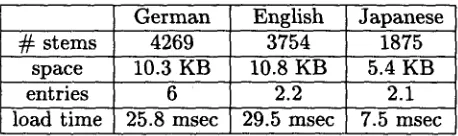
In order to save space and time in the run- time system, the expansion and the application of lexical rules is now done off-line. In addi- tion, certain parts of the feature structure are deleted, since they are only needed to restrict the application of lexical rules (see also section 7 for a similar approach). For each stem, all results are stored in compact form as one com- piled LISP file, which allows to access and load a requested entry rapidly with almost no restric- tion on the size of the lexicon. Although load time is small (see figure 1), the most frequently used entries are cached in main memory, reduc- ing effort in the lexicon stage to a minimum.
We continue to compute morphological infor- mation online, due to the significant increase of entries (a factor of 10 to 20 for German), which is not justifiable considering the minimal com- putation time for this operation.
German English Japanese
# stems 4269 3754 1875
space 10.3 KB 10.8 KB 5.4 KB
entries 6 2.2 2.1
load time 25.8 msec 29.5 msec 7.5 msec
Figure 1: Space and time requirements, space, entries and load time values are per stem
3 I m p r o v e m e n t s i n u n i f i c a t i o n
Unification is the single most expensive oper- ation performed in the course of parsing. Up to 90% of the CPU time expended in parsing a sentence using a large-scale unification based grammar can go into feature structure and type unification. Therefore, any improvements in the efficiency of unification would have direct conse- quences for the overall performance of the sys- tem.
One key to reducing the cost of unification is to find the simplest set of operations that meet the needs of grammar writers but still can be efficiently implemented. The unifier which was part of the original HPSG grammar develop- ment system mentioned in the introduction (de- scribed by (Backofen and Krieger, 1993)) pro- vided a number of advanced features, including distributed (or named) disjunctions (D6rre and Eisele, 1990) and support for full backtracking. While these operations were sometimes useful,
they also made the unifier much more complex than was really necessary.
The unification algorithm used by the cur- rent system is a modification of Tomabechi's (Tomabechi, 1991) "quasi-destructive" unifica- tion algorithm. Tomabechi's algorithm is based on the insight that unification often fails, and copying should only be performed when the uni- fication is going to succeed. This makes it par- ticularly well suited to chart-based parsing.
During parsing, each edge must be built with- out modifying the edges that contribute to it. With a non-backtracking unifier, one option is to copy the daughter feature structures before performing a destructive unification operation, while the other is to use a non-destructive al- gorithm that produces a copy of the result up to the point a failure occurs. Either approach will result in some structures being built in the course of an unsuccessful unification, wasting space and reducing the overall throughput of the system. Tomabechi avoids these problems by simulating non-destructiveness without in- curring the overhead necessary to support back- tracking. First, it performs a destructive (but reversible) check that the two structures are compatible, and only when t h a t succeeds does it produce an output structure. Thus, no out- put structures are built until it is certain that the unification will ultimately succeed.
While an improvement over simple destruc- tive unification, Tomabechi's approach still suf- fers from what Kogure (Kogure, 1990) calls re- dundant copying. The new feature structures produced in the second phase of unification in- clude copies of all the substructures of the in- put graphs, even when these structures are un- changed. This can be avoided by reusing parts of the input structures in the output structure (Carroll and Malouf, 1999) without introducing significant bookkeeping overhead.
[image:2.612.80.309.312.380.2]disjunctive normal form (DNF). Of course, the ratio of the n u m b e r of rules and lexical entries in the original g r a m m a r and t h e DNFed g r a m m a r depends on t h e 'style' of t h e g r a m m a r writer, t h e particular g r a m m a t i c a l t h e o r y used, the n u m b e r of disjunction alternatives, and so on. However, context m a n a g e m e n t for distributed disjunctions requires enormous overhead when compared to simple conjunctive unification, so the benefits of using a simplified unifier out- weigh the cost of moving to DNF. For the Ger- m a n and Japanese VERBMOBIL grammars, we got 1.4-3× more rules and lexical entries, but by moving to a sophisticated conjunctive unifier we obtained an overall speed-up of 2-5.
4 P r e c o m p i l i n g T y p e U n i f i c a t i o n After changing t h e unification engine, t y p e uni- fication now b e c a m e a big factor in processing: nearly 50% of t h e overall unification and copy- ing time was t a k e n up by t h e c o m p u t a t i o n of the greatest lower b o u n d s (GLBs). A l t h o u g h we have in the past c o m p u t e d GLBs online effi- ciently with bit vectors, off-line c o m p u t a t i o n is of course superior.
The feasibility of the latter m e t h o d depends on the n u m b e r of types T of a g r a m m a r . T h e English g r a m m a r employs 6000 types which re- sults in 36,000,000 possible GLBs. Our exper- iments have shown, however, t h a t only 0.5%- 2% of the t y p e unifications were successful and only these GLBs need to be entered into t h e GLB table. In our implementation, accessing an arbitrary GLB takes less t h a n 0.002 msec, compared to 15 msec of 'expensive' bit vector computation (following (A'/t-Kaci et al., 1989)) which also produces a lot of m e m o r y garbage. Our m e t h o d , however, does not consume any m e m o r y and works as follows. We first assign a unique code (an integer) to every t y p e t E 7-. After that, the GLB of s and t is assigned the following code (again an integer, in fact a fixnum): code(s) × ITI + code(t). This array- like encoding guarantees t h a t a specific code is given away to a GLB at most once. Finally, this code together with t h e GLB is stored in a hash table. Hence, t y p e unification costs are mini- mized: two symbol table lookups, one addition, one multiplication, and a hash table lookup.
In order to access a unique m a x i m a l lower b o u n d ( = GLB), we must require t h a t the t y p e
hierarchy is a lower semilattice (or b o u n d e d complete partial order). This is often not the case, but this deficiency can be overcome either by pre-computing the missing types (an efficient i m p l e m e n t a t i o n of this takes approximately 25 seconds for the English g r a m m a r ) or by making t h e online table lookup more complex.
A naive i m p l e m e n t a t i o n of t h e off-line compu- t a t i o n (compute the GLBs for T × T ) only works for small grammars. Since t y p e unification is a c o m m u t a t i v e operation (glb(s,t) = glb(t, s);
s , t E 7"), we can improve the algorithm by computing only glb(s,t). A second improve- m e n t is due to t h e following fact: if the GLB of s and t is b o t t o m , we do not have to com- pute the GLBs of the subtypes of b o t h s and t, since t h e y guarantee to fail. Even with these improvements, the GLB c o m p u t a t i o n of a spe- cific g r a m m a r took more t h a n 50 C P U hours, due to t h e special 'topology' of the t y p e hierar- chy. However, not even t h e failing GLBs need to be c o m p u t e d (which take m u c h of the time). W h e n starting with the leaves of the t y p e hi- erarchy, we can c o m p u t e m a x i m a l components w.r.t, the s u p e r t y p e relation: by following the s u b s u m p t i o n links upwards, we obtain sets of types, s.t. for a given c o m p o n e n t C, we can guarantee t h a t glb(s,t) ~ _k, for all s,t E C.
This last technique has helped us to drop the off-line c o m p u t a t i o n time to less t h a n one C P U hour.
Overall when using the off-line GLBs, we ob- tained a parsing speed-up of 1.5, compared to t h e bit vector computation. 2
5 P r e c o m p i l i n g R u l e F i l t e r s
T h e aim of t h e m e t h o d s described in this and t h e next section is to avoid failing unifications by applying cheap 'filters' (i.e., m e t h o d s t h a t are cheaper t h a n unification). T h e first filter we want to describe is a rule application filter. We have used this m e t h o d for quite a while, and it has proven b o t h efficient and easy to employ. Our rule application filter is a function t h a t
2An alternative approach to improving the speed of type unification would be to implement the GLB table as a cache, rather than pre-computing the table's con- tents exhaustively. Whether this works well in practice or not depends on the efficiency of the primitive glb(s, t)
takes two rules and an argument position and returns a boolean value that specifies if the sec- ond rule can be unified into the given argument position of the first rule.
Take for example the binary filler-head rule in the HPSG grammar for German. Since this grammar allows not more than one el- ement on the SLASH list, the left hand side of the rule specifies an empty list as SLASH value. I n the second (head) argument of the rule, SLASH has to be a list of length one. Consequently, a passive chart item whose top- most rule is a filler-head rule, and so has an empty SLASH, can not be a valid second ar- gument for another filler-head rule application. The filter function, when called with argu- ments
(filler-head-rule-nr, filler-head-rule-nr, 2 )
for mother rule, topmost rule of the daughter and argument position respectively, will return false and no unification a t t e m p t will be made.The conjunctive grammars have between 20 and 120 unary and binary rule schemata. Since all rule schemata in our system bear a unique number, this filter can be realized as a three di- mensional boolean array. Thus, access costs are minimized and no additional memory is used at run-time. The filters for the three languages are computed off-line in less than one minute and rule out 50% to 60% of the failing unifications during parsing, saving about 45% of the parsing time.
6
D y n a m i c U n i f i c a t i o n F i l t e r i n g
( ' Q u i c k C h e c k ' )Our second filter (which we have dubbed the 'quick check') exploits the fact that unification fails more often at certain points in feature structures than at others. For example, syn- tactic features such as CAW(egory) are very fre- quent points of failure, whereas unification al- most never fails on semantic features which are used merely to accumulate pieces of the logical form. Since all substructures are typed, uni- fication failure is manifested by a type clash when attempting a type unification. The quick check is invoked before each unification attempt to check the most frequent failure points, each stored as a feature
path.
The technique works as follows. First, there is an off-line stage, in which a modified unifi- cation engine is used that does not return im-
mediately after a single type unification failure, but instead records in a global data structure the paths at which all such failures occurred. Using this modified system a set of sentences is parsed, and the n paths with the highest failure counts are saved. It is exactly these paths that are used later in filtering.
During parsing, when an active chart item (i.e., a rule schema or a partly instantiated rule schema) and a passive chart item (a lexical entry or previously-built constituent) are combined, the parser has to unify the feature structure of the passive item into the substructure of the ac- tive item that corresponds to the argument to be filled. If either of the two structures has not been seen before, the parser associates with it a vector of length n containing the types at the end of the previously determined paths. The first position of the vector contains the type cor- responding to the most frequently failing path, the second position the second most frequently failing path, and so on. Otherwise, the existing vectors of types are retrieved. Corresponding elements in the vectors are then type-unified, and full unification of the feature structures is performed only if all the type unifications suc- ceed.
Clearly, when considering the number of paths n used for this technique, there is a trade- off between the time savings from filtered uni- fications and the effort required to create the vectors and compare them. The main factors involved are the speed of type unification and the percentage of unification attempts filtered out (the 'filter rate') with a given set of paths. The optimum number of paths cannot be de- termined analytically. Our English, German and Japanese grammars use between 13 to 22 paths for quick check filtering, the precise num- ber having been established by experimenta- tion. The paths derived for these grammars are somewhat surprising, and in many cases do
not
fit in with the intuitions of the grammar-writers. In particular, some of the paths are very long (of length ten or more). Optimal sets of paths for grammars of this complexity could not be produced manually.performed essentially just duplicates work car- ried out later in unification). T h e r e is also over- lap between t h e quick check and t h e rule filter (previous section) since t h e y are applied at the same point in processing. We have found t h a t (given a reasonable n u m b e r of paths) the quick check is t h e more powerful filter of t h e two be- cause it functions dynamically, taking into ac- count feature instantiations t h a t occur during t h e parsing process, b u t t h a t t h e rule filter is still valuable if executed first since it is a single, very fast table lookup. Applying b o t h filters, the filter rate ranges from 95% to over 98%. T h u s almost all failing unifications are avoided. C o m p a r e d to the system with only rule applica- tion filtering, parse time is reduced by approxi- m a t e l y 75% 3 .
7
R e d u c i n g Feature S t r u c t u r e Size
via
R e s t r i c t o r sT h e 'category' information t h a t is a t t a c h e d to each chart item of the parser consists of a single feature structure. T h u s a rule is i m p l e m e n t e d by a feature structure where the daughters have to be unified into p r e d e t e r m i n e d substructures. Although this implementation is along t h e lines of HPSG, it has the drawback t h a t the tree structure t h a t is already present in t h e chart items is duplicated in the feature structures.
Since H P S G requires all relevant informa- tion to be contained in the S Y N S E M feature of
t h e m o t h e r structure, the unnecessary daugh- ters only increase the size of t h e overall feature s t r u c t u r e without constraining the search space. Due to the Locality Principle of H P S G (Pollard and Sag, 1987, p. 145ff), t h e y can therefore be legally removed in fully instantiated items. T h e situation is different for active chart items since daughters can affect their siblings.
To be independent from a-certain grammati- cal t h e o r y or implementation, we use restrictors
similar to (Shieber, 1985) as a flexible and easy- to-use specification to p e r f o r m this deletion. A
positive restrictor is an a u t o m a t o n describing t h e paths in a feature s t r u c t u r e t h a t will re- m a i n after restriction (the deletion operation),
3There are refinements of the technique which we have implemented and which in practice produce ad- ditional benefits; we will report these in a subsequent paper. Briefly, they involve an improvement to th e path collection method, and the storage of other information besides types in the vectors.
whereas a negative restrictor specifies t h e parts to be deleted. B o t h kinds of restrictors can be used in our system.
In addition to the removal of the tree struc- ture, t h e g r a m m a r writer can specify the re- strictor f u r t h e r to remove features t h a t are only used locally and do not play a role in further derivation. It is worth noting t h a t this m e t h o d is only correct if t h e specified restrictor does not remove p a t h s t h a t would lead to future unifica- tion failures. T h e reduction in size results in a speed-up in unification itself, but also in copy- ing and m e m o r y m a n a g e m e n t .
As already m e n t i o n e d in section 2, there ex- ists a second restrictor to get rid of unnecessary parts of t h e lexical entries after lexicon process- ing. T h e speed gain using the restrictors in parsing ranges from 30% for the G e r m a n sys- t e m to 45% for English.
8
Limiting t h e N u m b e r of Initial
Chart I t e m s
Since t h e n u m b e r of lexical entries per stem has a direct impact on the n u m b e r of parsing hy- potheses (in t h e worst case leads to an expo- nential increase), it would be a good idea to have a cheap m e c h a n i s m at h a n d t h a t helps to limit these initial items. T h e technique we have i m p l e m e n t e d is based on t h e following observa- tion: in order to contribute to a reading, certain items (concrete lexicon entries, but also classes of entries) require t h e existence of other items such t h a t t h e non-existence of one allows a safe deletion of the o t h e r (and vice versa). In Ger- man, for instance, prefix verbs require t h e right separable prefixes to be present in the chart, but also a potential prefix requires its prefix verb.
Note t h a t such a technique operates in a m u c h larger context (in fact, t h e whole chart) t h a n a local rule application filter or the quick-check m e t h o d . T h e m e t h o d works as follows. In a preprocessing step, we first separate the chart items which encode prefix verbs from those items which represent separable prefixes. Since b o t h specify the morphological form of the pre- fix, a set-exclusive-or operation yields exactly the items which can be safely deleted from the chart.
onto 97 lexical entries--remember, k o m m e might encode prefix verbs such as a n k o m m e n (arrive), zuriickkommen (come back), etc. al- though here, none of the prefix verb readings are valid, since a prefix is missing. Using the above method, only 8 of 97 lexical entries will remain in the chart. The sentence Ich k o m m e morgen an ( I (will) arrive tomorrow) results in 8 + 7 entries for k o m m e (8 entries for the come reading together with 7 entries for the arrive reading of k o m m e ) and 3 prepositional read- ings plus 1 prefix entry for an. However in Der M a n n wartet an der Tiir (The man is waiting at the door), only the three prepositional read- ings for an come into play, since no prefix verb anwartet exists. Although there are no English prefix verbs, the m e t h o d also works for verbs requiring certain particles, such as come, come along, come back, come up, etc.
The parsing time for the second example goes down by a factor of 2.4; overall savings w.r.t, our reference corpus is 17% of the parsing time (i.e., speed-up factor of 1.2).
9 C o m p u t i n g B e s t P a r t i a l A n a l y s e s
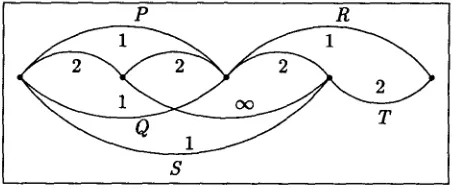
Given deficient, ungrammatical, or spontaneous input, a traditional parser is not able to de- liver a useful result. To overcome this disadvan- tage, our approach focuses on partial analyses which are combined in a later stage to form to- tal analyses without giving up the correctness of the overall deep grammar. But what can be considered good partial analyses? Obviously a (sub)tree licensed by the g r a m m a r which covers a continuous part of the input (i.e., a passive parser edge). But not every passive edge is a good candidate since otherwise we would end up with perhaps thousands of them. Instead, our approach computes an ' o p t i m a l ' connected se- quence of partial analyses which cover the whole input. The idea here is to view the set of pas- sive edges as a directed graph and to c o m p u t e shortest paths w.r.t, a user-defined estimation function.
Since this graph is acyclic and topologically sorted, we have chosen the DAG-shortest-path algorithm (Cormen et al., 1990) which runs in O(V + E). We have modified this algorithm to cope with the needs we have encountered in speech parsing: (i) one can use several start and ~nd vertices (e.g., in case of n-best chains or
word graphs); (ii) all best shortest paths are returned (i.e., we obtain a shortest-path sub- graph); (iii) estimation and selection of the best edges is done incrementally when parsing n- best chains (i.e., only new passive edges entered into the chart are estimated and perhaps se- lected). This approach has one i m p o r t a n t prop- erty: even if certain parts of the input have not undergone at least one rule application, there are still lexical edges which help to form a best p a t h through the passive edges. This means that we can interrupt parsing at any time, but still obtain a useful result.
Let us give an example to see how the estima- tion function on edges (-- trees) might look like (this estimation is actually used in the German grammar):
• n-ary tree (n > 1) with utterance status (e.g., NPs, PPs): value 1
• lexical items: value 2
• otherwise: value c~
T h i s approach does not always favor paths with longest edges as the example in figure 2 shows--instead it prefers paths containing no lexical edges (where this is possible) and there might be several such paths having the same cost. Longest (sub)paths, however, can be ob- tained by employing an exponential estimation function. Other properties, such as prosodic information or probabilistic scores could also be utilized in the estimation function. A de- tailed description of the approach can be found in (Kasper et al., 1999).
P R
S
[image:6.612.321.548.546.642.2]10 C o n c l u s i o n s a n d F u r t h e r W o r k The collection of methods described in this pa- per has enabled us to unite deep linguistic anal- ysis with speech processing. The overall speed- up compared to the original system is about a factor of 10 up to 25. Below we present some absolute timings to give an impression of the current systems' performance.
German English Japanese # sentences 5106 1261 1917
# words 7 6.7 7.2
# lex. entries 40.9 25.6 69.8 # chart items 1024 234 565
# results 5.8 12.4 53.6
time first 1.46 s 0.24 s 0.9 s time overall 4.53 s 1.38 s 4.42 s
In the table, the last six rows are average val- ues per sentence, time first and time overall
are the mean CPU times to compute the first result and the whole search space respectively.
# lex. entries and # chart items give an im- pression of the lexical and syntactic ambiguity of the respective grammars 4
The German and Japanese corpora and half of the English corpus consist of transliterations of spoken dialogues used in the VEI:tBMOBIL project. These dialogues are real world dia- logues about appointment scheduling and va- cation planning. They contain a variety of syn- tactic as well as spontaneous speech phenom- ena. The remaining half of the English corpus is taken from a manually constructed test suite, which may explain some of the differences in absolute parse time.
Most of the methods are corpus independent, except for the quick check filter, which requires a training corpus, and the use of a purely con- junctive grammar, which will do worse in cases of great amounts of syntactic ambiguity because there is currently no ambiguity packing in the parser. For the quick check, we have observed that a random subset of the corpora with about one to two hundred sentences is enough to ob- tain a filter with nearly optimal filter rate.
Although the actual efficiency gain will vary for differently implemented grammars, we are
4The computations were made using a 300MHz SUN Ultrasparc 2 with Solaris 2.5. The whole system is pro- grammed in Franz Allegro Common Lisp.
certain that these techniques will lead to sub- stantial improvements in almost every unifica- tion based system. It is, for example, quite un- likely that unification failures are equally dis- tributed over the different nodes of the gram- mar's feature structure, which is the most im- portant prerequisite for the quick check filter to work. Avoiding disjunctions usually requires a reworking of the grammar which will pay off in the end.
We have shown that the combination of al- gorithmic methods together with some disci- pline in grammar writing can lead to a practi- cal high performance analysis system even with large general grammars for different languages. There is, however, room for further improve- ments. We intend to generalize to other cases the technique for removing unnecessary lexical items. A detailed investigation of the quick- check method and its interaction with the rule application filter is planned for the near future. Since almost all failing unifications are avoided through the use of filtering techniques, we will now focus on methods to reduce the number of chart items that do not contribute to any anal- ysis; for instance, by computing context-free or regular approximations of the HPSG grammars (e.g., (Nederhof, 1997)).
A c k n o w l e d g m e n t s
R e f e r e n c e s
Hassan Ait-Kaci, Robert Boyer, Patrick Lin- coln, and Roger Nasr. 1989. Efficient imple-
mentation of lattice operations. A CM Trans-
actions on Programming Languages and Sys- tems, 11(1):115-146, January.
Rolf Backofen and Hans-Ulrich Krieger. 1993. The TD£///D/A/'e system. In R. Backofen, H.- U. Krieger, S.P. Spackman, and H. Uszkor-
eit, editors, Report of the EAGLES Work-
shop on Implemented Formalisms at DFKI, Saarbriicken, pages 67-74. DFKI Research Report D-93-27.
John Carroll and Robert Malouf. 1999. Effi- cient graph unification for parsing feature- based grammars. University of Sussex and Stanford University.
Ann Copestake. 1998. The (new) LKB system. Ms, Stanford University,
http ://~n~-csli. stanford, edu/~aac/newdoc, pdf.
Thomas H. Cormen, Charles E. Leiserson, and Ronald L. Rivest. 1990. Introduction to Al- gorithms. MIT Press, Cambridge, MA.
Jochen DSrre and Andreas Eisele. 1990.
Feature logic with disjunctive unification. In Proceedings of the 13th International Conference on Computational Linguistics, COLING-90, pages Vol. 3, 100-105.
Walter Kasper, Bernd Kiefer, Hans-Ulrich Krieger, C.J. Rupp, and Karsten L. Worm. 1999. Charting the depths of robust speech parsing. In Proceedings of the ACL-99 The- matic Session on Robust Sentence-Level In- terpretation.
Bernd Kiefer and Oliver Scherf. 1996. Gimme more HQ parsers. The generic parser class of DISCO. Unpublished draft. German Research Center for Artificial Intelligence (DFKI), Saarbr/icken, Germany.
Kiyoshi Kogure. 1990. Strategic lazy incremen- tal copy graph unification. In Proceedings of the 13th International Conference on Com- putational Linguistics (COLING '90), pages 223-228, Helsinki.
Hans-Ulrich Krieger and Ulrich Sch~ifer. 1994.
7"DE--a type description language for
constraint-based grammars. In Proceedings
of the 15th International Conference on Computational Linguistics, COLING-94,
pages 893-899. An enlarged version of this
paper is available as DFKI Research Report RR-94-37.
Hans-Ulrich Krieger and Ulrich Sch~ifer. 1995. Efficient parameterizable type expansion for typed feature formalisms. In Proceedings of the l~th International Joint Conference on Artificial Intelligence, IJCAI-gS, pages 1428- 1434. DFKI Research Report RR-95-18. Mark Jan Nederhof. 1997. Regular approxima-
tions of cfls: A grammatical view. In Pro- ceedings of the 5th International Workshop on Parsing Technologies, IWPT'97, pages 159- 170.
Carl Pollard and Ivan A. Sag. 1987.
Information-Based Syntax and Seman- tics. Vol. I: Fundamentals. CSLI Lecture Notes, Number 13. Center for the Study of Language and Information, Stanford.
Stuart M. Shieber. 1985. Using restriction to extend parsing algorithms for complex-
feature-based formalisms. In Proceedings of
the 23rd Annual Meeting of the Associa- tion for Computational Linguistics, ACL-85,
pages 145-152.
Hideto Tomabechi. 1991. Quasi-destructive graph unification. In Proceedings of the 29th Annual Meeting of the Association for Com- putational Linguistics, volume 29, pages 315- 322.
Hans Uszkoreit, Rolf Backofen, Stephan Buse- mann, Abdel Kader Diagne, Elizabeth A. Hinkelman, Walter Kasper, Bernd Kiefer, Hans-Ulrich Krieger, Klaus Netter, G/inter Neumann, Stephan Oepen, and Stephen P. Spackman. 1994. DISCO--an HPSG-based NLP system and its application for appoint-
ment scheduling. In Proceedings of COLING-
94, pages 436-440. DFKI Research Report RR-94-38.
Wolfgang Wahlster. 1993. VERBMOBIL--
translation of face-to-face dialogs. Re-