Transcriptomic analysis reveals Toxoplasma gondii strain-specific
differences in host cell response to dense granule protein GRA15
Qing Liu1,2 . Wen-Wei Gao2 . Hany M. Elsheikha3 . Jun-Jun He1 . Fa-Cai Li1 .
Wen-Bin Yang1 . Xing-Quan Zhu1
Jun-Jun He
1 State Key Laboratory of Veterinary Etiological Biology, Key Laboratory of Veterinary
Parasitology of Gansu Province, Lanzhou Veterinary Research Institute, Chinese Academy of
Agricultural Sciences, Lanzhou, Gansu Province 730046, PR China.
2 College of Animal Science and Veterinary Medicine, Shanxi Agricultural University, Taigu,
Shanxi Province 030801, PR China.
3 Faculty of Medicine and Health Sciences, School of Veterinary Medicine and Science,
Abstract Growth and replication of the protozoan parasite Toxoplasma gondii within host cell entail the production of several effector proteins, which the parasite exploits for
counteracting the host’s immune response. Despite considerable research to define the host
signaling pathways manipulated by T. gondii and their effectors, there has been limited
progress into understanding how individual members of the dense granule proteins (GRAs)
modulate gene expression within host cells. The aim of this study was to evaluate whether T.
gondii GRA15 protein plays any role in regulating host gene expression. Baby Hamster
Kidney cells (BHK-21) were transfected with plasmids encoding GRA15 genes of either type
I GT1 strain (GRA15I) or type II PRU strain (GRA15II). Gene expression patterns of
transfected and nontransfected BHK-21 cells were investigated using RNA-sequencing
analysis. GRA15I and GRA15II induced both known and novel transcriptional changes in the
transfected BHK-21 cells compared with nontransfected cells. Pathway analysis revealed that
GRA15II was mainly involved in the regulation of Tumor Necrosis Factor (TNF), NF-κB,
HTLV-I infection and NOD-like receptor signaling pathways. GRA15I preferentially
influenced the synthesis of unsaturated fatty acids in host cells. Our findings support the
hypothesis that certain functions of GRA15 protein are strain-dependent; and that GRA15
modulates the expression of signaling pathways and genes with important roles in T. gondii
pathophysiology. A greater understanding of host signaling pathways influenced by T. gondii
effectors, would allow the development of more efficient anti-T. gondii therapeutic schemes,
capitalizing on disrupting parasite virulence factors to advance the treatment of toxoplasmosis.
Introduction
Toxoplasma gondii is a zoonotic protozoan parasite capable of infecting almost any nucleated
cell type in most species of warm-blooded mammals (Dubremetz 1998; Liu et al. 2015).
Approximately 138 unique genotypes of T. gondii have been identified (Su et al. 2012). Of
which genotypes I, II and III are the predominant lineages in North America and Europe
(Howe et al. 1995). These genotypes have remarkable differences in their virulence in mice; a
single parasite of the hypervirulent genotype I T. gondii strain can be 100% lethal to a mouse;
however, genotype II (intermediate in virulence) and genotype III (avirulent) strains had LD50
values of 103-104 and 104-105, respectively (Sibley et al. 1992; Howe et al. 1996; Saeij et al.
2006). Parasites of genotype I have a greater ability to breach biological barriers than those of
genotype II and genotype III (Boothroyd et al. 2002; Barragan et al. 2003). Differences in
strain virulence are paralleled with strain-specific differences in the parasite-derived effector
proteins originating from apical secretory organelles - such as microneme proteins (MICs),
rhoptry proteins (ROPs) and dense granule proteins (GRAs) (Mercier et al. 2015; Hakimi et al.
2017; Liu et al. 2017).
T. gondii secretes a large array of polymorphic effector proteins, such as MICs, ROPs and
GRAs, which are crucial for host cell invasion, intracellular growth and evasion of the host
immune response (Fox et al. 2011; Bougdour et al. 2013; Braun et al. 2013; Ma et al. 2014).
The GRAs, in particular, have been shown to contribute to T. gondii pathogenesis in multiple
activation of TRAF6 and the generation of reactive oxygen species (ROS), leading to
enhanced proinflammatory responses by macrophages (Yang et al. 2015). GRA16 regulates
several genes associated with cell cycle progression and the p53 tumor suppressor pathway
(Bougdour et al. 2013). GRA17 and GRA23 enable T. gondii to obtain more nutrients by
altering parasitophorous vacuole membrane (PVM) permeability (Gold et al. 2015). The
dense granule protein TgIS blocks the interferon (IFN) response by recruiting the Mi-2/NuRD
repressor complex to STAT1 binding sites in the promoter regions of the responsive genes.
GRA24 activates MAPK signaling and regulates expression of genes encoding growth factors
and/or cytokines/chemokines that support the parasite replication (Braun et al. 2013).
Of note is GRA15 in type II strains (GRA15II), a polymorphic protein, which has been
shown to be essential in the activation of NF-κB pathway via induction of TRAF6 and IκB
kinase (IKK), leading to phosphorylation and degradation of IκB, and IL-1β induction via
activation of host caspase-1 (Rosowski et al. 2011; Gov et al. 2013). Interestingly, T. gondii
type II-specific induction of the immunomodulatory microRNAs, miR-146a and miR-155,
was found to be independent of GRA15, which is a known activator of these microRNAs
(Cannella et al. 2014), suggesting that other effectors are likely to be involved in this process.
Despite significant advances in our understanding of the basic biology of T. gondii GRAs and
the identification of 30 different GRAs (Mercier et al. 2015), the full spectrum of host
signaling mechanisms modulated by GRA15 remains to be elucidated and GRA15I-induced
To further explore the biological function of T. gondii GRA15, we examined the
transcriptomes of Baby Hamster Kidney cells (BHK-21) transfected with GRA15I orGRA15II.
We hypothesized that transcriptomic analysis of host BHK-21 cells transfected with GRA15
protein from different T. gondii genotypes may reveal new insights into the molecular
mechanisms of genotype-specific virulence contributions of GRA15 effector to the
pathogenesis of T. gondii. Results showed that GRA15I and GRA15II induced known and
novel transcriptional changes in transfected BHK-21 cells. Notably, GRA15II was mainly
involved in the regulation of TNF, NF-κB, HTLV-I infection and NOD-like receptor
signaling pathways; whereas, GRA15I upregulated genes associated with the synthesis of
unsaturated fatty acids, probably to meet the metabolic demands of the growing parasite
within the host cells.
Materials and methods
Parasite and cell cultures
Toxoplasma gondii tachyzoites, type I GT1 strain and type II PRU strain, were maintained by
weekly passage in human foreskin fibroblast (HFF) cells at 37 °C with 5% CO2 in Dulbecco’s
modified Eagle medium (DMEM) supplemented with 10% fetal bovine serum (FBS) and 10
(BHK-21) used in the transfection experiments were purchased from the American Type
Culture Collection (ATCC) and maintained in DMEM containing 5% FBS.
Construction of the recombinant plasmids
Total RNA from T. gondii GT1 strain was isolated using TRIzol reagent according to the
manufacturer’s instructions (Invitrogen, USA) in order to generate a cDNA library. The
fragment of GRA15 gene from GT1 strain encoding a 584-residue (from aa52 to aa635)
peptide was amplified from cDNA using RT-PCR. The GRA15 PCR primers included
GRA15-forward (5’-GGGGGATCCATAATTCGGTGGCTTGGGTATCTTAC-3’) and
GRA15-reverse (5’-GGGGAATTCTCATGGAGTTACCGCTGATTGTGTG-3’). The PCR
product was cloned into a pMD19-T vector (Takara, Dalian, China) and digested with the
restriction enzymes BamHI and EcoRI. Digested fragments were purified and ligated into a
pCMV-mCherry vector at the EcoRI and BamHI sites. The recombinant plasmid (designated
pCMV-GRA15I) was transformed into E. coli DH5α strain (Transgen, Beijing, China) and
verified by restriction digestion. The sequence of the GRA15 coding region was confirmed by
sequencing (Sangon Biotech, Shanghai, China). The recombinant plasmid pCMV-GRA15II
containing the fragment of the GRA15II gene encoding a 500-residue (from aa51 to aa550)
peptide was similarly constructed, with the exception that total RNA was isolated from T.
Expression analysis of recombinant plasmids in BHK-21
BHK-21 cells (~80% confluent) were transfected with the recombinant plasmids
(pCMV-GRA15I or pCMV-GRA15II) using Lipofectamine 2000 reagent (Life Technologies,
USA), and harvested 48 hr post-transfection for Western blot analysis. Cells transfected with
pCMV-GRA15I or pCMV-GRA15II were separately lysed using cell lysis buffer (Beyotime,
China). After pelleting the cellular debris by centrifugation, cell proteins in the supernatant
were collected and separated using 12% SDS-polyacrylamide gels, followed by transfer onto
a polyvinylidene fluoride (PVDF) membrane (Millipore, USA) at 15 mA for 30 min. The
PVDF membrane was then incubated with anti-mCherry mouse monoclonal antibody for 2 hr,
and HRP-labeled goat anti-mouse IgG antibody for 1 hr. Finally, DAB reagent (TIANGEN,
China) was used to reveal peroxidase activity. The BHK-21 cells transfected with an empty
pCMV-mCherry vector served as a control.
Transcriptome sequencing and read alignment
Here, the transcriptomic response of BHK-21 cells to T. gondii GRA15 protein was
determined. We performed transcriptomic analysis of BHK-21 cells transfected with
pCMV-GRA15I, pCMV-GRA15II or pCMV-mCherry. Three biological replicates were
examined for each condition. RNA was extracted individually from each biological replicate
6000 Nano LabChip using Agilent 2100 Bioanalyzer (Agilent Technologies, Santa Clara, CA,
USA). The concentration of RNA was determined using Nanodrop 2000 (Thermo Scientific,
USA). Three micrograms of RNA sample from each biological replicate was used for the
construction of transcriptome libraries with a NEBNext® Ultra™ RNA Library Prep Kit for
Illumina® (NEB, USA), and the index codes were added. After filtering low quality reads and
removing adapters, high quality clean reads were aligned to the golden hamster genome using
SOAPaligner/SOAP2. No more than 5 mismatches in the alignment were permitted. RNA
isolation, library construction, RNA sequencing and reads alignment were performed at The
Novogene Bioinformatics Institute (Beijing, China).
Bioinformatics analysis
Differential expression of RNAs was identified using the "DESeq" bioconductor package in R
(Anders and Huber 2010). The Benjamini-Hochberg’s approach was used for adjusting false
discovery rate (FDR). We defined genes as being differentially expressed between groups if
they had an FDR adjusted P-value (q-value) of < 0.05. GO enrichment analysis was
performed, and only GO terms with a corrected P-value < 0.05 were considered significantly
enriched. KEGG database (http://www.genome.jp/kegg/) was used for pathway analysis, with
a corrected P-value <0.05 was set as the threshold.
Toxoplasma gondii expresses effectors during different stages of infection, suggesting that
these effector molecules play critical roles in the parasite’s life cycle (Mercier et al. 2015;
Hakimi et al. 2017; Liu et al. 2017). Indeed, growth and replication of T. gondii within the
host cell require the production of multiple effector proteins that the parasite employs in order
to establish a successful infection (Fox et al. 2011; Bougdour et al. 2013; Braun et al. 2013;
Ma et al. 2014; Hakimi et al. 2017). Despite considerable research efforts, many questions
remain about the level of impact that these effector proteins have on the host cell signaling
pathways. To identify host factors that underpin T. gondii pathogenesis, we compared the
transcriptomes of BHK-21 cells exposed to T. gondii GRA15 protein with untreated cells
using a transcriptome sequencing (RNA-seq) approach. We focused on examining the effect
of GRA15 protein in two T. gondii strains belonging to two different genotypes (type 1 GT1
and type 2 PRU) on host cell transcriptomes. Global transcriptomic analysis revealed
strain-specific gene expression patterns of GRA15-transfected BHK-21 cells; and identified
candidate genes for future studies into the molecular mechanisms of host-T. gondii interaction.
Our results add to the growing body of evidence that strain-specific polymorphism in T.
gondii effectors released into host cells during infection can induce distinct differences in the
modulation of host signaling pathways (Reese et al. 2011; Niedelman et al. 2012; Hakimi et al.
2017).
Fragments of GRA15I and GRA15II were successfully amplified from cDNA of T. gondii GT1
strain and PRU strain, respectively (Fig. 1A); and recombinant pCMV-GRA15I and
pCMV-GRA15II plasmids were successfully constructed. The resultant plasmids were
confirmed by restriction enzyme digestion (Fig. 1B). To detect the expression of transduced
genes, total protein was extracted from BHK-21 cells at 48 h post transfection. Western
blotting analysis showed that BHK-21 cells transfected with pCMV-GRA15II or
pCMV-GRA15I plasmids, expressed 82 kDa GRA15II-mCherry and 90 kDa
GRA15I-mCherry fusion proteins, respectively (Fig. 2, lane 1 and lane 2). Cells transfected
with the empty control pCMV-mCherry vector expressed a ~30 kDa protein (Fig. 2, lane 3).
Analysis of differential gene expression
The RNA integrity number values (RIN) of all 9 RNA extracts were >8.0, indicating the high
quality of samples used as input to the RNA sequencing library preparation. RNA-seq raw
data were submitted to the NCBI database under the accession number PRJNA394179.
Comparing mRNA libraries from pCMV-GRA15I-transfected BHK-21 cells with BHK-21
cells transfected with pCMV-mCherry, identified 128 differentially expressed genes (DEGs),
of which 61 were up-regulated and 67 were down-regulated (Fig. 3A). Comparing mRNA
libraries from BHK-21 cells transfected with pCMV-GRA15II to BHK-21 cells transfected
mRNAs (Fig. 3B). Clustering analysis of DEGs in the two treatment conditions compared
with the control is shown in Fig. 3C.
GO enrichment and KEGG analysis
Using a corrected P-value <0.05 as a cut-off, no GO term was found significantly enriched.
However, the top GO terms enriched in BHK-21 cells transfected with pCMV-GRA15I were
involved in glucose metabolism, amino acid biosynthesis, entry into host cell, gene
transcription and metabolic processes (Fig. 4A). The top enriched GO terms of DEGs in
BHK-21 cells transfected with pCMV-GRA15II were involved in cell growth, immune
response, inflammation and metal ion transport (Fig. 4B).
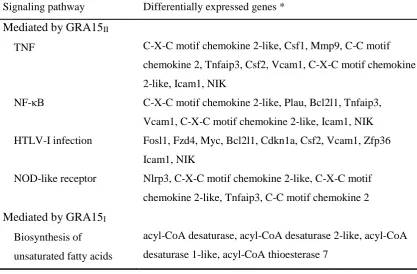
KEGG enrichment analysis, based on a corrected P-value <0.05, indicated that DEGs in
BHK-21 cells transfected with pCMV-GRA15I were significantly enriched in the synthesis of
unsaturated fatty acids (Table 1). This indicated that the T. gondii GT1 strain might induce
unsaturated FAs synthesis in host cells (compared to PRU strain) via GRA15I, possibly to
meet the nutritional demands of the proliferating parasite. T. gondii contains three FAs
synthesis pathways and can scavenge unsaturated FAs from host cells (Waller et al. 1998;
Seeber et al. 2003; Ramakishnan et al. 2012). Lipids are key to the survival of T. gondii as an
obligate intracellular parasite and unsaturated FAs are essential for sustaining the parasite
growth and genesis of the membrane of the newly formed parasites (Gratraud et al. 2009;
In agreement with data from previous studies, GRA15II was found to activate the host
NF-κB signaling pathway (Rosowski et al. 2011; Morgado et al. 2014). GRA15II was shown
to activate the NF-κB pathway in HFFs independent of MyD88 and TRIF, but dependent on
TRAF6 and the IKK complex (Rosowski et al. 2011). Our results showed that GRA15II
activates NF-κB pathway downstream of TRAF2, TRAF3 and TRAF5, probably via the
upregulation of the mitogen-activated protein kinase kinase kinase 14 (also known as
NF-kappa-B-inducing kinase [NIK]), a key molecule involved in activating canonical and
noncanonical NF-κB signaling pathway (Table 1, Fig. 5). Thus, it is possible that GRA15II
contributes to the activation of NF-κB signaling pathway using a number of molecular
mechanisms.
Differential gene expression analysis showed that cells transfected with pCMV-GRA15II
were significantly enriched in TNF, HTLV-I infection and NOD-like receptor signaling
pathways (Table 1). Activation of these pathways can lead to the upregulation of several host
molecules; such as NLR family pyrin domain containing 3 (Nlrp3), C-C motif chemokine 2,
tumor necrosis factor and alpha-induced protein 3 (Tnfaip3), all play critical roles in immune
and inflammatory responses (Ozaki et al. 2015; Hung et al. 2017). GRA15II alone, without
involvement of the parasite, was found to induce CD40 expression in bone marrow-derived
macrophages in a NF-κB-dependent manner, and to promote T. gondii immunity through the
production of interleukin-12 (Morgado et al. 2014). The GRA15II-associated dysregulation of
immune signaling and other host defense pathways, to proliferate and persist within their
hosts.
The manipulation of NF-κB pathway by T. gondii remains undefined. Type 1 T. gondii
strains can transiently block NF-κB nuclear translocation regardless of the host cell infected
(Shapira et al. 2002). However, type 2 strains had the opposite effect through the activity of
GRA15 (Rosowski et al. 2011). Another transcription factor, GRA7, was found to activate
MAPK and NF-κB, and the proinflammatory cytokine expression in macrophages (Yang et al.
2015). It is possible that other transcription factors with yet unknown molecular mechanisms
are also involved in the regulation of the NF-κB pathway. We have recently shown that
GRA15II interacts with mouse Luzp1, which is involved in regulating host non-coding RNA
genes (Liu et al. 2017). It remains to be elucidated whether or not Luzp1 plays a role in the
GRA15II-induced activation of the NF-κB signaling pathway.
GRA15 appears to play additional roles in modulating the parasite’s interaction with host
cells. Through activation of NF-κB pathway, GRA15II can induce polarization of
macrophages to classically activated phenotype M1 (Jensen et al. 2011). M1 macrophages
produce pro-inflammatory cytokines, such as TNF-α, IL-1β, IL-6 and IL-12, and high levels
of ROS and nitric oxide (Gordon 2003), probably to limit the parasite growth, hence
facilitating the establishment of chronic type II T. gondii infection. The proto-oncogene c-Myc
is a key transcription factor, regulating the expression of many genes involved in critical host
cellular processes; such as cell cycle progression, cell metabolism and apoptosis (Dang and
2014). Our data also showed that GRA15II induces upregulation of c-Myc in BHK-21 cells
(additional file 3), suggesting that upregulation of c-Myc is a potential mechanism by which
GRA15II inhibits apoptosis of infected host cells.
In conclusion, we determined the host cell transcriptomic changes associated with
exposure to T. gondii GRA15 protein. We analyzed RNA-seq data from BHK-21 cells
expressing GRA15I protein of GT1 strain, or GRA15II protein of PRU strain and discovered
altered signaling pathways in cells transfected with each protein compared to control cells.
GRA15II was mainly involved in the regulation of TNF, NF-κB, HTLV-I and NOD-like
receptor signaling pathways. GRA15I induced the synthesis of host unsaturated FAs. These
results provide new insight into the role of GRA15II-NIK signaling in immune response
against T. gondii, and confirmed the finding that GRA15II induces activation of host cell
NF-κB signaling in a strain-specific, not a cell type-specific, manner. These previously
unidentified features of the host transcriptomic response to T. gondii GRA15 extend our
understanding of the cellular signaling pathways and effectors activated following T. gondii.
Further investigations are required to better understand the interrelationship between
synergistic effects of GRA15s on host cell regulatory networks.
Conflict of interest The authors declare that they have no competing interests.
Natural Science Foundation of China (Grant No. 31230073) and the Elite Program of Chinese
Academy of Agricultural Sciences. We thank Novogene Corporation for technical assistance.
Data availability statement The transcriptomic data supporting the results of this article were deposited in the NCBI database (http://www.ncbi.nlm.nih.gov/sra/) under the accession
number PRJNA394179.
References
Alloatti A, Gupta S, Gualdrón-López M, Nguewa PA, Altabe SG, Deumer G, Wallemacq P,
Michels PA, Uttaro AD (2011) Stearoyl-CoA desaturase is an essential enzyme for the
parasitic protist Trypanosoma brucei. Biochem Biophys Res Commun 412(2):286-290
Anders S, Huber W (2010) Differential expression analysis for sequence count data. Genome
Biol 11(10):R106
Barragan A, Sibley LD (2003) Migration of Toxoplasma gondii across biological barriers.
Trends Microbiol 11(9):426-430
Boothroyd JC, Grigg ME (2002) Population biology of Toxoplasma gondii and its relevance
to human infection: do different strains cause different disease? Curr Opin Microbiol
5(4):438-442
Bougdour A, Durandau E, Brenier-Pinchart MP, Ortet P, Barakat M, Kieffer S,
Host cell subversion by Toxoplasma GRA16, an exported dense granule protein that
targets the host cell nucleus and alters gene expression. Cell Host Microbe 13(4):489-500
Braun L, Brenier-Pinchart MP, Yogavel M, Curt-Varesano A, Curt-Bertini RL, Hussain T,
Kieffer-Jaquinod S, Coute Y, Pelloux H, Tardieux I, Sharma A, Belrhali H, Bougdour A,
Hakimi MA (2013) A Toxoplasma dense granule protein, GRA24, modulates the early
immune response to infection by promoting a direct and sustained host p38 MAPK
activation. J Exp Med210(10):2071-2086
Cannella D, Brenier-Pinchart MP, Braun L, van Rooyen JM, Bougdour A, Bastien O, Behnke
MS, Curt RL, Curt A, Saeij JP, Sibley LD, Pelloux H, Hakimi MA (2014) miR-146a and
miR-155 delineate a microRNA fingerprint associated with Toxoplasma persistence in the
host brain. Cell Rep 6(5):928-937
Dang CV, Lewis BC (1997) Role of oncogenic transcription factor c-Myc in cell cycle
regulation, apoptosis and metabolism. J Biomed Sci 4(6):269-278
Dang CV, Resar LM, Emison E, Kim S, Li Q, Prescott JE, Wonsey D, Zeller K (1999)
Function of the c-Myc oncogenic transcription factor. Exp Cell Res 253(1):63-77
Dubremetz JF (1998) Host cell invasion by Toxoplasma gondii. Trends Microbiol 6(1):27-30
Fox BA, Falla A, Rommereim LM, Tomita T, Gigley JP, Mercier C, Cesbron-Delauw MF,
Weiss LM, Bzik DJ (2011) Type II Toxoplasma gondii KU80 knockout strains enable
functional analysis of genes required for cyst development and latent infection. Eukaryot
Franco M, Shastri AJ, Boothroyd JC (2014) Infection by Toxoplasma gondii specifically
induces host c-Myc and the genes this pivotal transcription factor regulates. Eukaryot Cell
13(4):483-493
Gold DA, Kaplan AD, Lis A, Bett GC, Rosowski EE, Cirelli KM, Bougdour A, Sidik SM,
Beck JR, Lourido S, Egea PF, Bradley PJ, Hakimi MA, Rasmusson RL, Saeij JP (2015)
The Toxoplasma Dense Granule Proteins GRA17 and GRA23 mediate the movement of
small molecules between the host and the parasitophorous vacuole. Cell Host Microbe
17(5):642-652
Gordon S (2003) Alternative activation of macrophages. Nat Rev Immunol 3(1):23-35
Gov L, Karimzadeh A, Ueno N, Lodoen MB (2013) Human innate immunity to Toxoplasma
gondii is mediated by host caspase-1 and ASC and parasite GRA15. mBio 4(4).
pii:e00255-13
Gratraud P, Huws E, Falkard B, Adjalley S, Fidock DA, Berry L, Jacobs WR Jr, Baird MS,
Vial H, Kremer L (2009) Oleic acid biosynthesis in Plasmodium falciparum:
characterization of the stearoyl-CoA desaturase and investigation as a potential
therapeutic target. PLoS One4(9):e6889
Hakimi MA, Olias P, Sibley LD. (2017) Toxoplasma effectors targeting host signaling and
transcription. Clin Microbiol Rev 30(3):615-645
Howe DK, Sibley LD. (1995) Toxoplasma gondii Comprises 3 clonal lineages: Correlation of
Howe, DK, Summers BC, Sibley LD (1996) Acute virulence in mice is associated with
markers on chromosome VIII in Toxoplasma gondii. Infect Immun 64(12):5193-5198
Hung YY, Lin CC, Kang HY, Huang TL (2017) TNFAIP3, a negative regulator of the TLR
signaling pathway, is a potential predictive biomarker of response to antidepressant
treatment in major depressive disorder. Brain Behav Immun 59:265-272
Jensen KD, Wang Y, Wojno ED, Shastri AJ, Hu K, Cornel L, Boedec E, Ong YC, Chien YH,
Hunter CA, Boothroyd JC, Saeij JP (2011) Toxoplasma polymorphic effectors determine
macrophage polarization and intestinal inflammation. Cell Host Microbe9(6):472-483
Liu Q, Li FC, Elsheikha HM, Sun MM, Zhu XQ (2017) Identification of host proteins
interacting with Toxoplasma gondii GRA15 (TgGRA15) by yeast two-hybrid system.
Parasit Vectors 10(1):1
Liu Q, Li FC, Zhou CX, Zhu XQ (2017) Research advances in interactions related to
Toxoplasma gondii microneme proteins. Exp Parasitol 176:89-98
Liu Q, Wang ZD, Huang SY, Zhu XQ (2015) Diagnosis of toxoplasmosis and typing of
Toxoplasma gondii. Parasit Vectors 8:292
Ma JS, Sasai M, Ohshima J, Lee Y, Bando H, Takeda K, Yamamoto M (2014) Selective and
strain-specific NFAT4 activation by the Toxoplasma gondii polymorphic dense granule
protein GRA6. J Exp Med 211(10):2013-2032
Mercier C, Cesbron-Delauw MF (2015) Toxoplasma secretory granules: one population or
Morgado P, Sudarshana DM, Gov L, Harker KS, Lam T, Casali P, Boyle JP, Lodoen MB
(2014) Type II Toxoplasma gondii induction of CD40 on infected macrophages enhances
interleukin-12 responses. Infect Immun82(10):4047-4055
Niedelman W, Gold DA, Rosowski EE, Sprokholt JK, Lim D, Farid Arenas A, Melo MB,
Spooner E, Yaffe MB, Saeij JP (2012) The rhoptry proteins ROP18 and ROP5 mediate
Toxoplasma gondii evasion of the murine, but not the human, interferon-gamma response.
PLoS Pathog 8(6):e1002784
Ozaki E, Campbell M, Doyle SL (2015) Targeting the NLRP3 inflammasome in chronic
inflammatory diseases: current perspectives. J Inflamm Res 8:15-27
Ramakrishnan S, Docampo MD, Macrae JI, Pujol FM, Brooks CF, van Dooren GG, Hiltunen
JK, Kastaniotis AJ, McConville MJ, Striepen B (2012) Apicoplast and endoplasmic
reticulum cooperate in fatty acid biosynthesis in apicomplexan parasite Toxoplasma
gondii. J Biol Chem 287(7):4957-4971
Ramakrishnan S, Docampo MD, MacRae JI, Ralton JE, Rupasinghe T, McConville MJ,
Striepen B (2015) The intracellular parasite Toxoplasma gondii depends on the synthesis
of long-chain and very long-chain unsaturated fatty acids not supplied by the host cell.
Mol Microbiol 97(1):64-76
Ramakrishnan S, Serricchio M, Striepen B, Bütikofer P (2013) Lipid synthesis in protozoan
parasites: a comparison between kinetoplastids and apicomplexans. Prog Lipid Res
Reese ML, Zeiner GM, Saeij JP, Boothroyd JC, Boyle JP (2011) Polymorphic family of
injected pseudokinases is paramount in Toxoplasma virulence. Proc Natl Acad Sci U S A
108(23):9625-9630
Rosowski, EE, Lu, DN, Julien L, Rodda L, Gaiser RA, Jensen KD, Saeij JP (2011)
Strain-specific activation of the NF-kappaB pathway by GRA15, a novel Toxoplasma
gondii dense granule protein. J Exp Med 208(1):195-212
Saeij JP, Boyle JP, Coller S, Taylor S, Sibley LD, Brooke-Powell ET, Ajioka JW, Boothroyd
JC (2006) Polymorphic secreted kinases are key virulence factors in toxoplasmosis.
Science 314(5806):1780-1783
Shapira S, Speirs K, Gerstein A, Caamano J, Hunter CA (2002) Suppression of NF-kappaB
activation by infection with Toxoplasma gondii. J Infect Dis185 Suppl 1:S66-72
Sibley L D, Boothroyd JC (1992) Virulent strains of Toxoplasma gondii comprise a single
clonal lineage. Nature 359(6390):82-85
Su C, Khan A, Zhou P, Majumdar D, Ajzenberg D, Dardé ML, Zhu XQ, Ajioka JW,
Rosenthal BM, Dubey JP, Sibley LD (2012) Globally diverse Toxoplasma gondii isolates
comprise six major clades originating from a small number of distinct ancestral lineages.
Proc Natl Acad Sci U S A 109(15):5844-5849
Waller RF, Keeling PJ, Donald RG, Striepen B, Handman E, Lang-Unnasch N, Cowman AF,
Besra GS, Roos DS, McFadden GI (1998) Nuclear-encoded proteins target to the plastid
in Toxoplasma gondii and Plasmodium falciparum. Proc Natl Acad Sci U S A
Wang JL, Li TT, Elsheikha H.M, Chen K, Zhu WN, Yue DM, Zhu XQ, Huang SY (2017)
Functional characterization of rhoptry kinome in the virulent Toxoplasma gondii RH
strain. Front Microbiol 8:84
Yang CS, Yuk JM, Lee YH, Jo EK (2015) Toxoplasma gondii GRA7-Induced TRAF6
Figure legends:
Fig. 1 Generation of the recombinant plasmids.(A)Lane M: DNA marker. Lane 1 and lane 2
represent gel electrophoresis of the GRA15I fragment and GRA15II fragment amplified from
cDNA of T. gondii GT1 strain and T. gondii PRU strain, respectively. (B) Enzymatic
digestion of the recombinant plasmids. Lane M: DNA marker. Lane 1 and lane 2 represent the
recombinant plasmids pCMV-mCherry-GRA15I and pCMV-mCherry-GRA15II digested with
EcoRI and BamHI, respectively.
Fig. 2 Western immunoblotting analysis of the expressed protein products by positive plasmids. Lane 1: protein of the pCMV-mCherry-GRA15II-transfected BHK-21 cell lysate;
lane 2: protein of the pCMV-mCherry-GRA15I-transfected BHK-21 cell lysate; and lane 3:
protein of the empty pCMV-N-mCherry-transfected BHK-21 cell lysate.
Fig. 3 Effects of Toxoplasma gondii GRA15 on host gene transcription. Volcano plots showing the differentially expressed genes (DEG) of BHK-21 cells transfected with (A)
pCMV-mCherry-GRA15I or (B) pCMV-mCherry-GRA15II compared to control cells. Red:
upregulated genes; green: downregulated genes; blue: non-differentially expressed genes. padj,
adjusted P-value. (C) Heat map and hierarchical clustering showing expression values of all
DEGs. Each column represents a different treatment condition and each row represents a
gene.
Fig. 4 Gene Ontology (GO) enrichment analysis of differentially expressed genes (DEGs) in the transfected BHK-21 cells. (A) Top GO terms in cells transfected with pCMV-GRA15I
were involved in glucose metabolism, amino acid biosynthesis, metabolic processes,
membrane remodeling, entry into host cell, and gene transcription. (B) GO terms of DEGs in
cells transfected with pCMV-GRA15II were involved in cell growth, immune response,
inflammation, and metal ion transport.
Table 1 Differentially expressed genes and associated signaling pathways.
* All differentially expressed genes were upregulated.
Signaling pathway Differentially expressed genes *
Mediated by GRA15II
TNF C-X-C motif chemokine 2-like, Csf1, Mmp9, C-C motif
chemokine 2, Tnfaip3, Csf2, Vcam1, C-X-C motif chemokine
2-like, Icam1, NIK
NF-κB C-X-C motif chemokine 2-like, Plau, Bcl2l1, Tnfaip3,
Vcam1, C-X-C motif chemokine 2-like, Icam1, NIK
HTLV-I infection Fosl1, Fzd4, Myc, Bcl2l1, Cdkn1a, Csf2, Vcam1, Zfp36
Icam1, NIK
NOD-like receptor Nlrp3, C-X-C motif chemokine 2-like, C-X-C motif
chemokine 2-like, Tnfaip3, C-C motif chemokine 2
Mediated by GRA15I
Biosynthesis of
unsaturated fatty acids
acyl-CoA desaturase, acyl-CoA desaturase 2-like, acyl-CoA
Supplement materials:
Additional file 1: Gene expression profiling based on Fragments per Kilobase per Million mapped reads (FPKM) values.
Additional file 2: Gene expression analysis of RNA-seq data, showing DEGs between
BHK-21 cells transfected with pCMV-GRA15I and control BHK-21 cells transfected with
pCMV-mCherry.
Additional file 3: Gene expression analysis of RNA-seq data, showing DEGs between
BHK-21 cells transfected with pCMV-GRA15II and control BHK-21 cells transfected with
pCMV-mCherry.
Additional file 4: Gene expression analysis of RNA-seq data, showing DEGs between
BHK-21 cells transfected with pCMV-GRA15I and BHK-21 cells transfected with