Edited by:
Brivaela Moriceau, Centre National de la Recherche Scientifique (CNRS), France
Reviewed by:
Peter Croot, National University of Ireland Galway, Ireland Anne-Julie Cavagna, Vrije Universiteit Brussel, Belgium
*Correspondence:
Jill N. Sutton [email protected]
Specialty section:
This article was submitted to Marine Biogeochemistry, a section of the journal Frontiers in Earth Science
Received:29 May 2017
Accepted:21 December 2017
Published:30 January 2018
Citation:
Sutton JN, André L, Cardinal D, Conley DJ, de Souza GF, Dean J, Dodd J, Ehlert C, Ellwood MJ, Frings PJ, Grasse P, Hendry K, Leng MJ, Michalopoulos P, Panizzo VN and Swann GEA (2018) A Review of the Stable Isotope Bio-geochemistry of the Global Silicon Cycle and Its Associated Trace Elements. Front. Earth Sci. 5:112. doi: 10.3389/feart.2017.00112
A Review of the Stable Isotope
Bio-geochemistry of the Global
Silicon Cycle and Its Associated
Trace Elements
Jill N. Sutton1*, Luc André2, Damien Cardinal3, Daniel J. Conley4,5, Gregory F. de Souza6, Jonathan Dean7,8, Justin Dodd9, Claudia Ehlert10, Michael J. Ellwood11,
Patrick J. Frings12,13, Patricia Grasse14, Katharine Hendry15, Melanie J. Leng8,16, Panagiotis Michalopoulos17, Virginia N. Panizzo16,18and George E. A. Swann16,18
1Université de Brest - UMR 6539 CNRS/UBO/IRD/Ifremer, LEMAR - IUEM, Plouzané, France,2Earth Sciences Department,
Royal Museum for Central Africa, Tervuren, Belgium,3LOCEAN Laboratory, Sorbonne Universités (UPMC, Univ Paris 06),
Centre National de la Recherche Scientifique, IRD, MNHN, Paris, France,4Department of Geology, Lund University, Lund,
Sweden,5Stellenbosch Institute for Advanced Study, Stellenbosch, South Africa,6Institute of Geochemistry and Petrology,
ETH Zurich, Zurich, Switzerland,7School of Environmental Sciences, University of Hull, Hull, United Kingdom,8NERC
Isotope Geosciences Facilities, British Geological Survey, Nottingham, United Kingdom,9Geology and Environmental
Geosciences, Northern Illinois University, DeKalb, IL, United States,10Max Planck Research Group for Marine Isotope
Geochemistry, Institute for Chemistry and Biology of the Marine Environment, University of Oldenburg, Oldenburg, Germany,
11Research School of Earth and Ocean Sciences, Australian National University, Canberra, ACT, Australia,12Earth Surface
Geochemistry, Helmholtz Centre Potsdam GFZ German Research Centre for Geosciences, Potsdam, Germany,
13Department of Geoscience, Swedish Museum of Natural History, Stockholm, Sweden,14Ocean Circulation and Climate
Dynamics, GEOMAR Helmholtz Centre for Ocean Research Kiel, Kiel, Germany,15School of Earth Sciences, University of
Bristol, Bristol, United Kingdom,16Centre for Environmental Geochemistry, University of Nottingham, Nottingham,
United Kingdom,17Hellenic Centre for Marine Research, Institute of Oceanography, Anavyssos, Greece,18School of
Geography, University of Nottingham, Nottingham, United Kingdom
Silicon (Si) is the second most abundant element in the Earth’s crust and is an important nutrient in the ocean. The global Si cycle plays a critical role in regulating primary productivity and carbon cycling on the continents and in the oceans. Development of the analytical tools used to study the sources, sinks, and fluxes of the global Si cycle (e.g., elemental and stable isotope ratio data for Ge, Si, Zn, etc.) have recently led to major advances in our understanding of the mechanisms and processes that constrain the cycling of Si in the modern environment and in the past. Here, we provide background on the geochemical tools that are available for studying the Si cycle and highlight our current understanding of the marine, freshwater and terrestrial systems. We place emphasis on the geochemistry (e.g., Al/Si, Ge/Si, Zn/Si, δ13C, δ15N,δ18O, δ30Si) of dissolved and biogenic Si, present case studies, such as the Silicic Acid Leakage Hypothesis, and discuss challenges associated with the development of these environmental proxies for the global Si cycle. We also discuss how each system within the global Si cycle might change over time (i.e., sources, sinks, and processes) and the potential technical and conceptual limitations that need to be considered for future studies.
INTRODUCTION
The global silicon (Si) cycle is of great interest due to the role that silicate weathering has played in maintaining climatic stability on geological time scales (Siever, 1991; Frings et al., 2016; Conley et al., 2017) and because Si is an important nutrient for many organisms in marine and freshwater ecosystems. It occurs as silicate minerals in association with all rock types (igneous, metamorphic, sedimentary). Weathering, biological and geochemical transformations, transport and interactions with other elements (in particular nutrients and carbon) form the basis of the global biogeochemical Si cycle (Frings et al., 2016). The global Si cycle has evolved through geologic time with overall declines in oceanic dissolved Si due to the uptake and deposition by organisms (Siever, 1991; Conley et al., 2017). While the modern Si biogeochemical cycle is influenced by anthropogenic forcing (Laruelle et al., 2009), the processes of weathering and burial as biogenic silica (bSiO2) are the dominant processes in
the biogeochemical Si cycle.
The paper aims to review the use of Si stable isotopes and associated trace elements in order to address the following questions:
(1) What is the bio-geochemistry of biogenic silica?
(2) What is the current state of knowledge regarding the influence of biogenic silica on the global Si cycle?
(3) What is the influence of early to late sediment diagenesis on biogenic silica, and thus its utility as an environmental proxy for palaeoceanographic interpretation?
Although modeling is not being covered in the review, its importance cannot be underscored as it has been increasingly used to understand the mechanisms controlling Si isotope fractionation (e.g.,Qin et al., 2016) and the development of the Si isotope composition as a tracer of biogeochemical silicon cycle in modern and past natural systems (e.g.,Gao et al., 2016).
Silicon Reservoirs
The chemical weathering of silicate minerals and the eventual cycling of weathered products (clays, dissolved Si) provide the starting point of Si bio-geochemistry and its interaction with other elemental cycles such as carbon. Silicate weathering represents an important sink of atmospheric CO2over geological
time scales (Berner et al., 1983; Wollast and Mackenzie, 1989; Brady and Carroll, 1994) and depends on temperature and precipitation. Thus, the rate at which weathering occurs will be enhanced through changes in global temperature (White and Blum, 1995).
Silicon rarely occurs as the pure element in nature and appears most often in combination with oxygen to form solid silicate minerals or amorphous compounds (including biogenic Si), or in aqueous solutions it occurs as orthosilicic acid (Si(OH)4)
(Iler, 1979). Silicon exists in major pools in dissolved and solid forms in all reservoirs: extra-terrestrial, continental (e.g., soil, vegetation, hydrothermal), freshwater (e.g., rivers, lakes, groundwater, organisms, sediment), atmospheric (e.g., aerosols), and oceanic (e.g., water column, organisms, sediment and pore-waters, oceanic crust, hydrothermal), (Figure 1). The dominant
transformation processes are weathering of silicate rocks and the formation of secondary minerals and release of dissolved Si, uptake of dissolved Si by organisms for the biomineralization of biogenic Si, and the remineralization of Si. Coastal regions are of special importance here because they support a large fraction of the global primary production and control the transfer of dissolved and particulate nutrients from land to the open ocean (Conley et al., 1993; Rabouille et al., 2001).
Biomineralization, the Structure of
Biogenic Silica, and Its Relevance to the
Global Si Cycle
Many organisms use dissolved Si, including diatoms, silicoflagellates, radiolarians, sponges, and higher plants, to produce solid bSiO2 structures. Biogenic silica, also called
biogenic opal, is the second most abundant mineral type formed by organisms after calcium carbonate (Brümmer, 2003). Biogenic silica is amorphous and its density, hardness, solubility, viscosity and composition may vary considerably (Perry et al., 2003). The silica structures are based upon a random network of SiO4
tetrahedral units connected through covalently linked Si-O-Si bonds of variable bond angle and bond lengths (Mann and Perry, 1986). All silicifying organisms utilize Si(OH)4; however, each
silicifying organism has a unique biomineralizing pathway. Details on the process of silicification can be found in the literature for diatoms (Hildebrand et al., 1997; Martin-Jezequel et al., 2000; Claquin et al., 2002; Hildebrand, 2008; Thamatrakoln and Hildebrand, 2008; Brunner et al., 2009; Thamatrakoln and Kustka, 2009), sponges (Wilkinson and Garrone, 1980; Reincke and Barthel, 1997; Cha et al., 1999; Maldonado et al., 1999, 2005; Brümmer, 2003; Uriz et al., 2003; Muller et al., 2007; Schröder et al., 2007), and higher plants (Takahashi et al., 1990; Ma et al., 2001, 2006).
Globally, diatoms (unicellular autotrophic algae) dominate the bSiO2production with an estimate of 240±40 Tmol yr−1
(Tréguer and De La Rocha, 2013) (Figure 1). The degree of bSiO2production (i.e., silicification) of diatom frustules can vary
significantly, even within the same species, and is primarily a function of ambient dissolved Si (DSi) concentration and cellular growth rate, whereby the bSiO2content of a cell decreases during
DSi limitation and/or accelerated growth (Martin-Jezequel et al., 2000; Claquin et al., 2002; Baines et al., 2010).
Until recently, the relevance of marine siliceous sponges on the Si cycle has been largely ignored and their role is currently being re-visited with a biogenic Si production estimated at 3.6±
3.7 Tmol yr−1(Maldonado et al., 2005; Tréguer and De La Rocha,
2013) (Figure 1).
Higher plants produce roughly 84 (60–180) Tmol yr−1 of
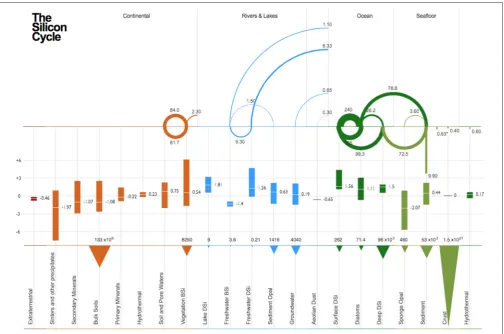
FIGURE 1 |Schematic of the modern day global Si cycle grouped by reservoir and their associatedδ30Si values (in‰). The figure is divided into three parts. The upper part indicating the magnitude of the fluxes (in 1012mol yr−1; Tmol yr−1) between each reservoir, the middle part showing their associatedδ30Si values, and the
lower part showing reservoir size. The fluxes are numerically and figuratively represented, moving in a clockwise manner (e.g., In the Ocean compartment, there is a flux of 240 Tmol yr−1from Surface DSi to Diatoms, after the Diatoms dissolve, there is 135 Tmol yr−1flux back from the Diatoms to the Surface DSi in the upper
water column). In the case where the flux points downwards (e.g., 9.90 Tmol yr−1within the sediment reservoir), the flux is effectively removed from the system. *
Value assumed to underestimate flux (see section Diagenetic Silica Precipitation and Reverse Weathering). Estimates for the Si fluxes were obtained from the following sources:Carey and Fulweiler (2012),Frings et al. (2016),Laruelle et al. (2009),Tréguer and De La Rocha (2013). Estimates for the range ofδ30Si values were obtained from the following sources:Ehlert et al. (2016); Figure 2 fromFrings et al. (2016)and references therein;Varela et al. (2016)andPanizzo et al. (2017). All data used to prepare this figure are available in Table S1.
ratio >1, whereas non-accumulating plants have a passive or discriminating Si uptake system (Takahashi et al., 1990; Ma et al., 2001). After uptake, DSi is rapidly transported through the plant to the different tissues within the transpiration stream. Due to transpirational water loss, DSi is gradually concentrated, and phytoliths are formed by precipitation in plant cells when the concentration increases above 2 mM. Thus, phytoliths vary in size and shape depending on the cell type, plant organ and plant species they are deposited inMadella et al. (2005).
Global Si Cycle Over Time
The global oceanic Si cycle has evolved through geologic time primarily due to the uptake of dissolved Si and subsequent biomineralization by organisms, especially sponges, radiolarians and diatoms (Siever, 1991). Substantial advances have occurred in our understanding of the evolution of the geological Si cycle through the use of the fossil record, silica isotope geochemistry and the phylogenomics of biosilicification (Conley et al., 2017;
large-scale changes in DSi concentrations in the geologic record (Fontorbe et al., 2016, 2017).
In the recent years, there have been a considerable number of studies on palaeo-environments of the Archean (4 – 2.5 Ga) and Proterozoic (2.5 – 0.5 Ga). Most use Si - O isotopes, elemental ratios (Ge/Si, REEs) or other isotopic systems (Fe, S. . . ) associated to silica in Banded Iron Formations (e.g., André et al., 2006; Heck et al., 2011; Delvigne et al., 2012), cherts (e.g., Robert and Chaussidon, 2006; Chakrabarti et al., 2012) or paleosols (e.g.,Delvigne et al., 2016). These studies all use the knowledge gained from modern, experimental and/or less ancient palaeo-records to interpret geochemical palaeo-records, in order to reconstruct, for instance, the ocean temperature and oxygen levels, input of hydrothermal, and intensity of weathering. However, it is still challenging to provide a clear picture of these ancient environments because the studies have divergent results. A multi-proxy approach is therefore required. This is particularly needed to assess the level of preservation of the samples in order to take into account diagenesis while interpreting the geochemical signals into reconstruction of paleo-environments (Marin-Carbonne et al., 2014).
Modern day anthropogenic factors have a strong influence on the global Si cycle, for example through increases in CO2,
temperature and changes in hydrological regimes and erosion, variations in agriculture and land use, eutrophication and changes in nutrient stoichiometry in coastal regions, and river damming (e.g., Rickert et al., 2002; Struyf et al., 2004, 2010; Laruelle et al., 2009; Clymans et al., 2011; Carey and Fulweiler, 2012). Anthropogenic perturbations of the global biogeochemical Si cycle are due to the gradual aggradation or depletion of the amorphous SiO2pool held in continental soils (Barão et al., 2015;
Vandevenne et al., 2015) and aquatic sediments (Frings et al., 2014b) in response to these changing environmental forcings (Struyf and Conley, 2012) and river damming (Conley et al., 1993). Our emerging understanding is that DSi inputs from the continents have potentially altered the magnitude andδ30Si composition of DSi supplied to the open ocean mostly because of changes occurring on the continent as well as changes of the silica sink on continental margins (Bernard et al., 2010; Frings et al., 2016). This includes short time scales such as anthropogenic impacts (not only on Si, but also on other nutrients e.g., N, P, Fe) and possibly to an extent large enough to impact whole-ocean isotopic signatures on the timescale of Quaternary glacial cycles. Thus, the sensitivity of biogeochemical Si cycling to anthropogenic pressure, especially in coastal regions, will likely be highlighted in the future (Laruelle et al., 2009; Bernard et al., 2010) and the continental Si cycle should not be neglected when interpreting pre-Quaternary long-term δ30SibSiO2 records from
marine sediment records (Egan et al., 2013; Fontorbe et al., 2016).
STABLE SILICON ISOTOPE RATIOS TO
STUDY THE GLOBAL SI CYCLE
Silicon has three naturally occurring stable isotope with the following mean abundances:28Si: 92.23%,29Si: 4.67%, and30Si:
3.10%. The Si isotope composition is expressed in delta notation (δnSi) and can be calculated according to the following formula:
δnSix(‰) = ([(nSi/28Si)x−(nSi/28Si)standard)]
/[(nSi/28Si)standard])×1000 (1)
where n can represent29Si or30Si,xrefers to either bSiO2or DSi
and standard is the atomic ratio of the heavy and light Si isotopes of the quartz standard (NBS28).
Several processes have been shown to fractionate Si isotopes, which explain why this tool can be used to trace the Si biogeochemical cycle. The extent of isotopic fractionation is defined by the isotopic fractionation factor (α) that can be expressed byHoefs (2009):
-for kinetic isotopic exchange (irreversible reaction)
α=k28Si/k30Si
Where k refers to the rate constants for the reaction of light and heavy isotopes.
-for equilibrium
α=(30Si:28Si)A/(30Si:28Si)B
Where A and B are two chemical substances, typically the substrate (A) and the product (B) of the reaction.
For practical and analytical reasons, Si isotope ratios and Si isotope fractionation are reported in delta notation with the permil (‰) scale. A useful way to think about Si isotope values is as fractionation of Si isotopes, or the difference between the
δ30Si values of DSi and bSiO2as described byεin Equation (2)
and calculated (Criss, 1999) as:
ε∼=1000•(αbSiO2−DSi−1) (2)
where αbSiO2−DSi is the isotopic fractionation factor between
the product (bSiO2) and the substrate (DSi). Note the lack of
redox speciation and organic complexation for silicon limits fractionation effects to predominately inorganic kinetic exchange factors, contrary to many other elements (Wiederhold, 2015).
The following is a description of the systems, processes and transformations that control the global silica cycle, and the known constraints on theδ30Si (seeFigure 1).
Weathering
Weathering is a major process that fractionates Si isotopes in the critical zone. When primary minerals (−0.90<δ30Si<+1.40‰,
Vegetation
Significant fractionation has been observed during the uptake of Si by plant roots (Opfergelt et al., 2006a,b; Ding et al., 2008a,b; Sun et al., 2008) and exogenous material on the surface of vegetation (Engström et al., 2008), although the transporters behind both forms of uptake remain largely unknown. Theδ30Si composition of these plants (Figure 1), and in particular of phytoliths is in the first instance regulated by the physical environment around the plant including the soluble Si concentration of the medium (Opfergelt et al., 2006b), the weathering of the soil substrate (Opfergelt et al., 2008) and soil organic matter (Ding et al., 2008a). Beyond this, there is clear evidence that significant isotopic fractionation can occur between plants with increased fractionation in heavy Si accumulators (Ding et al., 2005, 2008a,b; Opfergelt et al., 2006a,b). Rayleigh fractionation during the transportation of Si within plants also causes heavier isotopes to be concentrated within the xylem whilst lighter isotopes are preferentially deposited in phytoliths lower down the plant (Ding et al., 2005, 2008a,b; Opfergelt et al., 2006a,b; Hodson et al., 2008). Phytoliths have higher dissolution rates than other silicate materials (e.g., tephra, clay, feldspars, quartz), and provide a major source of DSi in some soil/terrestrial environments (Derry et al., 2005; Struyf et al., 2009; Cornelis et al., 2010; Opfergelt et al., 2010).
Freshwater
Rivers
Over the past two decades, several studies of δ30Si in DSi in freshwaters have been published, but we are still only beginning to understand the controls and variability ofδ30Si in freshwaters. Since the first data of DSi in freshwaters by De La Rocha (De La Rocha et al., 2000),δ30Si has been analyzed from a number of rivers (and lakes) across the world including the Congo River and tributaries (Cardinal et al., 2010; Hughes et al., 2011), the Tana River (Hughes et al., 2012), the Yellow and Yangtze Rivers (Ding et al., 2004, 2011), the Kalix River in Sweden (Engström et al., 2010), Swiss alpine rivers (Georg et al., 2006), and most recently from the Nile River (Cockerton et al., 2013), the Amazon river and tributaries (Hughes et al., 2013), areas of central Siberia (Pokrovsky et al., 2013; Panizzo et al., 2017) and the Ganges (Fontorbe et al., 2013; Frings et al., 2015). The range inδ30Si from freshwaters, thus far analyzed, now stands at−0.17 to+4.66‰ (Figure 1).
In big-picture terms, (almost) every measurement ever made of river water DSi has been heavier than the parent material. When river water DSi concentrations are normalized to a conservative element (typically Na, which is common in silicate rocks), then it becomes clear that Si is removed from solution, either into secondary clay minerals or some form of bSiO2, and
that this removal is associated with a discrimination against the heavier isotopes of Si. This is consistent with our understanding derived from the microscale (e.g., Steinhoefel et al., 2011; Schuessler and von Blanckenburg, 2014) to the soil-column scale (e.g.,Opfergelt et al., 2012; Pogge von Strandmann et al., 2012). These all show that the new secondary mineral phases have less of the heavier isotopes relative to river waters. The same discrimination is also well established for plants (Ding et al., 2005,
2008a; Opfergelt et al., 2006a,b), freshwater diatoms (Alleman et al., 2005; Panizzo et al., 2016) and sponges, which preferentially utilize28Si over30Si (and29Si), thus leading to an increase inδ30Si in the host water.
Broadly, δ30Si values in river waters reflect the weathering regime, which is ultimately a mass-balance constraint. We can conceptualize two end-member weathering regimes: “kinetically limited” and “supply limited” (almost equivalent to the geomorphological terms “transport limited” and “weathering limited”; see e.g.,Stallard and Edmond, 1983). Kinetic limitation refers to a situation where the weathering flux (solute, DSi) is operating at maximum capacity for the conditions; increasing the factors that control the weathering rate (essentially temperature or water supply) will increase the rate of DSi export, because there is an excess of fresh material to be weathered. This could be e.g., the high Himalaya, the Andes, or (sub) glacial catchments (Georg et al., 2007; Fontorbe et al., 2013; Opfergelt et al., 2013) where physical erosion greatly outpaces chemical weathering. At very high erosion rates (low weathering intensity or congruency) river
δ30Si is low: there is no time, and no thermodynamic driving force, for clays to form, soils to develop or biology to have a meaningful influence on theδ30Si measured in a stream.
The other end-member (supply limited) is where essentially all material leaves the catchment as a dissolved flux; the rate of solute generation is limited by how quickly material is supplied. Increasing the factors that control the weathering rate (temperature or water supply) will not increase Si export, because there is nothing left to be weathered. In this case the conversion of parent material (bedrock) to river solute is (near-) complete, then there can be no observable fractionation: the river takes on the composition of the bedrock, regardless of how much bSiO2
cycling is taking place in the catchment (and assuming steady-state, and no loss of bSiO2). This is the case in e.g., the lowland,
blackwater tributaries of the Amazon (Hughes et al., 2013) and the Congo (Cardinal et al., 2010), where the interpretation is that the swampy, organic-matter-rich environments are conducive to the dissolution of previously formed clays.
Along a gradient of weathering intensity (0 to 1, where 0 is all material exported by physical erosion, and 1 where all denudation occurs as dissolved fluxes), the offset between source material (bedrock) and riverδ30Si should be zero at both ends and peak somewhere in the middle (Bouchez et al., 2013). The same is true for Li isotopes (Henchiri et al., 2016); in general, the isotopic separation along a weathering regime gradient is much clearer for Li (δ7Li) thanδ30Si (see e.g.,Dellinger et al., 2015; Frings et al., 2016). Superimposed on the above is the role of vegetation (see section Vegetation).
All the work published on the major catchment/riverine systems (e.g.,Cockerton et al., 2013) highlight the complexity of lake/drainage basin systems, and clearly illustrate that both Si concentrations and δ30Si are closely controlled by a mixture of weathering/erosion processes [regulated by the wider climate system (De La Rocha et al., 2000; Opfergelt and Delmelle, 2012)], aquatic productivity and catchment soil, vegetation. Studies of the Congo Basin, for example, have shown that δ30SiDSi is mainly regulated by the intensity of silicate
basin with spatial variations further driven by the type of weathering regime and the extent to which clays are dissolved by organic matter (Cardinal et al., 2010). These abiotic processes are then superimposed by seasonal biological processes, in particular by diatom biomineralization in the dry season, which exports significant amounts of Si out of the water column (Hughes et al., 2011). Other examples also account for the downstream increase in Nile River δ30Si to the progressive uptake of DSi by diatoms and other Si-accumulating organisms (Cockerton et al., 2013). Indeed,Cockerton et al. (2013)showed significant seasonal variations inδ30Si from freshwaters, with higherδ30Si in the dry season (+1.54 to +4.66‰) than the wet season (+0.48 to +3.45‰) due to reduced mobilization of dissolved Si from the catchment relative to its aquatic demand. These examples demonstrate the superimposed (often seasonal) control that freshwater bSiO2plays in regulatingδ30Si signatures, where
abiotic processes (chemical weathering and secondary mineral formation) otherwise dominate.
Additional examples also show the potential importance of vegetation in altering the Si concentration and/or δ30Si and regulating the flux of Si both into/out of river waters (Alleman et al., 2005; Ding et al., 2011; Hughes et al., 2011; Cockerton et al., 2013; Pokrovsky et al., 2013). For example, along the Yangtze River uptake of DSi by grasses in wetlands and rice in paddy fields drives a progressive increase inδ30SiDSidue to better phytolith
preservation in areas of high phytolith production and/or low phytolith dissolution (Ding et al., 2004). In contrast the net impact of vegetation on δ30SiDSi seems to be minimal in the
Okavango Delta, Congo and Amazon Basin due to the rapid dissolution/recycling of phytoliths (Cardinal et al., 2010; Hughes et al., 2013; Frings et al., 2014b).
Work on smaller aquatic systems has also shown significant temporal variations inδ30SiDSi. In a boreal river in North Sweden
seasonal changes in δ30SiDSi of 0.8‰ were attributed to: (1)
the release of plant derived bSiO2/phytoliths (lowδ30Si) during
snow melt; (2) changing inputs from headwaters; and (3) diatom biomineralization (Engström et al., 2010). Similarly, seasonal changes inδ30SiDSiof up to 0.6‰ were observed in a series of
rivers in Switzerland (Georg et al., 2006), whilst variations in a series of Icelandic rivers have been linked to differential erosion rates and secondary minerals formation (Opfergelt et al., 2013).
Other studies have shown a significant anthropogenic impact on δ30SiDSi, often in response to land use changes and dam
construction (Sun et al., 2011; Hughes et al., 2012; Delvaux et al., 2013). As a case study, along the River Nile, intensive water management through the irrigation/retention of waters behind dams exerts a significant control onδ30SiDSi(Cockerton
et al., 2013). In the Tana River (Kenya), downstream increases (decreases) in δ30SiDSi (DSi) are attributed to both greater
water retention time and the higher diatom DSi utilization in dams and reservoirs (Hughes et al., 2012), which leads to heavier (+0.54‰) downstream DSi compositions and a 41% decrease in concentrations. Similarly, outside of diatom growth season periods, theδ30SiDSisignature of Scheldt River (Belgium)
tributaries (a human disturbed watershed) are negatively correlated to the percentage of forest cover (r2 =0.95,p-value <0.01) and positively correlated to the percentage of arable land
cover (r2 =0.70,p-value<0.08) in the basin, suggesting that land use is a major control here onδ30SiDSisignatures (Delvaux
et al., 2013). All of these examples document how temporal (namely seasonal) and spatial changes in riverineδ30SiDSiin both
small and large drainage basins, can have great impact upon the delivery of DSi andδ30SiDSito the oceans over time (Frings et al.,
2016).
Challenges in Interpreting River Geochemistry
As outlined above, the cycling of DSi in river water is not a straightforward process. In general, we have a good conceptual understanding of the qualitative nature of the processes and the associated fractionations, but quantifying the fractionation at each step in the processes is often challenging. This is not a problem that is unique to Si isotope systematics (seeEiler et al., 2014).
The key steps in the generation of river water DSi include: (1) dissolution of the primary mineral, (2) incorporation of some fraction of this as a secondary phase, (3) bio-cycling and soil-column processes. Each of these steps is associated with multiple fractionations: We are beginning to understand that the (overall) Si isotope fractionation associated with any given process is extremely variable. Note that an analogy can be made with the ongoing work on biological Si fractionation (Sutton et al., 2013; Hendry et al., 2015). This range in observable isotope fractionation occurs because each phase transformation is typically several steps, each with their own fractionation. For example, the weathering of a primary silicate mineral to a secondary clay (e.g., plagioclase to kaolinite) will potentially involve breaking of bonds in mineral surface, diffusion across a leached layer and/or thin mineral-fluid boundary layer, de-solvation/coordination into and from solution, transfer to the precipitation site, and the forming of new bonds in the new mineral. Each step can involve isotope fractionation, plus various mass-balance constraints that regulate how much this fractionation can be expressed. They also involve fractionations of two fundamentally different manners: kinetic and equilibrium, which arise from Newtonian dynamics and bond-strength effects, respectively. Importantly, these fractionation events tend to cause opposing fractionation of the Si isotopes and complicate the interpretations of the resultingδ30Si values.
Laboratory experiments confirm that the combined fractionations associated with important processes (Si adsorption or precipitation) are both rate and temperature dependent (Geilert et al., 2014; Oelze et al., 2014, 2015; Roerdink et al., 2015), conclusions that are corroborated by well-designed field experiments (Geilert et al., 2015). In general, it is clear that there is no such thing as a single fractionation factor for a given process. This makes it hard to quantitatively interpret e.g., river DSi at a large scale, especially without a robust independent estimate of “fSi,” the fraction of Si remaining in
solution. Catchment mass-balance models (e.g.,Bouchez et al., 2013)) can help, but require that river sediment is collected and measured simultaneously and assume catchment steady-state. Predicting the magnitude, and even direction, of changes in the
understood. It is not clear, for example, if these transitions would result in a congruent weathering regime.
Lakes
Lacustrine systems represent a key component of the continental Si cycle, although only a handful of results have been published to date (Figure 1). Whilst riverine inputs cause initial lake profiles to be primarily a function of upstream catchment processes (weathering of rock and productivity inputs), subsequent in-lake DSi biomineralization can significantly modify DSi/δ30SiDSi
before waters continue through the outflow and eventually into the marine system (Alleman et al., 2005; Opfergelt et al., 2011). As with the oceans, siliceous productivity in lakes is primarily a function of light and nutrient availability. Accordingly, spatial/temporal patterns of DSi/δ30SiDSican often be linked to
factors including mixing/stratification regimes, which regulate the supply of nutrient rich deep waters to the photic zone and the retention of organisms in surface waters (Alleman et al., 2005).
The net efficiency of the biological pump in transferring Si from the water column into the sediment record is often higher in lakes than marine systems, due to lower dissolution rates that are in turn influenced by faster rates of sinking and sediment accumulation. However, in instances where dissolution is significant, for example in response to elevated pH or salinity, the impacts are clearly observed with elevated DSi concentrations and lower δ30Si (Opfergelt et al., 2011). Importantly, the contemporary studies carried out to date all highlight the potential for δ30Si to be used to study temporal changes in Si cycling, for example through the use of sediment cores. Whilst several organisms (diatoms, radiolaria, sponges) have been explored for this purpose in marine environments, work on freshwater systems has so far focused on diatoms with few data for other organisms (e.g., sponges Hughes et al., 2011). Calibrations have replicated marine studies in demonstrating a fractionation factor of ca. −1.1‰ that is independent of temperature and species (Alleman et al., 2005). Furthermore, contemporary data of δ30Sidiatom from open sediment traps
placed down the Lake Baikal water profile found a near constant
δ30Sidiatom composition, suggesting the full preservation of
the signal through the water column (Panizzo et al., 2016). More importantly, their comparison withδ30Sidiatomin surface
sediments, where high diatom valve dissolution occurs, argued for the absence of a Si isotope fractionation associated with diatom dissolution (Panizzo et al., 2016).
Challenges in Interpreting Lake Geochemistry and Palaeolimnological Records
As outlined above, there have been a handful of studies to date that have examined the application ofδ30SiDSi in limnological
settings (Alleman et al., 2005; Opfergelt et al., 2011; Panizzo et al., 2016, 2017). Lakes, in addition to the soil-vegetation system, play an important role in buffering continental DSi export to the oceans. Previous assumptions were that this buffering capacity of the continental Si cycle was in steady-state; however, this has now been challenged (Frings et al., 2014a).Frings et al. (2014a) highlight the effectiveness of lacustrine environments in retaining DSi in sediments via the bSiO2 pump, which on a global scale
can translate to a net export of between 21 and 27% of river DSi export. This equates to an estimation of 1.53 Tmol yr−1(Frings
et al., 2014a) (Figure 1). These data highlight the challenges in underpinning global estimates of lake biogeochemical cycling (particularly for large lakes and reservoirs) to better constrain the evolution of the global biogeochemical cycling of Si.
Marine
Silicon plays an important role in the marine realm as a vital macronutrient for silicifying organisms such as diatoms, radiolarians, siliceous sponges and silicoflagellates. Due to their short lifetimes and the dynamic, boom-bust nature of their populations, diatoms are dominantly responsible for the cycling of Siwithinthe ocean, due to the large fluxes associated with their uptake and export of Si (Figure 1), although other siliceous organisms may contribute to sedimentary standing stocks of Si in some regions (Maldonado et al., 2011). Diatoms are thought to be responsible for up to∼40% of oceanic primary productivity (Nelson et al., 1995), and are especially efficient at exporting carbon from the surface ocean (Buesseler, 1998), giving them an important role in the oceanic biological pump of carbon. The marine cycles of Si and C are thus linked, albeit not in any simple manner, due to the differential cycling of Si; the release of Si from diatom frustules is slower relative to the remineralization of C from diatom cells (Bidle and Azam, 1999; Ragueneau et al., 2000; Bidle et al., 2002; Smetacek et al., 2012). The largest Si fluxes within the global ocean are the result of diatom uptake in and export from the surface ocean (Tréguer and De La Rocha, 2013) (Figure 1), most of which takes place in the upwelling regions of the high-latitude open ocean (Honjo et al., 2008) as well as in coastal upwelling regions. Diatoms preferentially take up the lighter isotopes of Si during silicification (De La Rocha et al., 1997; Milligan, 2004; Sutton et al., 2013), resulting in a higherδ30SiDSi signature in surface ocean DSi (Figure 1).
Seawaterδ30SiDSi variations are thus primarily created by the
fractionation by diatom uptake in the euphotic zone of the ocean, where these photosynthesizers grow. This surface fractionation, combined with the oceanic circulation, is the major control on the global oceanic distribution ofδ30SiDSi, which has highlighted
some key features of the nature of marine Si cycling in recent years. However, other processes such as hydrothermal activity, and early sedimentary diagenesis are poorly quantified, and thus their impact on the interpretation of Si isotope and trace element signals in sedimentary bSiO2remains unknown
Global Water Column Distribution
Since active fractionation ofδ30Si by diatoms occurs within the euphotic zone of the ocean, the most extremeδ30SiDSivalues are
found within the uppermost 100 m of the water column, with values reaching above +3‰ both in highly nutrient-depleted oligotrophic gyres (with DSi concentrations <1µM;Reynolds et al., 2006; Grasse et al., 2013) as well as in the slightly more Si-rich high-latitude upwelling regions (with DSi concentrations of 2–13µM;Varela et al., 2004; Fripiat et al., 2011; de Souza et al., 2012a). These values are amongst the most highly fractionated
represents the highestδ30SiDSivalue found in the water column
(e.g., Cardinal et al., 2005; Cavagna et al., 2011; Ehlert et al., 2012). Below the maximum in the surface ocean, depth profiles of δ30SiDSi typically show a monotonic decrease with depth,
mirroring the increase in DSi concentration. The steepness of this isotopic gradient varies with oceanographic setting, with sharp δ30SiDSi decreases observed in upwelling regions where
DSi concentrations increase quickly with depth (e.g.,Cardinal et al., 2005; Ehlert et al., 2012). Elsewhere in the open ocean, where the silicicline is depressed and DSi concentrations increase only slowly through the uppermost 1,000 m of the water column,
δ30SiDSivalues remain elevated to intermediate depths, and can
reach up to +1.8‰ at depths of ∼800 m (de Souza et al., 2012a). These elevated values, which result from fractionation of δ30Si within the euphotic zone, provide robust evidence that the bSiO2-poor nature of the upper ocean is due to the
spreading of DSi-depleted water masses that derive from the Southern Ocean, as initially suggested bySarmiento et al. (2004). These water masses, Sub-Antarctic Mode Water (SAMW) and Antarctic Intermediate Water (AAIW), form from high-latitude surface water masses from which DSi has been stripped by the uptake of heavily silicified Southern Ocean diatoms. This DSi depletion is associated with an isotope fractionation, imparting SAMW and AAIW a highδ30SiDSi signature (de Souza et al.,
2012a), a process that has been dubbed “Southern Ocean isotope distillation” by Brzezinski and Jones (Brzezinski and Jones, 2015). The high δ30SiDSi signature of SAMW and AAIW is exported
to the upper ocean at a near-global scale (De La Rocha et al., 1998; de Souza et al., 2012a,b; Brzezinski and Jones, 2015; Singh et al., 2015). The upper-oceanδ30SiDSidistribution thus reflects
the importance of Southern Ocean water-mass subduction in resupplying DSi, together with other major nutrients, to the nutrient-poor low-latitude upper ocean. The major exception to this strong Southern Ocean influence is the DSi-rich upper ocean of the North Pacific Ocean (Reynolds et al., 2006), which obtains its DSi inventory via upwelling in the subarctic Pacific and also influences the upper-oceanδ30SiDSidistribution of the equatorial
Pacific (Beucher et al., 2008, 2011; de Souza et al., 2012a). By far the most coherent large-scaleδ30SiDSivariability in the
global ocean is observed in the deep and abyssal ocean, below about 2,000 m. Here, DSi concentrations vary by a factor of
∼20, from a little over 10µM in the DSi-poor waters formed in the North Atlantic Ocean, to over 180µM in the old, DSi-rich waters of the North Pacific Ocean (Garcia et al., 2014). The strongest DSi gradient is observed within the deep waters of the Atlantic Ocean, where DSi-poor North Atlantic Deep Water (NADW) overlies DSi-rich abyssal waters of Southern Ocean origin (Antarctic Bottom Water, AABW). This DSi gradient is associated with a coherentδ30SiDSigradient between
isotopically light AABW (+1.2‰) and isotopically heavy NADW with values up to +1.8‰ (de Souza et al., 2012b; Brzezinski
and Jones, 2015). It has been argued that the elevated δ30SiDSi
value of NADW is the result of the cross-equatorial transport of a heavy δ30SiDSi signature by SAMW and AAIW, which
flow northward in the Atlantic Ocean to close the upper limb of the meridional overturning circulation (Ehlert et al., 2012; de Souza et al., 2015), illustrating the degree to which
Southern Ocean Si utilization and the associated “distillation” of isotopes affects theδ30SiDSi distribution at the global scale
even in the deep ocean. Indeed, this Southern Ocean influence would appear to extend as far north as the Arctic Ocean: recent work has shown that Arctic deep waters Ocean bear the most elevated δ30SiDSi values in the global ocean, with
values averaging+1.9‰ (Varela et al., 2016). Since the Arctic Ocean receives most of its inflow from intermediate waters of the northern Atlantic Ocean, which are influenced by AAIW, the low-DSi, high-δ30SiDSi end-member characteristics of the
deep Arctic Ocean may ultimately derive from Southern Ocean isotope “distillation,” although the role of more local processes such as Si cycling within the Arctic Ocean as well as Si input from riverine discharge need to be investigated in more detail.
Apart from the Atlantic and Arctic Oceans, the deep water
δ30SiDSidistribution shows markedly little variability, with Indian
and Pacific Ocean deep waters exhibiting δ30SiDSi values of
around +1.2‰ to +1.3‰ (Beucher et al., 2008, 2011; de
Souza et al., 2012a; Grasse et al., 2013; Singh et al., 2015), i.e., essentially invariant considering the degree of analytical consistency between laboratories (Reynolds et al., 2007; Grasse et al., 2017). Although there are some hints of heterogeneity in the North Pacific, e.g., in the Cascadia Basin proximal to the North American continent (Beucher et al., 2008), when compared to the∼0.5‰ meridional gradient observed in the Atlantic Ocean,
δ30SiDSi variability in the Indian and Pacific Oceans is neither
particularly significant nor systematic. A possible explanation for this homogeneity comes from a modeling study of the controls on the deep oceanδ30SiDSi distribution (de Souza et al., 2014),
which found that deep waterδ30SiDSivalues outside the Atlantic
and Arctic Oceans are very strongly governed by the export of isotopically light DSi-rich abyssal water from the Southern Ocean.
Hydrothermal Vents
There are two types of hydrothermal vents that influence the marine Si cycle: (A) on-ridge hot (near critical point) black smoker fluids and, (B) warm (>45◦C) and cool (<20◦C) Ridge Flank Hydrothermal Fluids (RFHF). They are inherently similar in terms of the Si transfer to the ocean because (a) reactions at high and low temperature leach Si from the oceanic crust, resulting in high (17±3 mmol/kg for hot) and moderate (∼0.5±
0.2 mmol/kg for warm and cool) DSi hydrothermal fluids and (b) cooling of the hot fluids or warming of the cool and warm fluids removes DSi through precipitation of smectite-like clays before their venting from the seabed (Wheat and McManus, 2005). At a global scale, high temperature hydrothermal DSi fluxes can be constrained at a maximal of 0.14 ± 0.02 Tmol yr−1 using
a Si input of 17 ± 3 mmol/kg (the average concentration in hydrothermal vents at an exit temperature of 300◦
C) with a water flux at 8×10¹²kg yr−1(Coogan and Dosso, 2012). However, the
influence of hydrothermal inputs on the global marine Si cycle remain uncertain due to the paucity ofδ30Si data available. To date, the only published data are two data points (−0.4‰ and
Sedimentary Processes
Upon deposition on the seabed, recycling of SiO2 during early
diagenesis in marine sediments involves: (a) initial dissolution of bSiO2 and/or detrital siliceous phases and consequent DSi
build-up in marine pore waters (b) flux of dissolved Si out of the sediments and (c) bSiO2 reconstitution and/or precipitation of
SiO2-rich diagenetic solid phases. The three recycling processes
take place simultaneously and ultimately control DSi fluxes and diagenetic SiO2 deposition and storage in marine sediments
(Dixit et al., 2001; Aller, 2014) (Figure 1). When early diagenetic siliceous precipitates are rich in seawater-derived cations (e.g., K, Mg) the precipitation process is called “reverse weathering” and the cation-rich precipitates “reverse weathering products” (Mackenzie and Garrels, 1966; Michalopoulos and Aller, 1995).
Pore water and biogenic silica preservation
Theδ30Si of pore waters from marine sediments is an indicator of diagenetic turnover of Si and its impact on the preservation of environmental signals in bSiO2 (Ehlert et al., 2016). In
fine-grained terrigenous sediments of the Amazon delta these authigenic Al-Si phases form at a rate as high as 280µmol Si cm−2 yr−1(Michalopoulos and Aller, 2004). In shelf sediments
the rate is thought to be substantially lower at around 56
µmol Si cm−2yr−1, which, however, means that approximately
24% of the total dissolving bSiO2 re-precipitates in the upper
few centimeters of the sediment (Ehlert et al., 2016). Several experimental studies have shown that such Si precipitation is associated with strong enrichment of light Si isotopes up to
−4.5‰ in the product although they were not focused on sediment—pore water diagenesis (e.g.,Geilert et al., 2014; Oelze et al., 2014, 2015; Roerdink et al., 2015).
To date, there have been only a few studies that investigated the effect of diagenesis on preservation of the primary environmental signal in bSiO2 and they found potentially
differing results. Demarest et al. (2009)reported a preferential release of light Si isotopes during partial dissolution of bSiO2
in batch reactors, whereas leaching experiments with sediments showed no fractionation (Wetzel et al., 2014; Tatzel et al., 2015). In young hemi-pelagic sediments, the early diagenetic formation of new Al-Si phases is focused in the topmost layer of the sediment column (ca. 0–10 cm sediment depth). Ehlert et al. (2016) found pore waters from the Peruvian shelf with high δ30Si (average 1.46 ± 0.22‰) with the highest values occurring close to the sediment–water interface. These values were enriched compared to bSiO2 in the cores (average 0.85 ± 0.28‰) and overlying bottom water (<1.5‰), which is consistent with the formation of authigenic Al-Si phases from the dissolving bSiO2. The fractionation factor between the
precipitates and the pore waters was estimated at −2.0‰. However, the isotope composition of the bSiO2 seemed to
remain constant within the reactive surface layer where most of the dissolution and precipitation occurred, which makes isotopic fractionation during dissolution unlikely. From leaching experiments on older Pleistocene and Pliocene sediments,Tatzel et al. (2015)report that the formation of authigenic Al-Si phases should be 2‰ lighter than the pore waters they formed from, in agreement with previous experimental results (Delstanche et al., 2009; Geilert et al., 2014; Oelze et al., 2014, 2015). However, the
authors observed an increase of the Si isotope composition of the preserved SiO2during phase transformation from opal-A to
opal-CT. The reason for this was an isotope exchange between SiO2and pore water, and the Si isotope increase was higher with
an increase in the amount of detrital material in the sediment.
Diagenetic silica precipitation and reverse weathering
It has been proposed that reverse weathering reactions in marine sediments are significant oceanic sinks for K, Mg, and alkalinity (Mackenzie and Garrels, 1966; Rude and Aller, 1994; Michalopoulos and Aller, 1995, 2004; Sun et al., 2016). The precipitation process can also involve the uptake of minor elements (Li, Ge, F) into new authigenic siliceous phases, which can act as primary sinks and thus balance the oceanic mass and isotopic budget. The incorporation of redox-sensitive elements (e.g., Fe) depends on the availability and early diagenetic cycling of the relevant element in dissolved form.
Currently, the flux of reverse weathering on the global Si cycle is estimated at −0.63 ± 0.6 Tmol yr−1 (Frings
et al., 2016) or 1.5 ± 0.5 (Tréguer and De La Rocha, 2013) (Figure 1, Table S1), however, it is assumed that this flux is under-estimated. It has been proposed that reactive bSiO2that has undergone
reconstitution/dissolution/re-precipitation transformations remains partially unaccounted for (Michalopoulos and Aller, 2004; Presti and Michalopoulos, 2008) using the traditional operational leach method of DeMaster (1981). However, measurements of cosmogenic32Si incorporated
in reactive SiO2products indicate that even the modified alkaline
leach methods used to date in high sediment accumulation rates underestimate the amount of reconstituted bSiO2and authigenic
silicates stored in deltaic sediments (Rahman et al., 2016). Thus the conservative estimates for the net storage of altered bSiO2
and authigenic silicates in deltaic sediments range from 2–3x in the Mississippi (Presti and Michalopoulos, 2008) to 5–10x in the Amazon (Michalopoulos and Aller, 2004). Based on32Si, actual
storage in the Amazon delta may be 2–3x greater (i.e., 3–4.5 Tmol yr−1) than the best recent conservative estimates (Rahman et al.,
2016).
In general, the impact of dissolution, diagenesis and reverse weathering on the stable isotope analysis of bSiO2 are poorly
understood. Whilst it is possible to assess the degree of recrystallization of bSiO2through geological time (De La Rocha,
2003), there are some early stage dissolution and diagenetic processes that can occur in the water column and shallow sediments that may be more challenging to detect. However, studies seem to indicate that with high bSiO2concentrations in
the sediments, the originalδ30Si of the bSiO2is more likely to be
preserved because exchange with pore water and the formation of authigenic Al-Si phases is limited.
Additional Challenges in Interpreting Marine Data
In addition to environmental alteration (see sections Pore Water and Biogenic Silica Preservation and Diagenetic Silica Precipitation and Reverse Weathering) and any analytical challenges associated with the separation and cleaning (see section Multi-proxy Geochemical Approaches in Palaeoceanography) of bSiO2from sediment cores, ensuring the
Egan et al., 2012), there are a number of different biological and ecological assumptions that are required for the interpretation of both Si and oxygen isotopes (δ18O) in diatom bSiO2.
Firstly, many downcore studies assume a constant δ30Si fractionation factor of−1.1 ±0.4‰, which was based on the initial culture studies carried out byDe La Rocha et al. (1997). However, more recent studies show that this fractionation factor may be more variable, and potentially species-specific, based on both field studies (e.g.,Varela et al., 2004; Beucher et al., 2007; Ehlert et al., 2012; Fripiat et al., 2012) and culture experiments (Sutton et al., 2013).
Secondly, the mathematical models of DSi utilization also assume a starting value of δ30SiDSi for the upwelling water,
which supplies the essential nutrients to diatoms in the surface layer. To a certain extent, this can be estimated using simple box models (e.g., Beucher et al., 2007), and/or deep-water archives [see section Palaeoceanographic (and Palaeolimnological) Applications below Horn et al., 2011; Egan et al., 2013]. There is a potential that changes in water mass circulation, or end-member composition, could impact the distribution of silicon isotope ratios in the oceans (Hendry and Robinson, 2012) (see section Global Water Column Distribution). Furthermore, changes in inputs and— potentially—biological productivity and diatom bSiO2 burial
could change the whole ocean Si isotope budget over periods of time longer than the residence time of Si in the ocean, 10–15 thousand years (Frings et al., 2016; Hawkings et al., 2017).
PALAEOCEANOGRAPHIC (AND
PALAEOLIMNOLOGICAL) APPLICATIONS
The stable isotopic composition of biogenic bSiO2, together
with the concentration and stable isotope composition of trace elements within the bSiO2, provide a useful source of
palaeoceanographic data. The remains of silicifiers, isolated from marine sediments, are effective archives of marine Si cycling at different depths within the water column, yielding key information about DSi supply and utilization by marine algae. Si cycling by algae is important to quantify if we are to understand the processes that are critical to the cycling of carbon in the Earth’s climate system, such as changes in organic carbon production and export, oceanic circulation and chemical weathering (Frings et al., 2016). Biogenic SiO2has the potential
to provide records of marine Si cycling throughout the Cenozoic in the case of diatoms, and further back into the Meso- and Palaeozoic in the case of radiolarians and sponges, as it is well-preserved and widespread in sediments, and can be readily assessed for diagenesis through XRD analysis (e.g.,De La Rocha, 2003). In addition, bSiO2 archives are useful in climatically
important locations where the more traditional, carbonate-based palaeoceanographic archives (principally foraminifera) are poorly preserved, such as the Quaternary Southern Ocean.
In the following sections, we will provide a summary of the bSiO2-based palaeoceanographic tools available, including trace
element geochemistry (section Trace Element Geochemistry of Diatoms and Sponges) and major element stable isotope methods (section Major Element Stable Isotope Ratios in Diatoms,
Sponges and Radiolarians). These sections emphasize the value of multi-archive and –proxy approaches to better constrain changes in silicon (bio)geochemistry and examples of such applications are provided within the context of palaeoceanography in section Multi-proxy Geochemical Approaches in Palaeoceanography (e.g., Silicic Acid Leakage Hypothesis). Although we will focus on the more widely studied silicifying organisms (diatoms, sponges and radiolarians), there is a wealth of other silicifying organisms in the oceans that are yet to be explored for their potential as oceanographic archives.
Trace Element Geochemistry of Diatoms
and Sponges
Biogenic silica incorporates low quantities of trace elements into the structure. Although often in parts per million—or less—the concentrations of these elements (often normalized to Si) can reveal information about the environmental conditions during growth. Many of these elements show strong correlations with DSi in seawater and exhibit “refractory nutrient-like” profiles.
Aluminum
Aluminum is one of the most abundant, but highly variable, trace elements in bSiO2ranging from 0.0001 to 0.1 g/g (e.g.,Hendry
et al., 2011). Although Al uptake occurs by adsorption and is present in associated clay phases (van Bennekom and van der Gaast, 1976; Moran and Moore, 1988), Al is also incorporated into living diatom bSiO2 that is still protected by an organic
matrix (Gehlen et al., 2002). X-ray absorption spectra at the Al-K edge show that Al occurs in 4-fold co-ordination, with tetrahedra inserted inside the bSiO2framework, although samples of diatom
bSiO2 taken from natural marine waters show both 4- and
6-fold co-ordination, possibly as a result of clay contamination (Gehlen et al., 2002). Whilst there appear to be some climatic signals in Al/Si in diatom bSiO2(e.g.,Hendry et al., 2011), Al/Si
appears to be highly susceptible to rapid alteration during early sedimentation processes, most likely sourced from clay material (Ren et al., 2013) increasing an order of magnitude or more between water column or sediment trap samples and sediment core tops in both laboratory and field studies (Koning et al., 2002, 2007; Loucaides et al., 2010; Hendry et al., 2011). In addition to Al concentration analysis, diatom bSiO2 26Al and10Be have
also been explored as archives of marine cosmogenic nuclide concentrations (Lal et al., 2006). Less is known about the Al content of other silicifiers, although limited data indicate that the Al/Si of fresh sponge bSiO2 is lower than that of diatoms
(<0.0002 g/g;Hendry and Andersen, 2013).
Germanium
and regeneration of Ge from diatom bSiO2 is also non-ideal.
These differences are especially apparent at low DSi and Ge concentrations where there is apparent discrimination of Ge during Si uptake via bSiO2formation (Sutton et al., 2010), which
lead to significant non-zero Ge intercept and slightly non-linear behavior of the global Ge-Si relationship ([Ge]=0.76±0.00[Si]
+0.08±0.17,r2=1.00,n=248, Ge in pmol L−1and Si inµmol
L−1). The fractionation of Ge during uptake with Si is readily
apparent in deep sea sponges which have a lower affinity for Si uptake (Froelich and Barthel, 1997; Reincke and Barthel, 1997; Maher et al., 2006).
The two main sources of Ge and Si to the ocean are mineral weathering and hydrothermal fluids (Mortlock and Froelich, 1987; Mortlock et al., 1993; Kurtz et al., 2002). Weathering produces low Ge:Si ratios (Ge/Si) input ratios as reflected in the Ge/Si for rivers (0.3–1.2µmol/mol), while hydrothermal fluids have higher Ge/Si input ratios (8–14µmol/mol) (Mortlock and Froelich, 1987; Mortlock et al., 1993; Kurtz et al., 2002). The two main sinks for Ge removal from the ocean are through incorporation into bSiO2 and Ge lost via in non-opal phases
(Murnane et al., 1989; Hammond et al., 2000, 2004; King et al., 2000; McManus et al., 2003). Currently, there is debate about the magnitude and loss via the ‘missing Ge sink’ (Hammond et al., 2000, 2004; King et al., 2000; McManus et al., 2003; Baronas et al., 2016; Rouxel and Luais, 2017). Recently Baronas et al. (2016)have suggested that Ge loss from the ocean appears to be dependent on pore-water oxidation–reduction reactions and the formation authigenic aluminosilicate (see section Sedimentary Processes) minerals within marine sediments. Note, a recent study looking at the links between Ge isotopes and silicon in Hawaiian hydrothermal vents has shown the potential of this new isotopic system to trace the fate of hydrothermal elements released into the ocean (Escoube et al., 2015).
While inorganic Ge can be lost from solution through incorporation into biogenic silica and association with authigenic mineral formation, there is a large unreactive organic Ge pool within the dissolved phase; monomethyl- and dimethyl-germanium. The formation of these two species is relatively unknown, but it is speculated to be continentally derived and lost under anoxic conditions (Lewis et al., 1985, 1988, 1989). The residence time for these methylated forms of Ge are on the order of 100,000+years, which is considerably longer than that of inorganic Ge.
In addition, inorganic Ge can form stable complexes with organic molecules (e.g., humic acids) containing di-and polyfunctional carboxylic acids, polyalcohols di-and ortho-diphenols functional groups. Complexation of Ge by humic acids in freshwater regimes needs to be considered with interpreting variations in the Ge/Si ratio for the global ocean through time with respect to terrestrial inputs (Pokrovski and Schott, 1998). The organic Ge complexation has also been suggested to explain the low Ge/Si ratio in phytoliths due to different pathways of Ge relative to Si in the plant: Ge is not discriminated against at the root–soil solution interface but it is organically trapped in roots, in contrast to Si (Delvigne et al., 2009).
The Ge/Si imprinted into diatom frustules has proven useful for palaeo-reconstructions but it gives no information regarding
the sizes of the Si and Ge oceanic pools. The overall Ge/Si for the diatom bSiO2from the Southern Ocean is relatively constant and
appears to reflect seawater Ge/Si (Shemesh et al., 1988; Froelich et al., 1989); however, the late Pleistocene diatom Ge/Si record shows clear, systematic variations between interglacial (Ge/Si=
0.70–0.78 µmol/mol) and glacial periods (Ge/Si = 0.45–0.60
µmol/mol) (Froelich et al., 1989; Mortlock et al., 1991; Bareille et al., 1998) suggesting that size of either the Si or the Ge pool has varied (Murnane et al., 1989; Froelich et al., 1992; Hammond et al., 2000, 2004; King et al., 2000; McManus et al., 2003). To date, little progress has been made to follow up on this earlier work and our understanding on what drives the large variations has little advanced since the work ofKing et al. (2000),Hammond et al. (2004), andMcManus et al. (2003)(seeRouxel and Luais, 2017 for more detail).
Zinc
Zinc is incorporated into diatom bSiO2 in approximately 1–20
ppm levels. Culture studies show that the Zn/Si content of diatom bSiO2relate to the concentration of free Zn2+ions in the ambient
seawater (Ellwood and Hunter, 1999). However, more recent observations of Zn speciation in the Southern Ocean question this link, because the variability in free Zn2+ion concentrations are not captured by diatom bSiO2 Zn/Si (Baars and Croot,
2011). Field studies support a link between diatom bSiO2Zn/Si
and productivity and diatom bSiO2 burial rates, although the
mechanism behind this relationship is less clear and could relate to nutrient uptake vs. supply, growth rate or salinity (Hendry and Rickaby, 2008; Andersen et al., 2011). The Zn/Si ratio of diatom bSiO2 from sediment cores, which appears to be less
susceptible to initial alteration of the bSiO2as compared to Al/Si
(Hendry and Rickaby, 2008), has been used in a small number of studies as a proxy for changes in Zn supply to surface waters in the open ocean and coastal Southern Ocean regions (Ellwood and Hunter, 2000; Hendry and Rickaby, 2008). Recent studies indicate that a large proportion of Zn uptake by diatoms is into the organic material in the cell rather than the bSiO2, challenging
its use as a palaeoceanographic proxy (Twining et al., 2003). Thorough cleaning protocols are required to ensure only the Zn incorporated into the silica structure is analyzed (Hendry and Rickaby, 2008; Andersen et al., 2011).
Zinc isotopes (denoted byδ66Zn) in diatom bSiO2ranges from
0.7 to 1.5‰ and appears to relate to changes in seawaterδ66Zn composition because of biological drawdown of isotopically light Zn by phytoplankton. If this is the case, thenδ66Zn in diatom bSiO2 from sediment cores has the potential to be used as an
archive of Zn biogeochemical cycling in the past (Andersen et al., 2011). However, Zn isotopic fractionation during incorporation into diatoms appears to be determined by whether the diatom is utilizing a high or low-affinity Zn transport mechanism, in addition to ambient free Zn2+
concentrations, and is also heavily influenced by surface adsorption and organic matter incorporation (John et al., 2007; Zhao et al., 2014).
to differ between major groups of silicifying sponges: δ66Zn reflects seawater zinc isotopic values in Hexactinellids, whereas Demospongeδ66Zn, most likely reflects a combination of internal isotopic fractionation and fractionation of isotopes in dietary organic matter (Hendry and Andersen, 2013).
Major Element Stable Isotope Ratios in
Diatoms, Sponges and Radiolarians
Given that bSiO2is high-purity SiO2, the most straightforward
targets for geochemical analysis are stable Si and oxygen isotope ratios (denoted by δ30Si and δ18O, respectively). However, other major elements, including C and N that are encased within the bSiO2, have also been analyzed. Here, we review
recent developments in the use of major isotope systems in bSiO2 produced by diatoms, sponges and radiolarians as
palaeoceanographic proxies.
Carbon
Increasingly, studies of carbon isotopes are turning to the analysis of specific organisms rather than bulk organic matter so that changes in the carbon cycle can be better investigated without the complication of a mixed source. For example,δ13C analysis can be undertaken on the cellular (occluded) organic matter in diatoms, which is well protected from degradation by the frustule. During photosynthesis, organic carbon matter is formed from both HCO−
3 and CO2(aq) and incorporated into diatoms
(Tortell and Morel, 2002). The main control on δ13Cdiatom is
the balance between supply and demand for Dissolved Inorganic Carbon (DIC), driven by variations in biological productivity or carbon cellular concentrations. Organisms, including diatoms, preferentially use 12C over 13C, so as photosynthetic demand
for DIC rises, increasing amounts of 12C are removed from the DIC pool, leading to progressively higherδ13Cdiatom(Laws
et al., 1995). Other factors that could influence δ13Cdiatom
include changes in theδ13CDICof inputs to the water column,
particularly in the lacustrine environment where the sources of the carbon supplied will be more variable (Barker et al., 2013), dissolution of diatoms, which releases carbon into the ambient water, and changes in CO2(aq)concentration (Laws et al.,
1995; Rau et al., 1996, 1997). Therefore, if factors such as inter-species vital effects can be controlled for (Des Combes et al., 2008), or if samples of a single species are analyzed (Swann and Snelling, 2015), then changes inδ13Cdiatomcan be used to
reconstruct environmental changes. In marine sediments, this is usually primary productivity (e.g.,Shemesh et al., 1995; Panizzo et al., 2014; Swann and Snelling, 2015) and/or changes in CO2
(Heureux and Rickaby, 2015; Stoll et al., 2017). In the case of lake sediments,δ13Cdiatomis used to reconstruct changes in the
balance between the source and amount of carbon supply and the productivity within the lake ecosystem (e.g.,Barker et al., 2013).
Nitrogen
The measurement of variations in diatom-bound stable isotopes of nitrogen (expressed asδ15N) is a powerful tool to reconstruct past nitrogen (N) utilization from palaeo-archives (e.g.,Sigman et al., 1999; Robinson et al., 2004). To date,∼10 studies have used diatom-boundδ15N obtained from sediment cores to reconstruct
palaeo N cycling, with a strong focus on the Southern Ocean (e.g., Crosta and Shemesh, 2002; Robinson et al., 2004, 2005; Robinson and Sigman, 2008; Horn et al., 2011).Shemesh et al. (1993)was the first to develop a method that used the organic matter contained within the hydrated SiO2matrix of the diatom,
making it possible to measure diatom-bound N stable isotopes (15N and14N). However, during the last decade the chemical
preparation has systematically improved (e.g., Sigman et al., 1999; Robinson et al., 2004). During nitrate uptake, diatoms preferentially incorporate the lighter isotope (14N) into the organic matter (e.g.,Altabet et al., 1991; Montoya and McCarthy, 1995), which affects the isotope composition of both the diatom and the residual nitrate. An enzymatic pathway catalyzes this process, where nitrate is reduced to nitrite by nitrate reductase (e.g.,Needoba et al., 2003), which can lead to high fractionation factors of up to 14.0‰ in cultured polar diatoms (Horn et al., 2011). Generally, the fractionation of diatom-boundδ15N shows a broad range (1–14‰), with highδ15N variations among diatom species (1.9–11.2‰) with weak relationship betweenδ15N and cellular size and/or surface area (Horn et al., 2011). Unlike bulk sedimentary δ15N, which is routinely measured to reconstruct N cycling (N utilization and N-loss process), preparation of diatom-boundδ15N is more time consuming and cost intensive (Robinson et al., 2012), but does not appear to be isotopically altered by early bacterial diagenesis (e.g., Freudenthal et al., 2001).
Oxygen
The oxygen isotope (δ18O) values of calcareous marine microfossils, notably foraminifera, have been used extensively to constrain changes in ocean dynamics (such as global ice volume) over the past 70 Ma of Earth history (e.g., Zachos, 2001; Lisiecki and Raymo, 2005). Antarctic ice volume has likely played a significant role in Cenozoic deep water formation, oceanic circulation, and global-scale climate variations; however, poor preservation of calcareous fossils in high-latitude marine sediments has limited attempts to expand the geographical resolution of the benthic marine carbonate oxygen isotope record (Sarmiento and Toggweiler, 1984; Elderfield and Rickaby, 2000; Lisiecki and Raymo, 2005; Raymo et al., 2006). Unlike carbonate minerals, bSiO2 is generally well preserved in high-latitude
marine sediments; therefore, theδ18O values of diatom bSiO2
from these regions have the potential to vastly expand our understanding of coupled ice-ocean dynamics (e.g.,DeMaster, 2003; Swann and Leng, 2009).
Little is known about spiculeδ18O systematics, although there appear to be complex biological vital effects in freshwater sponges (Matteuzzo et al., 2013). A study of a marine carnivorous sponge
δ18O showed large fractionation effects and highly heterogeneous isotopic behavior within one individual (Hendry et al., 2015). One downcore study indicates that there are systematic offsets between spicule and diatom bSiO2δ18O (Snelling et al., 2014).
Silicon