Designing Mobile
Experiences for Collocated I
nteraction
Sus Lundgren
1, Joel E. Fischer
2, Stuart Reeves
2and Olof Torgersson
11
Interaction Design, Dept of Applied IT
Chalmers University of Technology/
University of Gothenburg
{sus.lundgren, olof.torgersson}@chalmers.se
2
The Mixed Reality Laboratory
School of Computer Science
University of Nottingham
{jef, str}@cs.nott.ac.uk
ABSTRACT
Many of our everyday social interactions involve mobile devices. Yet, these tend to only provide good support for distributed social interactions. Although much HCI and CSCW research has explored how we might support collocated, face-to-face situations using mobile devices, much of this work exists as isolated exemplars of technical systems or interaction designs. This paper draws on a range of such exemplars to develop a practical design framework intended for guiding the design of new mobile experiences for collocated interaction as well as analysing existing ones. Our framework provides four relational perspectives for designing the complex interplay between: the social situation in which it takes place; the technology used and the mechanics inscribed; the physical environment; and the temporal elements of design. Moreover, each perspective features some core properties, which are highly relevant when designing these systems. As part of presenting the framework we also explain the process of its construction along with practical advice on how to read and apply it. Author Keywords
Collocated interaction; face-to-face; design framework; interaction design.
ACM Classification Keywords
H.5.2 [Information Interfaces and Presentation]: User Interfaces.
General Terms Design
INTRODUCTION
Physical collocation and ‘face-to-face’ forms of interaction are now a pervasive and mundane feature of much technology use. We might navigate through streets with others [12], share photos [36], listen to music together or jointly edit a document using mobile devices. Yet, many portable technologies—particularly consumer electronics like smartphones and tablets—tend to be strongly oriented towards supporting distributed interactions, and have only limited built-in support for collocated use where
face-to-face interactions play a key role [39]. For example, taking and sharing group photos with your co-present friends and family can be an awkward endeavour. ‘Support’ for collocated action is provided by the possibility of ‘showing’ another person the screen of a phone or tablet or simply handing the device over. Sharing copies, however, often ends up being done by email, despite being collocated.
Technological support of collocated collaborative work is a central feature of CSCW. This research has often revolved around describing topics such as collocated awareness and coordination practices [8,23,25]. A classic exploration of this domain may also be found in single display groupware systems [27]. Recently, there has been significant research exploring more inherently mobile settings, examining novel collaborative ways of supporting physically collocated mobile device users beyond simple screen sharing practices described above [1,16,36]. While this strong line of work offers a large corpus of knowledge for CSCW, little coherent design synthesis of it has taken place.
In this paper we present a design framework to help analyse and design for collocated interaction. The framework is the outcome of a process focussed on helping designers shape mobile experiences which support collocated interaction. Our process of exploration has included a conference workshop with researchers, design activities with students, reflection on our own design experiences, and reviewing the literature on collocated mobile experiences, all of which aimed to cover and describe various perspectives and properties that are relevant for design within this domain. The resulting framework has two representational forms: a diagrammatic form and a list form. Respectively these provide both a relational map and a set of design properties. The framework is intended for two main forms of use:
• As a design tool for ideating and (re)-designing through selection and adaptation of the framework’s properties;
• As an analytic tool for systematically describing interactive systems for collocated mobile experiences. The core contribution of this work is to help understand how we can practically design interactive systems that support, enable, or augment face-to-face group interactions that occur in collocated settings.
We firstly review a range of literature that informed the framework’s construction. The paper then offers a presentation of the framework itself. Finally we provide © ACM, 2015. This is the author's version of the work. It is posted here
by permission of ACM for your personal use. Not for redistribution. The definitive version was published in
guidelines for its practical application, using design examples, discuss a set of reflections on the process of developing the framework and lastly consider it as describing a ‘genre’ of experiences.
RELATED WORK
Research on the design of digital tools and experiences for collocated settings and situations spans from classic CSCW research on technology support of collocated office environments [24,52] to diverse domains such as visiting cities [11], galleries and museums [19], theme parks [14], sports events [30], learning [4], playing [5], therapeutic situations [29], or sharing photos [36].
A range of systems have been designed to support collocated group identification, often employing multiple modalities including physical proximity, orientation, audible talk or other aural fingerprinting means, similarity of visual view and so on (e.g. see [2,31]). Various interaction techniques for collocated settings also allow users to leverage a range of novel modalities to manually indicate group situations, from touch and collocated display couplings [37,3], through to audio-based proximity groupings of mobile devices [22,49].
Beyond this, a related body of work has drawn attention to the empirical study of collocated social interactions surrounding system use [38,39] and their various design implications. This work points out the need to consider how technology fits or rubs up with the interactional resources people employ in face-to-face interaction, such as gaze, gestures, and bodily co-orientation. Examples include how environments may foster F-formations [42], how insights from studies of visual conduct may be used to design more sociable robots [32], how mutual observability of action may be a key resource for tabletop collaboration [27], or how collocated groups employ embodied resources to manage mobile notifications [16]. Whilst the focus of this paper is on practical design matters, we suggest this kind of collocated interaction analysis [26] is useful in future evaluations of experiences designed with our framework. In order to ground our framework in design examples, we first review experiences from the literature. Although many examples involve off-the-shelf hardware like phones and tablets, we designed our framework to be agnostic to hardware details. Further, while mobile devices are often used in these experiences, bodily mobility is not always a necessary feature [cf. 38]; and vice versa, whilst the experience may entail physically moving through space, the technology may be stationary. Moreover, our framework is not bound to certain kinds of modalities, e.g. different forms of input and output such as ‘natural’ interaction techniques. In our framework these are options for design, rather than requirements. Instead our framework attempts to emphasise relevant design properties that are specific to and characteristic of collocation.
Mobile collocated experiences
Our framework was developed from a wide range of examples of experiences designed for settings that feature collocated interaction. Due to the broad range of domains we intend to cover with our framework, we limit the review to illustrate the breadth of this work. When constructing our framework we used four distinct domains: cultural visiting experiences, leisure-related systems, pervasive and urban games, and mobile apps.
Cultural visiting experiences aim at enhancing shared visitor experiences, for example through audioguides for galleries [21], sculpture parks [20], or city tour guides [10]. Leisure-related work often has a playful and collaborative component related to photographs, sharing and co-creation: Automics [14] is an experience in which groups create photo-memories together; InstaCampus [16] instead features groups collaborating in photographing a campus; MobiPhos [36] is a photo-sharing application where users need to be collocated to share and explore each other’s photo collection; MobiComics [37] instead revolves around co-creating photo comics on phones and public displays.
Pervasive and urban games often have elements of collocated interaction and collaboration. Research around these experiences often reports on issues relevant to the CSCW community, such as ‘live’ orchestration from a control room [13], collaboration between people on the ground and online [18], and giving and following instructions in teams [50,44]. Some of these experiences may also have an educational character [51], or they may be classified as a ‘serious’ game, for example to study team coordination in a disaster response scenario [17].
Mobile apps are now a routine part of mobile device use. Apps we particularly drew on for our framework’s development were games, simply because there are several digital versions of board games that require gamers to be collocated, either as game interaction is not technologically mediated or requires a central shared device such as a board (e.g. Scrabble for phones and a tablet). There are also a few games where the core gameplay is collocated collaboration; one example is SpaceTeam, in which players instruct each other what to do on their respective phones. However there are also some work-related collaborative apps within our chosen design space, e.g. iBrainstorm, which will be described further below.
While the framework was constructed in view of the broad literature we reviewed, we describe three very different design examples from different domains in more detail. We will later refer to them when describing and grounding the various design properties in the following sections.
through the garden, triggering a sequence of sculpture-specific audio, audio instructions (e.g. inviting the visitors to observe the sculpture from a particular angle), and interpretive information provided after these. The design drives visitors to have both isolated (via headphones) moments, as well as and shared moments of talk around the sculptures.
Atomic Orchid [17] is a location-based mobile disaster response game, i.e. a ‘serious game’. Participants either play the role of first responders on the ground, or in an HQ. First responders are assigned a specific role: medic, soldier, transporter or fire-fighter, all which have different abilities. Their task is to rescue distributed virtual targets (representing human casualties and resources) by ‘carrying’ them to a drop off zone, something that often requires cooperation between roles—all whilst staying alive, and before the area is covered by a radioactive cloud. Responders are equipped with a ‘Geiger counter’-app, messaging, and a real-time map to locate targets and teammates. HQ players instead have a dashboard showing field responders’ location, health levels, targets, and the cloud, and run the operation.
iBrainstorm1 is a commercially available productivity app that supports creativity work in groups. It features a Bluetooth connection between an iPad and up to four iPhones. The phone app provides the ability to write virtual Post-Its and send them to the tablet with a ‘flick’ gesture. The tablet app allows for adding, colouring, editing and arranging the Post-Its as well as scribbling on the background. Sessions can be saved and shared.
Design frameworks
While our framework’s main focus is on supporting design of experiences for face-to-face group interactions that occur in a range of settings, there exist a number of relevant interaction design frameworks beyond CSCW. Firstly, some frameworks are intended to capture the qualities that may be used to describe the subjective user experience, e.g. Löwgren’s and Stolterman’s [35] use qualities, or Wright et al’s. [53] four types of experiences (sensual, emotional, and spatio-temporal). In contrast, other frameworks focus on the building blocks of interactive experiences, such as attributes of designing for location in pervasive games2 or the design languages for interaction gestalts of Lim et al. [33,34]. Drawing on the above, Lundgren [40] created a framework of interaction-related properties describing categories of interaction, expression, behaviour, complexity, change and time, and users. Most specifically relevant to our work, Schuster et al. have developed a taxonomy related to collocated interaction that frames a pervasive social context [46], using the four dimensions Space, Time, People, and
1 http://www.ibrainstormapp.com 2 http://designforlocation.org
Information. However, Schuster et al. suggest limiting the taxonomy to categorise artefacts. Although our framework is similar in some respects, it is useful not only for analysis and categorisation, but particularly, we argue, for design. A further influence has been Benford et al.’s trajectories framework, which captures the spatio-temporal journey through the user experience that extends over space and time, traversing multiple roles and interfaces [6]. It represents a similar kind of framework to ours, in that it is not just about the building blocks of interactive experiences, but also how they may be used to create specific user experiences.
FRAMEWORK OVERVIEW
The process of the framework’s construction is explored in more depth in a later section, but in brief it was constructed using a combination of two sources: firstly, a literature review; secondly, practical experience applying the framework with design students.
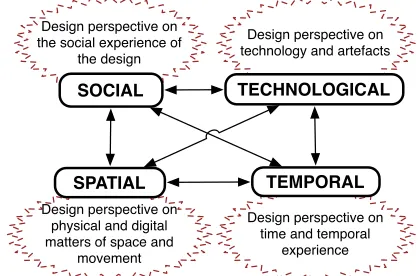
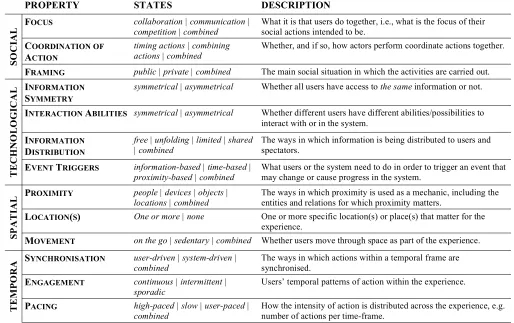
In short, the framework consists of four different perspectives, which are complemented with relevant design properties which in turn can have different states. It has two complementary representational forms; the diagrammatic form (Figures 1 and 2) and the list form (Table 1). Before we unpack the framework in full, we here provide a brief overview to prime the reader and to inform subsequent discussion.
[image:3.612.332.541.386.524.2]Figure 1: Framework overview (diagrammatic form)
Four perspectives
The framework’s four broad overarching design perspectives help the designer to systematically address the design of collocated interactive systems: Social, Technological, Spatial and Temporal.
The Social Perspective describes design properties related to the social features of collocated situations, e.g. the design of the face-to-face setting, the actors and their relationships within that setting.
The Technological Perspective describes design properties related to software and how it utilises existing hardware. It encompasses information flow, interaction abilities and actions that trigger progress.
Design perspective on time and temporal
experience Design perspective on
physical and digital matters of space and
movement Design perspective on the social experience of
the design
Design perspective on technology and artefacts
TEMPORAL TECHNOLOGICAL SOCIAL
The Spatial Perspective describes design properties related to all aspects of space, location and the physical environment.
The Temporal Perspective describes design properties related to the temporal experience of system users, involving the synchronisation and pacing of user activity. Properties and states
Each of the four perspectives has associated properties that we have found to be the most relevant. In turn, properties also have various associated (suggested) states. We have found through our process that states can be used for pinpointing differences between designs. For example, while all designs have the FOCUS-property, their respective
state (e.g. collaborative vs. competitive) instantiates these as distinct experiences. In addition, states support the use of the framework as a design tool, as will be shown in a later section (Using the Framework).
For clarity the properties and their states formatted in the following way: ‘PROPERTY [state | state | …]’. They are
listed in order of importance. Relations
A key feature of understanding this framework is that it is relational. Firstly, the perspectives both shape and are shaped by the other perspectives in the framework (see Figure 2). Hence, a methodical approach to using the framework takes each perspective in turn and uses it as a particular ‘standpoint’ from which to examine impacts on other design elements. Secondly, many properties are closely intertwined or dependent on each other, e.g. giving users different possibilities to interact with the system (asymmetric INTERACTION ABILITIES) supports the state
combining actions in the property COORDINATION OF
ACTIONS.
We detail example implications of the relational approach in subsequent sections describing the framework in detail. THE FRAMEWORK
In the rest of this section we now describe each perspective and their associated properties, providing examples of how they interrelate. We also ground descriptions of the properties and states through reference to the example experiences introduced earlier in this paper: Atomic Orchid, iBrainstorm and the Rufford audioguide.
The Social Perspective
The Social Perspective is the most complex and the least directly controllable by design. It describes the social ‘design’ of the experience. It encompasses considerations regarding the intricacies of the social situation that arise during the interactive experience: for instance users may take on different roles (e.g. as user or spectator, leader or sub-ordinate, adult and child). Moreover, users already have some sort of relationship to each other, which may be unknown to the designer, and they may either have or lack specific capabilities (e.g. driving skills or good eyesight).
This perspective has three properties: FOCUS,
COORDINATION OF ACTIONS and FRAMING.
FOCUS [collaboration | communication | competition | combined]. This design property sets the major interaction goal for the whole design, shaping the overall social focus of the activities engaged in by users. It describes the focus of users’ social actions, for example as collaborative, communicative and / or competitive.
For example, iBrainstorm’s design creates a strong focus on communication of ideas between users and ways to support collaboration around these. For Atomic Orchid the focus is also on collaboration, and communication is a requirement to accomplish the task. As for many other experiences, there may be a combination of states, so a competitive team-based game would incorporate all three, i.e. collaboration and communication within teams, and competition between teams. However, one of these must always be the main focus of design, steering the others. COORDINATION OF ACTION [timing actions | combining
actions | combined]. This property is concerned with how users perform actions together, thus shaping the interplay of interactions between users. They can either aim to carry out actions simultaneously, or combine their efforts (e.g. by complementing each other’s skills), or both.
Atomic Orchid combines both in that rescue of targets requires teams of responders with complementary roles to be at the same place at the same time, e.g. timing actions and combining actions. In contrast, iBrainstorm only expects users to combine actions, i.e. write Post-Its, move and sort Post-Its, scribble notes etc.
FRAMING [public | private | combined]. This is the main
social ‘situation’ where the activities are carried out and it thus affects design decisions related to how that situation is defined; one can demand very different things from users depending on whether they are in public or in private. Atomic Orchid, like many pervasive games, to a great extent takes place in public and participants must conduct their activities in light of all that being in public implies (e.g. acting professionally, taking into account those who are not part of the simulation, etc.).
Relations
These various properties associated with the Social Perspective can implicate and be implicated by each of the other perspectives. Here we outline some of these for illustrative purposes.
• FOCUS is closely tied to the Technological Perspective since design decision regarding INFORMATION
SYMMETRY, INFORMATION DISTRIBUTION and
INTERACTION ABILITIES help regulate it.
Spatial Perspective since it affects or is affected by properties like PROXIMITY and LOCATION(S). Its state
Timing actions is clearly linked to SYNCHRONISATION
(Temporal Perspective). Lastly, several properties within the Technological Perspective shape how, or when actions can be carried out, e.g., EVENT TRIGGERS and INTERACTION ABILITIES. Atomic Orchid exemplifies this
very well.
• FRAMING is tied to the Spatial Perspective since it affects
LOCATION(S) andMOVEMENT.These are more likely to affect the design when FRAMING is public.
The Technological Perspective
In contrast to the Social Perspective, the Technological Perspective is perhaps the most controllable by design. Underlying concerns within this perspective relate to choosing the hardware based on capabilities and limitations. For example, this includes the combination of devices (e.g. whether users should have tablets or phones) and their connectivity. Broadly speaking, the ratio of devices per user may also matter; if users share a device, they are bound to get the same information, for instance, and they are more likely to stay together. Lastly, the information within the system must be considered—e.g. is it system-generated (e.g. tracking positions), or user-generated?
This perspective has four properties: INFORMATION
SYMMETRY, INTERACTION ABILITIES, INFORMATION
DISTRIBUTION,and EVENT TRIGGERS.
INFORMATION SYMMETRY [symmetrical | asymmetrical].
This property is powerful in shaping user communication and behaviour, and is linked to INFORMATION
DISTRIBUTION. It regulates whether all users have access to the same type of information or not. For instance, each user might know their own position on a map, i.e. it is symmetrical across users. In case information is asymmetrical, different users have access to different kinds of information. For example, one participant might have access to information on locations to go to, while another might have information on which locations are interesting. INFORMATION SYMMETRY has previously been identified as
an important feature of team working (e.g. [48]) and has been used to create simulations of fire emergency responder training practices [51]. Differential access to resources for awareness activities in CSCW (e.g., [25]) is also relevant for this property.
Atomic Orchid features asymmetrical information in that the headquarters has an ‘omniscient’ point of view including ‘seeing’ the radioactive cloud, whereas the field responders only have a Geiger counter reading for their current location. iBrainstorm on the other hand is symmetrical, in that all users can see both the contents on the shared tablet and on their own phone (e.g., the Post-Its currently being written).
INTERACTION ABILITIES [symmetrical | asymmetrical].
This property shapes how users can act and interact within the experience, taking into account any special abilities the system can provide to different types of users. It can appear in many different ways, e.g. in rights to add / edit / delete content, rights to manage other users, rights to perform certain actions, and so on.
Atomic Orchid features asymmetry in many ways, e.g. field responders have asymmetrical different abilities in relation to each other (being medics, fire fighters etc.), but in addition field responders as a group have very asymmetrical INTERACTION ABILITIES in relation to HQ: the former can actually rescue targets whereas the latter can only assess and inform. iBrainstorm can be seen as symmetrical since all participants have a phone, from which they may add Post-Its, and share access to the tablet.
INFORMATION DISTRIBUTION [free | unfolding | limited |
shared | combined]. How to distribute information to users and spectators strongly affects how users act and interact. This issue of how information is physically and virtually distributed has long been a concern in CSCW (e.g. in the situated physical representations of distributed cognition [28]). For this property, free implies that all information is accessible for anyone anytime. Unfolding implies that more information is becoming available over time, either as a result of actions, or just time passing. Limited implies that there is some information that a certain user will never get (e.g. certain information about other users). Lastly one may, or may not, allow users to share information via the system. As an example, information is free in the Rufford audioguide; all the content is available at the touch of a button. In iBrainstorm, users share information and ideas as they ideate along, i.e. it combines unfolding and shared information. In Atomic Orchid, field responders have limited information but they also get shared information communicated by the HQ.
EVENT TRIGGERS [information-based | time-based |
proximity-based | combined]. This property describes what users or the system need to do in order to trigger an event that changes or causes progress in the system in some way. Triggers may be arriving at the right location or person (proximity-based), entering content in the system (information-based), or the passing of a deadline (time-based). The resulting events may be notifications, points, state changes, or another form of system output. Proximity-based EVENT TRIGGERS are often employed to support
collocation (e.g. [9, 43]) but are not as central as other properties in this perspective.
When the tablet and phones of iBrainstorm ‘detect’ each other, it is a proximity-based EVENT TRIGGER that causes
the application to start running. This in turn enables information-based TRIGGERS uploading written Post-Its.
may evoke the relevant information for the particular sculpture they are at (i.e. the event). In contrast, the expansion of the radioactive cloud in Atomic Orchid is a time-based TRIGGER, putting field respondents in danger
and thus regulating their movement.
Relations
The Technological Perspective has many relations to other perspectives; overall, it is perhaps the most controllable by design.
• INFORMATION SYMMETRY and INTERACTION ABILITIES
are closely tied to COORDINATION OF ACTION in the Social Perspective, since users may have different means to carry out certain actions; similarly they are tied to SYNCHRONISATION in the Temporal Perspective.
• INFORMATION DISTRIBUTION is related to FOCUS from the
Social Perspective, since the means of distributing information help shape whether and how users communicate (shared) or collaborate (shared, unfolding); similarly asymmetrical INFORMATION SYMMETRY opens
up for more communication.
• EVENT TRIGGERS are closely related to Spatial and Temporal Perspectives. Do users need to be within PROXIMITY with each other, be at a certain LOCATIONS,
carry out an action with SYNCHRONISATION? Equally, in what ways do EVENT TRIGGERS impact the
COORDINATION OF ACTION among social actors? The Spatial Perspective
The Spatial Perspective involves the consideration of the
physical and virtual space(s) in which the experience takes place. In this, it encompasses any aspect from designing for ‘anyplace anywhere’, a specific area anywhere or a specified location (e.g. a certain museum). It has three properties: PROXIMITY, LOCATION(S) and MOVEMENT.
PROXIMITY [people | devices | objects | locations | combined]. This property regulateswhich things need to be close in order for an activity, or event to play out. PROXIMITY may involve people, devices, objects (e.g., a
statue), or locations in any combinations (e.g. people with people, devices with locations, objects with locations etc.) Although devices are almost always equal to people this must not be taken for granted.
For example, iBrainstorm relies on PROXIMITY between
devices (phones and tablet are connected via Bluetooth), which implies proximity between people, and between people and devices. Atomic Orchid features virtual objects (placed on LOCATIONS defined by GPS-coordinates) that are to be rescued by players, requiring proximity between people and locations.
LOCATION(S) [one or more | none]. This property is
important when designing for a larger space. It defines whether there are any specific locations or places within the spatial boundaries that matter for the experience. For example, these could be different exhibits in a museum, or the place where the treasure is hidden in a game.
[image:6.612.102.509.424.728.2]For the Rufford audioguide the sculptures serve as locations. In Atomic Orchid, locations that matter are
defined by the geo-locations of virtual objects and drop-off zones. iBrainstorm in contrast has none.
MOVEMENT [on the go | sedentary | combined]. This property describes design decisions about user movement through the space as part of the experience. Is movement through space an inherent feature of the experience (e.g. visiting support for museums or cities)? And which kind of movement is desired (e.g. running, walking, cycling, or driving)?
iBrainstorm is designed to be used whilst sedentary (e.g., sitting). Atomic Orchid combines sedentary players in the HQ with field responders being on the go in their efforts to carry virtual objects to drop-off zones).
Relations
This is the one perspective with most interrelated dependencies: MOVEMENT and LOCATION(S) are closely
tied, and so are PROXIMITY and LOCATION(S). They also
have links to other perspectives.
• PROXIMITY is very closely linked to EVENT TRIGGERS
(Technological Perspective) which are proximity-based. It can also be related to the Social and Temporal perspectives respectively since it may be required for either COORDINATING ACTIONS orSYNCHRONISATION.
• LOCATIONS are related to the Social Perspective in that
they are affected by or affecting the FRAMING of a situation.
• MOVEMENT in space relates to the Temporal Perspective
particularly for ENGAGEMENT and PACING. For example,
a movement design that switches from sedentary activities to running creates strong contrasts in PACING. The Temporal Perspective
The Temporal Perspective is concerned with how time plays a role both as a particular design concept to be employed explicitly by the designer, as well as an inevitable feature of experience. Thus it encompasses the course and possible order of actions and events, the pace and possibly rhythm of the experience. It integrates some concepts from the trajectories framework by Benford et al. [4].
Properties of this perspective are SYNCHRONISATION,
ENGAGEMENT and PACING.
SYNCHRONISATION [user-driven | system-driven | combined]. This property describes the synchronisation of actions within a temporal frame—if any—and as such is most central for collocation-oriented designs. Possibilities for this property revolve around whether users control this themselves, or if the system enforces synchronisation in some way (including perhaps prompting or rewarding timing actions as a means of COORDINATION OF ACTION). In Atomic Orchid, SYNCHRONISATION is system-driven in
that the system requires field responders to be physically close to each other and an object at the same time in order
to rescue it. Examples of user-driven SYNCHRONISATION
would be users agreeing to meet somewhere to carry out an action together, as in the Rufford audioguide.
ENGAGEMENT[continuous | intermittent | sporadic]. This
refers to users’ broad temporal patterns of action within the experience, such as how intensely and how often they will engage with it and each other. This is highly dependent on the length of a session. Designers of a long-term pervasive game will for example more or less inherently assume and design for an intermittent or sporadic engagement [15].
For example, iBrainstorm allows intermitting ENGAGEMENT, however one can assume continuous
ENGAGEMENT during a focused collocated brainstorming
session. Atomic Orchid, on the other hand, requires continuous ENGAGEMENT during its relatively short sessions (~30mins).
PACING [high-paced | slow | user-paced | combined].
Pacing describes the way in which actions are distributed over time: is it stressful, relaxing or just right, and how does this affect social interaction between users?
Atomic Orchid is high-paced as it provides many actions (many targets to rescue, spread out on a relatively large area) in combination with the time-pressure provided by the spreading radioactive cloud (a time-based EVENT TRIGGER), resulting in an intense experience with much communication between users. For the Rufford audioguide the PACING is instead user-paced.
Relations
While elements of the Temporal Perspective are controllable by design, those more closely related to the experience of time are arguably less so. Nevertheless there is a general relationship to other perspectives, here we highlight some of these.
• There is a relation to the Social Perspective in that the manner of COORDINATION OF ACTION between collocated users will shape and be shaped by the minutiae of ENGAGEMENT, SYNCHRONISATION and PACING. For
instance timing actions is tied to SYNCHRONISATION;and if that is user-driven it requires or creates ENGAGEMENT.
Similarly, if there are many actions to be carried out this may lead to either a high-paced PACING, or a lot of communication between users in choosing which actions to carry out.
• Additionally, ENGAGEMENT, SYNCHRONISATION and
PACING will be affected by some design decisions made in the Technological Perspective, e.g. choice of time-based EVENT TRIGGERS, or unfolding INFORMATION DISTRIBUTION.
USING THE FRAMEWORK
The framework we have presented offers a way of codifying knowledge about the design of mobile systems supporting collocated interaction. It has been argued [7,45] that such frameworks offer a variety of applications in practice, providing sensitising concepts, shared design languages, or performing as ‘boundary objects’, in the sense of providing loose, flexible artefacts that can withstand multiple interpretations and conflicting perspectives [47] between interdisciplinary co-creators. In this section we offer practical advice on how it may be used, and broader implications on how it may be ‘read’.
Using the framework: for redesign
Building on photo-sharing as a familiar collaborative activity, we now show how key collocated design aspects of a photo-sharing system we created—Automics [14]—were changed to create InstaCampus [16]. Automicsis a system that allow visitors of a theme park to co-create photo story souvenirs of their day out together [14]. Each visitor has a mobile phone; they take photos that they annotate with speech bubbles, and select for photo story templates. All photos are automatically shared across the group, i.e. INFORMATION SYMMETRY is symmetrical. PROXIMITY to
key locations across the theme park serve as proximity-based EVENT TRIGGERS, prompting notifications to invite
photo taking and annotating (i.e. events). Newly available photos also serve as information-based EVENT TRIGGERS in that a notification is sent to each group member.
After a trial, group members remarked that they did not need notification of other member’s actions that they could see themselves (being collocated), and moreover our observations showed that group members were simultaneously engrossed in using the mobile app, instead of interleaving device use with face-to-face interaction; they were ‘alone together’.
Consequently, we changed the mechanics relating to collocation to investigate the issues we observed further, resulting in the InstaCampus app. Based on the same code base as Automics, InstaCampus was trialed to support a collaborative photo-taking exercise undertaken between multiple groups of participants. Their task was to collectively create a campus guide for new students and staff. Photos for the guide were mainly created by participants as they explored the campus, but this was supplemented by georeferenced images that were ‘seeded’ by us as designers before the trial. While similar to Automics, InstaCampus offered key differences in that photo-sharing between one group and another became selective and not broadcast to all group members.
PROPERTY STATES DESCRIPTION
SO
C
IA
L FOCUS collaboration | communication | competition | combined
What it is that users do together, i.e., what is the focus of their social actions intended to be.
COORDINATION OF
ACTION
timing actions | combining actions | combined
Whether, and if so, how actors perform coordinate actions together.
FRAMING public | private | combined The main social situation in which the activities are carried out.
TEC
H
N
O
L
O
G
IC
A
L INFORMATION
SYMMETRY
symmetrical | asymmetrical Whether all users have access to the same information or not.
INTERACTION ABILITIES symmetrical | asymmetrical Whether different users have different abilities/possibilities to interact with or in the system.
INFORMATION
DISTRIBUTION
[image:8.612.40.554.67.390.2]free | unfolding | limited | shared
| combined The ways in which information is being distributed to users and spectators.
EVENT TRIGGERS information-based | time-based |
proximity-based | combined
What users or the system need to do in order to trigger an event that may change or cause progress in the system.
SP
A
T
IA
L PROXIMITY people | devices | objects | locations | combined The ways in which proximity is used as a mechanic, including the entities and relations for which proximity matters.
LOCATION(S) One or more | none One or more specific location(s) or place(s) that matter for the
experience.
MOVEMENT on the go | sedentary | combined Whether users move through space as part of the experience.
TEM
P
O
R
A
L
SYNCHRONISATION user-driven | system-driven |
combined
The ways in which actions within a temporal frame are synchronised.
ENGAGEMENT continuous | intermittent |
sporadic
Users’ temporal patterns of action within the experience.
PACING high-paced | slow | user-paced |
combined
How the intensity of action is distributed across the experience, e.g. number of actions per time-frame.
In the terms of the framework, InstaCampus’ INFORMATION
SYMMETRY was made asymmetrical in that one collocated
team member received photo notifications (i.e. asymmetrical INFORMATION SYMMETRY) as the result of
PROXIMITY to locations (i.e. proximity-based EVENT
TRIGGERS): these indicated that they had ‘found’ images taken nearby (i.e. the georeferenced, seeded photos). In contrast with Automics’ symmetric distribution of notifications of newly taken photos, for InstaCampus, only a single local group member gets information-based EVENT -TRIGGERS (notifications) when the remote group has taken new photos. Moreover, the ‘seeded’ photos could only be added to the shared pool by one member of a given group, hereby introducing asymmetrical INTERACTION ABILITIES.
Note how PROXIMITY was not only used to trigger notifications in terms of proximity to locations but also in terms of proximity between people, so as to limit alerts of action to that of remote group members that could not have been observed.
As a result of the added asymmetry introduced to InstaCampus, the content of notifications were frequently brought up in conversations and shared between collocated group members [16]. While designers may have different goals for their collocated experiences, we felt that the frequent observations of how members made device use part of the face-to-face interaction was a compelling case of a successful design for collocated interaction.
In the terms of the framework, the design evolution from Automics to InstaCampus further demonstrates how certain properties can be harnessed to support collocated interaction. In this case, INTERACTION ABILITIES,
INFORMATION SYMMETRY, and PROXIMITY have been instantiated to specifically support collocated interaction. The use of concepts akin to our INFORMATION SYMMETRY
in related work focusing on face-to-face collaboration [48,51,25] further stresses their essential character.
Using the framework: for ideation
Speaking more generally, a framework such as this (featuring properties and states) can also be used to ideate initial designs: we have tried this with students on several occasions. This activity is more open than the redesign example above, thus we recommend as a guideline that designers decide on 4-6 properties and a state for each, and take it from there. The properties can be chosen at random or one can ensure that there is at least one from each perspective. For redesign we suggest using the ‘skewing method’ [41]: an artefact is analysed in terms of properties and states, and some of the states are then changed, hence asking “What if...?” in a structured way. For instance a group of students were given the following combinations: user driven SYNCHRONISATION, PROXIMITY between people, high-paced PACING and unfolding and shared
INFORMATION DISTRIBUTION. Students designed a simple
game where pairs of players get the same image on their phone; they then need to find each a match as fast as
possible and register each other’s names. The last pair to find each other in each round is eliminated from the game.
Guidelines for reading the framework
Understanding how to read the framework is important. We also argue that these guidelines may have relevance for reading frameworks in general.
Control versus outcomes. Some properties of the framework are inherently more controllable, while others are less so. For example, (Spatial) PROXIMITY between people may be very controllable through technological means, such as enforcing a group of users to meet up at a specific LOCATION in order to proceed with their
COORDINATION OF ACTION, whereas specifying how system
use is (Socially) FRAMED can be extremely difficult to pull off successfully. On the other hand, we may pursue a policy, as designers, of deliberately ceding control because we desire a wide variability of outcomes.
The situation. This is about what actually happens when the design is put to work. All designs must face ‘the world as it is discovered’. Technology, people, physical places, infrastructures and social practices are all things that will necessarily be encountered in the course of some design being used, yet preceded the design. Outcomes thus depend on a mixture of what is ‘discovered’ through the engagement with the design, and the ability of the designer to successfully construct controls for the particular situation they have intervened in. For instance, if we are designing a mobile app a museum, it will be used in what is a primarily public space, there will be restrictions on what is ‘reasonable’ conduct in that space, and there will likely be some sort of set of pre-existing roles assumed like an ‘audience’ in the form of other visitors, staff, guards, etc. DISCUSSION
We close with reflections on the participatory process we engaged in to help generate the framework itself, and the ways in which the framework may help define the genre of experiences for collocated interaction.
Developing the framework
Often when frameworks are presented, little is said about the process of creating frameworks. We provide a reflection on this process so as to inform others wishing to use this particular framework and / or to develop other frameworks. In constructing the framework we have made various assumptions and glosses in order to arrive at a practically usable tool for designers. This section also exposes these matters of limitation and compromise to the reader.
Inception
Initial framework construction and evaluation
Now a team of co-authors had been formed. We conducted a more formal review of the mobile collocated experiences highlighted at the workshop, enriched by further examples from research and commercial products. From this we derived a list representation of the framework containing many of the properties outlined in this paper. The next phase consisted of attempting more participatory practical classroom-based engagement with students training on an Interaction Design programme at the University of Gothenburg. The activity was part of the concept generation phase in the ‘Mobile Computing’ course and thus fit very well with the students’ work as they were at the stage of developing ideas for their projects. The initial framework list form (an expanded version of Table 1) was presented as a one hour lecture to the students who subsequently had a further two hours to use the framework in a mobile app design activity.
Refining the framework
Our interaction with the students formed an initial evaluation to iterate the framework. At the same time we began seeking out a diagrammatic way to present the framework, which in turn exposed its relational aspects, thus offering refinements that were emergent due to the combinations of other properties.
Further, from the student exercise we uncovered a number of reflections that fed into our iterative process. Firstly, we noted that frameworks have ‘fingerprints’ of their sources. By this we mean that our initial literature review that fed the framework tended to subtly colour the focus of the designs that the students ideated from it. We rectified this by analysing broader examples and improving the framework accordingly. Secondly, the framework design itself necessarily has to exclude a range of design possibilities. This was reflected in student feedback that certain properties were ‘missing’.
Thirdly, we noted that frameworks are worked with as ‘prescriptions’. Students found that the framework could be used for any kind mobile system, not just design for collocated interactions. At the same time they attempted to ‘stay true’ to the framework’s perceived intentions for the genre of designs that it was seen to prescribe. This became evident in the students’ designs. In addition, reviewer feedback provided on the initial version of this paper encouraged us to cut down the number of properties, focusing them on aspects that we felt are ‘critical’ to the genre of collocated interaction design.
The genre of experiences for collocated interaction As a final part of this discussion we would like to offer our rationale for how the properties define the ‘genre’ of experiences for mobile collocated interaction. We had a long list of properties initially, but we distilled it to its essence by asking: is this property characteristic for the design of mobile experiences which support collocated interaction? We excluded properties that were too general,
the results of other design decisions, or described phenomena related to ‘the world as it is discovered’ and thus out of the designers’ control.
Returning to the properties of our framework, there are strong arguments for all of them. FOCUS,COORDINATION OF
ACTION, INTERACTION ABILITIES, EVENT TRIGGERS, PROXIMITY, andSYNCHRONISATION are all closely tied to
making usersmeeting up and joining efforts, this covering the collocation-aspect. INFORMATION SYMMETRY and
INFORMATION DISTRIBUTION and to some extent
ENGAGEMENT support this further by regulating communication (and need for communication) between users.FRAMING,LOCATION(S)andMOVEMENT adhere to the
mobile / mobility aspect, and although it is possible to provide INTERACTION ABILITIES, INFORMATION
SYMMETRY, INFORMATION DISTRIBUTION, EVENT
TRIGGERS and PACING with analogue techniques, using
digital interactive systems enables a larger design space. Thus, the chosen properties help outline the design space for this particular genre: systems or experiences that aim to support or even enforce social, collocated activities as supported by mobile technology.
CONCLUSION
We have presented a framework for the design and analysis of mobile systems that support, enable or augment social, collocated interactive experiences, supported by mobile technology. The framework presents four interrelated design perspectives that shape and are shaped by each other. We have offered both a diagrammatic and a textual list form of the framework to support this process, specifically for: 1. focussed hands-on design ideation activities; 2. and analytic dissection of existing designs into their elements and relationships.
In order to show how the framework can be used, we have discussed a case-specific redesign process in detail. We also provided guidelines on how to read the framework, which had implications for reading other frameworks as well. We particularly drew attention to the tensions inherent in any design framework where the designer’s desire for control over its aspects (and the variation of this control-ability) rub up against the fact that the design must exist in the world and in some sense be shaped by the world ‘as we find it’. Finally, our work offered an account of the (limited) ways we attempted operationalisation and practical application during the framework’s construction through simple design activities with students, and periods of repeated refinement. We have tried to show how the process of constructing design frameworks itself can be an iterative, participatory process that involves evaluation, reflection and redesign. As such we see potential for researchers developing future CSCW-related design frameworks to adopt this approach. ACKNOWLEDGMENTS
helped us to develop the framework. This work is supported by EPSRC grants EP/I011587/1 and EP/K025848/1.
REFERENCES
1. Aoki, P.M., R.E. Grinter, A. Hurst, M.H. Szymanski, J.D. Thornton, and A. Woodruff. Sotto voce: exploring the interplay of conversation and mobile audio spaces. Proc. CHI ‘02, ACM Press (2002), 431-438.
2. Bao, X. and Choudhury, R. R. 2010. MoVi: mobile phone based video highlights via collaborative sensing. In Proc. MobiSys ‘10. ACM, New York, NY, USA, 357-370.
3. Bedwell, B. A Framework to Guide the Design of Environments Coupling Mobile and Situated Technologies. PhD Thesis, University of Nottingham, UK, 2010.
4. Benford, S., D. Rowland, M. Flintham, A. Drozd, R. Hull, J. Reid, J. Morrison, and K. Facer Life on the edge: supporting collaboration in location-based experiences. Proc. CHI ‘05, ACM Press (2005), 721– 730.
5. Benford, S., Crabtree, A., Reeves, S., Sheridan, J., Dix, A., Flintham, M., Drozd, A. The frame of the game: blurring the boundary between fiction and reality in mobile experiences. Proc. CHI ’06, ACM Press (2006), 427-436.
6. Benford, S., Giannachi, G., Koleva, B., Rodden, T. From interaction to trajectories: designing coherent journeys through user experiences’. Proc. CHI ’09, ACM Press (2009), 709–718.
7. Benford, S. & Giannachi, G. Performing Mixed Reality. MIT Press, September 2011.
8. Bentley, R.M., Hughes, J.A., Randall, D., Rodden, T., Sawyer, P., Shapiro, D. and Sommerville, I. Ethnographically informed systems design for air traffic control, Proc. CSCW ’92, ACM Press (1992), 123–129. 9. Bjork, S., Falk, J., Hansson, R., and Ljungstrand, P.
Pirates! using the physical world as a game board. In Proc. of INTERACT ‘01, IFIP, pp. 423–430, 2001. 10.Brown, B., and Chalmers M. Tourism and mobile
technology. Proc. ECSCW ’03, Klewer Academic Press (2003), 335-355.
11.Brown, B., M. Chalmers, M. Bell, M. Hall, I. MacColl, and P. Rudman Sharing the square: collaborative leisure in the city streets. Proc. ECSCW ’05, Springer (2005), 427–447.
12.Brown, B., McGregor, M., Laurier, E. iPhone in vivo: video analysis of mobile device use. Proc. CHI ’13, ACM Press (2013), 1031-1040.
13.Crabtree, A., S. Benford, Rodden, T., Greenhalgh, C., Flintham, M., Anastasi, R., Drozd, A., Row-Farr, J., Tandavanitj, N. and Steed, A. Orchestrating a mixed reality game 'on the ground'. Proc. CHI '04. ACM Press (2004), 391-398.
14.Durrant, A., Rowland, D., Kirk, D.S., Benford, S., Fischer, J.E, and McAuley, D. Automics: Souvenir generating photoware for theme parks. Proc. CHI ’11, ACM Press (2011), 1767–1776.
15.Fischer, J.E., Benford, S. Inferring player engagement in a pervasive experience. Proc. CHI ’09. ACM Press (2009), 1903-1906.
16.Fischer, J.E., Reeves, S., Moran, S., Greenhalgh, C., Benford, S. and Rennick-Egglestone, S. Understanding mobile notification management in collocated groups. Proc. ECSCW’13. Springer (2013), 21-44.
17.Fischer, J.E., Jiang, W., Kerne, A., Greenhalgh, C., Ramchurn, S.D., Reece, S., Pantidi, N. and Rodden, T. Supporting team coordination on the ground:
requirements from a mixed reality game. Proc. COOP ‘14, Springer (2014), 46-67.
18.Flintham, M., Benford, S., Anastasi, R., Hemmings, T., Crabtree, A., Greenhalgh, C., Tandavanitj, N., Adams, M., and Row-Farr, J. Where on-line meets on the streets: experiences with mobile mixed reality games. Proc. CHI '03, ACM Press (2003), 569-576.
19.Flintham, M., Reeves, S., P. Brundell, Glover, A.T., Benford, S., Rowland, D., Koleva, B., Greenhalgh, C. Adams, M. Tandavanitj, N. and Row-Farr, J. Flypad: designing trajectories in a Large-Scale Permanent Augmented Reality Installation. Proc. ECSCW ’11, Springer (2011) 233–252.
20.Fosh, L., Benford, S., Reeves, S., Koleva, B., Brundell, P. See me, feel me, touch me, hear me: trajectories and interpretation in a sculpture garden. Proc. CHI ‘13, ACM Press (2013), 149-158.
21.Fosh, L., Benford, S., Reeves, S., Koleva, B. Gifting personal interpretations in galleries. Proc. CHI ’14. ACM Press (2014), 625-634.
22.Goel, M., Lee, B., Aumi, M.T.I., Patel, S., Borriello, G., Hibino, S. and Begole, B. SurfaceLink: using inertial and acoustic sensing to enable multi-device interaction on a surface. Proc. CHI ‘14. ACM Press (2014), 1387-1396.
23.Gross, T., Stary, C. and Totter, A. User-centered awareness in computer-supported cooperative work-systems: structured embedding of findings from social sciences. Int. Journ. of Hum.-Comp. Interact. 18, 3 (June 2005), 323-360.
24.Grudin, J. Computer-supported cooperative work: history and focus. Computer 27, 5, (1994), 19-26. 25.Heath, C. and Luff, P. (1992) Collaboration and control:
Crisis Management and Multimedia Technology in London Underground Line Control Rooms. Journ. of CSCW 1, 1 (1992), 24-48.
27.Hornecker, E., P. Marshall, N. S. Dalton, and Y. Rogers Collaboration and interference: awareness with mice or touch input. In: Proc. CSCW ’08, ACM Press (2008), 167–176.
28.Hutchins, E. Cognition in the Wild. MIT Press, Cambridge, MA, USA, 1995.
29.Hwang, I., Yoo, C., Hwang, C., Yim, D., Lee, Y.., Min, C., Kim, J. and Song, J. TalkBetter: family-driven mobile intervention care for children with language delay. Proc. CSCW ‘14. ACM Press (2014), 1283-1296. 30.Jacucci, G., Oulasvirta, A. and Salovaara, A. Active
construction of experience through mobile media: a field study with implications for recording and sharing. Pers. Ubi. Comp. 11, 4 (2007), 215–234.
31.Kim, T., Chang, A., Holland, L., and Pentland, A. 2008. Meeting mediator: enhancing group collaboration using sociometric feedback. Proc. CSCW ‘08. ACM Press (2008), 457-466.
32.Kuzuoka, H., K. Pitsch, Y. Suzuki, I. Kawaguchi, K. Yamazaki, A. Yamazaki, Y. Kuno, P. Luff, and C. Heath. Effect of restarts and pauses on achieving a state of mutual orientation between a human and a robot. Proc. CSCW ’08, ACM Press (2008), 201–204. 33.Lim, Y., Stolterman, E., Jung, H. and Donaldson, J.
Interaction gestalt and the design of aesthetic interactions. Proc. DIS ‘07, ACM Press (2007), 239-254.
34.Lim, Y., Lee, S. and Lee, K.: Interactivity attributes: a new way of thinking and describing interactivity. In: Proc. CHI ’09, ACM Press (2009),105-108.
35.Löwgren, J. and Stolterman, E.: Thoughtful interaction design. MIT Press (2004).
36.Lucero, A., Holopainen, J. and Jokela, T. Pass-Them-Around: Collaborative Use of Mobile Phones for Photo Sharing. Proc. of CHI ‘11, ACM Press (2011), 1787-1796.
37.Lucero, A., Holopainen, J. and Jokela, T. MobiComics: collaborative use of mobile phones and large displays for public expression. Proc. MobileHCI ’12, ACM Press (2012), 383-392.
38.Luff, P. and Heath, C. Mobility in collaboration. In: Proc. CSCW ’98, ACM Press (1998), 305–314. 39.Luff, P. and Jirotka, M. Interactional resources for the
support of collaborative activities: common problems in the design of technologies to support groups and communities’. In: Community Computing and Support Systems, Social Interaction in Networked Communities, Springer-Verlag (1998), 249–266.
40.Lundgren, S. Interaction-Related Properties of
Interactive Artifacts. Proc. Ambience ’11, CTF (2011), 112-121.
41.Lundgren, S. and Gkouskos, D. Escaping the obvious: skewing properties of interaction. Proc. NORDES ‘13, Nordes (2013), 32-39.
42.Marshall, P., Rogers, Y. and Pantidi, N. Using F-formations to analyse spatial patterns of interaction in physical environments. Proc. CSCW ‘11, ACM Press (2011), 445–454.
43.Mitchell, K., McCaffery, D., Metaxas, G., Finney, J., Schmid, S., and Scott, A. Six in the city: Introducing Real Tournament - a mobile IPv6 based context-aware multiplayer game. Proc. of NETGAMES ‘03, ACM Press (2003), 91–100.
44.Moran, S., Pantidi, N., Bachour, K., Fischer, J.E., Flintham, M., Rodden, T., Evans, S. and Johnson, S. Team Reactions to Voiced Agent Instructions in a Pervasive Game. Proc. IUI ’13. ACM Press (2013), 371-382.
45.Reeves, S. Designing interfaces in public settings: Understanding the role of the spectator in Human-Computer Interaction. Springer, January 2011.
46.Schuster, D., Rosi, A., Mamei, M., Springer, T., Endler, M., Zambonelly, F. Pervasive social context: taxonomy and survey, ACM Trans. on Intelli. Sys. and Tech. 4, 3, (June 2013).
47. Star, S. and Griesemer, J. Institutional ecology, ‘translations’ and boundary objects: amateurs and professionals in Berkeley's museum of vertebrate zoology, 1907-39. Social Studies of Science 19, 3 (1989), 387–420.
48.Stasser, G., and Titus, W. Pooling of unshared information in group decision making: biased information sampling during group discussion. Journ. of Personality and Soc. Psych. 48, 6 (1985), 1467-1478. 49.Sun, Z., Purohit, A., Bose, R., and Zhang, P. Spartacus:
spatially-aware interaction for mobile devices through energy-efficient audio sensing. Proc. MobiSys ‘13. ACM Press (2013), 263-276.
50.Tolmie, P., Benford, S., Flintham, M., Brundell, P., Adams, M., Tandavantij, N., Row Far, J. and Giannachi, G. "Act natural": instructions, compliance and
accountability in ambulatory experiences. Proc. CHI '12. ACM Press (2012), 1519-1528.
51.Toups, Z. O. and Kerne, A. 2007. Implicit coordination in firefighting practice: design implications for teaching fire emergency responders. Proc. CHI ‘07. ACM Press (2007), 707-716.
52.Weiser, M. The computer for the 21st century.
SIGMOBILE Mob. Comput. Commun. Rev. 3, 3, (1999), 3–11.