Aromatic monomers by in situ conversion of reactive intermediates in the
acid-catalyzed depolymerization of lignin
Peter J. Deuss,
†Martin Scott,
†Fanny Tran,
‡Nicholas J. Westwood,
‡Johannes G. de Vries*
,†,҂and
Katalin Barta*
,†† Stratingh Institute for Chemistry, University of Groningen, Nijenborgh 4, 9747 AG, Groningen, The Netherlands, E-mail: [email protected]
‡ School of Chemistry and Biomedical Science Research Complex, University of St. Andrews and EaStCHEM, North Haugh, St. Andrews, Fife, KY16 9ST, United Kingdom
҂ Leibniz-Insitut für Katalyse e.V. an der Universität Rostock Albert-Einstein-Straße 29a, 18059 Rostock, Germany, E-mail: [email protected]
ABSTRACT: Conversion of lignin into well-defined aromatic chemicals is a highly attractive goal, but is often hampered by recondensation of the formed fragments, especially in acidolysis. Here, we describe new strategies that markedly suppress such undesired pathways to result in diverse aromatic compounds previously not systematically targeted from lignin. Model studies established that a catalytic amount of triflic acid is very effective in cleaving the β-O-4 linkage, most abundant in lignin. An aldehyde product was identified as the main cause of side reactions under cleavage conditions. Capturing this unstable compound by reaction with diols and by in situ catalytic hydrogenation or decarbonylation lead to three distinct groups of aromatic compounds in high yields: acetals, ethanol- and ethyl-aromatics and methyl aromatics. Notably, the same product groups were obtained when these approaches were successfully extended to lignin. In addition, the formation of higher molecular weight side products was markedly suppressed, indicating that the aldehyde intermediates play a significant role in these processes. The described strategy has the potential to be generally applicable for the production of interesting aromatic compounds from lignin.
Introduction
approach developed by Stahl and coworkers.10 Furthermore single aromatic compounds were isolated upon catalytic depolymerization of lignin under low severity conditions.11 Here we present a new concept that affords three distinctly different classes of aromatic compounds from lignin, relying on acidolysis.
Acidolysis is one of the most widely used methods for the fractionation of lignocellulose into its main components,1a,2,12 and will regain importance if the implementation of the biorefinery concept is to be financially viable.13 Historically, acid pulping was mainly used for isolation of reduced molecular weight lignin fractions from the lignocellulose matrix.14 Although distinct aromatic compounds have been found upon acidolysis of lignin in early studies, these were mainly used in the context of structural elucidation, rather than in designing the depolymerization of lignin into valuable aromatic monomers.15 In fact, prolonged treatment of lignin with mineral acids in aqueous/organic media typically leads to substantial amounts of insoluble material and low monomer yields.14,16 Surprisingly, the specific causes of these recondensation phenomena, first observed decades ago,17 have remained largely unanswered, despite extensive mechanistic studies elucidating cleavage pathways.
Figure 1. Major identified cleavage pathways and products from lignin β-O-4 linkage acidolysis indicating C2- and C3-fragments.
Building on earlier reports,16,18 interesting recent mechanistic studies19 conducted with model compounds that mirror the most abundant β-O-4 linkage in lignin have established, that the phenyl-ether bond readily undergoes acidolysis at temperatures up to 150 °C and that two main cleavage pathways exist (Figure 1). Pathway A leads to C3-fragments typically referred to as Hibbert ketones, while Pathway B involves the loss of formaldehyde, leading to C2-fragments.16,19b,c In model studies, up to 50% of the products can correspond to cleavage via Pathway B.19a,d Interestingly however, the monomeric products observed after acidolysis of lignin, almost exclusively consist of phenolic-C3-ketones (Hibbert ketones).15c We noted, that the apparent lack of C2-products upon acidolysis of lignin likely indicates involvement of these fragments in recondensation reactions.
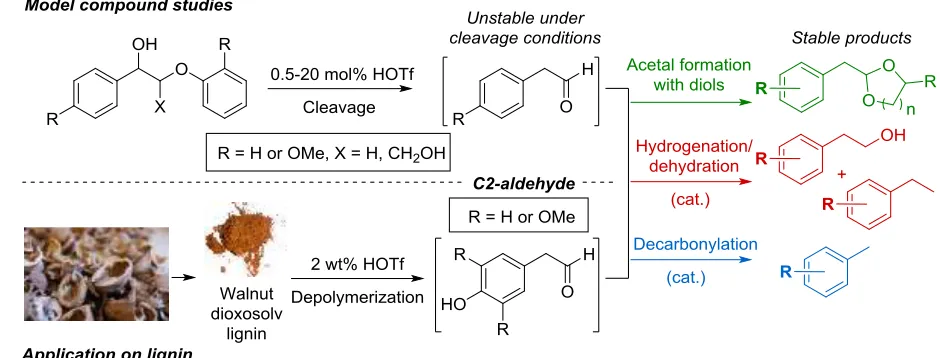
[image:2.612.85.546.270.444.2]pathways towards defined aromatic compounds derived from these C2-fragments. Methods, shown in Figure 2 were found suitable for this purpose.
Figure 2. Overview of the work presented in this manuscript showing the C2-aldehydes targeted for stabilization
During acid catalyzed depolymerization of lignin as substrate, recondensation pathways21 of analogous C2-aldehyde fragments could lead to the formation of higher molecular weight polymers.2,14,22 However, with the methodologies shown in Figure 2 we were able to show a significant decrease in the formation of insoluble material typically associated with lignin acidolysis and obtain distinct sets of aromatic products in agreement with the model studies.
Results and Discussion
Model compound studies
Scheme 1. Triflic acid catalyzed cleavage of β-O-4 model compounds 1a-c.
Figure 3. Reaction profiles for the cleavage of 1a-1c, showing a) all main products in toluene b) all main products in 1,4-dioxane c) the aldehyde product (2a) only at various reaction conditions d) aldehyde products (2a-c) in reactions using substrates 1a-1c.
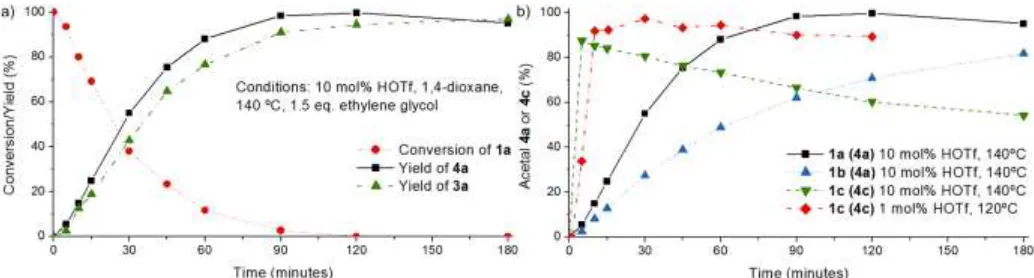
In-situ conversion of the aldehyde intermediates to acetals: Acetal formation with diols was selected to provide proof of principle for the aldehyde stabilization strategy (Table S3). This reaction itself is acid catalyzed, and the diols, used in stoichiometric amounts, can be derived from the sugar fraction of lignocellulosic biomass25 or from glycerol, which is the major side product of biodiesel production.26 Indeed, treatment of 1a-c with 1.5 eq of ethylene glycol and triflic acid resulted in excellent yields of the corresponding 1,3-dioxolanes 4a-c (>90%, Scheme 2, Figure 4a,b). Clean product mixtures were obtained (Figure S21) and a good agreement between guaiacol (3a) and acetal (4a-c) yields (Figures S14-S19) was observed accordingly. The effect of ethylene glycol on the selectivity was clearly demonstrated using labelled substrate 13C-1a. Full 13C-1a conversion and clean formation of 13C-4a was seen after 2 hours (Figure 5a). However, in the absence of ethylene glycol only using HOTf at 140oC, aldol condensation products (13C-ald-2a) of the formed aldehyde 13C-2a were observed (Figure 5b) even at low conversion (Figure 5c).
Scheme 2. In situ acetal formation with ethylene glycol upon triflic acid catalyzed cleavage of lignin β-O-4 model
compounds 1a-c.
[image:5.612.55.572.390.529.2]Figure 5. Comparison of 13C-NMR spectra of the crude reaction mixtures upon triflic acid catalyzed cleavage of 13C labelled lignin β-O-4 model compound 13C-1a (* = 13C) a) in the presence of ethylene glycol (EG), b) without ethylene glycol and c)
at incomplete conversion.
Substrates 1a-c showed a reactivity trend similar to that observed for the cleavage reactions depicted in Figure 4, albeit with slightly lower reaction rates (e.g. 2.8 h-1 to 1.6 h-1 for 1a). Notably, only 1 mol% HOTf and 120ºC were sufficient to achieve full conversion of the more labile 1c within minutes (Figure 4).
The procedure was generally applicable with a range of diols. Addition of 1,3-propanediol and 1,2-butanediol provided the corresponding 1,3-dioxolane and 1,3-dioxane acetals (5a-6a) in excellent yields, 6a being a mixture of diastereomers (Scheme 3). To our surprise, reactions with 1.5 equivalents glycerol also resulted in clean mixtures of acetals without side reactions involving glycerol dehydration. A rate very similar to the reaction using ethylene glycol (1.4 h-1 to 1.6 h-1) was observed (Figure S19). A near-equimolar mixture of the kinetically favored 7aa and thermodynamically favored 7ab was obtained, each being a mixture of two diastereomers.27 The two distinct 7ab diastereomers were isolated as single compounds using preparative HPLC while 7aa was isolated as a mixture. All four isomers were fully characterized by a combination of 1D and 2D-NMR methods (SI section 3.5). Interestingly, it has been shown that glycerol acetals are flavoring agents28 and 7aa and 7ab are components of hyacinth fragrances.27 These products contain two different types of hydroxyl
Scheme 3. High yield, in-situ acetal formation with different diols upon triflic acid catalyzed cleavage of lignin β-O-4 model compound 1a. a 1 : 1 mixture of diastereomers b near equimolar mixture of regioisomers 7aa and 7ab each being a mixture of diastereomers.
Cleavage of C3-β-O-4 lignin model compounds 8 and 9 (as diastereomeric mixtures as in lignin29) in the presence of ethylene glycol provided guaiacol (3a) and the corresponding 1,3-dioxolane acetals (Scheme 4). The good, 44% and 35% yields of 4a and 10 respectively correspond well to Pathway B occurring about 50% of the time giving a C2-fragment.19a,b Ketals related to the C3-Hibbert ketones formed via Pathway A were also observed (although were not isolate in pure form). The reactivity trend was similar to that observed for 1a-c, showing full conversion of 9 within minutes and slower cleavage of 8 (Figure S20).
In situ catalytic hydrogenation: Metal catalyzed approaches were also adapted for aldehyde stabilization to provide desirable simpler aromatics. Key requirements were compatibility with the cleavage conditions and surpassing the rates of aldehyde recondensation. In-situ hydrogenation with Ru (5 wt%) on carbon, in conjunction with catalytic amounts of HOTf was successfully carried out leading to a range of interesting products depending on reaction conditions (Scheme 5). First, the Ru:HOTf ratio was varied to optimize for the highest yield of aromatic products 3a and 11 (Scheme 5a, Table S4). This balance is delicate as too much Ru/C led to significant hydrogenation of the early intermediate 1416,19toform 14h that was resistant towards further cleavage.30 Up to 77% of 2-phenylethanol 11 was obtained at 130 °C (Figure 6). The formation of ethyl-benzene 12 (62%) was favored at 160 °C, with the corresponding ring hydrogenation product 12h (21%) also detected. At prolonged reaction times, a mixture of fully hydrogenated products containing 55% 2-cyclohexylethanol 11h and 23% ethylcyclohexane 12h (Scheme 5b) was obtained.
Scheme 5. Catalytic in situ hydrogenation upon triflic acid catalyzed cleavage of lignin β-O-4 model compound 1a to give aromatic products or cyclic aliphatic products.
Figure 6. Tunable formation of products 11 and 12(h) upon triflic acid catalyzed cleavage of β-O-4 model compound 1a at
[image:8.612.156.458.457.672.2]In situ catalytic decarbonylation: Catalytic decarbonylation was selected as a defunctionalization strategy unique to the aldehyde to obtain methyl-aromatics, previously not systematically targeted from lignin. Decarbonylation of aromatic aldehydes has previously been reported using iridium and phosphine ligands in refluxing 1,4-dioxane.31 Compatibility with the strongly acidic media was first established through extensive screening, using β-O-4 model compound 1a. Toluene 13a
was obtained in 73% yield at 120 °C using 1a and 2 mol% triflic acid (Scheme 6 and Figure 7). These milder reaction conditions were ideal as the slow decarbonylation required slow release of 2a. A phosphine to iridium ratio of >1.5 was detrimental not only to the decarbonylation,31 but also inhibited the cleavage reaction itself (Table S5). Using more labile 1c as substrate (Table S6) 4-methylanisole 13c was obtained in 76% yield with triflic acid loading as low as 0.5 mol%.
[image:9.612.181.430.371.599.2]Scheme 6. Catalytic in situ decarbonylation upon triflic acid catalyzed cleavage of β-O-4 model compounds 1a and 1c to give toluene 13a and 4-methylanisole 13c.
Aromatics from walnut dioxosolv lignin
The new catalytic methods relying on the in-situ conversion of reactive intermediates during acidolysis developed for model compounds were successfully translated to lignin. Protocols suitable for assessing the result of catalytic treatment were developed, and analysis was carried out by a combination of various methods.
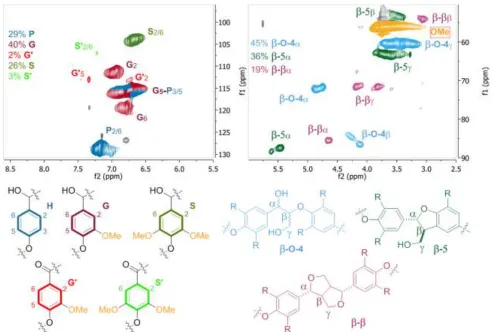
[image:10.612.52.547.333.665.2]Isolation and characterization of walnut dioxosolv lignin: Dioxosolv lignin was isolated from walnut shells via established organosolv procedures.32 A molecular weight average typical for organosolv lignins (Mn = 1290 g mol-1, Mw = 1680 g mol-1 and d = 1.3) was confirmed by GPC analysis (Figure S23). The relative ratios of the main linkages were determined by 2D-HSQC-NMR techniques following reported procedures.6l,11b Relative quantification of the main linkages provided a β-O-4 : β-5 : β-β ratio of 0.45 : 0.36 : 0.19. The β-O-4 to monomer ratio was 1 : 3.14 (Figures 8 and S24). These values correspond to a relatively condensed lignin structure, which is likely the result of the extraction conditions. Based on these values, the theoretical maximum monomer yield from this lignin was estimated to be 10 wt% assuming that only the β-O-4 linkages are cleaved and monomeric products are only obtained when two β-β-O-4 linkages flank a monomer.11b Additionally, the 2D-HSQC-NMR revealed a H (p-hydoxyphenyl) : G (guaiacyl) : S (syringyl) subunit ratio of 0.29 : 0.42 : 0.29, which corresponded well to the H : G : S ratios of product mixtures obtained after catalytic treatment (vide infra).
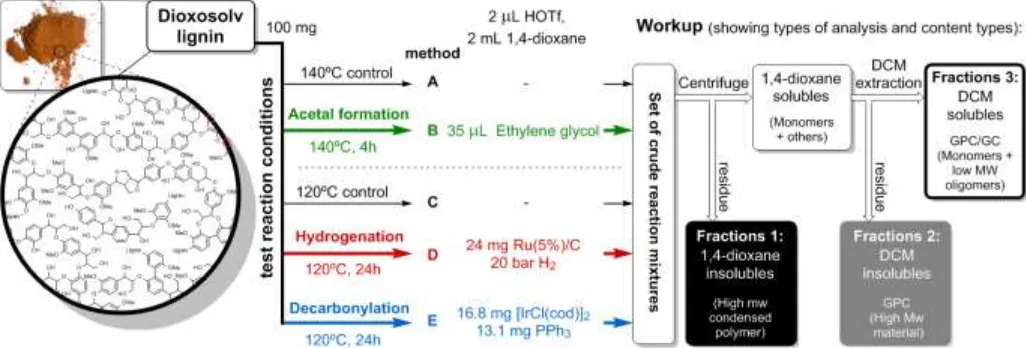
Methods for lignin depolymerization and fractionation of products: The three novel strategies for in situ conversion of reactive intermediates were applied to organosolv walnut lignin and reaction conditions are summarized in Figure 9. A low acid loading (2 wt%) was adopted in all runs to accommodate the increased lability of the β-beta-O-4 linkages in lignin compared to model compounds, due to the higher degree of methoxy-substitution. In situ acetal formation (Method B) was performed at 140 °C for 4 hours. Catalytic hydrogenation (Method D) and decarbonylation (Method E) were carried out at 120 °C for 24 hours. Corresponding control reactions (Method A and C) were carried out with only triflic acid.
The two main aspects of the product analysis focused on determining the amounts of insoluble material generated by recondensation reactions and the types and quantities of aromatic monomers formed. To this end, a suitable fractionation procedure was developed to separate products belonging to different molecular weight ranges (Fractions 1-3, Figure 9). While Fraction 1 represented the dark brown insoluble material directly related to recondensation reactions, Fraction 3 contained the desired low molecular weight products. Fraction 2 comprised of higher Mw, dioxane soluble material (For details of GPC analyses see Figures S27-S28).
Figure 9. Reaction conditions for depolymerization of dioxosolv walnut lignin using methodologies A-E (left). Scheme representing the workup procedure to obtain Fractions 1-3. (right)
[image:11.612.56.569.274.448.2]Figure 10. Dry-weight analysis of the different fractions obtained from lignin depolymerization experiments (Tables S7-S8). The values are derived from masses of crude fractions determined by weighing the solid residues upon solvent evaporation and drying.
Dioxane-solubles (Fraction 2) were the largest fraction of the samples obtained upon stabilization strategies (Methods B, D, E) while in the corresponding control reactions (Methods A and C) clearly the solids (Fraction 1) were the major products (for more details regarding the fractionation procedures see SI section 4.4.1).
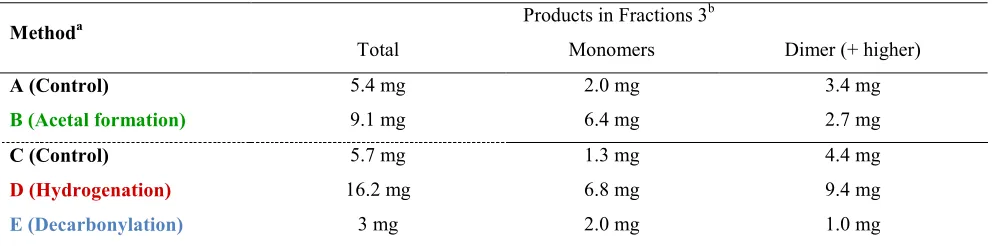
[image:12.612.50.546.591.714.2]Monomer yields: In-depth analysis was performed for all Fraction 3 samples, obtained in Methods A-E using GC-FID and GC-MS (Figures S26-S30). For details of the analysis see SI sections 4.4.2-4.4.5. Products from lignin depolymerization consisted of mainly aromatic monomers, dimers and a few low Mw oligomers. The results of quantification are presented in Table 1 and Figure 11. Methods B and D clearly delivered more monomer yields than the corresponding control reactions (6.4 and 6.8 mg respectively). In addition, the total low molecular weight products were 9.1 (Method B) and 16.2 mg (Method D). These results represent 60% and 80% of the theoretical maximum monomer yields for methods B and D respectively, calculated based on previously established methods6l,11b for the applied lignin source (vide supra, See also SI section 4.2), adjusted according to method used (for the calculation of monomer yields see Page S36-37). Thus the applied methodologies, especially acetal formation and hydrogenation, have the potential to deliver monomer yields close to theoretically expected values. The obtained yields are in agreement with other recently developed, mild β-O-4 cleavage methodologies.9,33 Other methods are also known, especially those using special lignin sources,10,11a or higher temperatures5,34 that afford higher monomer yields. We expect that the strategies described in this paper will be generally applicable to a broader range of lignins with sufficient β-O-4 content. Especially CEL lignins 10a with high β-O-4 content should lead to increased monomer yields.
Table 1. Distribution of monomeric and dimeric products in Fraction 3 for Methods A-E determined by GC-FID analysis.
Methoda Products in Fractions 3
b
Total Monomers Dimer (+ higher)
A (Control) 5.4 mg 2.0 mg 3.4 mg
B (Acetal formation) 9.1 mg 6.4 mg 2.7 mg
C (Control) 5.7 mg 1.3 mg 4.4 mg
D (Hydrogenation) 16.2 mg 6.8 mg 9.4 mg
E (Decarbonylation) 3 mg 2.0 mg 1.0 mg
b Values obtained by integration of GC-FID traces, using n-octadecane as internal standard. The amounts refer to products derived from 100 mg starting lignin. Note that this quantification only includes products of lignin origin, quantifiable by GC-FID and GC-MS. For more information on details of quantification see SI section 4.4.
Distinct classes of aromatic monomers from lignin: One of the most crucial questions was whether the different Methods A-E would deliver the types of monomers, determined by model studies. The products were identified to a large extent (>90%) by GC-MS (all details in Tables S10-S14). The corresponding product mixtures were analyzed according to several key descriptors, which are summarized in Figure 11. These analyses showed excellent agreement between the lignin and the model studies considering products formed via C2 pathways. It should also be noted, that products derived from lignin also included compounds formed through C3 pathways, as expected.
Figure 11. GC(FID/MS) analysis of Fraction 3 obtained in the different methodologies A-E showing a) distribution of alkyl chain lengths (C0-C3) within the product mixtures, as well as H : G : S ratios b) major products in Fraction 3, corresponding to the stabilization strategies (Methods B, D and E, percentages are based on the total weight of lignin monomeric products identified by GC-MS).
The acetal formation methodology (Method B), clearly showed excellent selectivity towards the expected products, as 79% of all identified monomeric products were C2-acetals (Figure 12), which corresponded to an overall yield of 5 wt% from dioxosolv lignin (Figure 11b). Ketals formed by ethylene glycol, of the expected C3-Hibbert ketones were also observed. These reactions were successfully upscaled and the corresponding acetals A1 and A2 were isolated as single compounds by column chromatography from beech ethanosolv lignin in 2.0 wt% (39 mg) and 2.6 wt% (53 mg) yield respectively (See SI section 5), in accordance with the values determined by GC-FID for walnut lignin.
Catalytic hydrogenation (Method D), provided substantial amounts of phenolic-C2 fragments (44%), the expected ethyl and ethanol-substituted aromatics34b,35 being the main C2-products. While 4-ethylphenol was the major product for the phenolic subunits, 2-(4-guaiacyl)-ethanol is a major product for the guaiacol subunit (see Figure S32). Additionally, propyl-phenolics were found, originating from the analogous hydrogenation of the C3-cleavage intermediates formed through Pathway A.7d-g,30,34b,36 Overreduction of the aromatic rings was not significant (8%).
Catalytic decarbonylation (Method E) led to lower overall quantities of monomeric aromatic products, however, the corresponding product mixture showed agreement with the used methodology (Figure S33). C1-phenolics (35%) arise from decarbonylation of the C2-aldehyde intermediate. The C0-phenolics (15%, phenol, guaiacol and syringol) are likely products of decarbonylation of the corresponding C1-vanillin type aldehydes that are known products during acid catalyzed lignin depolymerization. These results indicate, that decarbonylation is a promising strategy to access C1 aromatics from lignin, and future research should focus on the development of more active decarbonylation catalysts.
The control reactions (Methods A and C) provided mainly C3-monomers (Hibbert ketones) typical for acid catalyzed lignin depolymerization (Figuress 11a, S29 and S31),15,16 and as expected monomer quantities were low due to the severe recondensation processes.
Figure 12. GC-FID trace of a typical crude product mixture from depolymerization of walnut dioxosolv lignin using Method B. Identification based on GC-MS data of major peaks is shown (full peak overview in Table S11). aIsolated from an upscaled reaction using 2 g beech organosolv lignin. (see SI Section 5.)
Conclusion
For economically viable establishment of biorefineries, valorization of lignin is essential. To this end, new methods are desired, that depolymerize lignin in a sufficiently controlled manner so that the isolation of single compounds can be achieved. Here we present a novel approach to catalytic lignin depolymerization. Our key innovation is the in situ conversion of the reactive C2-aldehyde fragments (C2-aldehyde), formed during acid catalyzed depolymerization of lignin. This novel approach markedly suppresses the formation of high molecular weight side products and leads to three distinct classes of aromatic compounds upon acidolysis of lignin depending on the methodology used. This represents an important step towards extending the available pool of possible lignin-derived fine chemicals,1c especially since aldehydes can also be obtained by other catalytic routes.1a,2a,6k Future research will focus on in-depth mechanistic understanding of lignin conversion pathways and the precise role of reaction intermediates in order to maximize the amount of monomeric products.
ASSOCIATED CONTENT
Supporting Information: The supplied supporting information contains details on the materials and methods (SI section 1), synthesis of the model compounds (SI section 2), procedures and additional data on the cleavage of β-O-4 model compounds (SI section 3) as well as on the depolymerization of walnut dioxosolv lignin (SI section 4) and isolation of acetals from beech ethanosolv lignin (SI section 5). “This material is available free of charge via the Internet at http://pubs.acs.org.”
ACKNOWLEDGMENT
REFERENCES
1 (a) Zakzeski, J.; Bruijnincx, P. C. A.; Jongerius, A. L.; Weckhuysen, B. M. Chem. Rev. 2010, 110, 3552. (b) Ragauskas, A. J.; Beckham, G. T.; Biddy, M. J.; Chandra, R.; Chen, F.; Davis, M. F.; Davison, B. H.; Dixon, R. A.; Gilna, P.; Keller, M.; Langan, P.; Naskar, A. K.; Saddler, J. N.; Tschaplinski, T. J.; Tuskan, G. A.; Wyman, C. E. Science 2014, 344, 709. (c) Holladay, J. E.; White, J. F.; Bozell, J. J.; Johnson D. in Top value-Added Chemicals from Biomass Vol. II-Results of Screening for Potential Candidates from Biorefinery Lignin, U.S. Department of Energy (DOE) by PNNL, Richland, WA, US, 2007, PNNL-16983
2 (a) Xu, C.; Arancon, R. A. D.; Labidi, J.; Luque, R. Chem. Soc. Rev.2014, 43, 7485. (b) Boerjan, W.; Ralph, J.; Baucher, M. Annu. Rev. Plant Biol.2003, 54, 519.
3 (a) Tuck, C. O.; Pérez, E.; Horváth, I. T.; Sheldon, R. A.; Poliakoff, M. Science2012, 337, 695. (b) Vennestrøm, P. N. R.; Osmundsen, C. M.; Christensen, C. H.; Taarning, E. Angew. Chem. Int. Ed.2011, 50, 10502. (c) Dutta, S.; Wu, K. C.-W.; Saha, B. Catal. Sci. Technol.2014, 4, 3785.
4 Zaheer M.; Kempe, R. ACS Catal. 2015, 5, 1675. 5 Barta, K.; Ford, P. C. Acc. Chem. Res. 2014, 47, 1503.
6 (a) Hanson, S. K.; Baker, R. T.; Gordon, J. C.; Scott, B. L.; Sutton, A. D.; Thorn, D. L. J. Am. Chem. Soc. 2009, 131, 428. (b) Nichols, J. M.; Bishop, L. M.; Bergman, R. G.; Ellman, J. A. J. Am. Chem. Soc.2010, 132, 12554. (c) Son, S.; Toste, F. D. Angew. Chem., Int. Ed.2010, 49, 3791. (d) Sergeev. A. G.; Hartwig, J. F. Science2011, 332, 439. (e) Atesin, A. C.; Ray, N. A.; Stair, P. C.; Marks, T. J. J. Am. Chem. Soc. 2012, 134, 14682. (f) Fedorov, A.; Toutov, A. A.; Swisher, N. A.; Grubbs, R. H. Chem. Sci. 2013, 4, 1640. (g) Rahimi, A.; Azarpira, A.; Kim, H.; Ralph, J.; Stahl, S. S. J. Am. Chem. Soc. 2013, 135, 6415. (h) Feghali, E.; Cantat, T. Chem. Commun. 2014, 50, 862. (i) Nguyen, J. D.; Matsuura, B. S.; Stephenson, C. R. J. J. Am. Chem. Soc. 2014, 136, 1218. (j) Haibach, M. C.; Lease, N.; Goldman, A. S. Angew. Chem. Int. Ed. 2014, 53, 10160. (k) Harms, R. G.; Markovits, I. I. E.; Drees, M.; Herrmann, W. A.; Cokoja, M.; Kühn, F. E. ChemSusChem, 2014, 7, 429. (l) F. Tran, C. S. Lance, P. C. J. Kamer, T. Lebl, N. J. Westwood, Green. Chem.2014,DOI: 10.1039/c4gc01012d. (m) vom Stein, T.; den Hartog, T.; Buendia, J.; Stoychev, S.; Mottweiler, J.; Bolm, C.; Klankermayer, J.; Leitner, W. Angew. Chem. Int. Ed. doi: 10.1002/anie.201410620
7 (a) Vispute, T. P.; Zhang, H.; Sanna, A.; Xiao, R.; Huber, G. W.; Science 2010, 330, 1222. (b) He, J.; Zhao, Ch.; Lercher, J. A.; J. Am. Chem. Soc. 2012, 134, 20768. (c) Wang, X.; Rinaldi, R. Angew. Chem. Int. Ed. 2013, 52, 11499. (d) Song, Q.; Wang, F.; Cai, J.; Wang, Y.; Zhang, J.; Yu, W.; Xu, J.; Energy Environ. Sci., 2013, 6, 994. (e) Parsell, T. H.; Owen, B. C.; Klein, I.; Jarell, T. M.; Marcum, C. L.; Haupert, L. J.; Amundson, L. M.; Kenttämaa, H. I.; Ribeiro, F.; Miller, J. T.; Abu-Omar, M. M., Chem. Sci. 2013, 4, 806. (f) Zhang, J.; Teo, J.; Chen, X.; Asakura, H.; Tanaka, T.; Teremura, K.; Yan, N. ACS Catal.2014, 4 , 1574. (g) M. V. Galkin, J. S. M. Samec, ChemSusChem, 2014, 7, 2154-2158. (h) Jongerius, A. L.; Bruinincx, P. C. A.; Weckhuysen B. M.; Green Chem. 2013, 15, 3049. (i) Bouxin, F. P.; McVeigh, A.; Tran, F.; Westwood, N. J.; Jarvis, M. C.; Jackson, S. D. Green Chem.2015, 17, 1235.
8 (a) Kobayashi, H.; Ohta, H.; Fukuoka, A. Catal. Sci. Techol.2012, 2, 869. (b) Azadi, P.; Inderwildi, O. R.; Farnood, R.; King, D. A. Renew. Sustainable Energy Rev. 2013, 21, 506. (c) Deuss, P. J.; Barta, K. Coord. Chem. Rev. doi:10.1016/j.ccr.2015.02.004.
10 (a) Rahimi, A.; Ulbrich, A.; Coon, J. J.; Stahl, S. S. Nature2014, 515, 249. (b) Bruijnincx, P. C. A.; Weckhuysen, B. M. Nat. Chem.2014, 6, 1035.
11 (a) Barta, K.; Warner, G. R.; Beach, E. S.; Anastas, P. T. Green Chem.2014, 16, 191. (b) Lancefield, C. S.; Ojo, O. S.; Tran, F.; Westwood, N. J. Angew. Chem. Int. Ed. 2015, 54, 258.
12 Lundquist, G., Acidolysis. In: Methods in Lignin Chemistry, Lin, S. Y.; Dence, C.W. (eds), Springer-Verlag, Heidelberg,
1992, pp.287-300.
13 (a) Sannigrahi, P.; Pu, Y.; Ragauskas, A. Curr. Opin. Environ. Sustain.2010, 2, 383. (b) Patton-Mallory, M.; Skog, K. E.; Dale, V. H. Integrated Forest Biorefineries: Product-Based Economic Factors. In Integrated Forest Biorefineries: Challenges and Opportunities; Christopher, L., (Eds.),RSC Green Chemistry Series; The Royal Society of Chemistry, Cambridge, 2013, pp 80-97.
14 Adler, E. Wood Sci. Technol.1977, 11, 169.
15 (a) Pyle, J. J.; Brickman, L.; Hibbert, H. J. Am. Chem. Soc.1939, 61, 2189. (b) Brickman, L.; Pyle, J. J.; Hawkins W. L.; Hibbert, H. J. Am. Chem. Soc. 1940, 62, 986. (c) Kulka, M.; Hibbert, H. J. Am. Chem. Soc.1943, 65, 1180.
16 Lundquist, K. Appl. Polym. Symp. 1976, 28, 1393.
17 (a) Steeves, W. H.; Hibbert H. J. Am. Chem. Soc.1939, 61, 2194. (b) Lundquist, K. Acta Chem. Scand. 1970, 24, 889. 18 Mitchell, L.; Hibbert, H. J. Am. Chem. Soc. 1944, 66, 602.
19 (a) Sturgeon, M. R.; Kim, S.; Lawrence, K.; Paton, R. S.; Chmely, S. C.; Nimlos, M.; Foust, T. D.; Beckham, G. T. ACS Sustainable Chem. Eng. 2014, 2, 472. (b) Yokohama, T. J. Wood Chem. Technol. 2015, 35, 27. (c) Ito, H.; Imai, T.; Lundquist, K.; Yokoyama, T.; Matsumoto, Y. J. Wood Chem. Technol. 2011, 31, 172. (d) Imai, T.; Yokoyama, T.; Matsumoto, Y. J. Wood Sci.2011, 57, 219.
20 Yokoyama, T.; Matsumoto, Y. J. Wood Chem. Technol.2010, 30, 269. 21 Voitl, T.; von Rohr, P. R. ChemSusChem2008, 1, 763.
22 Roberts, V. M.; Stein, V.; Reiner, T.; Lemonidou, A.; Li, X.; Lercher, J. A. Chem. Eur. J.2011, 17, 5939. 23 Boerjan, W.; Ralph, J.; Baucher, M. Annu. Rev. Plant Biol.2003, 54, 519.
24 (a) Chang, Y.-A. Chinese J. Chem. 2007, 25, 989. (b) Watson, W. H.; Chen, J. S.; Zabel, V. J. Org. Chem. 1981, 46, 2916. 25 Liu, X.; Wang, X.; Yao, S.; Jiang, Y.; Guan, J.; Mu, X. RSC Adv. 2014, 4, 49501.
26 Zhou C.-H., Beltramini J. N., Fan Y.-X., Lu G. Q., Chem. Soc. Rev.2008, 37, 527. 27 Climent, M. J.; Corma, A.; Velty, A. Appl. Catal. A2004, 263, 155.
28 Woelfel, K.; Hartman, T. G. ACS Symp. Ser.1998, 705, 193.
29 Ralph, J.; Lundquist, J.; Brunow, G.; Lu, F.; Kim, H.; Schatz, P. F.; Marita, J. M.; Hatfield, R. D.; Ralph, S. A.; Christensen, J. H. Phytochem. Rev. 2004, 3, 29-60.
30 Konnerth, H.; Zhang, J.; Ma, D.; Prechtl, M. H. G.; Yan, N. Chem. Eng. Sci.2015, 123, 155. 31 Iwai, T.; Fujihara, T.; Tsuji, Y. Chem. Commun. 2008, 6215.
32 Pepper, J. M.; Baylis, P. E. T.; Adler, E. Can. J. Chem.1959, 37, 1241.
33 (a) Biannic, B.; Bozell, J. J. Org. Lett.2013, 15, 2730. (b) Bozell, J. J.; Astner, A.; Baker, D.; Biannic, B.; Cedeno, D.; Elder, T.; Hosseinaei, O.; Delbeck, L.; Kim, J.-W.; O’Lenick, C. J.; Young, T. Bioenerg. Res.2014, 7, 856.
34 (a) Huang, X.; Korányi, T. I.; Boot, M. D.; Hensen, E. J. M. ChemSusChem2014, 7, 2276. (b) Ma, R.; Hao, W.; Ma, X.; Tian, Y.; Li. Y. Angew. Chem. Int. Ed.2014, 53, 7310.
35 Ye, Y.; Zhang, Y.; Fan, J.; Chang, J. Biores.Technol.2012, 118, 648.