ISSN Online: 2168-541X ISSN Print: 2168-5428
DOI: 10.4236/chnstd.2018.74026 Nov. 30, 2018 328 Chinese Studies
Note-Taking Assisted with Computers—A
Practical Method to Build a Connection
between Chinese Pinyin & Characters
Wu Yang
1, Isabella Kam
21Foreign Languages School, Hunan University of Commerce,Changsha, China
2Confucius Institute, Woosong University, Daejeon, South Korea
Abstract
Chinese beginners often find themselves in struggling for learning compli-cated Chinese characters (also known as Hanzi), after the acquisition of Chi-nese pronunciation (ChiChi-nese Phonetic Alphabets, also called Pinyin). Actual experience of living and studying in China exposes a fact that people on daily basis are not using Pinyin to assist pronunciation. All means of social media only have Hanzi for people to recognize. The connection between Pinyin and Hanzi is a difficult part to accomplish for Chinese language beginners. Based on several years of teaching experience of Chinese language to speakers of other languages and working memory drill in English-Chinese interpretation, the author explores a practical way to build this connection between Pinyin and Hanzi by taking-notes using computers and mobile phones in class. In al-liance with fun language teaching methodologies, i.e., the Audiolingual me-thod, Communicative Language Teaching (CLT) to reassure the memory re-hearsal drill in association with imaginary situations. The research experi-ment results show that this method can stimulate beginners’ learning enthu-siasm and arouse their confidence and initiative in the long-run Chinese lan-guage learning process and it can facilitate Chinese beginners to better com-municate in the fast-changing social media.
Keywords
Note-Taking Assisted with Computer, Connection between Pinyin & Hanzi, Memory Rehearsal, Initiative
1. Introduction
Global Chinese Learning Heat and Chinese Language Beginners’
Dilemma
In the world context of artificial intelligence (AI), social media and digital
mo-How to cite this paper: Yang, W., & Kam, I. (2018). Note-Taking Assisted with Computers—A Practical Method to Build a Connection between Chinese Pinyin & Characters. Chinese Studies, 7, 328-342. https://doi.org/10.4236/chnstd.2018.74026
Received: September 18, 2018 Accepted: November 27, 2018 Published: November 30, 2018
Copyright © 2018 by authors and Scientific Research Publishing Inc. This work is licensed under the Creative Commons Attribution International License (CC BY 4.0).
http://creativecommons.org/licenses/by/4.0/
DOI: 10.4236/chnstd.2018.74026 329 Chinese Studies
bile applications are allowing people to communicate easier and in wilder area. The world is more multilingual with AI machine translation. The rise of China makes Chinese language become more popular than ever before. The Chinese language population is increasing drastically in recent years. However, many complain that Chinese language is the world’s most difficult language to learn due to the fact that it has two separate systems for pronunciation and writing.
The motivation of learning a language can be multiple. Apart from the pur-pose of studying, working and living in China, many declare that they learn the language out of sheer interest and intention of knowing the long standing and profound Chinese language and culture. They start their language and culture quest with great passion and confidence in learning Pinyin for the first month of learning process. However, many of them would soon find the dual separate Chinese language systems for pronunciation and writing very challenging and they hesitate in devoting time and energy in acquiring both. Some would strug-gle to decide whether to continue without learning the complicated strokes of Chinese characters. This learning journey would become low in accomplishment and less efficient in speaking and writing as time goes by. It would even hamper the entire Chinese learning due to the high drop rate of systematic Chinese learning after Pinyin process, especially for the overseas students coming to China for a degree without the requirement of obtaining HSK levels. (HSK is short for Hanyu Shuiping Kaoshi, Chinese Proficiency Test for other nationalities or other
Chinese ethic group learners) (Wang, 2016). The dilemma for Chinese language
beginner lies in whether to continue with the mastery of Pinyin only or going on with learning Hanzi, which seems to be two very distinct learning experiences. Pi-nyin learning is similar to learning many other languages which also can be marked with International Phonetic Alphabets (IPA), whereas, recognizing Hanzi requires more memory and culture awareness for better understanding in seman-tic level. This is, therefore, a long accumulating process due to the large number of Chinese characters forming from various combinations of strokes.
To solve Chinese beginner’s dilemma, a practical way to build a connection between Pinyin and Hanzi is required so as to maintain learning zest and initia-tive when it comes to the more time-consuming and seemingly more compli-cated Hanzi learning phase.
2. Literature and Definitions
2.1. Working Visual Memory Mechanism
Real life language learning experience of many people proved that if without proper interference or memory reinforcing drill, the learning process can be low in outcome due to the limited capacity and duration of short-term memory (STM). However, if in a language class, the instructor can properly guide the learning process with practical memory reinforcing skills based on the cognitive psychological theories, the study outcome can be more fulfilling and fruitful
(Baddeley & Hitch, 1974).
DOI: 10.4236/chnstd.2018.74026 330 Chinese Studies Shah, 1999). It is responsible for holding information temporarily available for processing. Working memory is important for reasoning and it is the guidance for decision-making and behavior (Antonino & Gezinus, 2017). It is often used as a synonymous term with short-term memory, but some theorists consider the two forms of memory distinct, assuming that working memory allows for the manipulation of stored information, whereas short-term memory (STM) only
refers to the short-term storage of information (Cowan, 2008). In comparison
with working visual memory, STM (or “primary” or “active memory”) is the ca-pacity for holding, but not manipulating, a small amount of information in mind in an active, readily available state for a short period of time. For example, STM can be used to remember a phone number that has just been recited. The dura-tion of STM (when rehearsal or active maintenance is prevented) is believed to
be in the order of 15 to 30 seconds(McLeod, 2009). The most commonly cited
capacity is The Magical Number Seven, Plus or Minus Two (which is frequently
referred to as Miller's Law), despite the fact that Miller himself stated that the figure was intended as “little more than a joke” (Miller, 1956) and that Cowan (2008) provided evidence that a more realistic figure is 4 ± 1 units. Although STM has very limited capacity and duration, One important feature of STM is that there are plenty of memory rehearsal ways to strengthen the encoding process, which means the primarily acoustic or visual information being trans-lated into sounds The encoding process of STM can be reinforced via various kinds of memory rehearsal drills, either from acoustic information to visual
in-formation, or from visual information to acoustic information (Mathy &
Feld-man, 2011). The ultimate goal for STM rehearsal is to transfer STM to long-term
memory, which can hold the information indefinitely (Malaia & Wilbur, 2018).
Magro et al. (2018)showed that the storage capacity of visual working
memo-ry is about four objects and that this capacity does not depend on the number of features making up the objects. Thus, visual working memory seems to process integrated objects rather than individual features, just as verbal working memory
handles higher-order “chunks” instead of individual features or letters
(Kowia-liewski & Majerus, 2018). The same is true in learning Chinese Hanzi, it will be very low efficient if students try to memorize single characters or phrases with-out organizing them in a group or sentence to form higher level chunks.
In this research, the author designs an experiment to build a connection be-tween Pinyin and Hanzi, which applies the working memory mechanism in Chinese Hanzi memory consolidation with the aid of rehearsal drill by display-ing the repeated visions of Chinese characters when typdisplay-ing in the required Chi-nese Pinyin and text via listening. This experiment is strictly carried on the basis of transferring visual working memory in combination of acoustic memory as-sistance, following a carefully designed memory reinforcement drill by repeat-ing, retelling and alter-situation paraphrasing.
2.2. Language Interpretation and Note-Taking Skills
DOI: 10.4236/chnstd.2018.74026 331 Chinese Studies
into another. It is a process in which one produces a first and final translation on
the basis of a one-time exposure to an expression in a source language (Wu,
2000).
The most common two modes of interpreting are simultaneous interpreting, which is done at the time, or 2 seconds lagging behind of the exposure to the source language, and consecutive interpreting, which is done at breaks to this exposure (Zhong, 2013).
The prerequisite for applying this method in Chinese language teaching class is that the students should have good enough English command. The “good enough” refers to the language proficiency level which is above the students’ target language proficiency level. In this research, the 16 South Korean students have proficient English level which is well above their target Chinese language proficiency level, therefore, the interpretation and note-taking drills in the expe-riment have yielded in satisfactory results. Traditionally, note-taking is done
with a pen and notebook, similarly to the Korean “받아쓰기” technique, which
means dictation. The difference between note-taking and dictation is shown on the notes being taken. Dictation requires the students to write down every single word, phrases and sentences, while note-taking allows students to mark with every possible symbols, signs, acronyms, abbreviations etc to bring back memory for the later required retelling exercise(Wu, 2008). In this experiment, the re-searcher combines the dictation and note-taking skills into real classroom drill and final assessment and used them alternatively for better learning outcome.
2.3. Traditional Chinese Language Teaching Methodologies
Language teaching methods in general should avoid being rigid and stiff, other-wise, the class would inevitably turn to be tedious and lifeless. To encourage students’ creativity and initiative, a Chinese language class should be specifically designed to suit students’ study motivation and single class objectives. Most tra-ditional approaches for teaching Chinese are teacher centered with the language instructor being the main authority. Students are regarded as “empty vessels” whose primary role is to passively receive information (via lectures and direct instruction) with an ultimate goal of achieving good testing and assessment
scores (Uzundag & Küntay, 2018). This phenomenon is very prominent in the
research experiment target group, which is a class of 16 South Korean Chinese language beginners. It appeared to the researcher that in the beginning of the 3-week experimental teaching, their primary motivation and great concern is to achieve A+ in the final assessment. It is also true for many untrained Chinese language instructors to have view their primary role of a teacher to be pass knowledge and information onto their students, without putting attention to make the classroom to be student-centered. The traditional Chinese class can be very boring if the instructor only applies the simple repeating technique for the entire class. In Student-Centered Approach, however, teachers and students play
an equally active role in the learning process (Westwood, 2008). The teacher’s
comprehen-DOI: 10.4236/chnstd.2018.74026 332 Chinese Studies
sion of material. Student learning is measured through both formal and informal forms of assessment, including group projects, student portfolios, and class par-ticipation. Teaching and assessments are connected; student learning is conti-nuously measured during teacher instruction. Commonly used teaching me-thods may include class participation, demonstration, recitation, memorization, or combinations of these.
To be more specific, there are plenty of language teaching methodologies ap-plicable in a traditional Chinese language class. Most commonly used metho-dologies include Communicative Language Teaching (CLT), the Audiolingual method and Situation Role play etc.
In combination with the note-taking with computers drill, the research applies the above mentioned methods in designing the experiment and assessment and anticipates not only a more active and lively class atmosphere, but also a more productive learning outcome.
3. Method & Experiment Design
This a empirical study for testifying the assumption of connection between Pi-nyin and Hanzi can be built: The higher proficient level in PiPi-nyin, the faster and easier for students to learn Hanzi. The purpose of this experiment is to apply working memory rehearsal mechanism, language interpretation and note-taking skills into Chinese language teaching to ensure students Chinese proficiency over a certain domain of topics in three weeks of training. Considering the tar-geted group is a 16-student class from South Korea, the researcher did a pre-test of Pinyin dictation to know whether all students meet the prerequisite of this experiment. The design of Pinyin dictation test is as follows:
The instructor prepares the listening recording together with the transcript in advance to guarantee a clear and standard pronunciation without any unex-pected classroom interference.
1) Listen and identify Pinyin Initials, finals and single syllables, which cover 25% of the test. Students need to note down every single pronounced Pinyin.
2) Listen and identify Pinyin for words and phrases, which cover 50%. Stu-dents are required to note down correctly the Pinyin, including the right initial, final and tone for the pronunciation.
3) Listen and write Pinyin for short Chinese sentences, which cover 25%. Stu-dents should note down correctly the punctuation and Pinyin, including the right initial, final and tone for the pronunciation.
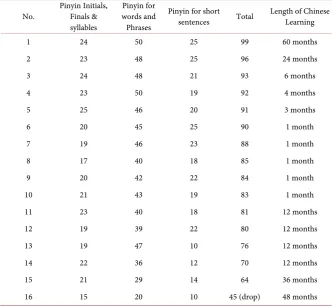
Only one student failed in the Pinyin Test and chose to drop from this 3-week class experiment.
Pinyin Dictation test result is shown in Table 1.
DOI: 10.4236/chnstd.2018.74026 333 Chinese Studies Table 1. Prerequisite pinyin dictation test result.
No. Pinyin Initials, Finals & syllables
Pinyin for words and Phrases
Pinyin for short
sentences Total Length of Chinese Learning
1 24 50 25 99 60 months
2 23 48 25 96 24 months
3 24 48 21 93 6 months
4 23 50 19 92 4 months
5 25 46 20 91 3 months
6 20 45 25 90 1 month
7 19 46 23 88 1 month
8 17 40 18 85 1 month
9 20 42 22 84 1 month
10 21 43 19 83 1 month
11 23 40 18 81 12 months
12 19 39 22 80 12 months
13 19 47 10 76 12 months
14 22 36 12 70 12 months
15 21 29 14 64 36 months
16 15 20 10 45 (drop) 48 months
Another premise for this classroom language experiment is for students to have computers that installed two softwares which will enable them to type in Chinese Hanzi and mark Pinyin automatically. Two software sare Sogou Pinyin and WPS office. In the training, the instructor has asked students to prepare their own laptops or mobile phones which can be installed with the two required software and function the same when typing in Chinese. The note taking with computer drill has last throughout 3 weeks with in-class spontaneous note-taking exercises, 2 scheduled quizzes, 2 home assignments and one final examination. An in-class note-taking exercise with Communicative Language Teaching and Audiolingual Method is shown in the following:
DOI: 10.4236/chnstd.2018.74026 334 Chinese Studies
The structure provided by the instructor: 主语(你) + 有没有 + 动词 + 过 +
宾语?
(Have you ever + done (V-ed) + something?)
Example 你nǐ有yǒu没méi有yǒu打dǎ过ɡuò群qún架jià? Have you ever been in a group fight before?
The supportive questions for digging details: 1) 你nǐ什shén么me时shí候hòu打dǎ的de群qún架jià? (When was it?)
2) 你nǐ们mén打dǎ了le谁shuí? (Who did you fight?)
3) 你nǐ们mén为wèi什shén么me打dǎ群qún架jià? (Why did you fight?) ...
This is a choice question and students can choose to answer from yes or no. If
yes, they reply 有, if no, they reply 没有. The exercise is done in a game and
students are always interested to dig for more details by asking supportive ques-tions using what, when, why, which, where and how. If students being asked felt a little embarrassed to reveal details, they can choose to DARE by accepting mi-nor punishment such as going down to the first floor and come back to the classroom by stairs in 3 minutes. The whole learning process is fun and informa-tive. The instructor has ensured students to use the given sentence pattern to form a similar question by typing in on the screen and also encouraged them to speak up out loud and communicate with each other in a pleasant way. Some students revealed that the class atmosphere is light and enjoyable and “I have learned more vocabulary and spoken as much Chinese voluntarily as my past 5 years combined”.
Questions provided by students are also interesting:
你nǐ有yǒu没méi有yǒu一个人看kàn过ɡuò日rì出chū? Have you ever enjoyed a sunset alone? 你nǐ有yǒu没méi有yǒuzh准ǔn时shíshàn上ɡ过ɡuò课kè? Have you ever been punctual for classes?
你nǐ有yǒu没méi有yǒu跟ɡēn别bié的de女nǚ人rén吃chī过ɡuò饭fàn? Have you ever eaten a meal with other women? 你nǐ有yǒu没méi有yǒu吃chī过ɡuò狗ɡǒu肉ròu? Have you ever eaten dog meat?
你nǐ有yǒu没méi有yǒu一yí个ɡè人rén去qù过ɡuò电diàn影yǐnɡ院yuàn看kàn过ɡuò浪lànɡ漫màn电diàn影yǐnɡ? Have you ever been to a cinema
for a romantic movie alone?
你nǐ有yǒu没méi有yǒu过ɡuò三sān个ɡè以yǐshàn上ɡ的de 女nǚ朋pénɡ友yǒu? Have you ever had more than three
girlfriends?
As the Magic number 7 (plus or minus two) provides evidence for the capacity of short term memory. Most adults can store between 5 and 9 items in their
short-term memory. This idea was put forward by Miller (1956) and he called it
the magic number 7. He though that short term memory could hold 7 (plus or minus 2 items) because it only had a certain number of “slots” in which items could be stored.
However, Miller didn’t specify the amount of information that can be held in each slot. Indeed, if we can “chunk” information together we can store a lot more information in our short term memory (Li, 2017).
DOI: 10.4236/chnstd.2018.74026 335 Chinese Studies
In the above designed exercise, the structure provided has 5 chunks (主语(你)
+ 有没有 + 动词 + 过 + 宾语?) which is within moderate STM capacity. It
should not be difficult for students to memorize. The instructor underlined three places and asked the students to replace with other words and continue to re-hearse the same pattern over and over again in 30 minutes by several memory reinforcing techniques, i.e., association (imaginary situations), visualization (typing in and displaying on screens), audiolingual rehearsal (repeating listening and speaking) and CLT (Communicative Language Teaching by engaging in conversations). The aim was to transfer STM to long-term memory which is not easily forgotten.
4. Findings
The three-week class training was designed to familiarize students to use Chi-nese language type-in software to communicate and express themselves has achieved expected experiment results. All 15 students have followed closely the experiment steps and have grasped basic skills of using the software to type in Chinese. The 15 students all reported with confidence in chatting and typing in Chinese Hanzi with their friends on social media applications. Some revealed that this training is very thought-provoking because they are always required to come up with different situations using provided sentence patterns. The process is guided and they have faith in speaking even creating new sentences rather than being asked to repeat with boredom. The results showed no obvious evi-dence for a connection between longer years of Chinese study and good Pinyin proficiency. Instead, some students who learned the language for only weeks or months have better Pinyin level than those who studied for years.
Table 2 shows students’ final assessment score and the rank comparison with
the prerequisite dictation test:
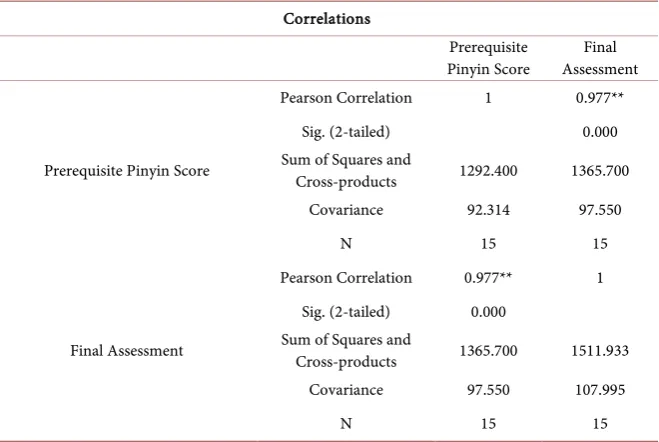
However, to compare the final assessment score with the prerequisite Pinyin test score, it is easy to find a correlation between actual Pinyin proficiency and efficient Hanzi learning (p < 0.000). Correlation between prerequisite pinyin test score and final assessment score is shown below in Table 3:
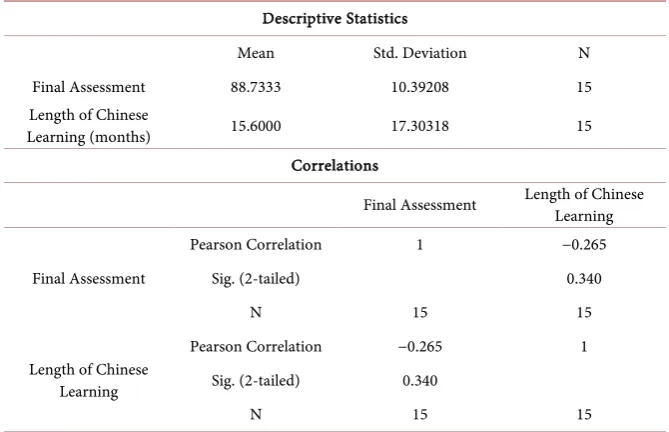
However, results showed that learners with longer Chinese learning time had no significant advantage in the final assessment score (P = 0.34 > 0.05). Table 4
demonstrates the correlation analysis results:
DOI: 10.4236/chnstd.2018.74026 336 Chinese Studies
Table 2. Final Assessment Score.
No. Type-in Exam Score (40%) Interpretation (20%) Dialogue (40%) (100%) Total Rank Comparison with Pinyin Dictation Test
1 39.5 20 40 99.5 1, 1
2 39 20 40 99 2, 2
3 38.5 19 40 97.5 4, 3
4 38 20 40 98 3, 4
5 37.5 18 40 95.5 5, 5
6 37 18 38 93 6, 6
7 36.5 17 38 91.5 8, 7
8 36 18 38 92 7, 8
9 36 16 37 89 9, 10
10 33 20 37 90 10, 9
11 32 18 36 86 11, 11
12 32 18 35 85 12, 12
13 30 17 34 81 13, 13
14 22 16 32 70 14, 14
15 19 15 30 64 15, 15
Table 3. Correlation between prerequisite pinyin & final assessment score.
Correlations
Prerequisite
Pinyin Score Assessment Final
Prerequisite Pinyin Score
Pearson Correlation 1 0.977**
Sig. (2-tailed) 0.000
Sum of Squares and
Cross-products 1292.400 1365.700
Covariance 92.314 97.550
N 15 15
Final Assessment
Pearson Correlation 0.977** 1 Sig. (2-tailed) 0.000
Sum of Squares and
Cross-products 1365.700 1511.933 Covariance 97.550 107.995
N 15 15
**. Correlation is significant at the 0.01 level (2-tailed).
[image:9.595.209.539.412.633.2]DOI: 10.4236/chnstd.2018.74026 337 Chinese Studies
Table 4. Correlation between final assessment score and length of chinese learning.
Descriptive Statistics
Mean Std. Deviation N
Final Assessment 88.7333 10.39208 15
Length of Chinese
Learning (months) 15.6000 17.30318 15
Correlations
Final Assessment Length of Chinese Learning
Final Assessment
Pearson Correlation 1 −0.265
Sig. (2-tailed) 0.340
N 15 15
Length of Chinese Learning
Pearson Correlation −0.265 1
Sig. (2-tailed) 0.340
N 15 15
第一部分:汉字输入测试,40分,(第9-10课录音内容)
听录音,在电脑上使用 Sogou 拼音输入法将听到的录音文字输入到 WPS
里,完成输入后请给文字标注拼音,输入的文本请选择Times New Roman字
体,16号,在30分钟内将输入的文本发送至[email protected].
Part One (Type-in Chinese characters, 40 points, Lesson 9 & 10)
Directions: Listen to the recording and type in the information in Chinese you hear using WPS and Sogou software. You should add Pinyin to (above) the characters. When you finish all the typing, select all typed-in information and choose TIMES NEW ROMAN font with a size of 16. Part one will cover Lesson 9 and lesson 10 of the textbook.
第二部分:英汉口译(20分,第11-12课内容)
根据教材第十一课和第十二课的内容,教师说英语,学生说汉语,考察学 生对词汇和句型的熟练度、语音和汉语表达能力。口语测试将会被录音。
Part Two (English-Chinese Interpretation, 20 points, Lesson 11 & Lesson 12 ) Directions: Students are required to interpret from English to Chinese what the instructor provided on-spot. This part will cover Lesson 11 and Lesson 12 of the textbook. This part is designed to test students’ language proficiency over vocabulary and sentences, pronunciation and language expression ability. The speaking test will be recorded.
第三部分:对话(20分,每组10分钟)
学生两两一组,就给定场合考察汉语会话、配合完成交流和对话的能力。(提
出并回复问题,组织对话,引导对话)。口语测试将会被录音。
Part Three Conversation (20 points, 10 minutes for each group)
DOI: 10.4236/chnstd.2018.74026 338 Chinese Studies
Each group chooses one topic from the following situations:
参加一场面试(面试官和求职者) Interviewee and interviewer
晚上吃什么What to have for dinner
暑假去中国玩Planning to go to China for summer vacation
周末做什么What to do this weekend
Students final assessment score has shown obvious positive correlation with their prerequisite Pinyin acquisition. The more proficient they can use pinyin, the faster and more accurate when they type in Chinese Hanzi using online software with AI association technology which can automatically correct the typing errors based on the users accustomed behavior and habits. These func-tions are very user-friendly to Chinese beginners who are not very confident communicating to people around in Chinese language. It largely lowers the dif-ficulties to hand-write Hanzi which reported by many international students as drawing and recognizing pictures especially when it comes to Chinese calligra-phy. The modern fonts can be chosen when they are doing typing in exercise and allow them to feel different styles of Hanzi writing and memorize them eas-ily and efficiently on a daeas-ily basis.
What’s more, after 3 weeks training using CLT and audiolingual method in combination with working memory reinforcing drill, all 15 students are able to communicate with the researcher on screen using emails or mobile social media applications in Chinese for any daily topics whenever they recall acquired voca-bulary and sentence patterns. Once the connection between Pinyin and Hanzi was built, students are not only more confident in expressing themselves in class, but also becoming more initiative and creative on screen after class. The ultimate goal for learning a language is to communicate, therefore, the research has satis-fied this primary goal of using Chinese language for beginners to express them-selves freely in class and after class.
5. Discussion
This 3-week experiment of note-taking with computers to build a connection between Chinese Pinyin and Hanzi is based on students’ acquisition of Pinyin. If the trainees are absolute beginners, they should be first receiving a systematic training of Chinese Pinyin. In China, 3 to 5 year old children usually receive a 3 to 6 months education of systematic Pinyin before they start to learn Hanzi. For International students studying in China, Chinese National Education Ministry suggests a minimum of 2 weeks concentrated time for Pinyin prior any Chinese Hanzi input to guarantee a better learning outcome. Therefore, if applying this experiment to another group, a prerequisite Pinyin dictation is also necessary to know whether they can be directly guided through this training. If they are ab-solute beginners, another 3 weeks of Pinyin training is required before this expe-riment.
DOI: 10.4236/chnstd.2018.74026 339 Chinese Studies
good English command so as to interact to the maximum extent in class. How-ever, this sometimes is not available due to the current main stream Chinese language teaching method is the target language (Chinese) immersion education instead of bilingual, letting alone multilingual immersion which largely moti-vates students to participate in communication and class activities.
6. Conclusion
Chinese language class needs to be live and fun. The teaching methods should be flexible in order to seek stimulation and to combine with various students’ learning motivations. In update with the current multilingual context in all kinds of social media, Chinese language class should also be of creativity and novelty in combination of practical teaching methods. For those who have any past lan-guage learning experience, they should be familiar with one saying: The palest
ink is better than the best memory (好记性不如烂笔头). In other words, the
connection between Chinese Pinyin and Hanzi should be reinforced in class to the maximum extent for better learning outcomes. This research carried out a three week experiment for a group of 15 South Korean Chinese beginners to better communicate with Chinese language using computers software and mo-bile phone, social media applications. The training process is designed with scientific working memory mechanism and language teaching methods, CLT and audiolingual methods in particular to stimulate students’ learning enthu-siasm and creativity.
The note-taking drill in language interpretation was done with computers in this experiment and with the help of modern artificial intelligence to generalize Pinyin and confirm pronunciation. The improved learning efficiency is a natural response to the modern technologies and innovative teaching methods. The students who participated in the drill have demonstrated active interaction and enthusiasm in class and have revealed faith in the future language learning en-deavors.
Therefore, this experiment has satisfied the designed goals of building a connection between students’ Pinyin with Hanzi by communicating with con-fidence and initiatives. It’s applicable to any level of Chinese language learners with a prerequisite of Pinyin learning for a minimum of 2 weeks prior the ex-periment.
The author takes a hint from this research that, teaching methods in the digi-tal era are certainly changing in the world of AI. It is up to teachers themselves to learn how to weave technology into their profession. Appendix is evidence of one student’s final examination paper in which he has demonstrated type-in skills and achieved a satisfactory outcome.
Conflicts of Interest
DOI: 10.4236/chnstd.2018.74026 340 Chinese Studies
References
Atkinson, R. C., & Shiffrin, R. M. (1971). The Control Processes of Short-Term Memory. Institute for Mathematical Studies in the Social Sciences, Stanford University.
Baddeley, A. D., & Hitch, G. (1974). The Psychology of Learning and Motivation: Ad-vances in Research and Theory (Vol. 8, pp. 47-89). New York: Academic Press.
Cowan, N. (2008). What Are the Differences between Long-Term, Short-Term, and Working Memory? Progress in Brain Research, 169, 323-338.
https://doi.org/10.1016/S0079-6123(07)00020-9
Kowialiewski, B., & Majerus, S. (2018). The Non-Strategic Nature of Linguistic Long-Term Memory Effects in Verbal Short-Term Memory. Journal of Memory and Language, 101, 64-83. https://doi.org/10.1016/j.jml.2018.03.005
Li, J. (2017). An Review on the Interpretation Memory Research. Translation Horizons, 1, 153-154.
Magro, L. O., Attout, L., Majerus, S., & Szmalec, A. (2018). Short- and Long-Term Mem-ory Determinants of Novel Word form Learning. Cognitive Development, 4, 47. Malaia, E., & Wilbur, R. B. (2018). Visual and Linguistic Components of Short-Term
Memory: A Common Neural Model for Spoken and Sign Languages. Cortex, 3, 34. https://doi.org/10.1016/j.cortex.2018.05.020
Mathy, F., & Feldman, J. (2011). What’s Magic about Magic Numbers? Chunking and Data Compression in Short-Term Memory. Cognition, 3, 122.
McLeod, S. A. (2009). Short-Term Memory.
https://www.simplypsychology.org/short-term-memory.html
Miller, G. (1956). The Magical Number Seven, Plus or Minus Two: Some Limits on Our Capacity for Processing Information. The Psychological Review, 63, 81-97.
https://doi.org/10.1037/h0043158
Miyake, A., & Shah, P., eds. (1999). Models of Working Memory: Mechanisms of Active Maintenance and Executive Control. Cambridge: Cambridge University Press. https://doi.org/10.1017/CBO9781139174909
Raffone & Wolters, (2017). A Cortical Mechanism for Binding in Visual Working Mem-ory. Journal of Cognitive Neuroscience, 13, 6.
Uzundag, B. A., & Küntay, A. C. (2018). Children’s Referential Communication Skills: The Role of Cognitive Abilities and Adult Models of Speech. Journal of Experimental Child Psychology, 172, 72-95. https://doi.org/10.1016/j.jecp.2018.02.009
Wang, F. (2016). Is HSK a Good Indicator of International Students’ Chinese Proficiency? Chinese Language Education, 8, 76.
Westwood, P. (2008). What Teachers Need to Know about Teaching Methods.
Camber-well, Vic: ACER Press.
Wu, Y. (2008). On the Process and Training Strategies of Consecutive Interpretation (CI) under the Perspective of Memory Psychology. Shanghai: Central South Univeristy Press.
Wu, Y. N. (2000). On the Teaching of English-Chinese Consecutive Interpretation. For-eign Languages and Translation, 6, 56.