CHECK THE CO-INOCULATION EFFICIENCY ON PLANT GROWTH AND PHOSPHOROUS UPTAKE
FROM PHOSPHATE SOLUBILIZING BACTERIA AND FUNGI FROM SALINITY AFFECTED SOIL IN
*,1
Bagalkar
1
Department of Microbiology Sant Gadge Baba
2Matoshri Vimlabai Deshmukh Mahavidyalaya, Amravati
ARTICLE INFO ABSTRACT
A present study was conducted to isolate, identify and characterize the phosphate solubilizing bacteria from salinity affected area of Amravati district (Daryapur, Bhatkuli, and Anjangaon
was observed (
ability of inorganic insoluble phosphate than bacteria, i.e., pseudomonas spp
fungi should be helpful to increase the crop yield in salinity affected soil by solubilizing large concentration of inorganic insoluble phosphate., Application of
plant growth promoting activity.
Copyright © 2017, Bagalkar and Dr. Deshmukh. This unrestricted use, distribution, and reproduction in any medium,
INTRODUCTION
Phosphorus (P) is the second most important macro
required by plants, next to nitrogen. Compared to other essential macronutrients (with exception of nitrogen), P is one of the less-abundant (0.1% of total) elements in the lithosphere (Jones and Oburger, 2011). Unlike nitrogen, this element is not acquired through biochemical fixation but comes from other sources to meet plant requirements. The sources include chemical fertilizers, animal manures, and plant residues including green manures, human, industrial and domestic wastes and, native compounds of phosphorus, both organic and inorganic already present in soil (SubbaRao, 1982
ranks next to N in importance for living plants, however, in comparison with other nutrients; the concentrat phosphorus in the soil solution is generally low. Phosphorus in decomposing litter is subject to the same pattern of immobilization and uptake by micro-organisms as found for N (Bargali et al., 2015). Microorganisms which are capable of solubilizing insoluble phosphate, also called phosphate solubilizing microorganisms (PSMs) not only provide plants with phosphorus, but also facilitate the growth of plants through (a) fixing atmospheric nitrogen (Dobbelaere 2002; Sahin et al., 2004) (b) accelerating the accessibility of
*Corresponding author: Bagalkar, N. W.
Department of Microbiology Sant Gadge Baba Amravati University, Amravati, India.
ISSN: 0975-833X
Vol.
Article History:
Received 16th September, 2017
Received in revised form 09th October, 2017
Accepted 26th November, 2017
Published online 27th December, 2017
Citation: Bagalkar, N. W. and Dr. Deshmukh, S. S.
solubilizing bacteria and fungi from salinity affected soil in amravati district
Key words:
Phosphate solubilizing bacteria (PSB), Biofertilizer, Salinity affected soil.
RESEARCH ARTICLE
INOCULATION EFFICIENCY ON PLANT GROWTH AND PHOSPHOROUS UPTAKE
FROM PHOSPHATE SOLUBILIZING BACTERIA AND FUNGI FROM SALINITY AFFECTED SOIL IN
AMRAVATI DISTRICT
Bagalkar, N. W. and
2Dr. Deshmukh, S. S.
Department of Microbiology Sant Gadge Baba Amravati University, Amravati, India
Matoshri Vimlabai Deshmukh Mahavidyalaya, Amravati, Sant Gadge Baba Amravati University,
ABSTRACT
A present study was conducted to isolate, identify and characterize the phosphate solubilizing bacteria from salinity affected area of Amravati district (Daryapur, Bhatkuli, and Anjangaon
was observed (Aspergillus spp, Penicillium spp.and trichoderma spp
ability of inorganic insoluble phosphate than bacteria, i.e., B.cereus, B.megaterium, B.polymyxa,, two pseudomonas spp, Enterobacter spp., the application of biofertilizer prepared by above mentioned fungi should be helpful to increase the crop yield in salinity affected soil by solubilizing large concentration of inorganic insoluble phosphate., Application of all isolated
plant growth promoting activity.
This is an open access article distributed under the Creative Commons medium, provided the original work is properly cited.
Phosphorus (P) is the second most important macro-nutrient required by plants, next to nitrogen. Compared to other essential macronutrients (with exception of nitrogen), P is one abundant (0.1% of total) elements in the lithosphere . Unlike nitrogen, this element is not acquired through biochemical fixation but comes from other sources to meet plant requirements. The sources include chemical fertilizers, animal manures, and plant residues industrial and domestic wastes and, native compounds of phosphorus, both organic and , 1982). Phosphorus ranks next to N in importance for living plants, however, in comparison with other nutrients; the concentration of phosphorus in the soil solution is generally low. Phosphorus in decomposing litter is subject to the same pattern of organisms as found for N Microorganisms which are capable of insoluble phosphate, also called phosphate solubilizing microorganisms (PSMs) not only provide plants with phosphorus, but also facilitate the growth of plants Dobbelaere et al., lerating the accessibility of
Department of Microbiology Sant Gadge Baba Amravati University,
other trace elements (Mittal et al hormones such as auxins (Jeon
2005), cytokinins (Gracia de Salamone gibberellins (Gutierrez et al., 2009 (Wani et al., 2007), hydrogen cyanide
enzymes and/or fungicidal compounds such as chit cellulose, protease (Dey et al
Hamdali et al., 2008) which ensure antagonism against phytopathogenic microorganisms. Therefore, it is worth to believe that production of plant growth promoting substances by PSMs may effectively contribute to their effect on the enhancement of the plant performance
The majority of the isolated org
although several fungi are also known to solubilize phosphates. These bacteria and fungi have the potential to be used as biofertilizers. Their role in increasing the soil nutrient value is of utmost importance. Their applic
resulted in an increased yield of several crops, such as cereals, legumes, fibers, vegetables, oils, and other crop plants (Hameeda et al., 2006a;
Silini-2011). Given the negative environmental
fertilizers and increasing costs, the utilization of phosphate solubilizing bacteria (PSB) is advantageous for sustainable agricultural practices (Khalimi
these insoluble phosphates into available forms for plant acidification, chelation, exchange reactions, and production of gluconic acid (Gyaneshwar et al
International Journal of Current Research
Vol. 9, Issue, 12, pp.62993-62998, December, 2017
Dr. Deshmukh, S. S. 2017. “Check the co-inoculation efficiency on plant growth and phosphorous uptake from phosphate bacteria and fungi from salinity affected soil in amravati district”, International Journal of Current Research
INOCULATION EFFICIENCY ON PLANT GROWTH AND PHOSPHOROUS UPTAKE
FROM PHOSPHATE SOLUBILIZING BACTERIA AND FUNGI FROM SALINITY AFFECTED SOIL IN
Amravati University, Amravati, India
Sant Gadge Baba Amravati University, Amravati
A present study was conducted to isolate, identify and characterize the phosphate solubilizing bacteria from salinity affected area of Amravati district (Daryapur, Bhatkuli, and Anjangaon). In these study trichoderma spp.) have the more solubilizing B.cereus, B.megaterium, B.polymyxa,, two application of biofertilizer prepared by above mentioned fungi should be helpful to increase the crop yield in salinity affected soil by solubilizing large all isolatedculture with lignite showed
Commons Attribution License, which permits
et al., 2008); (c) producing plant Jeon et al., 2003; Egamberdiyeva, Gracia de Salamone et al., 2001), and ., 2009); (d) releasing siderophores , hydrogen cyanide (Kang et al., 2010), enzymes and/or fungicidal compounds such as chitinase, et al., 2004; Lucy et al., 2004; which ensure antagonism against microorganisms. Therefore, it is worth to believe that production of plant growth promoting substances by PSMs may effectively contribute to their effect on the enhancement of the plant performance (Panhwar et al., 2011a). The majority of the isolated organisms are bacterial organisms, although several fungi are also known to solubilize phosphates. These bacteria and fungi have the potential to be used as biofertilizers. Their role in increasing the soil nutrient value is of utmost importance. Their application to crop fields has resulted in an increased yield of several crops, such as cereals, legumes, fibers, vegetables, oils, and other crop plants -Cherif et al., 2012; Viruel et al., . Given the negative environmental impacts of chemical fertilizers and increasing costs, the utilization of phosphate-solubilizing bacteria (PSB) is advantageous for sustainable
et al., 2012). PSB could convert these insoluble phosphates into available forms for plant via tion, exchange reactions, and production of et al., 2002; Chung et al., 2005).
INTERNATIONAL JOURNAL OF CURRENT RESEARCH
They may also promote plant growth by secreting plant hormones, such as indole acetic acid and cytokinin (Gulati et al., 2010). Currently, many PSB belonging to Pseudomonas, Bacillus, Rhizobium, Agrobacterium, Burkholderia, Achromobacter, Microccocus, Aerobacter, Enterobacter, Flavobacterium, and Erwinia have been isolated from soils (Poonguzhali et al., 2008). These bacteria can grow in media containing calcium-phosphate complexes as the sole source of P, solubilize and assimilate a large proportion of P, and release P in high amounts. Phosphate is solubilized via organic acid synthesis and released by microorganisms (Rodríguez and Fraga, 1999). This reaction, appearing as a halo or clear zone on the plate, is used to assess the P-solubilizing activity of these bacteria. Undoubtedly, the selection of considerably efficient PSB strains as possible inoculants will be a promising way to release large amount of P from soil to improve the current status of extensive chemical fertilizer usage. Microorganisms, especially the use of such phosphate solublizing bacteria (PSB) as inoculants simultaneously increases P uptake by the plant and therefore can be used as bio fertilizer (Puente et al., 2004). PSBs have a high potential to be used for the management of phosphorus in P deficient soils as well as disease suppression (Nico et al., 2012).
MATERIALS AND METHODS
Sample Collection
Total 128 Soil samples were collected from salinity affected area of Amravati district (Daryapur, Bhatkuli, and Anjangaon tahshil) in sterilized container. The soil suspension was prepared by mixing 1 g of soil sample in 9 mL distilled water then supernatant discarded and soil sample point inoculated on previously prepared and sterilized pikovaskaya’s agar plates. Then the pikovaskaya’s agar plates incubated at 28±2 oC for 24−48 h. And after completion of incubation time, Zone of phosphate solubilization was record. The colonies showed clear zone of solubilization further subculture on pikovaskaya’s agar plates (Isolates).
Microscopic Study
The gram staining was done in laminar airflow hood. For this purpose the slides were taken from slide rack. The slides were washed with ethanol. Then each colony was marked on the slides. Then with the help of inoculating needle the loopful strains were picked from each test tube and made a smear on the slides and heat fixed. The slides were then taken in the staining room for staining the smears. Then smears were stained in following steps
a) First applied crystal violet on each slides. Kept for 30 secs. b) Distilled water wash.
c) Iodine on the slides as mordant (1 min) then 95% alcohol washes and then washed with distilled water.
d) Safranin was applied on the slides and then washed with distilled water and
f) the slides air dried. The entire gram staining technique was done following the Christian Gram technique (Nico et al., 2012). Microscopic study of the Size, shape, arrangement motility grams staining was done for morphological study. The fungal isolates were identified up to generic level based on their colony morphology and microscopic examination as outlined in the manual of (Collee et al., 1996).
Bacterial colony identification and external morphology study
Using the spread plate technique the bacterial colony identification and external morphology was studied for which nutrient agar media was prepared. Therefore 100 ml of Nutrient agar Media was prepared for four Petri plates. The NA media was autoclaved and then poured in four Petri dishes which were also sterilized by autoclave. Then the serial dilutions of 10-2, 10-4, 10-6, 10-8 were chosen and from that 0.1 ml of culture was transferred from each serially diluted test tubes and spread on the Petri plates by means of the spreader. Then the Petri dishes were kept in the incubator for 37°Celsius for 24 hrs for the incubation and growth of bacteria. After 24 hrs of incubation the Petri dishes were taken out of the incubators and the following bacterial external morphology were studied.
Pure culture isolation of bacteria
Well developed and separated colonies which were identified on the nutrient agar plates were marked and then these separated colonies were chosen and by the help of inoculating needle the colonies were transferred and streaked separately on test tubes having nutrient agar slants for the growth of the single colonies of bacterial cultures from the mixed culture of bacteria. That was grown in the Petri plates. The test tubes were marked after the strains of chosen colonies from Petri plates and were left in the incubator at 37° Celsius overnight for growth and incubation. After incubation of the pure cultures overnight different single species of bacterial culture slants developed in the test tubes which were further picked and purified.
Screening of bacterial strains
After gram staining of the bacterial strains from the pure culture slants and microscopic studies the bacterial strains which were identified to be phosphate solubilising bacteria by studying the morphological structures were further confirmed by their ability to be grown on Pikovaskya agar media which is the most important test for the phosphate solubilising bacteria. The bacterial colonies were picked from the pure culture slants by the help of the inoculating needle and were streaked in the PKV agar media plates and were incubated at 37° Celsius overnight. In the next day the bacterial colonies showed a clear Halozone formation which confirmed them to be PSB bacterial species. For further studies these colonies were again grown in nutrient agar media and several Biochemical tests were performed
Identification of Bacterial Isolates through Biochemical Test
The PSBs isolated from salt affected soils was identified up to generic level based on morphological cultural and biochemical tests as specified in Bergey’s Manual of Determinative Bacteriology (Gilman, 1957). Biochemical test was performed as suggested by (Holt et al., 1994) which included tests as like Gram’s stain, IMViC reaction, catalase test, starch hydrolysis test oxidation fermentation test, Phenyl alanine deamination test, Nitrate reduction, Gelatin hydrolysis test, Urea hydrolysis test, Dehydrogenase test, Casein hydrolysis test, Citrate utilization test, Indol production test, Triple Sugar Iron (TSI) test, Carbohydrate fermentation test.
Phosphate Solubilization by Plate Assay
Solubilization of tricalcium phosphate was detected in Pikovskaya’s Agar medium (Garrity et al., 2001
was point inoculated at the center of Pikovskaya’s
and incubated for 24 – 48 h. The developments of clear around the colony indicate phosphate solubilizing activity. The zone of solubilization was observed around the colony and diameter was measured.
Effect of this isolates on test plant
For this experiment, pure cultures were grown in nutrient broth at 28 oC and diluted to a final concentration of
forming units (cfu) mL in sterile saline water (0.85%). The surface sterile seeds were inoculated by immersion in the PGPR suspension (ca -18 cfuml-1) for 45 min on rotary shaker (140 rev min-1), air dried and sown immediately into 2 pots, out of this 1 pot contain single super phosphate. Control seed were treated with sterile distilled water. Seed were sown in plastic pots (15 cm diameter) containing 1 kg of sterile soil and place in room, which having temp is (25 to 45
temp, pH - 6.8 – 7.2 and then supply daily sterile tap water as suitable. Observe the average growth of soybean plant and mung bean plant and record the height, root, leaf area, shoot and production.
Media and Reagents
The nutrient agar media for isolation and slant pr made. It includes peptone-5gm, beef extract
agar-18gm and distilled water-1000ml. B) Pikovaskya agar media was prepared Halozone test for PSB bacteria only. In its composition it has glucose-10gm/ml, yeast extrac
ammonium sulphate-0.5gm/ml, magnesium sulphate
0.1gm/ml, calcium phosphate- 5gm/ml, sodium chloride 0.2gm/ml, potassium chloride- 0.2gm/ml, manganese sulphate 0.002gm/ml, ferrous sulphate- 0.002gm/ml, Agar
and distilled water- 1000ml. C) Pikovaskya broth was prepared for production media and for mass production of PSB bacteria. In its composition it has glucose 10gm/ml, yeast extract 0.5gm/ml, ammonium sulphate- 0.5gm/ml, magnesium sulphate-0.1gm/ml, calcium phosphate-
chloride- 0.2gm/ml, potassium chloride- 0.2gm/ml, manganese sulphate- 0.002gm/ml, ferrous sulphate-
distilled water-1000ml. The biochemical tests included methyl red test, Vogaeus Proskaur test, indole test, citrate test, catalase test, starch hydrolysis test and nitrate reduction test. In the gram staining techniques crystal violet, Gram s iodine and safranin were used. Other reagents included Kovac s reagent, alpha napthol, hydrogen sulphide and Gram s iodine.
RESULTS
Out of 128 samples analyzed, total 34 isolates were isolated from salinity affected soils in Amravati district. (Daryapur, Bhatkuli, and Anjangaon tahshil). Out of 34 isolates 21 PSB and 13 fungi were found, but only 3 fungi species showed significant zone of P solubilization. Among 21,
bacterial culture showed variation and others were repeated. A clear halo zone was formed around the colonies after 2 days of incubation on solidified Pikovaskaya`s agar plates and phosphate solubilizing bacteria and fungi were selected and sub cultured on Pikovaskaya`s agar plates for further studies. On the basis of cultural character, Morphological character and Solubilization of tricalcium phosphate was detected in ., 2001). Each isolate was point inoculated at the center of Pikovskaya’s Agar plate 48 h. The developments of clear around the colony indicate phosphate solubilizing activity. The zone of solubilization was observed around the colony and diameter
this experiment, pure cultures were grown in nutrient broth and diluted to a final concentration of 10 colony – forming units (cfu) mL in sterile saline water (0.85%). The surface sterile seeds were inoculated by immersion in the ) for 45 min on rotary shaker ), air dried and sown immediately into 2 pots, this 1 pot contain single super phosphate. Control seed were treated with sterile distilled water. Seed were sown in plastic pots (15 cm diameter) containing 1 kg of sterile soil and place in room, which having temp is (25 to 45C ) room 7.2 and then supply daily sterile tap water as suitable. Observe the average growth of soybean plant and mung bean plant and record the height, root, leaf area, shoot
The nutrient agar media for isolation and slant preparation was 5gm, beef extract-3gm, NaCl-5gm, 1000ml. B) Pikovaskya agar media was prepared Halozone test for PSB bacteria only. In its 10gm/ml, yeast extract- 0.5gm/ml,
0.5gm/ml, magnesium
sulphate-5gm/ml, sodium chloride- 0.2gm/ml, manganese sulphate- 0.002gm/ml, Agar- 1.8gm/ml ya broth was prepared for production media and for mass production of PSB bacteria. In its composition it has glucose 10gm/ml, yeast extract- 0.5gm/ml, magnesium 5gm/ml, sodium 0.2gm/ml, manganese 0.002gm/ml and 1000ml. The biochemical tests included methyl red test, Vogaeus Proskaur test, indole test, citrate test, catalase s test and nitrate reduction test. In the gram staining techniques crystal violet, Gram s iodine and safranin were used. Other reagents included Kovac s reagent, alpha napthol, hydrogen sulphide and Gram s iodine.
al 34 isolates were isolated from salinity affected soils in Amravati district. (Daryapur, Bhatkuli, and Anjangaon tahshil). Out of 34 isolates 21 PSB and 13 fungi were found, but only 3 fungi species showed significant zone of P solubilization. Among 21, only 8 PSB bacterial culture showed variation and others were repeated. A clear halo zone was formed around the colonies after 2 days of incubation on solidified Pikovaskaya`s agar plates and all
bacteria and fungi were selected and sub cultured on Pikovaskaya`s agar plates for further studies. On the basis of cultural character, Morphological character and
biochemical character phosphate solubilizing bacteria was identifying. Following character was compare with ‘BERGEY’S MANUAL’ and all phosphate solubilizing bacteria and fungi were identified.
Bacillus megaterium, Bacillus subtilis, pseudomonas spp., Micrococcus (Aspergillus spp., Penicillium spp this isolate fungi (Aspergillus
tricoderma spp.) having efficiency of Phosphate was more as compare to other
bacteria that is(284, 220, 276). But
efficiency ofPhosphate solubilization was less as compare other isolated phosphate solubilizing bacteria
Efficiency of Phosphate solubilization
assay usingPikovaskaya’s Agar Medium (Figure 2).
To Isolate Phosphate Solubilizing Bacteria and Fungi from salinity affected soil in Amravati District (Daryapur, Bhatkuli, and Anjangaon)
Colonies showing zone of clearance were observed on Pikovaskaya‘s agar plates.
The ability to solubilize precipitated phosphate was positively exhibited by B
megaterium, Bacillus subtilis, pseudomonas spp., Micrococcus spp., fungi (Aspergillus
tricoderma spp.)
All phosphate solubilizing bacteria and fungi were selected and subculture on Pikovaskaya‘s agar plates for further studies. Determination of Efficiency of Phosphate solubilization, solubilize by
Bacillus megaterium, polymyxa, two pseudomonas Enterobacter spp., fungi ( spp. and tricoderma spp.)
Isolated PSB and fungi used for experiment (Table 2 and 3)
Determination of Efficiency of Phosphate solubilization
solubilize byIsolated 8 bacterial culture and 3 fungi.
[image:3.595.306.562.623.758.2]% of Efficiency of PSB was calculated by using following formula
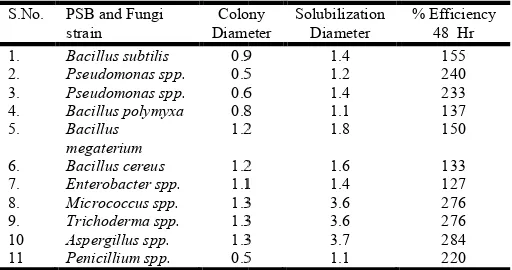
Table 1. Percentages of Efficiency of Solubilization
S.No. PSB and Fungi strain
Colony Diameter 1. Bacillus subtilis 0.9 2. Pseudomonas spp. 0.5 3. Pseudomonas spp. 0.6 4. Bacillus polymyxa 0.8 5. Bacillus
megaterium
1.2
6. Bacillus cereus 1.2 7. Enterobacter spp. 1.1 8. Micrococcus spp. 1.3 9. Trichoderma spp. 1.3 10 Aspergillus spp. 1.3 11 Penicillium spp. 0.5
Effect of phosphate solubilizing of and 3 fungi, on the growth of Soybean and
biochemical character phosphate solubilizing bacteria was haracter was compare with ‘BERGEY’S MANUAL’ and all phosphate solubilizing bacteria and fungi were identified. That is Bacillus cereus, Bacillus subtilis,Bacillus polymyxa, two Micrococcus spp., Enterobacter spp., fungi
spp. and tricoderma spp.) Out of Aspergillus spp., Penicillium spp. and ) having efficiency of Phosphatesolubilization was more as compare to otherisolated phosphate solubilizing (284, 220, 276). But Enterobacter spp. having Phosphate solubilization was less as compare to other isolated phosphate solubilizing bacteria that is (127). Efficiency of Phosphate solubilizationwas determined by plate
Pikovaskaya’s Agar Medium (Figure 2).
To Isolate Phosphate Solubilizing Bacteria and Fungi from salinity affected soil in Amravati District (Daryapur,
Colonies showing zone of clearance were observed on agar plates.
The ability to solubilize precipitated phosphate was positively exhibited by Bacillus cereus, Bacillus Bacillus subtilis, Bacillus polymyxa, two
Micrococcus spp., Enterobacter Aspergillus spp., Penicillium spp. and
All phosphate solubilizing bacteria and fungi were selected and subculture on Pikovaskaya‘s agar plates for further studies. Determination of Efficiency of Phosphate solubilization, solubilize by. Bacillus cereus, , Bacillus subtilis, Bacillus pseudomonas spp., Micrococcus spp., spp., fungi (Aspergillus spp., Penicillium tricoderma spp.)
Isolated PSB and fungi used for inoculation in pot Table 2 and 3)
mination of Efficiency of Phosphate solubilization Isolated 8 bacterial culture and 3 fungi.
% of Efficiency of PSB was calculated by using following
Percentages of Efficiency of Solubilization
Colony Diameter
Solubilization Diameter
% Efficiency 48 Hr
0.9 1.4 155
0.5 1.2 240
0.6 1.4 233
0.8 1.1 137
1.2 1.8 150
1.2 1.6 133
1.1 1.4 127
1.3 3.6 276
1.3 3.6 276
1.3 3.7 284
0.5 1.1 220
Pot experiment of Soybean plant
Following table shows the growth promotion in Soybean test plants as compared with control after 90 days.
Pot experiment of Mung bean plant
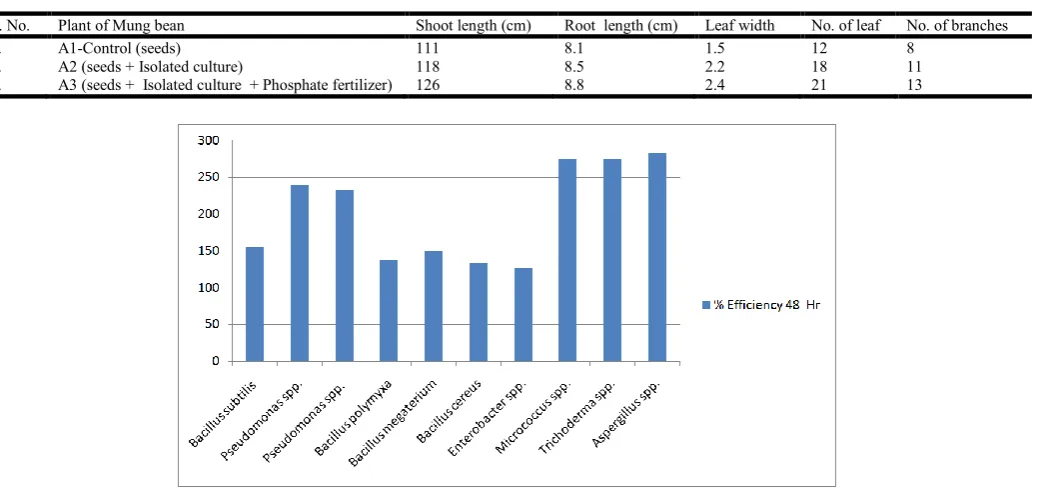
Following table shows the growth promotion in Mung bean test plants as compared with control after 90 days.
DISCUSSION
Phosphorus in soil is important for plant development, and the lack of P limits plant growth. Although chemical fertilizers are added to the soils, plants can only utilize low amounts of phosphatic fertilizers. In this case, the selection of highly efficient PSB will practically increase phosphorus in plant rhizosphere. Various PSB have been isolated from different plant roots (Sundara-Rao and Sinha, 1963; Yu et al., 2011). In the present study Out of 128 samples analyzed, total 34 isolates were isolated from salinity affected soils in Amravati district (Daryapur, Bhatkuli, and Anjangaon tahshil). Out of 34 isolates 21 PSB and 13 fungi were found, but only 3 fungi species showed significant zone of P solubilization. Among 21, only 8 PSB bacterial culture showed variation and others were repeated. A clear halo zone was formed around the colonies after 2 days of incubation on solidified Pikovaskaya`s agar plates and all phosphate solubilizing bacteria and fungi were selected and sub cultured on Pikovaskaya`s agar plates for further studies.. That is Bacillus cereus, Bacillus megaterium, Bacillus subtilis, Bacillus polymyxa, two pseudomonas spp., Micrococcus spp., Enterobacter spp., fungi (Aspergillus spp., Penicillium spp. and tricoderma spp.)Out of this isolate fungi (Aspergillus spp., Penicillium spp. and tricoderma spp.) having
efficiency of Phosphatesolubilization was more as compare to otherisolated phosphate solubilizing bacteria that is(284, 220, 276). But Enterobacter spp. having efficiency of Phosphate solubilization was less as compareto other isolated phosphate solubilizing bacteria that is (127). Efficiency of Phosphate solubilization was determined by plate assay using Pikovaskaya’s Agar Medium. (Afshan et al., 2015) Reported that salinity negatively affects biological activity by high osmotic stress which causes toxic effect on microbial growth excepting tolerant halophytic bacteria (Garcia and Hernandez, 1996). Also reported that bacterial strains with their genetic potential for increased tolerance to high salt and high temperature can enhance crop production in semi-arid and arid regions of the world. In root colonization assay, the ability of PSB inoculant to colonize the roots was assessed and the result clearly support the fact that greater the bacterial colonization in root helps the plant to thrive in saline condition. So it reveals that all isolated PSB and Fungi have capacity to colonize the roots even in saline condition and support the plants to grow.
[image:4.595.45.554.73.117.2]Diverse reports have described Bacillus spp. and other gram-positive bacteria as an important group in solubilization and mineralization of P in aquatic and terrestrial environments (Rodríguez andFraga, 1999; Nautiyal et al., 2000). Nevertheless, in our study all isolates play imp role for solubilization and mineralization of P in salinity affected soil. Several studies have reported the isolation of phosphobacteria from the rhizosphere (Gyaneshwar et al., 2002; Hill et al., 2007; Unno et al., 2005). The present study not only showed the occurrence of phosphobacteria in the rhizosphere of different crops in salinity affected soil but also check isolated strains effect on plant. The bioavailability of P depends on the solubility and structure of chemical forms, on the soil-root environment, as well as on the susceptibility to microbial
Table 2. Comparison of average growth in cm of test plant with control (24 pots)
S.No. Plant of Soybean Shoot length (cm) Root length (cm) Leaf width No. of leaf No. of branches
1. A1-Control (seeds) 66 8.9 3.2 32 10
2. A2 (seeds + Isolated culture) 68 9.4 3.2 36 12
[image:4.595.43.563.142.389.2]3. A3 (seeds + Isolated culture + Phosphate fertilizer) 74 9.9 3.3 48 15
Table 3. Comparison of average growth in cm of test plant with control (24 pots)
S. No. Plant of Mung bean Shoot length (cm) Root length (cm) Leaf width No. of leaf No. of branches
1. A1-Control (seeds) 111 8.1 1.5 12 8
2. A2 (seeds + Isolated culture) 118 8.5 2.2 18 11
3. A3 (seeds + Isolated culture + Phosphate fertilizer) 126 8.8 2.4 21 13
Figure 2. Percentages of efficiency
attack. Nowadays, great interest exists in the use of microorganisms as inoculants especially in areas with low P availability (Reyes et al., 2006). In the present Work is the preliminary step towards the use of phosphobacteria as inoculants for agro-pastoral systems in salinity affected soils for soybean plant and mung bean plant. The use of this technology can help minimize the P-fertilizer application, reduce environmental pollution, and promote sustainable agriculture in salinity affected soil.
Conclusion
It is concluded from the present study that all isolated phosphate solubilizing bacteria and fungi (Bacillus cereus, Bacillus megaterium, Bacillus subtilis,Bacillus polymyxa, two pseudomonas spp., Micrococcus spp., Enterobacter spp., fungi -Aspergillus spp., Penicillium spp. and tricoderma spp.)from salinity affected soil in Amravati district (Daryapur, Bhatkuli, and Anjangaon) are very useful for increasing solubilization of inorganic insoluble phosphate. This isolates are very important for increasing crop yield which is taken in salinity affected soil in productivity of, mung bean, soybean (Glycine Max) plant etc. Salinity is a serious environmental issue, as it limits crop growth and drastically reduces productivity. Therefore, in addition to these isolate increase crop productivity because these isolate not only solubilize phosphorous but also increases nitrogen uptake. From the study it was observed that the fungi have the more solubilizing ability of inorganic insoluble phosphate than bacteria. Hence the application of biofertilizer prepared by above mentioned fungi could be helpful to increase the crop yield in salinity affected soil by solubilizing large concentration of inorganic insoluble phosphates.
Acknowledgement
The authors are sincerely thankful to Dr. S. S. Deshmukhfor guided me, the authors are also thankful to all my friends (Roshan parise, Puran dhande, Ashish shende, Nikhilesh bajaj, Sonali gawande, subodh futane) for his moral support and suggestions in the preparation of the paper. The authors are grateful to the Editor-in-Chief for their encouragement and support.
REFERENCES
Afshan M., M. Kaleem, A. Sohail, H. Asma and I. Nasir. 2015. Isolation and characterization of plant growth-promoting rhizobacteria from wheat rhizosphere and their effect on plant growth promotion. Front. Microbiol., 1: 6.
Bargali, S. S., Kiran Shukla, Lalji Singh, Lekha Ghosh & M. L. Lakhera, 2015. Leaf litter decomposition and nutrient dynamics in four tree species of dry deciduous forest. Tropical Ecology, 56: 191-200.
Chung H., Park M., Madhaiyan M., Seshadri S., Song J., Cho H. and Sa T. 2005. Isolation and characterization of phosphate solubilizing bacteria from the rhizosphere of crop plants of Korea. Soil Biology and Biochemistry, 37: 1970–1974, doi: 10.1016/j.soilbio.2005.02.025
Collee, J.G., Miles, R.S. and Watt, B. 1996. Test for the identification of bacteria. In: Collee, J.G., Faser, A.G., Marmion, B.P., Simmons, A. (Eds). Mackie and McCartney practical medical microbiology, 14th edn. Churchill Livingstone, London. Pp. 13 -145.
Deubel A. and Merbach W. 2005. Influence of microorganisms on phosphorus bioavailability in soils. In: Buscot F, Varma
A (eds) Microorganisms in soils:roles in genesis and functions. Springer, Berlin, pp 177–191.
Dey R, Pal KK, Bhatt DM. and Chauhan SM. 2004. Growth promotion and yield enhancement of peanut (Arachis hypogaea L.) by application of plant growth-promoting rhizobacteria. Microbiol. Res., 159:371-394.
Dobbelaere S, Croonenborghs A, Thys A, Ptacek D, Okon Y. and Vanderleyden J. 2002. Effects of inoculation with wild type Azospirillum brasilense and A. irakense strains on development and nitrogen uptake of spring wheat and grain maize. Biol. Fert. Soils, 36:284-297.
Egamberdiyeva, D. 2005. Plant growth promoting
rhizobacteria isolated from a Calcisol in a semi-arid region of Uzbekistan: Biochemical characterization and effectiveness. J. Plant Nutr. Soil Sci., 168:94-99.
Garcia, C. and Hernandez, T. 1996. Influence of salinity on the biological and biochemical activity of a calciorthid soil. Plant Soil., 178: 225–263.
Garrity G.M., Winters M. and Searles D. 2001. Bergey’s Manual of SystematicBacteriology, 2nd Edn., Springer-Verlag, New York.
Gilman J.C. second ed. Oxford and IBH Publishing Company; New Delhi, India: 1957. A Manual of Soil Fungi
Gracia de Salamone IE, Hynes RK. and Nelson LM. 2001. Cytokinin production by plant growth promoting rhizobacteria and selected mutants. Can. J. Microbiol., 47:404-411.
Gulati A., Sharma N., Vyas P., Sood S., Rahi P., Pathania V., Prasad R. 2010. Organic acid production and plant growth promotion as a function of phosphate solubilization by Acinetobacter rhizosphaerae strain BIHB 723 isolated from the cold deserts of the trans Himalayas. Archive der Microbiology, 192: 975– 983, doi: 10.1007/s00203-010-0615-3.
Gutierrez CK, Matsui GY, Lincoln DE. and Lovell CR. 2009. Production of the phytohormone indole-3-acetic acid by the estuarine species of the genus Vibrio. Appl. Environ. Microbiol., 75:2253-2258.
Gyaneshwar PG, Nareshkumar G, Parekh LJ. and Poole PS. 2002. Role of soil microorganisms in improving P nutrition of plants. Plant Soil, 245:83-93.
Hamdali H, Hafidi M, Virolle MJ. and Ouhdouch, Y. 2008. Rock phosphate solubilizing Actinimycetes: Screening for plant growth promoting activities. World J. Microbiol. Biotechnol., 24:2565-2575.
Hameeda B, Harini G, Rupela OP, Wani SP. and Reddy G. 2006a. Growth promotion of maize by phosphate solubilizing bacteria isolated from composts and macrofauna. Microbiol. Res., 163:234-242
Hill JE, Kysela D. and Elimelech, M. 2007. Isolation and assessment of phytate-hydrolising bacteria from the DelMarVa Peninsula. Environ Microbiol., 9:3100–3107. Holt JG, Krieg NR, Sneath PHA, Staley JT. and Williams ST.
1994. Bergey’s Manual of Determinative Bacteriology, 9th ed. Williams and Wilkins, Baltimore, Maryland.
Jeon JS, Lee SS, Kim HY, Ahn TS. and Song HG. 2003. Plant
growth promotion in soil by some inoculated
microorganisms. J. Microbiol., 41:271-276.
Jones DL. and Oburger E 2011. Solubilization of phosphorous by soil microorganisms. In: Buneman, E., Oberson, A., Frossard, E. (eds.) Phosphorous in action, Vol.100: Biological processes in soil phosphorous cycling. Springer Berlin Heidelberg. pp. 169-198.
responses of plant roots. Plant Biotechnol. Rep., 4:179-183.
Khalimi K, Suprapta DN and Nitta Y. 2012. Effect of Pantoea agglomerans on growth promotion and yield of rice. Agric. Sci. Res. J., 2:240-249.
Lucy M, Reed E and Glick BR. 2004. Application of free living plant growth promoting rhizobacteria. Antonie van leeuwenhoek. 86:1-25.
Mittal V, Singh O, Nayyar H, Kaur J and Tewari R. 2008. Stimulatory effect of phosphate solubilizing fungal strains (Aspergillus awamori and Penicillium citrinum) on the yield of chickpea (Cicer arietinum L. cv. GPF2). Soil Biol. Biochem., 40:718-727.
Nautiyal, C.S., Bhadauria, S., Kumar, P., Lal, H., Mondal, R., and Verma, D. 2000. Stress induced phosphate solubilization in bacteria isolated from alkaline soils. FEMS Microbiol Lett, 182: 291–296
Nico, M, Ribaudo CM, Gori JI, Cantore ML. and Curá JA. 2012. Uptake of phosphate and promotion of vegetative growth in glucose-exuding rice plants (Oryza sativa) inoculated with plant growth-promoting bacteria. Applied Soil Ecology, 61,190–195.
Panhwar QA, Othman R, Zaharah AR, Sariah M, Naher UA 2011a. Contribution of phosphate-solubilizing bacteria in phosphorus bioavailability and growth enhancement of aerobic rice. Span J Agric Res., 3:810–820.
Poonguzhali, S. Poonguzhali, M. Madhaiyan, T. Sa 2008. Isolation and identification of phosphate solubilizing bacteria from chinese cabbage and their effect on growth and phosphorus utilization of plants J. Microbiol. Biotechnol., 18, pp. 773-777.
Puente ME, Bashan Y, Li CY. and Lebsky, V. K. 2004. Microbial populations and activities in the rhizoplane of rock-weathering desert plants. I. Root colonization and weathering of igneous rocks. Plant Biology, 6(5):629–642.
Reyes I, Valery A. and Valduz, Z. 2006. Phosphate-solubilizing micro-organisms isolated from rhizospheric and bulk soils of colonizer plants at an abandoned rock phosphate mine. Plant Soil, 287:69–75.
Rodríguez H. and Fraga R. 1999. Phosphate solubilizing
bacteria and their role in plant growth
promotion. Biotechnology Advances,17(4–5):319–359 Sahin F, Cakmakci R. and Kantar, F. 2004. Sugar beet and
barely yields in relation to inoculation with N2 fixing and phosphate solubilizing bacteria. Plant Soil, 265:123-129. Silini-Cherif H, Silini A, Ghoul M. and Yadav S. 2012.
Isolation and characterization of plant growth promoting traits of a rhizobacteria: Pantoea agglomerans Ima2. Pak. J. Biol. Sci., 15:267-276
SubbaRao, NS. 1982. Advances in agricultural
microbiology. India: Oxford and IBH Publications Company; pp. 229–305
Sundara-Rao WVB and Sinha MK 1963. Phosphate dissolving micro-organisms in the soil and rhizosphere. Indian J. Agric. Sci. 33:272-278. Biological and Life Science, 5:80-82.
Unno Y, Okubo K, Wasaki J, Shinano T and Osaki M. 2005. Plant growth promotion abilities and microscale bacterial dynamics in the rhizosphere of lupin analysed by phytate utilization ability. Environ Microbiol., 7:396–404.
Viruel E, Lucca ME and Sineriz, F. 2011. Plant growth promotion traits of phosphobacteria isolated from puna, Argentina. Arch. Microbiol., 193:489-496.
Wani PA, Khan MS and Zaidi A. 2007. Co-inoculation of nitrogen fixing and phosphate solubilizing bacteria to promote growth, yield and nutrient uptake in chickpea. Acta. Agron. Hung., 55:315-323.
Yu X., X. Liu, T. Zhu, G. Liu and C. Mao, 2011. Isolation and characterization of phosphate-solubilizing bacteria from walnut and their effect on growth and phosphorus mobilization. Biol. Fert. Soils, 47: 437–446.