DETERMINANTS OF INTERMEDIATION MODEL OF MICROFINANCE INSTITUTIONAL
*,1
Nicholas Gregory Okello,
1
Faculty of Business and Development Studies, Gulu University, P O Box 166, Gulu Uganda
2
Faculty of Agriculture and Environment
3
School of Statistics and Applied Economics, Makere
ARTICLE INFO ABSTRACT
The main role of financial institutions is to facilitate
borrowing units and they include commercial banks and microfinance institutions amongst the depository institutions. The study investigated the relationship between microfinance savings mobilization and loans
intermediation role of microfinance institutions in Acholi sub region as partitioned into seven districts. The basic model for the analysis of data was the Pooled Regression Mo
determinants of financial intermediation at institutional microfinance level were the savings mobilized, the capitalization funds and the willingness to borrow which were all significant at
Debt repayment which may
deployment. Whole sale capital funds to microfinance institutions should be lent on longer term duration to complement savings mobilized and equity funds to create greater impact to t
across the sub region. Savings mobilization drive should remain a central focus to increase loanable funds. The borrowers are the major driver to loan deployment, hence strict criteria for eligibility should be met at implementation stage.
Copyright © 2015 Nicholas Gregory Okello et al. This
unrestricted use, distribution, and reproduction in any medium, provided the original work is properly cited.
INTRODUCTION
This section covers the background on the intermediation role of financial institutions, the emerging importance of microfinance institutions especially in developing economies as well as the objective and hypothesis of the study upon which the determinants of institutional intermediation function can be established. The study has been pivoted at the institutional level of microfinance institutions as opposed to the macroeconomic approach to the importance of intermediation role in promoting economic growth which has attracted a number of scholars including Levine, Loayza, Beck (2000). It is aimed at generating policy implications that may impact on the microfinance institutions operational performances.
Background
The financial system in an economy is basically composed of financial institutions (FIs), financial instruments and financial markets within the domestic and global environmental factors.
*Corresponding author: Nicholas Gregory Okello,
Faculty of Business and Development Studies, Gulu University, P O Box 166, Gulu Uganda.
ISSN: 0975-833X
Article History:
Received 17th February, 2015
Received in revised form
25th March, 2015
Accepted 09th April, 2015
Published online 31st May,2015
Key words: Financial Intermediation, Microfinance Institutions, Savings Mobilization, Capitalization Funds, Loan Deployment, Pooled Regression Model, Uganda.
Citation: Nicholas Gregory Okello, Bruno Ocaya and Apollo Kasharu institutional operations in uganda”, International Journal of Current Research
RESEARCH ARTICLE
DETERMINANTS OF INTERMEDIATION MODEL OF MICROFINANCE INSTITUTIONAL
OPERATIONS IN UGANDA
Nicholas Gregory Okello,
3Bruno Ocaya and
2Apollo Kasharu
Faculty of Business and Development Studies, Gulu University, P O Box 166, Gulu Uganda
of Agriculture and Environment, Gulu University, P O Box 166, Gulu
School of Statistics and Applied Economics, Makerere University, P O Box, 7062, Kampala, Uganda
ABSTRACT
The main role of financial institutions is to facilitate the flow of funds from the saving units to the borrowing units and they include commercial banks and microfinance institutions amongst the depository institutions. The study investigated the relationship between microfinance savings mobilization and loans deployment at institutional level. A panel of secondary data was pooled on the intermediation role of microfinance institutions in Acholi sub region as partitioned into seven districts. The basic model for the analysis of data was the Pooled Regression Mo
determinants of financial intermediation at institutional microfinance level were the savings mobilized, the capitalization funds and the willingness to borrow which were all significant at
Debt repayment which may be unmatched with additional capital funds had a negative effect on loan deployment. Whole sale capital funds to microfinance institutions should be lent on longer term duration to complement savings mobilized and equity funds to create greater impact to t
across the sub region. Savings mobilization drive should remain a central focus to increase loanable funds. The borrowers are the major driver to loan deployment, hence strict criteria for eligibility should be met at implementation stage.
This is an open access article distributed under the Creative Commons Att use, distribution, and reproduction in any medium, provided the original work is properly cited.
This section covers the background on the intermediation role of financial institutions, the emerging importance of microfinance institutions especially in developing economies as well as the objective and hypothesis of the study upon which s of institutional intermediation function can be established. The study has been pivoted at the institutional level of microfinance institutions as opposed to the macroeconomic approach to the importance of intermediation role in promoting which has attracted a number of scholars . It is aimed at generating policy implications that may impact on the microfinance institutions operational performances.
The financial system in an economy is basically composed of financial institutions (FIs), financial instruments and financial markets within the domestic and global environmental factors.
ss and Development Studies, Gulu University, P O Box 166,
The main role of FIs is to facilitate the flow of funds from the saving units to the borrowing units and they include commercial banks and microfinance institutions (MFIs) amongst the depository institutions on the one hand. On the other hand, the non depository FIs includes pension funds providers, insurance companies and mutual funds institutions. The composition of these FIs depends on the state of development of the economy and henc
intermediation which is relatively low in developing economies as compared to those of developed economies with vibrant financial markets with a broad spectrum of products.
Financial intermediation is a productive activity in whi institutional unit incurs liabilities on its own account for the purpose of acquiring financial assets by engaging in financial transactions on the market (OECD, 2003). Financial intermediation is carried out by financial intermediaries as institutional units which include the MFIs.
and developing economies, the core intermediation role of financial intermediaries remain routed on facilitation of flows of funds from savings units to borrowing units through
International Journal of Current Research
Vol. 7, Issue, 05, pp.16353-16360, May, 2015
Nicholas Gregory Okello, Bruno Ocaya and Apollo Kasharu, 2015. “Determinants of intermediation model of microfinance
International Journal of Current Research, 7, (5), 16353-16360.
DETERMINANTS OF INTERMEDIATION MODEL OF MICROFINANCE INSTITUTIONAL
Apollo Kasharu
Faculty of Business and Development Studies, Gulu University, P O Box 166, Gulu Uganda
P O Box 166, Gulu Uganda
re University, P O Box, 7062, Kampala, Uganda
the flow of funds from the saving units to the borrowing units and they include commercial banks and microfinance institutions amongst the depository institutions. The study investigated the relationship between microfinance savings deployment at institutional level. A panel of secondary data was pooled on the intermediation role of microfinance institutions in Acholi sub region as partitioned into seven districts. The basic model for the analysis of data was the Pooled Regression Model. The key determinants of financial intermediation at institutional microfinance level were the savings
mobilized, the capitalization funds and the willingness to borrow which were all significant atp0.01.
be unmatched with additional capital funds had a negative effect on loan deployment. Whole sale capital funds to microfinance institutions should be lent on longer term duration to complement savings mobilized and equity funds to create greater impact to the community across the sub region. Savings mobilization drive should remain a central focus to increase loanable funds. The borrowers are the major driver to loan deployment, hence strict criteria for eligibility
is an open access article distributed under the Creative Commons Attribution License, which permits
The main role of FIs is to facilitate the flow of funds from the saving units to the borrowing units and they include commercial banks and microfinance institutions (MFIs) depository institutions on the one hand. On the other hand, the non depository FIs includes pension funds providers, insurance companies and mutual funds institutions. The composition of these FIs depends on the state of development of the economy and hence, the depth of financial intermediation which is relatively low in developing economies as compared to those of developed economies with vibrant financial markets with a broad spectrum of products.
Financial intermediation is a productive activity in which an institutional unit incurs liabilities on its own account for the purpose of acquiring financial assets by engaging in financial transactions on the market (OECD, 2003). Financial intermediation is carried out by financial intermediaries as nal units which include the MFIs. In both developed and developing economies, the core intermediation role of financial intermediaries remain routed on facilitation of flows of funds from savings units to borrowing units through
OF CURRENT RESEARCH
brokerage services and transformation of the financial claims (Greenbaum and Thakor, 2007) as cited in Andrieş and Cuza (2009). The financial products and the markets used in the two economies would, however, differ depending on the depth of financial intermediation.As pointed out in Scholtens and Wensveen (2000), financial intermediaries by their core roles, have remained more or less a passive agent who intermediates between ultimate savers and investors.
Earlier development in the intermediation theory was based on market imperfections to explain the existence of financial intermediaries and further that under the general equilibrium model of Arrow-Debreu, the intermediaries would be redundant since the savers and borrowers would be transacting directly with one another (Allen and Santomero, 1998). The modern intermediation theory to explain the existence of intermediaries has been based on three domains, namely information asymmetries, transaction costs and regulations factors.The informational asymmetries that exist in the financial market can be of an ex ante nature, generating adverse selection, they can be interim, generating moral hazard, and they can be of an ex post nature, resulting in auditing or costly state verification and enforcement (Scholtens and Wensveen, 2000). The second domain of transaction costs to explain the existence of financial intermediaries have been examined by a number of scholars which include amongst others Benston and Smith, 1976; Fama, 1980 as cited in Alin (2009). Financial intermediaries are capable of reducing transaction costs by acting as coalitions of lenders and/or borrowers to exploit economies of scale in the transaction technology. The third domain for the existence of financial intermediary is because they are heavily regulated for safety and soundness, consumer protection, credit allocation and entry into the business amongst other regulatory facets. These regulations act as rent to protect the financial intermediaries from competitors and also to stay in business.
There have been a number of development in the theory of financial intermediation which include amongst others, Allen and Santomero (1998) who asserted that the theory of financial intermediation that focused on informational asymmetries and costs reduction were too heavily focused on functions of financial institutions that are no longer crucial in many developed economies. And that modern financial intermediation theory should focus on a view of intermediaries that centers on two different roles that these firms currently play, namely;- facilitation of risk transfer and dealing with the increasingly complex maze of financial instruments and markets. Cetorelli, Mandel and Mollineaux (2012) concurred that indeed the financial intermediation has become very complexand banks’ balance sheets are now less reflective of actual intermediation activity of savings/investments functions. However, with a rejoinder that when intermediation is distilled down to its basic components, it is still the same system, with the same roles of matching supply of funding from savers with demand from borrowers. Another development to intermediation theory is the concept of value creation by financial intermediaries to explain their dominance in the financial sectorby Scholtens and Wensveen (2000). They asserted that when information asymmetries is not the motives for their commercial activities then risk and risk management
by financial intermediaries is the process that drive value creation along the value chain in their activities.
The concepts of microfinance as practiced in mainly the developing economies can be defined from many dimensions. In using the point of view of a financial system, microfinance refers to a financial institution, a financial product and a financial process of accessing financial services. As an FI, microfinance institutions (MFIs) are relatively small depository financial institutions, they accept checkable deposits in small amount and similarly give out loans or credit in small quantum for a relatively short duration of less than one year to poor individuals or microenterprises. As financial products, microfinance refers to micro savings, micro credits or microloans and micro insurance. As a process of accessing financial services, the related terms to microfinance are micro banking, microcredit, micro savings, microloan, micro lending, micro insurance, rural credit, rural lending, social enterprise, social entrepreneurship, and social ventures. Thus, according to Bank for International Settlements (2010), microfinance is the provision of financial services in limited amounts to low-income persons and small and/or informal businesses which is increasingly being offered by a variety of formal FIs, including banks and non-banks, either as their core business or part of a diversified portfolio.
According to IMF (2004), a variety of microfinance institutions has emerged over time to meet the unsatisfied demand for financial services in Africa. This has been due to lack of access to financial services from the formal financial system which is quite striking in many African countries where the poor represent the largest share of the population and yet the informal sector is an equally important part of the economy. Government in developing countries s have adopted either of
the three development models of MFIs intervention namely; - the integration model, the complementarity model and the
alternative model (Lapenu, 2010). Accordingly, the integration model has been practiced in India and Vietnam amongst other developing economies where the state is at the centre stage of developing the microfinance sector. In Indonesia, however, the private and public sectors are complementary to the state in driving innovations in the formations of MFIs. Madagascar adopted the alternative model in which MFIs are set up to fill operations. In Uganda the government has a whole ministry of microfinance. The latest and ongoing programme by the government of Uganda is the creation and support of one Savings and Credit Cooperative Organization (SACCO) per Sub County, to ensure extensive rural financial infrastructure based on the integration model. This was started in 2007 and its success and impact are ongoing (AMFIU2008; MoFPED 2008).
significantimprovements in terms of increased business incomes, improved accessto life-enhancing facilities, and empowerment of people, particularlywomen (Afrane, 2002). In Uganda, an evaluation study by Carlton, Manndorff, Obara, Reiter and Rhyne (2001), showed that participation in MFIs program results in clients expanding the amount of land they cultivate and diversifying the crops theygrow for sale and domestic consumption. Further, clients had acquired business related knowledge and savings skills among the most important positive results of participation in their microfinance programme.
This study has been motivated by the integration model of microfinance sector development where government is at the centre of ensuring extensive rural financial infrastructure in Uganda and the need at microfinance institutional level to examine the demand function of loans deployment in a developing economy.
Objective and Hypothesis
The specific objective was to establish the relationship between microfinance savings mobilization and loans deployment. The key hypothesis tested was as follows;-
;
o
H
Loans deployment does not depend on the savings, capitalization grant and willingness to borrow;
a
H
Loans deployment depend on the savings, capitalization grant and willingness to borrowMethodology
Study Site and Implementation Period
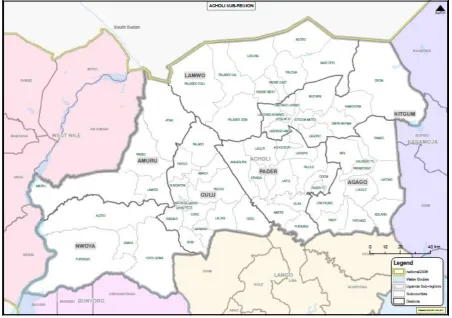
The study focused ontier four level of depository financial institutions in the Ugandan economy. It investigatedthe performance of depository MFIs which are categorized as SACCOs in the Acholi sub region which comprises the districts of Gulu, Kitgum, Amuru, Nwoya, Agago, Pader and Lamwo as shown in figure 1.The sub region was the epicentre of the civil war between the various rebels groups and the Government of Uganda from the 1980’s to 2006.
The performance of the MFIs were investigated in their core financial intermediation function. The quarterly secondary data on savings, loans and capitalization funds yielded 84 panel data points for the period between 2009 and 2011.
Study Design and Data Collection
The study adopted an historical perspective in which a panel of secondary data set was pooled on the intermediation role of MFIs/SACCOs. The secondary data were obtained at district levels from the UCSCU regional office and the field offices of SACCOs.
Study Population
[image:3.595.75.528.433.751.2]The study population comprised microfinance service providersat Tier Four level which were registered as SACCOs and were operating in the specified districts and report their operations to the SACCOs’ Regional Office located in Gulu district.
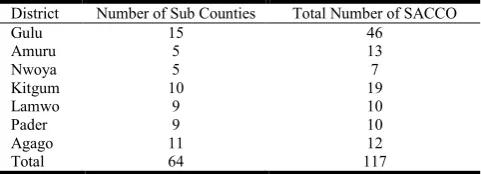
This gave a total population of 117SACCOs in 64 sub counties in the sub region of Acholi as shown in Table 1.
Table 1. Population Frame for SACCOs by District and Sub County
District Number of Sub Counties Total Number of SACCO
Gulu 15 46
Amuru 5 13
Nwoya 5 7
Kitgum 10 19
Lamwo 9 10
Pader 9 10
Agago 11 12
Total 64 117
Source: UCSCU Regional Office Gulu, 2012
Data Measurements
The study assigned Interval and Ratio measurement scales to various types of data that were collected. An Interval scale was used to classify the level of outstanding microloan, savings and beneficiaries on quarterly basis. Ratio measurement scales was used for measuring the number of individuals, amount of savings, loans and interest rates amongst others. Amounts were expressed in Uganda shillings (UGX) in either absolute or relative terms and in thousand or million as the case may be.
Quality Assurance
Data quality was ensured by collection of the secondary data by the principal investigator and comparing the entries with on-site records from the MFIs to strengthen objectivity and content validity. Overall, raw data were securely stored before and after entering them in soft forms. The soft forms were backed up in hard and electronic forms.
Panel Data Analysis Techniques
The types of data that became available for this empirical analysis were time series, cross section and panel. Time series data were obtained by collection of observations on the levels of microloans, savings, capitalization and beneficiaries from 2009 to 2011. The level of microfinance loans, savings, capitalization and beneficiaries that were classified by districts in the sub region as at a 30 December 2011 constituted the cross sectional data. The classification of these observations by districts over the period 1 January 2009 to 30 December 2011 became a panel data. Thus in this study, the cross sectional units consisted of districts which were tracked over time to obtain information on microfinance loans, savings, capitalization and beneficiaries. And the econometric analyses based on such data utilized panel data regression techniques. Panel data have space as well time dimensions and by combining time series of cross section observations, we get more informative data, more variability, less collinearity among variables, more degree of freedom and more efficiency (Gujarati, 2003). Panel data is currently one of the most active, innovative and rich methods which is rapidly emerging to incorporate several aspects of conventional pure cross section and pure time series econometric Ocaya (2011 & 1997).
Pooled Regression Model
The basic model for the analysis of data on the relationship between microfinance savings mobilization and loans deployment was the Pooled Regression Model (PRM) using EViews5 It assumed all coefficients for the intercepts and slopes were constant across time and districts and took the following generic matrix and algebraic forms;-
In matrix notation;
1 1 1 1 i1 1 1 1 2 1 2 1
2 2 2 2 i2 2 1 2 2 2
i i
(1) ( 1) ( ) where , ,
i i i i i K
T T K
n n n n iT k
y x x x
y x x
y
y i x y i x
y x
y i x
i1 2 1 i2
i ( 1) 1 2 2 1
, , 1,2,..., i
T iT iT i iT
x
i n
x x x
In algebraic notation;
/
, 1,2,..., ; 1,2,..., ; 1,2,..., .
it j jit it
y x i n t T j K
………1
where
i
number of districtst
Time periodj
Explanatory variables'
j
1, ,...
2
k
Common slopes to all explanatoryvariables
, i t
y
= set of n dependent variables for unit (district)i
and time periodt
'
jit
x
x
1it,
x
2it,...
x
Kit
Set of
explanatory variables fordistrict
i
and time periodt
Common intercept across districtsit
=the error term for districti
and time periodt
PRM is estimated under the assumptions thatthe ordinary least squares (OLS) is the best unbiased estimator (BLUE) under the assumption that;-
2
it
iid
(0,
)
for alli
and
t
, namely;-2
it it it js
[ ] 0,
[ ]
and Cov[
] 0 if
or
.
E
Var
t
s
i
j
The corresponding
F
statistics in the tests consisted of;-The general test statistic for '
p
'partitions (districts)The probability is given by the
F
statistic which is derived from the residual sum of squares (RSS) as;-
1 3
3
( ) / ( 1)
~ ( 1), ( ) ...(2)
/ ( )
where is the number of estimated coefficients from the pooled model.
RSS RSS k n
F F k n n T k
RSS n T k k
p
The number of partitions which are districts1 3
RSS
The residual sums of squares for models1-3nT
Total number of panel data setThe t-statistics and F-statistic were generated automatically as output of EViews5. These tests were carried out to establish the robustness of the relationship equation.The key hypothesis tested was as follows;-
;
o
H
Loans deployment does not depend on the savings, capitalization grant and willingness to borrow;
a
H
Loans deployment depend on the savings, capitalization grant and willingness to borrowTests for the Covariance Structure for the Pooled Data
Pooled data can take the form of either short or long panel. In short panel, the number of individual units are more than the number of time period while in long panel the number of time period is more than the number of individual units as was the case in this study. It was therefore important to consider the covariance structure for the pooled data by investigating the autocorrelation and heteroscedasticity of error structures of the individual units.
Autocorrelation
Autocorrelation occurs when sequential residual (error) terms are correlated with one another. Autocorrelation is the most common problem forecasters’ face. When the assumption of uncorrelated residuals is violated, we end up with models that have inefficient parameter estimates and upwardly-biased t-ratios and R2 values (Gujarati 2003). Autocorrelation were considered through visual detection of the scatter diagram of the residual terms obtained from the output tables of E views results and the comparison of the David Watson value with
R
2and the acceptable range of
d
1.50 2.0 2.50
(Greene, 2008).Heteroscedasticity
Heteroscedasticity, is the violation of the classical assumption that error terms have a constant variance, no autocorrelation and zero covariance of the disturbance terms, namely;-
1.
Var e
it
2; wherei
1, 2, ...,
n
;t
1, 2,...,
T
1, 2, ...,
j
K
;2.
Cov e e
it, js
0
ift
s i
,
j
3.E e
it
0
4.
ij0
There are a number of factors that causes heteroscedascticity according to Gujarati (2003) while quoting Valavanis (1959)
and these include amongst others; - error learning models for individuals, growth in discretionary income and improvement in data collection techniques. Others are the presence of outliers in a set of observation, violation of classical regression model through mis specification due to omission of important variables and skewness in the distribution of one or more variable in the model. And yet other causes include incorrect transformation and incorrect functional form of the regression model (Hendrys 1995) as cited in Gujarati (2003).
Heteroscedasticity was tested using Breusch-Pagan / Cook-Weisberg test for heteroscedasticity using STATA 11.0 under the following hypothesis;-
;
o
H
2it
Var e
The error variances are all equal (Homoscedasticity);
a
H
2it
Var e
The error variances are a multiplicative function of one or more variables (Heteroscedasticity)RESULTS
Relationship between Micro Loans, Savings, Capitalization Funds and Beneficiaries
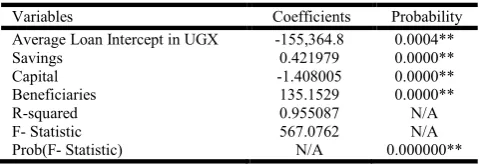
[image:5.595.313.553.473.555.2]The Relationship between Micro Loans, Savings, and CapitalizationFunds is based on the core financial intermediation role of depository financial institutions. Table 2is based on the PRM under the assumptions that all coefficients for the intercepts and slopes were constant across time and districts.
Table 2. Pooled Regression Model of Determinants of Micro Loans Deployment
Variables Coefficients Probability
Average Loan Intercept in UGX -155,364.8 0.0004**
Savings 0.421979 0.0000**
Capital -1.408005 0.0000**
Beneficiaries 135.1529 0.0000**
R-squared 0.955087 N/A
F- Statistic 567.0762 N/A
Prob(F- Statistic) N/A 0.000000**
Key:** p<0.01
The result shows that across the districts in Acholi sub region, there is a statistically significant relationship in the micro loans deployed with the savings mobilized and capitalization grants in the context of existing MFIs and beneficiaries atp<0.01.
The relationship is represented by the estimation equation and substituted coefficients as follows;
-LNS 155,364 0.42SVS 1.41CAP 135BEN ... (3)
Where; -
LNS
Levels of loans deployed in Acholi sub regionCAP
Levels of Capitalization funds mobilized in Acholi sub regionBEN
Number of Microfinance clients in Acholi sub region Tests for all the coefficients of the variables including the (F-statistic) were significant at
p0.00
as shown on Table 2.The David Watson statistic shows that
d
R
2where44
.
1
d
andR
2
96%
.The null sub hypothesis was rejected, leading to conclusions that the loan deployed depended on savings, capitalization grant, borrowers and the MFIs respectively as expected.As expected, the results suggested, ceteris paribus, that as the level of savings goes up by UGX 1.00 on average, the level of loans would increase by UGX 420and as the number of beneficiary goes up 1 member, on average, the loans requested would go up by UGX 135,000. However, unexpectedly, as the level of capital goes up by UGX 1.00 on average, the level of loan would decrease by UGX 1,410. The capitalization fund is largely made up debt capital from wholesale fund providers which have to be paid back and a small proportion from share capital from clients of MFIs. Donations as a component of capital fund to MFIs is largely uncertain and sporadic.
Covariance Structure for the Pooled Data
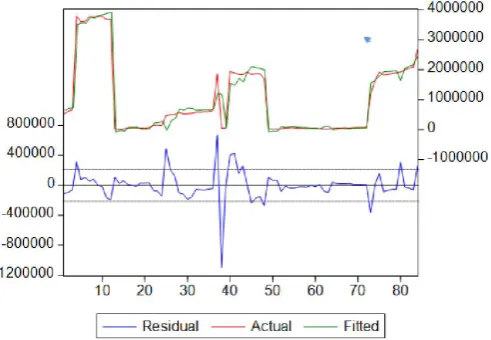
[image:6.595.39.285.519.689.2]The covariance structure for the pooled data looked at the autocorrelation and heteroscedasticity of error structures of the individual units. Both autocorrelation and heteroscedasticity were first considered through visual detection of the scatter diagram of the residual terms obtained from the output tables of E-views results. The scatter plot of the residual shows an “envelope” of even width of the error terms falling within the acceptable range of the fitted observations. As shown in figure 2, the plot of residuals along the horizontal X-axis show that there is no discernable pattern for the set of 84 observations.
Figure 2. Loan Deployment Residual Plots Against Actual and Fitted
Notes to the Figure 3
1. Lower plot represents the residuals
2. Upper plot represents the actual and fitted which is basically
merged except around the 40th observations/ data points
Non autocorrelation was further confirmed from the output table of E-views where the David Watson value
d
2.1
was within the acceptable range where the ideal would be of2.0
d
(Gujarati, 2003).Heteroscedasticity was further tested using Breusch-Pagan / Cook-Weisberg test for heteroscedasticity using STATA 11.0.
From Prob. of
X
2
2
0.1741>0.05, the test is not significant at 95% confidence level, and therefore, we asserted that there is no heteroscedasticity. Moreoverthe calculatedvalue of
X
2
1
1.85< 3.84 the value from theX
2
1
table, hence not significant. Therefore the ordinary least square assumptions were not violated due to absence of autocorrelation and heteroscedasticity.DISCUSSION
Relationship between Micro Loans, Savings, Capitalization Funds and Beneficiaries
At institutional level, the determinants to the micro loan deployment are the levels of micro savings mobilized, capitalization fundand the number of clients willing to borrow as expected. This is a core financial intermediation role which is relevant to developing economies which are striving to achieve breadth and depth of the financial sector in their economies Alin (2009). The relevance of the findings is in contrast with Allen and Santomero (1998) who argued that advance in the intermediation theory, especially for developed economies should analyse financial systems in terms of a functional perspectiverather than an institutional perspective. Thefunctional perspective is one based on the servicesprovided by the financial system, such as providing a way to transfer economicresources through time while the institutional perspective is one wherethe central focus is on the activities of existing institutions such as banks andinsurance companies. However, the pooled regression model derived in equation 3 had to be interpreted with caution since only the coefficients of savings and borrowers are positively related to the loans deployed. The coefficient for capitalization funds was unexpectedly negative which requires further scrutiny into the mix between debt capital and equity capital of microfinance institutions. Repayment of wholesale capital funds to the lenders which is unmatched with additional loan and low equity fund level could have had negative effect of reducing the volume of loans deployed to the community amongst other factors.
and sound SACCOs to ensure that financial services reach the population across the country (UCSCU, 2012).
AMFIU is yet another umbrella organization for the MFIS/SACCOs with the mandate to develop and operationalize a Performance Monitoring System for MFIs that will set standards and increase professionalism in the industry. AMFIU has the mandate to strengthen the capacity of MFIs to deliver appropriate and sustainable microfinance services to the economically active poor through co-ordination and organization of lateral learning workshops, thematic debates, exchange visits and linkage with other organizations (AMFIU, 2012). The need to mobilize savings for onwards lending is core to financial institutions and global in context. For instance, according to the MIX Market, the value of savings deposits in Asia in 2007 was just over USD 7 billion versus a USD 10.2 billion gross loan portfolio. Therefore, despite growth in countries such as Nepal and Pakistan, the challenge of responding to client need in regards to saving is far from being met (Latortue and Linthorst, 2011).
Another covariate is the capital required by MFIs/SACCOs for their operations including loan deployment. These are in the forms of equity capital, debt capital and grants from donors. Increase in equity capital would require the mandate of the Annual General Meeting to increase share capital by members who are predominantly poor in the communities across the sub region (UNDP, 2007). Retained earnings and reserves could yet be another source of equity capital to MFIs/SACCOs whenever they make profits though this has been minimal in the Uganda market (MFSL, 2012). Debt capital to MFIs/SACCOs is being provided by Microfinance Support Centre Ltd, a Government owned institution which is mandated to facilitate access to affordable, sustainable and convenient financial and business development services to active and productive Ugandans (MFSL 2012). Amongst other international agencies that provide funding to MFIs/SACCOs in Uganda is Oikocredit which is a worldwide financial cooperative that promotes global justice by empowering disadvantaged people with credit (Oikocredit, 2011). The findings showed an average ratio of loan to loanable funds of 96% across the districts and in Gulu district of 186%. This is an indication of gaps in the mobilization of savings to fund advances deployment. These gaps are in line with CGAP (2009), who noted that MFIs in Eastern Europe and Central Asia (ECA) were predominately comprised of NGOs, and these institutions were prohibited from raising capital through savings and therefore source their funds from donations and retained earnings.
Covariance Structure for the Pooled Data
The ordinary least square assumptions were not violated due to absence of autocorrelation and heteroscedasticity which were tested using visual detection of the scatter diagram of the residual terms, comparison of the David Watson value with
R
2in case of autocorrelation and the Breusch-Pagan / Cook-Weisberg test in case of heteroscedascticity. However, there are other teststhat could still be carried out using higher versions of E views and Stata or any other software that may be appropriate before employing the equation to estimate the level of microloan deployment. This would be to ensure estimators
that are consistent, unbiased and robust amongst others (Gujarati, 2003). Further, this study used secondary data from a sub region in Uganda which was recovering from a post conflict situation and the circumstances may not be applicable in other situation and different location as in Simon and Goss (2013).
Conclusion
The study reaffirmed that the micro loan deployment in Acholi sub region depended on micro savings mobilized, capitalization funds and the number of clients willing to borrow as expected.Debt repayment which may be unmatched with a build-up of other capital funds creates a negative effect on the model. Wholesale debt funds to enhance the operations of SACCOs across the districts with shorter duration could have a negative effect on the volume of loan deployed.
Recommendation
Lenders of whole sale capital funds to MFIs/SACCOs which are categorized as debt should be encouraged to lend on longer term duration to complement the savings mobilized and equity funds so as to create greater loan deployment impact to the community across the sub region. Future research should separate debt capital from equity capital to establish the effects of each component on loan deployment. Savings mobilization drive should remain a central focus to increase loan able funds. The borrowers are the major driver to loan deployment, hence criteria for eligibility should be set in a credit policy since their ability to pay back the loan remain crucial to avoid a stockpile of bad debts and subsequent erosion of the capital base.
Acknowledgements
I would like to acknowledge and thank Gulu University for the award of Post Graduate research grant and BSU Project for the award of the Small Collaborative research grant.
REFERENCES
Afrane, W. 2002. Impact Assessment of Microfinance Interventions in Ghana and South Africa; A Synthesis of Major Impacts and Lessons. Journal of Microfinance, 40 Volume 4 Number 1, Spring 2002
Alin Marius ANDRIEŞ, Theories Regarding Financial Intermediation and Financial Intermediaries – A Survey; The Annals of The "Ştefan cel Mare" University of Suceava. Fascicle of The Faculty of Economics and Public Administration, Vol. 9, No. 2(10), 2009
Allen, F, and Santomero A.M. The theory of financial Intermediation, Journal of Banking and Finance, 21 (1998) 1461-1485
AMFIU 2008. Uganda Microfinance Industry Assessment Report; August 2008
Andy Carlton, Hannes Manndorff, Andrew Obara, Walter Reiter, Elisabeth Rhyne Microfinance in Uganda; Austrian Ministry of Foreign Affairs, Department for Development Cooperation (2001)
Supervision; Bank for International Settlements, Communications, CH-4002 Basel, Switzerland. Pp 9.
Benston G.W and C.W. Smith 1976. A transaction cost approach to the theory of Financial intermediation, The Journal of Finance, Vol. X XXI (1), pp. 215-231
Bert Scholtens and Dick van Wensveen; A critique on the theory of financial Intermediation, Journal of Banking &
Finance, 24 (2000) 1243-1251www.elsevier.com/locate/
econbase
CGAP 2007. Beyond Good Intentions: Measuring the Social Performance of Microfinance Institutions Consultative Group To Assist The Poor
Fama E.F. 1980. Fama Banking in the theory of finance, Journal of Monetary Economics, 6 (1), pp. 39-57
Greenbaum, S. and Thakor, A. “Contemporary Financial Intermediation”, 2nd ed. Elsevier Academic Press,2007, p. 43
Gujarati, D.N. 2003. Basic Econometrics, (4th Ed.) New York; McGraw–Hill
Hendry F. David, Dynamic Econometrics, Oxford University Press, 1995, P.45
International Monetary Fund (IMF), 2004. IMF Working Paper WP/04/174; African Department, Microfinance in Africa: Experience and Lessons from Selected African Countries Lapenu, C. The Role of the State in Promoting Microfinance
Institutions; Discussion Paper
Manalo S. 2003. Microfinance Institutions’ Response in Conflict Environments, Africa Region Working Paper Series No. 54; June 2003; http://www.worldbank.org/afr/ wps/wp54.pd, Accessed 4 March 2014
Marlyn K., Simon and Jim Goes 2013. Dissertation and Scholarly Research; Recipes for Success. Seattle, WA; Dissertation Success. www.dissertationrecipes.com
Mawa, B. 2008. Impact of Microfinance: Towards Achieving Poverty Alleviation? Pakistan Journal of Social Sciences, 2008, 5: 876-882.
MFSL 2012. Annual Report 2012http://msc.co.ug/index.php/ about-msc/vision-and-mission, Accessed 14 February 2014 MoFPED, Background the Budget, 2008-9 Financial Year. Morduch, J. and Haley, B. 2002. Analysis of the Effects of
Microfinance on Poverty Reduction; NYU Wagner, 2002, Working Paper No. 1014
Morduch, J. and Haley, B. 2002. Analysis of the Effects of Microfinance on Poverty Reduction; NYU Wagner, 2002, Working Paper No. 1014
Ocaya, B 1997. Econometric Studies of Economic Performance, Debt and Structural Adjustment Programs in Ocaya, B. 2011. Simplified Practical Econometrics, 1st Edition,
Makerere University Departmental of Statistical Methods and Actuarial Science
OECD 2003, OECD glossary of statistical termsstats. oecd.org/.../det...(http://esa.un.org/unsd/sna1993/introductio n.asp) Retrieved 9 March 2015
Oikocredit 2011. Oikocredit Releases 2011 Social Performance Report of500 Microfinance Institutions; http://finance.
yahoo.com/news/oikocredit-releases-2011-Social-Performance-090000402.html
Sub Sahara Africa, PhD Dissertation, Northwestern University, Evanston, Illinois, USA
UCSCU, 2012. Uganda Cooperative Savings and Credit Union, Full Strategic Plan, 2012/13-2016/17
UNDP, 2005. Uganda Human Development Report UNDP, 2007. Uganda Human Development Report
Valavanis Stefan, Econometrics, Mcgraw Hill, New York, 1959 p.48.