A Batch Arrival Queue System with Coxian-2 Server
Vacations and Admissibility Restricted
Abdolrahim Badamchi Zadeh
Department of Statistics, Allameh Tabatabaii University, Tehran, Iran. Email: [email protected]
Received October 22nd,2011; revised December 18th, 2011; accepted January 4th, 2012
ABSTRACT
The M/G/1 classic queueing system were extended by many authors in last two decades. The systems with server’s va-cation are important models that extend the M/G/1 queueing system. Also another conditions such as admissibility re-stricted may occure in systems. From this motivation, in this system I consider a single server queue with batch arrival Poisson input. There is a restricted admissibility of arriving batches in which not all batches are allowed to join the sys-tem at all times. At each service completion epoch, the server may apt to take a vacation with probability θor else with probability 1 −θ may continue to be available in the system for the next service. The vacation period of the server has two heterogenous phases. Phase one is compulsory, and phase two follows the phase one vacation in such a way that the server may take phase two with probability p or may return back to the system with probability 1 − p. The vacation times are assumed to be general. All stochastic processes involved in this system (service and vacation times) are inde-pendent of each other. We derive the PGF’s of the system and by using them the informance measures are obtained. Some numerical approaches are examined the validity of results.
Keywords:Mx/G/1 Queue; Restricted Admissibility Policy; Bernoulli Vacation; Optional Vacation; Mean Queue Size;
Mean Response Time
1. Introduction
The concept of vacation in the M/G/1 queueing system were studied by Keilson and Servi in [1]. They intro-duced the concept of modified service time which has a main rule in the systems with general service and vaca-tion times.
In many examples such as production system, bank services, computer and communication networks; the system have vacation. For overhauling or maintenance the system the server may go to vacation.
For the systems with batch arrival the vacation time were analyzed by Baba in [2], he derived the queue size distribution, waiting time distribution and busy period distribution of Mx/G/1 queue with vacation times using
the well known supplementary variable technique. In many systems with batch arrival there is a restric-tion such that not all batches are allowed to join the sys-tem at all time. This policy is named restricted admissi-bility. For the first time Madan and Abu-Dayyeh [3,4] proposed an Mx/G/1 queueing system with restricted
ad-missibilty of arriving batches and Bernoulli schedule server vacation. Alnowibet and Tadj [5], also Madan and Choudhury [6] and Choudhury [7] work on this concepts. Recently author in [8] studied a batch arrival queueing
system with two phases of heterogenous service with optional second service and restricted admissibility with single vacation policy.
In fact this paper is a generalization of [9] in which the authors inspected a M/G/1 system with coxian-2 server vacation.
This paper adresses issue of model building of manu-facturing systems of job-shop type, where the server takes vacations after the end of each busy period. This vacation models can be utilized as a post processing time after clearing the jobs in the system. To be more realistic, we further assume that the arrivals occure in batches of random size instead of single units and it covers many practical situations. For example in manufacturing sys-tems of job-shop type, each job requires to manufacture more than one unit; in digital communication systems, messages which are transmitted could consist of a ran-dom number of packets. These manufacturing systems can be modeled by Mx/G/1 queue with a single vacation
policy and this extends the results of farmer works, espe-cially Doshi [10]. Here we consider as soon as the system becomes empty, the server leaves for vacatins of random length V1 and V2 (vacation periods). Upon termination of
begins to serve those customers that have arriving during that vacation (busy period), exhaustively i.e. once the service is started it goes on ontil there is no one in the queue. However, if the server does not find any customer in the system after returning from that vacation, he stays in the system waiting for the first one to arrive (dormant period). Thus, in our system, a vacation period, a dor-mant period and a busy period constitute a cycle. More-over, the system remains idle during a vacation period and a dormant period and these two period together con-stitue an idle period.
In Section 2 we deal with the mathematical model and definitions. Steady state conditions and generating func-tions are discussed in Section 3. Mean queue size and mean response time are computed respectively in Sec-tions 4 and 5. Finally in Section 6 some special cases and numerical results obtained.
2. Mathematical Model and Definitions
Consider an infinite capacity queueing facility where customers arrive at a service facility according to a compound Poisson process. According to natural as-sumption, an idle priod begins when the queue drops below level zero and a busy period as soon as the queue accumulates the same number one. However, after each service completion the server takes vacations. The deci-sions about taking a vacation after each service comple-tion or vacacomple-tions complecomple-tion are independent. Also, the vacations are iid random variables whose length is inde-pendent of the length of the service times. The service times are iid random variables independent of the input process. In order to fully describe the model, we use the following notations and definitions:
1) New customers arrive in batches according to a compound Poisson process with rate λ. Let Xk denote the
number of customers belonging to the kth arrival batch, where Xk, k = 1, 2, 3, ··· are with a common distribution
Pr Xk n a nn, 1,2,3,
and X(z) denotes the probability generating function of X. 2) The server provides one phases service to each cus-tomer. The service discipline is assumed to be first come first served (FCFS). Further, the service time is random variable B, with distribution function , Laplace transform and finite moments
for l≥ 1 .B x
l E B
*
B x
3) After completion of any customer’s service, the server may take a vacation with probability θ or may continue to be in the system with probability 1 – θ.
We assume that the vacation time has two phases with phase one is compulsory. However, after phase 1 vaca-tion, the server takes phase 2 vacation with probability p or may return back to the system with probability 1 – p. The vacation times are random variables Vi for i = 1, 2,
follows a general law of probability with distribution functionV xi
, Laplase transform and finitemoments i
V s
k iE V for k≥ 1.
4) There is an admissibility restricted policy for batches in which not all batches are allowed to join the system at all times. Let α(0 ≤α≤ 1) and β(0 ≤β≤ 1) be the probability that an arriving batches will allowed to join the sysytem during the period of server’s busy and vacation times respectively.
5) The random variables B, V1 and V2 are independent. Definition 2.1The modified service time or the time
required by a customer to complete the service cycle is given by
with probability with probability 1c c
B V B
B
(1)
where
1 2 1
with probability with probability 1
c
V V p
V
V p
(2)then the LST *( ) of is given by
c
B s Bc
* * * 1 *
c c
B s B s V s B s (3)
and
c
E B E B E Vc (4) also
2 2 2
c c
E B E B E B E V E V2
c (5)
where
c
1
E V E V pE V2
(6)also
2 2
1 2 1 2
c
E V E V pE V E V pE V2
2 (7)
Further we assume B
0 1, B
1 and B x
is continuous at x0, so that
1dB x x
B x
(8)
is the hazard rate function of B.
Also for i = 1, 2 we assume Vi
0 1, Vi
1and V xi
are continuous at . The hazard ratefunctions of ’s are
0 x
i
V
1i i
i
dV x x
V x
(9)
Definition 2.2The elapsed time of service at time “t”
is denoted by B t0
. For i = 1, 2, also V t0
denotethe elapsed time of vacation time at time “t”, and N tQ
0 if the server is idle at time , 1 if the server is busy at time ,
2 if the server is on first phase vacation at time , 3 if the server is on second phase vacation at time .
t t Y t t t (10)
Then we have a bivariate Markov process
N t L tQ
,
where L t
0 if Y t
0; L t
B t
if Y t
1;
0 1
L t V t if Y t
2 and
0
if2
L t V t Y t
3. Now for i = 1, 2 the following probabilities defined as
0
0
, , , ;
i n Q i i
V x t Prob N t n L t V t x V t x dx x 0,n0 (11)
,
,
0
; 0
n Q
P x t Prob N t n L t B t x B t x dx x 0,n0
(12)
and
, , , 1 d d 1 0, 0i n i n n i n k i n k
k
V x x V x
x
V x a V x
n x
0 Q 0, 0
R t Prob N t L t (13)
, (23)
With assumption that steady state exist, we let
0 lim 0
t R R t (14) and
lim
, 0, 0n n
t
P x dx P x t dx x n
(15)
,0 ,0 ,0
d 1
dxVi x i x V i x Vi x
x x
x
(24)
, lim , , 1, 2 0, 0
i n t i n
V x dx V x t dx i x n
(16)
also
0 1 1
0 1 1,0 0 2 2,0 0 1 d 1 d d
R x P
p x V x
x V x x
(25) Now for i = 1, 2 the PGF of this probabilities arede-fined as follow:
0
, n 1
n n
P x z z P x z x
, 0 (17)
0
0, n 0 1
n n
P z z P z
(18)At x0 for n0 the boundary conditions are Also
,
0
, n 1
i i n
n
V x z z V x z x
, 0i n
(19)
0 1 0 1 1, 0 2 2, 0 0 1 1 d dn n n
n
n
P a R x P
p x V x x
x V x x
d x x , x x n x 1 (26)
,
00, n 0
i
n
V z z V
(20)3. Steady-State Probability Generating
Function
1,n 0 0 n1 d
V
x P (27)From kolmogorov forward equations, for i = 1, 2 the
steady-state conditions can be written as follow also
2,n 0 ) 0 1 1, d
V p x V x
(28)
1 d d 1 0, 0 n n nn k n
k
P x x P x
x
P x a P x
n x
k (21) Finally the normalizing condition is
2
0 0 ,
0 1 0
d d
n o i n
n i n
R P x x V x x
(29)Lemma 3.1 The solution of first order Equation (21) is
0 0
d
1
and for i = 1, 2 the solution of first order Equation (23) is
1 , 0, 1 X z x
i i i
V x z V z V x e x0
x
x
(31)
Proposition 3.2 If for i = 1, 2
1
*
0
1 X z xd
B X z e B
(32)
1
*
0
1 X z xd
i i
V X z e V
(33)are the z-transforms of B and Vi respectively, then
*
1
1) 0, 1 1
1 P z P z B X z
X z (34)
*
1
2) 0, 1 1
1
i i i
V z V z V X z
X z (35)
0 * * 1 1 * 2 23) 0, 1
1 0, 1
(1 ) 0, 1
0, 1
zP z z R X z
P z B X z
p zV z V X z
zV z V X z
(36)
*
14) V 0,z P 0,z B 1 X z
z
(37)
*
2 1 1
5) V 0,z pV 0,z V 1X z (38)
Proof: 1) Since
0
, d P z P x z x
then by integeration from (30) by part the result obtained. 2) Since for i = 1, 2
0
, d
i i
V z V x z x
then from (31) similarly we have 2).
3) First multiply (26) in and summation from n = 1 to , then using (25) we obtain result.
n
z
4) By multiplying (27) in and summation from n = 0 to the result obtained .
n
z
5) By using the same technique on (28), we have 5). In the rest of this section for simplifying we omit
1 X z
from B* and
1X z
from*
Vi .
Corollary 3.3 1) By using (37), (38) in (36) we have
0
* * * * * *
1 1
1 0,
1 1
R z X z
P z
z B B V p B V V
2) By using (39) in (37) we have
0
*
1 * * * * * *
1 1
1 0,
1 1
R X z B
V z
z B B V p B V V
2 (40)
3) By using (41) in (38) we have
* *
0 1
2 * * * * * *
1 1
1 0,
1 1
p R X z B V
V z
z B B V p B V V
2 (41)
Corollary 3.4 1) By substituting (39) in (34) we have
0
*
* * * * * *
1 1
1
1 1
R z B P z
z B B V p B V V
2 (42)
and for i = 1, 2 substituting (40) and (41) in (35) result
* *
0 1
1 * * * * * *
1 1
1
1 1
R B V V z
z B B V p B V V
2
(43)
* * *
0 1 2
2 * * * * * *
1 1
1
1 1
p R B V V V z
z B B V p B V V
2 (44)
For calculating , by using the normalizing condi-tion (29) we have 0
R
0 1 1 1 2 1
R P V V 1 (45)
0 is the steady-state probability that the server is idle
but available in the system , hence if R
< 1
be the
stability condition under which the steady state solution exist, then R0
1
and by using (42), (43), (44) with L’Hopital we have
0
1 2
1 1
E X E B P R
E X E B E V p E V
and
1
1 0
1 2
1 1
E X E V V R
E X E B E V p E V
1
2 0
1 2
1 1
p E X E V V R
E X E B E V p E V
By substituting this values in (45) we have R0 1 , where
1
2E X E B E V p E V
(46)
Now the PGF of the queue size at a random epoch is
1 2 * * * * * 1 10 * * * * * *
1 1
1 1 1
1 1
Q
P z P z V z V z
z B B V p B V V R
z B B V p B V V
* 2 2 (47) 2 (39)
0
* * * * * *
1 1
0 * * * * * *
1 1 2
1 1 1
1 1
S
P z R zP z
z B B V p B V V R
z B B V p B V V
2
2
(48)
This is familiar with famous formula Pollaczek-Khin- chin in M/G/1 queue for PGF of system’s queue size.
4. Mean Queue Size
Let L be the mean number of customers in the system, then we have
Remark 3.5 In this system we set
* *
*
* *
*
1 1
1 1
G z B B V p B V V
1
d d
S
z P z L
z
(49) then
0
1
S
z G z
P z R
z G z
Proposition 4.1 From (49) and using (48) we have
2 2 2 2 2
2 2 1
c
E X E B E B E V E V
L
c
(50)
where E V
c and E V
c2
are in (6) and (7).
0 2
1 1 1 1
2 1
f g g f
L R
g
(51) Proof: P zS
has the form
0
f z R
g z , where
1
f z z G z
and
g z z G z
Since , then by using
L’Hopital’s rule, we have 1
1
limz f z limz g z 0where R0 1 and is in (46).
Also
1
1f G 1,
1 1
1 1g G
and by using (6) and (7)
1 2f
2 2
2
2
21 = 1 = 2 c c
g G E X E B E B E V E V
hence by substitute this value in (51) the result obtain.
R X
L W
5. Mean Response Time
where following the admissibility assumption of our model, X the actual arrival rate of batches is given by
The response time WR is the time interval from the
ar-rival time of a test customer to the time when it leaves the system after service completion i.e., waiting time plus service time.
X
(proportion of non-vacation time) + (proportion of vacation time). But the proportion of vacation time is By using Little’s formula, this measure of system is
1 1 2 1 1 2 c
V V E X E V pE V E X E V
and hence the proportion of non-vacation time is . Consequently
1E X E Vc
2
X E X E Vc
(52)
6. Special Cases and Numerical Results
Analyzing a queueing system via actual cases are very important and an useful way for confirm the models. In this section we chose known distributions for service time and vacation times, so with this and by sum nu-merical approches the validity of system examained.
Also this approch explain that our model can represent some practical problems reasonably well.
Case 1: Let the distribution of service time is -Er-
lang as follow
1 0, 11 !
x x e
dB x dx x
hence
*
1 B C z
C z
so E B
1 and
22
1 E B
. Also we assume the
distribution of vacation times respectively are
1 0, 11 !
x i i i i i i
i
i
x e
dV x dx x
i
hence
*
1
i i i
i i
i i
V C z
C z
so
i 1i
E V
and
22
1
i i
i i
E V
. If we chose
geo-metric distribution for batch size, i.e.
1
n1 na a a ,
, then
0 a 1
1 a E X
a
.
Now for numerical result we assume the following values for parametrs such that the steady state condition (< 1) obtained.
In this case using above values and (46), if 2 then with respect and hence steady state condi-tion is 0.2 0.63 1, so < 1.26. By using (50)
0.15 0.292 0.2 0.63
0.8 0.63
L
Table 1 shows some values of L with respect θ, in
which L increases with respect θwith a mild gradient. Also Figure 1 show the mild curve of L with respect θ.
Now we analyze L against . Using the values of
Table 2, if 0.5
1
then steady state condition is 0.257
or 3.8. Also L with respect is
2
0.075 0.257
1 0.257
L
Figure 2 shows L agains . Near 4 the system
blowing up. Untile 2 customers the system is stable.
Case 2: In this case we assume the distribution of
ser-vice time and for i = 1, 2 vacation times are exponential as follow
22
1 2
, ,
x
dB x e dx E B E B
22
1 2
, ,
x i
i i i i
i i
dV x e dx E V E V
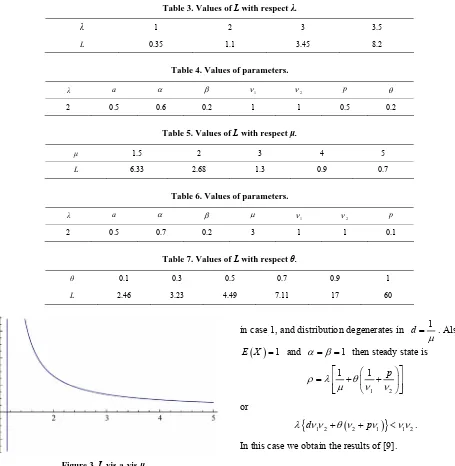
With geometric distribution for batch size and follow-ing values for parameters in Table 4 the steady state con-
dition is 1 0.12 1
or 1.13. Also
2 2
1 1.44 0.72 0.064
0.12
0.88
L
and the graph of model is in Figure 3. According to this
curve, L decresses with respet , and after 2 the system is stable.
Figure 1. L vis-a-vis θ.
Figure 2. L vis-a-vis λ. Table 1. Values of L with respect θ.
θ 0.1 0.3 0.5 0.7 0.9 1
L 0.5 0.77 1.12 1.62 2.53 3.43
Table 2. Values of parameters.
a 1 1 2 2 p
Table 3. Values of L with respect λ.
λ 1 2 3 3.5
L 0.35 1.1 3.45 8.2
Table 4. Values of parameters.
λ a 1 2 p
2 0.5 0.6 0.2 1 1 0.5 0.2
Table 5. Values of L with respect μ.
μ 1.5 2 3 4 5
L 6.33 2.68 1.3 0.9 0.7
Table 6. Values of parameters.
λ a 1 2 p
2 0.5 0.7 0.2 3 1 1 0.1
Table 7. Values of L with respect θ.
θ 0.1 0.3 0.5 0.7 0.9 1
L 2.46 3.23 4.49 7.11 17 60
Figure 3. L vis-a-vis μ.
Also Table 5 shows some values of L against μ. When μincresses from 1.5 to 2, then system changed in stable form.
In this case we assume θis unknown. With the values in
Table 6 the steady state condition is 0.46 0.52 1
or 1.02. Also
0.928 0.256 0.46 0.52
0.54 0.52
L
Table 7 shows some values of L against θ. After
0.5
, the system blowing up.
Case 3: In this case we assume the service time has
deterministic distribution. Hence it is sufficient
in case 1, and distribution degenerates in d 1
. Also if
1E X and 1 then steady state is
1 2
1 1 p
or
d 1 2 2 p1
1 2 .In this case we obtain the results of [9].
7. Concluding Remarks
REFERENCES
[1] J. Keilson and L. D. Servi, “Dynamic of the M/G/1 Vaca-tion Model,” Operations Research, Vol. 35, No. 4, 1987, pp. 575-582.
[2] Y. Baba, “On the Mx/G/1 Queue with Vacation Time,” Operations Research Letters, Vol. 5, No. 2, 1986, pp. 93- 98. doi:10.1016/0167-6377(86)90110-0
[3] K. C. Madan and W. Abu-Dayyeh, “Restricted Admissi-bility of Batches into an Mx/G/1 Type Bulk Queue with Modified Bernoulli Schedule Server Vacations,” ESSAIMP: Probability and Statistics, Vol. 6, No. 2, 2002, pp 113- 125. doi:10.105/ps:2002006
[4] K. C. Madan and W. Abu-Dayyeh, “Steady State Analy-sis of a Single Server Bulk Queue with General Vacation Time and Restricted Admissibility of Arriving Batches,” Revista Investigation Operational, Vol. 24, No. 2, 2003, pp. 113-123.
[5] K. Alnowibet and L. Tadj, “A Quarum Queueing System with Bernoulli Vacation Schedule and Restricted Admis-sibility,” Advanced Modeling and Optimization, Vol. 9, No.1, 2007, pp.171-180.
[6] K. C. Madan and G. Choudhury, “An Mx/G/1 Queue with a Bernoulli Vacation Schedule under Restricted Admissi-bility Policy,” Sankhya, Vol. 66, No. 1, 2004, pp 175-193. [7] G. Choudhury, “A Note on the Mx/G/1 Queue with a
Ran-dom Set-Up Time under a Restricted Admissibility Policy with a Bernoulli Vacation Schedule,” Statistical Method-ology, Vol. 5, No. 1, 2008, pp 21-29.
doi:10.1016/j.stamet.2007.03.002
[8] A. Badamchi Zadeh, “An Mx/(G
1, G2)/1/G(BS)Vs with Optional Second Services and Admissibility Restricted,” International journal of Information and Management Sciences, Vol. 20, No. 2009, pp. 305-316.
[9] K. C. Madan and A.-J. Jehad, “Steady State Analysis of an M/D/1 Queue with Coxian-2 Server Vacations and a Single Vacation Policy,” Information and Management Sciences, Vol. 13, No. 4, 2002, pp 69-81.
[10] B. T. Doshi, “Queueing System with Vacation—A Sur-vey,” Queueing Systems, Vol. 1, No. 1, 1986, pp 29-66.
doi:10.1007/BF01149327