Dependency and Control in Negotiation
Frederik G. S. Vos
University of Twente, The Netherlands
Type of Paper:
Master’s Thesis
First Supervisor: Dr. Huadong Yang
Second Supervisor: Haizheng Wu
Abstract
Power and especially powerlessness are present in almost all contexts, from parent-child dynamics, over work environments to international disputes. In relation to powerlessness, this research assumed that its element “control” is related to a partner’s ability of rewarding and executing punishment whereas the element “dependency” is related to the resource-related aspects of negotiations (which include motivational investment and lack of alternatives) and that these different elements have different effects on negotiation. The assumptions were tested using a 2x2 factorial between subjects design with dependency (yes/no) and being controlled (yes/no) as factors. Eighty-nine respondents, mainly students, (1) read one out of four vignettes for priming, (2) participated in a negotiation game and (3) completed a paper-and-pencil
questionnaire. The results show that individuals that are controlled have a reduced tendency to make the first offer (in comparison to non-controlled individuals) and dependent individuals tend to have lower outcomes (when compared to non-dependent individuals) in negotiation. The discussion and implications of these findings are further elaborated in the discussion section.
1. Introduction
Most of the time, powerless is presented in a way that control and dependence are combined. (Ng, 1980).For example, employees working in the economic recession age can be considered to be controlled by the company (it sets rules and can reward money or even punish by reducing salary) as well as depend on the company (if the employee loses his/her job, it is hard to get a new one). However, sometimes control and dependence can be separated.
a) On the one hand, people can be dependent but are not controlled. Imagine you want to go abroad to China for 6 months to travel and apply for a visa. Even though you submitted all the important materials, it is still possible that the embassy could refuse your application. Since there is only one Chinese embassy in the country (e.g. The Netherlands), you are dependent on the decision of this embassy. Essentially, the embassy can give you access to a resource you desire and, since you cannot reach the resource yourself, you feel powerless in relation to the embassy. Next to giving or refusing access to the visa, the embassy has no power to punish or reward you for your behavior. Therefore you are dependent without being controlled.
b) On the other hand, people can be controlled but not dependent. For example students in school are controlled, receiving kinds of rewards or punishment from the school they are studying in. however, they do not necessarily rely on one specific school. In terms of educational resources, they have the freedom to choose schools or move from one school to another. Within each school, they are still being controlled and feel powerless, but they have the choice between different schools, which makes them at the same time non-dependent.
specifically to the negotiation context. In the second section of this paper, testable hypotheses will be created, based on the new definition of powerlessness. Thirdly, I will present the methods used in this research and the results in relation to the hypotheses. This paper concludes with a discussion of my findings in relation to my assumption that control and dependence are two separate elements of powerlessness. I also indicate theoretical and practical implications, describe limitations and give directions for future research on powerlessness.
1.1 Theoretical Background
1.1.1 Power
Power is present in almost all contexts, from parent-child dynamics, over work environments to international disputes (Keltner, Gruenfeld & Anderson, 2003). Power has its origin in the Latin word “protere”, which means ‘to be able’ and involves normally two or more individuals (Guinnote, 2007), but can also be apparent without (physical) presence of other individuals (Rucker & Galinsky, 2008). Power, including powerfulness and powerlessness, has been known to affect various social behaviors and interactions (Bugental, 2010). Power is in particular an important concept in organizational contexts, since power-differentials are inherently tied to the notion of work and in particular subordinate-supervisor relationships. (Clegg & Courpasson, 2006; Elangovan & Xie, 2000)
outcomes (Fiske 1993; Magee, Galinsky & Gruenfeld, 2007; Thibaut & Kelley, 1959). However, despite these popular definitions of power, I adopt the definition from Guinote (2007) and
conceptualize power more broadly as “potential to influence another in psychologically
meaningful ways, inducing changes in behavior, opinions, attitudes, goals, needs or values of another person or group” (Guinote, 2007, p. 259; see also Vescio, Snyder & Butz, 2003). As
shown by Keltner et al., (2003) a large amount of research focusing on powerfulness is apparent in scientific literature; however, extensive research on powerlessness on its own is still lacking. Therefore, this research aims at approximating to the pure notion of powerlessness (including control and dependence) and its effects on negotiation. In order to assess powerlessness and its effects properly, I will first give a clear definition of powerlessness, then link this definition to negotiation, and create & test hypotheses related to the proposed elements of powerlessness. Finally, I will present implications of my findings for general society, as well as for
organizational contexts. The starting point is a clear definition of powerlessness.
1.1.2 Definition of Powerlessness
Until now, as already mentioned, research on power, especially in conflict research, almost solely focused on the side of the powerfulness and neglect the powerlessness. In this context, various descriptions and definitions of powerfulness exist in power-research, including such as overcoming resistance to achieve desired goals (House, 1988; Pfeffer, 1981), having the ability to significantly affect outcomes (Mintzberg, 1983; Salancik & Pfeffer, 1977) and ability to control own and other’s resources (Galinsky, Gruenfeld & Magee, 2003). (See Appendix A
almost always described as a reference to powerfulness, rather than possessing definitions on its own. Therefore, my questions in this context are:
Firstly, does powerlessness need its own definition and conceptualization or is it the opposite of powerfulness? How to define powerlessness? And secondly, what would be the effects of the different conceptualizations on (negotiation-) behavior of individuals?
The following paragraphs will deal with an attempt to define ‘powerlessness’. In summary, I
argue that powerful individuals are generally associated with the notion of control, whereas powerless individuals are associated with dependency as well as control. Control is generally referred to as capacity to modify other’s states and administering rewards as well as punishments
(see Keltner et al., 2003) (actual resources and punishments the individual can deliver), whereas dependence is characterized by lack of alternatives and a motivational investment (Emerson 1962). To give a good overview and dive deeper into these two aspects of powerlessness, I start to give a short description of the different aspects of power, namely control (Seeman, 1963) and dependence (Emerson, 1962). (See for a comparison also Appendix B) Then I will discuss these two concepts in relation to powerlessness and psychological literature and will arrive at a final conclusion through the means of this review.
1.1.2.1 Control.
outcomes of external controlled individuals rely on factors outside the influence of the individual. In this context, Bugental (2010) argues that people who have the perception that they are
controlled externally, may also perceive themselves as ‘power disadvantaged’ and thus
powerless. In general, control is about possessions (Rucker & Galinsky, 2008); including also rewards and punishments an individual can deliver (Keltner et al., 2003). In turn, from the powerless perspective, control means a rather passive behavior of receiving rewards and punishments and lacking possessions. Example: In the past, slaves were considered to be controlled by their ‘masters’ and even today employees in companies sometimes report the feeling of ‘being controlled’ by higher authorities.
1.1.2.2 Dependency.
‘Dependent’ is literally defined as “conditioned or determined by something else;
contingent” (Dictionary.com, n.d.). Dependency can be seen in terms of behavior control (Kelley & Thibaut, 1978), thus, having no control over the partner’s behavior on which an individual is
dependent. However, in addition to the overlapping part with control, dependency has its own unique characteristics.
There is the concept of resource dependence, respectively exchange perspective
medicine and he/she has no alternatives). However, when the medicine is also sold in other pharmacies or the person has less need for the medicine, this results in less dependency on a particular pharmacy owner. In sum, when this dependency-relation appears to be asymmetrical, powerful and powerless individuals emerge. In this context, power is a property of social relation of two or more interacting partners. The power A has over B is equal to the dependence B has on A, this dependence is characterized by availability of alternatives and motivational investment (Emerson, 1962).
1.1.2.3 The overlapping parts of control and dependency.
In conflict research on power, despite the different origins of the concepts of control and dependence, both notions are often intrinsically tied to each other. Generally, power is often seen only from the perspective of the powerful entity. For example, Jones & Gerard’s (1967) state that “what is control to A is dependence to B” (p.175). Additionally, Stevens & Fiske (2000) argue that “powerless people have little, if any, ability to control their outcomes” (p.909) which equals the notion of dependence and “they [the powerless] have less control over their partner’s
1.1.2.4 The unique characteristics of control and dependence.
Within the field of psychology, two authors, namely Lawler (1992) and Lewin (1941), have introduced conceptualizations of power that are comparable to the distinction between control and dependence.
Firstly, Lawler (1992) argues for a distinction between absolute and relative power of interacting partners. Absolute power is seen as individual level power and as independent from the other’s (absolute) power. Absolute power entails mostly the characteristics of possessions
and thus is similar to the concept of control. In contrast, relative power contains the aspect of dependence and it deals with the relational aspects of power. In this context, also Lawler’s (1992) conceptualization of absolute and relative power can be related to control and dependence.
Absolute power is related to control respectively ‘being controlled’ whereas relative power is
related to dependency, since dependency is strongly influenced by relational aspects. In this view, relative power is related to Emerson’s (1962) statement that powerless individual’s primary
concern is related to motivational investment in a resource and the availability of alternatives to a certain mediating factor/party, which is ultimately related to dependency. Thus, relativistic perspective is mirrored in the relative value and rareness of a resource and its connection to the mediating partner; it is a relational power that is a property of the dependency-relation between the powerful and powerless (Emerson, 1962) and not related to actual possession of punishment or reward capabilities. In contrast, absolute powerlessness is related to the possibility of
Secondly, dependence and control are comparable to Lewin’s (1941) distinction between inducible change and inducible force. On the one hand, inducible change is associated with creation of an urge in other individuals to change, but without directly influencing behavior. Therefore Lewin’s (1942) concept of inducible change is strongly related to the concept of indirect power. It is comparable to being dependent on others, since by influencing the alternatives to a resource and motivational investment (Emerson, 1962), the behavior is
indirectly influenced. Thus, in terms of dependence, behavior is not directly controlled but more contingent on the powerless’ preferences and perceptions of alternatives and therefore, it is strongly related to the concept of inducible change. On the other hand, Lewin’s (1941) concept of inducible force stresses that power can also change the behavior of others directly, e.g. by inducing reward or punishment. Therefore, due to the close relation of control to reward and punishment (see also Keltner et al., 2003), Lewin’s (1941), the concept of inducible force can be strongly related to the direct influence control exceeds on individuals. Ultimately, Lewin’s (1941) conceptualizations of inducible change and inducible force are comparable to the separate
elements of control and dependence.
Summarized, also Lawler (1992) and Lewin (1941) are in support of the notion that powerlessness can be split into controlled-powerlessness and dependent-powerlessness individuals. The next paragraph will show a comprehensive conclusion of all findings and present a definition of the two concepts of powerlessness.
1.1.2.5 Conclusion.
dependence, are frequently tied to each other, my literature review presented evidence that powerless individuals differ when it comes to the aspects of dependence and control.
Summarized, from my literature review including the different origins and the reviewed theoretical argumentations, it becomes clear that powerless individuals diverge in their views on power; not only from the perspective of powerfulness but also among each other. It is shown that their power relationships contain the key characteristics of control and dependence. Therefore, I argue that powerlessness is not just simply the opposite of powerfulness, but needs its own definition(s) with focus on dependence and control. Dependence is the rather intrinsic act of needing to reach a resource through a mediator, whereas ‘being controlled’ entailed focus on
punishment and rewards and a rather extrinsic characteristic of being subject to behavior-control by another entity. Thus, again outlined for clarity, dependence is a more active act of the
powerless individual, the behavior itself is less contingent and the lack of alternatives to a
mediator as well as motivational investment are the key concepts (see Emerson, 1962). The main focus of dependent-powerless individuals is related to the resource. In the light of control, the powerless is controlled by others, receiving punishment and rewards in a rather extrinsic way (mainly derived from Keltner et al., 2003). This ultimately leads me to the conclusion that two different forms of powerlessness exist which are defined as:
a) Definition of “Dependent-Powerlessness”:
b) Definition of “Controlled-Powerlessness”:
One individual/party is controlled-powerless when he/she has the psychological perception of (substantial) actual resources and punishments the other entity can deliver, which cannot be controlled by the powerless individual/party. (Extrinsic powerlessness towards a party)
1.1.3 Power and Negotiation
This research focuses on the negotiation context. Negotiation is generally defined as “the behavior of parties concerned when tuned towards one another, while they attempt agreement on the distribution or exchange of benefits or costs” (Van de Vliert, 1998, p. 323). Negotiation is a
communication-process between parties with diverging interests, which aims at reaching an agreement (Pruitt, 1983). In research, negotiation has been frequently distinguished according to whether competition or cooperation is emphasized. (Holmes, 1992; Putnam, 1985) In this sense, negotiation can range from purely distributive (competitive) to purely integrative (cooperative) contexts (Pavitt & Kemp, 1999). In more detail, “distributive bargaining [negotiation] occurs in
research applies a mixed-motive negotiation context, which gives room for win-win as well as win-lose interpretations of the situation (see also Pruitt & Carnevale, 1993).
2. Hypotheses
This chapter will allude to the effects of powerlessness in negotiation. The different aspects of powerlessness, namely control and dependence, are believed to have separated effects on negotiation behaviors and outcomes. I will outline the assumed effects of control and
dependence and form testable hypotheses per aspect of the negotiation. I begin with the aspect of first offer, then strategy and finally the negotiation outcome.
2.1 First Offer
In the context of this research, it is assumed that controlled individuals strongly focus on the negotiation partner and his/her preferences, in order to reach reward and especially avoid punishment (see the definition of controlled-powerlessness). Control is therefore accountable for the variation in the intention as well as the tendency to give the first offer, the reasons for this assumption will be outlined in the next paragraphs.
Generally, research has shown that personal power, including feelings of
controlled person can be considered to be more likely to wait for the articulation of the
preferences of the more powerful party and through these means, assess the preferences of the interaction partner. It is therefore hypothesized that the tendency to align to the other’s interest,
lack of personal power and thus, the increased focus on the negotiation partner, results in a lower tendency to make the first offer for controlled individuals, when compared to non-controlled individuals.
Hypothesis 1: Individuals that are controlled by the other party have a lower tendency to make the first offer than individuals that are not controlled.
2.2 Strategy
In this section, I assume that both, the elements being controlled and dependency affect the strategy individuals apply in the negotiations.
In general, there are several negotiation-strategies which can be enacted by negotiation partners. The most common distinctions between negotiation strategies are: avoiding,
compromising, dominating, integrating and obliging (see Rahim, 1983; 2001a). All these strategies can be used by the negotiating parties; however, often only one strategy is prevailing. In the context of powerlessness, research has shown that low-power individuals concede (and thus oblige) more than their counterparts (Balliet et al., 2011; Butt & Choi, 2010; De Dreu & van Kleef, 2004; Overbeck, Neale, & Govan, 2010; Sinaceur & Tiedens, 2006; van Kleef et al., 2004). In detail, obliging is defined as “associated with attempting to play down the differences
On the one side, controlled-powerlessness is related to feelings of lack of control and focus on punishment. As presented by the classic experiment of Milgram (1963), the perception of being controlled can have significant effects on obeying, respectively obliging behavior. In the concept of control, punishments and rewards are inherently tied to the entity that controls the individual. In this situation, the need for positive impressions (see Copeland, 1994; Jones, 1986), in combination with the high focus on punishments (Mathews & McLeod, 1985; McLeod & Mathews, 1988), can be considered to lead to a high degree of acceptance of the wishes of the negotiation partner. This is also indicated by the finding that controlled individuals are better at adjusting to the others' perspectives (Gruenfeld, Inesi, Magee & Galinsky, 2008), since this enables them to assess the wishes of the other party. In detail, obliging can be considered to be the best tactic to avoid punishment and make a positive impression (when a negotiation is inevitable), since it plays down differences between the negotiators and aims at satisfying the other party. As also indicated by Rahim (2002) and Rubin & Brown (1975) this tactic is strongly focused on the other’s concern and therefore highly fits the purpose of the controlled individual.
On the other side, dependent-powerlessness is related to motivational investment and a lack of alternatives to a certain mediator (see Emerson, 1962). In this aspect, an individual’s primary concern is related to reach the resource, which is at stake in the negotiation. Essentially, losing the negotiation partner (respectively the resource) is the main threat to individuals that are not able to reach a resource through other means (see Emerson, 1962). This indicates that
individuals can also be believed to be strongly focused on others and engage in increased obliging behaviors.
Combining these two perspectives, it emerges from the literature that dependency and control have an additive effects on obliging behavior. It is assumed that obliging behavior is influenced by both, dependence as well as control.
Hypothesis 2a: Individuals that are controlled by the other party will exert more obliging behavior than individuals that are not controlled by the other party.
Hypothesis 2b: Individuals that are dependent on the other party will exert more obliging behavior than individuals that are not dependent on the other party.
2.3 Outcomes
Generally, several researchers have indicated that people with less power tend to have lower aspirations, make more concessions, demand less and receive smaller outcomes than those with more power (De Dreu, 1995; De Dreu & Van Kleef, 2004; Giebels, De Dreu, & Van de Vliert, 1998; 2000; Pinkley, Neale, & Bennett, 1994; Tjosvold, 1985; for a review, see Pruitt & Carnevale, 1993). From the theoretical standpoint of this paper, it is assumed that the
characteristic of dependence within powerlessness influences the final outcomes. As I will outline in the next paragraph, it is reasonable to assume that the individuals which are dependent have lower outcomes/higher costs of negotiations than non-dependent individuals.
1962); thereby emphasizing the focus on the resource. Contrary, non-dependent individuals can still rely on other ways to reach the resource. Thus, individuals that are dependent are assumed to be more aware of the fact that the resource itself is the most desirable target; effectiveness
instead of efficiency is most valuable, since dependency increases the focus towards the resource. In relation to the previous example (the pharmacy and medicine), this means, that a person that can only get a particular medicine in one pharmacy, is more eager to get the medicine at high costs than a person that has several opportunities to buy this medicine at other pharmacies. In this vain, I assume that dependency is the triggering force to motivate individuals to gain access to a resource at all costs. Specifically, in the context of negotiation, the losses of the dependent negotiator will be higher and the outcomes therefore lower when the individual feels dependent, in comparison to non-dependent individuals, since the risk of not reaching the resource at-all is higher in the dependent context. It is therefore hypothesized that:
Hypothesis 3: Individuals that are dependent on the other party will have lower negotiation-outcomes than individuals that are not dependent on the other party.
3. Methods
This section describes the methods used in this study. At first, a summary of the characteristics of the respondents is presented; secondly, the procedure used to administer this research; thirdly, the manipulations and measures are described; and finally the Analysis methods are indicated.
3.1 Respondents
The participants of this study were mainly German and Dutch students. The sample was drawn from area around Enschede, the Netherlands. Ultimately, 89 responds remained for final data analysis. Of these 89 respondents, 2% participated in vocational school, 73% in a Bachelor and 24% a Masters-program as highest level of education. 63% were female and the main origins were Germany (45%) and Netherlands (39%). The mean age of the sample was about 23 years (M=23.38, SD=6.23).
3.2 Procedure
3.2.1 General procedure.
A 2x2 between-subject design was applied including four experimental conditions. Each respondent was assigned to one of four conditions, which only differed according to their
respective manipulations. The 2x2 research design aimed at tracing the impact of the two factors, being controlled (yes/no) and dependent (yes/no) on different dependent variables.
The respondents were approached using the University’s recruitment tool for respondents called “sona-systems” and advertisements at the University of Twente. Random assignment was
used for assigning each individual to one of the four scenarios. After the completion of the 20 minute experiment, respondents got either a ‘respondent-credit’ or a chocolate bar for
participation. The data collection took place from 25th September till 26th October 2012. Finally the data was accumulated and put into SPSS® 20 for analyses.
3.2.2 Experimental Procedure:
At arrival at the experiment-room, the respondents were asked to fill-in the informed consent. Additional, they were informed that they will take part in an online contract negotiation against another person. Therefore they were told that they would be required to immerse into the prescribed role. Additional, they were told that the other party can also accept offers at any point in the negotiation and that the whole experiment will take about 20 minutes.
Subsequently, they were led into a separate/isolated room with only a desktop-computer inside. Next, participants were asked to draw a lot (1 out of 4) to assign them to a scenario (the 86 participants were evenly spread across the four scenarios: 21 (dependent/not controlled); 23 (dependent/controlled); 22 (not dependent/not controlled) ; and 21 (not dependent/controlled)). Then, the negotiation-program was started and the researcher left the participant alone.
respondents had to indicate if they wanted to make the first offer and had to state their intention to make the first offer. Following, the negotiation-game consisted of 10 rounds in which the respondents were able to make offers in relation to the offers of “the other party” (which was in reality a computer-simulation), by typing-in numbers via the keyboard. After either accepting an offer or reaching the maximum of 10 rounds, the negotiation game was ended. Then, the
participants filled in a questionnaire, which was related to their negotiation strategies. Finally, the program ended and the participants were asked to fill a paper-and-pencil demographics-questionnaire in and to contact the researcher when ready.
The experiment closed with a thoroughly debriefing with the respondents, at which they were able to ask any questions about the research and leave remarks.
3.3 Experiment-Material
This section describes the independent variable used in this research. Two independent variables: Control and dependence, were manipulated with a vignette. Generally, the vignette technique can help to compensate lack of experience of the readers (Barter & Renold, 2000), avoid impressions management bias (respectively social desirability bias) and reduce bias (Alexander & Becker, 1978; Torres, 2009). Because of these benefits, it was chosen in the context of this research. The next paragraph will outline the content of the vignettes-scenarios.
3.3.1 The scenarios.
The Vignettes described the respondent as a third-year student searching for a job.
Ultimately he/she got invited by the company ‘Plinotek’ to discuss details of his/her contract (for
respondents were either told that they had no alternatives to a certain job-offer (high dependency) or that they had three other alternatives (low dependency). The manipulation of control consisted either of indicating that he/she will negotiate the conditions of the contract with the future
supervisor of the respondent who has the power decline the job-application (feeling strongly controlled) or he/she will negotiate with a HRM officer who does not possess the power do decline the application (feeling weakly controlled) (See also Appendix D).
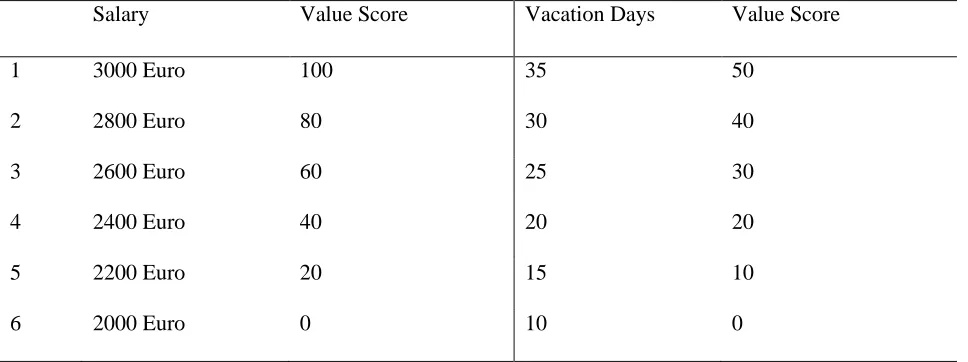
The table including a value scheme (table 1), which was necessary for negotiation, was introduced as follows: ‘The two issues that you need to negotiate are salary and vacation days in
[image:22.612.67.551.486.667.2]per year. The table below lists them as well as the value scores. The higher salary means the higher value, so as the vacation days. This means higher salary and more vacation days is your desire. The value score represents the importance of each outcome. The ultimate goal is to reach a high value score.’
Table 1
Negotiation Game and Value Scores
Salary Value Score Vacation Days Value Score
1 3000 Euro 100 35 50
2 2800 Euro 80 30 40
3 2600 Euro 60 25 30
4 2400 Euro 40 20 20
5 2200 Euro 20 15 10
3.4 Measures of Manipulation Check & Control Variables and Dependent
Variables
This section describes how the manipulation check and the dependent concepts in this research were measured. This section starts with a description of the manipulation check and continues with descriptions of the measures of strategies, first offer, information search and outcomes.
3.4.1 Measures of Manipulation Check & Control Variables
The manipulation check consisted of 8 questions measured on a five-point Likert scale ranging from 1 =strongly disagree) to 5 =strongly agree). One question was used to measured the perception of overall powerlessness “I feel powerless”. Being controlled (n=4; α=71), or being dependent (n=2; α= .77 ) were measured by more than one question to increase reliability. An
example of a question about dependence is: “I have no alternatives to this job offer.”; about control: “feel controlled by the other party”. Besides the general manipulation check,
respondents were also asked to answer demographic questions and questions related to possible control variables. Participants needed to indicate their gender (1=Male, 2=Female), age,
3.4.2 Dependent Measure of First Offer
The first offer was measured at first, by using a five-point Likert scale ranging from 1 (not likely at all) to 7 (very likely) to measure the respondents’ intention to make the fist offer and, secondly, the actual choice to make the first offer was measured (1=yes, making the first offer, 2= no, not making the first offer). It was assumed that these two measures would be highly related since intention is associated with actual behavior (see Aizen, 2005).
3.4.3 Dependent Measure of Obliging Strategy
The obliging strategy was measured using De Dreu et al.’s (2001) validated measure of
negotiation strategies, called the ‘DUTCH’. Four items were used to measure the strategy of obliging (α=.69) on a five-point Likert scale ranging from 1 (not appropriate at all) to 5 (very appropriate). An example of the questions for this strategy is: ‘I give in to the wishes of the other party’.
3.4.4 Dependent Measure of Outcomes
3.5 Analyses
The analyses were done using SPSS® 18 for Windows. Non-respondents, missing and wrong values were deleted listwise. Various analyses were conducted in order to test the
hypotheses. ANOVA was used for the manipulation check and some covariate checks (‘Gender’, ‘Origin’ and ‘Played Before’). Regression was applied at control-variable checks (‘Age’,
‘Education’, and ‘Immersion’). Univariate Analyses were used in a 2 x 2 between-subjects
design to test the hypotheses concerning ‘first offer intention’, ‘obliging behavior’ and
‘outcomes’. Finally, the chi-square test was administered to test the effects of control on actually ‘giving the first offer’, since in this case first offer is a categorical variable (see Field, 2000). A
4. Results
In this section, it is checked at first, whether covariates exist and the manipulations met their intended purposes. Secondly, for each of the focus areas in this research (first offer, obliging strategy and outcomes) the hypotheses get tested. This section concludes with a short summary of the findings.
4.1 Manipulation Checks
Regarding the manipulations, for the factor of control based powerlessness, the analysis indicated a significant difference in perception of being controlled (F(1,86) = 66.2 , p < .00) across the two condition being controlled (M=3.93, SD=.65) and non-controlled (M=2.73, SD=.73). With respect to the dependency based powerlessness manipulation, the results showed that the respondents felt significantly more dependent (F(1,86) =63.98 , p < .00) in the dependent
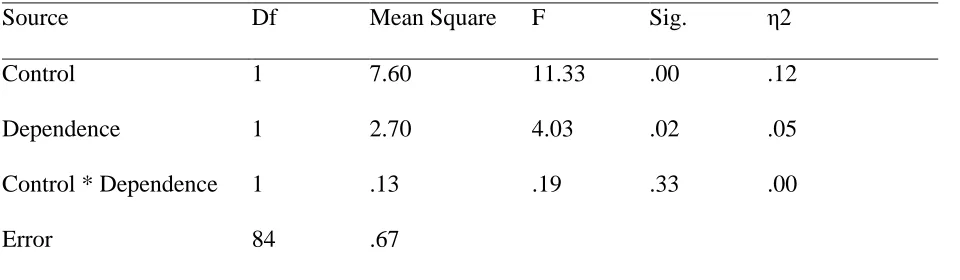
condition(M=3.83, SD=.89) than in the non-dependent condition (M=2.12, SD= .77). Finally, as shown in table 2, the respondents also felt more powerless when dependent (M=2.33, SD=.92) compared to non-dependent (M=1.95, SD=.80) and being controlled (M=2.43, SD=.91)
Table 2
Univariate Analyses of Perception of Powerlessness
Source Df Mean Square F Sig. η2
Control 1 7.60 11.33 .00 .12
Dependence 1 2.70 4.03 .02 .05
Control * Dependence 1 .13 .19 .33 .00
Error 84 .67
Note. One-Tailed Approach to Significance Testing
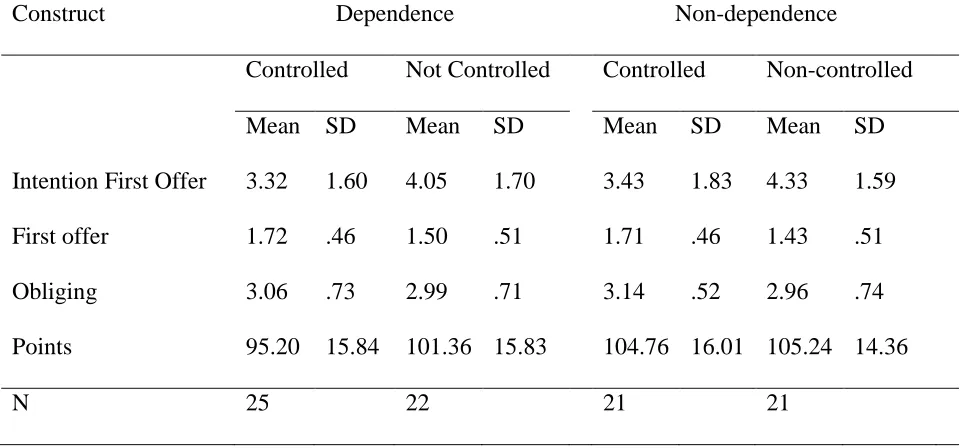
4.2 Descriptive Analyses
The analyses concerning control variables revealed that gender had a significant effect on the outcomes (F(1,87)=6.28, p<.05); women appeared to have had significant lower outcomes (M=98.21, SD=16.53) than men (M=106.67, SD=13,15). The other control-variable analyses including ‘Age’, ‘Education’, ‘Origin’, ‘Immersion’ and ‘Played Before’ showed no significant
influence on the dependent variables.
Table 3
Descriptive Statistics of the Dependent Variables Related to the (Mixed) Scenarios
Construct Dependence Non-dependence
Controlled Not Controlled Controlled Non-controlled
Mean SD Mean SD Mean SD Mean SD
Intention First Offer 3.32 1.60 4.05 1.70 3.43 1.83 4.33 1.59
First offer 1.72 .46 1.50 .51 1.71 .46 1.43 .51
Obliging 3.06 .73 2.99 .71 3.14 .52 2.96 .74
Points 95.20 15.84 101.36 15.83 104.76 16.01 105.24 14.36
N 25 22 21 21
4.3 Hypotheses testing
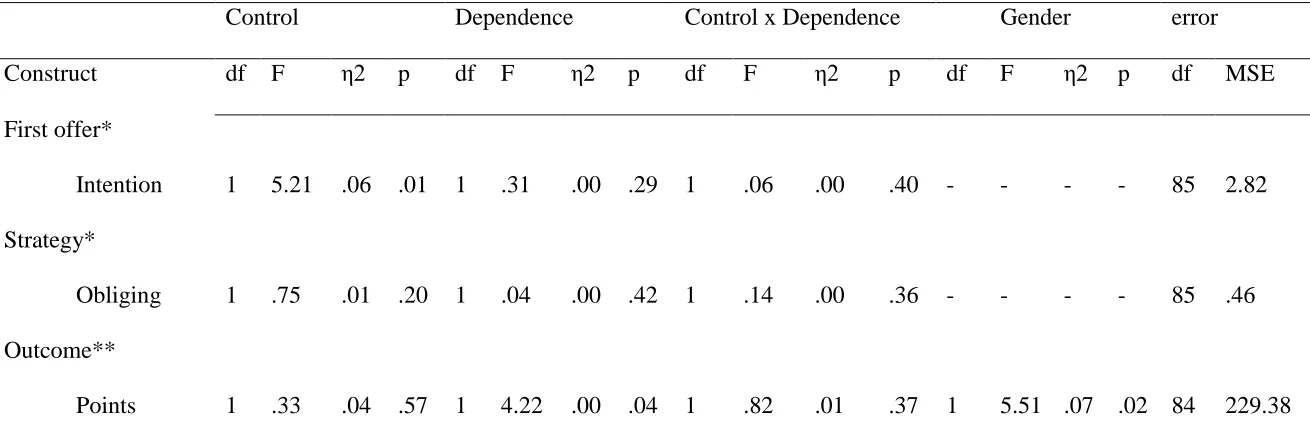
This section is an overview of the results found in the analyses. Table 4 at the end of this section shows the results of the univariate analyses concerning intention to make the first offer, obliging behaviors and outcomes. Now, the results will be discussed in detail concerning the hypotheses.
4.3.1 First Offer
to make the first offer (M=3.37, SD=1.69), than those who felt not being controlled (M=4.19, SD=1.64).
Additionally, further analyses revealed that the difference between controlled and non-controlled individuals on actually making the first offer is significant (c2(1, N = 89) =5.87, p <.05); controlled individuals tend to be less willing to give the first offer (13 giving first offer; 33 not giving the first offer) than non-controlled individuals (23 giving the first offer; 20 not giving the first offer). Therefore, hypothesis 1 is confirmed.
4.3.2 Strategies
As shown in table 4, the assumption that obliging behavior is influenced by dependence in comparison to (non-dependence) and by being controlled (in comparison to not being
controlled) is not supported by the data. Therefore, hypothesis 2 and 3 are not confirmed.
4.3.3 Outcome
In relation to dependence, when analyzing concerning the outcomes, thereby also taking the control variable ‘gender’ into account (table 4), the results indicate that dependent individuals
Table 4
Univariate Analysis with Control & Dependence predicting Intention to Make the First Offer and Strategy (Obliging Behavior) (N=89)
Control Dependence Control x Dependence Gender error
Construct df F η2 p df F η2 p df F η2 p df F η2 p df MSE
First offer*
Intention 1 5.21 .06 .01 1 .31 .00 .29 1 .06 .00 .40 - - - - 85 2.82
Strategy*
Obliging 1 .75 .01 .20 1 .04 .00 .42 1 .14 .00 .36 - - - - 85 .46
Outcome**
Points 1 .33 .04 .57 1 4.22 .00 .04 1 .82 .01 .37 1 5.51 .07 .02 84 229.38
In summary, the manipulations of this research turned out to be effective and only the control-variable gender had an effect on the dependent variable outcomes. Furthermore, the data gathered in this research shows support for two out of four hypotheses. In detail, the
characteristic of being controlled negatively affected the tendency to make the first offer and the actual behavior of making the first offer; dependence was accountable for reduced joint
5. Discussion
This section, firstly discusses the findings of this research and its value for power and negotiation research. Secondly, limitations and avenues for future research will be described. Ultimately, a (short) final conclusion is drawn.
This paper started by outlining how powerlessness is generally described as the opposite of powerfulness in other research and that the distinction of control and dependence is often believed to vanish in reality (Ng, 1980). In order to find an answer to my first research question: “Does powerlessness need its own definition or is it just the opposite of powerfulness? How to
define powerlessness?”, I made a review of the current literature on the topic of powerlessness. Despite indications from literature that powerless may be simply the opposite of powerfulness, I found evidence that the concept of powerlessness is more complicated.
In detail, the review of the topic powerlessness revealed that two elements are crucial to powerlessness, namely control and dependence. Summarized, it was argued that control is referred to ‘as capacity to modify other’s states and administering rewards as well as
punishments’ (see Keltner et al., 2003; Seeman, 1963) whereas dependence is characterized by a
perceived lack of alternatives and motivational investment (Emerson, 1962). Ultimately, based on these findings, I argued for distinct definitions of controlled and dependent oriented
powerlessness , which resulted in the following definitions: (1) One individual/party is
punishments the other entity can deliver, which cannot be controlled by the powerless individual/party.
In order to answer the second research question: “What would be the effects of the
control based and dependency based powerlessness on (negotiation-) behavior of individuals?”, the element of control was linked to negotiation partner, and the element of dependency was linked to resource and were applied to a mixed-motive negotiation. On the one hand, the findings show that control was indeed stronger related to the assumption that
controlled-powerless individuals have a reduced tendency to make the first offer and that they lack personal power as well as behave in a way that enables them to construe themselves vis-à-vis to the other’s interest. On the other hand, the findings indicate that dependency is the trigger to
motivate individuals to gain access to a resource at all costs. Because of the high focus on the resource, losing the negotiation partner (respectively the resource) was considered to be the main threat to individuals that are not able to reach a resource through other means. These findings show that control (compared to non-control) and dependence (compared to non-dependence) were both separate elements of powerlessness. Additionally it was shown that both separately affected the individual’s perceptions of being powerless and thus this also fits the assumption of
this research that they are both separate key elements of powerlessness.
Ultimately, the findings supported the assumed hypotheses. Control increases the focus on the negotiation partner, by aligning individuals vis-à-vis to others interests, and dependence increases the focus on the resource, by increasing the perception of rareness and irreplaceable loss.
non-control) as well as dependence (compared to non-dependence) were shown to have a connection with the perceptions of powerlessness, they were not directly linked to obliging behavior. Instead, only overall powerlessness is connected to obliging behavior directly, which has also been revealed in previous studies (Balliet et al., 2011; Butt & Choi, 2010; De Dreu & van Kleef, 2004; Overbeck et al., 2010; Sinaceur & Tiedens, 2006; van Kleef et al., 2004). I suspect that this finding may be due to the research design, which consisted of an artificial representation of a real negotiation and thus, may have inhibited individuals from enacting natural strategic behaviors. The origins and consequences of these assumptions will be further discussed in the ‘limitations and future research’ section.
In terms of contributions, this study adds significant value to social and organizational research, since it was necessary to assess how powerlessness should be properly defined, not only from the theoretical but also from the practical viewpoint, without being only treated as a reference point of powerfulness. As stated, power (including powerlessness) affects a majority of social interactions and the clear definitions presented in this research give a basis for more valid and reliable research in the context of future research on powerlessness.
Also, practical implications can be derived from this research. With the findings at hand, it will be easier for professional negotiators to tailor negotiation behaviors as well as trainings better, which are aimed at understanding the processes of powerlessness in negotiations. For example, an implication for corporate suppliers and purchasers of goods would be, that in order to gain higher outcomes in negotiations, the perception of a ‘rare resource’ should be evoked to increase the perceived dependency among the other firm’s purchasers. Thus, instead of wasting
From the viewpoint of organizational subordinate-supervisor relations, this research gives a deeper assessment of the ongoing processes. From the viewpoint of this paper, subordinates’ negotiations with supervisors are often based on the control rather than the resource perspective of powerlessness, since supervisors are associated with reward or punishment capabilities (Clegg & Courpasson, 2006). Instead of aiming for organizational objectives, strongly controlled
subordinates may behave stronger in relation to the needs and demands of the supervisor than of the firm. Therefore, it may be important for human resources functions within organizations to assess such dysfunctional power relations and they may restrict the power of supervisors, in order to allow organizational functioning of all its employees.
In summary, despite contrary indications in the literature, the results of this study show strong support for the theory that a distinction between controlled- and dependent-powerlessness is needed. Despite the careful administration of this research, some limitations of this study exist. These limitations as well as their implications and directions for future research will be presented next.
5.1 Future Research/Limitation
This section describes the limitation of this study and explores possible avenues for future research. Before switching to avenues for further research agendas, which are based on the main findings of this study, I begin with the three main limitations of this study and their
5.1.1 Limitations
The first of three limitations is related to the respondents and the material used. On the one hand, this research was administered at the University of Twente und included mainly students. Despite the psychological focus of this research, which is assumed to be quite universal among human beings, other groups of respondents, especially more experienced negotiators and people from other cultures could react differently to the perceptions of control and dependence. Therefore, the findings need to be replicated in studies including respondents with different cultural backgrounds and experience. On the other hand, the material and context that were applied in this research can be changed to test the findings in more situations and environments. In each situation the material should be tailored to the targeted sample. Vignettes need to be accustomed to the situation of the respondents in order to allow them to dive into the scenarios; otherwise they may reject the scenarios as unrealistic or not applicable. In this vain, validity of the findings can be strongly reassured when the material is extended to other topics or contexts (which need to get tailored to the target sample), like other work- and societal settings.
Secondly, as indicated by several respondents (in the debriefings and by written remarks), during the negotiation itself, own attitudes and behaviors sometimes overruled the ones
described in the scenario. Even though this random error was applicable to all conditions and thus had no effect on the direction of the effects found in this study, it could be possible that other methods, like face-to-face negotiations, are better applicable for negotiation-research.
negotiations. In this context, the various nonverbal signals of power (see Ellyson & Dovido, 1985) had no application. Visible presence has arousal inducing properties (Zajonc, 1965) and can involve status differentials (Bales et al., 1951). Vignettes as communication tool lack social cues (compare Bazerman, Curhan, Moore & Valley, 2000), which changes behaviors towards reduced evaluation anxiety or reduced attention to social norms (Kiessler & Sproull, 1992). Therefore, future research should test the findings of this research in real-life/face-to-face settings to assure ecological validity, this can also include role-play settings or even non-obtrusive observations of negotiations and bargaining situations in workplace settings.
5.1.2 Future Research
The first avenue for further research is related to information search and other cognitive processes of individuals in the context of powerlessness. As already outlined by other researchers, powerless individuals in general have attention to specific kinds of social information and seem to reason in more complex ways, with increased attention to consequences (Keltner et al, 2003; Lerner & Tetlock, 1999; Tetlock, 1992). Powerless individuals generally tend to use multiple sources of information, have interpretive reasoning (Guinote, 2007) and are believed to be better in estimating other’s interests, positions and information processing (Keltner & Robinson, 1997).
Secondly, it could be possible that not only powerlessness, but also powerfulness needs a distinction into different forms on powerfulness. It may be possible that literature on
powerfulness entails the same bias as literature of powerlessness, by describing powerfulness too broad as general possession of power and not capturing all its facets. Future research could investigate in how far powerfulness may also be influenced by perceptions of dependence and control. It is reasonable to assume that powerful figures that can reward or punish may behave differently than powerful ones that only possess a valuable and rare resource. Control in this aspect has the ability to directly and explicitly change other’s behaviors (compare “inducible
force” (Lewin, 1941)), whereas dependence can be considered to change behavior indirectly/ by creating implicit motivations (compare “inducible change” (Lewin, 1941)). Also, a resource may be gone after a negotiation whereas reward and punishments may have longer effects. Therefore, future research should tackle the question, if individuals that are powerful may also use different behaviors depending on the element of their power (‘element’ in relation to control and
dependence).
Thirdly, in relation to other negotiation research, it was interesting to conclude that outcome was not affected by first offer. This finding is interesting since it is argued in literature that the first move is often seen as anchor for negotiations and associated with improved
outcomes, and powerless individuals tend to engage in late-moves (Galinsky & Mussweiler, 2001, Magee et al., 2007, Mussweiler & Strack, 1999). Therefore, it could have been possible that control (which influenced the first move) should also have influences on outcomes, through its indirect/mediated effects via the first move. Two processes can be accountable for this
Montgomery, 1998; Shankar, Carpenter & Krishnamurthi, 1998). A theoretical implication of this finding is that the relations found of first move and final outcomes may need a new theoretical foundation and empirical assessment. It is also interesting to see how the different aspect of powerlessness may mediate or even moderate such relationships. On the other hand,
this finding provides further evidence for the separate effects of control and dependence on negotiation behaviors and that past negotiation research made a mistake by confusing control and dependence. Despite of being influenced by control and dependence at the same time, first move and outcomes were proven to be separately influenced by either control or dependence.
Fourthly, as already presented, negotiations are normally far more complex than
proposed by the literature. It is reasonable to assume that many aspects of the negotiation itself, like strategy, first move and also ongoing information procession, are interrelated and induce latent influences on each other. Future research should further aim at these interdependencies and assess how power, and especially powerlessness (being controlled & dependent), may affect these interdependencies.
5.2 Conclusion
In vain with Davis (1971), who proposed certain steps to make social research interesting, (1) I took in this paper the taken-for-granted assumption that powerlessness is the opposite of powerfulness, (2) adduced the proposition that powerlessness has more dimensions than simply being the opposite of powerfulness, (3) proved by methodological and empirical means the distinction between the different aspects of powerlessness (namely controlled- and dependent-powerlessness) and (4) posed the practical and theoretical consequences of these findings and its value for scientific advancements.
The considerable value of this research lies in the fundamental different view on the concept of being powerless, when compared to current power-literature. Essentially, power influences a huge amount of social interaction, especially in the context of organizations (Clegg & Courpasson, 2006). This research has its implication far beyond the theoretical perspective, since the perception of power(lessness) has considerable effects on social interaction and I assume that the different concept of powerlessness in this research challenges many traditional views on power.
In order to find answers to the research questions, this paper began with the assumption that powerlessness is not a direct opposite of powerfulness, but needs a definition of its own. Instead of a simple design of powerlessness, which was used in most studies, this paper assumed that powerlessness, as a concept, includes the perceptions of control and dependence. In
particular, it was assumed that control is related to a partner’s ability of rewarding and executing
this vain, the assumptions that the perception of being controlled was related to increased attention to the negotiation-partner (decreased intention to make the first offer), whereas
dependency was related to increased attention on reaching the resource ((instead of focusing on its costs (lower outcome-scores when compared to non-dependent individuals)) and the additive effects of control and dependence on obliging behavior. Whilst the first two hypotheses where supported, the latter was not. Ultimately, I came to the conclusion that, even though further research is necessary to validate the findings across situations and contexts, this paper succeeded in its aim to show that powerlessness needs a definition on its own, including the two concepts of control and dependence and that these two concepts have separate effect on negotiation
Acknowledgements
6. References
Ajzen, I. (2005). Attitudes, personality, and behavior (2nd. Edition). Milton-Keynes, England: Open University Press / McGraw- Hill.
Alexander , C. S., & Becker, H. J. (1978). The Use of Vignettes in Survey Research. The Public Opinion Quarterly, 42 (1), 93-104.
Bales, R., Strodtbeck, F. L., Mills, T. M., & Roseborough, M. E. (1951). Channels of communication in small groups. American Sociological Review, 16, 461–68.
Balliet, D., Mulder, L.B., & Van Lange, P. A. M. (2011). Reward, Punishment, and Cooperation: A Meta-Analysis. Psychological Bulletin,137 (4), 594–615.
Barter, C., & Renold, E. (2000). “I wanna tell you a story”: Exploring the application of
vignettes in qualitative research with children and young people. International Journal of Social Research Methodology, 3(4), 307–323.
Bazerman, M., Curhan, J.R., Moore, D.A., & Valley, K.L. (2000). Negotiation. Annual Review of Psychology, 51, 279–314.
Bugental, D.B. (2010). Paradoxical Power Manifestations. In A. Guinote & T.K. Vescio (eds.),
The Social Psychology of Power (pp. 209- 230). New York: Guilford Press.
Butt, A. N., & Choi, J. N. (2010). Does power matter? Negotiator status as a moderator of the relationship between negotiator emotion and behavior. International Journal of Conflict Management, 21, 124–146. doi: 10.1108/10444061011037378
Clegg, S. R., & Courpasson, D. (2006). Power and Organizations. Thousands oaks, CA: Sage Copeland, J. T. (1994). Prophecies of power: Motivational implications of social power for
Davis, M. S. (1971). That's Interesting!: Towards a Phenomenology of Sociology and a Sociology of Phenomenology. Philosophy of the Social Sciences, 1, 309-344. De Dreu, C. K. W. (1995). Coercive power and concession making in bilateral negotiation.
Journal of Conflict Resolution, 39, 646–670.
De Dreu, C. K.W. , & Van Kleef, G. A. (2004). The influence of power on the information search, impression formation, and demands in negotiation. Journal of Experimental Social Psychology, 40 (3), 303–319.
Dictionary.com (n.d.). dependent. Retrieved February 12, 2012, via http://dictionary.reference.com/browse/dependent
Emerson, R. M. (1962). Power-Dependence Relations. American Sociological Review, 27(1),
31-41.
Elangovan, A. R., & Xie, J. L. (2000). Effects of perceived power of supervisor on subordinate work attitudes. Leadership & Organization Development Journal, 21 (6), 319 – 328. Ellyson, S. L., & Dovidio, J. F. (1985). Power, dominance, and nonverbal behavior: Basic
concepts and issues. In S. L. Ellyson & J. F. Dovidio (eds.), Power, dominance, and nonverbal behavior (pp. 1-27). New York: Springer-Verlag.
Field, A. P. (2000). Discovering statistics using SPSS for Windows: Advanced techniques for the beginner. London: Sage.
Fiske, S. T. (1993). Controlling other people: The impact of power on stereotyping. American Psychologist, 48, 621–628.
Galinsky A. D., & Mussweiler T. (2001). First offers as anchors: the role of perspective-taking and negotiator focus. Jounal of Personality and Social Psychology, 81(4), 657–69. Gruenfeld, D. H., Inesi, M. E., Magee, J. C., & Galinsky, A. D. (2008). Power and the
Objectification of Social Targets. Journal of Personality and Social Psychology, 95 (1), 111-127. doi: 10.1037/0022-3514.95.1.111
Giebels, E., De Dreu, C. K. W., & Van de Vliert, E. (1998). The alternative negotiator as the invisible third at the table: The impact of potency information. The International Journal of Conflict Management, 9, 5–21.
Giebels, E., De Dreu, C. K. W., & Van De Vliert, E. (2000). Interdependence in negotiation: Effects of exit options and social motive on distributive and integrative negotiation.
European Journal of Social Psychology, 30, 255–272.
Guinote, A. (2007). Behaviour variability and the Situated Focus Theory of Power. European Review of Social Psychology, 18 (1), 256 — 295.
Helfat, C. E., & Lieberman, M. B. (2002). The birth of capabilities: Market entry and the importance of pre-history. Strategic Management Journal, 21, 961-980.
Holmes, M. E. (1992). Phase structures in negotiation. In L. L. Putnam & M. E. Roloff (eds.),
Communication and negotiation (pp. 83-105). Newbury Park, CA: Sage.
House, R. J. (1988). Power and personality in complex organizations. In B. M. Staw & L. L. Cum-mings (eds.), Research in organizational behavior (pp. 305-357). Greenwich, CT: JAI Press.
Jones, E. E. (1986). Interpreting interpersonal behavior: The effects of expectancies. Science, 234, 41–46.
Kelley, H. H., & Thibaut, J. W. (1978). Interpersonal relations: A theory of interdependence. New York: John Wiley.
Keltner, D., Gruenfeld, D. H., & Anderson, C. (2003). Power, approach, and inhibition.
Psychological Review, 110(2), 265-284. doi: 10.1037/0033-295x.110.2.265 Keltner, D., & Robinson, R. J. (1997). Defending the status quo: Power and bias in social
conflict. Personality and Social Psychology Bulletin, 23, 1066–1077.
Kiesler, S, & Sproull, L. (1992). Group decision making and communication technology.
Organisational Behavavior and Human Decision Processes, 52, 96–123.
Lawler, E. J. (1992). POWER PROCESSES IN BARGAINING. The Sociological Quarterly, 33, 17–34. doi: 10.1111/j.1533-8525.1992.tb00361.x
Lukes, S. (1986). Power. New York: New York University Press.
Lerner, J. S., & Tetlock, P. E. (1999). Accounting for the effects of accountability. Psychological Bulletin, 125, 255–275.
Lewin, K. (1941). Analysis of the concepts whole, differentiation, and unity. University of Iowa Studies in Child Welfare, 18, 226–261.
Lieberman, M. B., & Montgomery, D. B. (1998). First-mover (dis)advantages: Retrospective and link with the resource-based view. Strategic Management Journal, 19, 1111-1125.
MacLeod, C., & Mathews, A. (1988). Anxiety and the allocation of attention to threat. Quarterly Journal of Experimental Psychology, 40, 653–670.
Mathews, A., & MacLeod, C. (1985). Selective processing of threat cues in anxiety states.
Behaviour Research and Therapy, 23, 563–569.
Milgram, S. (1963). Behavioral study of obedience. Abnormal social Psychology, 67, 371-378. Mintzberg, H. (1983). Power in and around organizations. Englewood Cliffs, NJ: Prentice-Hall. Mussweiler T, & Strack F. (1999). Comparing is believing: a selective accessibility model of
judgmental anchoring. In W. Stroebe, M. Hewstone (eds.), European Review of Social Psychology (Vol. 10, pp. 135–68). Chichester, UK: Wiley.
Ng, S. H. (1980). The social psychology of power. London: Academic Press.
Overbeck, J. R., Neale, M. A., & Govan, C. L. (2010). I feel, therefore you act: Intrapersonal and interpersonal effects of emotion on negotiation as a function of social power.
Organizational Behavior and Human Decision Processes, 112, 126–139. doi:10.1016/j.obhdp.2010.02.004
Pavitt, C., & Kemp, B. (1999). Contextual and relational factors in interpersonal negotiation strategy choice. Communication Quarterly, 47(2), 133-150.
Pfeffer, J. (1981). Power in organizations. Marshfield, MA: Pitman.
Pinkley, R. L., Neale, M. A., & Bennett, R. (1994). The impact of alternative to settlement in dyadic negotiation. Organizational Behavior and Human Decision Processes, 57, 97–116. Pruitt, D. G. (1983). Achieving integrative agreements. In M. H. Bazerman & R. J. Lewicki
(eds.), Negotiating in organizations (pp. 35–50). Beverly Hills. CA: Sage.
Pruitt, D. G., & Carnevale, P. J. (1993). Negotiation in social conflict. London: Open University Press.
Pruitt, D. G., & Rubin, J. Z. (1986). Social conflict: Escalation, stalemate and settlement.
Putnam, L. L. (1985). Bargaining as task and process: Multiple functions of interaction sequences. In R. L. Street, Jr. & J. N. Cappella (eds.), Sequence and pattern in communicative behaviour (pp. 225-242). London: Edward Arnold.
Rahim, M. A. (1983). A measure of styles of handling interpersonal conflict. Academy of Management Journal, 26, 368–376.
Rahim, M. A. (2001a). Managing conflict in organizations (3rd ed.). Westport, CT: Quorum. Rahim, M. A. (2001b). A structural equations model of leader power, subordinates' styles of
handling conflict, and job performance. The International journal of conflict management 12 (3), 191 -211.
Rahim, M. A. (2002). Toward a theory of managing organizational conflict. International Journal of Conflict Management, 13 (3), 206 – 235.
Rubin, J. Z., & B. Brown (1975). The Social Psychology of Bargaining and Negotiations.
New York: Academic.
Rucker, D. D., & Galinsky, A. D. (2008). Desire to acquire: Powerlessness and compensatory consumption. Journal of Consumer Research, 35, 257–267.
Salancik, G. R., & Pfeffer, J. (1977). Who gets power-and how they hold onto it: A strategic contingency model of power. Organizational Dynamics, 5, 3-21.
Seeman, M. (1963).Alienation and social learning in a reformatory. American Journal of Sociology, 69, 270-284.
Sinaceur, M., & Tiedens, L. Z. (2006). Get mad and get more than even: The benefits of anger expressions in negotiations. Journal of Experimental Social Psychology, 42, 314–322. doi:10.1016/j.jesp.2005.05.002
Spreitzer, G. M. (1996). Social Structural Characteristics of Psychological Empowerment.
Management Journal, 39 (2), 483-504.
Stevens, L. E., & Fiske, S. T. (2000). Motivated impressions of a powerholder: Accuracy under task dependency and misperception under evaluation dependency. Personality and Social Psychology Bulletin, 26(8), 907-922.
Tetlock, P. E. (1992). The impact of accountability on judgment and choice: Toward a social contingency model. In M. P. Zanna (eds.), Advances in experimental social psychology
(Vol. 25, pp. 331–376). New York: Academic Press.
Thibaut, J. W., & Kelley, H. H. (1959). The social psychology of groups. New York: John Wiley. Thompson, L. L., Wang, J., & Gunia, B.C. (2010). Negotiation. Annual Review of Psychology,
61, 491–515.
Tjosvold, D. (1985). Power and social context in superior-subordinate interaction.
Organizational Behavior and Human Decision Processes, 35, 281–293.
Torres, S. (2009). Vignette Methodology and Culture-Relevance: Lessons Learned through a Project on Successful Aging with Iranian Immigrants to Sweden. Journal of Cross Cultural Gerontology, 24, 93–114.
van Kleef, G. A., De Dreu, C. K. W., & Manstead, A. S. R. (2004). The interpersonal effects of anger and happiness in negotiations. Journal of Personality and Social Psychology, 86, 57–76. doi:10.1037/0022-3514.86.1.57
Vescio, T. K., Snyder, M., & Butz, D. A. (2003). Power in stereotypically masculine domains: A social influence strategy6stereotype match model. Journal of Personality and Social Psychology, 85, 1062-1078.
Walton, R. E., & McKersie, R. B. (1965). A behavioral theory of labor relations. New York: McGraw-Hill.
7. Appendixes
7.1 Appendix A
Comparison of Definitions and Concepts of Powerful versus Powerless
Powerful Powerless Ability control own and other’s resources
Capacity to modify other’s states, withholding resources, administering punishments (Keltner, Gruenfeld & Anderson, 2003)
Internal locus of control
(High) Controllability
High control/power relative to other (Barach & Lawler)
Dependent on behavior of powerful other (Thibaut & Kelley, 1959)
External locus of control (Seeman, 1963)
Subjective power disadvantage (Bugental, 2010) (Low) Controllability (Weiner, 1985)
powerless motivated to restore control (Fiske & Dépret, 1996)
Low control/power relative to others (Bugental et al., 1989)
social exchange theory (Kelley, 1979; Thibaut & Kelley, 1959)= social power as fate control (Stevens & Fiske, 2000)
->Difference between fate control and behavior control (Thibaut and Kelley, 1959)
(High) alternatives' impact on aspirations and (low) conflict payoffs (resistance theory/
power-dependence theory) (Stevens & Fiske, 2000; Emerson, 1962)
Overcome resistance (House, 1988)
Distinction between Outcome- & Social Power (Dowding, 1996)
7.2 Appendix B
Differences and Similarities of Dependence and Control
Power(lessness)
Characteristic Dependence
(main source: Emerson, 1962)
Control Differences
Underlying thought Power property of social relation (Often) property of actor
Source of power Relations Possessions (e.g. Rucker & Galinsky, 2008)
Aspects Proportional to motivational investment of dependent person Proportional to availability of goals outside the relationship
(alternatives)
Power A->B=Dependency B->A Power B->A=Dependency A->B
External vs. internal locus of control Subjective power (dis)advantage (Bugental, 2010)
Sub/objective power to control or influence the other resides in control over the things he values
Including a mediator
More subjective
Actual resources and punishments the individual can deliver (Keltner & Gruenfeld, 2003)
More objective
is a state that can arise
from multiple inputs, not solely from control, Thus, power can be differentiated from control (Rucker & Galinsky, 2008). For example: feelings of powerlessness might stem not only from lacking control over others but from deprivation in economic own resources, respect, and knowledge (French and Raven 1959, cited in Rucker & Galinsky, 2008).
Assumed meaning: whereas dependency is always linked to power, so does control need a relational aspect
Similarities
Actor(s) Group/person (and situations) Group/person (and situations) Outcome Ultimately, able to control or
influence others conduct / being controlled
7.3 Appendix C
Research Scenario Including being Dependent and Controlled
Please project your thoughts into the following scenario, it is necessary that you
really dive into your role and act accordingly:
You are a last year’s master-student and are about to finish your degree in a month.
You are now searching for a full-time job. It appears that the job-market condition
at the moment is very difficult and that it is hard to find a job.
After an extensive search for jobs, you applied at several companies. All
companies declined your job-application, except one company, which responded
positively to it. This one company is called Plinotek. After surviving two selection
rounds and taking several interviews at Plinotek, they indicated that they are
generally interested in you.
7.4 Appendix D
Manipulations Used in this Research
Non-dependent
“Ultimately, four companies responded to your application positively. This means that even if you don’t get the job in your favorite company, there are still three other positions for you in other companies. Your favorite company is called Plinotek…”
dependent “Ultimately, only one company responded to your application positively and the others declined it. This one company is called Plinotek…”
Controlled “…they are generally interested in you.” “The person you are negotiating with is the vice president of the company. You know that he has the power to decline or accept your job-application.”
Non-Controlled
“…they indicated that they want you.” “The person you are negotiating with is the human resource (HR) manager of the company. He has only the responsibility to discuss with you the contract-details and has no power to influence the fact that you already have the job, unless you give up this offer.”