With 17 text-figures Printed in Great Britain
THE DERIVATION OF THE MOTOR COMMAND
TO THE SPIRACLES OF THE LOCUST
BY P. L. MILLER
Department of Zoology, Oxford, England
(Received 16 November 1966)
INTRODUCTION
Among insects several patterns of motor activity have been studied in which the sensory input bears no simple relation to the output. Of these most is known of the locust flight system as a result of the penetrating studies of Wilson (1961, 1964) and Wilson & Weis-Fogh (1962). Wilson & Wyman (1965) applied electrical shocks with random timing to the locust central nerve cord and produced patterned oscillations in groups of motoneurones which supply the flight muscles, similar but at lower fre-quency to those which occur naturally in flight. The ventilatory mechanisms of some insects show similarities with the locust flight system in so far as maintained stimula-tion, either electrical or by the application of gases, can produce patterned oscillations in neurones which bring about pumping movements (Huber, i960; Mill & Hughes, 1966; Miller, 1966). Unlike the flight system, however, such activity may also persist in the absence of input. The spiracle motoneurones too show persistent activity in the absence of input so that in the intact insect they need to be periodically switched off by other cells to allow the spiracle to open. In common with many cells in the arthro-pod cord their 'resting' state is apparently one of continuing activity. They are com-parable with the spontaneous units of unknown function which have been studied in the crayfish cord (Preston & Kennedy, 1962; Kennedy & Preston, 1963; Biederman, 1964; Takeda & Kennedy, 1965; Biederman-Thorson, 1966), and some of their properties are also comparable with those of the neurones of the crustacean cardiac ganglion (summary by Hagiwara, 1961).
In normal ventilation the first (prothoracic) spiracle of the locust, Sckistocerca
gregaria, opens for a short period during the inspiratory stroke of the abdomen and is
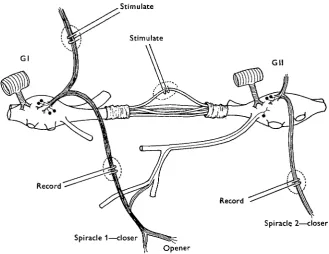
closed for the remainder of the cycle. In. co-operation with other spiracles this activity permits the abdominal pump to produce a uni-directional ventilating airstream which passes posteriorly through the insect. The valve movements are brought about by two muscles, an opener and a closer. The closer receives two motor axons from the median dorsal nerve of the prothoracic ganglion (G I), while the opener is supplied by three motor axons; two arise in GI and accompany the nerves to the closer, while the third arises in the mesothoracic ganglion (Gil) and proceeds to the opener in U N i and then joins the median nerve close to the spiracle (Fig. i) (Miller, 1960a, 1965). In spiracle 2 of the same species, Hoyle (1959) has shown that all muscle fibres are doubly innervated by a 'slow' and a 'fast' axon, whose effects on the muscle differ only by a small amount. Unlike many motor systems both contribute at roughly equal frequencies to normal activity, and their differing slow and fast properties may not be important.
MATERIAL AND METHODS
Scltistocerca gregaria Forskal and Locusta migratoria migratorioides (Reiche and Fairme), both kindly supplied by the Anti-Locust Research Centre, were used in these studies. Most experiments were performed on teneral adults of Sckistocerca but mature insects have also been examined. The results are derived from a total of 84 prepara-tions. The temperature was normally 20-220 C.
Records were taken from the transverse nerves to the spiracles by conventional methods which have already been described (Miller, 1960a). Electrical stimulation of nerves was carried out through fine platinum wire electrodes via an isolation unit, using square-wave pulses of 0-2 msec, duration at various frequencies and intensities. Stimulation of parts of a connective between G I and G i l was carried out after it had been desheathed and split into a number of small bundles, according to the method recommended by Fielden & Hughes (1962). One connective was cut through com-pletely, while the other was usually split into six to twelve bundles. After removal of the tough perineurium there was often a temporary conduction block, probably due to unavoidable stretching of the fibres, but recovery usually followed in less than 1 min. as indicated by the re-establishment of synchrony between spiracle 1 and abdominal pumping. Recordings taken from split bundles showed that the activity of recogniz-able units persisted for at least 1 hr. when the preparation was bathed in Hoyle's locust saline. Split bundles were lifted into air on the stimulating electrodes and surrounded by a small amount of petroleum jelly to prevent desiccation and minimize stimulus spread. The recording electrodes on the spiracle nerves were similarly treated and then reimmersed in saline (Fig. 1). No deleterious effects were observed as a result of the use of petroleum jelly (cf. Narahashi, 1963).
nerves. This indicated that the stimulated area was normally close to the electrodes, although with very high intensities of current it was sometimes possible to stimulate the motoneurones directly. In all preparations care was taken to minimize damage to the tracheae which supply the ganglia.
. Stimulate
Gil
Record
Spiracle. 2—closer Spiracle
[image:3.451.60.390.127.381.2]1-Opener
Fig. i. Schistocerca. Diagram to illustrate the stimulating and recording sites on the transverse nerves and split connectives between the prothoracic (GI) and mesothoracic (Gil) ganglia. The motor supply to the spiracle muscles is also shown.
RESULTS AND COMMENTS
Observations on the natural patterns of activity. A brief description of the natural
patterns of activity has already been given (Miller, 1960a, 1965): only activity in the two motor units to the closer muscle of spiracle 1 will be described here although similar patterns are distributed to spiracle 2. In favourable preparations their separate activity can be distinguished by the different spike heights, or one can be examined alone after damage of the axon of the other proximal to the electrodes. Three main patterns of activity can be distinguished (Figs. 2, 3).
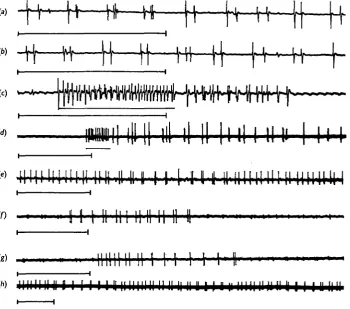
Pattern 1 consists of high-frequency bursts of impulses occurring at the same
frequency in both axons, between 100 and 250/sec/axon, and lasting about 100 msec. The two units fire either synchronously or alternately and the burst normally initiates contraction of the muscle and closure of the spiracle. The pattern comprises smooth regular firing, sometimes at a slowly declining frequency, and is usually quite distinct from pattern 2 which follows. Such bursts may occur synchronously in spiracles 1 and 2, but can occur in either alone; in the former case there is no synchronization of indi-vidual spikes in the two spiracles (Fig. 2 c, d).
352
When pumping is slow or stops temporarily, pattern 2 continues in the spiracle nerves and maintains a tetanus in the closer muscle until the next inspiratory stroke starts. Again both axons participate, firing at approximately equal frequencies (20-50 impulses/sec./axon). Pattern 2 may comprise either a, regular trains of impulses, often
(a)
(e) w ^
(0
(g)
m 11 in
H U H
1111
1
H
\\\
[image:4.451.55.406.133.442.2]H
Fig. 2. Patterns of motor activity in the axons to the closer muscle of spiracle 1, in intact locusts (a-g), and after the removal of G U I (h). (a, b) Pattern za in Schistocerca: synchronous impulses in each of the two axons (large spikes) occur in couplets, (c) A long high-frequency burst (pat-tern 1), underlined, in Locusta followed by pat(pat-tern 26 during fast ventilation, (d) A short high-frequency burst, underlined, in Schistocerca followed by pattern za. (e) Pattern zc in Schisto-cerca during a pause in ventilation; each unit fires regularly but independently. (/, g) Short expiratory trains in Locusta in which no high-frequency burst occurs and pattern 2 c is seen. (h) Free running in Schistocerca after removal of G I I I ; compare with e above. Horizontal scale below each trace = 200 msec.
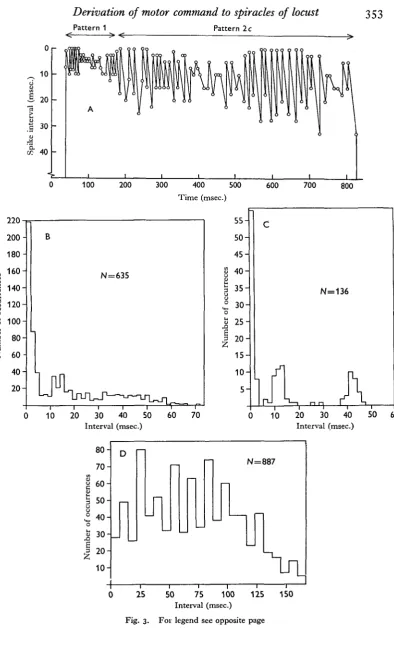
Legend to Fig. 3
Pattern 1 Pattern 2c
353
Time (msec.)
220
200-10
~\ 1 r 20 30 40 50
Interval (msec.)
8 0
-rfi
<D o u u 3 0 O
Numbe
r
5 5
5 0
4 5
4 0
3 5
3 0
2 5
2 0
1 5
1 0
5 -C
. A
u
1N=136
ru
60 10 20 30 40
Interval (msec.)
50 60
25 50 75 100
[image:5.451.29.424.32.678.2]Interval (msec.) Fig. 3. For legend see opposite page
354
in doublets (Figs. 2 a, b; 3B, C), synchronized in the two units; or b, less regular firing in which sometimes components of a or c can be recognized; or c, regular evenly spaced but independent trains of impulses in the two axons, usually at different frequencies so that a slower beat-frequency appears (Figs. 2 e,f, g; 3D). Pattern zc is identical with
free running which always appears after removal of the metathoracic ganglion (GUI),
Sp.iOH SP.1
200 msec.
SP. 2
r sp. i L sp. 1
• 4 k *
-•+-»»
-u-(e)
H IM
S p . 2
Sp, 1 IH > ) l M l — I t
200 msec.
\ \\\ -1111 >
. . i I . I . , i . I I . . 1 .
I*-- tilW \\\ i n | t | tt | | l - I K - H i - M l
200 msec.
Fig. 4(a). Simultaneous records from the motor nerves to spiracles i and io of Schistocerca during one ventilatory cycle. Only the activity in units supplying the closer muscles is seen: in spiracle io activity ceases during expiration and in spiracle i during inspiration. (b, c) Simul-taneous records from the motor nerves to spiracles I and 2 showing approximate synchroniz-ation between impulses during pattern ia firing, spiracle 2 usually leading by about 5 msec.
i
so
I
•z 100
'a. en
150 _
SO 100 150
Time (msec.)
200 250 300
Fig. 5. Plots of consecutive impulse intervals (both axons) during pattern za firing when impulse synchronization occurs between spiracles i ( O — O ) a n d 2 ( x x ). Points occur-ring at o in the vertical scale indicate the synchronous fioccur-ring of both units of a spiracle.
When pattern 2 a appears there is often approximate 1:1 synchronization of im-pulses between spiracles 1 and 2 (Figs. 46, c and 5). This has not been observed during
2b or c, or under any conditions after removal of G U I . Since at high frequencies
patterns 2a, b and c all produce a maintained tetanus of the closer muscle it may be functionally unimportant which firing plan is followed. However, tension measure-ments of the muscle contractions have not been made and close-paired impulses such as occur in 2 a are well known in other situations to cause tensions higher than are produced by the same frequency evenly spaced (Wilson & Davies, 1965); Hoyle (1959) has shown this to be the case in spiracle 2 of the locust.
In summary, therefore, pattern 2 comprises activity which is either largely syn-chronized (impulse for impulse) in both axons and in adjacent segments, or which is independent in each axon, or again which may be irregular and possibly a mixture of the first two.
Pattern 3 comprises short periods of no activity in the nerves when the muscle
relaxes and the spiracle opens coincident with the inspiratory stroke. During weak ventilation, activity in both axons of spiracle 2 may continue at a low frequency, but this does not normally occur in the spiracle 1 nerve. As a result spiracle 2 may remain more or less closed throughout the cycle and inspiration takes place only through spiracle 1, spiracles 3 and 4 also remaining closed. At such times spiracle 10 acts as the only expiratory spiracle and gaseous exchange is achieved with a minimum of spiracle opening. Similarly in resting dragonflies spiracles 1 and 10 alone are operational.
The synchronization of ventilatory activity throughout the insect
In order to produce effective uni-directional ventilation, spiracle movements must be precisely synchronized with the pumping strokes and these strokes must take place in all parts of the abdomen nearly simultaneously. Activity is co-ordinated in the locust by G III which lies one-tenth of the distance between spiracles 1 and 10. To bring about synchronized movements it must therefore excite remote regions through fast-conducting pathways with minimum delays or operate through a system with graded delays. Co-ordination in the abdominal cord is believed to be brought about by fast-conducting interneurones (Miller, 1966) similar to those which occur in the cricket (Huber, i960), and a further set has been postulated which runs anteriorly to harness the activity of the thoracic spiracles to the pumping rhythm (Miller, 1965).
Some measurements have been made of the delays between the occurrence of events in the ventilatory cycle in different parts of the insect. For example, bursts of impulses in lateral nerves from G U I to expiratory muscles commence up to 10msec, before corresponding high-frequency bursts in the spiracle 1 nerve. Comparable bursts leave the last abdominal ganglion in nerves to expiratory muscles about 60 msec, after the start of activity in the spiracle 1 nerve, while a similar delay intervenes be-tween the end of closer activity in the spiracle 1 nerve and the start of the high-frequency burst in the nerve to spiracle 10 (Fig. 4a). In dragonfly larvae Mill & Hughes (1966) found a relatively long delay, over 50 msec, between the expiratory bursts in adjacent abdominal segments, and exceptionally a delay of as much as 379 msec, between segments 5 and 7. Ventilation would therefore presumably have more of a peristaltic nature than in locusts.
ponding bursts in the spiracle i nerve by 5-7 msec. When impulse synchronization occurs between these spiracles (pattern za), spiracle 2 normally leads by about 5 msec, although considerable variation is seen (Figs. 4, 5). Such synchronization does not involve all the spikes; for example, in one preparation a train in the spiracle 1 nerve comprised a total of 246 spikes (both axons) of which 61 % were within 5 msec, of a corresponding spike in the spiracle 2 nerve. The frequency was 25/sec/axon, and since most spikes occurred synchronously in the two axons of spiracle 1 (cf. Fig. 3 B, C), the impulse intervals for the whole nerve were about o and 40 msec. Correspondingly in the spiracle 2 nerve, firing at 20/sec/axon, 68 % of the spikes were synchronized with spiracle 1 spikes, and many of the remainder were only a little more than 5 msec, from a spiracle 1 spike. In contrast, when pattern zc occurs, less than 3 % of the spikes are precisely synchronized in the two axons of spiracle 1 (cf. Fig. 3D) and a simi-larly small proportion is synchronized between spiracles. Pattern 2 c is thus charac-terized by a lack of intra- and intersegmental coupling while these are prominent in pattern za.
Localization of the spiracle motoneurone pacemaker
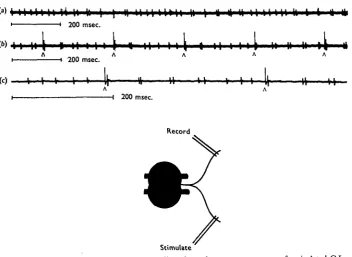
Free running occurs indefinitely in the motoneurones to the closer muscles of spiracles 1 and 2 after section of the connectives between G i l and G U I , and, as in pattern 2 c, there is no interaction or coupling between the units. Section of one G I -II connective and the contralateral G-II--III connective produces continuous free running in spiracle 1 while spiracle 2 remains synchronized with ventilation; the command interneurones therefore run through G i l from G U I to G I . In a prepara-tion in which G I is connected only with the head, stimulaprepara-tion of the head, mechani-cally or by light, accelerates free running which then slowly returns to its original frequency. Comparable stimulation of GI does not have this effect. If the head be-comes hypoxic, the frequency of free running declines and it may cease. Since spiracle 1 supplies the head directly with tracheae, control of its activity by the head is to be expected. After decapitation free running becomes insensitive to mechanical stimula-tion applied at any point.
cell. T h e alternative theory of a closed loop of cells which has been discussed by Kennedy & Preston (1963) can be discounted since there is no evidence for the necessary long refractory periods. Kennedy & Preston reached the same conclusion for the cells they were studying in crayfish ganglia. Biederman-Thorson (1966) has shown that many of the spontaneously active cells in crustacean ganglia derive their activity from intrinsic pacemakers, even when their firing pattern is not markedly regular, such cells having 'noisy' pacemakers.
(a> 1 II Ml | | It II |) | I l| I I H 11 Ml II ) I II II I l l l l l l l l > I M » 1 i 200 msec.
> *
111 1 i i » i » > * 11 1 > M i n 1 > 1 200 msec.
(c) k—+—I 1 k Ifr M H M 1 I
A
1 1 200 msec.
Record
[image:9.451.51.404.161.418.2]Stimulate
Fig. 6. Antidromic stimulation of and recordings from the transverse nerves of an isolated G I. (a) Free running without stimulation, (b, c) Stimulation with single shocks (A), which re-phase the spontaneous cycles of each motoneurone.
In some records the interval between the S spike and the subsequent P spike in the spiracle motor nerve was slightly longer than the normal pacemaking interval. This was most marked when the S spike followed closely after the preceding P spike and some examples are shown in Fig. 7. The juxtaposition of P and S spikes may produce a prolonged post-excitatory depression, or the delay may represent the activity of a negative feed-back mechanism which controls pacemaker frequency (cf. Bullock & Horridge, 1965, p. 314). However, the possible effects of stimulus spread cannot be excluded.
Normal pacemaker activity can be studied most readily in preparations in which one axon has been damaged proximal to the electrodes and the activity of the other alone is recorded. A histogram of the activity of one pacemaker recorded in this way is shown in Fig. 8, where it can be seen that the mean interval is 38 msec, with extreme values at 28 and 46 msec.
t , t
250 500 750 1000 1250 1500 1750
Time (msec.)
Fig. 7. Separate plots of consecutive impulse intervals for each motor unit supplying the closer muscle of spiracle 1. In the middle line, both units are shown. At arrows, antidromic shocks are given to the transverse nerve as in Fig. 6. x , stimulated spikes; O, pacemaker spikes. Stimu-lated spikes are sometimes followed by intervals greater than the normal spike interval.
140
120
100
80
40
20
n
N=529x=38 msec. S.D. =3-7 msec.
20 30 40 50
Spike interval (msec.)
The origin of motor activity in intact preparations
Antidromic stimulation of the transverse nerve has been applied to preparations with an intact nerve cord in an attempt to determine the contribution of the moto-neurone pacemakers to normal activity. When Locusta ventilates rapidly pattern
zb may be distinguished, but if ventilation is slowed by perfusion with 50% oxygen,
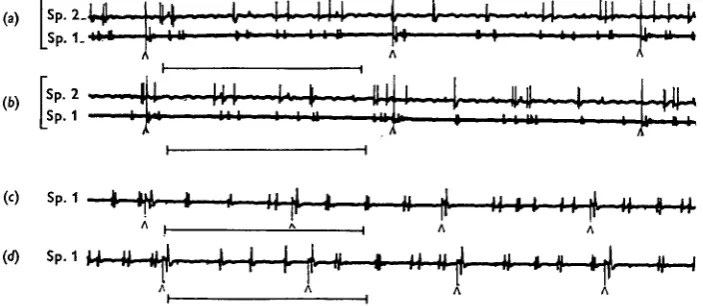
or by decapitation, pattern zb is often replaced by zc; that is, firing becomes more regular. During periods of 2 c firing, antidromic stimulation re-sets the cycle as in free running. Again the close proximity of P and subsequent S spikes sometimes results in a lengthened interval before the next P spike (Fig. gc and d). Pattern zc, therefore, like free running, seems to be solely due to the activity of the pacemakers which act independently of each other and of those in G i l .
(a)
4
sP. i . r t * (!• m M i> t 1 » |H- ' * »
A 1
sp.2 |L w—w±
Sp. 1 t U in 1 i uH
A
^
Fig. 9. (a, b) Simultaneous records from the transverse nerves to spiracles 1 and 2 of Schisto-cerca with cord intact during the delivery of single shocks (A) to the transverse nerve of spiracle 1 (lower line). Pattern za appears and antidromic stimulation does not affect the timing of the next natural impulse, (c, d). Records from spiracle 1 of Locusua during pattern 2 c firing when antidromic stimulation re-sets the timing of the next natural impulse. Horizontal scales below each trace = 200 msec.
When pattern 2 a appears, however, antidromic stimulation produces S spikes which are followed by natural spikes after a more variable interval. Moreover simultaneous records from spiracles 1 and 2, stimulation being applied to spiracle 1 alone, show that such natural spikes are often matched by spikes in the spiracle 2 nerve (Fig. ga, b). The spiracle 2 records act as a control for those from spiracle 1 and they suggest that S spikes are interpolated into the firing train without affecting the timing of subsequent spikes. Although spiracle 1 may be firing couplets at regular intervals, the timing at least of the first spike is not affected by the S spikes, and it can be concluded that during such firing the oscillation with the major period is determined by synaptic input and that the pacemakers are probably inactive.
[image:11.451.51.403.234.387.2]and 2; it may simultaneously suppress the activity of their pacemakers. Pattern 26 may sometimes be a mixture of a and c resulting from low activity in the command interneurone, or due to the effect of irregular suppression of pacemaker activity by inhibitory fibres. The spiracle motoneurones therefore seem to act either as segmental oscillators whose frequency can be adjusted, or as follower cells which are driven by a dominant oscillator in G U I .
Electrical stimulation of the command interneurones
As an alternative approach electrical stimulation has been applied to split bundles of the connectives between G I and Gil, after removal of GUI, in an attempt to activate the command interneurones and examine their effect on the segmental pacemaker activity. As previously mentioned the technique suffers from the major defect that the same fibres cannot be stimulated in successive preparations and that unavoidably a mass of axons is excited by each shock. Thus responses may be brought about via the natural pathways or by the activation of large numbers of axons none of which acts as the spiracle command fibre in the intact insect. However, the failure to affect the spiracle motoneruones by the simultaneous stimulation of large numbers of lateral afferent nerves, and the different effects of stimulation of different bundles of split connectives, suggest that massive and non-specific input does not account for the observed results.
Rowell (1964) has shown that dissociation of parts of the central nervous system of a locust drastically modifies the threshold of some reflex activities and the following preparations were therefore employed in the experiments:
1. Whole nervous system intact.
2. Central nervous system intact: all lateral thoracic nerves cut.
3. Connectives between G i l and G U I cut; lateral nerves of GI and G i l either all cut or left intact.
4. Connectives between G I and G i l cut; GI lateral nerves all cut or intact. 5. All the above preparations decapitated.
With the exceptions to be mentioned below, the choice of preparation did not affect the results. Although decapitation has marked effects on pacemaker activity, all the responses to connective stimulation could be obtained with or without the head. It was found most convenient to employ preparation 3 in which the fre-quency of free running could be kept low by the maintenance of hypoxic conditions in the head. Delicate control of the frequency was obtainable by opening and closing the cut ends of cephalic tracheae or by perfusion with hypoxic gases.
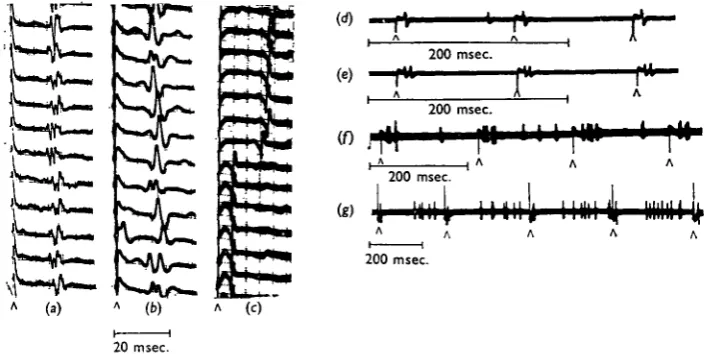
conduction in the spiracle motor axons taking place at 1 • 1-1 -5 m./sec and a total latency of 12—15 msec (Fig. 13), a ganglionic delay of 4-7 msec, can be postulated. This suggests the existence of at least one synapse. Since conduction velocity is probably slowed by the use of petroleum jelly, the central delay may be slightly shorter. Knights (1965) has pointed out that in dragonfly larvae an increased intensity of stimulation reduces central delays, part of the effect being due to spatial summation and part possibly to greater stimulus spread. Slight reductions of latency were obtained by increasing the intensity in spiracle motoneurone preparations, and with very high intensities it was possible to stimulate the motoneurones directly (Fig. 12c). High frequencies of stimulation on the other hand increased the latency, presumably due to synaptic fatigue as was found by Knights. Occasionally at low intensities of stimu-lation the latency was as great as 50 msec, and exceptionally 115 msec, when poly-synaptic pathways were probably involved. "
o x ° ° x o 0 X 0 o x o o
(a) Sp. 1 ^-i \\ t I w rl—U~ u H—t M H—'—' '—'
200 msec. (c)
o o x o o 0 0 0 0 x o o o v ' o o ox
&In" li'ii-'n "1 V 11' ,"1 n ' i , "
ti
a S p'
1t r r
. . A X . . . . . A X . . 2 0 0 m s e c .
[image:13.451.44.409.247.318.2]200 msec.
Fig. 10. Records from the spiracle nerves of Schistocerca with G U I removed, during the stimulation of a bundle of the split connective between GI and G i l with single shocks ( A ). The stimulated spikes are interpolated into free running activity with little or no perturbation
of the rhythm. In (a) and (c), records are from the spiracle i nerve; in (b) from the nerves of spiracles i and 2. The spontaneous firing of one unit is marked by O or • ; stimulated impulses are marked x .
Single shocks sometimes gave rise to responses which were interpolated into the free-running rhythm of spiracle i (in preparations without GUI) hardly affecting the timing of natural spikes in either axon. Examples are shown in Figs. 10 and n . In other preparations, however, where different bundles of axons were stimulated, the evoked response was sometimes followed either by a temporary acceleration of free running, or by a post-excitatory depression which lasted for twice the normal spike interval. 'Inhibitory' effects of this nature are discussed further below.
In preparations i and 2, with G III intact, a similar 1:1 response could be obtained during the expiratory phase when the motoneurones were naturally active, but stimulation failed to produce a response during inspiration when the units remained silent. Thus when the activity of the motoneurones is inhibited by G U I during inspiration, electrical stimulation is without effect; but when inhibition is produced as a result of hypoxic conditions in the head, in preparations without G U I , electrical stimulation is still effective. The inhibitory command interneurone from G U I must therefore act both on the pacemakers and at the synaptic regions of the cells. Head hypoxia, however, affects the pacemakers alone and thus does not prevent the spiracle from making movements synchronized with ventilation under conditions of respiratory stress, since it can still be driven by G U I .
P. L. MILLER
at a time when the normal spike interval was 80 msec. Such double firing is reminis-cent of that which sometimes occurs in flight motoneurones of the locust where Wilson (1964) has recognized an intrinsic refractory oscillatory mechanism. Double firing in response to a single input is also a feature of some Aplysia ganglion cells when they are fatigued or hyperpolarized (Tauc, 1962). Paired impulses occur in natural trains during pattern za firing in spiracle motoneurones of the locust, but it is not known if they also arise from a single input (cf. Hoyle, 1959). Electrical stimulation may of course be able to produce them by the activation of two central paths with different conduction rates.
0 r
10
20
30
40
500
Time (msec.)
1000 1500
1000 1500 2000 2500
Time (sec.)
Fig. 11. Plot of consecutive impulse intervals for each free-running unit separately of the spiracle 1 nerve (O—O ; • — • ) in Schistocera with G U I removed. Single shocks (arrows) are given to a bundle of the split connective between G I and G i l , and they interpolate im-pulses ( x ) into the spontaneous rhythm without re-setting it. Compare with Figs. 7 and 10.
Threshold stimulation of the connective produces either a response in both spiracle motoneurones or in neither. A response in one alone can be invoked only when its partner is in the refractory period of a preceding P spike. Normally the two units fire synchronously in response to stimulation, but in some preparations their latencies may vary by as much as 20 msec, even when pacemaker activity is suppressed (Fig.
12 d, e). The command interneurone may synapse with both motoneurones, but if only
one is caused to fire by a command its activity may in turn excite the other. No such interaction evidently occurs between the pacemaker zones.
Inhibitory effects. By the stimulation of different split bundles of the connective
response was followed by a high frequency of free running. A gradual reduction of intensity produced the same sequence in reverse.
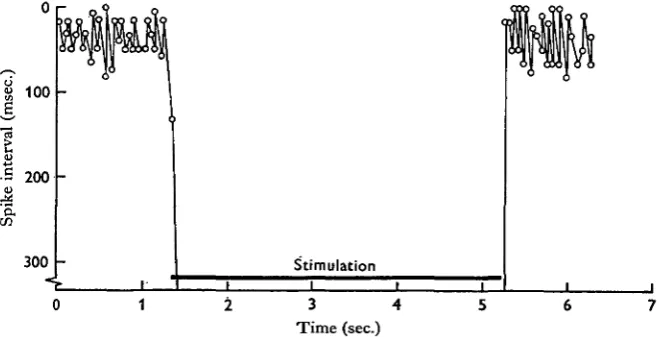
Stimulation at about 40 shocks/sec may produce a 1:1 response with every second shock, but after several seconds the response gradually disappears as the synapse fatigues. After a few seconds rest it can again be obtained. At 50/sec. no response is obtained, free running is inhibited and the nerves remain silent (Fig. 14); inhibition may outlast the period of stimulation by several seconds.
High-frequency stimulation may produce a cessation of synaptic responses as a result of post-excitatory depression or fatigue and this may also affect the pacemaker zone. Low-frequency stimulation (5/sec) at low intensities, however, probably causes inhibition by the activation of a specific inhibitory command fibre. It has not so far been possible to obtain in one and the same preparation separate connective bundles whose stimulation produces either excitation alone or inhibition alone, although each has been obtained on different occasions.
200 msec.
200 msec.
(0
200 msec.
(*) i u [ \ \ i \ \ \ \\t\\{ minii
200 msec.
[image:15.451.51.406.253.430.2]20 msec.
Fig. 12. Records from the transverse nerves of spiracles i and 2 during the stimulation of a bundle of the split connective between GI and G i l with single shocks (A ) in preparations with G U I removed, (a) 1:1 responses in the spiracle 2 nerve, both axons firing after a latency of about 16 msec.; the shock artifact starts the sweep, (b) The same for spiracle 1 which responds after a similar latency, (c) The same for spiracle 1 during a gradual increase of stimu-lus intensity (read from top to bottom). The latency is reduced slightly at higher intensities and a further increase in intensity then abruptly reduces it to about 5 msec, as the motoneurones are stimulated directly, (d) 1:1 responses to shocks delivered at 8/sec.; free running is suppres-sed and the units respond synchronously, (e) As in (d) but the two units fire 5 msec, apart. (/) Double firing in response to single shocks at 5/sec.; in each couplet the spikes are about 15 msec, apart and free running starts after a further 60—90 msec, (g) Shocks at 4/sec. produce a 1:1 response followed by a depression lasting more than twice the normal pacemaker cycle.
364
24
16
8
Spiracle 1
N=43
x=10 msec.
S.D.=1-8 msec.
-j
1
1 1 1 1 1
h
40
32
8 24
16
2 4 6 8 10 12 14 Latency (msec.)
Spiracle 2 N=86 x=14 msec, so. = 3-4 msec.
8 10 12 14 Latency (msec.)
16 18 20
Fig. 13. Histograms of the latencies of the first response of spiracles 1 and 2 when shocks are given to a bundle of the split connective 1 mm. from G I and 3 mm. from GIL The latency includes cord and transverse nerve conduction times as well as synaptic delays.
O r
8 100
•5 200
a
in
300 - Stimulation
_L J L
[image:16.451.68.398.445.613.2]0 1 2 3 4 5 6 7 Time (sec.)
The acceleration of free running. Following stimulation at high or low frequencies
there is often a prolonged period during which free running continues at an enhanced frequency; it may last for more than 15 min. and can occur in preparations with or without the head (Figs. 15 and 16). Stimulation of bundles of the split G I - I I
con-70
1-60
50
40
30
3
a
I 20
10
\
10 20 30 40 50 60 70 280 290
[image:17.451.49.393.137.359.2]Time (sec
Fig. 15. Plot of the frequency of impulses (both axons) against the time before and after a brief inhibition (bar) produced by connective stimulation as in Fig. 14, showing the gradual return to the original frequency which takes several minutes.
120 r
100
8 0
60
JS 40 a,
t—1
20
4 5 6 7 8 Time after end of inhibition (sec.)
10 11
[image:17.451.55.399.406.606.2]nective has occasionally produced acceleration with no other effect. This can take place via G i l , since it will also occur in the spiracle i motoneurones after section of the connective between stimulating electrodes and GI. Stimulation of the lateral nerves of G I does not produce an enhancement of frequency. Comparable long-lasting effects were found in cockroach ganglia by Luco (1963) after electrical stimu-lation, and by Kennedy and Preston. (1963) in crayfish ganglion cells.
The effects of the gradual application of a block to the GI-II connective
In order to distinguish between the activities of the postulated command inter-neurones, one connective between GI and G i l was progressively blocked either by mechanical damage or by cooling. The other connective was previously cut and the changes in activity of the spiracle 1 nerve were examined. A mechanical block was
Table 1. The five deviations from the normal firing plan of the spiracle 1 motoneurones to
the closer muscle which are produced by the gradual application of a cold block to one connective between GI and Gil, the contralateral connective being cut
Expiratory pattern Inspiratory pattern 1 Normal Free running 2 No high-frequency burst Normal 3 Gradual re-placement pattern 2 a
2C
Normal
of by
4
As in 3
Gradual ap-pearance of free running
S
In hypoxic prepara-tions, gradual dis-appearance of all activity
applied by cutting in turn each bundle of a split connective. The cold block was applied by lifting the connective on a metal hook which was cooled by evaporating ether under reduced pressure in a closed vessel. Such treatment produced a complete block of all activity but was fully reversible when the hook was allowed to return to room tempera-ture. It was thus possible to apply the block several times to the same preparation. Some difficulty in the interpretation of the results is encountered since ventilation was modified considerably by the treatment and this must be distinguished from the selective inactivation of interneurones which supply the spiracle motoneurones.
Five deviations from the normal firing plan were observed during the gradual appli-cation of a block, although not all in the same preparation; they are shown in Table i. No. 2 (in Table i) probably results from the general slowing of ventilation which is produced by the block, while nos. 4 and 5 are likely to be the result of the complete loss of contact between G I and GUI. However, nos. 1 and 3 are firing plans which are peculiar to this treatment and have not been seen under different circumstances. No. 1 may be explained by the selective block of an inhibitory interneurone and no. 3 by that of an excitatory interneurone which produces pattern za.
DISCUSSION
ganglia of the dragonfly abdomen. Nevertheless, their activity is subject to considerable variation and different motor patterns may be used on different occasions to achieve a maintained closure of the spiracle. Similarly, Ewing & Manning (1966) found that in different individuals of the same species of cockroach, and in different species, similar leg movements were not always achieved by the same motor patterns.
The activity of the spiracle motoneurones is compounded from two sources, the segmental and the metathoracic ganglion, and it may be further affected by head ganglia. The contribution of the segmental ganglion (GI for spiracle 1) is a regular smooth pattern of firing, usually independent in the two units, brought about by the activity of pacemakers which lie in some part of the motoneurone. The metathoracic ganglion drives the motor units via command interneurones and in doing so may suppress the activity of the pacemakers. This driven activity comprises a high-frequency burst (pattern 1) at the beginning of expiration and a maintained barrage of firing for the remainder of the stroke (pattern za). The regularity of firing and smooth decline in frequency of the high-frequency burst suggest that there is a sudden and maintained depolarization of synaptic regions in both units which produce the rapid discharge in spike-initiating zones with pacemaker properties, possibly some way from the synapses. Spiracles 1 and 2 appear to be controlled independently since either alone can produce a high-frequency burst, or it can occur in both at different frequencies. Pattern 2 a, which often follows the burst, comprises regular trains of impulses usually synchronized in the two axons and sometimes occurring in couplets in each. Such activity is often synchronized, impulse for impulse in spiracles 1 and 2, suggesting that one command interneurone excites both on a 1:1 basis. Antidromic stimulation of the transverse nerve does not affect this firing plan and local pacemaker action seems to play no part at least in the establishment of the major periods. Such an interneurone may fire at 20/sec. when the overall frequency in each motor axon is 40/sec, if the second spike of each couplet occurs as a result of an oscillation within the motoneurone. Wilson (1964) has shown this to be the case in the double firing of flight motoneurones, but the evidence is inconclusive for the spiracles.
branches 'take on almost the integrative role of separate internuncial elements'. A similar situation has been demonstrated by Tauc & Hughes (1963) in certain Aplysia neurones where not all branches of an axon are invaded by a spike. In other locust preparations, however, 1:1 responses in the spiracle nerves may be followed by tem-porary depressions before normal pacemaker firing is resumed. This may result from the simultaneous stimulation of excitatory and inhibitory interneurones, the latter with a slower conducting speed, which are both included in some bundles but not in others. But alternatively there may be weak interaction between synaptic and pace-maker regions, and differences between preparations may sometimes depend on their ages or on the extent of damage to tracheae during dissection. The possible effects of stimulus spread acting directly on synapses cannot be excluded.
Pattern zc, like free running, comprises regular and independent firing in the two motoneurones and it is probable that G U I plays no part in its production beyond exercising a general effect on the frequency. Such activity can be re-phased by anti-dromic stimulation of the transverse nerve before or after the removal of G U I and is quite independent in adjacent spiracles.
In adult dragonflies spiracle closure is maintained by a pattern of firing in the two axons which closely resembles free running in the locust. Activity corresponding to pattern 2 a has not been seen and it appears that the dragonfly lacks the interneurone responsible for this pattern (Miller, 1965). The presence of an excitatory command interneurone responsible for pattern za in the locust may be explained by the need to maintain spiracle closure at times when free running is slowed by hypoxic conditions in the head. Such activity will then permit abdominal pumping to maintain an efficient through-conduction of air and prevent ventilation from becoming tidal, which prob-ably happens in dragonflies under such conditions.
A tentative model for the arrangement and connexions of one motoneurone supply-ing the closer muscle of spiracle 1 is shown in Fig. 17. It is depicted with separate pacemaker and synaptic regions and with two inhibitory and three excitatory inter-neurones which make synaptic connexions. The interneurone responsible for pattern
za is shown as synapsing in a separate region of the motoneurone from that which
motoneurone such spontaneity is expressed at times, and can in some species con-tribute to the motor output, as well as possibly maintain the cell in a poised state of readiness.
Spike-initiating zone
Pacemaker
Frequency adjuster
Pattern 1 interneurone
To other spiraclei motoneurone
Spike-initiating zone
Pattern 2a interneurone
Inhibitory interneurone
from head
Inhibitory interneurone
from G III
Fig. 17. Model of the hypothetical lay-out and connexions of one motor unit supplying the closer muscle of spiracle 1. Explanation in the text.
SUMMARY
1. Three principal motor patterns have been distinguished in the nerves to the closer muscle of spiracle 1 of the locust. Pattern 1 brings about muscular contraction and spiracle closing; pattern 2 maintains the closure and may be brought about either by the activity of pacemakers located in each motoneurone or by synaptic activity or by a mixture of both. The possible origins of pattern 2 activity have been located by antidromic stimulation and by observations on the occurrence of impulse synchron-ization between the units of one segment and those of adjacent segments. In pattern 3, firing slows or stops and the spiracle opens.
2. In most individuals of Locusta, pacemaker activity predominates in pattern 2 firing, while in Schistocerca synaptic activity is more common. Different individuals of either species may remain consistent to one firing plan for long periods; their effect at normal frequencies at the muscle is indistinguishable.
pacemakers, and in the intact insect are believed to bring about accurate synchroniza-tion of the spiracle movements with abdominal pumping.
I am indebted to the Science Research Council for financial support, and to the Anti-Locust Research Centre for the supply of locusts.
REFERENCES
BIEDERMAN, M. A. (1964). Response of spontaneous units in crayfish ventral cord to direct current.
Comp. Biochem. Physiol. 12, 311—30.
BIEDERMAN-THORSON, M. A. (1966). Some mechanisms for unit activity in isolated crayfish central nervous systems.^, gen. Physiol. 49, 597-612.
BULLOCK, T. H. & HORRIDGE, G. A. (1965). Structure and Function in the Nervous System of Inverte-brates. San Francisco and London: W. H. Freeman and Co.
EWING, A. W. & MANNING, A. (1966). Some aspects of the efferent control of walking in three cockroach species. J. Insect Physiol. 12, 1115—18.
FIELDEN, A. (i960). Transmission through the last abdominal ganglion of the dragonfly nymph. J. exp. Biol. 37, 832-44.
FIELDEN, A. & HUGHES, G. M. (1962). Unit activity in the abdominal nerve cord of a dragonfly nymph. J. exp. Biol. 39, 31-44.
HAGIWARA, S. (1961). Nervous activities of the heart in Crustacea. Ergebn. Biol. 24, 287-311. HOYLE, G. (1959). The neuromuscular mechanism of an insect spiracular muscle. .7- Insect Physiol. 3,
378-94-HUBER, F. (i960). Experimentelle Untersuchungen zur nervosen Atmungsregulation der Orthopteren (Saltatoria, Gryllidae). Z. vergl. Physiol. 43, 359-91.
IWASAKI, S. & WILSON, D. M. (1966). Neuropile potentials following wing sensory nerve stimulation in locusts. Comp. Biochem. Physiol. 17, 693-5.
KENNEDY, D. & PRESTON, J. B. (1963). Post-activation changes in excitability and spontaneous firing of crustacean interneurones. Comp. Biochem. Physiol. 8, 173-9.
KNIGHTS, A. (1965). The activity of single motor fibres in arthropods. I. The dragonfly nymph. J. exp. Biol. 42, 447-61.
Luco, J. V. (1963). Plasticity and the natural response of a nervous organization. In Perspectives in Biology (eds. C. F. Cori, V. G. Foglia, L. E. Leloir and S. Ochoa), pp. 355-60. Amsterdam. MAYNARD, D. M. (1955). Activity in a crustacean ganglion. II. Pattern and interaction in burst
forma-tion. Biol. Bull. mar. biol. Lab. Woods Hole 109, 420-36.
MILL, P. J. & HUGHES, G. M. (1966). The nervous control of ventilation in dragonfly larvae.^, exp. Biol. 44. 297-316.
MILLER, P. L. (1960a). Respiration in the desert locust, II. The control of the spiracles. J. exp. Biol. 37,
237-O3-MILLER, P. L. (19606). Respiration in the desert locust, III. Ventilation and the spiracles during flight. J. exp. Biol. 37, 264-78.
MILLER, P. L. (1965). The central nervous control of respiratory movements. In The Physiology of the Insect Central Nervous System (eds. J. E. Treherne and J. W. L. Beament), pp. 141—55. London and New York: Academic Press.
MILLER, P. L. (1966). The regulation of breathing in insects. In Advances in Insect Physiology, vol. 3 pp. 279-354 (eds. J. W. L. Beament, J. E. Treherne and V. B. Wigglesworth). London and New York: Academic Press.
NARAHASHI, T. (1963). The properties of insect axons. In Advances in Insect Physiology, vol. i, pp. 175-256 (eds. J. W. L. Beament, J. E. Treherne and V. B. Wigglesworth). London and New York: Academic Press.
PRESTON, J. B. & KENNEDY, D. (1962). Spontaneous activity in crustacean neurons. J. gen. Physiol. 35, 831-36.
ROEDER, K. D. (1966). Interneurons of the thoracic nerve cord activated by tympanic nerve fibres in noctuid moths. J. Insect Physiol. 12, 1227-44.
ROWELL, C. H. F. (1964). Central control of an insect segmental reflex. I. Inhibition by different parts of the central nervous system. J. exp. Biol. 41, 559—72.
TAKEDA, K. & KENNEDY, D. (1965). The mechanism of discharge pattern formation in crayfish inter-neurones. J. gen. Physiol. 48, 435-53.
TAUC, L. (1962). Identification of active membrane areas in the giant neuron of Aplysia. J. gen. Physiol. 35. 1090-116.
WILSON, D. M. (1961). The central nervous control of flight in a locust. J. exp. Biol. 38, 471-90. WILSON, D. M. (1964). Relative refractoriness and patterned discharge of locust flight motor neurons.
J. exp. Biol. 41, 191-205.
WILSON, D. M. & DAVIS, W. J. (1965). Nerve impulse patterns and reflex control in the motor system of the crayfish claw. J. exp. Biol. 43, 193-210.
WILSON, D. M. & WEIS-FOGH, T. (1962). Patterned activity of coordinated motor units, studied in flying locusts. J. exp. Biol. 39, 643-67.
WILSON, D. M. & WYMAN, R. J. (1965). Motor output patterns during random and rhythmic stimula-tion of locust thoracic ganglia. Biophys. J. 5, 121—43.