28
Extraction of Message Sequence Charts from Narrative History Text
Girish K. Palshikar Sachin Pawar Sangameshwar Patil Swapnil Hingmire Nitin Ramrakhiyani Harsimran Bedi
{gk.palshikar,sachin7.p,sangameshwar.patil}@tcs.com
{swapnil.hingmire,nitin.ramrakhiyani,bedi.harsimran}@tcs.com
TRDDC, TCS Research and Innovation, India
Pushpak Bhattacharyya
IIT Patna, India
Vasudeva Varma
IIIT Hyderabad, India
Abstract
In this paper, we advocate the use of Mes-sage Sequence Chart (MSC) as a knowledge representation to capture and visualize multi-actor interactions and their temporal ordering. We propose algorithms to automatically ex-tract an MSC from a history narrative. For a given narrative, we first identify verbs which indicate interactions and then use dependency parsing and Semantic Role Labelling based approaches to identify senders (initiating ac-tors) and receivers (other actors involved) for these interaction verbs. As a final step in MSC extraction, we employ a state-of-the art algorithm to temporally re-order these inter-actions. Our evaluation on multiple publicly available narratives shows improvements over four baselines.
1 Introduction
Narrative texts, particularly in history, contain rich knowledge about actors and interactions among them along with their temporal and spatial de-tails. For such texts, it is often useful to ex-tract and visualize these interactions through a set of inter-related timelines, one for each ac-tor, where the timeline of an actor specifies the temporal order of interactions in which that ac-tor has participated. Message Sequence Chart (MSC) is an intuitive visual notation with rigor-ous mathematical semantics that can help to pre-cisely represent and analyze (Alur et al., 1996) such scenarios. Feijs (2000), and Li (2000) pro-pose techniques to convert software requirements to MSC. Event timeline construction is a related task about inferring the temporal ordering among events, but where events are not necessarily inter-actions among actors (Do et al., 2012). Another related line of research is storyline or plot gen-eration from narrative texts such as news stories or fiction (Chambers and Jurafsky,2009;Vossen
et al.,2015,2016;Goyal et al., 2010;Kim et al.,
2018), which uses different narratological out-put representations (not MSC), such as event se-quences or story curves.
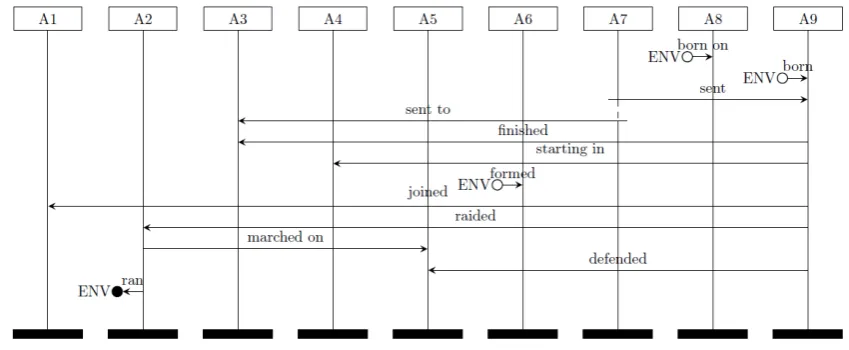
In this paper, we extract actors and their in-teractions from the given input history narrative text, and map them to actors and messages in the basic MSC notation. We generalize the pre-vious work along several dimensions, and pro-pose anunsupervised approach enriched with lin-guistic knowledge. MSC extracted from the given history text can be analyzed for consis-tency, similarity, causality and used for applica-tions such as question-answering. For example, from the example in Table1we extract the MSC as shown in Figure1, which can be used to answer questions like"Whom did Napoleon defend the National Convention from?". To the best of our knowledge, this is the first work that uses MSC to represent knowledge about actors and their in-teractions in narrative history text. Our approach is general, and can represent interactions among actors in any narrative text (e.g., news, fiction and screenplays). We propose unsupervised ap-proaches using dependency parsing and Semantic Role Labelling for extracting interactions and cor-responding senders/receivers. We use a state-of-the-art tense based technique (Laparra et al.,2015) to temporally order the interactions to create the MSC.
2 Problem Definition
Figure 1: MSC for the example history text.
1. Napoleon Bonaparte was born in 1769 on the island of Corsica.
2. When he was 9 years old, his parents sent him to a military school.
3. He finished school in 1785 before starting in the artillery department.
4. When the new government was formed , Napoleon joined its army.
5. When royalist rebels marched on the National Convention in October 1795,
the young officer defended it. 6. The rebels then ran away in panic.
7. Three months earlier, Napoleon had raided the rebels.
Table 1: Sample narrative text. Implicit and explicit temporal expressions are underlined.
with other actors. The reason for includingLOC
entities as actors is that locations are important in history, and a timeline of events at a partic-ular location provides an interesting perspective. Further, we also need to identify all coreferences of an actor and use acanonical (i.e., a standard-ized, normalized) mention for each; e.g., In Ta-ble 1, the actor mentions, Napoleon Bonaparte, Napoleon, he and the young officer refer to the actorNapoleon Bonaparte.
An interaction among actors is either (i) any deliberate (intentional) physical action, which is typically initiated by one or more actors and the remaining actors involved in it are affected by it in some way (e.g. attacked, joined), or (ii) communication, which results in passing of infor-mation or control among them (e.g. announced, talked).
We focus on interactions involving one or two actors. An interaction with itself involves only
one actor; e.g., the attackers fled. When more than two actors are involved in an interac-tion (e.g.,Napoleon’s parents sent him to a military school.), we break it into several pair-wise interactions, if possible. On the other hand, if the sender or receiver in an interaction are miss-ing, we use a dummy actorenvironment(denoted by ENV) as the corresponding sender or receiver. For instance, in the sentence "The rebels ran away in panic", there is no explicit receiver. So, as shown in Fig.1, we use ENV as the receiver for the message, i.e., we create the message(The rebels; ran; ENV).
Since we represent an interaction as a message in an MSC, the direction of the interaction is im-portant. We assume the direction to be from the initiator of the interaction to the actor affected by it. However, some interactions can be direction-less; e.g.,met, married. In such cases, we show the subject of the sentence as sender of the mes-sage in MSC. Though our notion of an interac-tion is similar to an event, a key difference be-tween them is that there is explicit and intentional involvement of actors in an interaction; e.g., an earthquakeis an event but it is not an interaction.
2.1 Scope
In this paper, we focus on interactions expressed using verbs because most of the action events in a language are expressed using verbs. We con-sider interactions expressed using nouns as part of future work. Not all interactions in history nar-ratives are important for creating an MSC. E.g., mental actions, such asfelt cheated, came to know, assumed, considered, envisioned, are not considered as interactions. Copula verbs and verbs denoting a state of an object or actor also do not trigger an interaction and hence, such verbs are ignored.
3 MSC Extraction
3.1 Actor Identification
We first make one pass through the text and iden-tify all the actors who are involved in one or more interactions. We group all co-referring mentions of an actor into a set, and choose one canonical mentionas a representative on the MSC. One com-plication can occur due tocomplex actors, which is an actor that contains multiple actors, one of which is independent and the others are depen-dentand serve to elaborate on the independent ac-tor; e.g.,his parents, military school, the army of the new government. We need to iden-tify a complex actor as a whole, and not its con-stituent actors separately. We use the algorithm in (Patil et al.,2018) to identify an actor and all its coreferents.
3.2 Interaction Identification
Typically the input text mentions many different interactions, and identifying each verbal interac-tion is required, omitting non-interacinterac-tions as dis-cussed in Section 2.1. A simple algorithm clas-sifies each verb in the given sentence as an ac-tion verb or a communication verb (and ignores other types of verbs) using WordNet hypernyms of the verb itself or its nominal forms. For ex-ample, for the verbdefended, one of its nominal forms,defence, has the categoryactin its hyper-nym tree; so it is classified as an action verb.
Since we are focusing on interactions that have already occurred, we focus on verbs in the past tense. In some cases, a verb not in the past tense, should also be considered as hav-ing past tense; e.g., in Growing up in rural Hunan, Mao described his father as a stern disciplinarian, “Growing” should be
considered to be in the past tense. To achieve this, we systematicallypropagatethe past tense to other verbs using linguistic rules. To detect verbs in past tense, we traverse the dependency parse tree of the input sentence in breadth-first-search (BFS) manner. A verb having POS tag ofVBDis definitely in the past tense. A verb withVBG or VBNPOS tag is considered to be in past tense if: (i) it is a child of another verb tagged withVBD; or (ii) it is the parent of an auxiliary verb tagged with VBD. An infinitive verb is deemed to be in past tense if it has a governor in the dependency tree with dependency relation either advcl:to or xcomp and the governor is tagged with VBD. In the above sentence, described is tagged with VBD and hence it is in past tense; Growing is tagged withVBGand is child ofdescribedin the dependency parse tree; hence, it is also considered to be in the past tense.
3.3 Message Creation
We need to map each identified interaction to one or more messages in the output MSC. We also need to identify the sender (initiator of the inter-action) and receiver (other actors involved in the interaction) for each message. We have developed several approaches for identifying a set of senders (SX) and a set of receivers (RX) for each valid interaction verb. IfSX andRX are both empty, we ignore that interaction. If only one of them is empty, we add a special actorEnvironment(ENV) to that set. Once such sets are identified, a mes-sage is created for each unique combination of a sender and a receiver for a particular interaction verb.
Dependency parsing-based Approaches: We developed two approaches for message creation based on dependency parsing output: i) Baseline B1 which directly maps the dependencies output to messages and ii) ApproachM1(Algorithm 1) which builds on the dependencies output by apply-ing additional lapply-inguistic knowledge. We use Stan-ford CoreNLP (Manning et al.,2014) for depen-dency parsing.
Approach M1 improves upon this baseline by generalizing connections between the verb and po-tential senders and receivers. Rather than consid-ering only direct connections in dependency tree, M1 identifies certain actors as senders which are connected to the verb with a set of allowable de-pendency paths such as nmod:poss → nsubj or nsubj → advcl (lines 3-9 in Algorithm 1). E.g., consider the sentenceBravery of Rajputs pushed the Mughals back. Here, Rajputs is not directly connected to pushed in the depen-dency tree. Still, M1 would be able to identify Rajputs as sender because its dependency path to the verb pushed isnmod:of → nsubj. Sim-ilarly, M1 identifies certain actors as receivers which are descendants of the verb in the depen-dency tree and the dependepen-dency paths connect-ing them to the verb satisfy certain properties such as “no other verb is allowed on the path” (lines 10-13 in Algorithm 1). Presence of an-other intermediate verb on such dependency path is a strong indicator that the receiver is an ar-gument for the intermediate verb. For example, in the sentence Crossing the Alps, Napoleon attacked Italy., “the Alps” is not a valid re-ceiver for the verbattackedbecause another verb Crossingoccurs on the dependency path connect-ingthe Alpstoattacked.
SRL-based Approaches: We developed two ap-proaches for message creation based on SRL: i) Baseline B2 which directly maps the SRL out-put to messages and ii) Approach M2 (Algo-rithm 2) which builds on the SRL output by applying additional linguistic knowledge. We use MatePlus (Roth and Lapata, 2015) for SRL which produces predicate-argument structures as per PropBank (Kingsbury and Palmer,2002). The baseline B2 simply maps each verbal predicate corresponding to an interaction verb to a set of messages. Actors corresponding to A0 arguments of a verbal predicate are identified as senders whereas actors corresponding to other arguments are identified as receivers.
Approach M2 improves upon this baseline by using VerbNet (Schuler, 2005) roles (the func-tion vnrole) associated with PropBank argu-ments. Certain selectional preferences are used on these VerbNet roles, so as to qualify them as valid senders or receivers. These preferences are based on the linguistic knowledge and the details are described in the Algorithm 2. E.g.,
consider the sentencePeter described John as very polite. Here, for the communication verb describe, vnrole (describe.01.A1) = theme. As per our linguistic rule, even if any actor is part ofthemeof a communication verb, that actor does not qualify to be a receiver, as it is not directly participating in the interaction. Line 18 in Algo-rithm2encodes this rule, thereby not allowing any actor which is part of a theme to be a receiver. Hence, in this example sentence,Johnwill not be a receiver fordescribe.
Algorithm 2 also handles a special case about Ergativeverbs which lie in between the spectrum of transitive and intransitive verbs. Their most distinguishing property is that when an ergative verb does not have a direct grammatical object, its grammatical subject plays an object-like role. E.g., consider following two sentences containing an ergative verbmove:
S1:Mao’s father moved him to a hostel. S2:Mao moved to Beijing.
In S1, moved has an object but in S2, it does not have any direct object. Semantic Role Labelling would assign the role A1 (thing moving) toMaoin S2 and hence it can not be a sender. But as S2 indicates that the actor (Mao) is willingly perform-ing the action of movperform-ing, we expectMao to be a sender. Hence, for an ergative verb, even if the SRL assigns A1 role to an actor, we consider such an actor for being sender if no A0 role is assigned for the ergative verb by the SRL (lines 9-13 in Al-gorithm2).
Combined SRL and Dependency parsing based Approach (M3): SRL tools are useful to identify senders and receivers of a message, but they do have a few important limitations. E.g. (i) SRL tool may fail to identify any A0 even when it is present or when it assumes the verb does not require A0 in the sentence; (ii) the identified A0 may be wrong or cannot be considered as a sender; (iii) SRL tool may fail to identify any A1/A2 even when it is present; (iv) the identified A1/A2 may be wrong or cannot be considered as a receiver.
Algorithm 1:create messages M1
input :s(sentence),A(set of known actors with coreferents),v(interaction verb),
DP OSS={nmod:poss, nmod:of},
DS={nsubj, nmod:agent},DR= {dobj, iobj, nmod∗, xcomp, nsubjpass, advcl:to},DI={advcl:to, xcomp}
output :SX= set of senders,RX= set of receivers
1 SX, RX:=∅
2 Ed:=GetDependencyT ree(s)
// Ed is set of tuples of the form
(a, b, dr) where a is governor of b
with dependency relation dr
3 foreachactora∈As.t.ahas mention insdo
4 if(v, a, ds)∈Ed ∧ ds∈DSthen
SX:=SX∪ {a};continue
5 if(v, a, nmod:∗with)∈Edthen
SX:=SX∪ {a};continue
6 if∃u s.t.(u, v, advcl∗)∈Ed∧(u, a, ds)∈
Ed ∧ ds∈DSthen
7 SX:=SX∪ {a};continue
8 if∃u s.t.(v, u, ds)∈Ed ∧ ds∈DS ∧ u.ner=
OT HER ∧ (u, a, dp)∈Ed ∧ dp∈DP OSS
then SX:=SX∪ {a};continue
9 if∃b s.t. b∈SX ∧ (b, a, nmod:∗with)∈Ed
then SX:=SX∪ {a};continue
10 foreachactorb∈A\SXs.t.bhas a mention in s and ∃pathPfromvtobinGusingEddo
11 if∃u6=v s.t. u.P OS=V B∗ ∧u∈ P ∧ (v, u, dr)∈Ed ∧ dr /∈DIthen
continue
12 if∃u6=v s.t. u.P OS=V B∗ ∧u∈ P ∧ (v, u,∗)∈/Edthen continue
13 if∃xinP s.t.(x, b, dr)∈Ed ∧ dr∈DRthen
RX:=RX∪ {b}
14 return(SX, RX)
cordial reception and was loaded with
gifts., MatePlus (in M2) identifiesHeas A0 for accorded, which is wrong becauseHe is not the initiator of this interation; He should be A1 for accord. We correct this by using the fact that B1 (dependencies based approach) detects the nsubjpassdependency betweenaccordedandHe and identifiesHeas receiver. As another example, for His father united him in an arranged marriage to Luo Yigu, thereby uniting
their land-owning families., MatePlus does not identify any A0 foruniting, where the true A0 isHis father, which we correct using the de-pendency parse in whichHis fatheris connected tounitingthrough the pathnsubj→advcl.
3.4 Message Label Generation
We propose a simple algorithm for generating a clear and intuitive label for each message, covering various scenarios. For a verbal event, the label includes the main verb (joined), followed by a particle if present (set up), a preposition
Algorithm 2:create messages M2
input :s(sentence),A(set of known actors with coreferents),v(interaction verb),
B0={agent, theme, cause},
B1={experiencer},
B2={AM LOC, AM DIR},
B3={asset, cause, extent, instrument,
stimulus, time, topic, theme, predicate},
B4={theme},B5={agent, theme}
output:SX= set of senders,RX= set of receivers
1 H :=M ateP lus(S);// output of MatePlus
2 SX, RX:=∅;
3 ifv /∈H∨is copula like(v)then return(SX, RX)
4 ifH.vhas argumentA0then
5 x:=H.v.A0.phrase;
6 ifxcontains an actor fromAthen
7 ifvnrole(H.v.A0)∈B0∨(is comm(H.v)∧
vnrole(H.v.A0)∈B1)then
8 SX:=SX∪ {get actor(x, A)};
9 else ifis ergative(v)∧H.vhas argumentA1then
10 x:=H.v.A1.phrase;
11 ifxcontains an actor fromAthen
12 ifvnrole(H.v.A1)∈B5then
13 SX:=SX∪ {get actor(x, A)};
14 foreachargumentAi(i >0) inH.vdo
15 x:=H.v.Ai.phrase;
16 ifxcontains no actor fromA\SXthen continue
17
18 ifH.v.Ai∈B2∨vnrole(H.v.Ai)∈/
B3∨(is action(H.v)∧H.v.Ai∈B4)then
19 RX:=RX∪ {get actor(x, A)};
20 ifH.vhas another predicatev0as argumentthen
21 SX0, RX0:=create messages M2(S, A, v0);
22 RX:=RX∪RX0;
23 return(SX, RX)
if present (cut off from), a negation if present (not cut off from), a secondary verb if present (infinitive, gerund or past participle), which also may be followed by a particle and/or prepo-sition (set up to defend, helped organize, set up for taking away from). The general syntax of our message label is given by the regex: NEG? MAIN VERB PARTICLE? (PREP|to)? (NEG? SECONDARY VERB PARTICLE? PREP?)?. We do not include adverbs, nor any nominal ob-jects and arguments as part of the message label. We also do not include any auxiliary or modal verbs; e.g., from had fled, was elected we get the message labelsfled, elected. Syntactic verbal structures such as could have helped indicate interactions that may not have taken place; so no messages are created for them.
3.5 Temporal Ordering of Messages
over-all high-level goal of automated MSC extraction. To order the messages, it is important to assign a temporal anchor to each message. A temporal an-chor is a point in time (such as1795-10-01), at which an interaction has happened. The granular-ity of the temporal anchor is defined at the level of a year (1795), a month (1795-10) or a day (1795-10-01), but not lower.
We can observe sentences in a narrative which contain explicit time expressions (timex). Explicit timex are date points which are self-contained (e.g., October 1795) or can be resolved based on previously occurring dates (e.g.,Three months earlier). Temporal anchors of messages in such sentences can be assigned normalized values of the explicit timex. To achieve this, we first iden-tify these explicit timex and normalize them using the Heideltime timex recognizer and normaliza-tion system (Str¨otgen and Gertz,2015). Secondly, the normalized explicit timex is assigned as the temporal anchor of the message which is present in the sentence. In case of sentences with multi-ple message verbs, the normalized explicit timex is assigned as the temporal anchor of the message which has its main verb nearest to the timex in the sentence’s dependency tree.
However, it is important to note that messages may be in sentences without any explicit timex. In order to find the temporal anchor of such messages we employ the “document level time-anchoring (DLT)” algorithm proposed by (Laparra et al.,
2015). The algorithm takes a list of messages (as per the text order) and document creation time (DCT) as inputs. The key assumption behind the algorithm is that all the messages of exactly same tense tend to occur in the text order, unless stated explicitly. In other words, the author will men-tion an explicit timex for the current message with tense t, only if its temporal anchor is different from the anchor of the last message of tenset.
The algorithm proceeds as follows: If a mes-sagem has a time anchortobtained from an ex-plicit timex, thent is stored in a tense-to-anchor map as the last seen anchor associated with the tense ofm. However, ifm does not have a tem-poral anchor assigned, then the last seen anchor of the message’s tense is obtained from the tense-to-anchor map and set asm’s temporal anchor. If the tense-to-anchor map does not have a mapping form’s tense then the provided DCT is set asm’s temporal anchor.
Once all messages are assigned some temporal anchor, a simple sorting algorithm is used to order the messages based on their anchors. While sort-ing it is taken care that the assumption ofordering messages with the same temporal anchor by their text orderis maintained.
4 Experimental Evaluation
4.1 Datasets
We evaluate our approach on history narratives as they are replete with multiple actors, spatio-temporal details and have varied forms of interac-tions. We choose public narratives of varying lin-guistic complexity to cover a spectrum of history: (i) famous personalities: Napoleon (Nap) (Littel,
2008), and Mao Zedong (Mao) (Wikipedia,2018), (ii) a key event: Battle of Haldighati (BoH) ( Chan-dra,2007), and (iii) a major phenomenon: Fascism (Fas) (Littel,2008).
We also use a subset of the Facebook’s bAbI QA dataset (Weston et al., 2015) which is a text understanding and reasoning benchmark. Our bAbIdataset includes 10 instances from the time-reasoning subset of the bAbI QA dataset. Each instance consists of two interleaved sets of infor-mation: a set of sentences describing an event and its time for e.g. Mary went to the cinema yesterday., and a set of temporal reasoning ques-tions which need to be answered based on the sen-tences seen till that instant. We remove the ques-tions from each instance keeping only the event description sentences as input to the approach.
We manually annotated these datasets for in-dependent actor mentions, their aliases (canonical mentions), interaction verbs, complete messages and temporal ordering of the messages. Number of sentences and messages for the datasets are: Nap (106, 99), Fas (117, 115), BoH (77, 133), Mao (58, 135) and bAbI (118, 118).
4.2 Evaluation
We give highest priority to the message label and hence senders / receivers of a message are deemed to be correct only if the corresponding message label has been identified correctly. As one of the evaluation measures, we report the F-measure for identifying only the message labels, ignoring the corresponding senders / receivers.
(denoted as L1 level) and ii) complete messages
with canonical mentions of the actors (L2 level).
As described in Section 3.1, each actor mention has a canonical mention associated with it, which represents a group of corefering actor mentions. At L1 level, a predicted message is counted as a
true positive if the combination of the predicted sender mention, receiver mention and message label (i.e., the complete message) is present in the gold-standard messages for the same sentence. False positives and false negatives are computed on similar lines and overall F-measures are com-puted for identifying complete messages, at the ac-tor mention level. Similarly, the corresponding F-measures atL2 (canonical mention) level are also
computed by considering canonical senders / re-ceivers instead of their mentions.
We conduct the experiments in two different settings: i) Setting S1: using gold-standard
in-formation about actor mentions, canonical men-tions and interaction verbs ii) Setting S2: using
predicted actors and interaction verbs. We use the approach proposed by Patil et al. (2018) for pre-dicting actor mentions and identifying canonical mentions; and a simple algorithm for predicting interaction verbs. For evaluating our temporal or-dering approach, we use Kendall’s τ rank corre-lation coefficient (Kendall,1938) to compare pre-dicted and gold time-lines of a key actor in each dataset (e.g.,Mao Zedongin theMaodataset).
As goal of Kof’s work (Kof, 2007) is same as our work on message extraction, we use it as one of the baselines (B-Kof). We also use Ope-nIE (Mausam et al.,2012) as another baseline (B-OIE). To avoid unnecessarily penalizing B-OIE, we consider only those extractions where relations fit our definition of interaction verbs and argu-ments fit our definition of actors. We compare our temporal ordering approach with the default text order based baseline (Text-Order). Table 2
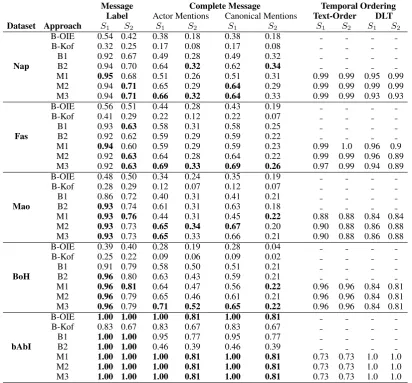
shows comparative performance of the proposed approaches for message extraction and temporal ordering.
4.3 Analysis of Results
It can be observed in Table2that our proposed ap-proaches M1 and M2 are consistently outperform-ing their correspondoutperform-ing baselines for all datasets in SettingS1. Also, the approach M3 outperforms
all other approaches in SettingS1 when
consider-ing actor mentions for the complete message. F1-measures in the settingS2 get reduced
con-siderably as compared toS1. Our approach is a
pipeline-based approach where output of actor and interaction verb identification are provided as in-put for the message creation algorithms. So, the errors in these earlier stages are propagated to the message creation stage, resulting in lower perfor-mance for the overall pipeline. Especially, identi-fying coreferences of actor mentions to determine canonical mentions, is a hard problem (Ng,2017). Hence, in the settingS2, we see a significant drop
in F1-measure when we go from L1 level
mes-sages to the L2 level where identification of
cor-rect canonical sender / receiver is important. History narratives tend to describe interactions mostly in the order in which they happen. Hence, we can observe that performance of the DLT based approach and Text-Order baseline is almost sim-ilar for the History datasets. In some instances, DLT based approach performs poorly as the de-fault fall back for any previously unobserved tense is the DCT. This can be incorrect if a message with its verb in past participle is anchored at DCT even after observing multiple previous messages in past tense anchored at an earlier time point. For datasets like bAbI in which text order of interac-tions differs significantly from the actual temporal order, the performance of the DLT based temporal ordering approach is better than the baseline.
5 Related Work
Though there has been some work in applying MSC for Software Engineering domain, less atten-tion is given to the automatic construcatten-tion of MSC using NLP. Feijs (2000) proposed an “object-oriented” approach to automatically construct an MSC from a narrative. The approach makes use of a set of generative rules in the form of a grammar. Kof (2007) proposed an approach to construct MSC for modelling scenarios from re-quirement analysis documents. Kof’s approach is based on the situation stack based notion of hu-man attention in a discourse (Grosz et al.,1995). However, the approach makes naive assumptions while finding senders, receivers and action verbs. For example, a sentence contains only one ac-tion verb, actors can be found in a pre-defined list and so on. As history narratives include mul-tiple senders/receivers/action verbs and the ac-tors are not pre-specified in a sentence Kof’s ap-proach (Kof,2007) is less suitable.
Message Complete Message Temporal Ordering Label Actor Mentions Canonical Mentions Text-Order DLT Dataset Approach S1 S2 S1 S2 S1 S2 S1 S2 S1 S2
B-OIE 0.54 0.42 0.38 0.18 0.38 0.18
B-Kof 0.32 0.25 0.17 0.08 0.17 0.08
B1 0.92 0.67 0.49 0.28 0.49 0.32
Nap B2 0.94 0.70 0.64 0.32 0.62 0.34
M1 0.95 0.68 0.51 0.26 0.51 0.31 0.99 0.99 0.95 0.99
M2 0.94 0.71 0.65 0.29 0.64 0.29 0.99 0.99 0.99 0.99
M3 0.94 0.71 0.66 0.32 0.64 0.33 0.99 0.99 0.93 0.93
B-OIE 0.56 0.51 0.44 0.28 0.43 0.19
B-Kof 0.41 0.29 0.22 0.12 0.22 0.07
B1 0.93 0.63 0.58 0.31 0.58 0.25
Fas B2 0.92 0.62 0.59 0.29 0.59 0.22
M1 0.94 0.60 0.59 0.29 0.59 0.23 0.99 1.0 0.96 0.9
M2 0.92 0.63 0.64 0.28 0.64 0.22 0.99 0.99 0.96 0.89
M3 0.92 0.63 0.69 0.33 0.69 0.26 0.97 0.99 0.94 0.89
B-OIE 0.48 0.50 0.34 0.24 0.35 0.19
B-Kof 0.28 0.29 0.12 0.07 0.12 0.07
B1 0.86 0.72 0.40 0.31 0.41 0.21
Mao B2 0.93 0.74 0.61 0.31 0.63 0.18
M1 0.93 0.76 0.44 0.31 0.45 0.22 0.88 0.88 0.84 0.84
M2 0.93 0.73 0.65 0.34 0.67 0.20 0.90 0.88 0.86 0.88
M3 0.93 0.73 0.65 0.33 0.66 0.21 0.90 0.88 0.86 0.88
B-OIE 0.39 0.40 0.28 0.19 0.28 0.04
B-Kof 0.25 0.22 0.09 0.06 0.09 0.02
B1 0.91 0.79 0.58 0.50 0.51 0.21
BoH B2 0.96 0.80 0.63 0.43 0.59 0.21
M1 0.96 0.81 0.64 0.47 0.56 0.22 0.96 0.96 0.84 0.81
M2 0.96 0.79 0.65 0.46 0.61 0.21 0.96 0.96 0.84 0.81
M3 0.96 0.79 0.71 0.52 0.65 0.22 0.96 0.96 0.84 0.81
B-OIE 1.00 1.00 1.00 0.81 1.00 0.81
B-Kof 0.83 0.67 0.83 0.67 0.83 0.67
B1 1.00 1.00 0.95 0.77 0.95 0.77
bAbI B2 1.00 1.00 0.46 0.39 0.46 0.39
[image:8.595.93.506.61.444.2]M1 1.00 1.00 1.00 0.81 1.00 0.81 0.73 0.73 1.0 1.0 M2 1.00 1.00 1.00 0.81 1.00 0.81 0.73 0.73 1.0 1.0 M3 1.00 1.00 1.00 0.81 1.00 0.81 0.73 0.73 1.0 1.0
Table 2: F1-measures for following approaches- B-OIE: OpenIE baseline, B-Kof: Kof (2007), B1: Base-line using only dependencies, B2: BaseBase-line using only SRL, M1: create messages M1 (Algorithm 1), M2: create messages M2(Algorithm2), M3: Combined approach using SRL and dependencies. SettingS1
corre-sponds to using gold actors and interaction verbs, SettingS2uses predicted actors and interaction verbs
Jurafsky (2009) on modelling of narrative schemas and their participants. They need acorpus of nar-rativesto identify prototypical schemas which try to capture common sequence of events. We ad-dress a different problem of extracting MSC from asinglenarrative and do not need a corpus. MSC has been proposed as a knowledge representation for a narrative text in (Bedi et al.,2017). We ex-tend their work to automatically construct MSC.
Open Information Extraction (OpenIE) systems aim to extract tuples consisting of relation phrases and their multiple associated argument phrases from an input sentence (Mausam et al.,2012). The predicate-argument structures in OpenIE seem similar to SRL and dependency parsing. How-ever, in dependency parsing the relations are fixed, while SRL systems require deeper semantic anal-ysis of a sentence and hence they depend on
lex-ical resources like PropBank and FrameNet. On the other hand, the predicate-argument structures in OpenIE are not restricted to any pre-specified or fixed list of relations and arguments.
6 Conclusions
References
Rajeev Alur, Gerard J Holzmann, and Doron Peled. 1996. An analyzer for message sequence charts. In
International Workshop on Tools and Algorithms for the Construction and Analysis of Systems, pages 35– 48. Springer.
Harsimran Bedi, Sangameshwar Patil, Swapnil Hing-mire, and Girish K. Palshikar. 2017. Event Time-line Generation from History Textbooks. In NLP-TEA@IJCNLP, pages 69–77.
Nathanael Chambers and Dan Jurafsky. 2009. Unsu-pervised learning of narrative schemas and their par-ticipants. InProceedings of the 47th Annual Meet-ing of the ACL and the 4th IJCNLP of the AFNLP, pages 602–610.
Satish Chandra. 2007. Medieval India: From Sultanat to the Mughals- Mughal Empire: Part Two. Har Anand Publications.
Quang Do, Wei Lu, and Dan Roth. 2012. Joint infer-ence for event timeline construction. In EMNLP-CoNLL, pages 677–687.
Loe M. G. Feijs. 2000. Natural language and message sequence chart representation of use cases. Informa-tion & Software Technology, 42(9):633–647.
Amit Goyal, Ellen Riloff, and Hal Daum´e III. 2010. Automatically Producing Plot Unit Representations for Narrative Text. InEMNLP, pages 77–86.
Barbara J. Grosz, Scott Weinstein, and Aravind K. Joshi. 1995. Centering: A framework for modeling the local coherence of discourse.Comput. Linguist., 21(2):203–225.
Maurice G Kendall. 1938. A new measure of rank cor-relation. Biometrika, 30(1/2):81–93.
Nam Wook Kim, Benjamin Bach, Hyejin Im, Sasha Schriber, Markus H. Gross, and Hanspeter Pfis-ter. 2018. Visualizing Nonlinear Narratives with Story Curves. IEEE Trans. Vis. Comput. Graph., 24(1):595–604.
Paul Kingsbury and Martha Palmer. 2002. From tree-bank to proptree-bank. InLREC, pages 1989–1993.
Leonid Kof. 2007. Scenarios: Identifying Missing Ob-jects and Actions by Means of Computational Lin-guistics. In 15th IEEE International Requirements Engineering Conference (RE 2007), pages 121–130.
Egoitz Laparra, Itziar Aldabe, and German Rigau. 2015. Document level time-anchoring for timeline extraction. InACL (2), pages 358–364.
Liwu Li. 2000. Translating use cases to sequence di-agrams. InProceedings of the 15th IEEE Interna-tional Conference on Automated Software Engineer-ing (ASE’00), page 293.
McDougal Littel. 2008. World History: Patterns of In-teraction. World History: Patterns of Int. Houghton Mifflin Harcourt Publishing Company.
Christopher D. Manning, Mihai Surdeanu, John Bauer, Jenny Rose Finkel, Steven Bethard, and David Mc-Closky. 2014. The stanford corenlp natural language processing toolkit. InACL, pages 55–60.
Mausam, Michael Schmitz, Stephen Soderland, Robert Bart, and Oren Etzioni. 2012. Open language learn-ing for information extraction. InEMNLP-CoNLL, pages 523–534.
Vincent Ng. 2017. Machine learning for entity corefer-ence resolution: A retrospective look at two decades of research. InAAAI, pages 4877–4884.
Sangameshwar Patil, Sachin Pawar, Swapnil Hingmire, Girish K. Palshikar, Vasudeva Varma, and Pushpak Bhattacharyya. 2018. Identification of Alias Links among Participants in Narratives. InACL.
Michael Roth and Mirella Lapata. 2015. Context-aware frame-semantic role labeling. Transactions of the Association for Computational Linguistics, 3:449–460.
Karin Kipper Schuler. 2005. Verbnet: A broad-coverage, comprehensive verb lexicon.
Jannik Str¨otgen and Michael Gertz. 2015. A baseline temporal tagger for all languages. InEMNLP, pages 541–547.
Piek Vossen, Tommaso Caselli, and Yiota Kont-zopoulou. 2015. Storylines for structuring massive streams of news. InProceedings of the First Work-shop on Computing News Storylines, pages 40–49.
Piek Vossen, Tommaso Caselli, and Yiota Kont-zopoulou. 2016. Storyline detection and tracking using dynamic latent dirichlet allocation. In Pro-ceedings of 2nd Workshop on Computing News Sto-rylines, pages 9–19.
Jason Weston, Antoine Bordes, Sumit Chopra, Alexan-der M Rush, Bart van Merri¨enboer, Armand Joulin, and Tomas Mikolov. 2015. Towards ai-complete question answering: A set of prerequisite toy tasks.
arXiv preprint arXiv:1502.05698.