Human Language Technologies: The 2015 Annual Conference of the North American Chapter of the ACL, pages 683–693,
Ontologically Grounded Multi-sense Representation Learning for Semantic
Vector Space Models
Sujay Kumar Jauhar Chris Dyer Eduard Hovy Language Technologies Institute
School of Computer Science Carnegie Mellon University Pittsburgh, PA 15213, USA
{sjauhar, cdyer, hovy}@cs.cmu.edu
Abstract
Words are polysemous. However, most ap-proaches to representation learning for lexical semantics assign a single vector to every sur-face word type. Meanwhile, lexical ontologies such as WordNet provide a source of com-plementary knowledge to distributional infor-mation, including a word sense inventory. In this paper we propose two novel and general approaches for generating sense-specific word embeddings that are grounded in an ontology. The first applies graph smoothing as a post-processing step to tease the vectors of differ-ent senses apart, and is applicable to any vec-tor space model. The second adapts predictive maximum likelihood models that learn word embeddings with latent variables representing senses grounded in an specified ontology. Em-pirical results on lexical semantic tasks show that our approaches effectively captures infor-mation from both the ontology and distribu-tional statistics. Moreover, in most cases our sense-specific models outperform other mod-els we compare against.
1 Introduction
Vector space models (VSMs) of word meaning play a central role in computational semantics. These represent meanings of words as contextual feature vectors in a high-dimensional space (Deerwester et al., 1990) or some embedding thereof (Collobert and Weston, 2008) and are learned from unanno-tated corpora. Word vectors in these continuous space representations can be used for meaningful se-mantic operations such as computing word similar-ity (Turney, 2006), performing analogical reasoning (Turney, 2013) and discovering lexical relationships
(Mikolov et al., 2013b). They have also proved use-ful in downstream NLP applications such as infor-mation retrieval (Manning et al., 2008) and question answering (Tellex et al., 2003), among others.
However, VSMs remain flawed because they as-sign a single vector to every word, thus ignoring the possibility that words may have more than one meaning. For example, the word “bank” can ei-ther denote a financial institution or the shore of a river. The ability to model multiple meanings is an important component of any NLP system, given how common polysemy is in language. The lack of sense annotated corpora large enough to robustly train VSMs, and the absence of fast, high quality word sense disambiguation (WSD) systems makes handling polysemy difficult.
Meanwhile, lexical ontologies, such as WordNet (Miller, 1995) specifically catalog sense invento-ries and provide typologies that link these senses to one another. These hand-curated ontologies pro-vide a complementary source of information to dis-tributional statistics. Recent research tries to lever-age this information to train better VSMs (Yu and Dredze, 2014; Faruqui et al., 2014), but does not tackle the problem of polysemy. Parallely, work on polysemy for VSMs revolves primarily around tech-niques that cluster contexts to distinguish between different word senses (Reisinger and Mooney, 2010; Huang et al., 2012), but does not integrate ontologies in any way.
In this paper we present two novel approaches to integrating ontological and distributional sources of information. Our focus is on allowing already exist-ing, proven techniques to be adapted to produce on-tologically grounded word sense embeddings. Our first technique is applicable to any sense-agnostic
VSM as a post-processing step that performs graph propagation on the structure of the ontology. The second is applicable to the wide range of current techniques that learn word embeddings from predic-tive models that maximize the likelihood of a corpus (Collobert and Weston, 2008; Mnih and Teh, 2012; Mikolov et al., 2013a). Our technique adds a latent variable representing the word sense to each token in the corpus, and uses EM to find parameters. Us-ing a structured regularizer based on the ontological graph, we learn grounded sense-specific vectors.
There are several reasons to prefer ontologies as distant sources of supervision for learning sense-aware VSMs over previously proposed unsuper-vised context clustering techniques. Clustering ap-proaches must often parametrize the number of clusters (senses), which is neither known a priori nor constant across words (Kilgarriff, 1997). Also the resulting vectors remain abstract and uninter-pretable. With ontologies, interpretable sense vec-tors can be used in downstream applications such as WSD, or for better human error analysis. Moreover, clustering techniques operate on distributional simi-larity only whereas ontologies support other kinds of relationships between senses. Finally, the existence of cross-lingual ontologies would permit learning multi-lingual vectors, without compounded errors from word alignment and context clustering.
We evaluate our methods on 3 lexical semantic tasks across 7 datasets and show that our sense-specific VSMs effectively integrate knowledge from the ontology with distributional statistics. Empir-ically, this results in consistently and significantly better performance over baselines in most cases. In the more marginal cases, analysis reveals that our performance is a result of the deficient structure of the ontology. We discuss and compare the two different approaches from the perspectives of per-formance, generalizability, flexibility and computa-tional efficiency. Finally, we qualitatively analyze the vectors and show that they indeed capture sense-specific semantics.
2 Unified Symbolic and Distributional Semantics
In this section, we present our two techniques for in-ferring sense-specific vectors grounded in an
ontol-ogy. We begin with notation. LetW ={w1, ..., wn} be a set of word types, and Ws = {sij | ∀wi ∈
W , 1 ≤j ≤ki}a set of senses, withki the num-ber of senses of wi. Moreover, let Ω = (TΩ, EΩ) be an ontology represented by an undirected graph. The vertices TΩ = {tij| ∀sij ∈ Ws} correspond to the word senses in the setWs, while the edges
EΩ={erij−i0j0}connect some subset of word sense
pairs(sij, si0j0)by semantic relationr1.
2.1 Retrofitting Vectors to an Ontology
Our first technique assumes that we already have a vector space embedding of a vocabulary Uˆ =
{uˆi| ∀ wi ∈ W}. We wish to infer vectors V =
{vij| ∀sij ∈ Ws} for word senses that are maxi-mally consistent with bothUˆ andΩ, by some notion of consistency. We formalize this notion as MAP inference in a Markov network (MN).
The MN we propose contains variables for every vector inUˆ andV. These variables are connected to one another by dependencies as follows. Variables for vectorsvij andvi0j0 are connected iff there exists
an edge er
ij−i0j0 ∈ EΩ connecting their respective word senses in the ontology. Furthermore, vectors ˆ
ui for the word types wi are each connected to all the vectorsvij of the different sensessijofwi. Ifwi is not contained in the ontology, we assume it has a single unconnected sense and set it’s only sense vectorvi1to it’s empirical estimateuˆi.
The structure of this MN is illustrated in Figure 1, where the neighborhood of the ambiguous word “bank” is presented as a factor graph.
We set each pairwise clique potential to be of the formexp(aku −vk2) between neighboring nodes. Hereuandvare the vectors corresponding to these nodes, andais a weight controlling the strength of the relation between them. We use the Euclidean norm instead of a distance based on cosine similarity because it is more convenient from an optimization perspective.
Our inference problem is to find the MAP esti-mate of the vectorsV, givenUˆ, which may be stated
1For example there might be a “synonym” edge between the
Figure 1: A factor graph depicting the retrofitting model in the neighborhood of the word “bank”. Observed vari-ables corresponding to word types are shaded in grey, while latent variables for word senses are in white.
as follows:
C(V) = arg min V
X
i−ij
αkuˆi−vijk2
+ X
ij−i0j0
βrkvij −vi0j0k2
(1)
Here α is the sense-agnostic weight and βr are relation-specific weights for different semantic re-lations. This objective encourages vectors of neigh-boring nodes in the MN to pull closer together, lever-aging the tension between sense-agnostic neighbors (the first summation term) and ontological neighbors (the second summation term). This allows the dif-ferent neighborhoods of each sense-specific vector to tease it apart from its sense-agnostic vector.
Taking the partial derivative of the objective in equation 1 with respect to vectorvij and setting to zero gives the following solution:
vij =
αuˆi+
X
i0j0∈Nij
βrvi0j0
α+ X i0j0∈Nij
βr
(2)
whereNij denotes the set of neighbors ofij. Thus, the MAP sense-specific vector is an α-weighted combination of its sense-agnostic vector and theβr -weighted sense-specific vectors in its ontological neighborhood.
We use coordinate descent to iteratively update the variables V using equation 2. The optimiza-tion problem in equaoptimiza-tion 1 is convex, and we nor-mally converge to a numerically satisfactory station-ary point within 10 to 15 iterations. This procedure
Algorithm 1Outputs a sense-specific VSM, given a sense-agnostic VSM and ontology
1: functionRETROFIT(U,ˆ Ω) 2: V(0)← {v(0)
ij = ˆui| ∀sij∈Ws}
3: whilekvij(t)−vij(t−1)k ≥∀i, jdo
4: fortij ∈TΩdo
5: v(ijt+1)←update using equation 2
6: end for
7: end while
8: returnV(t)
9: end function
is summarized in Algorithm 1. The generality of this algorithm allows it to be applicable to any VSM as a computationally attractive post-processing step.
An implementation of this technique is avail-able at https://github.com/sjauhar/ SenseRetrofit.
2.2 Adapting Predictive Models with Latent Variables and Structured Regularizers Many successful techniques for semantic represen-tation learning are formulated as models where the desired embeddings are parameters that are learnt to maximize the likelihood of a corpus (Collobert and Weston, 2008; Mnih and Teh, 2012; Mikolov et al., 2013a). In our second approach we extend an exist-ing probability model by addexist-ing latent variables rep-resenting the senses, and we use a structured prior based on the topology of the ontology to ground the sense embeddings. Formally, we assume a corpus
D={(w1, c1), . . . ,(wN, cN)}of pairs of target and context words, and the ontologyΩ, and we wish to infer sense-specific vectorsV ={vij| ∀sij ∈Ws}. Consider a model with parameters θ (V ∈ θ) that factorizes the probability over the corpus as
Q
(wi,ci)∈Dp(wi, ci;θ). We propose to extend such a model to learn ontologically grounded sense vec-tors by presenting a general class of objectives of the following form:
C(θ) = arg max θ
X
(wi,ci)∈D log(X
sij
p(wi, ci, sij;θ)) + logpΩ(θ) (3)
Chase loaned money
bank2
bank p(s|w)
p(c|s) Context word
(observed)
Sense
(latent)
Word
[image:4.612.86.288.64.128.2](observed)
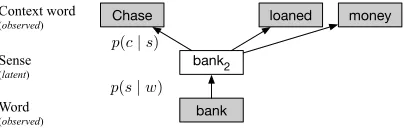
Figure 2: The generative process associated with the skip-gram model, modified to account for latent senses. Here, the context of the ambiguous word “bank” is gen-erated from the selection of a specific latent sense.
that grounds the vectors V in an ontology. This form permits flexibility in the definition of both
p(wi, ci, sij;θ)andpΩ(θ)allowing for a general yet powerful framework for adapting MLE models.
In what follows we show that the popular skip-gram model (Mikolov et al., 2013a) can be adapted to generate ontologically grounded sense vectors. The classic skip-gram model uses a set of parame-ters θ = (U, V), withU = {ui | ∀ci ∈ W} and
V = {vi | ∀wi ∈ W} being sets of vectors for context and target words respectively. The genera-tive story of the skip-gram model involves generat-ing the context wordci conditioned on an observed word wi. The conditional probability is defined to bep(ci |wi;θ) = P exp(ui·vi)
ci0∈Wexp(ui0 ·vi) .
We modify the generative story of the skip-gram model to account for latent sense variables by first selecting a latent word sensesij conditional on the observed wordwi, then generating the context word
ci from the sense distinguished wordsij. This pro-cess is illustrated in Figure 2. The factorization
p(ci | wi;θ) = Psijp(ci | sij;θ)×p(sij | wi;θ) follows from the chain rule since senses are word-specific. To parameterize this distribution, we de-fine a new set of model parametersθ = (U, V,Π), whereUremains identical to the original skip-gram,
V ={vij | ∀sij ∈Ws}are a set of vectors for word senses, andΠare the context-independent sense pro-portionsπij =p(sij |wi). We use a Dirichlet prior over the multinomial distributions πi for every wi, with a shared concentration parameterλ.
We define the ontological prior on vectors as
pΩ(θ) ∝ exp(−γ
X
ij−i0j0
βrkvij −vi0j0k2), whereγ
controls the strength of the prior. We note the sim-ilarity to the retrofitting objective in equation 1,
ex-cept withα= 0. This leads to the following realiza-tion of the objective in equarealiza-tion 3:
C(θ) = arg max θ
X
(wi,ci)∈D
log X sij
p(ci |sij;θ)×
p(sij |wi;θ)
−γ X
ij−i0j0
βrkvij−vi0j0k2
(4)
This objective can be optimized using EM, for the latent variables, and with lazy updates (Carpenter, 2008) everyk words to account for the prior regu-larizer. However, since we are primarily interested in learning good vector representations, and we want to learn efficiently from large datasets, we make the following simplifications. First, we perform “hard” EM, selecting the most likely sense at each position rather than using the full posterior over senses. Also, given that the structured regularizerpΩ(θ)is essen-tially the retrofitting objective in equation 1, we run retrofitting periodically everykwords (withα = 0 in equation 2) instead of lazy updates.2
The following decision rule is used in the “hard” E-step:
sij = arg maxs
ij p(ci|sij;θ (t))π(t)
ij (5)
In the M-step we use Variational Bayes to updateΠ with:
πij(t+1)∝ exp
ψc˜(wi, sij) +λπ(0)ij
exp (ψ(˜c(wi) +λ)) (6)
where˜c(·) is the online expected count andψ(·)is the digamma function. This approach is motivated by Johnson (2007) who found that naive EM leads to poor results, while Variational Bayes is consis-tently better and promotes faster convergence of the likelihood function. To update the parametersUand
V, we use negative sampling (Mikolov et al., 2013a) which is an efficient approximation to the original skip-gram objective. Negative sampling attempts to distinguish between true word pairs in the data, rel-ative to noise. Stochastic gradient descent on the following equation is used to update the model
rametersU andV:
L= logσ(ui·vij) +
X
j0
j06=j
logσ(−ui·vij0)
+X m
Eci0∼Pn(c)[logσ(−ui0·vij)] (7)
Hereσ(·)is the sigmoid function, Pn(c) is a noise distribution computed over unigrams and m is the negative sampling parameter. This is almost exactly the same as negative sampling proposed for the orig-inal skip-gram model. The only change is that we additionally take a negative gradient step with re-spect to all the senses that were not selected in the hard E-step. We summarize the training procedure for the adapted skip-gram model in Algorithm 2.
Algorithm 2Outputs a sense-specific VSM, given a corpus and an ontology
1: functionSENSEEM(D,Ω) 2: θ(0)←initialize
3: for(wi, ci)∈Ddo
4: ifperiod >kthen
5: RETROFIT(θ(t),Ω)
6: end if
7: (Hard) E-step:
8: sij ←find argmax using equation 5
9: M-step:
10: Π(t+1)←update using equation 6
11: U(t+1), V(t+1)←update using equation 7
12: end for
13: returnθ(t)
14: end function
3 Evaluation
In this section we detail experimental results on 3 lexical semantics tasks across 8 different datasets. We begin by detailing the training and setup for our experiments.
3.1 Resources, Data and Training
We use WordNet (Miller, 1995) as the sense repos-itory and ontology in all our experiments. WordNet is a large, hand-annotated ontology of English com-posed of 117,000 clusters of senses, or “synsets” that are related to one another through semantic relations such as hypernymy and hyponymy. Each synset ad-ditionally comprises a list of sense specific lemmas
which we use to form the nodes in our graph. There are 206,949 such sense specific lemmas, which we connect with synonym, hypernym and hyponym3 re-lations for a total of 488,432 edges.
To show the applicability of our techniques to dif-ferent VSMs we experiment with two difdif-ferent kinds of base vectors.
Global Context Vectors (GC) (Huang et al., 2012):These word vectors were trained using a neu-ral network which not only uses local context but also defines global features at the document level to further enhance the VSM. We distinguish three vari-ants: the original single-sense vectors (SINGLE), a multi-prototype variant (MULTI), – both are avail-able as pre-trained vectors for download4 – and a sense-based version obtained by running retrofitting on the original vectors (RETRO).
Skip-gram Vectors (SG) (Mikolov et al., 2013a): We use the word vector tool Word2Vec5 to train skip-gram vectors. We define 6 variants: a single-sense version (SINGLE), two multi-sense variants that were trained by first sense disambiguat-ing the entire corpus usdisambiguat-ing WSD tools, – one unsu-pervised (Pedersen and Kolhatkar, 2009) (WSD) and the other supervised (Zhong and Ng, 2010) (IMS) – a retrofitted version obtained from the single-sense vectors (RETRO), an EM implementation of the skip-gram model with the structured regularizer as described in section 2.2 (EM+RETRO), and the same EM technique but ignoring the ontology (EM). All models were trained on publicly available WMT-20116English monolingual data. This corpus of 355 million words, although adequate in size, is smaller than typically used billion word corpora. We use this corpus because the WSD baseline involves prepro-cessing the corpus with sense disambiguation, which is slow enough that running it on corpora orders of magnitude larger was infeasible.
Retrofitted variants of vectors (RETRO) are trained using the procedure described in algorithm 1. We set the convergence criteria to= 0.01with a maximum number of iterations of 10. The weights
3We treat edges as undirected, so hypernymy and hyponymy
are collapsed and unified in our representation schema.
4http://nlp.stanford.edu/~socherr/
ACL2012_wordVectorsTextFile.zip
in the update equation 2 are set heuristically: the sense agnostic weightαis 1.0, and relations-specific weightsβrare 1.0 for synonyms and 0.5 for hyper-nyms and hypohyper-nyms. EM+RETRO vectors are the exception where we use a weight ofα= 0.0instead, as required by the derivation in section 2.2.
For skip-gram vectors (SG) we use the following standard settings, and do not tune any of the values. We filter all words with frequency < 5, and pre-normalize the corpus to replace all numeric tokens with a placeholder. We set the dimensionality of the vectors to 80, and the window size to 10 (5 con-text words to either side of a target). The learning rate is set to an initial value of 0.025 and diminished linearly throughout training. The negative sampling parameter is set to 5. Additionally for the EM vari-ants (section 2.2) we set the Dirichlet concentration parameter λto 1000. We use 5 abstract senses for the EM vectors, and initialize the priors uniformly. For EM+RETRO, WordNet dictates the number of senses; also when available WordNet lemma counts are used to initialize the priors. Finally, we set the retrofitting periodkto 50 million words.
3.2 Experimental Results
We evaluate our models on 3 kinds of lexical seman-tic tasks: similarity scoring, synonym selection, and similarity scoring in context.
Similarity Scoring: This task involves using a semantic model to assign a score to pairs of words. We use the following 4 standard datasets in this evaluation: WS-353 (Finkelstein et al., 2002), RG-65 (Rubenstein and Goodenough, 19RG-65), MC-30 (Miller and Charles, 1991) and MEN-3k (Bruni et al., 2014). Each dataset consists of pairs of words along with an averaged similarity score obtained from several human annotators. For example an item in the WS-353 dataset is “book, paper→7.46”. We use standard cosine similarity to assign a score to word pairs in single-sense VSMs, and the following average similarity score to multi-sense variants, as proposed by Reisinger and Mooney (2010):
avgSim(wi, wi0) = 1
kikj
X
j,j0
cos(vij, vi0j0) (8)
The output of systems is evaluated against the gold standard using Spearman’s rank correlation coeffi-cient.
Synonym Selection:In this task, VSMs are used to select the semantically closest word to a tar-get from a list of candidates. We use the follow-ing 3 standard datasets in this evaluation: ESL-50 (Turney, 2001), RD-300 (Jarmasz and Szpakow-icz, 2004) and TOEFL-80 (Landauer and Dumais, 1997). These datasets consist of a list of target words that appear with several candidate lexical items. An example from the TOEFL dataset is “rug → sofa, ottoman, carpet, hallway”, with “carpet” being the most synonym-like candidate to the target. We be-gin by scoring all pairs composed of the target and one of the candidates. We use cosine similarity for single-sense VSMs, and max similarity for multi-sense models7:
maxSim(wi, wi0) = max
j,j0 cos(vij, vi0j0) (9)
These scores are then sorted in descending order, with the top-ranking score yielding the semantically closest candidate to the target. Systems are evalu-ated on the basis of their accuracy at discriminating the top-ranked candidate.
The results for similarity scoring and synonym selection are presented in table 1. On both tasks and on all datasets, with the partial exception of WS-353 and MEN-3k, our vectors (RETRO & EM+RETRO) consistently yield better results than other VSMs. Notably, both our techniques perform better than preprocessing a corpus with WSD infor-mation in unsupervised or supervised fashion (SG-WSD & SG-IMS). Simple EM without an ontolog-ical prior to ground the vectors (SG-EM) also per-forms poorly.
We investigated the observed drop in performance on WS-353 and found that this dataset consists of two parts: a set ofsimilar word pairs (e.g. “tiger” and “cat”) and another set ofrelatedword pairs (e.g. “weather” and “forecast”). The synonym, hypernym and hyponym relations we use tend to encourage
similarityto the detriment ofrelatedness.
We ran an auxiliary experiment to show this. SG-EM+RETRO training also learns vectors for context words – which can be thought of as a proxy for re-latedness. Using this VSM we scored a word pair by the average similarity of all the sense vectors of
7Here we are specifically looking for synonyms, so the max
Word Similarity (ρ) Synonym Selection (%) WS-353 RG-65 MC-30 MEN-3k ESL-50 RD-300 TOEFL-80
GC SINGLEMULTI 0.6230.535 0.6290.510 0.6570.309 0.3140.359 47.7327.27 47.8945.07 60.8752.17
RETRO 0.543 0.661 0.714 0.528 63.64 66.20 71.01
SG
SINGLE 0.639 0.546 0.627 0.646 52.08 55.66 66.67
EM 0.194 0.278 0.167 0.228 27.08 33.96 40.00
WSD 0.481 0.298 0.396 0.175 16.67 49.06 42.67
IMS 0.549 0.579 0.606 0.591 41.67 53.77 66.67
[image:7.612.99.514.58.193.2]RETRO 0.552 0.673 0.705 0.560 56.25 65.09 73.33 EM+RETRO 0.321 0.734 0.758 0.428 62.22 66.67 68.63
Table 1: Similarity scoring and synonym selection in English across several datasets involving different VSMs. Higher scores are better; best scores within each category are in bold. In most cases our models consistently and significantly outperform the other VSMs.
one word to the context vector of the other word, averaged over both words. With this scoring func-tion the correlafunc-tion ρ jumped from 0.321 to 0.493. While still not as good as some of the other VSMs, it should be noted that this scoring function negatively influences thesimilarword pairs in the dataset.
The MEN-3k dataset is crowd-sourced and con-tains much diversity, with word pairs evidencing similarity as well as relatedness. However, we aren’t sure why the performance for GC-RETRO improves greatly over GC-SINGLE for this dataset, while that of SG-RETRO and SG-RETRO+EM drops in rela-tion to SG-SINGLE.
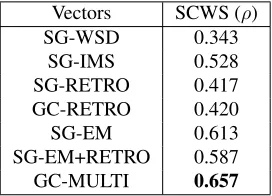
Similarity Scoring in Context: As outlined by Reisinger and Mooney (2010), multi-sense VSMs can be used to consider context when computing similarity between words. We use the SCWS dataset (Huang et al., 2012) in these experiments. This dataset is similar to the similarity scoring datasets, except that they additionally are presented in con-text. For example an item involving the words “bank” and “money”, gives the words in their re-spective contexts, “along the east bank of the Des Moines River” and “the basis of all money laun-dering” with a low averaged similarity score of 2.5 (on a scale of 1.0 to 10.0). Following Reisinger and Mooney (2010) we use the following function to as-sign a score to word pairs in their respective con-texts, given a multi-sense VSM:
avgSimC(wi, ci, wi0, ci0) = X
j,j0
p(sij|ci, wi)p(si0j0|ci0, wi0)cos(vij, vi0j0) (10)
Vectors SCWS (ρ)
SG-WSD 0.343
SG-IMS 0.528
SG-RETRO 0.417
GC-RETRO 0.420
SG-EM 0.613
SG-EM+RETRO 0.587
GC-MULTI 0.657
Table 2: Contextual word similarity in English. Higher scores are better.
As with similarity scoring, the output of systems is evaluated against gold standard using Spearman’s rank correlation coefficient.
[image:7.612.359.495.253.351.2]Method CPU Time
RETRO ~20 secs
EM+RETRO ~4 hours
IMS ~3 days
WSD ~1 year
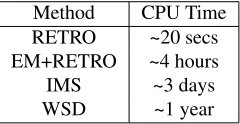
Table 3: Training time associated with different methods of generating sense-specific VSMs.
words – which we showed, hurt our performance on WS-353 – also contains word pairs with differ-ent POS tags. WordNet synonymy, hypernymy and hyponymy relations are exclusively defined between lemmas of the same POS tag, which adversely af-fects performance further.
3.3 Discussion
While both our approaches are capable of integrat-ing ontological information into VSMs, an impor-tant question is which one should be preferred? From an empirical point of view, the EM+RETRO framework yields better performance than RETRO across most of our semantic evaluations. Addi-tionally EM+RETRO is more powerful, allowing to adapt more expressive models that can jointly learn other useful parameters – such as context vectors in the case of skip-gram. However, RETRO is far more generalizable, allowing it to be used for anyVSM, not just predictive MLE models, and is also empiri-cally competitive. Another consideration is compu-tational efficiency, which is summarized in table 3.
Not only is RETRO much faster, but it scales linearly with respect to the vocabulary size, un-like EM+RETRO, WSD, and IMS which are de-pendent on the input training corpus. Nevertheless, both our techniques are empirically superior as well as computationally more efficient than both unsu-pervised and suunsu-pervised word-sense disambiguation paradigms.
Both our approaches are sensitive to the structure of the ontology. Therefore, an important considera-tion is the relaconsidera-tions we use and the weights we as-sociate with them. In our experiments we selected the simplest set of relations and assigned weights heuristically, showing that our methods can effec-tively integrate ontological information into VSMs. A more exhaustive selection procedure with weight tuning on held-out data would almost certainly lead to better performance on our evaluation suite.
3.4 Qualitative Analysis
We qualitatively attempt to address the question of whether the vectors are truly sense specific. In ta-ble 4 we present the three most similar words of an ambiguous lexical item in a standard VSM (SG-SINGLE) in comparison with the three most similar words of different lemma senses of the same lexical item in grounded sense VSMs (RETRO & SG-EM+RETRO).
Word or Sense Top 3 Most Similar
hanging hung dangled hangs
hanging (suspending) shoring support suspension hanging (decoration) tapestry braid smock
climber climbers skier Loretan
climber (sportsman) lifter swinger sharpshooter
[image:8.612.126.246.60.122.2]climber (vine) woodbine brier kiwi
Table 4: The top 3 most similar words for two polyse-mous types. Single sense VSMs capture the most fre-quent sense. Our techniques effectively separates out the different senses of words, and are grounded in WordNet.
The sense-agnostic VSMs tend to capture only the most frequent sense of a lexical item. On the other hand, the disambiguated vectors capture sense speci-ficity of even less frequent senses successfully. This is probably due to the nature of WordNet where the nearest neighbors of the words in question are in fact these rare words. A careful tuning of weights will likely optimize the trade-off between ontologically rare neighbors and distributionally common words.
In our analyses, we noticed that lemma senses that had many neighbors (i.e. synonyms, hypernyms and hyponyms), tended to have more clearly sense spe-cific vectors. This is expected, since it is these neigh-borhoods that disambiguate and help to distinguish the vectors from their single sense embeddings.
4 Related Work
fashion to allow for different number of senses for words. Guo et al. (2014) exploit bilingual align-ments to perform better context clustering during training. Tian et al. (2014) propose a probabilistic extension to skip-gram that treats the different pro-totypes as latent variables. This is similar to our sec-ond EM training framework, and turns out to be a special case of our general model. In all these pa-pers, however, the multiple senses remain abstract and are not grounded in an ontology.
Conceptually, our work is also similar to Yu and Dredze (2014) and Faruqui et al. (2014), who treat lexicons such as the paraphrase database (PPDB) (Ganitkevitch et al., 2013) or WordNet (Miller, 1995) as an auxiliary thesaurus to improve VSMs. However, they do not model senses in any way. Pile-hvar et al. (2013) do model senses from an ontology by performing random-walks on the Wordnet graph, however their approach does not take distributional information from VSMs into account.
Thus, to the best of our knowledge, our work presents the first attempt at producing sense grounded VSMs that are symbolically tied to lexi-cal ontologies. From a modelling point of view, it is also the first to outline a unified, principled and extensible framework that effectively combines the symbolic and distributional paradigms of semantics. Both our models leverage the graph structure of ontologies to effectively ground the senses of a VSM. This ties into previous research (Das and Smith, 2011; Das and Petrov, 2011) that propa-gates information through a factor graph to per-form tasks such as frame-semantic parsing and POS-tagging across languages. More generally, this ap-proach can be viewed from the perspective of semi-supervised learning, with an optimization over a graph loss function defined on smoothness proper-ties (Corduneanu and Jaakkola, 2002; Zhu et al., 2003; Subramanya and Bilmes, 2009).
Related to the problem of polysemy is the issue of different shades of meaning a word assumes based on context. The space of research on this topic can be divided into three broad categories: models for computing contextual lexical semantics based on composition (Mitchell and Lapata, 2008; Erk and Padó, 2008; Thater et al., 2011), models that use fuzzy exemplar-based contexts without composing them (Erk and Padó, 2010; Reddy et al., 2011), and
models that propose latent variable techniques (Dinu and Lapata, 2010; Séaghdha and Korhonen, 2011; Van de Cruys et al., 2011). Our work, which tackles the stronger form of lexical ambiguity in polysemy falls into the latter two of three categories.
5 Conclusion and Future Work
We have presented two general and flexible approaches to producing sense-specific VSMs grounded in an ontology. The first technique is ap-plicable to any VSM as an efficient post-processing step while the second provides a framework to in-tegrate ontological information with existing MLE-based predictive models. We presented an evalua-tion of 3 semantic tasks on 7 datasets. Our results show that our proposed methods are effectively able to capture the different senses in an ontology. In most cases this results in significant improvements over baselines. We have also discussed the trade-offs between the two techniques from several differ-ent perspectives. Finally, we have presdiffer-ented a qual-itative analysis investigating the nature of the senspecific vectors, and shown that they capture the se-mantics of different senses.
Our findings suggest several avenues for future research. We propose to use sense-specific vectors as features in downstream applications such a Word Sense Disambiguation. Our current approach as-sumes a fixed ontology, but we hope to explore a more bi-directional relationship between ontology and VSM in future work. In particularly we envisage simultaneously incrementing ontologies with struc-ture learning in addition to improving VSMs. We also hope to extend our research to the multi-lingual domain. We are particularly excited by the idea of using multi-lingual WordNets to learn sense specific semantic vectors that generalize across languages.
Acknowledgments
References
Elia Bruni, Nam-Khanh Tran, and Marco Baroni. 2014. Multimodal distributional semantics. Journal of Arti-ficial Intelligence Research (JAIR), 49:1–47.
Bob Carpenter. 2008. Lazy sparse stochastic gradient de-scent for regularized multinomial logistic regression. technical report, alias-i. available at http://lingpipe-blog.com/ lingpipe-white-papers.
Ronan Collobert and Jason Weston. 2008. A unified ar-chitecture for natural language processing: deep neu-ral networks with multitask learning. InProceedings of the 25th international conference on Machine learn-ing, ICML ’08, pages 160–167, New York, NY, USA. ACM.
Adrian Corduneanu and Tommi Jaakkola. 2002. On in-formation regularization. InProceedings of the Nine-teenth conference on Uncertainty in Artificial Intelli-gence, pages 151–158. Morgan Kaufmann Publishers Inc.
Dipanjan Das and Slav Petrov. 2011. Unsupervised part-of-speech tagging with bilingual graph-based projec-tions. InProc. of ACL.
Dipanjan Das and Noah A. Smith. 2011.
Semi-supervised frame-semantic parsing for unknown pred-icates. InProc. of ACL.
S. C. Deerwester, S. T. Dumais, T. K. Landauer, G. W. Furnas, and R. A. Harshman. 1990. Indexing by latent semantic analysis. Journal of the American Society for Information Science.
Georgiana Dinu and Mirella Lapata. 2010. Measuring distributional similarity in context. InProceedings of the 2010 Conference on Empirical Methods in Natural Language Processing, pages 1162–1172. Association for Computational Linguistics.
Katrin Erk and Sebastian Padó. 2008. A structured vector space model for word meaning in context. In Proceedings of the Conference on Empirical Meth-ods in Natural Language Processing, EMNLP ’08, pages 897–906, Stroudsburg, PA, USA. Association for Computational Linguistics.
Katrin Erk and Sebastian Padó. 2010. Exemplar-based models for word meaning in context. InProceedings of the ACL 2010 Conference Short Papers, pages 92– 97. Association for Computational Linguistics. Manaal Faruqui, Jesse Dodge, Sujay K Jauhar, Chris
Dyer, Eduard Hovy, and Noah A Smith. 2014.
Retrofitting word vectors to semantic lexicons. arXiv preprint arXiv:1411.4166.
Lev Finkelstein, Evgeniy Gabrilovich, Yossi Matias, Ehud Rivlin, Zach Solan, Gadi Wolfman, and Eytan Ruppin. 2002. Placing search in context: The con-cept revisited. In ACM Transactions on Information Systems, volume 20, pages 116–131, January.
Juri Ganitkevitch, Benjamin Van Durme, and Chris
Callison-Burch. 2013. PPDB: The paraphrase
database. InProceedings of NAACL-HLT, pages 758– 764, Atlanta, Georgia, June. Association for Compu-tational Linguistics.
Jiang Guo, Wanxiang Che, Haifeng Wang, and Ting Liu. 2014. Learning sense-specific word embeddings by exploiting bilingual resources. InProceedings of COLING, pages 497–507.
Eric H Huang, Richard Socher, Christopher D Manning, and Andrew Y Ng. 2012. Improving word representa-tions via global context and multiple word prototypes. InProceedings of the 50th ACL: Long Papers-Volume 1, pages 873–882.
Mario Jarmasz and Stan Szpakowicz. 2004. Roget’s thesaurus and semantic similarity. Recent Advances in Natural Language Processing III: Selected Papers from RANLP, 2003:111.
Mark Johnson. 2007. Why doesn’t em find good hmm pos-taggers? In EMNLP-CoNLL, pages 296–305. Citeseer.
Adam Kilgarriff. 1997. I don’t believe in word senses. Computers and the Humanities, 31(2):91–113. Thomas K Landauer and Susan T. Dumais. 1997. A
so-lution to plato’s problem: The latent semantic analysis theory of acquisition, induction, and representation of knowledge.Psychological review, pages 211–240. Christopher D. Manning, Prabhakar Raghavan, and
Hin-rich Schütze. 2008. Introduction to Information Re-trieval. Cambridge University Press, New York, NY, USA.
Tomas Mikolov, Kai Chen, Greg Corrado, and Jeffrey Dean. 2013a. Efficient estimation of word representa-tions in vector space.arXiv preprint arXiv:1301.3781. Tomas Mikolov, Wen-tau Yih, and Geoffrey Zweig. 2013b. Linguistic regularities in continuous space word representations. InProceedings of the 2013 Con-ference of the NAACL: Human Language Technolo-gies, pages 746–751, Atlanta, Georgia, June.
George Miller and Walter Charles. 1991. Contextual cor-relates of semantic similarity. InLanguage and Cog-nitive Processes, pages 1–28.
George A Miller. 1995. Wordnet: a lexical database for english.Communications of the ACM, 38(11):39–41. Jeff Mitchell and Mirella Lapata. 2008. Vector-based
models of semantic composition. In Proceedings of ACL-08: HLT, pages 236–244.
Arvind Neelakantan, Jeevan Shankar, Alexandre Pas-sos, and Andrew McCallum. 2014. Efficient non-parametric estimation of multiple embeddings per word in vector space. InProceedings of EMNLP. Ted Pedersen and Varada Kolhatkar. 2009. Wordnet::
Senserelate:: Allwords: a broad coverage word sense tagger that maximizes semantic relatedness. In Pro-ceedings of human language technologies: The 2009 annual conference of the north american chapter of the association for computational linguistics, companion volume: Demonstration session, pages 17–20. Associ-ation for ComputAssoci-ational Linguistics.
Mohammad Taher Pilehvar, David Jurgens, and Roberto Navigli. 2013. Align, disambiguate and walk: A uni-fied approach for measuring semantic similarity. In ACL (1), pages 1341–1351.
Siva Reddy, Ioannis P Klapaftis, Diana McCarthy, and Suresh Manandhar. 2011. Dynamic and static pro-totype vectors for semantic composition. InIJCNLP, pages 705–713.
Joseph Reisinger and Raymond J. Mooney. 2010. Multi-prototype vector-space models of word meaning. In Proceedings of the 11th Annual Conference of the North American Chapter of the Association for Com-putational Linguistics (NAACL-2010), pages 109–117. Herbert Rubenstein and John B. Goodenough. 1965. Contextual correlates of synonymy. Commun. ACM, 8(10):627–633, October.
Diarmuid Ó Séaghdha and Anna Korhonen. 2011. Prob-abilistic models of similarity in syntactic context. In Proceedings of the Conference on Empirical Methods in Natural Language Processing, EMNLP ’11, pages 1047–1057, Stroudsburg, PA, USA. Association for Computational Linguistics.
Amarnag Subramanya and Jeff A Bilmes. 2009. En-tropic graph regularization in non-parametric semi-supervised classification. InNIPS, pages 1803–1811. Stefanie Tellex, Boris Katz, Jimmy J. Lin, Aaron
Fernan-des, and Gregory Marton. 2003. Quantitative evalu-ation of passage retrieval algorithms for question an-swering. InSIGIR, pages 41–47.
Stefan Thater, Hagen Fürstenau, and Manfred Pinkal. 2011. Word meaning in context: A simple and effec-tive vector model. InIJCNLP, pages 1134–1143. Fei Tian, Hanjun Dai, Jiang Bian, Bin Gao, Rui Zhang,
Enhong Chen, and Tie-Yan Liu. 2014. A probabilistic model for learning multi-prototype word embeddings. InProceedings of COLING, pages 151–160.
Peter D. Turney. 2001. Mining the web for syn-onyms: Pmi-ir versus lsa on toefl. In Proceedings of the 12th European Conference on Machine Learn-ing, EMCL ’01, pages 491–502, London, UK, UK. Springer-Verlag.
Peter D. Turney. 2006. Similarity of semantic relations. Comput. Linguist., 32(3):379–416, September. Peter D Turney. 2013. Distributional semantics
be-yond words: Supervised learning of analogy and para-phrase. Transactions of the Association for Computa-tional Linguistics, 1:353–366.
Tim Van de Cruys, Thierry Poibeau, and Anna Korho-nen. 2011. Latent vector weighting for word mean-ing in context. InProceedings of the Conference on Empirical Methods in Natural Language Processing, pages 1012–1022. Association for Computational Lin-guistics.
Mo Yu and Mark Dredze. 2014. Improving lexical em-beddings with semantic knowledge. InProceedings of the 52nd Annual Meeting of the Association for Com-putational Linguistics.
Zhi Zhong and Hwee Tou Ng. 2010. It makes sense: A wide-coverage word sense disambiguation system for free text. InProceedings of the ACL 2010 System Demonstrations, pages 78–83. Association for Com-putational Linguistics.