Cross-lingual Wikification Using Multilingual Embeddings
Chen-Tse Tsai and Dan Roth University of Illinois at Urbana-Champaign
201 N. Goodwin, Urbana, Illinois, 61801 {ctsai12, danr}@illinois.edu
Abstract
Cross-lingual Wikification is the task of grounding mentions written in non-English documents to entries in the English Wikipedia. This task involves the problem of comparing textual clues across languages, which requires developing a notion of similarity between text snippets across languages. In this paper, we address this problem by jointly training multi-lingual embeddings for words and Wikipedia titles. The proposed method can be applied to all languages represented in Wikipedia, in-cluding those for which no machine trans-lation technology is available. We create a challenging dataset in 12 languages and show that our proposed approach outperforms var-ious baselines. Moreover, our model com-pares favorably with the best systems on the TAC KBP2015 Entity Linking task including those that relied on the availability of transla-tion from the target language to English.
1 Introduction
Wikipedia has become an indispensable resource in knowledge acquisition and text understanding for both human beings and computers. The task of Wikification or Entity Linking aims at disambiguat-ing mentions (sub-strdisambiguat-ings) in text to the correspond-ing titles (entries) in Wikipedia or other Knowledge Bases, such as FreeBase. For English text, this problem has been studied extensively (Bunescu and Pasca, 2006; Cucerzan, 2007; Mihalcea and Csomai, 2007; Ratinov et al., 2011; Cheng and Roth, 2013). It also has been shown to be a valuable component of several natural language processing and information extraction tasks across different domains.
Recently, there has also been interest in the cross-lingual setting of Wikification: given a mention from a document written in a foreign language, the goal is to find the corresponding title in the English Wikipedia. This task is driven partly by the fact that a lot of information around the world may be written in a foreign language for which there are limited lin-guistic resources and, specifically, no English trans-lation technology. Instead of translating the whole document to English,groundingthe important entity mentions in the English Wikipedia may be a good solution that could better capture the key message of the text, especially if it can be reliably achieved with fewer resources than those needed to develop a translation system. This task is mainly driven by the Text Analysis Conference (TAC) Knowledge Base Population (KBP) Entity Linking Tracks (Ji et al., 2012; Ji et al., 2015; Ji et al., 2016), where the target languages are Spanish and Chinese.
In this paper, we develop a general technique which can be applied to all languages in Wikipedia even when no machine translation technology is available for them.
The challenges in Wikification are due both to ambiguity and variability in expressing entities and concepts: a given mention in text, e.g., Chicago, may refer to different titles in Wikipedia (Chicago Bulls, the City, Chicago Bears, the band, etc.), and a title can be expressed in the text in multiple ways, such as synonyms and nicknames. These challenges are usually resolved by calculating some similarity between the representation of the mention and can-didate titles. For instance, the mention could be rep-resented using its neighboring words, whereas a
tle is usually represented by the words and entities in the document which introduces the title. In the cross-lingual setting, an additional challenge arises from the need to match words in a foreign language to an English title.
In this paper, we address this problem by using multilingual title and word embeddings. We repre-sent words and Wikipedia titles in both the foreign language and in English in the same continuous vec-tor space, which allows us to compute meaningful similarity between mentions in the foreign language and titles in English. We show that learning these embeddings only requires Wikipedia documents and language links between the titles across different languages, which are quite common in Wikipedia. Therefore, we can learn embeddings for all lan-guages in Wikipedia without any additional anno-tation or supervision.
Another notable challenge for the cross-lingual setting that we do not address in this paper is that of generating English candidate titles given a foreign mention when there is no corresponding title in the foreign language Wikipedia. If a title exists in both the English and the foreign language Wikipedia, there could be examples of using this title in the foreign language Wikipedia text, and this informa-tion could help us determine the possible English ti-tles. For example, Vladimir N. Vapnik exists in both the English Wikipedia (en/Vladimir Vapnik)1
and the Chinese Wikipedia (zh/⌫…˙s·⌥n<
K). In the Chinese Wikipedia, we may see the use of
the mention,n<Kas a reference, that is,,n<
Kis linked to the titlezh/⌫…˙s·⌥n<K.
Fol-lowing the inter-language links in Wikipedia, we can reach the English title en/Vladimir Vapnik. On the other hand, Dan Roth does not have a page in the Chinese Wikipedia, it would have been harder to get toen/Dan Rothfrom the Chinese mention. In this case, a transliteration model may be needed. Note that the difference between these two cases is only in generating English title candidates from the given foreign mention. The disambiguation method which identifies the most probable title is conceptu-ally the same, so our method could generalize as is to this case.
1We use en/Vladimir Vapnikto refer to the title of
en.wikipedia.org/wiki/Vladimir Vapnik
For evaluation purposes, we focus in this paper on mentions that have corresponding titles in both the English and the foreign language Wikipedia, and concentrate on disambiguating titles across lan-guages. This allows us to evaluate on a large number of Wikipedia documents. Note that under this set-ting, a natural approach is to do wikification on the foreign language and then follow the language links to obtain the corresponding English titles. However, this approach requires developing a separate wiki-fier for each foreign language if it uses language-specific features, while our approach is generic and only requires using the appropriate embeddings. Im-portantly, the aforementioned approach will also not generalize to the cases where the target titles only exist in the English Wikipedia while ours does.
We create a challenging Wikipedia dataset for 12 foreign languages and show that the proposed ap-proach, WikiME (Wikification using Multilingual Embeddings), consistently outperforms various baselines. Moreover, the results on the TAC KBP2015 Entity Linking dataset show that our ap-proach compares favorably with the best Spanish system and the best Chinese system despite using significantly weaker resources (no need for transla-tion). We note that the need for translation would have prevented the wikification of 12 languages used in this paper.
2 Task Definition and Model Overview
We formalize the problem as follows. We are given a document din a foreign language, a set of men-tions Md = {m1,· · · , mn} in d, and the English
Wikipedia. For each mention in the document, the goal is to retrieve the English Wikipedia title that the mention refers to. If the corresponding entity or con-cept does not exist in the English Wikipedia, “NIL” should be the answer.
Given a mentionm2Md, the first step is to
gen-erate a set of title candidatesCm. The goal of this
step is to quickly produce a short list of titles which includes the correct answer. We only look at the sur-face form of the mention in this step, that is, no con-textual information is used.
The second and the key is the ranking step where we calculate a score for each title candidatec2Cm,
men-tion. We represent the mention using various con-textual clues and compute several similarity scores between the mention and the English title candidates based on multilingual word and title embeddings. A ranking model learnt from Wikipedia documents is used to combine these similarity scores and output the final score for each title candidate. We then se-lect the candidate with the highest score as the an-swer, or output NIL if there is no appropriate candi-date.
The rest of paper is structured as follows. Sec-tion 3 introduces our approach of generating multi-lingual word and title embeddings for all languages in Wikipedia. Section 4 presents the proposed cross-lingual wikification model which is based on multi-lingual embeddings. Evaluations and analyses are presented in Section 5. Section 6 discusses related work. Finally, Section 7 concludes the paper.
3 Multilingual Entity and Word Embeddings
In this section, we describe how we generate a vector representation for each word and Wikipedia title in any language.
3.1 Monolingual Embeddings
The first step is to train monolingual embeddings for each language separately. We adopt the “Alignment by Wikipedia Anchors” model proposed in Wang et al. (2014). For each language, we take all docu-ments in Wikipedia and replace the hyperlinked text with the corresponding Wikipedia title. For exam-ple, consider the following Wikipedia sentence: “It is led by and mainly composed ofSunniArabs from IraqandSyria.”, where the three bold faced men-tions are linked to some Wikipedia titles. We re-place those mentions and the sentence becomes “It is led by and mainly composed ofen/Sunni Islam Arabs fromen/Iraq anden/Syria.” We then learn the skip-gram model (Mikolov et al., 2013a; Mikolov et al., 2013b) on this newly generated text. Since a title appears as a token in the transformed text, we will obtain an embedding for each word and title from the model.
The skip-gram model maximizes the following
objective: X
(w,c)2D
log1 +e1v0 c·vw +
X
(w,c)2D0
log1 e1v0 c·vw,
wherewis the target token (word or title),cis a con-text token within a window ofw , vw is the target
embedding representsw,v0
cis the embedding ofcin
context,Dis the set of training documents, andD0
contains the sampled token pairs which serve as neg-ative examples. This objective is maximized with respect to variables vw’s and vw0 ’s. In this model,
tokens in the context are used to predict the target token. The token pairs in the training documents are positive examples, and the randomly sampled pairs are negative examples.
3.2 Multilingual Embeddings
After getting monolingual embeddings, we adopt the model proposed in Faruqui and Dyer (2014) to project the embeddings of a foreign language and English to the same space. The requirement of this model is a dictionary which maps the words in En-glish to the words in the foreign language. Note that there is no need to have this mapping for every word. The aligned words are used to learn the projection matrices, and the matrices can later be applied to the embeddings of each word to obtain the enhanced new embeddings. Faruqui and Dyer (2014) obtain this dictionary by picking the most frequent trans-lated word from a parallel corpus. However, there is a limited or no parallel corpus for many languages. Since our monolingual embedding model consists also of title embeddings, we can use the Wikipedia title alignments between two languages as the dic-tionary.
LetAen 2 Ra⇥k1 andAfo 2 Ra⇥k2 be the
ma-trices containing the embeddings of the aligned En-glish and foreign language titles, whereais the num-ber of aligned titles and k1 and k2 are the dimen-sionality of English embeddings and foreign lan-guage embeddings respectively (i.e., each row is a title embedding). Canonical correlation analysis (CCA) (Hotelling, 1936) is applied to these two ma-trices:
Pen, Pfo=CCA(Aen, Afo),
wherePen 2 Rk1⇥dandPfo 2 Rk2⇥dare the
FEATURE TYPE DESCRIPTIONS
Basic given the mentionP r(c|m)andP r(mm|, and the fraction of timesc), the fraction of times the title candidatecis referred bymcis the target page
Other Mentions Cosine similarity ofThe maximum and minimum cosine similarity of the vectors ine(c)and the average of vectors inother-mentions(m)other-mentions(m)ande(c)
Local Context Cosine similarity ofe(c)andcontextj(m), forj= 30,100,and200
Previous Titles Cosine similarity ofThe maximum and minimum cosine similarity of the vectors ine(c)and the average of vectors inpreviousprevious-titles(m)-titles(m)ande(c)
Table 1:Features for measuring similarity of an English title candidatecand a mentionmin the foreign language, wheree(c)is the English title embedding ofc.other-mentions(m),previous-titles(m), andcontextj(m)are defined in Section 4.2.
embeddings, anddis the dimensionality of the pro-jected vectors, which is a parameter in CCA.
Let Een 2 Rn1⇥k1 be the matrix containing the
monolingual embeddings for all words and titles in English, where the number of words and titles isn1, We obtain the multilingual embeddings of English words and titles by
Een0 =EenPen2Rn1⇥d.
Similarly, the multilingual embeddings of the for-eign words and titles are stored in the rows of
E0
fo=EfoPfo2Rn2⇥d,
where there are n2 words and titles in the foreign language. The rows ofE0
en andEfo0 are the
repre-sentations of words and titles that we use to create the similarity features in the ranker.
Faruqui and Dyer (2014) show that the multi-lingual embeddings perform better than monolin-gual embeddings on various English word similarity datasets. Since synonyms in English may be trans-lated into the same word in a foreign language, the CCA model could bring the synonyms in English closer in the embedding space. In this paper, we further show that projecting the embeddings of the two languages into the same space helps us com-puting better similarity between the words and titles across languages and that a bilingual dictionary con-sisting of pairs of Wikipedia titles is sufficient to in-duce these embeddings.
4 Cross-lingual Wikification
We now describe the algorithm for finding the En-glish title given a foreign mention.
4.1 Candidate Generation
Given a mentionm, the first step is to select a set of English title candidates Cm, a subset of all
tles in the English Wikipedia. Ideally the correct ti-tle is included in this set. The goal is to produce a manageable number of candidates so that a more so-phisticated algorithm can be applied to disambiguate them.
Since we focus on the titles in the intersection of English and the foreign language Wikipedia, we can build indices from the anchor texts in the foreign lan-guage Wikipedia. More specifically, we create two dictionaries and apply a two-step approach. The first dictionary maps each hyperlinked mention string in the text to the corresponding English titles. We sim-ply lookup this dictionary by using the query men-tionmto retrieve all possible titles. The title candi-dates are initially sorted byP r(title|mention), the fraction of times the title is the target page of the given mention. This probability is estimated from all Wikipedia documents. The topktitle candidates are then returned.
If the first high-precision dictionary fails to gen-erate any candidate, we then lookup the second dic-tionary. We break each hyperlinked mention string into tokens, and create a dictionary which maps to-kens to English titles. The toto-kens ofmare used to query this dictionary. Similarly, the candidates are sorted byP r(title|token)and the topkcandidates are returned.
4.2 Candidate Ranking
Given a mentionmand a set of title candidatesCm,
indi-cates how relevant the title is tom. For a candidate c2Cm, we define the relevance as:
s(m, c) =X i
wi i(m, c), (1)
a weighted sum of the features, i, which are based
on multilingual title and word embeddings. We rep-resent the mention m by the following contextual clues and use these representation to compute fea-ture values:
• contextj(m): use the tokens withinj
charac-ters ofmto compute the TF-IDF weighted av-erage of their embeddings in the foreign lan-guage.
• other-mentions(m): a set of vectors that rep-resent other mentions. For each mention in the document other thanm, we represent it by aver-aging the embeddings of the tokens in the men-tion surface string.
• previous-titles(m): a set of vectors that rep-resent previous entities. For each mention be-forem, we represent it by the English embed-ding of the disambiguated title.
Lete(c)be the English embedding of the title can-didate c. The features used in Eq. (1) are shown in Table 1. We train a linear ranking SVM model with the proposed features to obtain the weights,wi,
in Eq. (1). Finally, the title which has the highest relevant score is chosen as the answer tom.
5 Experiments
We evaluate the proposed method on the Wikipedia dataset of 12 langugaes and the TAC’15 Entity Link-ing dataset.
For all experiments, we use the Word2Vec imple-mentation in Gensim2to learn the skip-gram model
with dimensionality 500 for each language. The CCA code for projecting mono-lingual embeddings is from Faruqui and Dyer (2014)3in which the ratio
parameter is set to 0.5 (i.e., the resulting multilingual embeddings have dimensionality 250).
We use Stanford Word Segmenter (Chang et al., 2008) for tokenizing Chinese, and use the Java built-in BreakIterator for Thai. For all other languages,
2https://radimrehurek.com/gensim/
3https://github.com/mfaruqui/
crosslingual-cca
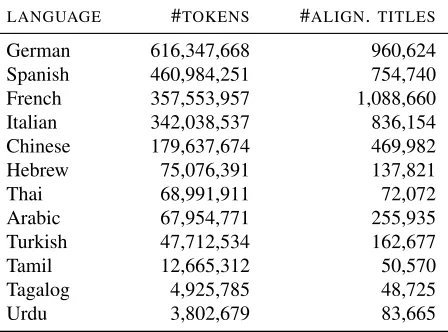
LANGUAGE #TOKENS #ALIGN.TITLES German 616,347,668 960,624 Spanish 460,984,251 754,740 French 357,553,957 1,088,660 Italian 342,038,537 836,154 Chinese 179,637,674 469,982 Hebrew 75,076,391 137,821 Thai 68,991,911 72,072 Arabic 67,954,771 255,935 Turkish 47,712,534 162,677 Tamil 12,665,312 50,570 Tagalog 4,925,785 48,725
[image:5.612.316.540.62.228.2]Urdu 3,802,679 83,665
Table 2:The number of tokens used in training the skip-gram model and the number of titles which can be aligned to the cor-responding English titles via the language links in Wikipedia.
tokenization is based on whitespaces. The number of tokens we use to learn the skip-gram model and the number of title alignments used by the CCA are given in Table 2. For learning the weights in Eq. (1), we use the implementation of linear ranking SVM in Lee and Lin (2014). Parameter selection and feature engineering are done by conducting cross-validation on the training data of Spanish Wikipedia dataset. 5.1 Wikipedia Dataset
LANGUAGE #TRAINING #TEST(#HARD) German 23,124 9,798 (3,266) Spanish 30,471 12,153 (4,051) French 37,860 14,358 (4,786) Italian 34,185 12,775 (4,254) Chinese 44,246 11,394 (3,798) Hebrew 20,223 16,146 (5,382) Thai 16,819 11,381 (3,792) Arabic 22,711 10,646 (3,549) Turkish 12,942 13,798 (4,598) Tamil 21,373 11,346 (3,776) Tagalog 4,835 1,074 (358) Urdu 1,413 1,389 (463)
Table 3: The number of training and test mentions of the Wikipedia dataset. The mentions are from the hyperlinked text in randomly selected Wikipedia documents. We ensure that there are at least one-third of test mentions are hard (cannot be solved by the most common title given the mention).
test documents, many mentions and titles actually overlap. To test that the algorithms really general-ize from training examples, we ensure that no (men-tion, title) pair in the test set appear in the training set. Table 3 shows the number of training men-tions, test menmen-tions, and hard mentions in the test set of each language. This dataset is publicly avail-able at http://bilbo.cs.illinois.edu/ ˜ctsai12/xlwikifier-wikidata.zip.
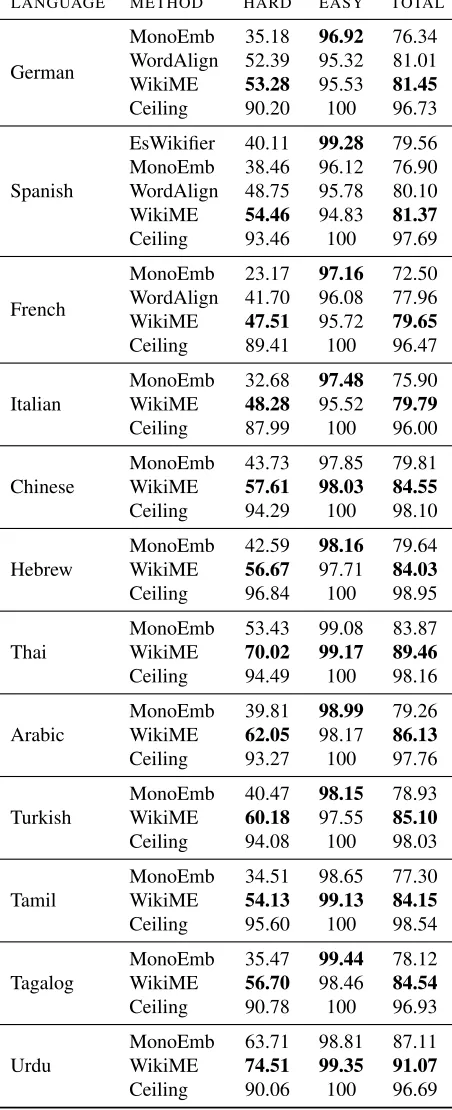
The performance of the proposed method (WikiME) is shown in Table 4 along with the fol-lowing approaches:
MonoEmb: In this method, we use the mono-lingual embeddings before applying CCA while all the other settings are the same as in WikiME. Since the monolingual embeddings are learnt separately for each language, calculating the cosine similarity of the word embedding in the foreign language and an English title embedding does not produce a good similarity function. The ranker, though, learns that the most important feature is P r(title|mention), and, consequently, performs well on easy mentions but has poor performance on hard mentions.
WordAlign: Instead of using the aligned Wikipedia titles in generating multilingual embed-dings, the CCA model operates on the word align-ments as originally proposed in Faruqui and Dyer (2014). We use the word alignments provided by Faruqui and Dyer (2014), which are obtained
LANGUAGE METHOD HARD EASY TOTAL
German
MonoEmb 35.18 96.92 76.34 WordAlign 52.39 95.32 81.01 WikiME 53.28 95.53 81.45
Ceiling 90.20 100 96.73
Spanish
EsWikifier 40.11 99.28 79.56 MonoEmb 38.46 96.12 76.90 WordAlign 48.75 95.78 80.10 WikiME 54.46 94.83 81.37
Ceiling 93.46 100 97.69
French
MonoEmb 23.17 97.16 72.50 WordAlign 41.70 96.08 77.96 WikiME 47.51 95.72 79.65
Ceiling 89.41 100 96.47
Italian MonoEmbWikiME 32.6848.28 97.4895.52 75.9079.79
Ceiling 87.99 100 96.00
Chinese MonoEmbWikiME 43.7357.61 97.8598.03 79.8184.55
Ceiling 94.29 100 98.10
Hebrew MonoEmbWikiME 42.5956.67 98.1697.71 79.6484.03
Ceiling 96.84 100 98.95
Thai MonoEmbWikiME 53.4370.02 99.0899.17 83.8789.46
Ceiling 94.49 100 98.16
Arabic MonoEmbWikiME 39.8162.05 98.9998.17 79.2686.13
Ceiling 93.27 100 97.76
Turkish MonoEmbWikiME 40.4760.18 98.1597.55 78.9385.10
Ceiling 94.08 100 98.03
Tamil MonoEmbWikiME 34.5154.13 98.6599.13 77.3084.15
Ceiling 95.60 100 98.54
Tagalog MonoEmbWikiME 35.4756.70 99.4498.46 78.1284.54
Ceiling 90.78 100 96.93
Urdu MonoEmbWikiME 63.7174.51 98.8199.35 87.1191.07
[image:6.612.314.540.69.624.2]Ceiling 90.06 100 96.69
Figure 1:Feature ablation study of WikiME. The left bar of each language shows the performance on hard mentions, whereas the right bar corresponds to the performance of all mentions. The descriptions of feature types are listed in Table 1.
from the parallel news commentary corpora com-bined with the Europarl corpus for English to Ger-man, France, and Spanish. The number of aligned words for German, France, and Spanish are 37,484, 37,582, and 37,554 respectively. WikiME performs statistically significantly better than WordAlign on all three languages.
EsWikifier: We use Illinois Wikifier (Ratinov et al., 2011; Cheng and Roth, 2013) on a Spanish Wikipedia dump and train its ranker on the same set of documents that are used in WikiME.
Ceiling: These rows show the performance of ti-tle candidate generation. That is, the numbers indi-cate the percentage of mentions that have the gold title in its candidate set, therefore upper-bounds the ranking performance.
In sum, WikiME can disambiguate the hard men-tions much better than other methods without sacri-ficing the performance on the easy mentions much. Comparing across different languages, it is impor-tant to note that languages which have a smaller size Wikipedia tend to have better performance, despite the degradation in the quality of the embeddings (see below). This is due to the difficulty of the datasets. That is, there is less ambiguity because the number of articles in the corresponding Wikipedia is small.
Figure 1 shows the feature ablation study of WikiME. For each language, we show results on hard mentions (the left bar) and all mentions (the right bar). We do not show the performance on easy mentions since it always stays high and does not change much. We can see that Local Context and Other Mentions are very effective for most of the languages. In particular, on hard mentions, the per-formance gain of the three feature groups is from almost 0 to around 50. For the easier dataset such as
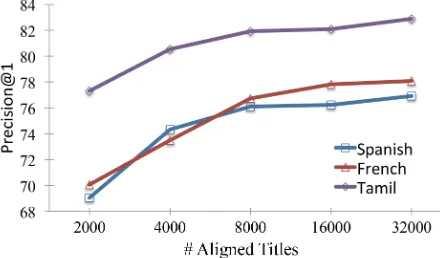
Figure 2:The number of aligned titles used in generating mul-tilingual embeddings versus the performance of WikiME.
Urdu,Basic featuresalone work quite well.
Figure 2 shows the performance of WikiME when we vary the number of aligned titles in generating multilingual embeddings. The performance drops a lot when there are only few aligned titles, especially for Spanish and French, where the results are even worse than MonoEmb when only 2000 titles are aligned. This indicates that the CCA method needs enough aligned pairs in order to produce good em-beddings. The performance does not change much when there are more than 16,000 aligned titles.
5.2 TAC KBP2015 Entity Linking
[image:7.612.317.537.223.352.2]and Facility.
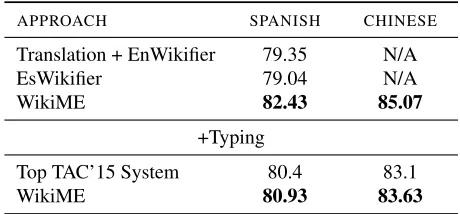
Table 5 shows the results. Besides the Span-ish Wikifier (EsWikifier) that we used in the previ-ous experiment, we implemented another baseline for Spanish Wikification. In this method, we use Google Translate to translate the whole documents from Spanish to English, and then the English Illi-nois Wikifier is applied to disambiguate the English gold mentions. Note that the target Knowledge Base of this dataset is FreeBase, therefore we use the FreeBase API to map the resulting English or Span-ish Wikipedia titles to the corresponding FreeBase ID. If this conversion fails to find the corresponding FreeBase ID, “NIL” is returned instead.
The ranker models used in all three systems are trained on Wikipedia documents. We can see that WikiME outperforms both baselines significantly on Spanish. It is interesting to see that the translation-based baseline performs slightly better than the Spanish Wikifier, which indicates that the machine translation between Spanish and English is quite re-liable. Note that this translation-based baseline got the highest score in this shared task when the men-tion boundaries were not given.
The row “Top TAC’15 System” lists the best scores of the diagnostic setting in which mention boundaries are given (Ji et al., 2016). Since the offi-cial evaluation metric considers not only the linked FreeBase IDs but also the entity types, namely, an answer is counted as correct only if the FreeBase ID and the entity type are both correct, we built two simple 5-class classifiers to classify each mention into the five entity types so that we can compare with the state of the art. One classifier uses Free-Base types of the linked FreeFree-Base ID as features, and this classifier is only applied to mentions that are linked to some entry in FreeBase. For NIL men-tions, another classifier which uses word form fea-tures (words in the mention, previous word, and next word) is applied. Both classifiers are trained on the training data of this task. From the last two rows of Table 5, we can see that WikiME achieves better results than the best TAC participants.
6 Related Work
Wikification on English documents has been stud-ied extensively. Earlier works (Bunescu and Pasca,
APPROACH SPANISH CHINESE
Translation + EnWikifier 79.35 N/A EsWikifier 79.04 N/A
WikiME 82.43 85.07
+Typing
Top TAC’15 System 80.4 83.1
WikiME 80.93 83.63
Table 5:TAC KBP2015 Entity Linking dataset. All results use gold mentions and the metric is precision@1. The top section only evaluates the linked FreeBase ID. To compare with the best systems in TAC, we also classify each mention into the five en-tity types. The results which evaluate both FreeBase IDs and entity types are shown in the bottom section.
2006; Mihalcea and Csomai, 2007) focus on local features which compare context words with the con-tent of candidate Wikipedia pages. Later, several works (Cucerzan, 2007; Milne and Witten, 2008; Han and Zhao, 2009; Ferragina and Scaiella, 2010; Ratinov et al., 2011) proposed to explore global fea-tures, trying to capture coherence among titles that appear in the text. In our method, we compute lo-cal and global features based on multilingual embed-dings, which allow us to capture better similarity be-tween words and Wikipedia titles across languages.
The annual TAC KBP Entity Linking Track has used the cross-lingual setting since 2011 (Ji et al., 2012; Ji et al., 2015; Ji et al., 2016), where the target foreign languages are Spanish and Chinese. To our best knowledge, most of the participants use one of the following two approaches: (1) Do en-tity linking in the foreign language, and then find the corresponding English titles from the resulting foreign language titles; and (2) Translate the query documents to English and do English entity linking. The first approach relies on a large enough Knowl-edge Base in the foreign language, whereas the sec-ond depends on a good machine translation system. The approach developed in this paper makes sig-nificantly simpler assumptions on the availability of such resources, and therefore can scale also to lower-resource languages, while doing very well also on high-resource languages.
corre-sponding candidates of the query document. This approach performs well on the Chinese dataset of TAC’13, but falls into the category (1). Moro et al. (2014) proposed another graph-based approach which uses Wikipedia and WordNet in multiple lan-guages as lexical resources. However, they only fo-cus on English Wikification.
McNamee et al. (2011) aims at the same cross-lingual Wikification setting as we do, where the challenge is in comparing foreign language words with English titles. They treat this problem as a cross-lingual information retrieval problem. That is, given the context words of the target mention in the foreign language, retrieve the most relevant English Wikipedia page. However, their approach requires parallel text to estimate word translation probabili-ties. In contrast, our method only needs Wikipedia documents and the inter-language links.
Besides the CCA-based multilingual word em-beddings (Faruqui and Dyer, 2014) that we ex-tend in Section 3, several other methods also try to embed words in different languages into the same space. Hermann and Blunsom (2014) use a sen-tence aligned corpus to learn bilingual word vectors. The intuition behind the model is that representa-tions of aligned sentences should be similar. Unlike the CCA-based method which learns monolingual word embeddings first, this model directly learns the cross-lingual embeddings. Luong et al. (2015) pro-pose Bilingual Skip-Gram which extends the mono-lingual skip-gram model and learns bimono-lingual em-beddings using a parallel copora and word align-ments. The model jointly considers within language co-occurrence and meaning equivalence across lan-guages. That is, the monolingual objective for each language is also included in their learning objec-tive. Several recent approaches (Gouws et al., 2014; Coulmance et al., 2015; Shi et al., 2015; Soyer et al., 2015) also require a sentence aligned parallel corpus to learn multilingual embeddings. Unlike other ap-proaches, Vuli´c and Moens (2015) propose a model that only requires comparable corpora in two lan-guages to induce cross-lingual vectors. Similar to our proposed approach, this model can also be ap-plied to all languages in Wikipedia if we treat docu-ments across two Wikipedia languages as a compa-rable corpus. However, the quality and quantity of this comparable corpus for low-resource languages
will be low, we believe.
We choose the CCA-based model because we can obtain multilingual word and title embeddings for all languages in Wikipedia without any additional data beyond Wikipedia. In addition, by decoupling the training of the monolingual embeddings from the cross-lingual alignment we make it easier to im-prove the quality of the embeddings by getting more text in the target language or a better dictionary be-tween English and the target language. Neverthe-less, as cross-lingul wikification provides another testbed for multilingual embeddings, it would be very interesting to compare these recent models on Wikipedia languages.
7 Conclusion
We propose a new, low-resource, approach to Wik-ification across multiple languages. Our first step is to train multilingual word and title embeddings jointly using title alignments across Wikipedia col-lections in different languages. We then show that using features based on these multilingual embed-dings, our wikification ranking model performs very well on a newly constructed dataset in 12 languages, and achieves state of the art also on the TAC’15 En-tity Linking dataset.
An immediate future direction following our work is to improve the title candidate generation process so that it can handle the case where the correspond-ing titles only exist in the English Wikipedia. This only requires augmenting our method with a translit-eration tool and, together with the proposed disam-biguation approach across languages, this will be a very useful tool for low-resource languages which have a small number of articles in Wikipedia.
Acknowledgments
References
R. Bunescu and M. Pasca. 2006. Using encyclopedic knowledge for named entity disambiguation. In Pro-ceedings of the European Chapter of the ACL (EACL). P.-C. Chang, M. Galley, and C. D. Manning. 2008. Opti-mizing chinese word segmentation for machine trans-lation performance. InProceedings of the third work-shop on statistical machine translation, Association for Computational Linguistics.
X. Cheng and D. Roth. 2013. Relational inference for wikification. In Proceedings of the Conference on Empirical Methods for Natural Language Processing (EMNLP).
J. Coulmance, J.-M. Marty, G. Wenzek, and A. Benhal-loum. 2015. Trans-gram, fast cross-lingual word-embeddings. InProceedings of EMNLP.
S. Cucerzan. 2007. Large-scale named entity disam-biguation based on Wikipedia data. InProceedings of the 2007 Joint Conference of EMNLP-CoNLL, pages 708–716.
M. Faruqui and C. Dyer. 2014. Improving vector space word representations using multilingual correlation. Association for Computational Linguistics.
P. Ferragina and U. Scaiella. 2010. Tagme: on-the-fly annotation of short text fragments (by wikipedia enti-ties). In Proceedings of the 19th ACM international conference on Information and knowledge manage-ment, pages 1625–1628. ACM.
S. Gouws, Y. Bengio, and G. Corrado. 2014. Bilbowa: Fast bilingual distributed representations without word alignments. InDeep Learning Workshop, NIPS. X. Han and J. Zhao. 2009. Named entity disambiguation
by leveraging wikipedia semantic knowledge. In Pro-ceedings of the 18th ACM conference on Information and knowledge management, pages 215–224. ACM. K. M. Hermann and P. Blunsom. 2014. Multilingual
distributed representations without word alignment. In
Proceedings of ICLR.
H. Hotelling. 1936. Relations between two sets of vari-ates. Biometrika, pages 321–377.
H. Ji, R. Grishman, and H. T. Dang. 2012. Overview of the tac2011 knowledge base population track. InText Analysis Conference (TAC2011).
H. Ji, J. Nothman, and B. Hachey. 2015. Overview of tac-kbp2014 entity discovery and linking tasks. InText Analysis Conference (TAC2014).
H. Ji, J. Nothman, B. Hachey, and R. Florian. 2016. Overview of tac-kbp2015 tri-lingual entity discovery and linking. InText Analysis Conference (TAC2015). C.-P. Lee and C.-J. Lin. 2014. Large-scale linear
RankSVM.Neural computation, 26(4):781–817.
T. Luong, H. Pham, and C. D. Manning. 2015. Bilin-gual word representations with monolinBilin-gual quality in mind. InProceedings of the 1st Workshop on Vector Space Modeling for Natural Language Processing. P. McNamee, J. Mayfield, D. Lawrie, D. W. Oard, and
D. S. Doermann. 2011. Cross-language entity linking. InProceedings of IJCNLP, pages 255–263.
R. Mihalcea and A. Csomai. 2007. Wikify!: linking doc-uments to encyclopedic knowledge. In Proceedings of ACM Conference on Information and Knowledge Management (CIKM), pages 233–242.
T. Mikolov, K. Chen, G. Corrado, and J. Dean. 2013a. Efficient estimation of word representations in vector space. InProceedings of Workshop at ICLR.
T. Mikolov, I. Sutskever, K. Chen, G. S. Corrado, and J. Dean. 2013b. Distributed representations of words and phrases and their compositionality. In Advances in neural information processing systems, pages 3111– 3119.
D. Milne and I. H. Witten. 2008. Learning to link with wikipedia. In Proceedings of ACM Conference on Information and Knowledge Management (CIKM), pages 509–518.
A. Moro, A. Raganato, and R. Navigli. 2014. Entity linking meets word sense disambiguation: a unified approach. InTransactions of the Association for Com-putational Linguistics, volume 2, pages 231–244. L. Ratinov, D. Downey, M. Anderson, and D. Roth.
2011. Local and global algorithms for disambiguation to wikipedia. InProceedings of the Annual Meeting of the Association for Computational Linguistics (ACL). T. Shi, Z. Liu, Y. Liu, and M. Sun. 2015.
Learn-ing crosslLearn-ingual word embeddLearn-ings via matrix co-factorization. InProceedings of ACL.
H. Soyer, P. Stenetorp, and A. Aizawa. 2015. Leveraging monolingual data for crosslingual compositional word representations. InProceedings of ICLR.
I. Vuli´c and M.-F. Moens. 2015. Bilingual word em-beddings from non-parallel document-aligned data ap-plied to bilingual lexicon induction. InProceedings of ACL.
Z. Wang, J. Zhang, J. Feng, and Z. Chen. 2014. Knowl-edge graph and text jointly embedding. In Proceed-ings of EMNLP.