Mainstreaming August Strindberg with Text Normalization
Adam Ek
Department of Linguistics Stockholm University
Sofia Knuutinen
Department of Linguistics Stockholm University
Abstract
This article explores the application of text normalization methods based on Lev-enshtein distance and Statistical Machine Translation to the literary genre, specif-ically on the collected works of August Strindberg. The goal is to normalize ar-chaic spellings to modern day spelling. The study finds evidence of success in text normalization, and explores some prob-lems and improvements to the process of analysing mid-19th to early 20th century Swedish texts. This article is part of an ongoing project at Stockholm University which aims to create a corpus and web-friendly texts from Strindsberg’s collected works.
1 Introduction
The purpose of the current study is to assert how well the Levenshtein and Statistical Machine Translation (SMT) methods developed by Eva Pet-tersson work on the 19th century texts of August Strindberg. This is done to see preliminary results on how well the normalization works on the text and in the future apply other Natural Language Processing (NLP) tools to the normalized data.
Normalizing historical text is a fairly new area in NLP, but it has a growing interest among re-searchers. The main interest has been in normaliz-ing spellnormaliz-ing and improvnormaliz-ing part of speech (POS) tagging. There is earlier research on normaliz-ing historical spellnormaliz-ing to modern spellnormaliz-ing and to follow are a few examples on some. Rule-based approaches have been studied by Rayson et al. (2005), Baron and Rayson (2008) and Pettersson et al. (2012).
A rule-based study was done by Rayson et al. (2005) on 16th to 19th century English texts. This study resulted in a tool called VARD (VARiant
Detector). The VARD tool was compared to the results of modern spellcheckers (MS-Word and Aspell) that are not trained for historical data. The results showed that VARD was more accu-rate in normalizing historical text. This same tool was later developed even further by Baron and Rayson (2008). They implemented phonetic matching against a modern dictionary and candi-date replacement rules for spelling variants within a text.
Pettersson et al. (2012) hand-crafted a small set of normalization rules based on 17th century court records and church texts to improve tagging and parsing of historical text. Their results showed that a small set of rules can work well in normalizing historical text and that it works for spellings even more archaic than their training data.
Pettersson et al. (2013b) researched a Leven-shtein based approach which was tested on the same data as Pettersson et al. (2012) used. The Levenshtein approach uses a weighted distance measure for comparing the original word form to word forms listed in a modern corpus or dictio-nary. The accuracy baseline for the Levenshtein method turned out to become 77% and by adding an error handling cache, in the form of a manually normalized training corpus the results increased even more up to 86,9%.
Pettersson et al. (2013a) approached the nor-malization task as a form of translation. It re-sulted in a statistical machine translation (SMT) based approach. The translation was done based on characters and not on words as whole. The re-sults showed that having even a small amount of training data works well and the SMT normaliza-tion showed an accuracy increase and reached a level of 86,1%.
This paper deals with spelling normalization of August Strindbergs books, which were writ-ten between 1869 and 1909. Strindbergs books are mainly written during the era of Late
ern Swedish. This means that they are a bit more modern than the data Pettersson et al. (2012) used when they began to research the different approaches to text normalization. There is even some shifts in spelling in the books since Strind-bergs last books were written at the time when Contemporary Swedish was making its way for-ward. Strindberg is even considered as one of the authors who had a big influence on the changes of the Swedish language.
The approaches used are Levenshtein-based normalisation and SMT-based normalization which is two out of four possible approaches presented by Pettersson (2016a). It will concen-trate on a qualitative analysis on both distinctive features of archaic Swedish and how well they are translated and on a few problematic areas in normalization picked from the data collected.
2 Method
2.1 Data
The data consists of August Strindbergs collected works,1 of which 59 books have been parsed to
XML and then into raw text format. The collected works consists of novels, short stories, poems and plays. The data used for testing is the chapters from each book excluding foreword, afterword, word clarifications, public reception. The data was preprocessed by removing all non-alphabetic char-acters and tokenizing the text with one token per line.
It is noteworthy that Strindberg uses code-switchingfrequently in the text, which are words that should not be considered as candidates for normalization. Chapters containing only french text has been removed manually and as many indi-vidual words as possible have been removed man-ually by identifying french spelling patterns.
The Swedish corpus, training and tuning data for both methods was provided by Eva Pettersson (Pettersson 2016b).2 The corpus data (language
model data) consists of 1166539 tokens, the train-ing data consists of 28777 tokens and the tuntrain-ing data of 2650 tokens. The data is from a different genre, court records and church documents, while Strindbergs works are mainly literary fiction. The data is also older (15th to 17th century) compared to the texts of Strindberg which were written from
172 books in total provided by Litteraturbanken. 2http://stp.lingfil.uu.se/˜evapet/histNorm/
1869 to 1909.3This results in that the training data
is not fully optimized for the current task.
The modern language dictionary used for both methods is the SALDO dictionary (version 2) (Baron et al., 2008). The corpus of original spelling mapped to manually normalized word forms is compiled from the Gender and Work cor-pus of court records and church texts from 15th to 17th century. (Pettersson, 2016b)
2.2 Normalization 2.2.1 Levenshtein
The Levenshtein-based approach calculates the extended Levenshtein edit distance4 between the
original word and any token present in a modern language dictionary. It picks out the candidate(s) with the smallest distance and then proceeds to choose the best candidate out of several (given there are more than one candidate for the word). Perl was used to perform the Levenshtein-based normalization. The data used for this was a mod-ern language dictionary, a corpus of original words mapped to manually normalized spelling, a corpus of modern language to choose the most frequent candidate in the case of more than one candidate, a file containing weights lower than 1 for commonly occurring edits observed in training data and a file containing the edit distance threshold value. All these, except for the input file, were provided in Pettersson’s HistNorm package.
2.2.2 SMT
When using SMT, the task of text normalization is seen as a translation, where the translation is between spelling conventions rather than between different languages. This is achieved by using character-based translations, where the individual characters rather than words are treated as the low-est level entity, words are treated as middle level, and sentences as the top level. The SMT-based normalization was performed using Moses Statis-tical Machine Translation System,5GIZA++6and
SRILM.7
3Strindberg wrote his later texts just as the Swedish
spelling reform of 1906 took place. It is unclear if he decided to follow their directions.
4Extended edit distance uses both single character edits
and additional operations such as double deletion and single-to-double substitution (Pettersson,2016a)
5http://www.statmt.org/moses/
The input data was tokenized, then each char-acter in the word was separated with a whitespace to indicate that each character should be regarded as the lowest level entity, and newlines to indicate the end of a paragraph.
In a standard language model (LM) where words are considered words etc. a slightly lower n-gram order might be appropriate, but as the current data is based on characters rather than words the n-gram order is increased to capture longer words, and their spellings. Work on this has been done by Nakov and Tiedmann (2012), and their results pointed towards an order of 10 for character-based SMT.
Moses SMT was initialized with a language model of order 10, with standard smoothing (Good-Turing Discounting) and (Linear) interpo-lation created with SRILM then trained and tuned with the Minimum Error Rate Training (MERT) algorithm.
3 Results
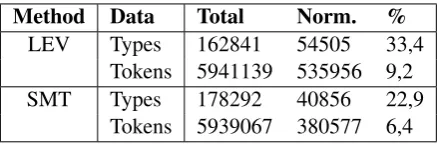
The evaluation of Levenshtein and SMT is done with a quantitative analysis (Table 1) and two qual-itative analyses (Table 2, Table 3).
The quantitative analysis of the normalization is illustrated in Table 1, where the total number of tokens and types normalized in the text is shown. The normalizations in Table 1 shows all normal-izations that were made, regardless of their cor-rectness.
Method Data Total Norm. %
LEV Types 162841 54505 33,4 Tokens 5941139 535956 9,2 SMT Types 178292 40856 22,9
Tokens 5939067 380577 6,4
Table 1: Data normalization percentages for Lev-enshtein (LEV) and SMT. Norm=Normalized.
It can be seen that a significant yet not partic-ularly large amount of tokens were normalized, 6,4% (SMT) and 9,2% (Levenshtein), however the normalization rate for types is much higher for both methods, 22,9% (SMT) and 22,9% (Leven-shtein).
The features examined in Table 2 is the follow-ing: hv (hvad, hvilken),qv (qvinna/kvinna, qvant-fysik/kvantfysik), dt (fasdt/fast, måladt/målat), fv (hufvud/huvud, ¨ofver/¨over), archaic
preteri-tum conjucation of verbs ending with -o e.g. gingo/gick, fingo/fick, voro/var, these features were chosen based on their frequency and recognizabil-ity.
These words are only a subset of the totality of words with archaic Swedish spelling, changes such as e → ¨aand less frequent archaic spelling conventions have been ignored.
Method Correct Incorrect Accuracy
LEV 895 105 89,5%
[image:3.595.72.291.501.574.2]SMT 818 182 81,8%
Table 2: Normalizations of Swedish words with archaic spelling. Correct=Archaic spelling nor-malized correctly, Incorrect = Archaic spelling normalized incorrectly, Accuracy= CorrectCorrect+Incorrect.
In Table 2, 1000 words with archaic spelling was chosen randomly, the evaluations is then done by manually checking if the words with archaic spelling is normalized to the correct modern ver-sion of the words.
True positives (TP), false positives (FP) and false negatives (FN) were identified manually. Among the 1000 candidates surnames such as Lindqvist are normalized to Lindkvist, which is correct, but in modern Swedish the archaic spelling is still being used, so these cases have been removed from the evaluation in Table 2. Many cases of French and English words appear and have been marked as FP (False Positive), also compound words such assandtorrthave been marked as FP, the archaic Swedish spellingdt oc-curs insandtorrt, but it is formed as the the two wordssandandtorrtare concatenated, it is not an actual instance of archaic spelling.
At this stage the most interesting percentage is the relationship between correct and incorrect nor-malizations, i.e. Correct
Correct+Incorrect, this shows how well these methods perform on words with ar-chaic spelling, which is 89,5% for Levenshtein and 81,8% for SMT.
(recall) is 95.3% for Levenshtein and 92.1% for SMT, which means that out of all the words with archaic spelling, 95,3% and 92,1% of them are caught. Table 3 shows the precision and recall on types in the dataset for both methods.
Method Precision Recall
LEV 8,2% 95,3%
SMT 7,3% 92,1%
Table 3: PrecisionTPTP+FPand recall TPTP+FNfor Lev-enshtein and SMT based on the normalization of types.
It can be observed that both methods generally output similar result for correct and incorrect nor-malizations on archaic words, the same trend is seen in both precision and recall where the dif-ference is not huge, 3.2% for recall and 0.9% for precision. An extensive and complete analysis of the errors in word selection has not been done at this point, but the observed phenomenas will be addressed below.
4 Discussion
From the normalization data it has been observed that a large portion of the incorrectly normalized words is compound words, e.g. qvinnotårar →
kvinnoårar (SMT), nordljuset → mordlust (Lev-enshtein). As shown in the first example (SMT), the first part of the compound is normalized cor-rectly, however the second compound part is in-correctly normalized with the removal oft, which makes this into an incorrect normalization.
The second example (Levenshtein) shows that the entire compound word may change form, both the first and the second compound.
Levenshtein does word to word mappings and normalizes compound words as two separate words while searching for candidates. SMT on the other hand regards each word as a collection of characters and does not differentiate between com-pounds words and normal words.
SMT removed one letter in the first example from the compound while Levenshtein regarded its compound as two separate entities which re-sulted in that the two words received normaliza-tions separately which changed the meaning of both parts instead of just one. For the Levenshtein-based approach there should be some tuning around normalizing compound words. Compound
splitting can be a good thing but there could be some restrictions made to improve it.
The main issue for SMT is the different gen-res in the training data and the texts of August Strindberg. Common words with archaic Swedish spelling is caught, but also a few words that were not archaic but had archaic spelling features by accident were normalized, such as sandtorrt →
stort (SMT). This phenomena is quite hard to solve during the normalization process, the best method would be a lexicon which consists of an updated vocabulary with a larger scope than the current one, this enables us to identify that sand-torrtis a compound word consisting of two mod-ern Swedish words and not an instance of archaic Swedish spelling.
As noted many instances ofcode-switching ap-pear in the text of Strindberg, and not all foreign words are caught in the preprocessing as these of-ten appear randomly in the text. This lowers the representability of the test on total amount of types and tokens normalized by the methods, the accu-racy is unaffected as the foreign words can be ruled out when manually checking the results.
The two problems, code-switching and com-pound words in conjunction is responsible for a large portion of the normalised words in both method, which as mentioned above distorts the actual number of relevant words that are normal-ized. Another issue is that the 5 features from Ta-ble 2 which were analyzed is not all of the words that were normalized correctly, or have archaic Swedish spelling, which means that another por-tion of the normalized texts is correct. Many fea-tures of archaic Swedish has been overlooked at the moment due to time limitations, as the data has to be validated by hand.
What remains to do is to Part-Of-Speech tag the text and evaluate the results of both the Lev-enshtein and SMT normalized versions, as well as the original texts. The suspicion is that the normal-ized versions will perform better than the original, but the question remains, if and how much the text normalization has done to improve the results.
be assumed that the word has been normalized in-correctly.8 Some changes in the POS-tagging is
wanted, for words with archaic spelling, but all other changes in the POS-tags should be regarded as incorrect, thus in performing POS-tagging all the false positive (FP) normalizations can be iden-tified.
5 Conclusions
The accuracy of both the methods showed suc-cess, however both methods in conjunction with the training data results in a very low precision rate. Some solutions to this has been suggested, such as foreign word recognition (FWR), further-more another data set for training that is further-more genre specific and closer to 19th century Swedish as well as specific methods to handle compound words better, for both Levenshtein and SMT.
In conclusion, the current methods work rather well when the input is Swedish words with archaic spelling, but for texts which contains words with modern Swedish spelling, a more complex system with additional components will be needed. This is seen clearly when comparing precision and re-call of the two methods. Both methods pick up most of the instances of archaic spelling, but they also pick up a large amount of irrelevant data.
References
A. Baron and P. Rayson. 2008.Vard2: A tool for deal-ing with spelldeal-ing variation in historical corpora, In Postgraduate Conference in Corpus Linguistics, As-ton University, Birmingham, UK.
E. Pettersson, B. Megyesi and J. Nivre. 2012
Rule-Based Normalisation of Historical Text a
Di-achronic Study, Proceedings of KONVENS 2012
(LThist 2012 workshop), Vienna, September 21, 2012
E. Pettersson, B. Megyesi and J. Tiedemann. 2013 An SMT Approach to Automatic Annotation of
Histor-ical Text, Proceedings of the workshop on
compu-tational historical linguistics at NODALIDA 2013. NEALT Proceedings Series 18/Linkping Electronic Conference Proceedings 87: 5469.
E. Pettersson, B. Megyesi and J. Nivre. 2013
Normalisation of Historical Text Using Context-Sensitive Weighted Levenshtein Distance and
Com-pound Splitting , Proceedings of the 19th Nordic
8This method works with the assumption that the original
POS-tag is correct. A change of tags could also mean that the normalization is successful and an incorrectly tagged word now is tagged correctly.
Conference of Computational Linguistics (NODAL-IDA 2013); Linkping Electronic Conference Pro-ceedings 85: 163-179
E. Pettersson 2016 Spelling Normalisation and Lin-guistic Analysis of Historical Text for Information Extraction, Studia Linguistica Upsaliensia 17. 147 pp. Uppsala: Acta Universitatis Upsaliensis, Upp-sala, Sweden.
E. Pettersson 2016 User Manual for Normalisation
of Noisy Input Data using HistNorm, Department of
Linguistics and Philology. Uppsala: Uppsala univer-sity, Uppsala, Sweden.
L. Borin, M. Forsberg and L. L¨onngren. 2008 Saldo 1.0 (svenskt associationslexikon version 2), Sprk-banken, Gothenburg: University of Gothenburg. Gothenburg, Sweden.
P. Rayson, D. Archer, and N. Smith. 2005.VARD ver-sus Word A comparison of the UCREL variant de-tector and modern spell checkers on English
histor-ical corpora, In Proceedings from the Corpus
Lin-guistics Conference Series online e-journal, volume 1, Birmingham, UK.