Original Article
Association of catechol-O-methyltransferase val158Met
polymorphism with postoperative analgesic opioid use
Jinghua Jiao1,2, Yan Li3, Lei Liu4, Yuheng Wang1, Xiaojing Jiang2, Xiaoguang Chen2
1Department of Anesthesiology, Central Hospital, Shenyang Medical College, Shenyang 110024, Liaoning, P. R. China; Departments of 2Anesthesiology, 4Ophthalmology, The First Affiliated Hospital, China Medical University, Shenyang 110001, Liaoning, P. R. China; 3Department of English, School of Fundamental Sciences, China Medical University, Shenyang 110122, Liaoning, P. R. China
Received December 23, 2015; Accepted June 8, 2016; Epub August 15, 2016; Published August 30, 2016
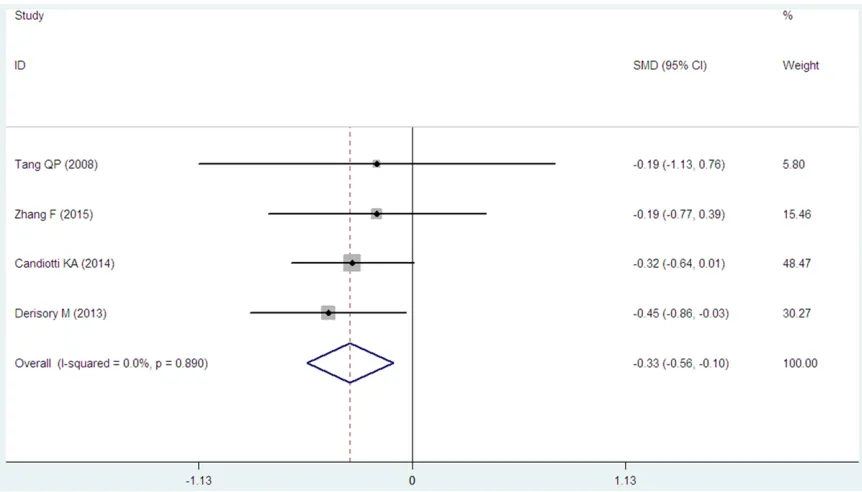
Abstract: This meta-analysis was performed to assess the effects of COMT rs4860 polymorphism on postopera-tion analgesia with opioid consumppostopera-tion. We conducted a search of all papers using PubMed, the Cochrane Library, EMbase, Ovid, Web of Science, Google (scholar), Chongqing VIP database, CBMDisc, and CNKI database. The fixed or random effect model was determined according to the heterogeneity among researches. The crude standard-ized mean difference (SMD) with 95% confidence interval (CI) was calculated. Publication bias was estimated using funnel plots and Begg’s and Egger’s test. Five studies involving 517 cases were included in this meta-analysis. The results indicated that cases with AA homozygote of the COMT rs4860 polymorphism required less opioid doses to achieve adequate pain relief, compared with those carrying the G allele (AG+GG) in 24 h after operation (SMD=-0.33, 95% CI -0.56, -0.10, P=0.005). Nevertheless, there were no statistically significant differences between an AA homozygote and a G carrier (AG+GG) in opioid doses in 48 h after operation (SMD=-0.01, 95% CI -0.35, 0.33, P=0.94) and pain score at 24 h after operation (SMD=-0.09, 95% CI -0.33, 0.15, P=0.47). There were no statistically significant differences between an AA homozygote and a G carrier (AG+GG); Future studies should be undertaken to ascertain any contribution of this polymorphism in opioid consumption in postoperative conditions.
Keywords: Catechol-O-methyltransferase, postoperation analgesia, polymorphism, meta-analysis
Introduction
Nowadays, Opioid such as morphine and Fentanyl has been widely used in postopera-tion pain control and showed well effects [1]. However, the consumption of opioid in postop-eration pain control varies widely among indi-viduals [2] and the reason remains unclear even considering other factors such as heredi-ty, sex, age, weight and organ function [3]. Under these circumstances, there were many candidate genes approaches in effect of opioid consumption on postoperation pain control including Catechol-O-Methyltransferase (COMT) gene.
The chromosomal allocation of COMT gene is 22q11.2, which encodes the COMT protein. Reports have suggested that the important role of COMT single-nucleotide polymorphisms (SNPs) is played in affecting an individual’s
sen-sitivity to pain. COMT SNPs comprising rs4633, rs4818, rs6269 and rs4680, and rs4680 (G1947A (Val158Met)) were widely researched. Previous study, having compared opioid doses required by AA homozygote patients with those required subjects carrying G allele, has shown that AA patients need lower average opioid doses compared to other subjects [4]. In addi-tion, there was a significant difference in opioid doses among the three protein-coding (AA vs. AG vs. GG) genotypes in 24 h postoperation. However, other studies have also revealed that no significant differences of opioid need are observed among different rs4680 SNPs at 24 h after operation [5-8]. accordingly the outcomes of individually published researches were limit-ed and rather conflicting.
those eligible researches, in order to evaluate the precise effects of COMT rs4860 polymor-phism on postoperation analgesia with opioid doses, which would have a much greater pos-sibility of reaching reasonably sound conclu- sions.
Materials and methods
Literature search strategy
Two reviewers (Jinghua Jiao and Xiaoguang Chen) independently scrutinized studies on the effects of COMT rs4860 polymorphism on postoperation analgesia with opioid doses. We searched PubMed, the Cochrane Library, EM- base, Ovid, Web of Science, Google (scholar), Chongqing VIP database, Chinese Biological Medicine, China National Knowledge Infras- tructure, Wan Fang Data and Chongqing VIP database (Last search was updated on OCT 19, 2015), using the terms (“single nucleotide poly-morphism” or “SNP” or “polypoly-morphism” or “ge- ne mutation” or “genetic variants”) and (“Ca-
gesia with opioid (fentanyl or morphine) for pain relief; and (4) the most complete (sufficient data) and latest results of the researchers with multiple publications.
Exclusion criteria
The exclusion criteria were defined as: 1) abstracts, letters, reviews, editorial articles or none clinical studies; 2) incomplete data, geno-type number or frequency not reported; 3) duplicates of previous publications.
Data extraction
[image:2.612.89.375.73.386.2]Data from the chosen studies were extracted independently by two reviewers (Jinghua Jiao and Xiaoguang Chen) into a standardized data-base. When discrepancies were appeared, all authors were recruited to assess the data. The following information was collected: first, au- thor, publication year, country, ethnicity, sam-ple sizes of cases, numbers of genotype and other characteristics.
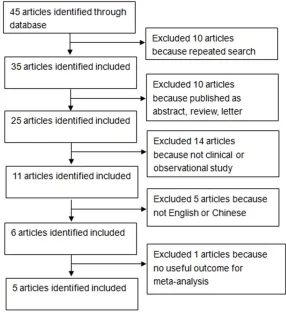
Figure 1. Flow chart demonstrating those studies that were processed for inclusion in the meta-analysis.
techol-O-Methyltransferase” or “COMT”) and (“Fentanyl” or “Fentora” or “Phentanyl” or “Fentanest” or “morphine” or “R-4263” or “Duragesic”). Pub-Med option “Related Arti- cles” was used for each study to search additional potential-ly relevant studies. Reference lists or textbooks were re- viewed manually. We sear- ched articles without lan-guage restriction, but only English or Chinese articles were contained in this me- ta-analysis.
Selection criteria
anal-Table 1. Characteristic of included studies
First author Publication Year Country Ethnicity number Case
(n) Age (year)
Study design
ASA physical
status Surgery
Genotype
method SNP ID Opioid Evaluating indicators scoreNOS
Kolesnikov Y, et al. [5] 2011 Estonia Caucasian 102 54.6±11.1 Prospective,
observational I/II Abdominal surgery PCR (Val158Met) rs4680 Morphine Morphine dose for 48 h 6 Pain score for 24 h
Nausea score Sedation score Antinausea drugs Tang QP, et al. [6] 2008 China Asian 39 46.49±13.86 Observational I/II Abdominal
surgery PCR (Val158Met) rs4680 Fentanyl Fentanyl dose for 24 h 6
Zhang F, et al. [7] 2015 China Asian 115 20-75 Observational I/III Radical
gastrectomy
PCR rs6269 Fentanyl Fentanyl dose for 24 h 6
rs4680 Fentanyl dose for 48 h rs4633 VAS pain score at 24 h rs4818 VAS pain score at 48 h Candiotti KA, et al. [8] 2014 USA Caucasian 152 NA Observational I/III Elective
nephrectomy TaqMan assay (Val158Met) rs4680 Morphine Opioid consumption for 24 h 6 Pain score for 24 h Derisory M, et al. [9] 2013 Italy Caucasian 109 18-75 Observational NA Abdominal/
urological PCR (Val158Met) rs4680 Morphine Opioid consumption for 24 h 6 rs6269
[image:3.792.92.706.84.348.2]The review and analysis were guided by the PRISMA statement [9].
Statistical analysis
The crude standardized mean difference (SMD) with 95% confidence interval (CI) was calculat-ed. Hardy-Weinberg equilibrium was evaluated by the chi-square test. Heterogeneity was examined with I square statistic interpreted as the proportion of total variation contributed by between-study variation. If there was a statisti-cal heterogeneity (P<0.10, I2>50%), the random
effects model (Der Simonian and Laird method) would be utilized to estimate the SMD [10, 11]. Otherwise, we applied fixed effects model (Mantel-Haenszel method) to doing the analy-sis [12]. The possible publication bias was assessed with funnel plots and Egger’s test and Begg’s test. An asymmetric plot suggests a possible publication bias and the P value of Egger’s test or Begg’s test less than 0.05 was considered representative of significant publi-cation bias [13]. All statistical tests were per-formed with STATA Version 11.0 software (Sta- ta Corp., College Station, TX). A 2-tailed P<0.05 for any test was considered to be statistically significant.
Results
Study inclusion and characteristics
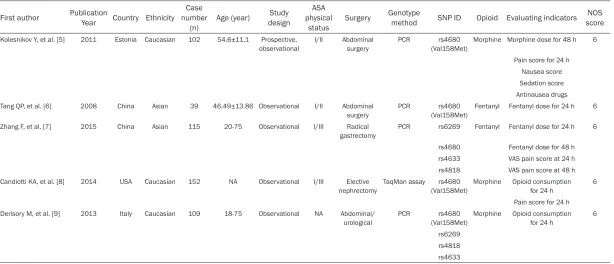
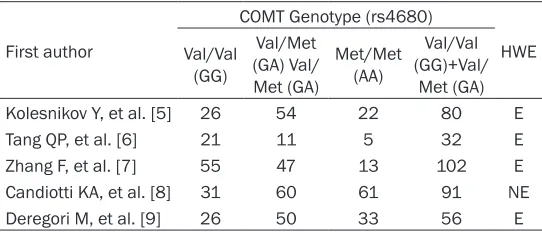
After review, five researches (involving 517 cases) meet the inclusion criteria and were included in the meta-analysis [4-8]. The de- tailed screening process is shown in Figure 1. The studies identified and their main character-istics and genotype number were summarized in Tables 1 and 2.
control postoperation pain in 24 h (SMD=-0.48, 95% CI -0.76, -0.20, P=0.001). Nevertheless, there were no statistically significant differenc-es between an AA homozygote and a G carrier (AG+GG) in opioid doses in 48 h after operation (SMD=-0.01, 95% CI -0.35, 0.33, P=0.94) and pain score at 24 h after operation (SMD=-0.09, 95% CI -0.33, 0.15, P=0.47).
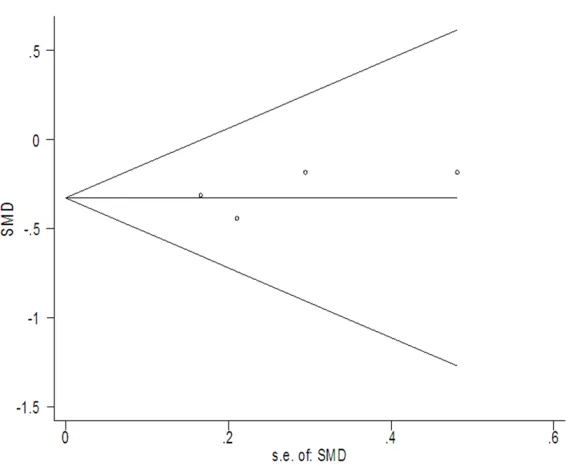
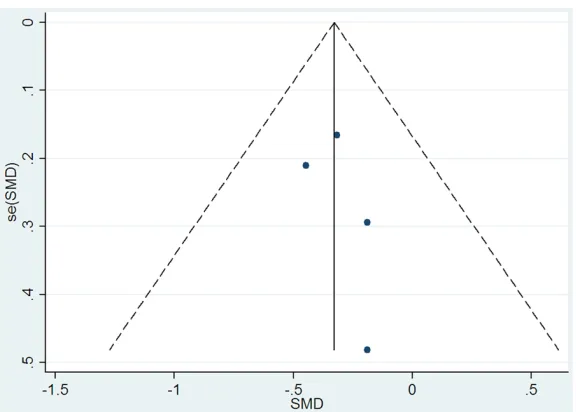
There was no heterogeneity between studies and no significant publication bias according to Egger’s (Figure 3) and Begg’s tests (Figure 4) (Begg, P=0.73; Egger, P=0.53). The funnel plot was symmetrical as seen in Figure 5.
Discussion
To the best of our knowledge, it is the first meta-analysis to make the evaluation of the effects of COMT rs4860 polymorphism on postoperation analgesia with opioid. Previous report have investigated the association bet- ween COMT gene polymorphism and chronic human pain using meta-analysis [14] and indi-cated that chronic pain like fibromyalgia or chronic widespread pain was related to the COMT SNPs rs4680. In previous clinical stud-ies, low COMT activity has been linked to the increased sensitivity to postoperative pain [15]. In order to discover the mechanism, several studies have tested the functional effects of COMT rs4860 polymorphism on postoperative pain control with fentanyl or morphine, but their results have been inconclusive [4-8].
[image:4.612.90.361.96.212.2]In our meta-analysis, five clinical observational studies were included with a total of 517 cases who received postoperation analgesia with opi-oid. The results of this meta-analysis demon-strated that there was a relationship between Table 2. COMT Genotype (rs4680) frequency for included
stud-ies
First author
COMT Genotype (rs4680)
HWE Val/Val (GG) Val/Met (GA) Val/ Met (GA) Met/Met (AA) Val/Val (GG)+Val/ Met (GA)
Kolesnikov Y, et al. [5] 26 54 22 80 E
Tang QP, et al. [6] 21 11 5 32 E
Zhang F, et al. [7] 55 47 13 102 E
Candiotti KA, et al. [8] 31 60 61 91 NE
Deregori M, et al. [9] 26 50 33 56 E
HWE: Hardy-Weinberg equilibrium. COMT: Catechol-O-Methyltransferase. E: Equilibrium. NE: Not equilibrium.
Quantitative data synthesis
COMT rs4860 polymorphisms and doses of
[image:5.612.91.525.96.374.2]opioid in 24 h after operation. Cases with AA phism demanded less opioid doses to adquate pain control (there is no difference between AA Table 3. Summary SMD and 95% CI of the effects of Catechol-O-Methyltransferase (COMT) rs4860 polymorphism on the opioid consumption for postoperation analgesia
24 h opioid doses 24 h pain scores 48 h opioid doses
AA Homozygotes vs. G-carriers
No. of Studies 4 3 3
No. of AA 112 96 40
No. of AG+GG 301 273 214
SMD (95% CI) -0.33 (-0.56, -0.10) -0.09 (-0.33, 0.15) -0.01 (-0.35, 0.32)
P value 0.005 0.47 0.94
Heterogeneity, I2 (%) 0 24.2 0
AA vs. AG
No. of Studies 4 3 3
No. of AA 112 96 40
No. of AG 133 161 112
SMD (95% CI) -0.23 (-0.47, 0.02) -0.11 (-0.32, 0.21) 0.01 (-0.35, 0.37)
P value 0.06 0.67 0.94
Heterogeneity, I2 (%) 0 0 0
AA vs. GG
No. of Studies 4 3 3
No. of AA 112 96 40
No. of GG 133 112 102
SMD (95% CI) -0.49 (-0.77, -0.20) -0.06 (-0.32, 0.21) -0.05 (-0.43, 0.33)
P value 0.001 0.49 0.79
Heterogeneity, I2 (%) 42.1 0 0
SMD: standardized mean difference; CI: confidence interval.
[image:5.612.90.521.405.651.2]pain score at 24 h after operation) compared with those carrying the G allele (AG+GG) in 24 h after operation. Only one study reported that there was no s difference with tatistical signifi-cance on pain score at 48 h after operation among genotype groups [7]. So the opioid con-sumption and pain score were the same at 48h after operation among COMT rs4860 genotype groups. These notable results could be dedu- ced at list: 1) the same opioid consumption
tical significance, a trivial potential study bias might have occurred in this meta-analysis. In addition, we did not consider researches pub-lished in languages except English or Chinese. In conclusion, this meta-analysis suggested that the COMT rs4860 polymorphisms were associated with doses of opioid in 24 h after operation. COMT rs4860 gene may be useful to predict cases’ response to postoperation
[image:6.612.91.376.70.287.2]anal-Figure 3. Egger’s publication bias plot (AA vs. AG+GG).
Figure 4. Begg’s funnel plot with pseudo 95% confidence limits (AA vs. AG+GG).
among COMT rs4860 geno-type groups, based on the pain relief after 24 h postop-eration, 2) the same opioid consumption from 24 h to 48 h postoperation, in accor-dance with the same pain score at 24 h postoperation achieved by distinct COMT rs4860 genotype cases. In any case, according to this meta-analysis result, clinical doctor could use less opioid consumption to achieve pain control for cases with AA homozygote of the COMT rs4860 polymorphism.
[image:6.612.92.376.319.552.2]statis-gesia. However, this conclusion should be in- terpreted cautiously. To better understand the effects of COMT rs4860 polymorphism on postoperation analgesia with opioid in humans, large sample studies should be carried out in future.
Acknowledgements
Many thanks to Xiaomei Wu, Ph.D, Professor of the Department of Clinical Epidemiology and Evidence Medicine in the First Affiliated Hospital of China Medical University for her assistance in this work. This study was support-ed by Science and Technology Planning Pro- ject of Shenyang City (No. F13-221-9-71) and Liaoning Provincial Education Science and Planning Projects (No. JG14DB450) and Sci- ence and Technology Fund Project of Shenyang Medical College (No. 20142034).
Disclosure of conflict of interest
None.
Address correspondence to: Drs. Jinghua Jiao and Xiaoguang Chen, Department of Anesthesiology, Central Hospital, Shenyang Medical College, Shenyang 110024, Liaoning, P. R. China; Department of Anesthesiology, The First Affiliated Hospital, China Medical University, Shenyang 110001, Liaoning, P. R. China; E-mail: [email protected] (JHJ); [email protected] (XGC)
[3] Droney J, Riley J, Ross JR. Evolving knowledge of opioid genetics in cancer pain. Clin Oncol (R Coll Radiol) 2011; 23: 418-428.
[4] De Gregori M, Garbin G, De Gregori S, Minella CE, Bugada D, Lisa A, Govoni S, Regazzi M, Allegri M, Ranzani GN. Genetic variability at COMT but not at OPRM1 and UGT2B7 loci modulates morphine analgesic response in acute postoperative pain. Eur J Clin Pharmacol 2013; 69: 1651-1658.
[5] Kolesnikov Y, Gabovits B, Levin A, Voiko E, Veske A. Combined catechol-O-methyltransfer-ase and mu-opioid receptor gene polymor-phisms affect morphine postoperative analge-sia and central side effects. Anesth Analg 2011; 112: 448-453.
[6] Tang QP, Ma X, Liao Q, Cheng YH. The correla-tion between COMT polymorphisms preopera-tive anxiety and postoperapreopera-tive fentanyl dose. Chinese Journal of Clinical Psychology 2008; 16: 321-323.
[7] Zhang F, Tong J, Hu J, Zhang H, Ouyang W, Huang D, Tang Q, Liao Q. COMT gene haplo-types are closely associated with postopera-tive fentanyl dose in patients. Anesth Analg 2015; 120: 933-940.
[8] Candiotti KA, Yang Z, Buric D, Arheart K, Zhang Y, Rodriguez Y, Gitlin MC, Carvalho E, Jaraba I, Wang L. Catechol-o-methyltransferase poly-morphisms predict opioid consumption in postoperative pain. Anesth Analg 2014; 119: 1194-1200.
[image:7.612.90.378.68.274.2][9] Moher D, Liberati A, Tetzlaff J, Altman DG. PRISMA Group Preferred reporting items for systematic reviews and meta-analyses: the
Figure 5. A funnel plot of effects of Catechol-O-Methyltransferase (COMT) rs4860 polymorphism on the opioid consumption for postoperation analge-sia (AA vs. AG+GG).
References
[1] Murphy GS, Szokol JW, Avram MJ, Greenberg SB, Marymont JH, Shear T, Parikh KN, Patel SS, Gupta DK. Intraoperative Metha- done for the Prevention of Postoperative Pain: A Randomized Double-blin- ded Clinical Trial in Cardiac Surgical Patients. Anesthe- siology 2015; 122: 1112-1122.
PRISMA statement. PLoS Med 2009; 6: e1000097.
[10] DerSimonian R, Laird N. Meta-analysis in clini-cal trials. Control Clin Trials 1986; 7: 177-188. [11] DerSimonian R, Kacker R. Random-effects model for meta-analysis of clinical trials: an update. Contemp Clin Trials 2007; 28: 105-114.
[12] Mantel N, Haenszel W. Statistical aspects of the analysis of data from retrospective studies of disease. J Natl Cancer Inst 1959; 22: 719-748.
[13] Egger M, Davey SG, Schneider M, Minder C. Bias in meta-analysis detected by a simple graphical test. BMJ 1997; 315: 629-634.
[14] Tammimäki A, Männistö PT. Catechol-O-methy- ltransferase gene polymorphism and chronic human pain: a systematic review and meta-analysis. Pharmacogenet Genomics 2012; 22: 673-691.