Is Structure Necessary for Modeling Argument Expectations
in Distributional Semantics?
Emmanuele Chersoni Aix-Marseille University
Enrico Santus
Singapore University of Technology and Design
Philippe Blache Aix-Marseille University
Alessandro Lenci University of Pisa
Abstract
Despite the number of NLP studies dedicated to thematic fit estimation, little attention has been paid to the related task of composing and updating verb argument expectations. The few exceptions have mostly modeled this phenomenon withstructureddistributional models, implicitly assuming a similarlystructuredrepresentation of events. Recent experimental evidence, however, suggests that human processing system could also exploit an unstructured “bag-of-arguments” type of event rep-resentation to predict upcoming input. In this paper, we re-implement a traditional structured model and adapt it to compare the different hypotheses concerning the degree of structure in our event knowledge, evaluating their relative performance in the task of the argument expectations update.
1
Introduction
An important trend of current research in linguistics and cognitive science aims at investigating the mechanisms behind anticipatory processing in natural language (Kamide et al., 2003; DeLong et al., 2005; Federmeier, 2007; Van Petten and Luka, 2012; Willems et al., 2015). It is, indeed, uncontroversial that our cognitive system tries to predict incoming input on the basis of prior information, and this strat-egy is probably crucial for dealing with the rapidity of linguistic interactions (Christiansen and Chater, 2016). By means of different experimental paradigms, several studies have focused on the role of event knowledge in the activation of expectations on verb arguments (McRae et al., 1998, 2005; Hare et al.,
2009; Bicknell et al., 2010). During sentence processing, verbs (arrest) activate expectations on their
typical argument nouns (crook), and nouns do the same for other arguments frequently co-occurring in
the same events (cop-crook). The explanation proposed by these studies is that the human ability to
antic-ipate the incoming input depends on general knowledge about events and their typical participants. This knowledge, stored in the semantic memory, ‘reacts’ to the linguistic stimulus: the more the processed information is coherent with a prototypical event scenario, the easier for the comprehension system is to constrain the range of the events potentially described by the sentence and to predict the upcoming sentence arguments.
According to one of the most influential accounts of event-based prediction, the event representa-tion includes both the thematic roles and the lexical meanings of the arguments, as well as the relarepresenta-tions
between different roles. Therefore, there is the assumption of astructural distinctionbetween the
partic-ipants filling the roles (Kim et al., 2016) (i.e. some arguments are goodagents, other are goodpatients
Po-tentials (ERPs) focused on the N400 component,1whose amplitude is generally interpreted as reflecting the predictability of a word in context (Kutas and Hillyard, 1984). One of their findings was that there is no significant difference in the N400 amplitude at the target verb in sentences like (1a) and (1b) (normal vs.role-reversedargument configuration):
(1) a. The restaurant owner forgot whichcustomerthewaitresshadservedduring dinner
yester-day.
b. The restaurant owner forgot whichwaitressthecustomerhadservedduring dinner
yester-day.
That is to say, even if different roles are assigned tocustomerandwaitressin (1a) and (1b), this difference
seems to have no impact on the N400 amplitude.
Given the lack of influence of the structural roles, in order to circumscribe their hypothesis (which
we will henceforth refer to as thebag-of-arguments hypothesis), the authors set up another experiment,
in which they tested whether the predictions could be influenced also by other co-occurring words (i.e.,
not necessarily arguments; we will refer to this possibility as thebag-of-words hypothesis). In order to
carry out this test, they compared the amplitudes for sentences like (2a) and (2b) (argument substitution), finding a significantly smaller N400 component for the first sentence type.
(2) a. The exterminator inquired which neighborthe landlord had evicted from the apartment
complex.
b. The neighbor inquired whichexterminator thelandlord hadevicted from the apartment
complex.
Chow et al. (2015) concluded that only the eventargumentscan influence predictions about a verb, and
that arguments are represented in a sort of unstructured collection (i.e., bag-of-arguments). Therefore,
according to them, predictions would be sensitive to the meaning of the arguments, but not to their structural roles, which are computed later. For example, the difference between typical agents and typical patients, according to this account, would not be included in the representation of an event.
In the last few years, a related issue has been debated in the field of distributional semantics, i.e. whether there is any added value in using structured representations of linguistic contexts over bag-of-words ones (e.g., contexts represented as co-occurrence windows). While structured models have been shown to outperform the latter in a number of semantic tasks (Pad´o and Lapata, 2007; Baroni and Lenci, 2010; Levy and Goldberg, 2014), some bag-of-word models proved to be extremely competitive, at least under certain parameter settings (Baroni et al., 2014). A recent paper by Lapesa and Evert (2017) explicitly addressed the question of whether using structured distributional semantic models is worth the effort, by comparing the performance of syntax-based and window-based distributional models on four different tasks. The authors showed that, even after extensive parameter tuning, the former have a significant advantage only in one task out of four (i.e., noun clustering). Interestingly, in the discussion they leave open the question of whether their results can generalize to linguistically challenging task such as the prediction of thematic fit ratings.
In this paper, we specifically investigate this point. The main questions we want to address are:
what are the implications of thebag-of-arguments hypothesisfor current models of thematic fit? More
precisely, is it really necessary to havestructuredrepresentations to carry out a thematic fit-related task,
such as the argument expectation update?
In order to answer our questions, we implemented three models of argument expectations, adapting
them to the above-mentioned hypotheses (i.e.,structuredandunstructured, the latter including both the
bag-of-arguments and thebag-of-words hypothesis), and we compared their performance in a binary selection task.
1The N400, one of the most well-studied ERP components, is a negative-going deflection that peaks around 400 ms after
2
Related Work
One of the most influential distributional model of thematic fit was introduced by Baroni and Lenci
(2010), who represented verb semantic roles with aprototype vectorobtained by averaging the
dependency-based vectors of the words typically filling those roles (i.e. thetypical fillers). Within the Distributional
Memory (DM) framework, which was based on syntactic dependencies, Baroni and Lenci used gram-matical functions such as subject and object to approximate the thematic roles of agent and patient, and they measured role typicality by means of a Local Mutual Information score (Evert, 2004) computed be-tween verb, arguments and syntactic relations. The basic assumption is that the higher the distributional similarity of a candidate argument with a role prototype, the higher its predictability as a filler for that role will be. As a gold standard, the authors used the human-elicited thematic fit ratings collected by McRae et al. (1998) and Pad´o (2007), and they evaluated the performance by measuring the correlation between these ratings and the scores generated by the model (as already proposed by Erk et al. (2010)).
Lenci (2011) later extended this ‘structured-approach’ to account for the dynamic update of the expectations on an argument, which depends on how other roles in the sentences are filled. For instance,
given the agentbutcher the expected patient of the verbcutis likely to bemeat, while given the agent
coiffeur the expected patient of the same verb is likely to behair. By means of the same DM tensor, this study tested an additive and a multiplicative model (Mitchell and Lapata, 2010) to compose the distributional information coming from the agent and from the predicate of an agent-verb-patient triple
(e.g.,butcher–cut–meat), generating a prototype vector which represents the expectations on the patient
filler, given the agent filler. The triples of the Bicknell dataset (Bicknell et al., 2010), which were used for the first time to evaluate such a model, are still today, at the best of our knowledge, the only existing gold standard for this type of task.
Although the ‘structured-approach’ to thematic fit was influential for a number of other works (Say-eed and Demberg, 2014; Say(Say-eed et al., 2015; Greenberg et al., 2015; Say(Say-eed et al., 2016; Santus et al., 2017), the task of modeling the update of the argument expectations has received relatively little atten-tion. An exception is the work by Tilk et al. (2016), who trained a neural network on a role-labeled corpus in order to optimize the distributional representation for thematic fit estimation. Their model was also tested on the task of the composition and update of argument expectations, where it was able to achieve
a performance comparable to Lenci (2011) on the triples of the Bicknell dataset.2 Notice that both the
models of Lenci (2011) and Tilk et al. (2016) necessarily rely on the hypothesis that the arguments are structurally distinct, since they are trained either on argument tuples containing fine-grained dependency information, or on sentences labeled with semantic roles.
Outside the specific area of study of thematic fit modeling, Ettinger et al. (2016) successfully used a type of unstructured representation for another sentence processing-related task, i.e. modeling N400 am-plitudes with distributional spaces. The authors proposed a method based on word2vec (Mikolov et al., 2013) to build vector representations of sentence context, and to quantify the relation of an upcoming target word to the context. After training their word vectors on the Ukwac corpus (Baroni et al., 2009) with the Skip-Gram architecture, they modeled the mental state of a comprehender at a certain point of a sentence as the average of the vectors of the words in the sentence up to that point. The predictability of a target word in a sentence was measured as the cosine similarity between its vector, and the context-vector obtained by averaging the vectors of the preceding words. Ettinger and colleagues tested their method on the sentences used in the ERP study by Federmeier and Kutas (1999), in which three different conditions were defined, and they observed that the context-target similarity scores across conditions were follow-ing the same pattern of the N400 amplitudes of the original experiment. Thus, this work shows how data on N400 variations can be modeled even by means of vectors with minimal or no syntactic information.
2
3
Experiments
Rationale. Baroni and Lenci (2010) computed the thematic fit for a candidatef iller(e.g.,policeman)
in an argumentslot(e.g., agent) of aninputlexical item (e.g.,arrest) as the similarity score between the
vector of the candidatef illerand a prototype of the typicalslotfiller, built by summing the vectors for
the top-kmost typical fillers ofinputforslot(e.g., the typical agents for thearrest-event, such ascop,
officer, policewoman, etc.). In this model, syntactic relations were used to approximate verb-specific semantic roles and to identify the most typical fillers. For example, the agent role is approximated by
the subject relation, so that the typical f illersfor the agent slotare the typical subjects of theinput
verb. Similarly, the patient role is approximated by the object relation, so that the typicalf illersfor the
patientslotare the typical objects of theinputverb.
We propose an extension of the model by Lenci (2011) and we interpret thematic fit asthe expectation
of an argument(i.e., what the prototype vector is meant to represent:EXslot(input)), claiming that the
update on expectations for a filler caused by new input (e.g. a verb combining with an agent) could be
modeled by means of a functionf(x)that combines the prototypes built for every input:
EXslot(hinput1, input2i) =f(EXslot1(input1), EXslot2(input2)) (1)
where the functionf(x)is the sum or the pointwise multiplication between the prototype vectors. Once
the expectations are calculated, thef illerfit for theslotofhinput1, input2ican be computed by
mea-suring the similarity (e.g., by vector cosine) between the f illerand the expectations. As an example,
if we want to estimate how likely is burglar as a patient of the policeman arrested the..., we build a
prototype out of the vectors of typical objects co-occurring with the subjectpoliceman-n, then we do the
same for the vectors of typical objects of the verbarrest-v, and finally we combine the prototype vectors
throughf(x), by either sum or multiplication. At this point, we can estimate thef illerfit by calculating
the following similarity:
EXpatient(burglar|hpolice, arresti) =
sim(burglar, f(EXcooc patient(policeman), EXpatient(arrest))) (2)
Since distributional similarity is used as a measure of the predictability of a filler for a certain role, we
expect that the thematic fit score ofburglarfor the patientslotofhpoliceman, arrestediwill be much
higher than forsinger-n. Indeed,burglarsare more typical patients in this type of situation thansingers
are. Notice that while in Lenci (2011) the update function modified the association scores between the
predicate and the fillers, in the present casef(x)directly composes the prototype vectors associated with
hinput1, input2i.
Models. In our experiments, we compared three different distributional semantic models (henceforth DSMs), all inspired by Lenci (2011): i) a structured model, which is similar to the one presented in
Lenci (2011) (DEPS); ii) a variation of this system, modeling thebag-of-arguments hypothesis(BOA);
iii) a baseline relying on thebag-of-words hypothesis(BOW). The key difference between our models is
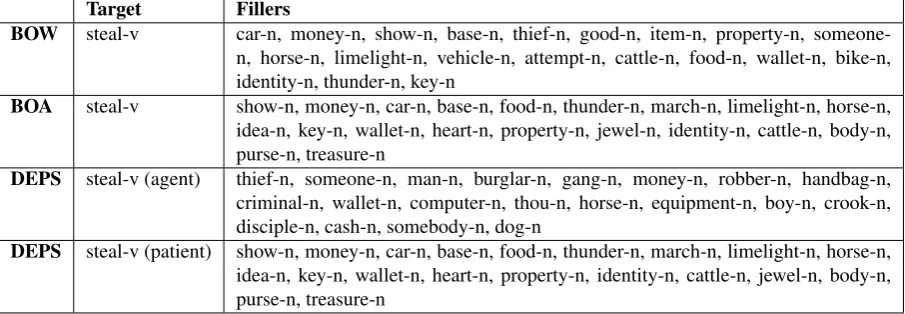
to be found in the selection of the fillers (see Table 1):
• DEPS: Similarly to Lenci’s system, DEPS makes use of information on specific syntactic relations
to select role fillers: the agent-role prototypes will be built out of the most typical subjects, the patient-role prototypes out of the most typical objects, and so on (see the last two rows of Table
1).3 This means that not only the semantic information is taken in consideration (e.g.policeman),
but also the thematic role of the filler (e.g.sbj:policeman,obj:policeman, etc.). Since dependencies
3
Target Fillers
BOW steal-v car-n, money-n, show-n, base-n, thief-n, good-n, item-n, property-n, someone-n, horse-someone-n, limelight-someone-n, vehicle-someone-n, attempt-someone-n, cattle-someone-n, food-someone-n, wallet-someone-n, bike-someone-n, identity-n, thunder-n, key-n
BOA steal-v show-n, money-n, car-n, base-n, food-n, thunder-n, march-n, limelight-n, horse-n, idea-n, key-n, wallet-n, heart-n, property-n, jewel-n, identity-n, cattle-n, body-n, purse-n, treasure-n
DEPS steal-v (agent) thief-n, someone-n, man-n, burglar-n, gang-n, money-n, robber-n, handbag-n, criminal-n, wallet-n, computer-n, thou-n, horse-n, equipment-n, boy-n, crook-n, disciple-n, cash-n, somebody-n, dog-n
[image:5.595.72.525.72.229.2]DEPS steal-v (patient) show-n, money-n, car-n, base-n, food-n, thunder-n, march-n, limelight-n, horse-n, idea-n, key-n, wallet-n, heart-n, property-n, identity-n, cattle-n, jewel-n, body-n, purse-n, treasure-n
Table 1: Top-20 filler nouns for the wordsteal-vin our three models (for DEPS, we provide the fillers
for the agent and the patient slot, while in the other models there is no distinction).
are used to filter fillers entering in the role representation, this model is the closest one to theories
assumingstructuredevent knowledge.
• BOA: Almost identical to the DEPS model, except for the fact that the most typical arguments are
not bound to a specific syntactic slot. Indeed, according to Chow et al. (2015), the arguments of a
verb liketo serve(customer,waitress,tray, etc.) are represented like anunstructuredcollection. In
this type of model, thus, the top-ktypical fillers will includeall the strongly associated arguments,
abstracting away from the specific syntactic relation.
• BOW: In this baseline, the typical fillers are not arguments, but words typically co-occurring with
the targets in a window of fixed width (possibly having no syntactic relation to the targets).
Going back to the previous example, the core idea of the DEPS model is that processing a
sen-tence fragment like the policeman arrested the... leads to the activation only of the typicalpatientsof
such events, since the event knowledge is assumed to be structured. Therefore, the predictability of an argument is measured in terms of its similarity with the prototype built out of the activated patients.
On the other side, the BOA model assumes no distinction between the arguments (i.e., whether they are agents, patients, locations or others), and consequently the sentence fragment above would activate
all the typical arguments of the verbarrest. This means that the predictability of an argument will be
equivalent to its similarity with the prototype of a generic argument of the verb.
Finally, the BOW baseline has no notion of structure at all, not even the underspecified argument relation of the BOA model, and thus the prototypes of this model are just representations of the typical
neighbors of the target words. It should be recalled at this point that abag-of-wordsaccount of prediction
was ruled out by the experimental results by Chow et al. (2015), since only arguments turned out to have
an impact. Nonetheless, since we have chosen abag-of-words model with a very narrow window (i.e.,
two words on the left and right of the target), BOW could also capture indirectly syntactic information (i.e., words frequently co-occurring with the targets within a narrow window are very likely to be also syntactically related to them). Therefore, we expect it to be a reasonably strong baseline.
Corpus and DSMs. Distributional information is derived from the concatenation of the British National Corpus (Leech, 1992) and of the Wacky (Baroni et al., 2009) corpus. Both were parsed with the Malt-parser (Nivre and Hall, 2005). From this concatenation, we built a dependency-based DSMs, where the tuples are weighted by means of Positive Local Mutual Information (PLMI, Evert (2004)). Given the
co-occurrence countOtrf of the targett, the syntactic relationrand the fillerf, we computed the expected
countEtrf (i.e., the simple joint probability of indipendent variables, corresponding to the product of the
probabilities of the single events).4
The PLMI for each target-relation-filler tuple is computed as follows:
LM I(t, r, f) =log
O
trf
Etrf
∗Otrf (3)
P LM I(t, r, f) =max(LM I(t, r, f),0) (4)
Our DSM contains 28,817 targets (i.e., all nouns and verbs with frequency above 1000 in the training
corpora), and all syntactic relations were included.5 We also built a window-based DSM to extract
co-occurrence information for the BOW model, counting only the co-co-occurrences between the nouns and the verbs of the list above within a word window of width 2.
Prototypes The prototypes of all models were built out of the vectors of thekmost typical fillers for
each model type, and we tested 10, 20, 30, 40, and 50 as values ofk.6
As in previous studies, PLMI values were used as typicality scores: in the DEPS model, the typicality
ranking of the fillers for a given role takes into accountonly the fillers occurring in the corresponding
syntactic slot(e.g. the subject for the agent, the object for the patient etc.), whereas in the BOA model the typicality of a filler only depends on the PLMI score with the target, thus ignoring the type of syntactic
re-lation.7As for the BOW baseline, the words used for building the prototype are simply co-occurring with
the targets within a word window of width 2, and such co-occurrences have been PLMI-weighted as well.
Compositional Functions. The compositional functions that we used to combine the prototypes are the vector sum and the pointwise vector multiplication (Mitchell and Lapata, 2010). An important difference between the compositional functions lies in the fact that, while the sum retains the dimensions that are not shared by both prototype vectors, the multiplication sets them to zero those dimensions. This has an obvious impact on the computation of the cosine, as it could drastically reduce the number of dimensions on which the similarity score is computed.
Datasets and Evaluation. The models were tested on the datasets from the ERP experiments by Bicknell et al. (2010) and Chow et al. (2015).
The Bicknell dataset was introduced to test the hypothesis that the typicality of a verb direct object depends on the subject argument. With this purpose in mind, the authors selected 50 verbs, each paired with two agent nouns that significantly changed the scenario evoked by the subject-verb combination. They obtained typical patients for each agent-verb pair by means of production norms, and they used such data to generate triples where the patient was congruent with the agent and with the verb. For each congruent triple, an incongruent triple was generated as well, by combining each verb-congruent patient pair with the other agent noun, in order to have items describing atypical situations.
The final dataset is composed by 100 plausible-implausibile triples, which were used to build the sentences for a self-paced reading and for an ERP experiment. The subjects were presented with sentence pairs such as:
• The journalist checked the spelling of the last report. (plausible)
• The mechanic checked the spelling of the last report. (implausible).
Bicknell et al. (2010) reported shorter reading times and smaller N400 amplitudes for the plausible condition. The goal, for a thematic fit model of the argument expectations update, is to assign a higher
5
We added the extra relation VERB, accounting for the link between typically co-occurring subjects and objects. An analogous relation was already in Baroni and Lenci (2010).
6
The choice of the parameter range is in line with previous NLP studies on thematic fit (Sayeed et al., 2015; Greenberg et al., 2015).
7It goes without saying that using syntactic functions to identify the fillers of semantic roles is just an approximation.
cosine similarity score to the plausible triple, as in Lenci (2011). Moreover, Tilk et al. (2016) evaluated their systems on two different versions of this task, since the triple pairs can be created by combining either triples differing only for the agent, or triples differing only for the patient. Following the
ter-minology from this latter study, we will refer to Accuracy 1 meaning the accuracy of the models in
scoring differing-by-patient triples, and toAccuracy 2meaning the accuracy in the classification of the
differing-by-agent ones.
We also turned into similar triples the 50 verb-arguments combinations of the role reversal experi-ment by Chow et al. (2015), by creating triple pairs corresponding to the normal and to the role-reversed
condition. For example, the sentences in Example (1) were turned into the form:customer-n waitress-n
serve-v(normal) and waitress-n customer-n serve-v(role-reversed). Notice that we preserved the order in which the experimental subjects saw the arguments and the verb, with the latter at the end. Conse-quently, instead of composing the prototype vectors of the typical fillers of the patient role given an agent and a predicate, as we did for the Bicknell dataset, we derive the expectation vector for the verb from the composition of the prototypes of the typical predicates of the agent and of the patient.
The binary selection task is the same used with the Bicknell dataset, the only difference being that the goal for our models is to assign higher scores to the triples in the standard argument configuration (i.e., the expectation vector should be closer to the verb vector in the normal condition). Only the DEPS results are reported for the Chow dataset, because unstructured models assign exactly the same score to normal and role-reversed triples (independently of the order in which the prototypes of the head verb for each argument are created, the combined prototype will be the same). This is, of course, consistent with the report of the ERP experiment by Chow and colleagues, who found no differences in the N400 amplitudes elicited by the two sentence types.
The performance of the DEPS model on the Chow dataset is of particular interest, as the model has the structural information that is lacking in the other two. If DEPS has to reproduce the N400 pattern found by Chow and colleagues, the scores for the normal and for the role-reversed conditions should not differ significantly.
4
Results
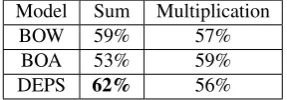
In Table 2 and 3, we report the results for the three model types on the Bicknell dataset for the two kinds
of prototype composition andk= 20. This latter value is the most common in the literature (Baroni and
Lenci, 2010; Greenberg et al., 2015), and the one that gave us the highest accuracy scores.
The DEPS model is almost always the best performing one on the Bicknell dataset, with the exception of a single drop for the multiplicative model in the Accuracy 1 evaluation. The sum turned out to be the most efficient combination function in the majority of the models, and a possible explanation is that the application of multiplication to dependency-based prototype vectors led to sparsity problems. The
results obtained by the DEPS Sum model are the highest ones, and the Accuracy 2 score fork = 20
is extremely close to the best performance reported in Lenci (2011) (73%).8 The task of classifying
differing-by-patient triples turns out to be harder, as the accuracies are lower and none of the models is
significantly better than a random baseline (p-values were computed with theχ2statistical test)9, whereas
the Accuracy 2 scores of both the Deps Sum Model and the Deps Multiplication Model have a significant
advantage (for both of them,p <0.05).
We also carried out the Wilcoxon rank sum test on the scores generated by all models, and we found that the DEPS-sum model is the only one that manages to assign significantly different scores to the
sentences in the two conditions (W = 5660, p <0.05; for all the other models,p >0.1) (see Figure 1).
The BOA model was found instead to be worst performing one, even lower than the BOW baseline, and often the recorded accuracy scores are very close to a random baseline. Also, the differences between conditions were far from significance in any of the versions of the model.
8
The only result available for comparison in the literature is the one obtained by Lenci (2011) on the Accuracy 2 task, since the evaluation of Tilk et al. (2016) was carried out on a way smaller subset of the Bicknell dataset (64 triples).
9
Model Sum Multiplication
BOW 59% 57%
BOA 53% 59%
[image:8.595.226.370.71.121.2]DEPS 62% 56%
Table 2: Accuracy 1 on Bicknell (100% coverage) fork= 20
Model Sum Multiplication
BOW 60% 56%
BOA 58% 57%
[image:8.595.228.369.155.208.2]DEPS 72% 68%
Table 3: Accuracy 2 on Bicknell (100% coverage) fork= 20
Figure 2 shows the performance variation of the Sum models on Bicknell dataset, while varying the number of fillers used to build the prototype. At a glance, we can observe that DEPS models achieve higher accuracies with fewer fillers. This is kind of expected, since the good performances of such models
are likely to be due to a more restrictive selection of the fillers. With higher values ofk, the selection
of more weakly-related fillers is probably introducing noise in the prototype. On the other hand, BOA models slightly improve when more fillers are used, but in general their performance is almost always equivalent to BOW models. This indicates, in our view, that the underspecified dependency relation of the BOA model is insufficient to build a precise representation of the expectations on an upcoming argument, unless a larger number of fillers is taken into account. Moreover, even if typical arguments are selected by virtue of a dependency relation, the absence of information on the dependency type makes these models essentially equivalent to window-based ones. Finally, as for the difference between the scores in the two conditions, the Wilcoxon rank sum test returns a significant difference only for the
DEPS Sum model withk= 10,20(in both cases,p <0.05).
Concerning the performance of DEPS on the Chow dataset, it can be seen in Table 4 that the system identifies the triple in the normal condition with a level of accuracy between 62% and 68%. The scores
are quite steady, independently fromk, and again, the Sum models are generally performing better (but
never significantly better than a random baseline: for all parameter settings,p >0.05).
Interestingly, after applying the Wilcoxon rank sum test, it turns out that the differences between the assigned scores never differ significantly between the normal and the argument reversal condition (for
all values ofk,p >0.05; see also Figure 1). This result is coherent with the outcome of the role-reversal
experiment by Chow and colleagues, who found no difference between the N400 elicited by the two sentence types. In other words, structural information does not help in predicting the upcoming verb.
k Sum Multiplication
10 68% 66%
20 62% 64%
30 64% 62%
40 64% 62%
[image:8.595.237.360.559.636.2]50 66% 62%
Table 4: Accuracy on Chow (100% coverage) for the DEPS model for different values ofk
Implausible Plausible
0.
0
0.
2
0.
4
0.
6
0.
8
Normal Role-reversed
0.
1
0.
2
0.
3
0.
4
0.
5
0.
6
Powered by TCPDF (www.tcpdf.org) Powered by TCPDF (www.tcpdf.org)
[image:9.595.93.499.79.238.2]Powered by TCPDF (www.tcpdf.org) Powered by TCPDF (www.tcpdf.org)
Figure 1: Cosine scores assigned by DEPS-sum model (k = 20) for the Bicknell dataset (left) and for
the Chow dataset (right).
Figure 2: Average of Accuracy 1 and Accuracy 2 on Bicknell dataset, for all the Sum models for different
values ofk
5
Conclusions
In this paper, we addressed the question of whether structured information is necessary to model the argument expectation update. With this purpose in mind, we have implemented a traditional system for composing and updating thematic fit estimations (Lenci, 2011) and we adapted it to model both structured
and unstructured representations (the latter including both thebag-of-arguments and thebag-of-words
hypotheses). We compared the performance of these models on the binary selection task of the argument expectation update and on their ability to replicate the experimental results from the studies by Bicknell et al. (2010) and Chow et al. (2015).
Our results show that structured models perform better in a task of composing and updating argument
expectations, and can reproduce the ERP results reported for both datasets. On the other hand, the
bag-of-argumentsmodel had lower scores in the classification task on the Bicknell dataset, and it was not able to discriminate between the plausible and the implausible condition.
It should be recalled that thebag-of-arguments hypothesis was proposed to account for the results
[image:9.595.146.454.306.468.2]hypothesize a delay in the assignment of the thematic roles. Moreover, as already pointed out by Kim et al. (2016), the N400 component is generally not sensitive to the implausibility derived by thematic role reassignments, but the presence of event knowledge violation in such cases can be signaled by other ERP
components.10 In sum, the idea of a structure in the event knowledge does not seem to be incompatible
with the findings of Chow and colleagues, since our structured DSMs replicated the lack of significant differences between normal and role-reversed sentences. On the other side, models with no structural information struggle in modeling the results of datasets where the items differ for their context-sensitive
argument typicality, like the one from Bicknell et al. (2010).11
The performance of the DEPS model also complies with the conclusions of Ettinger et al. (2016), which showed how DSMs could be used to reproduce the N400 variations. Such a component is known to be tied to the general semantic relatedness of a target word to its sentential context, and not to syntactic
anomalies.12From this point of view, it is interesting that our structured models, despite their coherence
with the ERP results by Chow et al. (2015), are still able to distinguish the sentence in the normal condition from the role-reversed one with an accuracy always above 60%. Future research could explore in which measure thematic fit models can be sensitive to differences between syntactically-composed representation. Finally, with reference to Lapesa and Evert (2017), our results make the expectation update task a good candidate for being among those that clearly benefit from using fine-grained syntactic information, as it seems to require knowledge about the relation types and about the interdependencies between participants.
Future works might aim at comparing these model types on other NLP tasks, to check how many of them effectively take advantage from structured representations. For the moment, we can conclude that structure is an important added value for thematic fit models.
Acknowledgments
This work has been carried out thanks to the support of the A*MIDEX grant (nANR-11-IDEX-0001-02) funded by the French Government “Investissements d’Avenir” program.
We would like to thank the anonymous reviewers for their comments and for their helpful suggestions.
References
Baroni, M., S. Bernardini, A. Ferraresi, and E. Zanchetta (2009). The WaCky Wide Web: A
Collec-tion of Very Large Linguistically Processed Web-crawled Corpora. Language Resources and
Evalua-tion 43(3), 209–226.
Baroni, M., G. Dinu, and G. Kruszewski (2014). Dont Count, Predict! A Systematic Comparison of
Context-counting vs. Context-predicting Semantic Vectors. InProceedings of ACL.
Baroni, M. and A. Lenci (2010). Distributional Memory: A General Framework for Corpus-based
Semantics. Computational Linguistics 36(4), 673–721.
Bicknell, K., J. L. Elman, M. Hare, K. McRae, and M. Kutas (2010). Effects of Event Knowledge in
Processing Verbal Arguments. Journal of Memory and Language 63(4), 489–505.
10Kim et al. (2016) point out that role-reversed sentences typically elicit en enhanced P600 components compared to their
plausible counterparts (see also the experiments in Kim and Osterhout (2005) and Kim and Sikos (2011)).
11The ‘bag-of-arguments’ mechanism described by Chow et al. (2015) actually concerns a very early stage of the
comprehen-sion process. Moreover, in a later response article, Chow et al. (2016) brought evidence that verb predictions become sensitive to structural roles of the arguments if more time is available for prediction.
We thank one of our reviewers for pointing this out.
12The study of Chow et al. (2015) is an example of experimental evidence for this claim, but see also the results from Fischler
Chersoni, E., P. Blache, and A. Lenci (2016). Towards a Distributional Model of Semantic Complexity.
Proceedings of the COLING Workshop on Computational Linguistics for Linguistic Complexity.
Chow, W.-Y., S. Momma, C. Smith, E. Lau, and C. Phillips (2016). Prediction as memory retrieval:
timing and mechanisms.Language, Cognition and Neuroscience 31(5), 617–627.
Chow, W.-Y., C. Smith, E. Lau, and C. Phillips (2015). A ’Bag-of-arguments’ Mechanism for Initial Verb
Predictions.Language, Cognition and Neuroscience (Advance online publication) 31(5), 577–596.
Christiansen, M. H. and N. Chater (2016). The Now-or-Never Bottleneck: A Fundamental Constraint on
Language.Behavioral and Brain Sciences 39.
DeLong, K. A., T. P. Urbach, and M. Kutas (2005). Probabilistic Word Pre-activation During Language
Comprehension Inferred from Electrical Brain Activity. Nature Neuroscience 8(8), 1117–1721.
Dinu, G., N. T. Pham, and M. Baroni (2013). DISSECT-DIStributional SEmantics Composition Toolkit. InProceedings of the ACL System Demonstrations.
Erk, K., S. Pad´o, and U. Pad´o (2010). A Flexible, Corpus-Driven Model of Regular and Inverse
Selec-tional Preferences.Computational Linguistics 36(4), 723–763.
Ettinger, A., N. H. Feldman, P. Resnik, and C. Phillips (2016). Modeling N400 Amplitude Using Vector
Space Models of Word Representation. InProceedings of the 38th Annual Conference of the Cognitive
Science Society, pp. 1445–1450.
Evert, S. (2004). The Statistics of Word Cooccurrences: Word Pairs and Collocations. Ph. D. thesis.
Federmeier, K. D. (2007). Thinking Ahead: The Role and Roots of Prediction in Language
Comprehen-sion. Psychophysiology 44(4), 491–505.
Federmeier, K. D. and M. Kutas (1999). A Rose by any Other Name: Long-term Memory Structure and
Sentence Processing. Journal of Memory and Language 41(4), 469–495.
Fischler, I., D. G. Childers, T. Achariyapaopan, and N. W. Perry (1985). Brain Potentials During
Sen-tence Verification: Automatic Aspects of Comprehension. Biological Psychology 21(2), 83–105.
Greenberg, C., A. B. Sayeed, and V. Demberg (2015). Improving Unsupervised Vector-space Thematic
Fit Evaluation via Role-filler Prototype Clustering. InProceedings of HLT-NAACL.
Hare, M., M. Jones, C. Thomson, S. Kelly, and K. McRae (2009). Activating Event Knowledge.
Cogni-tion 111 2, 151–67.
Kamide, Y., G. T. Altmann, and S. L. Haywood (2003). The Time-course of Prediction in Incremental
Sentence Processing: Evidence from Anticipatory Eye Movements . Journal of Memory and
Lan-guage 49(1), 133 – 156.
Kim, A. E., L. D. Oines, and L. Sikos (2016). Prediction During Sentence Comprehension is More
than a Sum of Lexical Associations: the Role of Event Knowledge.Language, Cognition and
Neuro-science 31(5), 597–601.
Kim, A. E. and L. Osterhout (2005). The Independence of Combinatory Semantic Processing: Evidence
from Event-related Potentials.Journal of Memory and Language 52(2), 205–225.
Kim, A. E. and L. Sikos (2011). Conflict and Surrender During Sentence Processing: An ERP Study of
Syntax-semantics Interaction.Brain and Language 118(1), 15–22.
Kutas, M. and S. A. Hillyard (1984). Brain Potentials During Reading Reflect Word Expectancy and
Lapesa, G. and S. Evert (2017). Large-scale Evaluation of Dependency-based DSMs: Are They Worth
the Effort? InProceedings of EACL.
Leech, G. (1992). 100 Million Words of English: the British National Corpus (BNC). Language
Re-search 28(1), 1–13.
Lenci, A. (2011). Composing and Updating Verb Argument Expectations: A Distributional Semantic
Model. InProceedings of the ACL Workshop on Cognitive Modeling and Computational Linguistics.
Levy, O. and Y. Goldberg (2014). Dependency-Based Word Embeddings. In Proceedings of ACL.
McRae, K., M. Hare, J. L. Elman, and T. Ferretti (2005). A Basis for Generating Expectancies for Verbs
from Nouns.Memory & Cognition 33(7), 1174–1184.
McRae, K., M. J. Spivey-Knowlton, and M. K. Tanenhaus (1998). Modeling the Influence of Thematic
Fit (and Other Constraints) in On-line Sentence Comprehension.Journal of Memory and Language 38,
283–312.
Mikolov, T., K. Chen, G. Corrado, and J. Dean (2013). Efficient Estimation of Word Representations in
Vector Space. arXiv preprint arXiv:1301.3781.
Mitchell, J. and M. Lapata (2010). Composition in Distributional Models of Semantics. Cognitive
Science 34(8), 1388–1429.
Nivre, J. and J. Hall (2005). Maltparser: A Language-independent System for Data-driven Dependency
Parsing. InProceedings of the Workshop on Treebanks and Linguistic Theories, pp. 13–95.
Pad´o, S. and M. Lapata (2007). Dependency-Based Construction of Semantic Space Models.
Computa-tional Linguistics 33(2), 161–199.
Pad´o, U. (2007). The Integration of Syntax and Semantic Plausibility in a Wide-coverage Model of
Human Sentence Processing. Ph. D. thesis.
Santus, E., E. Chersoni, A. Lenci, and P. Blache (2017). Measuring thematic fit with distributional feature
overlap. InProceedings of EMNLP.
Sayeed, A. and V. Demberg (2014). Combining Unsupervised Syntactic and Semantic Models of
The-matic Fit. InProceedings of CLIC-IT.
Sayeed, A., V. Demberg, and P. Shkadzko (2015). An Exploration of Semantic Features in an
Unsuper-vised Thematic Fit Evaluation Framework. Italian Journal of Linguistics.
Sayeed, A., C. Greenberg, and V. Demberg (2016). Thematic Fit Evaluation: an Aspect of Selectional
Preferences. InProceedings of the ACL Workshop on Evaluating Vector-Space Representations for
NLP.
Tilk, O., V. Demberg, A. B. Sayeed, D. Klakow, and S. Thater (2016). Event Participant Modelling with
Neural Networks. InProceedings of EMNLP.
Van Petten, C. and B. J. Luka (2012). Prediction During Language Comprehension: Benefits, Costs, and
ERP Components.International Journal of Psychophysiology 83(2), 176–190.
Willems, R. M., S. L. Frank, A. D. Nijhof, P. Hagoort, and A. Van den Bosch (2015). Prediction During