Review Article
MTRR A66G polymorphism and non-Hodgkin lymphoma
risk: a meta-analysis
Na Wang1, Haiping Yang1, Xianlong Wang2
1Department of Hematology, The First Affiliated Hospital, Henan University of Science and Technology, Luoyang
471003, Henan, P. R. China; 2The Third People’s Hospital of Luoyang City, Luoyang 471000, Henan, P. R. China
Received September 13, 2015; Accepted December 3, 2015; Epub February 15, 2016; Published February 29, 2016
Abstract: Background: Several studies have explored the relationship between methionine synthase reductase (MTRR) A66G polymorphism and non-Hodgkin lymphoma (NHL) risk, however, the published results were con-troversial. Thus, a meta-analysis was performed to provide a more precise estimate of the association of MTRR
A66G polymorphism with NHL risk. Methods: The PubMed, Elsevier, China National Knowledge Infrastructure and Wanfang Databases were searched (up to February 01, 2015) to collect case-control studies investigating the rela-tionship between MTRR A66G polymorphism and NHL risk. Odds ratios (ORs) with 95% confidence intervals (CIs) were applied to assess the strength of association. Results: Finally, five case-control studies, bearing 1357 cases and 3374 controls, were included in this meta-analysis. The results of overall comparisons suggested that there was no significant association between MTRR A66G polymorphism and NHL risk under all four genetic models (AG vs. AA: OR=0.97, 95% CI=0.84-1.11, P=0.65; GG vs. AA: OR=1.06, 95% CI=0.85-1.31, P=0.62; GG vs. AA+AG: OR=1.02, 95% CI=0.85-1.23, P=0.84; AG+GG vs. AA: OR=0.99, 95% CI=0.87-1.13, P=0.90). In the subgroup analy-ses by ethnicity and NHL subtype, significant association was found in Asians (GG vs. AA: OR=1.32, 95% CI=1.01-1.72, P=0.04; GG vs. AA+AG: OR=1.34, 95% CI=1.03-1.73, P=0.03) and diffuse large B-cell lymphoma (DLBCL) in overall population (GG vs. AA: OR=1.46, 95% CI=1.05-2.03, P=0.02; GG vs. AA+AG: OR=1.46, 95% CI=1.06-2.00, P=0.02). Conclusion: The present meta-analysis suggested that MTRR A66G polymorphism was associated with an increased risk for NHL in Asian populations and for DLBCL in whole population. Further well-designed studies based on larger sample sizes are required to confirm these findings.
Keywords: Methionine synthase reductase, polymorphism, non-Hodgkin lymphoma, meta-analysis
Introduction
Non-Hodgkin lymphoma (NHL) is a complex group of heterogeneous disease containing multiple subtypes, each with specific morpho-logic, immunophenotypic and clinical charac-teristics [1]. NHLs can be broadly divided into two major groups: B-cell lymphomas and T-cell lymphomas, and each of these can be further classified based on clinical features, pathology, histology and genetic indicators [2]. Diffuse large B-cell lymphoma (DLBCL) and follicular lymphoma are the two major subtypes of B- cell lymphomas, which make up approximate- ly 85% of all NHL cases. The incidence of NHL has increased steadily in the last few decades [3]. It was estimated that 70,800 NHL pati- ents were newly diagnosed and 18,990 deaths were occurred in 2014 in the United States [4].
genes encoding folate-metabolizing enzymes may cause interindividual differences and have been associated with the risk of malignant lym-phoma [15-17].
Folate metabolism network not only provides essential cofactors in the production of primary methyl donor for DNA methylation, it also sup-plies the methyl group for DNA synthesis [18, 19]. Folate metabolism is regulated by folate-metabolizing pathway genes. Methionine syn-thase (MTR) is one of the most critical enzymes involved in folate metabolism, which is respon-sible for synthesis of methionine through irre-versible transfer of a methyl group from 5- methyltetrahydrofolate. The enzymatic active form of MTR is maintained by methionine syn-thase reductase (MTRR), an enzyme that regen-erates functional MTR by reductive methylation [20]. The A66G polymorphism at codon 22 is the most common functional polymorphism in MTRR and the variant enzyme has a lower affin-ity for MTR [21, 22]. Changes in MTRR activaffin-ity may significantly influence DNA methylation and synthesis, and altered DNA synthesis and methylation have been linked to human cancer risk, including lymphoma [23, 24]. MTRR A66G polymorphism has been widely investigated in a variety of diseases, such as Down syndrome, breast cancer, and leukemia [25-27]. Several studies have focused on the relationship bet- ween this polymorphism and NHL risk, but the published results remain controversial. The discrepancies among investigations may be ascribed to the relatively small sample size in each study and ethnicity difference. Therefore, we performed a meta-analysis to provide a more precise evaluation of the association of MTRR A66G polymorphism with NHL risk.
Materials and methods
Studies identification
A systematic literature search in the PubMed, Elsevier, China National Knowledge Infrastruct- ure platform and Wanfang databases was con-ducted to identify studies that explored the relationship between MTRR A66G polymor-phism and NHL risk. The search terms and key-words were as follows: “methionine synthase reductase” or “MTRR”, “polymorphism” or “vari- ant” or “variation”, and “NHL” or “non-Hodg- kin lymphoma” or “non-Hodgkin’s lymphoma”. There were no restriction to the language and the latest search was undertaken on February
01, 2015. The references cited in the eligible studies were also examined to find additional studies.
Inclusion criteria
All studies included in this meta-analysis must have met the following criteria: (a) case-control studies assessing the relationship between MTRR A66G polymorphism and NHL risk; (b) the case group had confirmed diagnosis; (c) genotype frequencies for both cases and con-trols were available; (d) the distribution of geno-types in the control group was in consistent with Hardy-Weinberg equilibrium (HWE). The case reports, meta-analysis, reviews, letters and editorial articles were excluded.
Data extraction
Two reviewers independently extracted infor-mation from each eligibility study and disagree-ment was addressed by discussion. The follow-ing data were extracted from each study: first author’s name, year of publication, country, ethnicity, controls source, genotyping methods, sample size of cases and controls, genotype frequencies of the MTRR A66G polymorphism for cases and controls, and HWE of control group.
Statistical analysis
The strength of association between MTRR A66G polymorphism and NHL risk was assess- ed by odds ratios (ORs) with corresponding 95% confidence intervals (CIs) under the het-erozygote model (AG vs. AA), homozygote model (GG vs. AA), recessive model (GG vs. AA+AG) and dominant model (AG+GG vs. AA). The sig-nificance of combined OR was determined by the Z-test. The Q-test was used to evaluate the between-study heterogeneity. If P>0.05, indi-cating that there was no significant heterogene-ity, the fixed-effects model (Mantel-Haenszel) was applied to combine the data, otherwise, the random-effects model (DerSimonian-Laird) was selected. Subgroup analyses were per-formed according to ethnicity and NHL subtype. Funnel plot was applied to evaluate publication bias. HWE of genotypes distribution in the con-trol group was checked using the χ2-test and
soft-ware STATA v12.0 (Stata Corporation, College Station, TX) and Review Manager v5.2 (The Cochrane Collaboration, Oxford, UK).
Results
Study characteristics
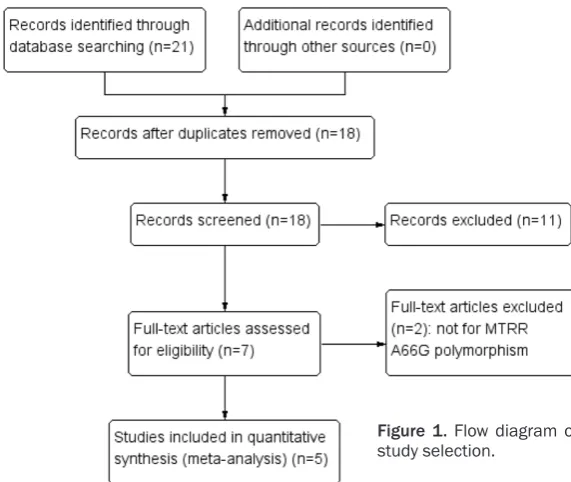
A flow diagram showing the process of study selection was illustrated in Figure 1. According to the literature search strategy, a total of 18 potentially relevant publications were identi-fied. 11 articles were excluded firstly because of irrelevant research; under the included crite-ria, two studies were excluded as not for MTRR A66G polymorphism research [28, 29]. Finally, five case-control studies were included in this meta-analysis, bearing 1357 cases and 3374 controls [30-34]. Among these publications, there were three studies for Caucasians [30-32], two studies for Asians [33, 34]. The con-trols were healthy populations and blood bank donors and mainly matched for age, gender and ethnicity. Genotypes distribution in the controls of all included studies were in consis-tent with HWE. Table 1 showed the detailed characteristics of included studies.
Meta-analysis results
The main results of meta-analysis and hetero-geneity test were listed in Table 2. As shown in Table 2, there was no significant heterogeneity
1.02, 95% CI=0.85-1.23, P=0.84; AG+GG vs. AA: OR=0.99, 95% CI=0.87-1.13, P=0.90) (Ta- ble 2). In the subgroup analyses by ethnicity and NHL subtype, MTRR A66G polymorphism was significantly associated with an increased risk for NHL in Asian populations (GG vs. AA: OR=1.32, 95% CI=1.01-1.72, P=0.04; GG vs. AA+AG: OR=1.34, 95% CI=1.03-1.73, P=0.03), and for DLBCL in whole population (GG vs. AA: OR=1.46, 95% CI=1.05-2.03, P=0.02; GG vs. AA+AG: OR=1.46, 95% CI=1.06-2.00, P=0.02) (Table 2).
Publication bias
Funnel plots were applied to assess the publi-cation bias in the overall meta-analysis and the results showed that all points were symmetri-cally distributed and the shape of funnel plots revealed no obvious asymmetry, suggesting the absence of publication bias (Figure 2).
Discussion
[image:3.629.98.384.78.319.2]Human MTRR is a housekeeping gene and locates at chromosome 5 (5p15.2-p15.3) [35]. MTRR enzyme is responsible for the regenera-tion of the active form of MTR by reductive methylation and plays a key role in folate and vitamin B12-dependent homocysteine metabo-lism [36]. The enzyme has three characteristic sites which bind FMN, FAD, and NADPH. The most common polymorphism in MTRR is A66G
Figure 1. Flow diagram of study selection.
among the included studies in overall populations (Ph= 1.00, I2=0%; P
Table 1. Main characteristics of studies included in the meta-analysis
Reference Year Country Ethnicity Control source Genotyping method Sample size Case Control HWE Quality score
Case Control AA AG GG AA AG GG
Gemmati [30] 2004 Italy Caucasian Blood donor PCR-RFLP 200 257 51 106 43 59 122 76 0.46 8
Gra [31] 2008 Russia Caucasian Blood donor Biochip 76 177 16 40 20 33 92 52 0.49 7
Kim [33] 2008 Korea Asian Population-based Pyrosequencing 584 1700 292 235 57 857 718 125 0.13 9
Suthandiram [34] 2015 Malaysia Asian Blood donor Sequenom MassARRAY 372 722 178 153 41 353 306 63 0.77 7
Weiner [32] 2011 Russia Caucasian Blood donor Real-time PCR 125 518 26 64 35 97 259 162 0.72 9
HWE, Hardy-Weinberg equilibrium; PCR, polymerase chain reaction; RFLP, restriction fragment length polymorphism.
Table 2. Results of meta-analysis for methionine synthase reductase (MTRR) A66G polymorphism and NHL risk
Variables No. AG vs. AA GG vs. AA GG vs. AA+AG AG+GG vs. AA
OR (95% CI) P Ph* OR (95% CI) P P
h* OR (95% CI) P Ph* OR (95% CI) P Ph*
Overall 5 0.97 (0.84-1.11) 0.65 1.00 1.06 (0.85-1.31) 0.62 0.13 1.02 (0.85-1.23) 0.84 0.05 0.99 (0.87-1.13) 0.90 0.91
Ethnicity
Asian 2 0.97 (0.83-1.14) 0.72 0.85 1.32 (1.01-1.72) 0.04 0.90 1.34 (1.03-1.73) 0.03 0.85 1.03 (0.88-1.19) 0.74 0.87
Caucasian 3 0.95 (0.70-1.30) 0.76 0.95 0.73 (0.52-1.04) 0.08 0.85 0.77 (0.58-1.01) 0.06 0.63 0.87 (0.65-1.16) 0.35 1.00 Subtype
DLBCL 2 1.01 (0.83-1.24) 0.91 0.35 1.46 (1.05-2.03) 0.02 0.41 1.46 (1.06-2.00) 0.02 0.56 1.08 (0.89-1.31) 0.42 0.30 T-cell NHL 2 0.99 (0.70-1.38) 0.94 0.76 0.97 (0.57-1.65) 0.91 0.50 0.97 (0.62-1.52) 0.89 0.54 0.99 (0.72-1.37) 0.95 0.64
[image:4.809.101.712.227.349.2]substitution, which results in an amino acid substitution from isoleucine to methionine at codon 22 (I22M). The I22M variant is located in the putative FMN-binding domain of the MTRR enzyme that is suggested to interact with MTR. Substitution of an isoleucine by a methionine in this part of the enzyme might disrupt the bind-ing of MTRR to the MTR-cob(I) alanine-complex, thereby decreasing the rate of homocysteine remethylation [22, 37]. The variant enzyme has a 3- to 4-fold lower affinity for MTR [21]. Thus, DNA methylation and synthesis may be influ-enced by alterations in this enzyme activity, which lead to tumorigenesis. Some studies have investigated the association between the MTRR A66G polymorphism and risk of cancers. This polymorphism has been associated with a decreased risk for acute lymphoblastic leuke-mia [27], and an increased risk for adult menin-gioma [38]. However, there are controversial findings about the role of MTRR A66G polymor-phism in the development risk of NHL. Weiner et al. [32] found that the genotype frequencies of MTRR A66G polymorphism in NHL patients were similar to those in the controls, suggest-ing a lack of association between this variant and NHL risk. While the MTRR 66GG genotype was associated with increased risk for DLBCL (OR=1.56, 95% CI=1.03-2.38) in study report-ed by Kim et al. [33].
To investigate the effect of MTRR A66G poly-morphism on NHL risk through a more robust
subgroup analysis according to NHL subtype, significant association was found in DLBCL under homozygote model and recessive model, but not in T-cell lymphomas in any comparison models, which may be explained that the effect of genetic polymorphisms on cancer risk is vari-ous to different clinical subtypes.
However, some limitations need to be address- ed in interpreting the results of this meta-anal-ysis. Our analysis largely used unadjusted esti-mates without adjustment for other potential confounders such as folate intake status, life-styles and exposures, which may influence the combined results. Due to the limited number of relevant included studies, the pooled results in some subgroups may have insufficient statisti-cal power to detect a slight effect. In addition, folate intake status has an important impact on DNA methylation and synthesis, which may influence cancer risk by potential gene-nutri-tion interacgene-nutri-tions. Due to the limited original data, potential gene-environment interactions were not evaluated in this study.
[image:5.629.98.385.79.274.2]In summary, the present meta-analysis found that MTRR A66G polymorphism was associat-ed with an increasassociat-ed risk for NHL in Asian popu-lations and for DLBCL in whole population. Since limited relevant studies were included in this meta-analysis, larger sample sizes and well-designed studies are required in the future to confirm these findings. Moreover, gene-gene
Figure 2. Funnel plot for publication bias test under heterozygote model (AG vs. AA). Each point represents a separate study for the indicated association. Log [OR], natural logarithm of odds ratio.
and gene-environment interactions should also be considered in further analysis.
Disclosure of conflict of interest
None.
Address correspondence to: Dr. Na Wang, Depart- ment of Hematology, The First Affiliated Hospital, Henan University of Science and Technology, 24 Jinghua Road, Luoyang 471003, Henan, P. R. China. Tel: 86-379-64830480; E-mail: wangnayfy@163. com
References
[1] Shankland KR, Armitage JO and Hancock BW. Non-Hodgkin lymphoma. Lancet 2012; 380: 848-857.
[2] Campo E, Swerdlow SH, Harris NL, Pileri S, Stein H and Jaffe ES. The 2008 WHO classifi-cation of lymphoid neoplasms and beyond: evolving concepts and practical applications. Blood 2011; 117: 5019-5032.
[3] Skrabek P, Turner D and Seftel M. Epidemiology of non-Hodgkin lymphoma. Transfus Apher Sci 2013; 49: 133-138.
[4] Siegel R, Ma J, Zou Z and Jemal A. Cancer sta-tistics, 2014. CA Cancer J Clin 2014; 64: 9-29. [5] Bassig BA, Lan Q, Rothman N, Zhang Y and
Zheng T. Current understanding of lifestyle and environmental factors and risk of non-hodgkin lymphoma: an epidemiological update. J Can- cer Epidemiol 2012; 2012: 978930.
[6] Morton LM, Slager SL, Cerhan JR, Wang SS, Vajdic CM, Skibola CF, Bracci PM, de Sanjosé S, Smedby KE, Chiu BC, Zhang Y, Mbulaiteye SM, Monnereau A, Turner JJ, Clavel J, Adami HO, Chang ET, Glimelius B, Hjalgrim H, Melbye M, Crosignani P, di Lollo S, Miligi L, Nanni O, Ramazzotti V, Rodella S, Costantini AS, Stag- naro E, Tumino R, Vindigni C, Vineis P, Becker N, Benavente Y, Boffetta P, Brennan P, Cocco P, Foretova L, Maynadié M, Nieters A, Staines A, Colt JS, Cozen W, Davis S, de Roos AJ, Hartge P, Rothman N, Severson RK, Holly EA, Call TG, Feldman AL, Habermann TM, Liebow M, Blair A, Cantor KP, Kane EV, Lightfoot T, Roman E, Smith A, Brooks-Wilson A, Connors JM, Gas- coyne RD, Spinelli JJ, Armstrong BK, Kricker A, Holford TR, Lan Q, Zheng T, Orsi L, Dal Maso L, Franceschi S, La Vecchia C, Negri E, Serraino D, Bernstein L, Levine A, Friedberg JW, Kelly JL, Berndt SI, Birmann BM, Clarke CA, Flowers CR, Foran JM, Kadin ME, Paltiel O, Weisen- burger DD, Linet MS and Sampson JN. Etiologic heterogeneity among non-Hodgkin lymphoma subtypes: the InterLymph Non-Hodgkin Lym-
phoma Subtypes Project. J Natl Cancer Inst Monogr 2014; 2014: 130-144.
[7] Chiu BC, Weisenburger DD, Zahm SH, Cantor KP, Gapstur SM, Holmes F, Burmeister LF and Blair A. Agricultural pesticide use, familial cancer, and risk of non-Hodgkin lymphoma. Cancer Epidemiol Biomarkers Prev 2004; 13: 525-531.
[8] Ekström-Smedby K. Epidemiology and etiology of non-Hodgkin lymphoma--a review. Acta On- col 2006; 45: 258-271.
[9] Tan DE, Foo JN, Bei JX, Chang J, Peng R, Zheng X, Wei L, Huang Y, Lim WY, Li J, Cui Q, Chew SH, Ebstein RP, Kuperan P, Lim ST, Tao M, Tan SH, Wong A, Wong GC, Tan SY, Ng SB, Zeng YX, Khor CC, Lin D, Seow AL, Jia WH and Liu J. Genome-wide association study of B cell non-Hodgkin lymphoma identifies 3q27 as a sus-ceptibility locus in the Chinese population. Nat Genet 2013; 45: 804-807.
[10] Skibola CF, Curry JD and Nieters A. Genetic susceptibility to lymphoma. Haematologica 2007; 92: 960-969.
[11] Rendleman J, Antipin Y, Reva B, Adaniel C, Przybylo JA, Dutra-Clarke A, Hansen N, Heguy A, Huberman K, Borsu L, Paltiel O, Ben-Yehuda D, Brown JR, Freedman AS, Sander C, Zelenetz A, Klein RJ, Shao Y, Lacher M, Vijai J, Offit K and Kirchhoff T. Genetic variation in DNA re-pair pathways and risk of non-Hodgkin’s lym-phoma. PLoS One 2014; 9: e101685.
[12] Grulich AE and Vajdic CM. The epidemiology of non-Hodgkin lymphoma. Pathology 2005; 37: 409-419.
[13] Roche LM, Paul SM and Costa SJ. Acquired im-mune deficiency syndrome and the increase in non-Hodgkin lymphoma incidence in New Jersey from 1979 to 1996. Cancer 2001; 92: 2948-2956.
[14] Grulich AE, Vajdic CM and Cozen W. Altered im-munity as a risk factor for non-Hodgkin lym-phoma. Cancer Epidemiol Biomarkers Prev 2007; 16: 405-408.
[15] Lee KM, Lan Q, Kricker A, Purdue MP, Grulich AE, Vajdic CM, Turner J, Whitby D, Kang D, Chanock S, Rothman N and Armstrong BK. One-carbon metabolism gene polymorphisms and risk of non-Hodgkin lymphoma in Australia. Hum Genet 2007; 122: 525-533.
[16] Niclot S, Pruvot Q, Besson C, Savoy D, Ma- cintyre E, Salles G, Brousse N, Varet B, Landais P, Taupin P, Junien C and Baudry-Bluteau D. Implication of the folate-methionine metabo-lism pathways in susceptibility to follicular lym-phomas. Blood 2006; 108: 278-285.
folate-me-tabolizing genes and risk of non-Hodgkin lym-phoma. Blood 2004; 104: 2155-2162. [18] Küppers R. Mechanisms of B-cell lymphoma
pathogenesis. Nat Rev Cancer 2005; 5: 251-262.
[19] Rossi D, Capello D, Gloghini A, Franceschetti S, Paulli M, Bhatia K, Saglio G, Vitolo U, Pileri SA, Esteller M, Carbone A and Gaidano G. Aberrant promoter methylation of multiple genes throughout the clinico-pathologic spec-trum of B-cell neoplasia. Haematologica 2004; 89: 154-164.
[20] Olteanu H, Munson T and Banerjee R. Differ- ences in the efficiency of reductive activation of methionine synthase and exogenous elec-tron acceptors between the common polymor-phic variants of human methionine synthase reductase. Biochemistry 2002; 41: 13378-13385.
[21] Wilson A, Platt R, Wu Q, Leclerc D, Christensen B, Yang H, Gravel RA and Rozen R. A common variant in methionine synthase reductase combined with low cobalamin (vitamin B12) increases risk for spina bifida. Mol Genet Metab 1999; 67: 317-323.
[22] Wolthers KR and Scrutton NS. Protein interac-tions in the human methionine synthase-me-thionine synthase reductase complex and im-plications for the mechanism of enzyme reacti-vation. Biochemistry 2007; 46: 6696-6709. [23] Robien K and Ulrich CM. 5,10-Methylenetetra-
hydrofolate reductase polymorphisms and leu-kemia risk: a HuGE minireview. Am J Epidemiol 2003; 157: 571-582.
[24] Habib EE, Aziz M and Kotb M. Genetic polymor-phism of folate and methionine metabolizing enzymes and their susceptibility to malignant lymphoma. J Egypt Natl Canc Inst 2005; 17: 184-192.
[25] Zampieri BL, Biselli JM, Goloni-Bertollo EM, Vannucchi H, Carvalho VM, Cordeiro JA and Pavarino EC. Maternal risk for Down syndrome is modulated by genes involved in folate me-tabolism. Dis Markers 2012; 32: 73-81. [26] Sangrajrang S, Sato Y, Sakamoto H, Ohnami S,
Khuhaprema T and Yoshida T. Genetic poly-morphisms in folate and alcohol metabolism and breast cancer risk: a case-control study in Thai women. Breast Cancer Res Treat 2010; 123: 885-893.
[27] Fang DH, Ji Q, Fan CH, An Q and Li J. Methionine synthase reductase A66G polymorphism and leukemia risk: evidence from published stud-ies. Leuk Lymphoma 2014; 55: 1910-1914. [28] Lim U, Wang SS, Hartge P, Cozen W, Kelemen
LE, Chanock S, Davis S, Blair A, Schenk M, Rothman N and Lan Q. Gene-nutrient interac-tions among determinants of folate and one-carbon metabolism on the risk of non-Hodgkin
lymphoma: NCI-SEER case-control study. Blood 2007; 109: 3050-3059.
[29] Li Q, Lan Q, Zhang Y, Bassig BA, Holford TR, Leaderer B, Boyle P, Zhu Y, Qin Q, Chanock S, Rothman N and Zheng T. Role of one-carbon metabolizing pathway genes and gene-nutri-ent interaction in the risk of non-Hodgkin lym-phoma. Cancer Causes Control 2013; 24: 1875-1884.
[30] Gemmati D, Ongaro A, Scapoli GL, Della Porta M, Tognazzo S, Serino ML, Di Bona E, Rode- ghiero F, Gilli G, Reverberi R, Caruso A, Pasello M, Pellati A and De Mattei M. Common gene polymorphisms in the metabolic folate and methylation pathway and the risk of acute phoblastic leukemia and non-Hodgkin’s lym-phoma in adults. Cancer Epidemiol Biomarkers Prev 2004; 13: 787-794.
[31] Gra OA, Glotov AS, Nikitin EA, Glotov OS, Kuznetsova VE, Chudinov AV, Sudarikov AB and Nasedkina TV. Polymorphisms in xenobiot-ic-metabolizing genes and the risk of chronic lymphocytic leukemia and non-Hodgkin’s lym-phoma in adult Russian patients. Am J Hematol 2008; 83: 279-287.
[32] Weiner AS, Beresina OV, Voronina EN, Voro- paeva EN, Boyarskih UA, Pospelova TI and Filipenko ML. Polymorphisms in folate-metabo-lizing genes and risk of non-Hodgkin’s lympho-ma. Leuk Res 2011; 35: 508-515.
[33] Kim HN, Lee IK, Kim YK, Tran HT, Yang DH, Lee JJ, Shin MH, Park KS, Shin MG, Choi JS and Kim HJ. Association between folate-metaboliz-ing pathway polymorphism and non-Hodgkin lymphoma. Br J Haematol 2008; 140: 287-294.
[34] Suthandiram S, Gan GG, Zain SM, Bee PC, Lian LH, Chang KM, Ong TC and Mohamed Z. Genetic polymorphisms in the one-carbon me-tabolism pathway genes and susceptibility to non-Hodgkin lymphoma. Tumour Biol 2015; 36: 1819-1834.
[35] Leclerc D, Wilson A, Dumas R, Gafuik C, Song D, Watkins D, Heng HH, Rommens JM, Scherer SW, Rosenblatt DS and Gravel RA. Cloning and mapping of a cDNA for methionine synthase reductase, a flavoprotein defective in patients with homocystinuria. Proc Natl Acad Sci U S A 1998; 95: 3059-3064.
[36] Olteanu H and Banerjee R. Human methionine synthase reductase, a soluble P-450 reduc-tase-like dual flavoprotein, is sufficient for NADPH-dependent methionine synthase acti-vation. J Biol Chem 2001; 276: 35558-35563. [37] Gaughan DJ, Kluijtmans LA, Barbaux S, Mc-
concentrations. Atherosclerosis 2001; 157: 451-456.
[38] Zhang J, Zhou YW, Shi HP, Wang YZ, Li GL, Yu HT and Xie XY. 5,10-Methylenetetrahydro- folate reductase (MTHFR), methionine