Inferring Sentence-internal Temporal Relations
Mirella Lapata
Department of Computer Science
University of Sheffield
Regent Court, 211 Portobello Street
Sheffield S1 4DP, UK
[email protected]
Alex Lascarides
School of Informatics
University of Edinburgh
2 Buccleuch Place
Edinburgh EH8 9LW, UK
[email protected]
Abstract
In this paper we propose a data intensive ap-proach for inferring sentence-internal tempo-ral relations, which relies on a simple prob-abilistic model and assumes no manual cod-ing. We explore various combinations of fea-tures, and evaluate performance against a gold-standard corpus and human subjects perform-ing the same task. The best model achieves 70.7% accuracy in inferring the temporal rela-tion between two clauses and 97.4% accuracy in ordering them, assuming that the temporal relation is known.
1
Introduction
The ability to identify and analyse temporal information is crucial for a variety of practical NLP applications such as information extraction, question answering, and sum-marisation. In multidocument summarisation, informa-tion must be extracted, potentially fused, and synthesised into a meaningful text. Knowledge about the temporal or-der of events is important for determining what content should be communicated (interpretation) but also for cor-rectly merging and presenting information (generation). In question answering one would like to find out when a particular event occurred (e.g.,When did X resign?) but also to obtain information about how events relate to each other (e.g.,Did X resign before Y?).
Although temporal relations and their interaction with discourse relations (e.g., Parallel, Result) have re-ceived much attention in linguistics (Kamp and Reyle, 1993; Webber, 1991; Asher and Lascarides, 2003), the automatic interpretation of events and their temporal re-lations is beyond the capabilities of current open-domain NLP systems. While corpus-based methods have acceler-ated progress in other areas of NLP, they have yet to make a substantial impact on the processing of temporal infor-mation. This is partly due to the absence of readily
avail-able corpora annotated with temporal information, al-though efforts are underway to develop treebanks marked with temporal relations (Katz and Arosio, 2001) and de-vise annotation schemes that are suitable for coding tem-poral relations (Ferro et al., 2000; Setzer and Gaizauskas, 2001). Absolute temporal information has received some attention (Wilson et al., 2001; Schilder and Habel, 2001; Wiebe et al., 1998) and systems have been developed for identifying and assigning referents to time expressions.
Although the treatment of time expressions is an im-portant first step towards the automatic handling of tem-poral phenomena, much temtem-poral information is not ab-solute but relative and not overtly expressed but implicit. Consider the examples in (1) taken from Katz and Arosio (2001). Native speakers can infer that John first met and then kissed the girl and that he first left the party and then walked home, even though there are no overt markers sig-nalling the temporal order of the described events.
(1) a. John kissed the girl he met at a party. b. Leaving the party, John walked home.
c. He remembered talking to her and asking her for her name.
In this paper we describe a data intensive approach that automatically captures information pertaining to the temporal order and relations of events like the ones illus-trated in (1). Of course trying to acquire temporal infor-mation from a corpus that is not annotated with tempo-ral relations, tense, or aspect seems rather futile. How-ever, sometimes there are overt markers for temporal re-lations, the conjunctionsbefore, after, while, and when
being the most obvious, that make relational information about events explicit:
(2) a. Leonard Shane, 65 years old, held the post of presi-dent before William Shane, 37, was elected to it last year.
b. The results were announced after the market closed. c. Investors in most markets sat out while awaiting the
U.S. trade figures.
making predictions about the order in which events oc-curred when there are no obvious markers signalling tem-poral ordering. We will assess the feasibility of such an approach by initially focusing on sentence-internal tem-poral relations. We will obtain sentences like the ones shown in (2), where a main clause is connected to a sub-ordinate clause with a temporal marker and we will de-velop a probabilistic framework where the temporal re-lations will be learned by gathering informative features from the two clauses. This framework can then be used for interpretation in cases where overt temporal markers are absent (see the examples in (1)).
Practical NLP applications such as text summarisa-tion and quessummarisa-tion answering place increasing demands not only on the analysis but also on the generation of temporal relations. For instance, non-extractive summarisers that generate sentences by fusing together sentence fragments (e.g., Barzilay 2003) must be able to determine whether or not to include an overt temporal marker in the generated text, where the marker should be placed, and what lexical item should be used. We assess how appropriate our ap-proach is when faced with the information fusion task of determining the appropriate ordering among a temporal marker and two clauses. We infer probabilistically which of the two clauses is introduced by the marker, and effec-tively learn to distinguish between main and subordinate clauses.
2
The Model
Given a main clause and a subordinate clause attached to it, our task is to infer the temporal marker linking the two clauses. Formally, P SMtjSS represents the probability that a marker tjrelates a main clause SMand a subordinate
clause SS. We aim to identify which marker tj in the set
of possible markers T maximises P SMtjSS:
t argmax
tj T
P SMtjSS
argmax
tj T
P SMP tjSMP SSSMtj (3)
We ignore the term P SM in (3) as it is a constant and use Bayes’ Rule to derive P SMtj from P tjSM:
t argmax
tj T
P tjSMP SSSMtj
argmax
tj T
P tjP SMtjP SSSMtj (4)
We will further assume that the likelihood of the subordinate clause SSis conditionally independent of the
main clause SM (i.e., P SSSMtj P SStj). The as-sumption is clearly a simplification but makes the estima-tion of the probabilities P SMtj and P SStj more reli-able in the face of sparse data.
t
argmax
tj T
P tjP SMtjP SStj (5)
SM and SS are vectors of features aM 1a
M n and a
S1a
Sn characteristic of the propositions occurring with the marker tj (our features are described in detail
in Section 3.2). By making the simplifying assumption that these features are conditionally independent given the temporal marker, the probability of observing the con-junctions aM
1a M
n and a S
1a S
n is:
t argmax
tj T
P tj
∏
i P a
Mi tjP a
Si tj (6)
We effectively treat the temporal interpretation prob-lem as a disambiguation task. From the (confusion) set T of temporal markers after, before, while, when, as, once,
until, since , we select the one that maximises (6). We compiled a list of temporal markers from Quirk et al. (1985). Markers with corpus frequency less than 10 per million were excluded from our confusion set (see Sec-tion 3.1 for a descripSec-tion of our corpus).
The model in (6) is simplistic in that the relation-ships between the features across the clauses are not cap-tured directly. However, if two values of these features for the main and subordinate clauses co-occur frequently with a particular marker, then the conditional probabil-ity of these features on that marker will approximate the right biases. Also note that some of these markers are am-biguous with respect to their meaning: one sense ofwhile
denotes overlap, another contrast;sincecan indicate a se-quence of events in which the main clause occurs after the subordinate clause or cause,as indicates overlap or cause, andwhencan denote overlap, a sequence of events, or contrast. Our model selects the appropriate markers on the basis of distributional evidence while being agnostic to their specific meaning when they are ambiguous.
For the sentence fusion task, the identity of the two clauses is unknown, and our task is to infer which clause contains the marker. This can be expressed as:
p
argmax
pM S
P t
∏
i
P ap i
tP a p
i t (7)
where p is generally speaking a sentence fragment to be realised as a main or subordinate clause ( p S
p M or p M
p
S ), and t is the temporal marker linking the two clauses.
We can estimate the parameters for the models in (6) and (7) from a parsed corpus. We first identify clauses in a hypotactic relation, i.e., main clauses of which the subor-dinate clause is a constituent. Next, in the training phase, we estimate the probabilities P a
Mi
tj and P a
Si tj by simply counting the occurrence of the features a
Mi and aS
mem-ber of the confusion set to choose. For the sentence fu-sion task, it is the temporal order of the two clauses that is unknown and must be inferred. A similar approach has been advocated for the interpretation of discourse rela-tions by Marcu and Echihabi (2002). They train a set of naive Bayes classifiers on a large corpus (in the order of 40 M sentences) representative of four rhetorical relations using word bigrams as features. The discourse relations are read off from explicit discourse markers thus avoid-ing time consumavoid-ing hand codavoid-ing. Apart from the fact that we present an alternative model, our work differs from Marcu and Echihabi (2002) in two important ways. First we explore the contribution of linguistic information to the inference task using considerably smaller data sets and secondly apply the proposed model to a generation task, namely information fusion.
3
Parameter Estimation
3.1 Data Extraction
Subordinate clauses (and their main clause counterparts) were extracted from the BLLIPcorpus (30 M words), a Treebank-style, machine-parsed version of the Wall Street Journal (WSJ, years 1987–89) which was produced using Charniak’s (2000) parser. From the extracted clauses we estimate the features described in Section 3.2.
We first traverse the tree top-down until we iden-tify the tree node bearing the subordinate clause label we are interested in and extract the subtree it dominates. Assuming we want to extractafter subordinate clauses, this would be the subtree dominated by SBAR-TMP in Figure 1 indicated by the arrow pointing down. Having found the subordinate clause, we proceed to extract the main clause by traversing the tree upwards and identify-ing the S node immediately dominatidentify-ing the subordinate clause node (see the arrow pointing up in Figure 1). In cases where the subordinate clause is sentence initial, we first identify the SBAR-TMP node and extract the subtree dominated by it, and then traverse the tree downwards in order to extract the S-tree immediately dominating it.
For the experiments described here we focus solely on subordinate clauses immediately dominated by S, thus ignoring cases where nouns are related to clauses via a temporal marker. Note also that there can be more than one main clause that qualify as attachment sites for a sub-ordinate clause. In Figure 1 the subsub-ordinate clauseafter the sale is completed can be attached either tosaid or
will loose. We are relying on the parser for providing rel-atively accurate information about attachment sites, but unavoidably there is some noise in the data.
3.2 Model Features
A number of knowledge sources are involved in infer-ring temporal ordeinfer-ring including tense, aspect, tempo-ral adverbials, lexical semantic information, and world knowledge (Asher and Lascarides, 2003). By selecting features that represent, albeit indirectly and imperfectly,
(S1 (S (NP (DT The) (NN company)) (VP (VBD said)
(S (NP (NNS employees)) (VP (MD will)
(VP (VB lose)
(NP (PRP their) (NNS jobs)) (SBAR-TMP (IN after)
(S (NP (DT the) (NN sale))
(VP (AUX is) (VP (VBN completed))) ))))))))
Figure 1: Extraction of main and subordinate clause from parse tree
these knowledge sources, we aim to empirically assess their contribution to the temporal inference task. Below we introduce our features and provide the motivation be-hind their selection.
Temporal Signature (T) It is well known that ver-bal tense and aspect impose constraints on the tempo-ral order of events but also on the choice of tempotempo-ral markers. These constraints are perhaps best illustrated in the system of Dorr and Gaasterland (1995) who exam-ine how inherent (i.e., states and events) and non-inherent (i.e., progressive, perfective) aspectual features interact with the time stamps of the eventualities in order to gen-erate clauses and the markers that relate them.
Although we can’t infer inherent aspectual features from verb surface form (for this we would need a dic-tionary of verbs and their aspectual classes together with a process that infers the aspectual class in a given con-text), we can extract non-inherent features from our parse trees. We first identify verb complexes including modals and auxiliaries and then classify tensed and non-tensed expressions along the following dimensions: finiteness, non-finiteness, modality, aspect, voice, and polarity. The values of these features are shown in Table 1. The features finiteness and non-finiteness are mutually exclusive.
Verbal complexes were identified from the parse trees heuristically by devising a set of 30 patterns that search for sequencies of auxiliaries and verbs. From the parser output verbs were classified as passive or active by building a set of 10 passive identifying patterns requiring both a passive auxiliary (some form ofbeandget) and a past participle.
To illustrate with an example, consider again the parse tree in Figure 1. We identify the verbal groups
will lose andis completed from the main and subordi-nate clause respectively. The former is mapped to the fea-tures present, future, imperfective, active, affirmative , whereas the latter is mapped to present, /0, imperfective, passive, affirmative , where /0indicates the absence of a modal. In Table 2 we show the relative frequencies in our corpus for finiteness (FIN), past tense (PAST), active voice (ACT), and negation (NEG) for main and
FINITE = past, present
NON-FINITE = infinitive, ing-form, en-form
MODALITY = /0, future, ability, possibility, obligation
ASPECT = imperfective, perfective, progressive
VOICE = active, passive
NEGATION = affimative, negative
Table 1: Temporal signatures
Feature onceM onceS sinceM sinceS
FIN 0.69 0.72 0.75 0.79
PAST 0.28 0.34 0.35 0.71
ACT 0.87 0.51 0.85 0.81
MOD 0.22 0.02 0.07 0.05
[image:4.612.248.534.71.163.2]NEG 0.97 0.98 0.95 0.97
Table 2: Relative frequency counts for temporal features
As can be seen there are differences in the distribution of counts between main and subordinate clauses for the same and different markers. For instance, the past tense is more frequent insincethanoncesubordinate clauses and modal verbs are more often attested insincemain clauses when compared withoncemain clauses. Also,oncemain clauses are more likely to be active, whereasonce subor-dinate clauses can be either active or passive.
Verb Identity (V) Investigations into the interpreta-tion of narrative discourse have shown that specific lexical information plays an important role in determing tempo-ral interpretation (e.g., Asher and Lascarides 2003). For example, the fact that verbs likepush can cause move-ment of the patient and verbs likefalldescribe the move-ment of their subject can be used to predict that the dis-course (8) is interpreted as the pushing causing the falling, making the linear order of the events mismatch their tem-poral order.
(8) Max fell. John pushed him.
We operationalise lexical relationships among verbs in our data by counting their occurrence in main and sub-ordinate clauses from a lemmatised version of the BLLIP
corpus. Verbs were extracted from the parse trees con-taining main and subordinate clauses. Consider again the tree in Figure 1. Here, we identify lose and complete, without preserving information about tense or passivisa-tion which is explictly represented in our temporal sig-natures. Table 3 lists the most frequent verbs attested in main (VerbM) and subordinate (VerbS) clauses conjoined
with the temporal markersafter, as, before, once, since, until, when, andwhile(TMark in Table 3).
Verb Class (VW, VL) The verb identity feature does
not capture meaning regularities concerning the types of verbs entering in temporal relations. For example, in Ta-ble 3sellandpayare possession verbs,sayandannounce
are communication verbs, andcome andriseare motion verbs. We use a semantic classification for obtaining some
TMark VerbM VerbS NounN NounS AdjM AdjS
[image:4.612.93.282.164.230.2]after sell leave year company last new as come acquire market dollar recent previous before say announce time year long new once become complete stock place more new since rise expect company month first last until protect pay president year new next when make sell year year last last while wait complete chairman plan first other
Table 3: Verb, noun, and adjective occurrences in main and subordinate clauses
degree of generalisation over the extracted verb occur-rences. We experimented with WordNet (Fellbaum, 1998) and the verb classification proposed by Levin (1993).
Verbs in WordNet are classified in 15 general se-mantic domains (e.g., verbs of change, verbs of cogni-tion, etc.). We mapped the verbs occurring in main and subordinate clauses to these very general semantic cate-gories (feature VW). Ambiguous verbs in WordNet will
correspond to more than one semantic class. We resolve ambiguity heuristically by always defaulting to the verb’s prime sense and selecting the semantic domain for this sense. In cases where a verb is not listed in WordNet we default to its lemmatised form.
Levin (1993) focuses on the relation between verbs and their arguments and hypothesizes that verbs which behave similarly with respect to the expression and inter-pretation of their arguments share certain meaning com-ponents and can therefore be organised into semanti-cally coherent classes (200 in total). Asher and Lascarides (2003) argue that these classes provide important infor-mation for identifying semantic relationships between clauses. Verbs in our data were mapped into their corre-sponding Levin classes (feature VL); polysemous verbs
were disambiguated by the method proposed in Lapata and Brew (1999). Again, for verbs not included in Levin, the lemmatised verb form is used.
Noun Identity (N) It is not only verbs, but also nouns that can provide important information about the semantic relation between two clauses (see Asher and Lascarides 2003 for detailed motivation). In our domain for example, the nounshareis found in main clauses typically preced-ing the nounmarket which is often found in subordinate clauses. Table 3 shows the most frequently attested nouns (excluding proper names) in main (NounM) and
subordi-nate (NounS) clauses for each temporal marker. Notice
that time denoting nouns (e.g.,year,month) are quite fre-quent in this data set.
Laboratories Inc.), person names (e.g.,Jose Y. Campos), and locations (e.g., New England) which were subse-quently substituted by the general categories person,
organisation, andlocation.
Noun Class (NW). As in the case of verbs, nouns
were also represented by broad semantic classes from the WordNet taxonomy. Nouns in WordNet do not form a single hierarchy; instead they are partitioned according to a set of semantic primitives into 25 semantic classes (e.g., nouns of cognition, events, plants, substances, etc.), which are treated as the unique beginners of separate hierarchies. The nouns extracted from the parser were mapped to WordNet classes. Ambiguity was handled in the same way as for verbs.
Adjective (A) Our motivation for including adjec-tives in our feature set is twofold. First, we hypothesise that temporal adjectives will be frequent in subordinate clauses introduced by strictly temporal markers such as
before,after, and until and therefore may provide clues for the marker interpretation task. Secondly, similarly to verbs and nouns, adjectives carry important lexical infor-mation that can be used for inferring the semantic relation that holds between two clauses. For example, antonyms can often provide clues about the temporal sequence of two events (seeincomingandoutgoingin (9)).
(9) The incoming president delivered his inaugural speech. The outgoing president resigned last week.
As with verbs and nouns, adjectives were extracted from the parser’s output. The most frequent adjectives in main (AdjM) and subordinate (AdjS) clauses are given in
Table 3.
Syntactic Signature (S) The syntactic differences in main and subordinate clauses are captured by the syntac-tic signature feature. The feature can be viewed as a mea-sure of tree complexity, as it encodes for each main and subordinate clause the number of NPs, VPs, PPs, ADJPs, and ADVPs it contains. The feature can be easily read off from the parse tree. The syntactic signature for the main clause in Figure 1 is [NP:2 VP:2 ADJP:0 ADVP:0 PP:0] and for the subordinate clause [NP:1 VP:1 ADJP:0 ADVP:0 PP:0]. The most frequent syntactic signature for main clauses is [NP:2 VP:1 PP:0 ADJP:0 ADVP:0]; subordinate clauses typically contain an adverbial phrase [NP:2 VP:1 ADJP:0 ADVP:1 PP:0].
Argument Signature (R) This feature captures the argument structure profile of main and subordinate clauses. It applies only to verbs and encodes whether a verb has a direct or indirect object, whether it is modified by a preposition or an adverbial. As with syntactic signa-ture, this feature was read from the main and subordinate clause parse-trees. The parsed version of the BLLIP cor-pus contains information about subjects. NPs whose near-est ancnear-estor was a VP were identified as objects. Modifi-cation relations were recovered from the parse trees by
finding all PPs and ADVPs immediately dominated by a VP. In Figure 1 the argument signature of the main clause is [SUBJ,OBJ] and for the subordinate it is [OBJ].
Position (P) This feature simply records the position of the two clauses in the parse tree, i.e., whether the sub-ordinate clause precedes or follows the main clause. The majority of the main clauses in our data are sentence titial (80.8%). However, there are differences among in-dividual markers. For example,once clauses are equally frequent in both positions. 30% of thewhen clauses are sentence intitial whereas 90% of the after clauses are found in the second position.
In the following sections we describe our experi-ments with the model introduced in Section 2. We first investigate the model’s accuracy on the temporal interpre-tation and fusion tasks (Experiment 1) and then describe a study with humans (Experiment 2). The latter enables us to examine in more depth the model’s classification accu-racy when compared to human judges.
4
Experiment 1: Interpretation and Fusion
4.1 Method
The model was trained on main and subordinate clauses extracted from the BLLIP corpus as detailed in Sec-tion 3.1. We obtained 83,810 main-subordinate pairs. These were randomly partitioned into training (80%), de-velopment (10%) and test data (10%). Eighty randomly selected pairs from the test data were reserved for the hu-man study reported in Experiment 2. We performed pa-rameter tuning on the development set; all our results are reported on the unseen test set, unless otherwise stated.
4.2 Results
In order to assess the impact of our features on the inter-pretation task, the feature space was exhaustively evalu-ated on the development set. We have nine features, which results in 9!
9 k!
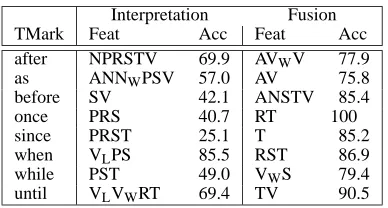
feature combinations where k is the arity of the combination (unary, binary, ternary, etc.). We mea-sured the accuracy of all feature combinations (1023 in total) on the develoment set. From these, we selected the most informative combinations for evaluating the model on the test set. The best accuracy (61.4%) on the develop-ment set was observed with the combination of verbs (V) with syntactic signatures (S). We also observed that some feature combinations performed reasonably well on indi-vidual markers, even though their overall accuracy was not better than V and S combined. Some accuracies for these combinations are shown in Table 4. For example, NPRSTV was one of the best combinations for generating
after, whereas SV was better forbefore(feature abbrevi-ations are as introduced in Section 3.2).
de-Interpretation Fusion TMark Feat Acc Feat Acc after NPRSTV 69.9 AVWV 77.9
as ANNWPSV 57.0 AV 75.8
before SV 42.1 ANSTV 85.4 once PRS 40.7 RT 100 since PRST 25.1 T 85.2 when VLPS 85.5 RST 86.9
while PST 49.0 VWS 79.4
[image:6.612.90.284.69.173.2]until VLVWRT 69.4 TV 90.5
Table 4: Best feature combinations for individual markers (development set)
Interpretation Fusion
E SV E ARSTV
TMark Prec Rec Prec Rec Prec Prec after 61.5 66.5 51.6 55.2 96.7 75.2 as 61.5 62.6 57.0 52.8 93.2 70.5 before 50.0 51.5 32.0 39.1 96.8 84.1 once 60.0 25.0 12.7 15.0 100 88.3 since 69.4 26.3 25.4 12.0 98.2 81.0 when 83.0 91.1 84.7 85.0 99.3 83.8 while 71.5 28.9 38.0 25.8 97.7 82.8 until 57.8 52.4 38.5 47.7 97.8 87.8
Acc 70.7 62.6 97.3 80.1
Baseline 42.6 42.6 42.6 42.6 50.0 50.0
Table 5: Results on interpreation and fusion (test set)
cisions are combined in some way (anensemble) can be more accurate than any of its component classifiers if the errors of the individual classifiers are sufficiently uncor-related (Dietterich, 1997). In this paper an ensemble was constructed by combining classifiers resulting from train-ing different parametrisations of our model on the same data. A decision tree (Quinlan, 1993) was used for select-ing the models with the least overlap and for combinselect-ing their output.
The decision tree was trained and tested on the de-velopment set using 10-fold cross-validation. We experi-mented with 65 different models; out of these, the best re-sults on the development set were obtained with the com-bination of 12 models: ANWNPSV, APSV, ASV, VWPRS,
VNPS, VLS, NPRSTV, PRS, PRST, PRSV, PSV, and SV.
These models formed the ensemble whose accuracy was next measured on the test set. Note that the features with the most impact on the interpretation task are verbs either as lexical forms (V) or classes (VW, VL), the syntactic
structure of the main and subordinate clauses (S) and their position (P). The argument structure feature (R) seems to have some influence (it is present in five of the 12 com-binations), however we suspect that there is some overlap with S. Nouns, adjectives and temporal signatures seem to have less impact on the interpretation task, for the WSJ domain at least. Our results so far point to the importance of the lexicon (represented by V, N, and A) for the marker interpretion task but also indicate that the syntactic
com-plexity of the two clauses is crucial for inferring their se-mantic relation.
The accuracy of the ensemble (12 feature combina-tions) was next measured on the unseen test set using 10-fold cross-validation. Table 5 shows precision (Prec) and recall (Rec). For comparison we also report preci-sion and recall for the best individual feature combina-tion on the test set (SV) and the baseline of always se-lecting when, the most frequent marker in our data set (42.6%). The ensemble (E) classified correctly 70.7% of the instances in the test set, whereas SV obtained an accuracy of 62.6%. The ensemble performs signifi-cantly better than SV (χ2
10257, df 1, p005) and both SV and E perform significantly better than the base-line (χ2
67173, df 1, p005 and χ
2
127861, df 1, p005, respectively). The ensemble has diffi-culty inferring the markerssince,onceandwhile(see the recall figures in Table 5).Sinceis often confused with the semantically similarwhile.Until is not ambiguous, how-ever it is relatively infrequent in our corpus (6.3% of our data set). We suspect that there is simply not enough data for the model to accurately infer these markers.
For the fusion task we also explored the feature space exhaustively on the development set, after remov-ing the position feature (P). Knowremov-ing the linear prece-dence of the two clauses is highly predictive of their type: 80.8% of the main clauses are sentence initial. However, this type of positional information is typically not known when fragments are synthesised into a meaningful sen-tence.
The best performing feature combinations on the de-velopment set were ARSTV and ANWRSV with an
ac-curacy of 80.4%. Feature combinations with the highest accuracy (on the development set) for individual mark-ers are shown in Table 4. Similarly to the interepreta-tion task, an ensemble of classifiers was built in order to take advantage of the complementarity of different model parameterisations. The decision tree learner was again trained and tested on the development set using 10-fold cross-validation. We experimented with 44 different model instantiations; the best results were obtained when the following 20 models were combined: AVWNRSTV,
ANWNSTV, ANWNV, ANWRS, ANV, ARS, ARSTV,
ARSV, ARV, AV, VWHS, VWRT, VWTV, NWRST, NWS,
NWST, VWT, VWTV, RT, and STV. Not surprisingly V
and S are also important for the fusion task. Adjectives (A), nouns (N and NW) and temporal signatures (T), all
seem to play more of a role in the fusion rather than the interpretation task. This is perhaps to be expected given that the differences between main and subordinate clauses are rather subtle (semantically and structurally) and more information is needed to perform the inference.
[image:6.612.73.301.220.353.2]individual marker is shown in Table 5 (we omit re-call as it is always one). Both the ensemble and AR-STV significantly outperform the simple baseline of 50%, amounting to always guessing main (or subordi-nate) for both clauses (χ2
484846, df 1, p005 and χ2 167081, df 1, p005, respectively). The ensemble performed significantly better than ARSTV (χ2
123363, df 1, p005).
Although for both tasks the ensemble outperformed the single best model, it is worth noting that the best in-dividual models (ARSTV for fusion and PSTV for inter-pretation) rely on features that can be simply extracted from the parse trees without recourse to taxonomic infor-mation. Removing from the ensembles the feature combi-nations that rely on corpus external resources (i.e., Levin, WordNet) yields an overall accuracy of 65.0% for the in-terpretation task and 95.6% for the fusion task.
5
Experiment 2: Human Evaluation
5.1 Method
We further compared our model’s performance against human judges by conducting two separate studies, one for the interpretation and one for the fusion task. In the first study, participants were asked to perform a multiple choice task. They were given a set of 40 main-subordinate pairs (five for each marker) randomly chosen from our test data. The marker linking the two clauses was removed and participants were asked to select the missing word from a set of eight temporal markers.
In the second study, participants were presented with a series of sentence fragments and were asked to arrange them so that a coherent sentence can be formed. The fragments were a main clause, a subordinate clause and a marker. Participants saw 40 such triples randomly se-lected from our test set. The set of items was different from those used in the interpretation task; again five items were selected for each marker.
Both studies were conducted remotely over the In-ternet. Subjects first saw a set of instructions that ex-plained the task, and had to fill in a short questionnaire including basic demographic information. For the inter-pretation task, a random order of main-subordinate pairs and a random order of markers per pair was generated for each subject. For the fusion task, a random order of items and a random order of fragments per item was generated for each subject. The interpretation study was completed by 198 volunteers, all native speakers of English. 100 vol-unteers participated in the fusion study, again all native speakers of English. Subjects were recruited via postings to local Email lists.
5.2 Results
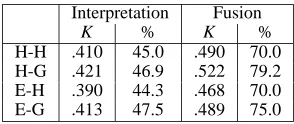
Our results are summarised in Table 6. We measured how well subjects agree with the gold-standard (i.e., the cor-pus from which the experimental items were selected) and how well they agree with each other. We also show how
Interpretation Fusion
[image:7.612.352.499.70.132.2]K % K % H-H .410 45.0 .490 70.0 H-G .421 46.9 .522 79.2 E-H .390 44.3 .468 70.0 E-G .413 47.5 .489 75.0
Table 6: Agreement figures for subjects and ensemble (inter-subject agreement is shown in boldface)
well the ensembles from Section 4 agree with the humans and the gold-standard. We measured agreement using the Kappa coefficient (Siegel and Castellan, 1988) but also report percentage agreement to facilitate comparison with our model. In all cases we compute pairwise agreements and report the mean. In Table 6, H refers to the subjects, G to the gold-standard, and E to the ensemble.
As shown in Table 6 there is less agreement among humans for the interpretation task than the sentence fu-sion task. This is expected given that some of the mark-ers are semantically similar and in some cases more than one marker are compatible with the meaning of the two clauses. Also note that neither the model nor the sub-jects have access to the context surrounding the sentence whose marker must be inferred (we discuss this further in Section 6). Additional analysis of the interpretation data revealed that the majority of disagreements arose for
as andonce clauses.Oncewas also problematic for our model (see the Recall in Table 5). Only 33% of the sub-jects agreed with the gold-standard foras clauses; 35% of the subjects agreed with the gold-standard for once
clauses. For the other markers, the subject agreement with the gold-standard was around 55%. The highest agree-ment was observed for since and until (63% and 65% respectively).
The ensemble’s agreement with the gold-standard approximates human performance on the interpretation task (.413 for E-G vs. .421 for H-G). The agreement of the ensemble with the subjects is also close to the upper bound, i.e., inter-subject agreement (see, E-H and H-H in Table 6). A similar pattern emerges for the fusion task: comparison between the ensemble and the gold-standard yields an agreement of .489 (see E-G) when subject and gold-standard agreement is .522 (see H-G); agreement of the ensemble with the subjects is .468 when the upper bound is .490 (see E-H and H-H, respectively).
6
Discussion
rele-vant for applications such as summarisation or question answering where sentence fragments must be combined into a fluent sentence. For the fusion task our model deter-mines the appropriate ordering among a temporal marker and two clauses.
We experimented with a variety of linguistically mo-tivated features and have shown that it is possible to ex-tract semantic information from corpora even if they are not semantically annotated in any way. We achieved an accuracy of 70.7% on the interpretation task and 97.4% on the fusion task. This performance is a significant im-provement over the baseline and compares favourably with human performance on the same tasks. Previous work on temporal inference has focused on the automatic tagging of temporal expressions (e.g., Wilson et al. 2001) or on learning the ordering of events from manually anno-tated data (e.g., Mani et al. 2003). Our experiments further revealed that not only lexical but also syntactic informa-tion is important for both tasks. This result is in agreement with Soricut and Marcu (2003) who find that syntax trees encode sufficient information to enable accurate deriva-tion of discourse reladeriva-tions.
An important future direction lies in modelling the temporal relations of events across sentences. The ap-proach presented in this paper can be used to support the “annotate automatically, correct manually” methodology used to provide high volume annotation in the Penntree-bank project. An important question for further investiga-tion is the contribuinvestiga-tion of linguistic and extra-sentential information to modelling temporal relations. Our model can be easily extended to include contextual features and also richer temporal information such as tagged time ex-pressions (see Mani et al. 2003). Apart from taking more features into account, in the future we plan to experiment with models where main and subordinate clauses are not assumed to be conditionally independent and investigate the influence of larger data sets on prediction accuracy.
Acknowledgments
The authors are supported byEPSRCgrant number GR/R40036. Thanks to Regina Barzilay and Frank Keller for helpful com-ments and suggestions.
References
Asher, Nicholas and Alex Lascarides. 2003. Logics of
Conver-sation. Cambridge University Press.
Barzilay, Regina. 2003. Information Fusion for Multi-Document
Summarization: Praphrasing and Generation. Ph.D. thesis,
Columbia University.
Charniak, Eugene. 2000. A maximum-entropy-inspired parser. In Proceedings of the 1st Conference of the North
Ameri-can Chapter of the Association for Computational Linguis-tics. Seattle, WA, pages 132–139.
Dietterich, T. G. 1997. Machine learning research: Four current directions. AI Magazine 18(4):97–136.
Dorr, Bonnie and Terry Gaasterland. 1995. Selecting tense as-pect and connecting words in language generation. In
Pro-ceedings of 14th International Joint Conference on Artificial Intelligence. Montr´eal, Canada, pages 1299–1307.
Fellbaum, Christiane, editor. 1998. WordNet: An Electronic Database. MIT Press, Cambridge, MA.
Ferro, Lisa, Inderjeet Mani, Beth Sundheim, and George Wil-son. 2000. Tides temporal annotation guidelines. Technical report, The MITRE Corporation.
Johnson, W. E. 1932. Probability: The deductive and inductive problems. Mind 49:409–423.
Kamp, Hans and Uwe Reyle. 1993. From Discourse to Logic:
Introduction to Modeltheoretic Semantics of Natural Lan-guage, Formal Logic and Discourse Representation Theory.
Kluwer, Dordrecht.
Katz, Graham and Fabrizio Arosio. 2001. The annotation of temporal information in natural language sentences. In
Pro-ceedings of ACL Workshop on Temporal and Spatial Infor-mation Processing. Toulouse, France, pages 104–111.
Lapata, Maria and Chris Brew. 1999. Using subcategorization to resolve verb class ambiguity. In Proceedings of the Joint
SIGDAT Conference on Empirical Methods in Natural Lan-guage Processing and Very Large Corpora. College Park,
MD, pages 266–274.
Levin, Beth. 1993. English Verb Classes and Alternations: A Preliminary Investigation. University of Chicago Press,
Chicago.
Mani, Inderjeet, Barry Schiffman, and Jianping Zhang. 2003. Inferring temporal ordering of events in news. In
Proceed-ings of the 1st Human Language Technology Conference and Annual Meeting of the North American Chapter of the As-sociation for Computational Linguistics. Edmonton, Canada.
Marcu, Daniel and Abdessamad Echihabi. 2002. An unsuper-vised approach to recognizing discourse relations. In
Pro-ceedings of the 40th Annual Meeting of the Association for Computational Linguistics. Philadelphia, PA, pages 368–375.
Quinlan, Ross J. 1993. C4.5: Programs for Machine Learning. Series in Machine Learning. Morgan Kaufman, San Mateo, CA.
Quirk, Randolph, Sidney Greenbaum, Geoffrey Leech, and Jan Svartvik. 1985. A Comprehensive Grammar of the English
Language. Longman, London.
Schilder, Frank and Christopher Habel. 2001. From tempo-ral expressions to tempotempo-ral information: Semantic tagging of news messages. In Proceedings of ACL Workshop on
Tem-poral and Spatial Information Processing. Toulouse, pages
65–72.
Setzer, Andrea and Robert Gaizauskas. 2001. A pilot study on annotating temporal relations in text. In Proceedings of ACL
Workshop on Temporal and Spatial Information Processing.
Toulouse, France, pages 73–80.
Siegel, Sidney and N. John Castellan. 1988. Non Parametric
Statistics for the Behavioral Sciences. McGraw-Hill, New
York.
Soricut, Radu and Daniel Marcu. 2003. Sentence level discourse parsing using syntactic and lexical information. In
Proceed-ings of the 1st Human Language Technology Conference and Annual Meeting of the North American Chapter of the As-sociation for Computational Linguistics. Edmonton, Canada,
pages 228–235.
Webber, Bonnie Lynn. 1991. Structure and ostension in the interpretation of discourse deixis. Language and Cognitive
Processes 6(2):107–135.
Wiebe, Janyce M., Thomas P. O’Hara, Thorsten ¨Ohrstr¨om Sand-gren, and Kenneth J. McKeever. 1998. An empirical approach to temporal reference resolution. Journal of Artifical
Intelli-gence Research 9:247–293.
Wilson, George, Interjeet Mani, Beth Sundheim, and Lisa Ferro. 2001. A multilingual approach to annotating and extract-ing temporal information. In Proceedextract-ings of ACL Workshop
on Temporal and Spatial Information Processing. Toulouse,