Original Article
Analysis and clinical significance of chromosomal
testing results for eugenics and genetic testing
Xijiang Hu, Qingli Suo
Wuhan Children’s Hospital Affiliated to Tongji Medical College of Huazhong University of Science and Technology (Wuhan Maternal and Child Healthcare Hospital), Wuhan City, Hubei Province, China
Received July 31, 2017; Accepted September 21, 2017; Epub October 15, 2017; Published October 30, 2017
Abstract: Objective: To investigate the clinical significance of chromosomal testing for adverse pregnancy outcomes by studying the relationship between chromosomal test results of the eugenics and genetic testing and adverse pregnancy outcomes. Methods: A total of 2,831 couples with eugenics and genetic testing from January 2014 to December 2015 in our hospital were retrospectively analyzed and 218 couples with adverse pregnancy outcomes were selected as research subjects in this study. Chromosomal testing results and general information such as age and childbearing history of all the research subjects were collected and all the research data were statistically ana-lyzed. Results: It was found that 218 out of 2831 couples who did eugenic examination gave abnormal birth, with a rate of 7.7%. It was also found that the age of the women when at pregnancy was higher than their normal coun-terparts.Thetermination of pregnancy ranked highest of the abnormal birth in the study, accounting for 54.59%, followed by fetal malformation and stillbirth. For the chromosomal analysis of the 218 couples who give imperfect births, 45 of them were diagnosed as unusual, with a rate of 10.32%. There was no such a case that both of two in a couple were chromosomal abnormal. The chromosomal abnormality rate of female (12.84%) was higher than that of male (7.80%) (P=0.001). The most common chromosomal abnormality was the balanced translocation (51.11%), which caused 60.87% of termination of pregnancy. The detectable rate of chromosomal abnormality in defective in-fants was the highest, followed by abortion and fetal malformation. Conclusion: Maternal chromosomal abnormality is more inclined to be detected in adverse pregnancy outcomes, and balanced translocation was the most common chromosomal abnormality in adverse pregnancy outcomes.
Keywords: Eugenics and genetic, chromosomal abnormality, fetal malformation
Introduction
Adverse pregnancy outcomes refer to the prob-lems of the female during pregnancy, such as spontaneous abortion and stillbirth, or other problems like neonatal dysplasia, mental re- tardation, fetal malformation, etc. [1]. Both ma- ternal and external circumstances are likely to lead to adverse pregnancy outcomes, among which, chromosome abnormality is one of the main reasons [2].
The number of defective infants (including fe- tal malformation, dysplasia, etc.) in China is increasing by about 900,000 cases per year [3]. Deformity, poor intelligence and dysplasia of these defective infants not only have serious impact on their families but also lower thecom-prehensive quality of Chinese [4, 5]. Although
chromosome detection is mature, its relevance to clinic practices stillremains to be seen [6]. Therefore, maternal eugenics and genetic test-ing have very important significance in compre-hensive quality improvement for Chinese [7]. There were 218 couples appearing adverse pregnancy outcomes in 2,831 couples who consulted for the eugenics and genetic testing and they were retrospectively analyzed. It was re- ported as follows.
Materials and methods
General information
outcomes were selected as research subjects of this study. Inclusion criteria: Who hadad-verse pregnancy outcome history of premature infant, defective infant, abortion, fetal malfor-mation, stillbirth, etc.; who didn’t take
contra-ceptive or exposed to strong ray before and after pregnancy; who did chromosomal testing and signed informed consent.
Research methods
Chromosomal testing results and general infor-mation such as age and childbearing history of all the research subjects were collected and all the research data were statistically analyzed.
Statistical methods
SPSS17.0 software was used for statistical analysis. Enumeration data was expressed by frequency and the comparison between cou-ples with adverse pregnancy outcomes and normal couples were performed by chi square test. Measurement data was presented by mean and standard deviation and the compari-sons between two groups were carried out by t test. When P<0.05, the difference reached sta-tistical significance.
Results
The occurrence of adverse pregnancy out -comes
There were 218 couples appearing adverse pregnancy outcomes in 2,831 couples who consulted for the eugenics and genetic testing, with 7.7% of the incidence.
Comparison of general information between couples with adverse pregnancy outcomes
and normal couples
It could be seen from the general information that the age of the women when at pregnancy was higher than their normal counterparts. (P=0.003), but there was nosignificant differ-ence in gravidity and parity. See Table 1.
The composition of adverse pregnancy
[image:2.612.94.523.84.152.2]The termination of pregnancy ranked highest of the abnormal birth in the study, accounting for Table 1. Analysis of general informationofeugenics andgenetic testers
Subject Pregnant age Gravidity Parity
Couples with adverse pregnancy outcomes 28.49±2.93 3.89±0.34 1.38±0.19
Normal couples 25.39±3.02 3.02±0.17 1.41±0.31
Statistics 7.391 0.931 0.033
P 0.003 0.183 0.361
[image:2.612.86.287.336.606.2]Figure 1. The compo-sition of adverse preg-nancy outcomes.
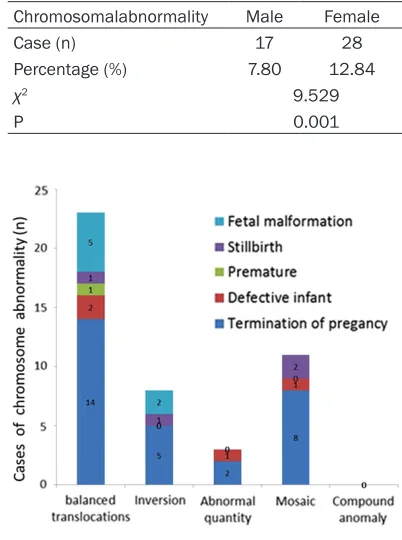
Table 2. Comparison of chromosomal abnor-mality of adverse pregnancy outcomes Chromosomalabnormality Male Female
Case (n) 17 28
Percentage (%) 7.80 12.84
χ2 9.529
P 0.001
54.59%, followed by fetal deformity and still-birth. See Figure 1.
Comparison of chromosomal abnormality of adverse pregnancy outcomes
For the chromosomal analysis of the 218 cou-ples who give imperfect births, 45 of them were diagnosed as unusual. There is not a single case where both man and women have abnor-mal chromosoabnor-mal arrangement. and there was no one detected out two or more chromosomal abnormalities in one subject, either.
The chromosomal abnormality rate of female (12.84%) was higher than that of male (7.80%) with statistically significant difference. See Table 2.
The relationship between the composition of chromosomal abnormality and adverse preg
-nancy outcomes
The most common of all chromosomal abnor-malities was the balanced translocation (51.11%). There was 60.87% of termination of pregnancy caused by balanced translocation. See Figure 2.
Comparison of detectable rate of chromosom
-al abnorm-ality
The detectable rate of chromosomal abnormal-ity in defective infants was the highest, fol-lowed by abortion and fetal deformity, and that in premature infants was the lowest. See Table 3.
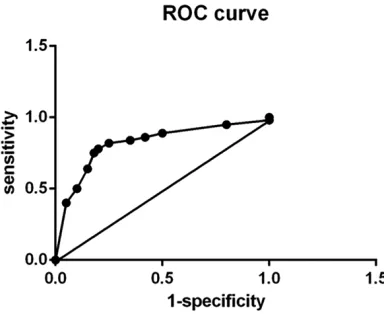
alysis of the 218 couples who give imperfect births, 45 of them were diagnosed as unusual, see Table 4. With 20.6% of sensitivity and 92.3% of specificity, its area under the curve was 0.793, which owned diagnostic value. See Figure 3.
Discussion
[image:3.612.89.524.87.162.2]As the carrier of human DNA, chromosomes play a leading role in the human body and they are extremely essential [8]. Once chromosomal abnormality appears, it may lead to varioushe-reditary diseases [9, 10]. Therefore, if advance chromosomal testing andtimely intervention for couplescan be carried out, many cases of adverse pregnancy outcomewill be avoided [11]. The result in this study showed that 218 out of 2831 couples who did eugenic examina-tion gave abnormal birth, with a rate of 7.7%. It was demonstrated that the incidence of chro-mosomal abnormalities in the general popu- lation was approximately 0.5% [12]. Neve- rtheless, the incidence in this study was obvi-ously higher than that in above study, which may be because pregnant women who had family history of genetic diseases paid more attention to eugenics and genetic testing, and most of them consulted onthis aspect and did chromosomal testing [13-15]. It could be seen from the general information in this study that the males were older than the females. Itis associated with national conditions in China that the males are older than the females in the most of couples, but there is no direct correla-tion between age and adverse pregnancy out-comes [16-18].
Table 3. Comparison of detectable rates of chromosomal abnormalities
Adverse pregnancy outcomes Termination of pregnancy Fetal malformation Stillbirth Premature infant Defective infant
The total number of cases 119 43 31 14 11
Detectablerate(n, %) 29 (24.37) 7 (16.28) 4 (12.90) 1 (7.14) 4 (36.36)
χ2 9.484
[image:3.612.89.348.210.260.2]P 0.004
Table 4. The number of chromosomal abnormality detection(n)
Adverse pregnancy
outcomes Normal pregnancy outcomes
Chromosomal abnormality 45 200
Chromosomal normality 173 2413
The number of chromosomal abnor
-mality detection and its diagnostic accuracy
Most of adverse pregnancy outcomes were ter-mination of pregnancy in this study, accounting for 54.59%, followed by fetal malformation and stillbirth. In this study, 45 cases of chromosom-al abnormchromosom-alities were founded out in 218 cou-ples, with a rate of 10.32%. There was no such a case that both of two in a couple were chro-mosomal abnormality. The chrochro-mosomal abnormality rate of female (12.84%) was higher than that of male (7.80%). The above results were similar to the findings of Fei et al., but the abnormality rate in this study was higher than that in their findings [19]. It was possible that the sample size in this study was so small that there was sample selection bias.
The most common chromosomal abnormality was the balanced translocation (51.11%). And there were 60.87% of termination of pregnancy caused by balanced translocation, followed by mosaic and inversion. However, Natesan found that the most cases of termination of pregnan-cy were caused by mosaic [20]. There may be regional differences, which can be further con-firmed in future studies. Balanced translocatio-nis a common type of chromosome structure abnormality, meaning that two or more than two chromosomes fracture and then they link together after exchanging their positions. Hence, the number and variety of genes never change; instead, two fragments exchange their positions. That is why the maternal and pater-nal generally have no clinical manifestation of chromosomal abnormalities, but there may be an obvious abnormality in embryo. The longer the translocation is, the greater the impact on the embryo is, especially for the time of embryo
development, therefore, if there is a transloca-tion, the pregnancy time will be affected most [21]. It can also be seen in this study, the main-ly adverse pregnancy outcomes in balanced translocation is abortionand the longer translo-cation fragment may cause the abortion. The gene arrangement of inversion has changed, but the type of gene has not. So, there is nor-mal phenotype for couples who are the inver-sion carriers. However, when the inverted chro-mosome is paired with a normal chrochro-mosome, the formed chromosome will be unbalanced, leading to gene deletion. Additionally, the lon-ger the gene misses, the greater the change in phenotype is. That is why the probability of fet- al malformationis higher when the inversion occurs, which is usually easy to be detected and pregnant women are suggested to be ter-minated the pregnancy during testing. The fac-tors that affect chromosomal abnormalities also vary. On one hand, the maternal and pater-nal themselves are carriers of chromosomal abnormalities. On the other hand, if the mater-nal is affected by some extermater-nal factors during pregnancy, such as drugs, radiation, and infec-tion, it can also cause gene mutations in the embryo, resulting in chromosomal abnormali-ties, which can lead to abortion and fetal mal-formation further.
From the detectable rate, many congenital dis-eases can be detected by chromosomal test-ing. From the results in this study, the defective infants were most likely to be detected through chromosomal testing, followed by abortion and-fetal malformation, but it was hard for the pre-mature infants to be detected in the same way. Therefore, pregnant couples should be encour-aged to carry out chromosomal testing so as to detect the adverse pregnancy outcomes early and terminate the pregnancy in time.
However, there were also some limitations in this study. Due to the low incidence of adverse pregnancy outcomes, only 45 couples with adverse pregnancy outcomes were studied, that was to say, small sample size. Therefore, we can increase the sample size in future stud-ies and conduct in-depth study with large sam-ples so as to obtain more scientific conclusio- ns
To sum up, chromosomal abnormalities in fe- male are more likely to cause adverse pregnan-cy outcomes, and balanced translocation is the
[image:4.612.93.285.72.229.2]most common causes inchromosomal abnor-malities, followed by fetal malformation and stillbirth. Therefore, chromosomal testing for eugenics and genetic consultants can effec-tively detect abortion, fetal malformationand other adverse pregnancy outcomes.
Disclosure of conflict of interest
None.
Address correspondence to: Qingli Suo, Wuhan Children’s Hospital Affiliated to Tongji Medical College of Huazhong University of Science and Technology (Wuhan Maternal and Child Healthcare Hospital), No.100 Hongkong Road, Jiang’an District, Wuhan City, Hubei Province, 430016, China. Tel: +86-027-82433245; E-mail: suoqingli152@163. com
References
[1] Tai CH, Ho CL, Chen YL, Chen WL and Lee GB. A novel integrated microfluidic platform to per-form fluorescence in situ hybridization for chromosomal analysis. Microfluidics & Nano-fluidics 2013; 15: 745-752.
[2] Perrin A, Basinko A, Douet-Guilbert N, Guegan-ic N, Le Bris MJ, AmGuegan-ice V, De Braekeleer M and Morel F. Aneuploidy and DNA fragmentation in sperm of carriers of a constitutional chromo-somal abnormality. Cytogenet Genome Res 2011; 133: 100-106.
[3] Lau TK, Cheung SW, Lo PS, Pursley AN, Chan MK, Jiang F, Zhang H, Wang W, Jong LF, Yuen OK, Chan HY, Chan WS and Choy KW. Non-in-vasive prenatal testing for fetal chromosomal abnormalities by low-coverage whole-genome sequencing of maternal plasma DNA: review of 1982 consecutive cases in a single center. Ul-trasound Obstet Gynecol 2014; 43: 254-264. [4] Flynn H, Yan J, Saravelos SH and Li TC.
Com-parison of reproductive outcome, including the pattern of loss, between couples with chromo-somal abnormalities and those with unex-plained repeated miscarriages. J Obstet Gyn-aecol Res 2014; 40: 109-116.
[5] Baker GJ. Christianity and eugenics: the place of religion in the British eugenics education society and the American eugenics society, c.1907-1940. Soc Hist Med 2014; 27: 281-302.
[6] Fujita M, Yashiro Y and Suzuki M. Throwing the baby out with the bathwater: a critique of Spar-row’s inclusive definition of the term ‘in vitro eugenics’. J Med Ethics 2014; 40: 735-736. [7] Douet-Guilbert N, Tous C, Le Flahec G, Bovo C,
Le Bris MJ, Basinko A, Morel F and De
Braekel-eer M. Translocation t(2;7)(p11;q21) associat-ed with the CDK6/IGK rearrangement is a rare but recurrent abnormality in B-cell lymphopro-liferative malignancies. Cancer Genet 2014; 207: 83-86.
[8] Oswal N, Christov G, Sridharan S, Khambad-kone S, Bull C and Sullivan I. Aberrant subcla-vian artery origin in tetralogy of Fallot with pul-monary stenosis is associated with chro- mosomal or genetic abnormality. Cardiol Young 2014; 24: 478-484.
[9] He Y, Li X, Wang D, Zhang E, Hu Y, Wang W, Huang R and Xiao R. Acute promyelocytic leu-kaemia with a PML-RARA insertional transloca-tion and a chromosome 21 abnormality in XYY syndrome: case report. J Int Med Res 2014; 42: 1363-1373.
[10] Hillman SC, Barton PM, Roberts TE, Maher ER, McMullan DM and Kilby MD. BAC chromosom-al microarray for prenatchromosom-al detection of chromo-some anomalies in fetal ultrasound anoma-lies: an economic evaluation. Fetal Diagn Ther 2014; 36: 49-58.
[11] Liao C, Yi CX, Li FT and Li DZ. The prevalence of non-detectable chromosomal abnormalities by QF-PCR in amniocentesis for certain referral indications: experience at a mainland Chinese hospital. Arch Gynecol Obstet 2014; 289: 75-78.
[12] Anaya G, Moreno-Millan M, Bugno-Poniewier-ska M, Pawlina K, Membrillo A, Molina A and Demyda-Peyras S. Sex reversal syndrome in the horse: four new cases of feminization in individuals carrying a 64,XY SRY negative chro-mosomal complement. Anim Reprod Sci 2014; 151: 22-27.
[13] Williamson SR, Wang M, Montironi R, Eble JN, Lopez-Beltran A, Zhang S, Fan R, Wang L, Os-unkoya AO, Koch MO and Cheng L. Molecular characteristics of urothelial neoplasms in chil-dren and young adults: a subset of tumors from young patients harbors chromosomal ab-normalities but not FGFR3 or TP53 gene muta-tions. Mod Pathol 2014; 27: 1540-1548. [14] Liaw FP, Lau LC, Lim AS, Lim TH, Lee GY and
Tien SL. CpG Oligonucleotide and Interleukin 2 stimulation enables higher cytogenetic abnor-mality detection rates than 12-o-tetradecano-lyphorbol-13-acetate in Asian patients with B-cell chronic lymphocytic leukemia (B-CLL). Int J Hematol 2014; 100: 545-553.
[15] Lathi RB, Gustin SL, Keller J, Maisenbacher MK, Sigurjonsson S, Tao R and Demko Z. Reli-ability of 46,XX results on miscarriage speci-mens: a review of 1,222 first-trimester miscar-riage specimens. Fertil Steril 2014; 101: 178-182.
from the ecologically disturbed habitats of sol-ang valley, kullu district, himachal pradesh. Cytologia 2015; 80: 203-222.
[17] Shinmura K, Kato H, Kawanishi Y, Nagura K, Kamo T, Okubo Y, Inoue Y, Kurabe N, Du C, Iwaizumi M, Kurachi K, Nakamura T and Sug-imura H. SASS6 overexpression is associated with mitotic chromosomal abnormalities and a poor prognosis in patients with colorectal can-cer. Oncol Rep 2015; 34: 727-738.
[18] Kotini AG, Chang CJ, Boussaad I, Delrow JJ, Dolezal EK, Nagulapally AB, Perna F, Fishbein GA, Klimek VM, Hawkins RD, Huangfu D, Murry CE, Graubert T, Nimer SD and Papapetrou EP. Functional analysis of a chromosomal deletion associated with myelodysplastic syndromes using isogenic human induced pluripotent stem cells. Nat Biotechnol 2015; 33: 646-655. [19] Fei CZ, Zhang J, Lin Y, Wang X, Zhang K, Zhang
L, Zheng W, Wang M, Li T, Xiao S, Xue F and Wang C. Safety evaluation of a triazine com-pound nitromezuril by assessing bacterial re-verse mutation, sperm abnormalities, micro-nucleus and chromosomal aberration. Regul Toxicol Pharmacol 2015; 71: 585-589.
[20] Natesan SA, Handyside AH, Thornhill AR, Otto-lini CS, Sage K, Summers MC, Konstantinidis M, Wells D and Griffin DK. Live birth after PGD with confirmation by a comprehensive ap-proach (karyomapping) for simultaneous de-tection of monogenic and chromosomal disor-ders. Reprod Biomed Online 2014; 29: 600-605.