284
Can Neural Generators for Dialogue
Learn Sentence Planning and Discourse Structuring?
Lena Reed, Shereen Oraby and Marilyn Walker
Natural Language and Dialogue Systems Lab, University of California, Santa Cruz
{lireed,soraby,mawalker}@ucsc.edu
Abstract
Responses in task-oriented dialogue sys-tems often realize multiple propositions whose ultimate form depends on the use of sentence planning and discourse struc-turing operations. For example a rec-ommendation may consist of an explic-itly evaluative utterance e.g. Chanpen Thai is the best option, along with con-tent related by the justification discourse relation, e.g. It has great food and ser-vice, that combines multiple propositions into a single phrase. While neural gen-eration methods integrate sentence plan-ning and surface realization in one end-to-end learning framework, previous work has not shown that neural generators can: (1) perform common sentence planning and discourse structuring operations; (2) make decisions as to whether to realize content in a single sentence or over mul-tiple sentences; (3) generalize sentence planning and discourse relation operations beyond what was seen in training. We systematically create large training cor-pora that exhibit particular sentence plan-ning operations and then test neural mod-els to see what they learn. We compare models without explicit latent variables for sentence planning with ones that provide explicit supervision during training. We show that only the models with additional supervision can reproduce sentence plan-ning and discourse operations and gener-alize to situations unseen in training.
1 Introduction
Neural natural language generation (NNLG) promises to simplify the process of producing high
quality responses for conversational agents by re-lying on the neural architecture to automatically learn how to map an input meaning representation (MR) from the dialogue manager to an output ut-terance (Gaˇsi´c et al.,2017;Sutskever et al.,2014). For example, Table1 shows sample training data for an NNLG with a MR for a restaurant named
ZIZZI, along with three reference realizations, that
should allow theNNLGto learn to realize the MR as either 1, 3, or 5 sentences.
# Type Example
PRICERANGE[MODERATE],AREA[RIVERSIDE],
NAME[ZIZZI],FOOD[ENGLISH],EATTYPE[PUB]
NEAR[AVALON],FAMILYFRIENDLY[NO]
1 1 Sent Zizzi is moderately priced in riverside, also it isn’t family friendly, also it’s a pub, and it is an English place near Avalon.
2 3 Sents Moderately priced Zizzi isn’t kid friendly, it’s in riverside and it is near Avalon. It is a pub. It is an English place.
[image:1.595.311.521.639.713.2]3 5 Sents Zizzi is moderately priced near Avalon. It is a pub. It’s in riverside. It isn’t family friendly. It is an English place.
Table 1: Sentence Scoping: a sentence planning operation that decides what content to place in each sentence of an utterance.
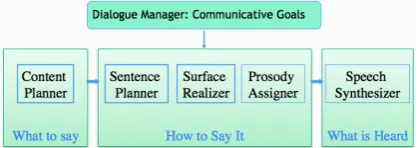
In contrast, earlier models of statistical natu-ral language generation (SNLG) for dialogue were based around the NLG architecture in Figure 1
(Rambow et al., 2001; Stent, 2002; Stent and Molina,2009).
Figure 1: Statistical NLG Dialogue Architecture
en-gine, which then makes decisions how to render the utterance using separate modules for content planning and structuring, sentence planning and surface realization (Reiter and Dale, 2000). The sentence planner’s job includes:
• Sentence Scoping: deciding how to allocate the content to be expressed across different sentences;
• Aggregation: implementing strategies for re-moving redundancy and constructing com-pact sentences;
• Discourse Structuring: deciding how to ex-press discourse relations that hold between content items, such as causality, contrast, or justification.
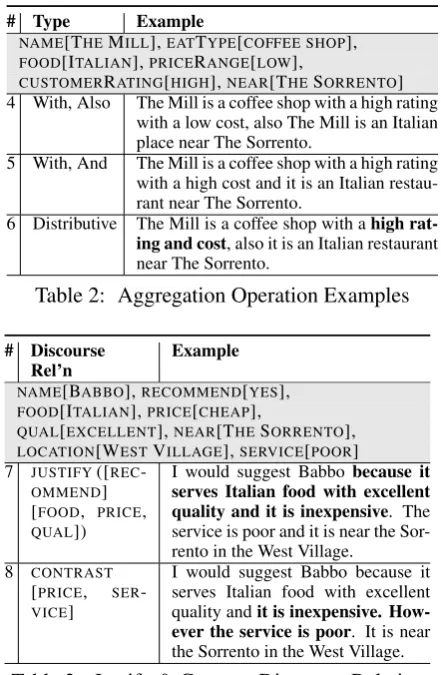
Sentence scoping (Table1) affects the complex-ity of the sentences that compose an utterance, allowing the NLG to produce simpler sentences when desired that might be easier for particular users to understand. Aggregation reduces redun-dancy, composing multiple content items into sin-gle sentences. Table 2 shows common aggrega-tion operaaggrega-tions (Cahill et al.,2001;Shaw,1998). Discourse structuring is often critical in persua-sive settings (Scott and de Souza, 1990; Moore and Paris,1993), in order to express discourse re-lations that hold between content items. Table 3
shows howRECOMMENDdialogue acts can be in-cluded in the MR, and how content can be related withJUSTIFYandCONTRASTdiscourse relations (Stent et al.,2002).
Recent work in NNLG explicitly claims that
training models end-to-end allows them to doboth
sentence planning and surface realization without the need for intermediate representations (Dusek and Jurc´ıcek, 2016b; Lampouras and Vlachos,
2016;Mei et al., 2016;Wen et al., 2015; Nayak et al.,2017). To date, however, no-one has actu-ally shown that an NNLG can faithfully produce outputs that exhibit the sentence planning and dis-course operations in Tables1, 2and 3. Instead,
NNLGevaluations focus on measuring the seman-tic correctness of the outputs and their fluency (Novikova et al.,2017;Nayak et al.,2017).
Here, we systematically perform a set of con-trolled experiments to test whether an NNLG can learn to do sentence planning operations. Sec-tion 2 describes our experimental setup and the
NNLGarchitecture that allows us, during training, to vary the amount of supervision provided as to
# Type Example
NAME[THEMILL],EATTYPE[COFFEE SHOP],
FOOD[ITALIAN],PRICERANGE[LOW],
CUSTOMERRATING[HIGH],NEAR[THESORRENTO] 4 With, Also The Mill is a coffee shop with a high rating
with a low cost, also The Mill is an Italian place near The Sorrento.
5 With, And The Mill is a coffee shop with a high rating with a high cost and it is an Italian restau-rant near The Sorrento.
6 Distributive The Mill is a coffee shop with ahigh rat-ing and cost, also it is an Italian restaurant near The Sorrento.
Table 2: Aggregation Operation Examples
# Discourse Rel’n
Example
NAME[BABBO],RECOMMEND[YES],
FOOD[ITALIAN],PRICE[CHEAP],
QUAL[EXCELLENT],NEAR[THESORRENTO],
LOCATION[WESTVILLAGE],SERVICE[POOR] 7 JUSTIFY([REC
-OMMEND] [FOOD, PRICE,
QUAL])
I would suggest Babbobecause it serves Italian food with excellent quality and it is inexpensive. The service is poor and it is near the Sor-rento in the West Village.
8 CONTRAST
[PRICE, SER
-VICE]
[image:2.595.305.526.53.391.2]I would suggest Babbo because it serves Italian food with excellent quality andit is inexpensive. How-ever the service is poor. It is near the Sorrento in the West Village.
Table 3: Justify & Contrast Discourse Relations
which sentence planning operations appear in the outputs. To ensure that the training data contains enough examples of particular phenomena, we ex-periment with supplementing crowdsourced data with automatically generated stylistically-varied data from PERSONAGE (Mairesse and Walker,
2011). To achieve sufficient control for some ex-periments, we exclusively use Personage training data where we can specify exactly which sentence planning operations will be used and in what fre-quency. It is not possible to do this with crowd-sourced data. While our expectation was that an
NNLGcan reproduce any sentence planning opera-tion that appears frequently enough in the training data, the results in Sections3, 4and 5show that explicit supervision improves thesemantic accu-racyof theNNLG, provides the capability to con-trolvariation in the output, and enables general-izingto unseen value combinations.
2 Model Architecture and Experimental Overview
of sentences in the generated output; (2) distribu-tive aggregation, as in Example 6 in Table2, an aggregation operation that can compactly express a description when two attributes share the same value; and (3) discourse contrast, as in Example 8 in Table3.
Distributive aggregation requires learning a proxy for the semantic property ofequalityalong with the standard mathematical distributive op-eration, while discourse contrast requires learning a proxy for semantic comparison, i.e. that some attribute values are evaluated as positive ( inexpen-sive) while others are evaluated negatively (poor service), and that a successful contrast can only be produced when two attributes are on opposite poles (in either order), as defined in Figure2.1
DISTRIBUTIVEAGGREGATION
ifAT T R1:=ADJi andAT T R2:=ADJj andADJi=ADJj
then DISTRIB(AT T R1, AT T R2)
DISCOURSECONTRAST
if EVAL(ADJi(AT T R1)) = POS and EVAL(ADJj(AT T R2)) = NEG then CONTRAST(AT T R1, AT T R2)
Figure 2: Semantic operations underlying dis-tributive aggregation and contrast
Our goal is to test how well NNLG models can produce realizations of these sentence plan-ning operations with varying levels of supervi-sion, while simultaneously achieving high seman-tic fidelity. Figure 3 shows the general architec-ture, implemented in Tensorflow, based on TGen, an open-source sequence-to-sequence (seq2seq) neural generation framework (Abadi and others.,
2015; Dusek and Jurc´ıcek, 2016a).2 The model
uses seq2seq generation with attention (Bahdanau et al.,2014;Sutskever et al.,2014) with a sequence of LSTMs (Hochreiter and Schmidhuber, 1997) for encoding and decoding, along with beam-search and an n-best reranker.
The input to the sequence to sequence model is a sequence of tokens xt, t ∈ {0, . . . , n} that represent the dialogue act and associated argu-ments. Eachxi is associated with an embedding vectorwiof some fixed length. Thus for each MR, TGen takes as input the dialogue acts
represent-1
We also note that the evaluation of an attribute may come from the attribute itself, e.g. “kid friendly”, or from its adjec-tive, e.g. “excellent service”.
[image:3.595.317.515.70.315.2]2https://github.com/UFAL-DSG/tgen
Figure 3: Neural Network Model Architecture, il-lustrating both theNO SUPERVISIONbaseline and models that add theTOKENsupervision
ing system actions (recommendand informacts) and the attributes and their values (for example, an attribute might be price range, and its value might be moderate), as shown in Table 1. The MRs (and resultant embeddings) are sorted inter-nally by dialogue act tag and attribute name. For every MR in training, we have a matching refer-ence text, which we delexicalize in pre-processing, then re-lexicalize in the generated outputs. The en-coder reads all the input vectors and encodes the sequence into a vector hn. At each time step t, it computes the hidden layerhtfrom the inputwt and hidden vector at the previous time stepht−1,
following:
ht= (W1.xt+W2.ht−1) +b
[image:3.595.94.270.286.393.2]theNNLGto produce the correct type of sentence planning operation;(3) models with semantic su-pervision, tested only on distributive aggregation, where the input vector is supplemented with spe-cific instructions of which attribute value to dis-tribute over, e.g.low,averageorhigh, in theDIS
-TRIBUTE token. We describe the specific model
variations for each experiment below.
Data Sets. One challenge is that NNLG
mod-els are highly sensitive to the distribution of phe-nomena in training data, and our previous work has shown that the outputs of NNLG models ex-hibit less stylistic variation than their training data (Oraby et al., 2018b). Moreover, even large cor-pora, such as the 50K E2E Generation Challenge corpus, may not contain particular stylistic vari-ations. For example, out of 50K crowdsourced examples in the E2E corpus, there are 1,956 ex-amples of contrast with the operator “but”. There is only 1 instance of distributive aggregation be-cause attribute values are rarely lexicalized identi-cally in E2E. To ensure that the training data con-tains enough examples of particular phenomena, our experiments combine crowdsourced E2E data3 with automatically generated data from PERSON -AGE (Mairesse and Walker, 2011).4 This allows us to systematically create training data that ex-hibits particular sentence planning operations, or combinations of them. The E2E dataset consists of pairs of reference utterances and their mean-ing representations (MRs), where each utterance contains up to 8 unique attributes, and each MR has multiple references. We populatePERSONAGE
with the syntax/meaning mappings that it needs to produce output for the E2E meaning representa-tions, and then automatically produce a very large (204,955 utterance/MR pairs) systematically var-ied sentence planning corpus.5
Evaluation metrics. It is well known that eval-uation metrics used for translation such as BLEU are not well suited to evaluating generation out-puts (Belz and Reiter, 2006; Liu et al., 2016;
Novikova et al.,2017): they penalize stylistic vari-ation, and don’t account for the fact that differ-ent dialogue responses can be equally good, and can vary due to contextual factors (Jordan,2000;
3
http://www.macs.hw.ac.uk/ InteractionLab/E2E/
4
Source code forPERSONAGEwas provided by Franc¸ois Mairesse.
5We make available the sentence planning for NLG
cor-pus at: nlds.soe.ucsc.edu/sentence-planning-NLG.
Krahmer et al., 2002). We also note that pre-vious work on sentence planning has always as-sumed that sentence planning operations improve the quality of the output (Barzilay and Lapata,
2006;Shaw,1998), while our primary focus here is to determine whether an NNLG can be trained to perform such operations while maintaining se-mantic fidelity. Moreover, due to the large size of our controlled training sets, we observe few prob-lems with output quality and fluency.
Thus we leave an evaluation of fluency and nat-uralness to future work, and focus here on evaluat-ing the multiple targets of semantic accuracy and sentence planning accuracy. Because the MR is clearly defined, we define scripts (information ex-traction patterns) to measure the occurrence of the MR attributes and their values in the outputs. We then compute Slot Error Rate (SER) using a vari-ant of word error rate:
SER = S+D+I+H
N
whereS is the number of substitutions,D is the number of deletions,Iis the number of insertions,
H is the number of hallucinations and N is the number of slots in the input MR.
We also define scripts for evaluating the ac-curacy of the sentence planner’s operations. We check whether: (1) the output has the right num-ber of sentences; (2) attributes with equal values are realized using distributive aggregation, and (3) discourse contrast is used when semantically ap-propriate. Descriptions of each experiment and the results are in Section3, Section4, and Section5.
3 Sentence Scoping Experiment
To test whether it is possible to control basic sen-tence scoping with an NNLG, we experiment first with controlling the number of sentences in the generated output, as measured using the period op-erator. See Table1. We experiment with two dif-ferent models:
• No Supervision: no additional information in the MR (only attributes and their values)
• Period Count Supervision: has an addi-tional supervision token,PERIOD, specifying the number of periods (i.e. the number of sen-tences) to be used in the output realization.
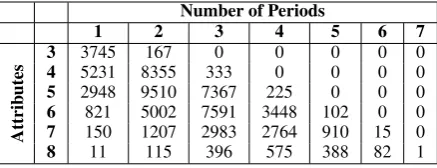
for the outputs are generated from PERSONAGE. Table4shows the number of training instances for each MR size for each period count. The right frontier of the table shows that there are low fre-quencies of training instances where each propo-sition in the MR is realized in its own sentence (Period = Number of MR attrs -1). The lower left hand side of the table shows that as the MRs get longer, there are lower frequencies of utterances with Period=1.
Number of Periods
1 2 3 4 5 6 7
Attrib
utes
3 3745 167 0 0 0 0 0
4 5231 8355 333 0 0 0 0
5 2948 9510 7367 225 0 0 0
6 821 5002 7591 3448 102 0 0
7 150 1207 2983 2764 910 15 0
[image:5.595.73.292.211.295.2]8 11 115 396 575 388 82 1
Table 4: Distribution of Training Data
We start with the default TGen parameters and monitor the losses on Tensorboard on a subset of 3,000 validation instances from the 64,000 train-ing set. The best setttrain-ings use a batch size of 20, with a minimum of 5 epochs and a maximum of 20 (with early-stopping based on validation loss). We generate outputs on the test set of 398 MRs.
Sentence Scoping Results.Table5shows the ac-curacy of both models in terms of the counts of the output utterances that realize the MR attributes in the specified number of sentences. In the case of NOSUP, we compare the number of sentences in the generated output to those in the corresponding test reference, and for PERIODCOUNT, we com-pare the number of sentences in the generated out-put to the number of sentences we explicitly en-code in the MR. The table shows that the NO -SUP setting fails to output the correct number of sentences in most cases (only a 22% accuracy), but the PERIODCOUNTsetting makes only 2 mis-takes (almost perfect accuracy), demonstrating al-most perfect control of the number of output sen-tences with the single-token supervision. We also show correlation levels with the gold-standard ref-erences (all correlations significant atp≤0.01).
Model Slot Period Period Error Accuracy Correlation
NOSUP .06 0.216 0.455
PERIODCOUNT .03 0.995 0.998
Table 5: Sentence Scoping Results
Generalization Test. We carry out an additional experiment to test generalization of the PERIOD -COUNT model, where we randomly select a set of 31 MRs from the test set, then create a set in-stance for each possiblePERIODcount value, from 1 to the N-1, where N is the number of attributes in that MR (i.e. PERIOD=1 means all attributes
are realized in the same sentence, andPERIOD =N-1 means that each attribute is realized in its own sentence, except for the restaurant name which is never realized in its own sentence). This yields 196 MR and reference pairs.
This experiment results in an 84% accuracy (with correlation of 0.802 with the test refs,p ≤
0.01). When analyzing the mistakes, we observe that all of the scoping mistakes the model makes (31 in total) are the case of PERIOD=N-1. These cases correspond to the right frontier of Table 4
where there were fewer training instances. Thus while the period supervision improves the model, it still fails on cases where there were few in-stances in training.
Complexity Experiment. We performed an ad-ditional sentence scoping experiment where we specified a target sentence complexity instead of a target number of sentences, since this may more intuitively correspond to a notion of reading level or sentence complexity, where the assumption is that longer sentences are more complex (Howcroft et al., 2017;Siddharthan et al., 2004). We used the same training and test data, but labeled each reference as either high, medium or low complex-ity. The number of attributes in the MR does not include the name attribute, since that is the subject of the review. A reference was labeled high when there are > 2 attributes per sentence, medium when the number of attributes per sen-tence is > 1.5 and ≤ 2 and low when there are
≤1.5attributes per sentence.
This experiment results in 89% accuracy. Most of the errors occur when the labeled complexity was medium. This is most likely because there is often only one sentence difference between the two complexity labels. This indicates that sen-tence scoping can be used to create references with either exactly the number of sentences requested or categories of sentence complexity.
4 Distributive Aggregation Experiment
Operation Example
PERIOD X serves Y. It is in Z. “WITH”CUE X is in Y, with Z.
[image:6.595.74.292.61.134.2]CONJUNCTION X is Y and it is Z. & X is Y, it is Z. ALLMERGE X is Y, W and Z & X is Y in Z “ALSO”CUE X has Y, also it has Z. DISTRIB X has Y and Z.
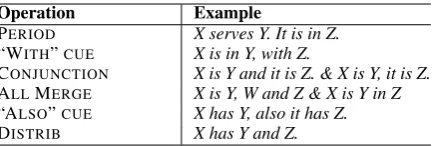
Table 6: Scoping and Aggregation Operations in
PERSONAGE
single sentences or phrases. We focus here on dis-tributive aggregation as defined in Figure2and il-lustrated in Row 6 of Table2. In anSNLGsetting,
the generator achieves this type of aggregation by operating on syntactic trees (Shaw, 1998; Scott and de Souza, 1990; Stent et al., 2004; Walker et al., 2002b). In an NNLG setting, we hope the model will induce the syntactic structure and the mathematical operation underlying it, automati-cally, without explicit training supervision.
To prepare the training data, we limit the val-ues for PRICE and RATING attributes to LOW,
AVERAGE, and HIGH. We reserve the
combina-tion{PRICE=HIGH,RATING=HIGH}for test, leav-ing two combinations of values where distribution is possible ({PRICE=LOW, RATING=LOW} and
{PRICE=AVERAGE, RATING=AVERAGE}). We then use all three values in MRs where the price and rating are not the same {PRICE=LOW, RAT
-ING=HIGH}. This ensures that the model does see the value HIGHin training, but never in a set-ting where distribution is possible. We always dis-tribute when possible, so every MR where the val-ues are the same uses distribution. All other oppor-tunities for aggregation, in the same sentence or in other training sentences, use the other aggregation operations defined in PERSONAGEas specified in Table6, with equal probability.
Model Slot Error
Distrib Accu-racy
Distrib Accuracy (onHIGH)
NOSUP .12 0.29 0.00
BINARY .07 0.99 0.98 SEMANTIC .25 0.36 0.09
Table 7: Distributive Aggregation Results
The aggregation training set contains 63,690 to-tal instances, with 19,107 instances for each of the two combinations that can distribute, and 4,246 in-stances for each of the six combinations that can’t distribute. The test set contains 408 MRs, 288 specify distribution overHIGH (which we note is nota setting seen in train, and explicitly tests the
models’ ability to generalize), 30 specify distri-bution over AVERAGE, 30 over LOW, and 60 are examples that do not require distribution (NONE). We test whether the model will learn the equal-ity relation independent of the value (HIGH vs.
LOW), and thus realize the aggregation withHIGH. The distributive aggregation experiment is based on three different models:
• No Supervision: no additional information in the MR (only attributes and their values)
• Binary Supervision: we add a supervision token,DISTRIBUTE, containing a binary 0 or 1 indicating whether or not the corresponding reference text contains an aggregation opera-tion over attributesprice rangeandrating.
• Semantic Supervision: we add a supervi-sion token, DISTRIBUTE, containing a string that is either none if there is no aggrega-tion overprice range andrating in the cor-responding reference text, or a value ofLOW,
AVERAGE, orHIGHfor aggregation.
As above, we start with the default TGen pa-rameters and monitor the losses on Tensorboard on subset of 3,000 validation instances from the 63,000 training set. The best settings use a batch size of 20, with a minimum of 5 epochs and a max-imum of 20 epochs with early-stopping.
Distributive Aggregation Results.Table7shows the accuracy of each model overall on all 4 values, as well as the accuracy specifically on HIGH, the only distribution value unseen in train. Model NO -SUPhas a low overall accuracy, and is completely unable to generalize toHIGH, which is unseen in training. It is frequently able to use the HIGH
value, but is not able to distribute (generating out-put like high cost and cost). Model BINARY is by far the best performing model, with an almost perfect accuracy (it is able to distribute overLOW
and AVERAGE perfectly), but makes some
mis-takes when trying to distribute overHIGH; specif-ically, while it is always able to distribute, it may use an incorrect value (LOWorAVERAGE). When-ever BINARY correctly distributes over HIGH, it interestingly always selects attribute RATING
be-foreCOST, realizing the output ashigh rating and price. Also, BINARY is consistent even when it incorrectly uses the value LOW instead of HIGH:
[image:6.595.90.267.572.643.2]Source MR Realization
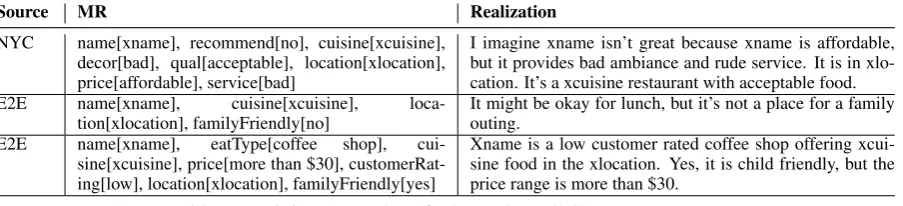
NYC name[xname], recommend[no], cuisine[xcuisine], decor[bad], qual[acceptable], location[xlocation], price[affordable], service[bad]
I imagine xname isn’t great because xname is affordable, but it provides bad ambiance and rude service. It is in xlo-cation. It’s a xcuisine restaurant with acceptable food.
E2E name[xname], cuisine[xcuisine],
loca-tion[xlocation], familyFriendly[no]
It might be okay for lunch, but it’s not a place for a family outing.
E2E name[xname], eatType[coffee shop],
cui-sine[xcuisine], price[more than $30], customerRat-ing[low], location[xlocation], familyFriendly[yes]
[image:7.595.74.526.65.168.2]Xname is a low customer rated coffee shop offering xcui-sine food in the xlocation. Yes, it is child friendly, but the price range is more than $30.
Table 8: Training examples of E2E and NYC Contrast sentences
Training Sets NYC #N E2E #N
3K N/A 3,540 contrast 7K 3,500 contrast 3,540 contrast
11K 3,500 contrast 3,540 contrast + 4K random 21K 3,500 contrast 3,540 contrast + 14K random 21KCONTRAST 3,500 contrast 3,540 contrast + 14K random Table 9: Overview of the training sets for contrast experiments
onHIGH, where most of the mistakes onHIGH in-clude repeating the attribute high rating and rat-ing, including examples where it does not dis-tribute at all, e.g. high rating and high rating. We plan to explore alternative semantic encodings in future work.
5 Discourse Contrast Experiment
Persuasive settings such as recommending restau-rants, hotels or travel options often have a criti-cal discourse structure (Scott and de Souza,1990;
Moore and Paris, 1993;Nakatsu, 2008). For ex-ample a recommendation may consist of an explic-itly evaluative utterance e.g. Chanpen Thai is the best option, along with content related by the jus-tify discourse relation, e.g. It has great food and service, as in Table3.
Our experiments focus on DISCOURSE
-CONTRAST. We developed a script to find
contrastive sentences in the 40K E2E training set by searching for any instance of a contrast cue word, such as but, although, and even if. This identified 3,540 instances. While this data size is comparable to the 3-4K instances used in prior work (Wen et al., 2015; Nayak et al.,
2017), we anticipated that it might not be enough data to properly test whether an NNLG can learn to produce discourse contrast. We were also interested in testing whether synthetic data would improve the ability of the NNLG to produce contrastive utterances while maintaining semantic fidelity. Thus we usedPERSONAGEwith its native database of New York City restaurants (NYC) to generate an additional 3,500 examples of one form
of contrast using only the discourse marker but, which are most similar to the examples in the E2E data. Table 8 illustrates both PERSONAGE and E2E contrast examples. While PERSONAGE also contains JUSTIFICATIONS, which could possibly confuse theNNLG, it offers many more attributes that can be contrasted and thus more unique instances of contrast. We create 4 training datasets with contrast data in order to systematically test the effect of the combined training set. Table 9
provides an overview of the training sets, with their rationales below.
3K Training Set. This dataset consists of all in-stances of contrast in the E2E training data, i.e. 3,540 E2E references.
7K Training Set. We created a training set of 7k references by supplementing the E2E contrastive references with an equal number of PERSONAGE
references.
11K Training Set. Since 7K is smaller than de-sirable for training an NNLG, we created several
additional training sets with the aim of helping the model learn to correctly realize domain semantics while still being able to produce contrastive utter-ances. We thus added an additional 4K crowd-sourced E2E data that was not contrastive to our training data, for a total of 11,065. See Table9.
Contrast Test Sets. To have a potential for con-trast there must be an attribute with a positive value and another attribute with a negative value in the same MR. We constructed 3 different test sets, two for E2E and one for NYC. We created a delexicalized version of the test set used in the E2E generation challenge. This resulted in a test of 82 MRs of which only 25 could support con-trast (E2E TEST). In order to allow for a better test of contrast, we constructed an additional test set of 500 E2E MRs all of which could support contrast (E2E CONTRAST TEST). For the NYC test, which provides many opportunities for con-trast, we created a dataset of 785 MRs that were different than those seen in training (NYC TEST). At test time, in the 21K contrast token experiment, we utilize the contrast token as we did in training.
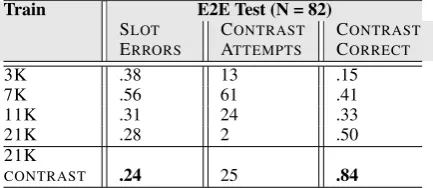
Train E2E Test (N = 82)
SLOT
ERRORS
CONTRAST
ATTEMPTS
CONTRAST
CORRECT
3K .38 13 .15
7K .56 61 .41
11K .31 24 .33
21K .28 2 .50
21K
[image:8.595.72.289.304.398.2]CONTRAST .24 25 .84
Table 10: Slot Error Rates and Contrast for E2E
Train E2E Contrast Test (N=500)
SLOT
ERRORS
CONTRAST
ATTEMPTS
CONTRAST
CORRECT
3K .70 213 .19
7K .45 325 .22
11K .23 227 .70
21K .17 13 .62
21K
CONTRAST .16 422 .75
Table 11: Slot Error Rates and Contrast for E2E, Contrast Only
Train NYC Test (N = 785)
SLOT
ERRORS
CONTRAST
ATTEMPTS
CONTRAST
CORRECT
3K N/A N/A N/A
7K .29 784 .65
11K .26 696 .71
21K .25 659 .82
21K
[image:8.595.71.286.438.538.2]CONTRAST .24 566 .85
Table 12: Slot Error Rates and Contrast for NYC
Contrast Results. We present the results for both slot error rates and contrast for the E2E test set in Table10, E2E Contrast in Table11, and NYC test set in Table12.
Table 10 shows the results for testing on the original E2E test set, where we only have 25 in-stances with the possibility for contrast. Overall, the table shows large performance improvements with theCONTRASTtoken supervision for 21K for both slot errors and correct contrast. On the E2E test set, the the 3K E2E training set gives a slot er-ror rate of .38 and only 15% correct contrast. The 7K training set, supplemented with additional gen-erated contrast examples gets a correct contrast of .41 but a much higher slot error rate. Interesting-lyx, the 11K dataset is much better than the 3K for contrast correct, suggesting a positive effect for the automatically generated contrast examples along with more E2E training data. The 21K set without the contrast token does not attempt con-trast since the frequency of concon-trast data is low, but with theCONTRASTtoken, it attempts contrast every time it is possible (25/25 instances).
In Table11with only contrast data, we see sim-ilar trends, with the lowest slot error rate (.16) and highest correct contrast (.75) ratios for the ex-periment with token supervision on 21K. Again, we see much better performance from the 11K set than the 3K and 7K in terms of slot error and correct contrast, indicating that more training data (even if that data does not contain contrast) helps the model. As before, we see very low contrast at-tempts with 21K without supervision, with a huge increase in the number of contrast attempts when using token supervision (422/500).
Table 12 also shows large performance im-provements from the use of theCONTRASTtoken supervision for the NYC test set, again with im-provements for the 21K CONTRAST in both slot error rate and in correct contrast. Interestingly, while we get the highest correct contrast ratio of .85 with 21K CONTRAST, we actually seefewer contrast attempts, showing that the most explic-itly supervised model is becoming more selective when deciding when to do contrast. When training on the 7K dataset, the neural modelalways pro-duces a contrastive utterance for the NYC MRs (all the NYC data is contrastive). Although it never sees any NYC non-contrastive MRs, the ad-ditional E2E training data allows it to improve its ability to decide when to contrast (Row 21KCON
[image:8.595.70.289.587.684.2]6 Related Work
Much of the previous work focused on sentence planning was done in the framework of statistical
NLG, where each module was assumed to require training data that matched its representational re-quirements. Methods focused on training individ-ual modules for content selection and linearization (Marcu, 1997; Lapata, 2003; Barzilay and Lap-ata,2005), and trainable sentence planning for dis-course structure and aggregation operations (Stent and Molina,2009;Walker et al.,2007;Paiva and Evans,2004;Sauper and Barzilay,2009;H. Cheng and Mellish,2001). Previous work also explored statistical and hybrid methods for surface realiza-tion (Langkilde and Knight,1998;Bangalore and Rambow, 2000; Oh and Rudnicky, 2002). and text-to-speech realizations (Hitzeman et al.,1998;
Bulyko and Ostendorf,2001;Hirschberg,1993). Other work on NNLG also uses token supervi-sion and modifications of the architecture in or-der to control stylistic aspects of the output in the context of text-to-text or paraphrase genera-tion. Some types of stylistic variation correspond to sentence planning operations, e.g. to express a particular personality type (Oraby et al.,2018b;
Mairesse and Walker,2011;Oraby et al.,2018a), or to control sentiment and sentence theme (Ficler and Goldberg,2017). Herzig et al. (2017) auto-matically label the personality of customer care agents and then control the personality during gen-eration. Rao and Tetreault (2018) train a model to paraphrase from formal to informal style and Niu and Bansal (2018) use a high precision classifier and a blended language model to control utterance politness.
Previous work on contrast has explored how the user model determines which values should be contrasted, since people may have differing opin-ions about whether an attribute value is positive or negative (e.g. family friendly) (Carenini and Moore, 1993; Walker et al., 2002a; White et al.,
2010). To our knowledge, no-one has yet trained an NNLG to use a model of user preferences for
content selection. Here, values are treated as in-herently good or bad, e.g. service is ranked from great to terrible.
7 Discussion and Conclusion
This paper presents detailed, systematic experi-ments to test the ability of NNLG models to pro-duce complex sentence planning operations for
re-sponse generation. We create new training and test sets designed specifically for testing sentence planning operations for sentence scoping, aggre-gation and discourse contrast, and train novel models with increasing levels of supervision to ex-amine how much information is required to con-trol neural sentence planning. The results show that the models benefit from extra latent variable supervision, which improves the semantic accu-racyof theNNLG, provides the capability to con-trolvariation in the output, and enables general-izingto unseen value combinations.
In future work we plan to test these methods in different domains, e.g. the WebNLG challenge or WikiBio dataset (Wiseman et al., 2018;Colin et al., 2016). We also plan to experiment with more complex sentence planning operations and test whether anNNLGsystem can be endowed with fine-tuned control, e.g. controlling multiple ag-gregation operations. Another possibility is that hierarchical input representations representing the sentence plan might improve performance or al-low finer-grained control (Moore et al.,2004;Su and Chen, 2018;Bangalore and Rambow,2000). It may be desirable to control which attributes are aggregated together, distributed or contrasted, and to allow more than two values to be contrasted.
Here, our main goal was to test the ability of dif-ferent neural architectures to learn particular sen-tence planning operations that have been used in previous work inSNLG. Because we don’t make
claims about fluency or naturalness, we did not evaluate these with human judgements. Instead, we focused our evaluation on automatic assess-ment of semantic fidelity, and the extent to which the neural architecture could reproduce the desired sentence planning operations. In future work, we hope to quantify the extent to which human sub-jects prefer the outputs where the sentence plan-ning operations have been applied.
8 Acknowledgments
References
Mart´ın Abadi and others. 2015. TensorFlow: Large-scale machine learning on heterogeneous systems. Software available from tensorflow.org.
Dzmitry Bahdanau, Kyunghyun Cho, and Yoshua Bengio. 2014. Neural machine translation by jointly learning to align and translate. CoRR, abs/1409.0473.
S. Bangalore and O. Rambow. 2000. Exploiting a prob-abilistic hierarchical model for generation. InProc. of the 18th Conference on Computational Linguis-tics, pages 42–48.
Regina Barzilay and Mirella Lapata. 2005. Collective content selection for concept-to-text generation. In
Proceedings of the conference on Human Language Technology and Empirical Methods in Natural Lan-guage Processing, pages 331–338. Association for Computational Linguistics.
Regina Barzilay and Mirella Lapata. 2006. Aggrega-tion via set partiAggrega-tioning for natural language genera-tion. InProceedings of the main conference on Hu-man Language Technology Conference of the North American Chapter of the Association of Computa-tional Linguistics, pages 359–366. Association for Computational Linguistics.
Anja Belz and Ehud Reiter. 2006. Comparing au-tomatic and human evaluation of nlg systems. In
EACL.
I. Bulyko and M. Ostendorf. 2001. Joint Prosody Pre-diction and Unit Selection for Concatenative Speech Synthesis. InICASSP, volume II, pages 781–784.
Lynne Cahill, John Carroll, Roger Evans, Daniel Paiva, Richard Power, Donia Scott, and Kees van Deemter. 2001. From rags to riches: exploiting the potential of a flexible generation architecture. InMeeting of the Association for Computational Linguistics.
Giuseppe Carenini and Johanna Moore. 1993. Gener-ating explanation in context. InProc. of the Interna-tional Workshop on Intelligent User Interfaces.
Emilie Colin, Claire Gardent, Yassine Mrabet, Shashi Narayan, and Laura Perez-Beltrachini. 2016. The webnlg challenge: Generating text from dbpedia data. In Proceedings of the 9th International Nat-ural Language Generation conference, pages 163– 167.
Ondrej Dusek and Filip Jurc´ıcek. 2016a. A context-aware natural language generator for dialogue sys-tems. volume abs/1608.07076.
Ondrej Dusek and Filip Jurc´ıcek. 2016b. Sequence-to-sequence generation for spoken dialogue via deep syntax trees and strings. volume abs/1606.05491.
Jessica Ficler and Yoav Goldberg. 2017. Controlling linguistic style aspects in neural language genera-tion. In Proceedings of the EMNLP Workshop on Stylistic Variation, pages 94–104.
Milica Gaˇsi´c, Dilek Hakkani-T¨ur, and Asli Celikyil-maz. 2017. Spoken language understanding and in-teraction: machine learning for human-like conver-sational systems. Computer Speech and Language 46, pages 249 – 251.
Renate Henschel H. Cheng, Massimo Poesio and Chris Mellish. 2001. Corpus-based np modifier genera-tion. InProc. of the NAACL.
Jonathan Herzig, Michal Shmueli-Scheuer, Tommy Sandbank, and David Konopnicki. 2017. Neural re-sponse generation for customer service based on per-sonality traits. InProceedings of the 10th Interna-tional Conference on Natural Language Generation, pages 252–256.
Julia B. Hirschberg. 1993. Pitch accent in context: pre-dicting intonational prominence from text. Artificial Intelligence Journal, 63:305–340.
Janet Hitzeman, Alan W. Black, Paul Taylor, Chris Mellish, and Jon Oberlander. 1998. On the use of automatically generated discourse-level information in a concept-to-speech synthesis system. InProc. of the International Conference on Spoken Language Processing, ICSLP98, pages 2763–2766.
Sepp Hochreiter and J¨urgen Schmidhuber. 1997. Long short-term memory. Neural computation, 9(8):1735–1780.
David M. Howcroft, Dietrich Klakow, and Vera Dem-berg. 2017. The extended sparky restaurant corpus: Designing a corpus with variable information den-sity. InProc. Interspeech 2017, pages 3757–3761.
Pamela W. Jordan. 2000. Influences on attribute selec-tion in redescripselec-tions: A corpus study. In Proc. of CogSci2000.
Emiel Krahmer, Andr´e Verleg, and Sebastiaan van Erk. 2002. Graph-based generation of referring expres-sions. Computational Linguistics, page to appear.
Gerasimos Lampouras and Andreas Vlachos. 2016. Imitation learning for language generation from un-aligned data. InCOLING, pages 1101–1112. ACL.
I. Langkilde and K. Knight. 1998. Generation that ex-ploits corpus-based statistical knowledge. InProc. of COLING-ACL.
M. Lapata. 2003. Probabilistic text structuring: Exper-iments with sentence ordering. InProc. of the ACL.
Francois Mairesse and Marilyn A. Walker. 2011. Con-trolling user perceptions of linguistic style: Train-able generation of personality traits. Computational Linguistics.
Daniel Marcu. 1997. From local to global coherence: A bottom-up approach to text planning. InProc. of the 14th National Conference on Artificial Intelli-gence and 9th Innovative Applications of Artificial Intelligence Conference (AAAI-97/IAAI-97), pages 629–636, Menlo Park. AAAI Press.
Hongyuan Mei, Mohit Bansal, and Matthew R. Walter. 2016. What to talk about and how? selective gener-ation using lstms with coarse-to-fine alignment. In
Proceedings of NAACL-HLT, pages 720–730.
J. D. Moore and C. L. Paris. 1993. Planning text for ad-visory dialogues: Capturing intentional and rhetori-cal information. Computational Linguistics, 19(4).
Johanna Moore, Mary Ellen Foster, Oliver Lemon, and Michael White. 2004. Generating tailored, com-parative descriptions in spoken dialogue. InProc. FLAIRS-04.
Crystal Nakatsu. 2008. Learning contrastive connec-tives in sentence realization ranking. InProceedings of the 9th SIGdial Workshop on Discourse and Di-alogue, pages 76–79, Columbus, Ohio. Association for Computational Linguistics.
Neha Nayak, Dilek Hakkani-Tur, Marilyn Walker, and Larry Heck. 2017. To plan or not to plan? dis-course planning in slot-value informed sequence to sequence models for language generation. InProc. of Interspeech 2017.
Tong Niu and Mohit Bansal. 2018. Polite dialogue gen-eration without parallel data. Transactions of the As-sociation for Computational Linguistics, 6:273–289.
Jekaterina Novikova, Ondej Duek, Amanda Cercas Curry, and Verena Rieser. 2017. Why we need new evaluation metrics for nlg. In Proceedings of the 2017 Conference on Empirical Methods in Natural Language Processing, pages 2241–2252.
Alice H. Oh and Alexander I. Rudnicky. 2002. Stochastic natural language generation for spoken dialog systems. Computer Speech and Language: Special Issue on Spoken Language Generation, 16(3-4):387–407.
Shereen Oraby, Lena Reed, TS Sharath, Shubhangi Tandon, and Marilyn Walker. 2018a. Neural mul-tivoice models for expressing novel personalities in dialog. Proc. Interspeech 2018, pages 3057–3061.
Shereen Oraby, Lena Reed, Shubhangi Tandon, TS Sharath, Stephanie Lukin, and Marilyn Walker. 2018b. Controlling personality-based stylistic vari-ation with neural natural language generators. In
SIGDIAL.
Daniel S. Paiva and Roger Evans. 2004. A frame-work for stylistically controlled generation. In Nat-ural Language Generation, Third Internatonal Con-ference, INLG 2004, number 3123 in LNAI, pages 120–129. Springer.
O. Rambow, M. Rogati, and M. Walker. 2001. Evalu-ating a trainable sentence planner for a spoken di-alogue travel system. In Proc. of the Meeting of the Association for Computational Lingustics, ACL 2001.
Sudha Rao and Joel Tetreault. 2018. Dear sir or madam, may i introduce the gyafc dataset: Corpus, benchmarks and metrics for formality style transfer. InNorth American Associatio of Computational Lin-guistics Conference, NAACL-18.
Ehud Reiter and Robert Dale. 2000. Building Natural Language Generation Systems. Cambridge Univer-sity Press.
Christina Sauper and Regina Barzilay. 2009. Auto-matically generating wikipedia articles: A structure-aware approach. InProceedings of the Joint Confer-ence of the 47th Annual Meeting of the ACL and the 4th International Joint Conference on Natural Lan-guage Processing of the AFNLP: Volume 1-Volume 1, pages 208–216. Association for Computational Linguistics.
Donia R. Scott and Clarisse Sieckenius de Souza. 1990. Getting the message across in RST-based text gen-eration. In Robert Dale, Chris Mellish, and Michael Zock, editors, Current Research in Natural Lan-guage Generation. Academic Press, London.
James Shaw. 1998. Clause aggregation using linguistic knowledge. InProc. of the 8th International Work-shop on Natural Language Generation, Niagara-on-the-Lake, Ontario.
A. Siddharthan, A. Nenkova, and K. McKeown. 2004. Syntactic simplification for improving content selec-tion in multi-document summarizaselec-tion. In Proceed-ings of the 20th International Conference on Com-putational Linguistics (COLING 2004).
Amanda Stent. 2002. A conversation acts model for generating spoken dialogue contributions. Com-puter Speech and Language: Special Issue on Spo-ken Language Generation.
Amanda Stent and Martin Molina. 2009. Evaluating automatic extraction of rules for sentence plan con-struction. In Proc. of the SIGDIAL 2009 Confer-ence: The 10th Annual Meeting of the Special Inter-est Group on Discourse and Dialogue, pages 290– 297.
Amanda Stent, Marilyn Walker, Steve Whittaker, and Preetam Maloor. 2002. User-tailored generation for spoken dialogue: An experiment. InICSLP.
Shang-Yu Su and Yun-Nung Chen. 2018. Investigat-ing lInvestigat-inguistic pattern orderInvestigat-ing in hierarchical natural language generation. In7th IEEE Workshop on Spo-ken Language Technology (SLT 2018).
Ilya Sutskever, Oriol Vinyals, and Quoc V Le. 2014. Sequence to sequence learning with neural net-works. InAdvances in neural information process-ing systems, pages 3104–3112.
M. A. Walker, S. J. Whittaker, A. Stent, P. Maloor, J. D. Moore, M. Johnston, and G. Vasireddy. 2002a. Speech-Plans: Generating evaluative responses in spoken dialogue. InIn Proc. of INLG-02.
Marilyn Walker, Owen Rambow, and Monica Rogati. 2002b. Training a sentence planner for spoken di-alogue using boosting. Computer Speech and Lan-guage: Special Issue on Spoken Language Genera-tion, 16(3-4):409–433.
Marilyn A. Walker, Amanda Stent, Franc¸ois Mairesse, and Rashmi Prasad. 2007. Individual and do-main adaptation in sentence planning for dialogue.
Journal of Artificial Intelligence Research (JAIR), 30:413–456.
Tsung-Hsien Wen, Milica Gasic, Nikola Mrksic, Pei-Hao Su, David Vandyke, and Steve Young. 2015. Semantically conditioned lstm-based natural lan-guage generation for spoken dialogue systems. In
Proceedings of the 2015 Conference on Empirical Methods in Natural Language Processing.
Michael White, Robert A. J. Clark, and Johanna D. Moore. 2010. Generating tailored, comparative de-scriptions with contextually appropriate intonation.
Computational Linguistics, 36(2):159–201.