ON STOCHASTIC TREE DISTANCES AND THEIR TRAINING VIA
EXPECTATION-MAXIMISATION
Martin Emms
School of Computer Science and Statistics, Trinity College, Dublin, Ireland [email protected]
Keywords: Tree-distance, Expecation-Maximisation.
Abstract: Continuing a line of work initiated in (Boyer et al., 2007), the generalisation of stochastic string distance to a stochastic tree distance is considered. We point out some hitherto overlooked necessary modifications to the Zhang/Shasha tree-distance algorithm for all-paths and viterbi variants of this stochastic tree distance. A strategy towards an EM cost-adaptation algorithm for the all-paths distance which was suggested by (Boyer et al., 2007) is shown to overlook necessary ancestry preservation constraints, and an alternative EM cost-adaptation algorithm for the Viterbi variant is proposed. Experiments are reported on in which a distance-weighted kNN categorisation algorithm is applied to a corpus of categorised tree structures. We show that a 67.7% base-line using standard unit-costs can be improved to 72.5% by the EM cost adaptation algorithm.
1
INTRODUCTION
The classification of tree structures into cate-gories is necessary in many settings. In natu-ral language processing an example is furnished by Question-Answering systems, which frequently have a Question-Categorisation sub-component, whose purpose is to assign the question to one of a number of predefined semantic categories (section 5 gives some details). Often one would like to obtain such a clas-sifier by a data-driven machine-learning approach, rather than by hand-crafting one. The distance-based approach to such a classifier is to have a pre-categorised example set and to compute a category for a test item based on its distances to examples in the example set, such as via k-NN.
With items to be categorised represented as trees, a crucial component in such a classifer is the mea-sure used to compare trees. The tree-distance first proposed by (Tai, 1979) is a well motivated candidate measure (see later for further details). This measure can be seen as composing a relation between trees out of several kinds of atomic operations (match, swap, delete, insert) the costs of which are dependent on the labels of the nodes involved. The performance of such a distance-based classifier is therefore very dependent on the settings of these atomic costs.
In the work presented below probabilistic variants of the standard tree-distance are considered and then Expectation-Maximisation techniques are considered
as potential means to adapt atomic costs given a cor-pus of training tree pairs.
2
NON-STOCHASTIC SEQUENCE
AND TREE DISTANCES
Let us begin by formulating some definition relation to the familiar notion of string-distance. The formu-lations follow closely those of (Ristad and Yianilos, 1998) and are chosen to allow an easy transition to the stochastic case.
LetΣbe an alphabet. Let the set of edit operation identifiers, EdOp, be defined by
EdOp= ((Σ∪ {λ})×(Σ∪ {λ}))\hλ,λi
and let an edit-script be a sequence e1. . .en#, n≥0, with each ei∈EdOp and with # as a special end-of-script marker. Given an edit-end-of-script
A
, it can be pro-jected into a ’source’ string src(A
)∈Σ∗, by contenat-ing the left elements of the contained operations, and likewise into a ’target’ string trg(A
)∈Σ∗:src(#) =ε trg(#) =ε
src(hλ,yi
A
) =src(A
) trg(hx,λiA
) =trg(A
)src(hx,yi
A
) =x src(A
) trg(hx,yiA
) =y trg(A
)The yield of edit-script
A
can be defined as pair of stringshsrc(A
),trg(A
)i. If(s,t) =yield(A
), each ei∈A
is interpretable as an edit operation in a process of transforming s to t: deletion(a,λ), insertion(λ,b), or match/substitution(a,b). Let E(s,t)be all scripts which yield(s,t). The multiple scripts in E(s,t) de-scribe alternative ways to transform s into t.If costs are defined for such edit-scripts, a string-distance between s and t can be defined as the cost of the least-cost script in E(s,t).
Alternatively one can consider the partial, 1-to-1, order-respecting mappings from s to t. Costs can be defined for such mappings and a distance mea-sure defined via minimising these costs. Script-based and mapping-based definitions are equivalent (Wag-ner and Fischer, 1974): fundamentally an edit-script is viewable as a particular serialisation of a mapping. For ordered, labelled trees, the analogue to stan-dard string distance was first considered by (Tai, 1979). We develop the definitions relevant to this below, starting first with a mapping-based definition. The equivalent script-based definition follows this.
A Tai mapping is a partial, 1-to-1 mappingσfrom the nodes of source tree S to a target tree T which re-spects left-to-right order and ancestry1. For the pur-pose of assigning a score to such a mapping it is con-venient to identify three sets:
1So if(i
1,j1)and(i2,j2)are in the mapping, then (T1)
le f t(i1,i2)iff le f t(j1,j2)and (T2) anc(i1,i2)iff anc(j1,j2)
M
the(i,j)∈σ: the ’matches’ and ’swaps’D
the i∈S s.t.∀j∈T,(i,j)6∈σ: the ’deletions’I
the j∈T s.t.∀i∈S,(i,j)6∈σ: the ’insertions’WhereΣis the label alphabets of source and target trees, letγ(i)be the label of node i. Let
C
be a cost table of dimensions|Σ|+1× |Σ|+1. The cost of a mapping is the sum over the atomic costs defined by2for(i,j)∈
M
cost isC
[γ(i)][γ(j)] for i∈D
cost isC
[γ(i)][0] for j∈I
cost isC
[0][γ(j)]The so-called unit-cost matrix,
C
01has 0 on the diag-onal and 1 everywhere else. For a given cost matrixC
, the Tai- or tree-distance∆(S,T)is defined as the cost of the least-costly Tai mappingσbetween S and T .There is an alternative, more procedural definition route, via tree-edit operations analogous to string-edit operations. The table below depicts the three edit op-erations:
operation script element
x
(m~l(xd)~ ~r)
→(m~ld~~r)
(x,λ)
y
(m~ld~~r)
→(m~l(yd)~ ~r)
(λ,y)
x y
(m~l(xd)~ ~r)
→(m~l(yd)~ ~r)
(x,y)
Thus deletion involves making the daughters of some node x into the daughters of that node’s parent m, insertion involves taking some of the daughers of a node m and making them instead the daughters of a new daughter y of m, and swapping/matching involves simply replacing some node x with a node y at the same position.
The right-hand column shows the script element which is used to record the use of particular edit op-eration. Using the same table of cost
C
as was used for costing a mapping, a cost can be assigned to the script describing the operations to transform a tree S into a tree T , and a script-based definition of distance then given via minimising this cost.The mapping- and script-based definitions are equivalent (Tai, 1979; Kuboyama, 2007), with a script serving as a serialised representation of a mapping. (Zhang and Shasha, 1989) provided an efficient algo-rithm for its calculation.
2See also (Emms and Franco-Penya, 2011) in these
To illustrate, below is shown first a mapping be-tween two trees, and second the sequence of edit-operations corresponding to it, with some of the inter-mediate stages as these operations are applied; with unit-costs the distance is 33:
a a b
a b
b
c
a b
b a b
a a b
a b
b
c
a b
b a b
a b
b a b a (b,b)(a,a)(b,b)(.,a) (b,b)(a,.)
(a,c) a a
a b
b b
a
It is easy to see that for strings encoded as linear, vertical trees, the string-distance and tree-distance co-incide. We will use tree-distance and Tai-distance in-terchangeably, though the literature contains several other, non-equivalent notions bearing the name tree-distance. Based, as it is, simply on the notion of map-pings respecting the two defining dimensions of trees, the Tai distance seems a particularly compelling no-tion.
3
STOCHASTIC SEQUENCE AND
TREE DISTANCES
(Ristad and Yianilos, 1998) introduced a probabilis-tic perspective on string distance, defining a model which assigns a probability to every possible edit-script. Edit-script compoments ei∈EdOp∪ {#}are pictured as generated in succession, independently of each other. There is an emission probability p on edit-script components, such that ∑e∈EdOp∪{#}p(e) =1, and a script’s probability is defined by
P(e1. . .en) =
∏
ip(ei)
For a given string pair(s,t), as before E(s,t) de-notes all the edit-scripts which have (s,t) as their
3It is worth noting that for the equivalence between
mapping-based costs and script-based costs, the scripts which correspond to mappings mention each source and tar-get symbol exactly once. Thus the ’short’ script segments shown in the picture are not representative of the scripts which correspond to a mapping
yield. They then define the all-paths stochastic edit distance,Πa(s,t), as the sum of the probabilities of all scripts e∈E(s,t), whilst the viterbi versionΠv(s,t)is the probability of the most probable one.
It is natural to consider to what extent the proba-bilistic perspective adopted for string-distance by Ris-tad and Yianilos can be applied to tree-distance. The simplest possibility is to use exactly the same model of edit-script probability, which leads to the notions: Definition 1 (All-scripts stochastic Tai similari-ty/distance). The all-scripts stochastic Tai similarity, ΘA
s(S,T), is the sum of the probabilities of all
edit-scripts which represent a Tai-mapping from S to T . The all-scripts stochastic Tai distance,∆As(S,T), is its negated logarithm, ie.
2−∆As(S,T)=ΘA s(S,T)
Definition 2 (Viterbi-script stochastic Tai similari-ty/distance). The Viterbi-script stochastic Tai similar-ity, ΘVs(S,T), is the probability of the most proba-ble edit-script which represents a Tai-mapping from S to T . The Viterbi-script stochastic Tai distance, ∆V
s(S,T), is its negated logarithm, ie.
2−∆Vs(S,T)=ΘV s(S,T)
ForΘAs and ΘVs the probabilities on each possi-ble component of an edit script, EdOp∪ {#}, must be defined. In a similar fashion to the non-stochastic case, let this be defined by a table CΘof dimensions |Σ|+1× |Σ|+1 such that:
forhx,yi ∈Σ×Σ p(hx,yi) =CΘ(x,y) for x∈Σ p(hx,λi) =CΘ(γ(i),0) for y∈Σ p(hλ,yi) =CΘ(0,γ(j))
p(#) =CΘ(0,0)
For convenience CΘ(0,0)is interpreted as p(#). The sum over all the entries in this table should be 1. It is clear that an equivalent cost-table C∆ can be de-fined, containing the negated logs of the CΘ entries, and that∆Vs(S,T)can be equivalently defined by an additive scoring of the scripts using the entries in C∆. Therefore∆Vs(S,T) coincides with the standard no-tion of tree-distance4if the cost-table is restricted to be the image of a possible probability-table under the negated logarithm mapping. We will call such tables stochastically valid cost tables. Again it is easy to see that with sequences encoded as vertical trees, these notions coincide with those defined on sequences by Ristad and Yianilos.
4∆V
s(S,T)will include a contribution from the negated
For the Viterb-script distance∆Vs(S,T), the well known Zhang/Shasha algorithm is an implementa-tion. The Viterbi-script similarityΘV
s can also be ob-tained by a variant replacing+with×. Implementing the All-script distance∆As(S,T) (or equivalent simi-larityΘAs(S,T)) turns out though to require one sub-tle change to the original Zhang/Shasha formulation. This is explained at further length below.
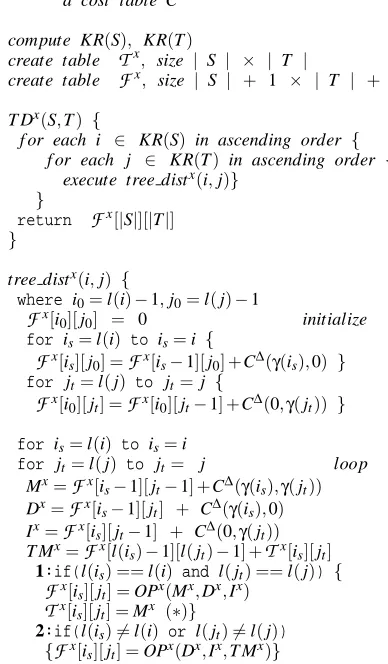
Figure 1 gives an algorithm for∆A
s and∆Vs. To dis-cuss it first some definitions from (Zhang and Shasha, 1989) are required. The algorithm operates on the left-to-right post-order traversals of trees. If k is the index of a node of the tree, the left-most leaf, l(k), is the index of the leaf reached by following the left-branch down. For a given leaf there is a highest node of which it is the left-most leaf and any such node is called a key-root. For any tree S, KR(S) is the key-roots ordered by position in the post-order traversal. If i is the index of a node of S, S[i]is the sub-tree of S rooted at i (i.e. all nodes n such that l(i)≤n≤i). Where i is any node of a tree S, for any iswith l(i)≤is≤i, the prefix of S[i]from l(i)to
iscan be seen as a forest of subtrees of S[i], denoted
For(l(i),is).
The description instantiates to two algorithms, with x=V for Viterbi, and x=A for All-Scripts. In both cases, it is a doubly nested loop ascending through the key-roots of S and T , in which for each pair of key-roots(i,j), a sub-routine tree distx(i,j)is called. Values in a tree-table
T
are set during calls to tree distx(i,j)and persist. Each call to tree distx(i,j) operates on a sub-region5of the forest-tableF
, from l(i)−1,l(j)−1 to i,j. The loop is designed so thatF
[is][jt] is the forest-distance from For(l(i),is) toFor(l(j),jt).
F
-entries do not persist between sep-arate calls to tree distx(i,j).In the Viterbi case, T DV, there is no inversion from neg-logs to probabilities, and the algorithm can be applied when C∆ is an arbitrary table of atomic costs.
It is the design of case 2 that enforces that only Tai mappings are considered: when a forest distance
F
V[is][jt]is to be computed, the possibility that is is mapped to jt is factored into a forest+tree combina-tion T MV =
F
V[l(is)−1][l(jt)−1] +
T
V[is][jt], so that descendants of is can only possibly match with descendants of jtand vice-versa.Setting x to V for Viterbi, the algorithm is almost identical to that in (Zhang and Shasha, 1989), except
5The initialisation sets the left-most column of this to
represent the pure deletion cases For(l(i),is)to/0, and the
uppermost row to represent the pure insertion cases /0 to For(l(j),jt)
input:traversals S and T o f two trees a cost table C∆
compute KR(S), KR(T)
create table Tx, size | S | × | T |
create table Fx, size | S | + 1 × | T | + 1
T Dx(S,T) {
f or each i ∈ KR(S) in ascending order { f or each j ∈ KR(T) in ascending order {
execute tree distx(i,j)} }
return Fx[|
S|][|T|] }
tree distx(i,j) {
where i0=l(i)−1,j0=l(j)−1
Fx[i
0][j0] = 0 initialize for is=l(i) to is=i {
Fx[i
s][j0] =Fx[is−1][j0] +C∆(γ(is),0) } for jt=l(j) to jt= j {
Fx[i
0][jt] =Fx[i0][jt−1] +C∆(0,γ(jt)) }
for is=l(i) to is=i
for jt=l(j) to jt= j loop
Mx=Fx[i
s−1][jt−1] +C∆(γ(is),γ(jt))
Dx=Fx[i
s−1][jt] + C∆(γ(is),0)
Ix=Fx[i
s][jt−1] + C∆(0,γ(jt))
T Mx=Fx[l(i
s)−1][l(jt)−1] +Tx[is][jt] 1:if(l(is) ==l(i) and l(jt) ==l(j)) {
Fx[i
s][jt] =OPx(Mx,Dx,Ix)
Tx[i
s][jt] =Mx (∗)}
2:if(l(is)6=l(i) or l(jt)6=l(j))
{Fx[i
[image:4.595.305.499.108.440.2]s][jt] =OPx(Dx,Ix,T Mx)}
Figure 1: Viterbi and All-paths tree-distance algorithms. Set x to V throughout for Viterbi, with OPV = min, and x to A for All-paths, with OPA = logsum, where logsum(x1. . .xn) =−log(∑i(2−xi)).
for the asterixed line, which in the original would be:
T
V[is][jt] =
F
V[is][jt](∗∗)Whereas the original (**) formula for updating the tree table in case 1 updates it to store the true tree-distance between S[is]and T[jt], the (*) variant stores just MV, the cost of the least-cost script for an align-ment of For(l(is),is)to For(l(jt),jt)in which nodes
is and jt are mapped to each other. For the Viterbi cost, (*) and (**) could be interchanged and so have
T
V[is][jt]store a cost in which isand jt might not be mapped to each other: in such a case when the values in
T
V are called on in case 2, the T MV component will just be equal to one or other of the IVor DV com-ponents over which the minimum is calculated.relevant trees or forests. Looking again at the aster-ixed line, through not setting
T
A[is][jt] =
F
A[is][jt],T
A[is][jt]is not the log of the sum of the probabilities of all the scripts which can align S[is]and T[jt]but in-stead the sum over all the cases in which isis mapped
to jt. For the subsequent use of
T
Ain case 2, this is now a necessary feature: ifT
A[is][jt]does not have this interpretation then when these values are called upon in case 2, probabilities of scripts ending in either deletion of isor insertion of jtare doubly counted.
Example Let t1=t2= (b (b) (a b)), and suppose the cost-table to the right below, which represents as negated logs the assumptions that all probabilites are 0 except for p(a,λ) =1/8=p(λ,a), p(b,b) =1/4, and p(#) =1/2. The left is the only Tai-mapping which is associated with a non-zero probability edit-script in this setting
b b
b b
a
b
a
b
λ a b
λ 1 3 in f
a 3 in f in f b in f in f 2
By inspection, ΘAs(t1,t2) = (1/2)6(1/64), ΘV
s(t1,t2) = (1/2)6(1/128), and these are the values, or rather their negated logs, which will be calculated6 by the algorithm in Figure 1. However, if
T
A[a3][a3] were to include the probabilities for scripts involving the deletions or insertions of a, ΘA
s(t1,t2) would be incorrectly calculated to be (1/2)6(3/64).
As a final remark concerning the algorithm for the Viterbi case, it is straightforward to extend the algo-rithm so that it returns not just the cost of the best script but also the best script itself. Hence we shall write(v,V) =T DV(S,T).
4
EM FOR COST ADAPTATION
As noted in section 1, a possible use of a distance measure is for deployment in a k-NN classifier, deter-mining a category for a test item based on its distances to examples in a pre-categorised example set. This is the case in the experiments reported on in section 5. In those experiments the categorised items are the syntax-structures of natural language questions, and the categories are broad semantic categories, such as
6The reason for the premultiplying(1/2)6factor in these
numbers is that it is easier in this case to calculate first ig-noring p(#)and from a table in which all entries are twice as large, and then to correct for the over-estimation; the only scripts making any contribution all have length 5
HUM(’the question expects a human being to be iden-tified as the answer’) orLOC(’the question expects a location to be identified as the answer’).
For the tree-distance measures, the performance of the classifier is going to vary with the atomic pa-rameter settings in the cost-table C∆. One might ex-pect that scripts between pairs of trees (or strings) that belong to the same category differ from scripts between pairs of trees (or strings) that belong to dif-ferent categories. For example, for the question-categorisation scenario, on same-category pairs one might expect that the substitution (who/when) to be less frequent that the substitution state/country. In terms of the parameters of the stochastic dis-tances this would correspond to P(who,when)<<
P(state,country), or equivalently in terms of negated logs, C∆(who,when)>>C∆(state,country). This leads to the idea that one might be able to use Expectation-Maximisation techniques (Dempster et al., 1977) to adapt edit-probs from a corpus of same-category nearest neighbours.
adaptation EM
of costs nearest
same−category
neighbours
Such a technique, for the case of stochastic string distance, was first proposed by (Ristad and Yianilos, 1998).
4.1
All-scripts EM
As a first step towards a cost-adaptation algorithm, consider the following brute-force all-scripts EM al-gorithm, EMb fA, consisting in interations of the fol-lowing pair of steps
(Exp)A generate a virtual corpus of scripts by
treat-ing each traintreat-ing pair(S,T)as standing for all the edit-scriptsσ, which can relate S to T , weighting each by its conditional probability P(σ/ΘA
s(S,T),
under current probalities CΘ
(Max) apply maximum likelihood estimation to the virtual corpus to derive a new probability table.
A virtual count or expectationγS,T(op)contributed by
S,T for an operaton op can be defined by
γS,T(op) =
∑
σ:S7→T
[ P(σ) ΘA
s(S,T)
×f req(op∈σ)]
operation(a,λ)occuring in various scripts between a particular tree pair
a
a b
b b
a
c
b b b a a
σi) P(
A
=Σ σ1
σi
σn
= occ. of (a,.)
(a,.)
b b b a
a a
a b b b
a
Θ
For the case of linear trees, this amounts to the same adaptation proposal as that put forward by (Ristad and Yianilos, 1998). This brute-force algorithm is exponentially expensive. To obtain a feasible equiv-alent algorithm one may attempt to apply the same strategy as that used by (Ristad and Yianilos, 1998) for the case of linear trees, which is for each tree pair (S,T), to first compute position-dependent ex-pectationsγ(S,T)[i][j](op)for each operation and then sum these position-independent expectations to give the expecations per-pairγ(S,T)(op). In this approach,
γ(S,T)[i][j](m,m′), the expectation for a swap (m,m′)
at(i,j)has the semantics γ(S,T)[i,j](m,m′) =∑σ∈E(S,T),(mi,m′
j)∈σ[ p(σ)
ΘA s(S,T)
]
= 1
ΘA s(S,T)
×∑σ∈E(S,T),(mi,m′
j)∈σ[p(σ)]
or in words, it is the sum over the conditional prob-abilities of any scriptσcontaining a mi,m′j
substitu-tion, given that it is a script between S and T . For the case of linear trees, the position-dependent expectationsγ(S,T)[i][j] can be computed
feasibly because firstly, the summation in the above can be factorised into a product of 3 terms
∑σ∈E(S,T),(mi,m′j)∈σ[p(σ)]
=∑σpre∈E(S1:1−1,T1: j−1)[p(σpre)]×
p(m,m′)×
∑σsu f f∈E(Si+1:I,Tj+1:J)[p(σsu f f)]
(1)
and secondly the summations over the possible scripts prefixing(mi,m′j), and the possible scripts suffixing
(mi,m′j)can be straightforwardly calculated; the first is the all-scripts algorithm, and the second an easily formulated ’backwards’ variant.
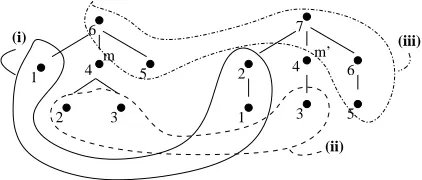
For the case of general trees (as opposed to linear trees) (Boyer et al., 2007) propose such a factorisa-tion approach. Their proposal turns out, however, to be unsound, factorizing the problem in a way which is invalid given the ancestry-preservation aspect of Tai mappings7. To explain this, consider Figure 2, which reproduces the essentials of an example from their pa-per8.
7A fact which they concede p.c. 8Fig. 3 p61
1 7
2 6
3 5
6
1 4 5
2 3
4
m m’
(i)
(ii)
[image:6.595.309.520.95.185.2](iii)
Figure 2: The swap-case in expectation calculation
For the pair of trees, we wish to calculate the position-dependent expectationγ[4,4](m,m′). (Boyer et al., 2007) propose an algorithm implying the correctness of the factorisation
∑σ∈E(S,T),(m4,m′4)∈σ[p(σ)]
=∑σ1∈E([(·1)],(·2(·1)))[p(σ1)]× [(i)]
∑σ2∈E([(·2)(·3)],[(·3)])[p(σ2)]×p(m,m
′) [(ii)] ∑σ3∈E([(·6(·5))],[(·7(·6(·5)))])[p(σ3)] [(iii)]
(2)
where the terms (i)–(iii) corresponds to the indicated regions in Figure 2. The problem is with final term (iii) in the product. Each edit-scriptσ∈E(S,T) rep-resents a Tai mapping between S and T . The summa-tion ∑σ∈E(S,T),(m4,m′
4)∈σ[p(σ)] refers to those scripts
which represent a Tai mapping with the property that m4 is mapped to m′4. This means that if an ances-tor of m4 is in the mapping (ie. not deleted) then its image under the mapping must be an ancestor of m′4, and vice-versa. The final term in the product, ∑σ3∈E([·6(·5)],[·7(·6(·5))])[p(σ3)], sums over any script
between these two sub-trees of S and T and this will include scripts in which node·6of S is mapped to·6 of T , and this corresponds to a mapping in which an ancestor of m4is mapped to a non-ancestor of m′4:
1
7
2 6
3 5
6
1 4 5
2 3
4
m m’
For example if the only non-zero probability script from(·6(·5))to(·7(·6(·5)))is one mapping the·6of S to the·6 of T then γ[4,4](m,m′) should be zero, though according to (2) it will not be.
For general trees, a feasible equivalent to the brute-force EMAb f remains an unsolved problem.
4.2
Viterbi EM
(Exp)V generate a virtual corpus of scripts by
treat-ing each traintreat-ing pair (S,T) as standing for the best edit-script σ, which can relate S to T , weighting it by its conditional probability P(σ)/ΘA
s(S,T), under current costs
C
Where
V
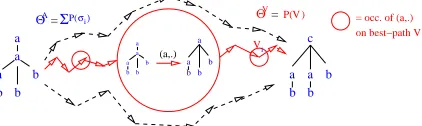
is the best-script, the virtual count or expec-tationγS,T(op)contributed by S,T for the operaton op would in this case be defined byγ(S,T)(op) =
ΘV s(S,T) ΘA
s(S,T)
×f req(op∈
V
)and the (Exp)V step accumulates these values γ(S,T)(op)for all possible op’s over all training pairs.
The picture below attempts to illustrate this for a par-ticular operation(a,λ)occuring on the best-path
V
between a particular tree paira
a b
b b
a
c
b b b a a
V ) P(
i
(a,.)
b b b a
a a
a b bb
a V
V=
= occ. of (a,.) on best−path V
σi) P(
A=Σ
[image:7.595.76.287.310.373.2]Θ Θ
Figure 3 spells out this Viterbi cost-adaptation algo-rithm for stochastic tree-distance.9
input: a set P o f tree pairs (S,T)
a cost table C, size |Σ|+1 × |Σ|+1
create tables γ,Cnew same size as C
while(conv 6= true) { zero all entries in γ
for each (S,T) ∈ P {
let (v, V) =T DV(S,T), a=T DA(S,T) γ[λ][λ]+=2−v/2−a
for each (x,y)∈ EdOp {
γ[x][y]+=(f req o f (x,y) in V)×2−v/2−a
} }
Cnew=−log(γ/sum(γ))
if (Cnew6=C){C=Cnew} else {conv=true}
}
return C
Figure 3: Viterbi EM cost adaptation for tree-distance. Note Σis the label alphabet of the tree-pairs inP. The algorithms T DV and T DAare as defined in Figure 1
Such Viterbi training variants have been found beneficial, for example in the context of parameter training for PCFGs (Bened´ı and S´anchez, 2005).
9Simple modifications of the algorithm as formulated
force it to generate a symmetric expectation tableγ.
5
EXPERIMENTS WITH VITERBI
EM COST-ADAPTATION
We have conducted some experiments with this Viterbi EM cost-adaptation approach. In particular we have considered how it might adapt a tree-distance measure that is put to work in a k-NN classification algorithm.
Figure 4 outline the distance-weighted kNN clas-sification algorithm which was used in the experi-ments.
knn class(Examples,C∆,k;T) {
let D = SORT({(S,∆Vs(S,T)) | S ∈ Examples } while(!resolved) {
P=top(k, D), V =weighting( P) if(no winner in V) { set k = k + 1 }
else { resolved = true } }
return category with highest vote in V }
Figure 4: Distance-weighted k nearest neighbour classifi-cation
top(k,
D
)basically picks the first k items fromD
10. The weighting converts the panel of distance-rated items to weighted votes for their categories, and in the experiments reported later, the options for the con-version of an item of category C, at distance d, into a vote vote(C,d)are Majority: vote(C,d) =1; Du-dani: vote(C,d) = (dmax−d)/(dmax−dmin), or 1 ifdmax=dmin, where dmax and dminare maximum and minimum distances in the panel (Dudani, 1976).
It can arise that the test tree T contains a symbol for which C∆ has no entry. One option is to assign all operations involving the symbol some default cost κ. See the Appendix for a proof that the ordering of neigbours is independent of the value chosen forκ
In applying the EMV cost-adaptation in the con-text of the k-NN classification algorithm, the training set for cost-adaptation was taken to consists of tree pairs(S,T), where for each example-set tree S, T is a nearest same-category neighbour. The training algo-rithm should less the stochastic tree-distance between these trees.
EMV like all other EM algorithms needs an ini-tialisation of its parameters. We will use C∆u(d)for a ’uniform’ initialisation with diagonal factor d. This will mean that C∆u(d)is a stochastically valid cost-table, with the additional properties that (i) all diag-onal entries are equal (ii) all non-diagdiag-onal entries are equal (iii) diagonal entries are d times more probable
10Modulo some niceties concerning ties which space
[image:7.595.73.256.438.606.2]than non-diagonal. For these purposes the cost-table entry for p(#)is treated as non-diagonal. As an illus-tration, for an alphabet of just 2 symbols, the initiali-sations C∆u(d)for d = 3, 10, 100, and 1000 are:
3 λ a b
λ 3.7 3.7 3.7 a 3.7 2.115 3.7 b 3.7 3.7 2.115
10 λ a b
λ 4.755 4.755 4.755 a 4.755 1.433 4.755 b 4.755 4.755 1.433
100 λ a b
λ 7.693 7.693 7.693 a 7.693 1.05 7.693 b 7.693 7.693 1.05
1000 λ a b
λ 10.97 10.97 10.97 a 10.97 1.005 10.97 b 10.97 10.97 1.005
As a smoothing option concerning a table C∆ de-rived by EMV, let C∆λ be its interpolation with the original C∆u(d)as follows
2−C∆λ[x][y]=λ(2−C∆[x][y]) + (1−λ)(2−C∆u(d)[x][y]) with 0≤λ≤1, withλ=1 giving all the weight to the derived table, andλ=0 giving all the weight to the initial table.
The dataset used was a natural language process-ing one, beprocess-ing a corpus of (broadly) semantically cat-egorised, and syntactically analysed questions, which was created by from two pre-existing datasets. Ques-tionBank (QB) is a hand-corrected treebank for ques-tions (Judge et al., 2006; Judge, 2006b), (Judge, 2006a). A substantical percentage of the questions in QB are taken from a corpus of semantically cat-egorised, syntactically unannotated questions (CCG, 2001). From these two corpora we created a corpus of 2755 semantically categorised, syntactically anal-ysed questions, spread over the semantic categories as follows11
Cat HUM ENTY DESC NUM LOC ABBR
N 647 621 533 461 455 38
% 23.48 22.54 19.35 16.73 16.52 1.38
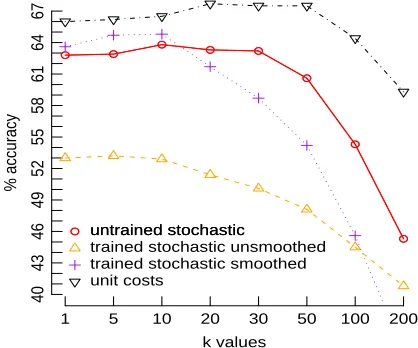
For further details of the software and data see (Emms, 2011). Figure 5 shows some results of a first set of experiments, with unit-costs and then with some stochastic variants. For the stochastic variants, the cost initialisation was C∆u(3)in each case. All the experiments followed a stratified 10-fold cross-validation approach. The data was randomly split into 10 equal size folds, with approximately equal distri-bution of the categories in each. Then in turn each fold has taken as the test data, and the remaining 9 folds used as the example set. When cost-adaptation was applied this means that the training pairs for EMV come from the example set. The figure shows
re-11See (CCG, 2001) for details of the semantic category
labels
sults using the Dudani-voting variant of k-NN; the Majority-voting variant was less effective.
k values
% accuracy
1 5 10 20 30 50 100 200
40
43
46
49
52
55
58
61
64
67
untrained stochastic untrained stochastic
[image:8.595.309.518.134.308.2]trained stochastic unsmoothed trained stochastic smoothed unit costs
Figure 5: Categorisation performance with unit costs and some stochastic variants
The first thing to note is that performance with unit-costs (▽, max. 67.7%) exceeds performance with the non-adapted C∆u(3)costs (
◦
, max. 63.8%). Though not shown, this remains the case with far higher set-tings of the diagonal factor. Performance after ap-plying EMV to adapt costs (△, max. 53.2%) is worse than the initial performance (◦
, max. 63.8%). A Leave-One-Out evaluation, in which example-set items are categorised using the method on the remain-der of the example-set, gives accuracies of 91% to 99%, indicating EMV has made the best-scripts con-necting the training pairs too probable, over-fitting the cost table. The vocabulary is sufficiently thinly spread over the training pairs that its quite easy for the learn-ing algorithm to fix costs which make almost every-thing but exactly the training pairs have zero proba-bility. The performance when smoothing is applied (+,max. 64.8%), interpolating the adapted costs with the initial cost, withλ=0.99, is considerably higher than without smoothing (△), attains a slightly higher maximum than with unadapted costs (◦
), but is still worse than with unit costs (▽).The following is a selection from the top 1% of adapted swap costs.
8.50 ? .
8.93 NNP NN 9.47 VBD VBZ 9.51 NNS NN 9.78 a the 11.03 was is 11.03 ’s is
12.31 The the 12.65 you I 13.60 can do 13.83 many much 13.92 city state 13.93 city country
words differing only by capitalisation, related parts of speech (VBD vs VVZ etc), verbs and their contrac-tions and so on. One might expect this discounting of these swaps relative to others to assist the categorisa-tion, though the results reported so far indicate that it did not.
Recall that the cost-table for the stochastic edit distance is a representation of probabilites, with prob-abilities represented by their negated base-2 loga-rithms. A 0 in this case represents the probability 1. Because in a stochastically valid cost table, the sum over all the represented probabilities must be 1, a single 0 entry in a cost table implies infinite cost entries everywhere else. This means that a stochasti-cally valid cost table cannot have zero costs on the diagonal, which is the situation of the unit-cost ta-ble,
C
01. This aspect perhaps mitigates against suc-cess. The diagonal factor d in the cost initialisation is designed to make the entries on the diagonal more probable than other entries, but even with very high values for d, indicating a high ratio between the diag-onal and off-diagdiag-onal probabilities, the diagdiag-onal costs are not negligible. This means that the unit-cost set-ting,C
01, which is clearly ’uniform’ in a sense, is not directly emulated by the ’uniform’ stochastic initiali-sations C∆u(d). The performance with the unadapted uniform stochastic initialisation was below the perfor-mance with unit-costs. Although results in Figure 5 show just the outcomes withC
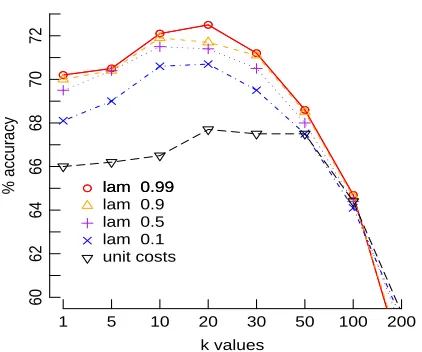
u(3), this remained the case with far larger values of the diagonal factor d. This invites consideration of outcomes if a final step is applied in which all the entries on the cost-table’s diagonal are zeroed. In work on adapting cost-tables for a stochastic version of string distance used in du-plicate detection, (Bilenko and Mooney, 2003) used essentially this same approach. Figure 6 shows out-comes when the trained and smoothed costs finally have the diagonal zeroed.The (▽) series once again shows the outcomes with unit-costs. In this experiment, with the diagonal zeroed, this is necessarily also the outcome ob-tained with any unadapted uniform stochastic ini-tialisation C∆u(d). The other lines in the plot show the outcomes obtained with costs adapted by EMV, smoothed at varius levels of interpolation (λ∈ {0.99,0.9,0.5,0.1}) and with the diagonal zeroed. Now the unit costs base-line is clearly out-performed, the best result being 72.5% (k=20, λ=0.99), as compared to 67.5% for unit-costs (k=20). Also bet-ter results are obtained with the higher levels of the interpolation factor, indicating greater weight given to the values obtained by EMVand less to the stochastic initialisation.
k values
% accuracy
1 5 10 20 30 50 100 200
60
62
64
66
68
70
72
[image:9.595.310.521.98.274.2]lam 0.99 lam 0.99 lam 0.9 lam 0.5 lam 0.1 unit costs
Figure 6: Categorisation performance: adapted costs with smoothing and zeroing
6
CONCLUSIONS
One can tentatively conclude on the basis of these ex-periments that the Viterbi EM cost-adaptation can in-crease the performance of a tree-distance based clas-sifier, and improve it to above that attained in the unit-cost setting, though this does require smoothing of de-rived probabilites and a final step of zeroing the diag-onal.
Experiments with further data-sets is required. One type of data of interest would be the digit-recognition data-set represented by a tree-encoding of outline looked at by (Bernard et al., 2008). It would also be interest to look at applications not to do with categorisation per-se. For example, in the NLP-related tasks of question-answering and en-tailment recognition, the aim is assess pairs of sen-tences for their likelihood to be a question-answer or hypothesis-conclusion pair. A training set of such pairs could also serve as potential input to the cost adaptation algorithm.
Alignments between different pairs of trees can end up being represented by the same edit-script. A minimal example is that the script(a,A)(b,B)(c,C) can serve to connect both the pairs (t1,t2) and (t1′,t2′), where:
t1 :(c(a)(b)) t2 :(C(A)(B))
t1′:(c(b(a))) t2′:(C(B(A)))
between the tree-pairs. A direction for further work is the investigation of such a model of aligned trees, and how it relates to some other recent proposals concerning adaptive tree measures such as (Takasu et al., 2007), (Dalvi et al., 2009)
ACKNOWLEDGEMENTS
This research is supported by the Science Founda-tion Ireland (Grant 07/CE/I1142) as part of the Cen-tre for Next Generation Localisation (www.cngl.ie) at Trinity College Dublin.
REFERENCES
Bened´ı, J.-M. and S´anchez, J.-A. (2005). Estimation of stochastic context-free grammars and their use as lan-guage models. Computer Speech and Language, 19(3):249–274.
Bernard, M., Boyer, L., Habrard, A., and Sebban, M. (2008). Learning probabilistic models of tree edit dis-tance. Pattern Recogn., 41(8):2611–2629.
Bilenko, M. and Mooney, R. J. (2003). Adaptive duplicate detection using learnable string similarity measures. In Proceedings of the Ninth ACM SIGKDD Interna-tional Conference on Knowledge Discovery and Data Mining (KDD-2003), pages 39–48.
Boyer, L., Habrard, A., and Sebban, M. (2007). Learning metrics between tree structured data: Application to image recognition. In Proceedings of the 18th Euro-pean Conference on Machine Learning (ECML 2007), pages 54–66.
CCG (2001). corpus of classified questions by Cog-nitive Computation Group, University of Illinois l2r.cs.uiuc.edu/∼cogcomp/Data/QA/QC.
Dalvi, N., Bohannon, P., and Sha, F. (2009). Robust web ex-traction: an approach based on a probabilistic treeedit model. In SIGMOD 09: Proceedings of the 35th SIGMOD international conference on Management of data, pages 335–348, New York, NY, USA. ACM. Dempster, A., Laird, N., and Rubin, D. (1977). Maximum
likelihood from incomplete data via the em algorithm. J. Royal Statistical Society, B 39:138.
Dudani, S. (1976). The distance-weighted k-nearest neigh-bor rule. IEEE Transactions on Systems, Man and Cy-bernetics, SMC-6:325–327.
Emms, M. (2011). Tree-distance code and datasets reported on in experiments www.scss.tcd.ie/Martin.Emms/ TreeDist.
Emms, M. and Franco-Penya, H.-H. (2011). On order equivalences between distance and similarity mea-sures on sequences and trees. In Proceedings of ICPRAM 2012 International Conference on Pattern Recognition Application and Methods.
Judge, J. (2006a). Corpus of syntactically annotated ques-tions http://www.computing.dcu.ie/jjudge/qtreebank/.
Judge, J. (2006b). Adapting and Developing Linguistic Re-sources for Question Answering. PhD thesis, Dublin City University.
Judge, J., Cahill, A., and van Genabith, J. (2006). Ques-tionbank: creating a corpus of parse-annotated ques-tions. In ACL 06: Proceedings of the 21st Interna-tional Conference on ComputaInterna-tional Linguistics and the 44th annual meeting of the ACL, pages 497–504, Morristown, NJ, USA. Association for Computational Linguistics.
Kuboyama, T. (2007). Matching and Learning in Trees. PhD thesis, Graduate School of Engineering, Univer-sity of Tokyo.
Ristad, E. S. and Yianilos, P. N. (1998). Learning string edit distance. IEEE Transactions on Pattern Recognition and Machine Intelligence, 20(5):522–532.
Tai, K.-C. (1979). The tree-to-tree correction problem. Journal of the ACM (JACM), 26(3):433.
Takasu, A., Fukagawa, D., and Akutsu, T. (2007). Statisti-cal learning algorithm for tree similarity. In ICDM 07: Proceedings of the 2007 Seventh IEEE International Conference on Data Mining, pages 667672, Washing-ton, DC, USA. IEEE Computer Society.
Wagner, R. A. and Fischer, M. J. (1974). The string-tostring correction problem. Journal of the Association for Computing Machinery, 21(1):168–173.
Zhang, K. and Shasha, D. (1989). Simple fast algorithms for the editing distance between trees and related prob-lems. SIAM Journal of Computing, 18:1245–1262.
APPENDIX
Proof concerning out of table costs
Let C∆be a cost-table associated with a given la-bel alphabetΣ, let T be a tree with n symbols 6∈Σ, and let κbe a fixed, out-of-table cost for any(x,u), where x∈Σ∪ {λ}, u6∈Σ. Suppose S is a tree whose labels are in Σ. Everyσ∈E(S,T)involve n out-of-table events. Suppose
V
is the least-cost script, with cost costκ(V
). Now suppose under a higher setting of κ′for out-of-table costs, thatV
′6=V
is the least-costscript, so costκ′(
V
′)<costκ′(V
). But recostingac-cording toκgives costκ(
V
′)<costκ(V
), which con-tradicts minimality ofV
under κ. So the minimal script is invariant to changes of κ, and ∆vκ′(S,T)−∆v