Proceedings of the Second Workshop on Subword/Character LEvel Models, pages 72–77
A Multi-Context Character Prediction Model
for a Brain-Computer Interface
Shiran Dudy and Steven Bedrick Center for Spoken
Language Understanding Oregon Health & Science University
Portland, OR, USA
{dudy,bedricks}@ohsu.edu
Shaobin Xu and David A. Smith College of Computer
and Information Sciences Northeastern University
Boston, MA, USA
{shaobinx,dasmith}@ccs.neu.edu
Abstract
Brain-computer interfaces and other aug-mentative and alternative communication de-vices introduce language-modeing challenges distinct from other character-entry methods. In particular, the acquired signal of the EEG (electroencephalogram) signal is noisier, which, in turn, makes the user intent harder to decipher. In order to adapt to this condi-tion, we propose to maintain ambiguous his-tory for every time step, and to employ, apart from the character language model, word in-formation to produce a more robust prediction system. We present preliminary results that compare this proposed Online-Context Lan-guage Model (OCLM) to current algorithms that are used in this type of setting. Evalua-tions on both perplexity and predictive accu-racy demonstrate promising results when deal-ing with ambiguous histories in order to pro-vide to the front end a distribution of the next character the user might type.
1 Introduction
Augmentative and alternative communication (AAC) devices are aimed at individuals facing communication disabilities, and aim to enable them to interact with their environment, assisting with both comprehension as well as expression of the individual (Beukelman and Mirenda,2005; American Speech Language Hearing Association et al.,2004). In particular, a Brain-Computer In-terface (BCI) has been employed as an aiding de-vice for patients who have experienced loss of mo-tor control, and who might struggle with produc-ing spoken or written language (Birbaumer et al., 1999;Sellers et al.,2010) (as in e.g. Amyotrophic Lateral Sclerosis). A BCI system measures a user’s brain’s electrical activity, typically using electroencephalography (EEG), and attempts to infer intent, often in response to stimuli such as row-column scanning.
Communication rates in BCI systems tend to be quite slow. To reduce the prediction time of the next letter in the sequence, one approach is to incorporate language models into AAC de-vices (Vertanen and Kristensson,2011), and BCI in particular (Mora-Cortes et al.,2014). The po-tential advantage of combining a language model with EEG information in a BCI system is twofold: achieving higher accuracy of target predictions, as well as gains in the speed of the process of typ-ing the user’s intended strtyp-ing (Speier et al.,2011; Orhan et al.,2011). It may also help with reduc-ing the number of necessary stimuli required for symbol selection (Speier et al.,2016).
Mora-Cortes et al. (2014) describe different types of EEG responses common when employing a typing-based BCI, and in the review of Speier et al.(2016), event-related potentials (ERP) seem to be the prevailing choice in particular. In the RSVP-Keyboard (Orhan et al.,2012), an ERP sig-nal is elicited in response to a rapid display of let-ters. Other systems such as the P300 (Farwell and Donchin, 1988) present a user with a grid of let-ters and the ERP signal is retrieved in response to a flash of each row or column.
In such systems, a language model provides the prior distribution that serves as a bias to the EEG evidence when computing the posterior distribu-tion of a symbol as shown in Equadistribu-tion1
p(sym|EEG) = p(sym)p(EEG|sym)
p(EEG) (1)
Traditionally, such BCI systems commit to a single decision (given their posterior results), which introduces a problem once the decision is not aligned with the user. One option is to allow for a backspace character, though this poses com-plex modeling challenges (Fowler et al.,2013). In our system we propose to partly commit to a de-cision with regard to the user intent, and maintain more than one candidate for every letter selection.
Figure 1: EEG evidence for6letter selections
This way, the best path is frequently re-evaluated and as a result can revise previously typed strings. Maintaining more than one candidate may re-duce frustration among users, and minimize time spent correcting errors. We also, as recommended by Mora-Cortes et al. (2014) and Speier et al. (2016), explicitly incorporate word-level informa-tion and mix word-level and character-level lan-guage models to improve letter level prediction. Notably, this approach allows our system to sup-port out-of-vocabulary (OOV) words.
Ambiguous input is widely used in traditional Automatic Speech Recognition (Jelinek, 1997) systems along with the Viterbi algorithm (Viterbi, 1967) to find the best path of the utterance bottom-up, from acoustic phoneme units (often triphones) to characters and words (often represented as the C◦L◦Gcomposition), and recently in keyboard settings as well by swiping (Ouyang et al.,2017). To the best of our knowledge, it has rarely been explored in the area of BCI, with a notable excep-tion being the work of Speier et al. (2015), who later found it to be intractable due to complexity issues (Speier et al.,2016).
In this work, we present the Online-Context Language Model (OCLM) and describe the pro-cess of producing prior distributions given EEG evidence as part of our BCI system. Our contribu-tions are specifically in the context of BCI as we integrate word language models (within the sys-tem), allow for OOV words to be typed, and op-timize over word-level paths to compute optimal priors. Our mixed-context approach achieves su-perior performance in the face of noisy input com-pared with a purely character-level model.
2 Methodology 2.1 Overview
To illustrate our method, the steps presented are applied on the input in Figure1, which depicts a temporal sequence of EEG evidence. Each num-bered state represents a selection epoch in which a user has attempted to “type” a letter. Arcs tran-sitioning between nodesitoi+ 1represent pos-sible selections, and (though not drawn as such in this figure) are weighted with the normalized EEG likelihoods of time stepiretrieved from the BCI.
Figure 2: left to rightword historyandtrailing prefix
In this example, the OCLM is currently aiming to provide a prior distribution for the 7th letter se-lection given the EEG evidence. Assume that the intended string the user wishes to type is “the mo”. The first step taken is to split the EEG history lattice shown in Figure1into two parts: one, con-taining all strings before the last space (“#” in Fig-ure1), which we will call the “word history” lat-tice, and another, containing all possible strings af-terthe last space, called the “trailing prefix” (Ftp) as shown in Figure2.1
The word history(Fwh) represents all possible complete words that the user is assumed to have finished typing. The second part represents the word that the user is assumed to be in the middle of typing, and can be thought of as the set of possi-ble prefixes for the current intended word. We can use this to generate possible wordcompletions.
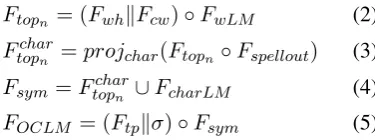
A current in-progress word lattice (Fcw) is gen-erated by finding all possible in-vocabulary words that start with the “trailing prefix.” By concatenat-ing both the word history lattice (Fwh) as well as a lattice of possible in-progress words, and then composing the result with a word-level language model (FwLM), we are able to produce a weighted
n-best list of hypothesized words that the user may be trying to produce (Ftopn, Equation2).
Ftopn = (FwhkFcw)◦FwLM (2)
Ftopcharn =projchar(Ftopn◦Fspellout) (3)
Fsym=Ftopcharn ∪FcharLM (4)
FOCLM = (Ftpkσ)◦Fsym (5)
We next take the lattice of “current words”, compose that with a word-to-character spellout machine (Fspellout), project the result into charac-ter space (Equation3), and then take the union of the result with a character language model to pro-duce a “symbol language model” lattice (Fsym in Equation4).
We are now ready to compute probabilities for the likely next symbol the user intends to select. We do this by taking our original trailing prefix
1Thetrailing prefixshown in figure2is simplified for
lattice (Ftp, containing distributions over charac-ters actually selected by the user), concatenating it a character “wild card” machine (σ, represent-ing the next character that the user intends to se-lect to continueFtp), and intersecting the resulting machine with Fsym (Equation 5). At this point, we are able to extract a probability distribution over possible character selections by performing weight pushing to the end of the machine, and then examining the final set of arcs inFOCLM. All of these FST operations are implemented with the OpenFst (Allauzen et al., 2007) and OpenGRM-NGRAM (Roark et al.,2012) libraries.
2.2 Out of Vocabulary Words
It is crucial that our system allows its users to en-ter novel, out-of-vocabulary words, which we sup-port in the following way. Above, we described how we take the lattice of characters making up the current, in-progress word and combine it with a lexicon transducer to produce a weighted lat-tice of possible word completions. Our approach deals differently and distinguishes between rarely seen words in the training set and completely un-seen words. Infrequent words that were un-seen less than five times but at least once during training are mapped to <unk>word-symbol. In these cases, an attempt to complete a prefix for such a word re-sults in an<unk>word token as a possibility in Fcw’s list. FwLM is also trained on these<unk> representations suggesting that <unk>is treated similarly to any other word appearing in the train-ing after the infrequent word was mapped to it (following the process in Equations2to5). How-ever, while the described process applies to un-common but observed words, when a prefix is part of an unseen word and there is no possible com-pletion provided by the lexicon then,Fcw=∅and the process is reduced to Equations 4and5such thatFsym = FcharLM. The FcharLM contains a failure (φ) transition such that for every possible prefix in Ftp that is not found inFsym (which in this situation is equivalent to FcharLM), we back off to a partial prefix route.
2.3 Word Completion
As described above, while computing the prior distribution over the next character, every new piece of evidence that is added to the system (i.e., each new attempt at character selection by the user) is appended to a “trailing prefix,”Ftp, which we use to compute hypotheses about the current
words the user might be in the middle of typing. In Equation2above,Fcw contains all possible in-vocabulary words that the user may be trying to produce, andFtopnis a refined list of those words.
This means that our architecture is able to produce both word- and character-level predictions simul-taneously, and can easily vary the number of such predictions.
2.4 Auto-correction
While character deletion or insertion events are not auto-corrected in our approach, we address auto-correction to some degree. As described in the main process of computing the prior distribu-tion, there is a frequent re-assessment the previ-ously typed words. This history is recalculated as more EEG evidence of letter selections is in-troduced; this recalculation occurs mainly when the space character is introduced as it affects the word-boundaries and thus the history. As a sult, at each time step, the updated history is re-scored by the word language-model (FwLM), as our estimated most-likely word history may have changed. In Figure1, for instance, we start with “she” and “the” as possible histories. As character selection continues, we might have “monkey” as a strongly-predicted possible word completion; in this case, FwLM will prioritize “the” over “she,” as “the monkey” is more probable than “she mon-key”. However, if “modifies” were to be judged more likely byFtopn, “she” would get prioritized
over “the”. Making additional and extended use of this information is part of our future work plan.
3 Experimental Evaluation
In order to evaluate the OCLM, we constructed a simulated character selection task to compare the performance of three different algorithms. The first is a smoothed character 5-gram model (“NGRAM”),2 in which prediction is conducted
by intersecting the history (EEG evidence, plus the wildcard σ) with the LM lattice. In this and our other n-gram models, we used Kneser-Ney smoothing (Kneser and Ney,1995). The second algorithm we evaluated against was a ”prefix lan-guage model” that included a character lanlan-guage model (PreLM, Equation 6) explicitly trained on character prefixes of in-vocabulary words (Fwp)
2Our choice of an ngram order of 5 was for empirical
combined with a closure over the NGRAM model. This model used an identical prediction mecha-nism as did theNGRAMmodel, but was designed to be better-equipped to handle in-progress words.
P reLM = (FN GRAMkFspace)*kFwp (6) The third is the OCLM described in Sec-tion2. All models were trained on the Brown cor-pus (Francis and Kuˇcera,1979), and data split was 80%for training and20%for testing. The results are on the test set. The test set contained10,265 sentences and176,280words. Our simulated task was as follows. For each test sentence, we proceed character by character. At each point in the sen-tence, we provide the algorithms with some repre-sentation of the history of the sentence up to that point, and ask the models to predict the following character target.
We evaluated each model in terms of the tra-ditional average character-level perplexity. Since our model is intended to be used to support char-acter prediction, we also measured the reciprocal rank of the ground-truth target letter, both overall as well as by position within a word (to compare performance earlier in words vs. later). We also looked at the proportion of predictions for which the model placed the correct target letter in the top 10 sorted guesses (ACC@10). We evaluated under two conditions: the first simulating a “determin-istic” history, in which we assume that the EEG signal is reliable, and an “ambiguous” history, in which we take the top-nletters from the EEG sig-nal at each time point as possible selections.
3.1 Deterministic History
In this condition, the language model was pro-vided with the “correct” character history up to each prediction point. We refer to this as then=1 scenario, as it describes the state of deterministic history of unambiguous and accurate EEG selec-tion at each time point.
Table1shows that NGRAM algorithm has sub-par performance when comsub-pared to both OCLM and PreLM as its Mean Reciprocal Rank (MRR) as well as Perplexity (PPX) are lower and higher respectively. ACC@10 that stands for sentence average prediction for the target within top 10 guesses also demonstrate inferior performance for the NGRAM method.
OCLM and PreLM appear to have similar per-formance, which surprised us given how different
metric NGRAM PreLM OCLM
MRR 0.4 0.7 0.75
PPX 4.4 1.8 1.9
[image:4.595.318.514.62.116.2]ACC@10 0.69 0.96 0.96
Table 1: Evaluation Results (n=1)
1 2 3 4 5 6 7 8 9 10 11 12 13 14 15 16 17 18 19 20 21 22 23 24 25 26 0.0
0.2 0.4 0.6 0.8 1.0
OCLM
RRs of letter positions within a word
1 2 3 4 5 6 7 8 9 10 11 12 13 14 15 16 17 18 19 20 21 22 23 24 25 26 0.0
0.2 0.4 0.6 0.8 1.0
PRE
Figure 3: Reciprocal Ranks of letter positions within words (n=1)
their approaches are. In order to explore more deeply, we attempted to examine the internal be-havior within each word in the test set. In Figure3 the Reciprocal Ranks (RR), are presented for each letter position within a word. The OCLM algo-rithm demonstrates has higher RR (than PreLM) earlier in the word (position 5 vs. position 11) which is maintained for a longer period of time (10 positions in a row vs 7). Arguably, it is de-sired that the algorithm would predict correctly as early as possible, as its impact is on greater num-ber of words (there are more words with5letters than with 10) and, a longer duration of high RR contributes to more accurate predictions as well. An analogous analysis of perplexity found a simi-lar pattern oflowerperplexity atearlierpositions, together with similar duration, and a similar per-formance profile in OCLM vs PreLM.
3.2 Ambiguous History
[image:4.595.325.507.158.307.2]al-gorithms’ performance when given histories con-sisting of the mostnlikely EEG characters at each time point forn ∈ {2,3}. In all cases, the target character was included, but it was not always the most “probable.” Likelihoods were drawn from a Gaussian PDF functions of target and non-target simulating a high performing user3.
In BCI settings, utterances are often shorter than those that are common in datasets such as the Brown Corpus; therefore, we evaluated on a subset of the test-set containing all sentences of 10 words or less, resulting in2,954sentences with16,519 words. For reasons of computational tractability, we simulated an ambiguous history over a win-dow of the immediate past10characters; beyond that, we treated history as “fixed,” and provided the models with correct targets.4
Table 2 presents the results for ambiguous in-put ofn=2 andn=3. Overall adding more history to these type of algorithms degrades their perfor-mance. However, the level of degradation seems to vary between OCLM to PreLM. OCLM can pro-duce more accurate predictions and has a higher MRR rate for bothns. PPX also is slightly lower than in PreLM.
nbest metric PreLM OCLM
MRR 0.29 0.51
n=2 PPX 3.5 3.0
ACC@10 0.69 0.87
MRR 0.26 0.44
n=3 PPX 4 3.9
ACC@10 0.63 0.83
Table 2: Evaluation Results (n=2,n=3) A further inspection5into the letter position
per-formance of n=2 shows that OCLM’s MRR re-mains relatively high (close to1) especially from the fifth letter position while PreLM falls to val-ues around 0.2. While not shown, the PPX val-ues are consistent again with the MRR behav-ior. The same pattern appears with a noisier his-tory of n=3. There, OCLM experienced addi-tional degradation, and its high MRR lasted for a shorter term; from the seventh position to the tenth. PreLM’s MRR revolved around slightly less than 0.2. OCLM’s PPX was relatively low yet higher than of n=2 and was higher for PreLM. This, together with Table2indicate a performance
3The PDFs were overlapping to some degree to enable
likelihood confusions of target with non-target
4PreLM fails to run on complete ambiguous history 5Not included in this work for reasons of space.
degradation in OCLM, but a break-downin per-formance for PreLM. These results emphasize the durability of OCLM over PreLM when the input has more than one possibility.
4 Conclusions
We presented the OCLM architecture for predic-tive typing with a brain-computer interface. The OCLM enables incorporating ambiguous histories and word-level knowledge to improve its tions. The OCLM demonstrated improved predic-tion quality as it takes place earlier in the process and for a longer duration across different condi-tions of ambiguous input to the system. Our ar-chitecture also allows for personalization by em-ploying another lattice to Equation 4 of a user’s probable words.
Our future work will focus on integrating the OCLM architecture into our group’s BCI system, and evaluating the algorithm with real end-users to see if it reduces the number of sequence displays for each letter selection. Since speed is an impor-tant component in the usability of a BCI system, we also plan to assess total typing time as well as accuracy; note that, as our system’s predictions be-come more accurate, the downstream components of our BCI system will also improve.
Another important area of future work will be to more thoroughly investigate our system’s handling of OOV words, and identify avenues for improve-ment as needed. We also hope to take advantage of our model’s architecture to provide user-level personalization, and to explore more concrete ap-proaches to autocorrection. Our work to date has focused on the AAC literature, and there is current work in areas such as spelling correction that may prove useful here.
Acknowledgments
[image:5.595.94.268.406.501.2]References
Cyril Allauzen, Michael Riley, Johan Schalkwyk, Woj-ciech Skut, and Mehryar Mohri. 2007. OpenFST: A General and Efficient Weighted Finite-State Trans-ducer Library. InInternational Conference on
Im-plementation and Application of Automata, pages
11–23. Springer.
American Speech Language Hearing Association et al. 2004. Roles and Responsibilities of Speech-Language Pathologists with Respect to Augmenta-tive and AlternaAugmenta-tive Communication: Technical Re-port.
David R. Beukelman and Pat Mirenda. 2005. Aug-mentative & Alternative Communication: Support-ing Children & Adults with Complex
Communica-tion Needs, 3rd edition. Paul H. Brookes Publishing
Co.
Niels Birbaumer, Nimr Ghanayim, Thilo Hinterberger, Iver Iversen, Boris Kotchoubey, Andrea K¨ubler, Juri Perelmouter, Edward Taub, and Herta Flor. 1999. A Spelling Device for the Paralysed. Nature, 398(6725):297.
Lawrence Ashley Farwell and Emanuel Donchin. 1988. Talking Off the Top of Your Head: Toward a Mental Prosthesis Utilizing Event-Related Brain Potentials. Electroencephalography and Clinical Neurophysiol-ogy, 70(6):510–523.
Andrew Fowler, Brian Roark, Umut Orhan, Deniz Er-dogmus, and Melanie Fried-Oken. 2013. Improved Inference and Autotyping in EEG-Based BCI Typ-ing Systems. In Proceedings of the 15th Interna-tional ACM SIGACCESS Conference on Computers
and Accessibility, ASSETS ’13, pages 15:1–15:8,
New York, NY, USA. ACM.
WN Francis and H Kuˇcera. 1979. Brown Corpus Man-ual of Information to Accompany a Standard Corpus of Present-Day American English, revised and am-plified. Providence, RI: Brown University,
Depart-ment of Linguistics.
Frederick Jelinek. 1997. Statistical Methods for
Speech Recognition. MIT press.
R. Kneser and H. Ney. 1995. Improved Backing-Off for M-Gram Language Modeling. In1995 Interna-tional Conference on Acoustics, Speech, and Signal
Processing, volume 1, pages 181–184 vol.1.
Anderson Mora-Cortes, Nikolay V Manyakov, Niko-lay Chumerin, and Marc M Van Hulle. 2014. Lan-guage Model Applications to Spelling with Brain-Computer Interfaces. Sensors, 14(4):5967–5993.
U. Orhan, K. E. Hild, D. Erdogmus, B. Roark, B. Oken, and M. Fried-Oken. 2012. Rsvp Keyboard: An EEG Based Typing Interface. In2012 IEEE International Conference on Acoustics, Speech and Signal
Pro-cessing (ICASSP), pages 645–648.
Umut Orhan, Deniz Erdogmus, Brian Roark, Shalini Purwar, Kenneth E Hild, Barry Oken, Hooman Nezamfar, and Melanie Fried-Oken. 2011. Fusion with Language Models Improves Spelling Accuracy for ERP-based Brain Computer Interface spellers.
In Engineering in Medicine and Biology Society,
EMBC, 2011 Annual International Conference of
the IEEE, pages 5774–5777. IEEE.
Tom Ouyang, David Rybach, Franc¸oise Beaufays, and Michael Riley. 2017. Mobile Keyboard In-put Decoding with Finite-State Transducers. arXiv
preprint arXiv:1704.03987.
Brian Roark, Richard Sproat, Cyril Allauzen, Michael Riley, Jeffrey Sorensen, and Terry Tai. 2012. The Opengrm Open-Source Finite-State Grammar Soft-ware Libraries. InProceedings of the ACL 2012
Sys-tem Demonstrations, pages 61–66, Jeju Island,
Ko-rea. Association for Computational Linguistics.
Eric W Sellers, Theresa M Vaughan, and Jonathan R Wolpaw. 2010. A Brain-Computer Interface for Long-Term Independent Home Use. Amyotrophic
Lateral Sclerosis, 11(5):449–455.
W Speier, C Arnold, and N Pouratian. 2016. Integrat-ing Language Models into Classifiers for BCI Com-munication: A Review. Journal of Neural Engineer-ing, 13(3):031002.
W Speier, CW Arnold, A Deshpande, J Knall, and N Pouratian. 2015. Incorporating Advanced Lan-guage Models into the P300 Speller Using Par-ticle Piltering. Journal of Neural Engineering, 12(4):046018.
William Speier, Corey Arnold, Jessica Lu, Ricky K Taira, and Nader Pouratian. 2011. Natural Lan-guage Processing with Dynamic Classification Im-proves P300 Speller Accuracy and Bit Rate. Journal
of Neural Engineering, 9(1):016004.
Keith Vertanen and Per Ola Kristensson. 2011. The Imagination of Crowds: Conversational AAC Lan-guage Modeling Using Crowdsourcing and Large Data Sources. InProceedings of the Conference on Empirical Methods in Natural Language Process-ing, EMNLP ’11, pages 700–711, Stroudsburg, PA, USA. Association for Computational Linguistics.