Native Language Identification using Phonetic Algorithms
Charese Smiley Indiana University Bloomington, IN 47405
Sandra K¨ubler Indiana University Bloomington, IN 47405
Abstract
In this paper, we discuss the results of the IUCL system in the NLI Shared Task 2017. For our system, we explore a va-riety of phonetic algorithms to generate features for Native Language Identifica-tion. These features are contrasted with one of the most successful type of features
in NLI, character n-grams. We find that
although phonetic features do not perform
as well as character n-grams alone, they
do increase overall F1 score when used
to-gether with charactern-grams.
1 Introduction
Native Language Identification (NLI) is the task of automatically predicting the native language (L1) of a speaker given an unlabeled artifact such as a writing sample or speech transcript in a second language (L2). In a typical encounter with a non-native speaker, humans have a variety of contex-tual clues such as race, approximate age, style of dress, and accent to assist us in making a predic-tion about the person’s native language. However, when predicting L1 relying on features that can be extracted from text alone, we must proceed with-out the assistance of these visual and acoustic sig-nals. Acoustic cues can be an important source of information since speakers often transfer char-acteristics of their L1 onto L2. For example, a Japanese L1 speaker may transfer the rigid CV syl-lable structure onto English and epenthesize vow-els into consonant clusters, which may also be re-flected in writing. Thus, having phonetic informa-tion may prove useful in an NLI classificainforma-tion task. However, we need to make sure that the features we add can be acquired from text and do not con-tribute to data sparsity. For the IUCL system in the Native Language Identification Shared Task
(Mal-masi et al.,2017), we began with the premise that acoustic features lost in text are important for lan-guage identification and they can be reconstructed using pseudo-auditory features derived from pho-netic algorithms that were developed for robust matching in text search. Additionally, we explore a dictionary lookup that provides a phonetic rep-resentation of the words in text.
English orthography is rich, complex, and at times idiosyncratic. Using phonetic algorithms, we can reduce some of this complexity by produc-ing a phonetic representation of a word through a series of transformations that map characters and character sequences with similar pronuncia-tion to a single representapronuncia-tion such as mapping both<ph>and<f>→<f>. To our knowledge, phonetic algorithms have not been explored to generate features for NLI.
2 Related Work
The first NLI Shared Task was part of the 2013 Building Educational Applications (BEA)
work-shop (Tetreault et al.,2013). Participants received
the training portion of the TOEFL11 corpus and were asked to identify the native language of the essay writer from among a closed set of 11 lan-guages available in the corpus. Scoring was based on classification accuracy on an unseen test set in 3 tasks: 1 closed training task where only train-ing data provided in the TOEFL11 corpus could be used, and 2 open training tasks. In the first open training task, researchers could use any train-ing data except for the TOEFL11 corpus. In the
second task, they could use any training data
in-cludingthe TOEFL11 corpus.
Both character-level and word-level n-grams
have featured prominently in past work.
Charac-ter n-grams ranging from lengths 1-9 have been
used (Tetreault et al.,2013). Early work featuring
character bigrams is that of Tsur and Rappoport (2007), which achieved 66% accuracy in 5-way classification. They suggested that character fea-tures can serve as a proxy for phonology and that learners’ word choices in essays are influenced by their native language. That is, learners gravitate to words in the target language whose phonology matched that of their native language while avoid-ing words that do not. This tendency can be cap-tured at the character level.
Word-level n-grams have been widely used in
a variety of approaches (e.g. Bykh and Meurers,
2012;Jarvis et al.,2013). Traditionally, shortern -grams with lengths of 1-3 characters are more use-ful for computational tasks due to the data sparsity
that ensues as the length of then-gram increases.
Bykh and Meurers(2012), however, used longest
recurringn-grams that appeared in 2 or more
es-says with good results, perhaps capturing longer collocations and set phrases used by learners from
specific L1s. Wong and Dras (2009) and Jarvis
et al.(2013) found that both character features and lexical features are effective but classification ac-curacy deteriorated when both feature types are used together.
Part-of-speech n-grams also feature widely in
previous work (Koppel et al.,2005a,b;Wong and
Dras,2009). Lexicaln-grams have been shown to
outperform POS n-grams for classification
accu-racy (Bykh and Meurers, 2012). The traditional
motivation for the use of POSn-grams is based on
the assumption that they abstract away from the confounding effect of essay topic (Koppel et al., 2005a,b;Wong and Dras, 2009). However, POS tag sequences may still be topic dependent. For instance, an opinion piece may contain more
per-sonal pronouns than a scientific paper. Brooke
and Hirst (2011) suggest that the essay prompts may lend themselves to responses in different reg-isters and the register may manifest itself beyond the lexicon.
Additionally, a number of studies have used syntactic features: context-free grammar (CFG)
production rules (Wong and Dras, 2011; Bykh
and Meurers, 2014), Tree Substitution Grammar
(TSG) fragments (Swanson and Charniak,2012),
and Stanford Dependencies (Malmasi and Cahill, 2015).
3 Data
For the 2017 shared task, similar to the 2013
shared task (Tetreault et al., 2013), the data
con-sists of essays from the same 11 L1s, with the test data drawn from a similar distribution as the original TOEFL11 corpus. In addition to the writ-ten text, transcripts of speech and i-vector acoustic features were included in the data release as they have shown promising results for dialect
identi-fication (Malmasi et al., 2016; Zampieri et al.,
2017). The NLI 2017 shared task contains tracks for essay, speech transcript, and i-vectors alone as well as a fusion task combining all features. The IUCL system focuses exclusively on the es-say task.
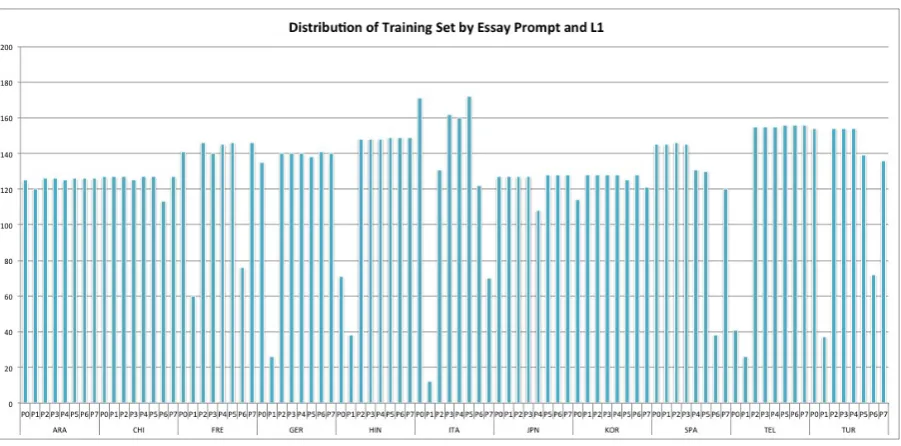
This dataset consisted of 11 L1s: Arabic (ARA), Chinese (CHI), French (FRE), German (GER), Hindi (HIN), Italian (ITA), Japanese (JPN), Korean (KOR), Spanish (SPA), Telugu (TEL), and Turkish (TUR). There were a total of 11,000 training essays (1,000 for each L1) and 1,100 development essays (100 for each L1). Ad-ditionally, the data contained the test taker id, es-say prompt, and speech prompt. The distribution of essays by essay prompt for the development
set, shown in Figure1, varies by L1 with Arabic
and Korean having the most balanced distribution among prompts and Turkish and Italian having the least.
4 Acoustic Features
Our system utilizes phonetic features for NLI. We explore 3 algorithms that were developed for
ro-bust matching: Soundex (section 4.1), Double
Metaphone (DMETA) (section4.2), and the New
York State Identification and Intelligence System
(NYSIIS) (section4.3).1 Soundex relies on
sim-ple conversion rules that mostly ignore vowels and groups consonants together by place of articula-tion in the mouth. The approach abstracts over is-sues of 1-to-many sound-symbol correspondence in English. For example, the sound /ks/ can be written as both <ks> and <x> as in tacks and
tax. Soundex converts the two spellings to two
different representations. In contrast, the NYSIIS and the Metaphone family of algorithms (Philips, 1990,2000) go a step further to incorporate more of the peculiarities of English spelling, which is necessary for better mappings of homophones. 1Features were generated using the Fuzzy library
Figure 1: Distribution of data in the development set by number of essays per prompt for each L1.
Thus, all of these algorithms abstract away from specific types of acoustic distinctions, but they dif-fer in which distinctions they ignore.
Finally, we also use the Carnegie Mellon University Pronouncing Dictionary (CMU) (sec-tion4.4) which provides a lookup for the pronun-ciation of known words. This has the added benefit of providing more accurate mappings than a rule-based converter would and thus a better handling of known words. Moreover, the CMU dictionary can differentiate different vowel sounds where the other algorithms cannot.
4.1 Soundex
Soundex (Knuth,1973) is an early algorithm first
patented in 1918. Under Soundex, the first letter of a word is retained (including all vowels and consonants), all other consonants are mapped to the numbers 1-6, and all other vowels, along with consonants <h>, <w>, and <y>, are dropped. Consonants are converted to numbers within the algorithm as follows: 1:b, f, p, v, 2: c, g, j, k, q, s, x, z, 3:d, t, 4:l, 5:m,n, and 6:r.
This conversion ensures that the consonants are divided roughly along places of articulation with 1 for labials, 2 for coronals and dorsals (excluding<l>and<r>), 3 for dentals, 4 for lat-erals, 5 for nasals, and 6 for rhotics. Repeated numbers after conversion, such as<mn>, which becomes 55, are reduced to a single number (e.g., 5). All words are normalized to a starting let-ter plus 3 digits by either omitting any
remain-ing characters for longer words or appendremain-ing ze-ros until there are 3 digits for shorter words.
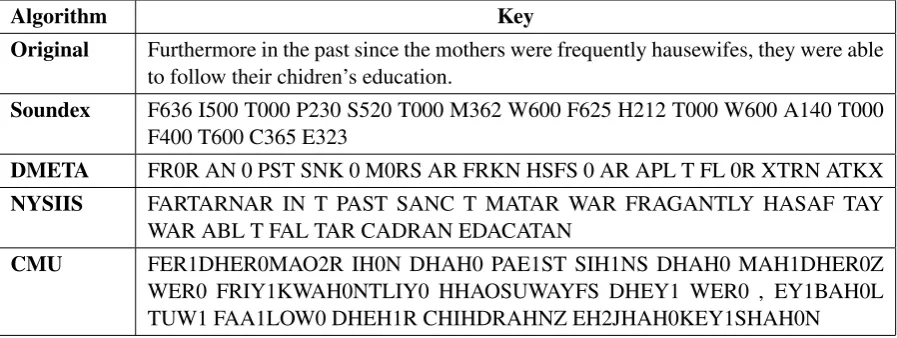
Ta-ble1 shows an example sentence from the
train-ing set written by a Turkish speaker converted to keys using Soundex and the other algorithms in this paper. One of the the advantages of the Soundex algorithm is that it is easy to implement the small number of rules mapping from letters to numbers. However, since it does not take into account English spelling rules, words that do not sound very similar can end up mapped to the same
key. For example, Cajun and Cigna both map
to C250 (Philips, 1990). For our purposes, this
means that adaptations of vowels along with adap-tations where the place of articulation does not change are not represented in the features.
4.2 Double Metaphone
The original Metaphone phonetic algorithm
(Philips, 1990), uses an inventory of 16
conso-nants, 0BFHJKLMNPRSTWXZ, where 0 stands for /T/ andXfor /S/ or /tS/. All 21 orthographic
En-glish consonants are mapped to these 16, by col-lapsing some letters like <d>and <t> to<t>. Metaphone contains a number of improvements
over Soundex. For example, the letter <c> is
sometimes pronounced as /s/ and sometimes as /k/ and the Metaphone algorithm covers many of such cases whereas Soundex does not due to its more simplistic mapping strategy.
Algorithm Key
Original Furthermore in the past since the mothers were frequently hausewifes, they were able to follow their chidren’s education.
Soundex F636 I500 T000 P230 S520 T000 M362 W600 F625 H212 T000 W600 A140 T000 F400 T600 C365 E323
DMETA FR0R AN 0 PST SNK 0 M0RS AR FRKN HSFS 0 AR APL T FL 0R XTRN ATKX
NYSIIS FARTARNAR IN T PAST SANC T MATAR WAR FRAGANTLY HASAF TAY WAR ABL T FAL TAR CADRAN EDACATAN
CMU FER1DHER0MAO2R IH0N DHAH0 PAE1ST SIH1NS DHAH0 MAH1DHER0Z
[image:4.595.75.524.63.232.2]WER0 FRIY1KWAH0NTLIY0 HHAOSUWAYFS DHEY1 WER0 , EY1BAH0L TUW1 FAA1LOW0 DHEH1R CHIHDRAHNZ EH2JHAH0KEY1SHAH0N
Table 1: Sample sentence represented using various phonetic algorithms
2000) includes many changes and improvements over the original algorithm. Following Soundex, DMETA originally retains the first vowel in words and returns a key with a maximum of 4 letters. Ad-ditionally, it collapses all vowels to the letter A,
and as such the wordsAuto andOtto, for
exam-ple, are mapped to the same key. It also combines the letters <p>and<b>, treats<y>and<w>
as vowels (thus eliminating them in post word-initial contexts) and includes a number of mod-ifications to account for spelling influences from foreign words. Finally, the Double Metaphone al-gorithm returns multiple keys for words that could be pronounced in alternate ways. However, for the use in the IUCL system, we only choose the first key provided since the algorithm favors the most common American pronunciation over other alternatives. As an example, consider Spanish bor-rowings with<ll>that could be pronounced in an
Americanized way as /l/ (e.g. armadillo, flotilla)
or in the Spanish way as /j/ (e.g. tortilla, paella).
This is an issue for a rather small number of words, roughly 10% based on Phillips’ sample, but should
not be of much consequence for our application.2
4.3 NYSIIS
Similar to the Double Metaphone algorithm, the NYSIIS algorithm extends Soundex by encoding each letter with consideration for English spelling nuances rather than strict reliance on place of ar-ticulation. Unlike the previous two algorithms, NYSIIS maintains the position of vowels within the word but collapses them by converting all
vow-2There is a newer version of the Metaphone algorithm,
Metaphone 3 which is available for commercial use but the details remain unpublished.
els to<A>. Also, some versions of NYSIIS main-tain the entire key rather than limiting it to the first
Nletters (e.g. exactly 4 letters for Soundex and 1-4 for DMETA). However, word final<s>and<a>
are removed. For the IUCL system, we use the non-truncated version of the key. Thus, NYSIIS retains more information in comparison to the pre-vious two conversion algorithms.
4.4 CMU Pronunciations
The Carnegie Mellon University Pronouncing
Dictionary (CMU)3 is an open source
dictio-nary that contains pronunciations for more than 134,000 English words using a set of 39 phonemes and stress markers for vowels. The previous algorithms were designed to minimize the dif-ferences between homophones and near homo-phones. However, since this dictionary was de-veloped for use in automatic speech recognition (ASR) applications rather than text search, the mappings are based on the common pronuncia-tions of American English words. For unknown
words, we the LOGIOS Lexicon Tool4 which
generates a CMU pronunciation using letter-to-sound rules. Using this tool, the misspelled word
hausewifesin Table1is converted into the the pro-nunciation HHAOSUWAYFS.
Soundex, DMETA, and NYSIIS all fall under the category of fuzzy matching algorithms. The original intention for these algorithms were to im-prove recall when searching for names where the exact spelling is unknown or uncertain and they
3http://www.speech.cs.cmu.edu/cgi-bin/
cmudict
4http://www.speech.cs.cmu.edu/tools/
still enjoy widespread use in search applications. The main advantage for using algorithmic pho-netic converters such as these is that they can pro-duce a key as output no matter word is given as in-put. This has an advantage over dictionary-based methods like CMU which, under its pure imple-mentation, fails when a word (such as a proper name or misspelling) falls outside of its internal list, however large. On the other hand, dictionary methods like CMU have the advantage of produc-ing a more nuanced and accurate key for known words. This is especially true when it comes to representation of vowels. All of the other phonetic algorithms mentioned in this paper either collapse all vowels to a common representation or elimi-nate them in non-word-initial positions whereas in
Table1we see that the CMU output most closely
resembles the original words.
4.5 Experimental Setup
For all experiments, we use the C-Support Vec-tor Classifier implementation in scikit-learn with a
linear kernel.5 For feature values, rather than
us-ing a frequency count matrix for features in the document, the TF-IDF score for the term is used instead. TF is the term frequency, i.e., the num-ber of occurrences of a term in a document. IDF is the inverse document frequency, which is calcu-lated by dividing the total number of documents in a corpus by the number of documents contain-ing term t (if t is not equal 0). The application of TF-IDF weighting has been used to good effect in
previous research (Gebre et al.,2013).
The benefit of using TF-IDF weighting in this task is that it dampens the effect of terms that are well dispersed throughout the corpus while em-phasizing terms that occur less frequently and only within a smaller set of documents. For NLI, TF-IDF weighting is useful for capturing and amplify-ing the effects of vocabulary choices that are L1-specific. When using binary features, for exam-ple, only the presence or absence of a feature is recorded. This effectively weights rare features, such as low frequency words and spelling errors, the same as common features, such as function words. In contrast, TF-IDF gives a measure of the informativeness of a word since a word that ap-pears in many documents will have a lower IDF than one that rarely occurs. Therefore, terms that
5http://scikit-learn.org/stable/
modules/generated/sklearn.svm.SVC.html
System F1 (macro) Accuracy
Random baseline 0.0909 0.0909
Essay baseline 0.7104 0.7109
Soundex 0.7455 0.7473
CMU 0.7629 0.7627
DMETA 0.7697 0.7727
NYSIIS 0.7830 0.7836
Char† 0.8206 0.8209
Char+CMU 0.8147 0.8145
Char+NYSIIS 0.8190 0.8191
Char+DMETA† 0.8262 0.8264
[image:5.595.312.518.61.226.2]Char+Soundex 0.8300 0.8300
Table 2: Essay track results. Systems marked by†
were submitted as part of the official NLI Shared Task. The remaining systems were submitted out-side of the official testing phase.
receive a high TF-IDF score will occur with high frequency in a small number of documents.
All experiments were conducted using character
n-grams of length 2-9. Additionally, we restricted
the minimum document frequency to 5 documents and the maximum to 5% of documents in the train-ing set.
5 Results
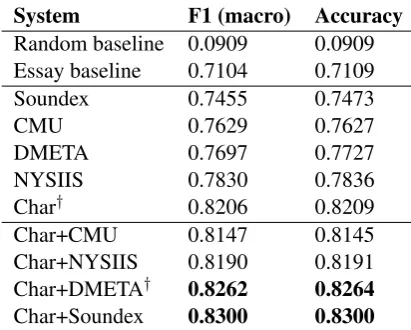
We show the results of the different feature sets in
Table 2. All approaches perform well above the
random baseline of 0.0909 (1/11) and above the shared task baseline of 0.7104 for the 11-way clas-sification task. Results for the single feature runs show that none of the algorithms outperformed
ba-sic charactern-grams (Char) features, which result
in an F1 of 0.8206. Of the phonetic algorithms, NYSIIS shows the highest performance while Soundex and the CMU dictionary approach do not fare well, reaching an F1 of 0.7455 and 0.7697 respectively. This shows that the closest model-ing of pronunciation is not helpful for the task. When we combine character-based features with the acoustic features, we observe that all combina-tions show improvements over the acoustic-only features. Additionally, combining with DMETA and Soundex results in higher performance than
charactern-grams alone, reaching an F1 of 0.8262
and 0.8300 respectively. The highest performing acoustic-only model, NYSIIS, shows the least im-provement, which indicates that the features ex-tracted from this particular conversion are
CHI JPN KOR HIN TEL FRE ITA SPA GER ARA TUR
Predicted label
CHI
JPN
KOR
HIN
TEL
FRE
ITA
SPA
GER
ARA
TUR
True label
88 4 2 3
1
2
5 86 7
1
1
4 6 81 1
1
1
2 4
84 11
1
4
2 1 1 30 59
2
5
2
86 3 4 3 1 1
1
3 85 7 3
1
1
4
1 3 88
3
1 1 2
2 1 3 88 2
2 1
1 1 2 2 4
83 4
1 3 2 2
2
4 4 1 81
Confusion Matrix
[image:6.595.144.457.65.347.2]0.0
0.1
0.2
0.3
0.4
0.5
0.6
0.7
0.8
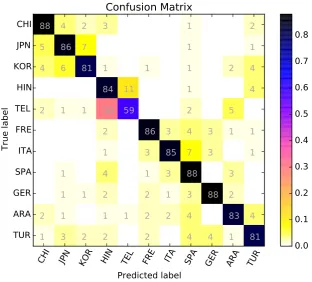
Figure 2: Confusion matrix for best official run, Char+DMETA
possible reason can be found in the higher num-ber of features provided by NYSIIS as opposed to Soundex and DMETA since NYSIIS does not truncate the acoustic representation. However, this requires further investigation.
6 Discussion
Overall, we see that phonetic algorithms do not
perform as well as charactern-grams for NLI. One
reason for this could be that by mapping charac-ters to a simpler representation, important infor-mation is lost. For example, one of the most
com-mon misspellings for Arabic speakers is becouse
but it would be rendered the same asbecauseby
all of the phonetic algorithms except for CMU. Information losses such as this could account for the reduced performance of phonetic algorithms as
compared to charactern-grams.
On the other hand, the advantage of phonetic algorithms is that commonly used phrases such as
for many reasons(common among Arabic speak-ers) can be collapsed into one feature and captured even when minor spelling differences exist (espe-cially if those errors have to do with vowels or consonant sounds that are close in place of articu-lation).
One of the most informative phrases in for
Turk-ish L1 writers was ATKX SSTM (DMETA) and E323 S235 (Soundex) which translates to
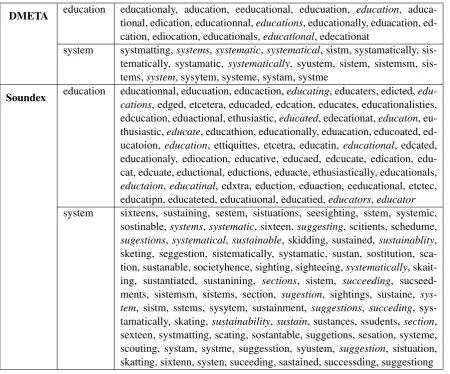
‘educa-tion system’. Table 3 shows all of the variants
of both words found in the training and develop-ment data with the variants for Turkish L1 writers shown in italics. Both DMETA and Soundex cap-ture a wide range of variants including spelling
errors and various parts-of-speech. As Table 3
demonstrates, Soundex is much more aggressive in combining words that do not sound as
simi-lar (e.g. sixteen, scouting, skidding) into a
sin-gle key (S235). Overall, the power of DMETA and Soundex is that used in conjunction with other
features, such as character n-grams, these types
of features are able to take advantage of longer phrases even when they include spelling errors.
We reach the highest results in the official test-ing phase of the NLI Shared Task 2017 with the
combination of character n-grams with DMETA
features, which surpasses the character features by about 0.5% absolute and the DMETA features by about 5.6% absolute. Outside of the testing phase,
our best run combined character n-grams with
DMETA education educationaly, aducation, eeducational, educuation,tional, edication, educationnal,educations, educationally, eduacation, ed-education,
aduca-cation, edioaduca-cation, educationals,educational, edecationat
system systmatting,systems,systematic,systematical, sistm, systamatically,
sis-tematically, systamatic, systematically, syustem, sistem, sistemsm,
sis-tems,system, sysytem, systeme, systam, systme
Soundex education educationnal, educuation, educaction,cations, edged, etcetera, educaded, edcation, educates, educationalisties,educating, educaters, edicted,
edu-edcucation, eduactional, ethusiastic,educated, edecationat,educaton,
eu-thusiastic,educate, educathion, educationally, eduacation, educoated,
ed-ucatoion, education, ettiquittes, etcetra, educatin, educational, edcated,
educationaly, ediocation, educative, educaed, edcucate, edication, edu-cat, edcuate, eductional, eductions, eduacte, ethusiastically, educationals,
eductaion, educatinal, edxtra, eduction, eduaction, eeducational, etctec,
educatipn, educateted, educatiuonal, educatied,educators,educator
system sixteens, sustaining, sestem, sistuations, seesighting, sstem, systemic,
sostinable,systems,systematic, sixteen,suggesting, scitients, schedume,
sugestions,systematical, sustainable, skidding, sustained, sustainablity, sketing, seggestion, sistematically, systamatic, sustan, sostitution, sca-tion, sustanable, societyhence, sighting, sighteeing,systematically,
skait-ing, sustantiated, sustaninskait-ing, sections, sistem, succeeding,
sucseed-ments, sistemsm, sistems, section, sugestion, sightings, sustaine,
sys-tem, sistm, sstems, sysytem, sustainment, suggestions, succeding,
sys-tamatically, skating,sustainability, sustain, sustances, ssudents,section, sexteen, systmatting, scating, sostantable, suggetions, sesation, systeme,
scouting, systam, systme, suggesstion, syustem, suggestion, sistuation,
[image:7.595.72.523.60.434.2]skatting, sixtenn, systen, suceeding, sastained, successding, suggestiong Table 3: Variants of “education system” in the corpus that are collapsed by DMETA and Soundex. Words in italics are taken from Turkish L1 essays.
not captured in spelling directly.
We had a closer look at the errors that our
sys-tem makes. Figure2shows a confusion matrix for
the best setting using character and DMETA fea-tures. The table shows that the main weak point of the learner lies in confusing Hindi and Telugu. This is not surprising given the fact that Indians are often multilingual and speak more than two lan-guages. Additionally, English is often used as a lingua franca on the Indian subcontinent with fre-quent contact from speakers from a variety of L1s resulting in highly similar linguistic patterns.
7 Conclusion and and Future Work This paper explored NLI using feature sets derived from 3 phonetic algorithms and one dictionary-based lookup. We have shown that our system IUCL can profit from having access to acoustic
features in addition to character n-grams. In the
future, we plan to further explore variants of
pho-netic conversions in which we do not abbreviate the words but rather segment them into acoustic
n-grams. Will will also explore how features
de-rived from phonetic algorithms can be combined with other lexical and syntactic features.
References
Julian Brooke and Graeme Hirst. 2011. Na-tive language detection with ‘cheap’ learner cor-pora. In Conference of Learner Corpus Research (LCR2011). Louvain-la-Neuve, Belgium.
Serhiy Bykh and Detmar Meurers. 2012. Na-tive language identification using recurring n-grams – investigating abstraction and do-main dependence. In Proceedings of COL-ING 2012. Mumbai, India, pages 425–440.
http://www.aclweb.org/anthology/C12-1027. Serhiy Bykh and Detmar Meurers. 2014. Exploring
of COLING 2014, the 25th International Confer-ence on Computational Linguistics: Technical Pa-pers. Dublin, Ireland, pages 1962–1973.
Binyam Gebrekidan Gebre, Marcos Zampieri, Peter Wittenburg, and Tom Heskes. 2013. Improving na-tive language identification with tf-idf weighting. In the 8th NAACL Workshop on Innovative Use of NLP for Building Educational Applications (BEA8). pages 216–223.
Scott Jarvis, Yves Bestgen, and Steve Pepper. 2013. Maximizing Classification Accuracy in Native Lan-guage Identification. InProceedings of the Eighth Workshop on Innovative Use of NLP for Building Educational Applications. Association for Compu-tational Linguistics, Atlanta, Georgia, pages 111– 118.
Donald E Knuth. 1973.The Art of Computer Program-ming, Addison-Wesley, Reading, MA, volume 3, chapter Sorting and Searching.
Moshe Koppel, Jonathan Schler, and Kfir Zigdon. 2005a. Automatically determining an anonymous author’s native language. In International Confer-ence on IntelligConfer-ence and Security Informatics. At-lanta, GA, pages 41–76.
Moshe Koppel, Jonathan Schler, and Kfir Zigdon. 2005b. Determining an author’s native language by mining a text for errors. In Proceedings of the Eleventh ACM SIGKDD International Conference on Knowledge Discovery in Data Mining. Chicago, IL, pages 624–628.
Shervin Malmasi and Aoife Cahill. 2015. Measuring feature diversity in native language identification. In
Proceedings of the Tenth Workshop on Innovative Use of NLP for Building Educational Applications (BEA). Denver, CO, pages 49–55.
Shervin Malmasi, Keelan Evanini, Aoife Cahill, Joel Tetreault, Robert Pugh, Christopher Hamill, Diane Napolitano, and Yao Qian. 2017. A Report on the 2017 Native Language Identification Shared Task. In Proceedings of the 12th Workshop on Building Educational Applications Using NLP. Copenhagen, Denmark.
Shervin Malmasi, Marcos Zampieri, Nikola Ljubeˇsi´c, Preslav Nakov, Ahmed Ali, and J¨org Tiedemann. 2016. Discriminating between Similar Languages and Arabic Dialect Identification: A Report on the Third DSL Shared Task. InProceedings of the Var-Dial Workshop. Osaka, Japan.
Lawrence Philips. 1990. Hanging on the metaphone.
Computer Language7(12).
Lawrence Philips. 2000. The double metaphone search algorithm. C/C++ Users Journal18(6):38–43. Benjamin Swanson and Eugene Charniak. 2012.
Na-tive Language Detection with Tree Substitution
Grammars. InProceedings of the 50th Annual Meet-ing of the Association for Computational LMeet-inguistics (Volume 2: Short Papers). Association for Compu-tational Linguistics, Jeju Island, Korea, pages 193– 197. http://www.aclweb.org/anthology/P12-2038. Joel Tetreault, Daniel Blanchard, and Aoife Cahill.
2013. A Report on the First Native Language Iden-tification Shared Task. InProceedings of the Eighth Workshop on Building Educational Applications Us-ing NLP. Association for Computational Linguis-tics, Atlanta, GA, USA.
Oren Tsur and Ari Rappoport. 2007. Using Clas-sifier Features for Studying the Effect of Native Language on the Choice of Written Second Lan-guage Words. In Proceedings of the Workshop on Cognitive Aspects of Computational Language Acquisition. Association for Computational Lin-guistics, Prague, Czech Republic, pages 9–16.
http://www.aclweb.org/anthology/W/W07/W07-0602.
Sze-Meng Jojo Wong and Mark Dras. 2009.
Contrastive Analysis and Native Language Identification. In Proceedings of the Aus-tralasian Language Technology Association Workshop 2009. Sydney, Australia, pages 53–61.
http://www.aclweb.org/anthology/U09-1008. Sze-Meng Jojo Wong and Mark Dras. 2011.
Ex-ploiting Parse Structures for Native Language Iden-tification. In Proceedings of the 2011 Confer-ence on Empirical Methods in Natural Language Processing. Association for Computational Linguis-tics, Edinburgh, Scotland, UK., pages 1600–1610.
http://www.aclweb.org/anthology/D11-1148. Marcos Zampieri, Shervin Malmasi, Nikola Ljubeˇsi´c,