The Effect of Error Rate in Artificially Generated Data for Automatic
Preposition and Determiner Correction
Fraser Bowen and Jon Dehdari and Josef van Genabith University of Saarland
Deutsches Forschungsinstitut f¨ur K¨unstliche Intelligenz
Abstract
In this research we investigate the im-pact of mismatches in the density and type of error between training and test data on a neural system correcting preposition and determiner errors. We use syntheti-cally produced training data to control er-ror density and type, and ”real” erer-ror data for testing. Our results show it is possible to combine error types, although preposi-tions and determiners behave differently in terms of how much error should be artifi-cially introduced into the training data in order to get the best results.
1 Introduction
The field of Grammatical Error Correction (GEC) is currently dominated by neural translation mod-els, specifically sequence-to-sequence translation. However, despite offering substantial improve-ments on the well-established statistical machine translation approach to GEC, neural networks come with their own challenges.
Firstly, neural models require a large amount of training data, however the amount of annotated learner English consisting of source (original text) and target (corrected text) is low. Models are at risk of overfitting, simply because the volume of data is not high enough. Secondly, the data that has been used up until now does not generalise very well across different test sets. This means that there has been some success in correcting er-rors, but only from test sets that are in some sense similar to the training data. Thirdly, it is generally unknown how erroneous the test data is, and if the training data has a different distribution of errors, it is likely that unwanted corrections will be made, or required corrections will be missed.
Currently, there is research into generating arti-ficial data for training neural models, specifically data that resembles learner English (Cahill et al., 2013;Rozovskaya and Roth, 2010;Felice,2016; Liu and Liu, 2016). The artificial data is gener-ated from monolingual sentences of grammatical English by systematically introducing noise into it. This way, training data consisting of sentences with both “incorrect” and “correct” versions can be generated from monolingual data, which is eas-ily accessible. There is also evidence that artifi-cially generated data can generalise a GEC system better than simply using manually procured cor-rection data (Cahill et al.,2013).
A third advantage of synthetically introducing noise into a corpus is the ability to control how much noise, and which noise, is introduced. The first main question of our research is how the amount of noise introduced into the corpus af-fects a neural model’s behaviour at test time with respect to mismatches in error density and error type between training and test data. Artificial data lends itself to this kind of research, thanks to the control over the corpus.
Up until now, the effect of the amount of errors in the training corpus has only been explored with prepositions specifically (Cahill et al.,2013). We begin by extending this line of research to deter-miners. The second research question is then: how do two different types of error interact? It is quite possible that introducing many types of frequent grammatical errors one after the other would not create convincing artificial learner data, because several types of error can affect the same word, and a neural model may not be able to learn to combine them in this way.
2 Related Work
Currently the best results in GEC have used neu-ral machine translation. Yuan and Briscoe(2016) achieved the best scores using a 2-layer encoder-decoder system with attention, trained on the Cambridge Learner Corpus (CLC), a large data set of two million correction Learner English sen-tences. The CLC is not publicly available, which has inspired the use of automatically generated data with neural models. Liu and Liu(2016) have done exactly this with 16 different types of errors. Their success, although small compared to using manually annotated supervised revision data, has inspired our investigation into the particular ef-fects of combining error types in an artificial cor-pus.
One particularly interesting approach to gener-ating artificial data is from Cahill et al. (2013), who, focusing on preposition errors, creates con-fusion sets for each preposition using supervised revision data, and selects replacements at ran-dom from these probability distributions. This ap-proach was developed fromRozovskaya and Roth (2010), who first suggested the idea of probabilis-tically selecting likely error candidates. Interest-ingly, the artificial data proved to make manually annotated data more robust, meaning that it gen-eralised better across different types of test sets, despite the fact that the overall quality of correc-tions was lowered. This was confirmed byFelice (2016), who also found that this kind of probabilis-tic error generation increases precision, and lowers recall.
One main focus of our research is the effect of the amount of errors in the training corpus on the amount of corrections made at test time. Ro-zovskaya et al.(2012) identify a useful technique known as error inflation, where more errors are in-troduced into the training data in order to improve recall. This is further explored in our work.
3 Experimental Setup 3.1 Data
In our research, errors are systemically intro-duced into “correct” English data. The correct data comes from the NewsCrawl corpus in WMT-2016.1 It is open domain, featuring a wide variety
of topics and writing styles, taken from recent ar-1http://www.statmt.org/wmt16/
translation-task.html
ticles. We used 21,789,157 sentences for training, and 5,447,288 held-out sentences from the same source for a development set.
We follow the same methodology ofCahill et al. (2013) to generate noise. Specifically, supervised revision data is used to see how often particular words are corrected into specific prepositions or determiners. The revision data which is used for our research is the Lang-8 corpus, which is avail-able for academic purposes upon request.2 The
corpus is scraped from the Lang-8 website, where crowd-sourced grammar corrections are posted for non-native speakers of English. It is arguably more reliable than Wikipedia, which contains van-dalism, however, it is noticeably smaller than Wikipedia.
The process of introducing errors into the WMT data using the Lang-8 corpus is as follows:
1. Extract plain text versions of the Lang-8 pus, consisting solely of sentences with cor-rections
2. Compare source sentence with corrections using an efficientdiff algorithm.3 Note that
this often included several steps of revisions. 3. Prepare a list of all prepositions/determiners. This is taken from the tags of the WMT data retrieved from the Stanford tagger.4
4. Remove all sentences that do not contain a single revision involving a preposition or a determiner. Using a hand-crafted set of possible prepositions/determiners, it is deter-mined for each sentence whether it involves a deletion (eg. “for”→“NULL”), an addition (eg. “NULL”→“the”), or a replacement (eg. “on”→“in”).
5. Generate confusion sets for each preposi-tion/determiner by listing all the deletions which are replaced by that word, and count-ing the frequency of each specific revision. 2http://cl.naist.jp/nldata/lang-8 3http://code.google.com/p/
google-diff-match-patch
From there, generate a probability distribu-tion for each preposidistribu-tion/determiner.
6. Insert the target word itself into the distribu-tion with a frequency relative to the error rate. An 80% error rate for example means that 20% of the time, the same word is selected, effectively leaving it in its “correct” form. 7. Prepositions/determiners in the WMT corpus
are systemically replaced by one of the op-tions in their respective probability distribu-tions, selected at random by a sampler.
3.2 Experiments
Cahill et al.(2013) have made their revision data extracted from Wikipedia available for download, which is why it is appropriate to compare it to the revision data which is extracted from Lang-8. Both sets of revision data are used to create two separate confusion sets for prepositions. They are then used to create two sets of error corpora in which 20%, 40%, 60% and 80% of prepositions are altered according to the error introduction pro-cedure detailed above.
To compare, revision data extracted from Lang-8 is also used to create error corpora containing the same amounts of prepositional error. It is worth noting thatCahill et al.’s research does not include the empty “NULL” preposition, meaning that er-rors in which a preposition is missing are not ac-counted for. By contrast, in our work we include every case in which a preposition is inserted, as well as replaced, although we do not deal with deletions. Deleting prepositions which were in-serted in the revision data simply follows the same procedure as replacements, where a preposition is replaced with the null preposition. Inserting prepositions which were deleted in the revision data is much more difficult, as it is not clear where in a sentence each preposition should be. The use of context words before and after a deletion is be-ing explored in more current research, but does not feature in these experiments. This is neverthe-less a major contribution, because insertions and deletions make up a significant part of the errors. In Lang-8, for example, there were 10054 correc-tions of preposicorrec-tions, of which 4274 were inser-tions, and 2657 were deletions. This means that replacements only consist of 31% percent of the errors.
We also use determiner revision data extracted from Lang-8 to create determiner errors in a
sim-ilar fashion, with 20%, 40%, 60% and 80% of er-rors.
A final set of synthetic error data is then gener-ated where both prepositions and determiners are introduced into the same corpus, containing 20%, 40%, 60% and 80% of both kinds of error. This is to investigate whether the GEC system is capable of dealing with two types of error at once.
3.3 Evaluation
In order to test the effects of mismatching error density and type between training and test data, each model is tested on specially created test sets with varying amounts of error in them.Cahill et al. (2013) found that the highest scores came from models both trained and tested on similar error rates. Our research aims to build on this finding.
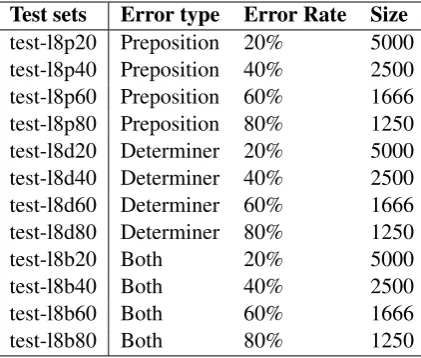
The first test set is made from Lang-8, which is also used to create the confusion sets for the training data. Specifically, only the sentences with prepositions, determiners, and a mix of both in the revisions are used. No other types of error are in-cluded. These sentences are mixed with corrected sentences (where the revised sentence is used as both source and target) to varying degrees. In each case, 1000 sentences of erroneous data are mixed with either 4000, 1500, 666, or 250 sentences of “correct” English, also taken from Lang-8. This is in order to create test sets in which 20%, 40%, 60%, and 80% of sentences are erroneous, simi-lar to the training data. Table1shows the test sets created out of the Lang-8 corpus.
The NUCLE corpus (Ng et al.,2014) was used as training and test sets for the CoNLL-2014 Shared Task (Ng et al.,2014) on GEC, and since then has been commonly used in the field for com-parison with previous work. The NUCLE corpus is used in our research in order to generate test sets from a different domain, despite those test sets being smaller. Again, prepositions, determin-ers and a combination of both are extracted and mixed with corrected sentences from the same cor-pus. Due to the smaller amount of relevant errors, as many sentences containing each error as possi-ble are taken. For prepositions, this amounts 332 sentences, for determiners, 595 sentences, and for both, 169 sentences. Table2 shows the test sets created out of the NUCLE corpus.
Test sets Error type Error Rate Size
test-l8p20 Preposition 20% 5000 test-l8p40 Preposition 40% 2500 test-l8p60 Preposition 60% 1666 test-l8p80 Preposition 80% 1250 test-l8d20 Determiner 20% 5000 test-l8d40 Determiner 40% 2500 test-l8d60 Determiner 60% 1666 test-l8d80 Determiner 80% 1250
test-l8b20 Both 20% 5000
test-l8b40 Both 40% 2500
test-l8b60 Both 60% 1666
[image:4.595.75.286.62.241.2]test-l8b80 Both 80% 1250
Table 1: Lang-8 Corpus test sets
RNN encoder–decoder network with attention5.
OpenNMT was chosen because of its ease of use, and similarity to the architecture used by the cur-rent state of the art results reported by Yuan and Briscoe(2016). The selected evaluation metric is the GLEU score, which has been shown to be the most appropriate metric for GEC (Napoles et al., 2015).
4 Results and Discussion
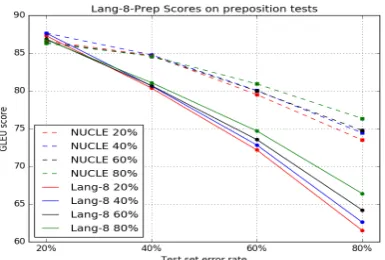
The first objective of our research is to see the dif-ference between testing on Lang-8 and NUCLE test sets when trained on data containing vary-ing error densities created usvary-ing data from Lang-8. For prepositional errors, the GLEU scores of the four different models are in Table 3, and the results are plotted in Figure 4. When tested on corpora with only 20% error, the GLEU score re-mains the same on both test sets. However, the higher the error rate in the test set, the better the models perform on the NUCLE set in comparison with the Lang-8 set. This is surprising, seeing as the Lang-8 corpus was used to inform the process of error generation in the training set.
In the tables cited in this paper, it is expected that the highest scores will occur along the di-agonal. A test set containing 20% error would be best handled by training data which also con-tains 20% error. Likewise with 40%, 60% and 80 %. Conversely, training data containing 80% er-ror would not perform as well on test data con-taining 40% as the training data which also has 40% error. This data shows, however that this is not always the case. When testing on 80%
er-5http://opennmt.net/
Test sets Error type Error Rate Size
test-np20 Preposition 20% 1660 test-np40 Preposition 40% 830 test-np60 Preposition 60% 553 test-np80 Preposition 80% 415 test-nd20 Determiner 20% 2975 test-nd40 Determiner 40% 1487 test-nd60 Determiner 60% 992 test-nd80 Determiner 80% 744
test-nb20 Both 20% 845
test-nb40 Both 40% 423
test-nb60 Both 60% 282
test-nb80 Both 80% 211
Table 2: NUCLE Corpus test sets
ror, the models trained on 80% error density them-selves obtain – as expected – the highest score, al-though only slightly. Interestingly, however, the 80% models also perform better on the 40% and 60% test sets, which seems to confirmRozovskaya et al. (2012)’s “Error Inflation” idea. This is the idea that putting more errors than needed into the training data helps the model generalise more.
One interesting observation from the data is the fact that all the models perform better on the 20% test sets. This is likely because the models are ca-pable of recognising that a sentence need not be corrected, and doing so is simpler than finding a correction of incorrect sentences.
Figure 1: Plot of the data in Table3
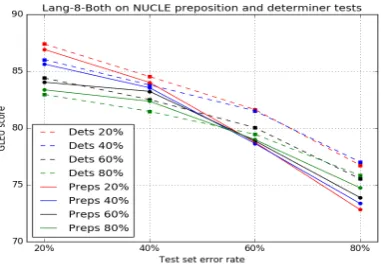
Figure 2: Plot of the data in Table4
Figure 3: Plot of the data in Table5
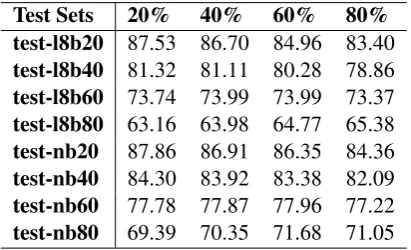
The results of training models on data con-taining a combination of both kinds of error on combined preposition and determiner test data is shown in Table5and Figure4. The data is con-sists of slightly lower scores in general, suggest-ing that mixsuggest-ing error types does not have as high a quality of correction as single errors. Also, the NUCLE test scores in particular suffer in compari-son with the singular error models, showing a fail-ure to generalise across domains. Finally, “Error Inflation” also does not appear to work here.
These results shed doubt on the “Error Infla-tion” present in the preposition experiment. If it were dependent on the type of error, and preposi-tions were the kind which encouraged the use of “Error Inflation”, then it follows that it should at least be present in the combined models. Instead of different error types subtly influencing the be-haviour of the combined model in a cumulative way, the behaviour seems more random. In one case, the 20% combined model performs better on the 40% NUCLE test set than the 40% one, which suggests that reducing the amount of introduced error would make an improvement.
[image:5.595.87.278.567.697.2]be considered compared to the determiners. Al-though many determiners are considered, the vast majority of the cases involve the three articles “a”, “an” and “the”, as well as the null determiner. This is evidence for the need to consider the variation between different errors types when generating er-rors.
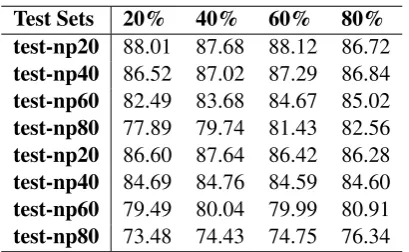
[image:6.595.322.517.90.225.2]The final research question is whether the con-fusion set generated from Wikipedia revisions by Cahill et al.(2013) is much different from the one generated from Lang-8. Table 8 and Figure 4 show the results of preposition models informed by Wikipedia and Lang-8 tested on Lang-8 test sets. Table 9 and Figure 4 show the results of the same models on the NUCLE test sets. As ex-pected, the errors generated from the confusion set informed by Lang-8 performs better on the Lang-8 test sets than on the NUCLE test sets. What is in-teresting, however, is that the Wikipedia revisions performed significantly better not only on the NU-CLE test sets, but also on the Lang-8 test sets. This is surprising, because the Wikipedia revisions are not necessarily in the same domain, whereas the Lang-8 revisions are from the same dataset. Fur-thermore, the Wikipedia revisions do not take in-sertions or deletions into account. It is clear that the amount of revisions considered makes a dif-ference: there were 10054 Lang-8 revisions, and 303847 Wikipedia revisions, 30 times more. The small amount of Lang-8 revisions could also ac-count for the noise identified in the Lang-8 mod-els, but this noise is also present in the Wikipedia revisions, where “error inflation” appears to only appear sometimes and not always.
[image:6.595.323.516.329.462.2]Figure 4: Plot of the data in Table6
[image:6.595.87.278.542.674.2]Figure 5: Plot of the data in Table7
Figure 6: Plot of the data in Table8
[image:6.595.321.514.566.697.2]5 Conclusion
Our research aims to shed light on the issue of choosing how many errors to include in artificially generated erroneous data by tackling two specific error types. Results reveal some predictable out-comes, such as that it is easier to deal with test cor-pora which have smaller error rates, because leav-ing correct sentences alone is easier for the model to learn than making a good correction. Also, in most cases, there is a correlation between the er-ror rate of the training data and the test data. How-ever, some of the results revealed unexpected out-comes. Although it is possible that the data is noisy, the results, particularly for the prepositions, support a concept called “Error Inflation”, which suggests that including more errors into the train-ing data will lead to a higher GLEU score. This ef-fect was not observed in the determiner and com-bined models, suggesting that there might be vari-ation between different error types depending on the distribution of revisions made for that error type. It is possible to combine two error types to-gether into one training set, and tackle two error types at once at test time, although the scores are not as high as when solving only individual errors. Also, the confusion set generated from Wikipedia revisions proved to yield better results than that generated from Lang-8, due to the significantly larger number of revisions. Finally, this research supports generating erroneous data as a valid ap-proach to improving neural models for GEC, and informs future researchers about the effects of er-ror rate mismatches in training and test data. Acknowledgments
We would like to thank Joel Tetreault for his ad-vice and experience in Automatic Error Genera-tion, as well as Mamoru Komachi of Lang-8 for access to the Lang-8 dataset.
References
Aoife Cahill, Nitin Madnani, Joel Tetreault, and Diane Napolitano. 2013. Robust systems for preposition error correction using Wikipedia revi-sions. In Proceedings of the 2013 Conference of the North American Chapter of the Associa-tion for ComputaAssocia-tional Linguistics: Human Lan-guage Technologies. Atlanta, Georgia, pages 507– 517. http://www.aclweb.org/anthology/N13-1055. Mariano Felice. 2016. Artificial error generation
for translation-based grammatical error
correc-tion. Technical Report UCAM-CL-TR-895, University of Cambridge, Computer Laboratory. http://www.cl.cam.ac.uk/techreports/UCAM-CL-TR-895.pdf.
Zhuoran Liu and Yang Liu. 2016. Exploit-ing unlabeled data for neural grammatical er-ror detection. ArXiv preprint 1611.08987. http://arxiv.org/abs/1611.08987.
Courtney Napoles, Keisuke Sakaguchi, Matt Post, and Joel Tetreault. 2015. Ground truth for grammati-cal error correction metrics. InProceedings of the 53rd Annual Meeting of the Association for Compu-tational Linguistics and the 7th International Joint Conference on Natural Language Processing (Vol-ume 2: Short Papers). Beijing, China, pages 588– 593. http://www.aclweb.org/anthology/P15-2097. Hwee Tou Ng, Siew Mei Wu, Ted Briscoe,
Christian Hadiwinoto, Raymond Hendy Susanto, and Christopher Bryant. 2014. The CoNLL-2014 shared task on grammatical error correc-tion. In Proceedings of the Eighteenth Confer-ence on Computational Natural Language Learn-ing: Shared Task. Baltimore, Maryland, pages 1–14. http://www.aclweb.org/anthology/W14-1701. Alla Rozovskaya and Dan Roth. 2010. Training
paradigms for correcting errors in grammar and usage. In Human Language Technologies: The 2010 Annual Conference of the North American Chapter of the Association for Computational Lin-guistics. Los Angeles, California, pages 154–162. http://www.aclweb.org/anthology/N10-1018. Alla Rozovskaya, Mark Sammons, and Dan Roth.
2012. The UI system in the HOO 2012 shared task on error correction. InProceedings of the Sev-enth Workshop on Building Educational Applica-tions Using NLP. Montr´eal, Canada, pages 272–280. http://www.aclweb.org/anthology/W12-2032. Zheng Yuan and Ted Briscoe. 2016.
Grammati-cal error correction using neural machine transla-tion. In Proceedings of the 2016 Conference of the North American Chapter of the Association for Computational Linguistics: Human Language Tech-nologies. San Diego, California, pages 380–386. http://www.aclweb.org/anthology/N16-1042.
Test Sets 20% 40% 60% 80% test-l8p20 87.29 87.63 86.85 86.77
test-l8p40 80.35 80.63 80.68 81.07
test-l8p60 72.17 72.82 73.54 74.68
test-l8p80 61.51 62.60 64.21 66.39
test-np20 86.60 87.64 86.42 86.28
test-np40 84.69 84.76 84.59 84.60
test-np60 79.49 80.04 79.99 80.91
[image:8.595.311.521.75.201.2]test-np80 73.48 74.43 74.75 76.34 Table 3: GLEU score according to how much
preposition error in training data informed by Lang-8, tested on test sets with varying amounts of error fromLang-8 and NUCLE.
Test Sets 20% 40% 60% 80% test-l8d20 88.16 86.76 86.39 84.38
test-l8d40 81.94 82.18 82.20 80.53
test-l8d60 74.83 75.92 76.45 74.99
test-l8d80 65.36 67.54 68.61 69.49
test-nd20 87.64 86.40 85.82 83.63
test-nd40 84.74 84.53 84.22 83.53
test-nd60 81.95 81.96 81.98 81.13
[image:8.595.80.284.81.207.2]test-nd80 77.08 77.36 77.79 78.20 Table 4: GLEU score according to how much de-terminererror in training data informed by Lang-8, tested on test sets with varying amounts of error fromLang-8 and NUCLE.
Test Sets 20% 40% 60% 80% test-l8b20 87.53 86.70 84.96 83.40
test-l8b40 81.32 81.11 80.28 78.86
test-l8b60 73.74 73.99 73.99 73.37
test-l8b80 63.16 63.98 64.77 65.38
test-nb20 87.86 86.91 86.35 84.36
test-nb40 84.30 83.92 83.38 82.09
test-nb60 77.78 77.87 77.96 77.22
test-nb80 69.39 70.35 71.68 71.05 Table 5: GLEU score according to how much
combined preposition and determiner error in training data informed by Lang-8, tested on test sets with varying amounts of error from Lang-8 and NUCLE.
Test Sets 20% 40% 60% 80% test-nd20 87.40 86.02 84.40 82.95
test-nd40 84.53 83.80 82.51 81.47
test-nd60 81.63 81.52 80.04 79.45
test-nd80 76.73 77.01 75.53 75.82
test-np20 86.91 85.63 84.03 83.36
test-np40 84.02 83.55 83.22 82.35
test-np60 78.75 78.64 78.88 78.99
[image:8.595.313.519.311.437.2]test-np80 72.82 73.36 73.88 74.74
Table 6: GLEU score according to how much
combined preposition and determiner error in training data informed by Lang-8, tested sepa-rately onNUCLEtest sets with varying amounts ofdeterminererror, and thenprepositionerror.
Test Sets 20% 40% 60% 80% test-nb20 88.01 87.55 86.85 85.36
test-nb40 84.48 84.12 83.51 83.36
test-nb60 77.58 77.51 77.26 77.45
test-nb80 69.05 69.64 69.57 70.58
test-nb20 87.74 87.39 86.71 85.72
test-nb40 83.43 83.04 82.41 81.90
test-nb60 74.98 74.79 74.32 73.83
[image:8.595.80.284.312.438.2]test-nb80 64.66 64.66 64.45 64.49
Table 7: GLEU score according to how much
prepositionerror (first 4 rows) ordeterminer er-ror (last 4 rows) in training data informed by Lang-8, tested on test sets with varying amounts of com-bineddeterminer/preposition error from NUCLE.
Test Sets 20% 40% 60% 80% test-l8p20 87.27 87.00 86.72 85.66
test-l8p40 79.52 79.78 79.67 79.03
test-l8p60 70.87 71.63 72.03 71.99
test-l8p80 59.66 61.18 62.09 62.85
test-l8p20 87.29 87.63 86.85 86.77
test-l8p40 80.35 80.63 80.68 81.07
test-l8p60 72.17 72.82 73.54 74.68
test-l8p80 61.51 62.60 64.21 66.39
Table 8: GLEU score according to how much preposition error in training data informed by
[image:8.595.79.285.546.671.2] [image:8.595.312.520.548.674.2]Test Sets 20% 40% 60% 80% test-np20 88.01 87.68 88.12 86.72
test-np40 86.52 87.02 87.29 86.84
test-np60 82.49 83.68 84.67 85.02
test-np80 77.89 79.74 81.43 82.56
test-np20 86.60 87.64 86.42 86.28
test-np40 84.69 84.76 84.59 84.60
test-np60 79.49 80.04 79.99 80.91
[image:9.595.80.285.312.438.2]test-np80 73.48 74.43 74.75 76.34 Table 9: GLEU score according to how much preposition error in training data informed by