Text Segmentation Using N-grams to Annotate Hadith Corpus
Shatha Altammami
School of Computing University of Leeds
Leeds,UK
Eric Atwell
School of Computing University of Leeds
Leeds,UK
Ammar Alsalka
School of Computing University of Leeds
Leeds,UK
Abstract
In this paper, we exploit natural language pro-cessing techniques to build a system that au-tomatically segments Hadith into its two main components, Isnad and Matn. We evaluate the previous attempts to segment Hadith and iden-tified the limitations in these studies. Then a Hadith segmentation system is built and tested with Hadith collections extracted from six dif-ferent Hadith books. The result demonstrates that bi-grams are effective in identifying Ha-dith segments with 92.5% accuracy.
1 Introduction
Advancement in Artificial Intelligence (AI), specifically Natural Language Processing (NLP), encouraged researchers to tackle problems associ-ated with textual data. In this work, we exploit NLP methods to build a system that automatically segments Hadith text, which is the collection of narratives reporting different aspects of Prophet Muhammad’s life.
Hadith originated in the 7th century and is con-sidered classical Arabic with unique structure, lin-guistic features, and patterns that make it suit-able for applying computational models. More-over, Hadith possesses historical importance and is still used by Muslims around the world. This is because not all Islamic laws and regulations are mentioned in the Islamic holy book, the Quran. Hence, producing Hadith resources will be useful for a wider community including Islamic scholars, historians, linguists, and computer scientists.
Before building such Hadith resources, it is cru-cial to explain what constitutes the Hadith litera-ture. It is a huge collection of Hadiths1that record every aspect of the prophet’s life. In addition to that, there are supporting documents which in-clude commentaries that explain the Hadith text, 1The plural of Hadith is AHadith, but we will use Hadiths
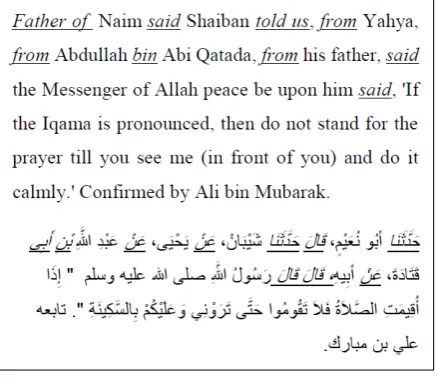
Figure 1: Hadith Example, Isnad in bold
and biographic material that identify narrators of Hadith, which is central in studying Hadith au-thenticity.
Hadith types vary, it could be a short sentence or long paragraph describing what the prophet said in a specific incident, a dialogue of the prophet’s conversation with someone, or a story told by the prophet’s companions that explain the prophet’s actions in a specific matter like ’prayer’. Every Hadith consists of two parts, as shown in Figure 1, theIsnad which is a chain of narrators shown in bold face text, followed byMatnwhich is the actual teaching. However, these parts exist as one sentence or paragraph where researchers manually segment Isnad from Matn to focus on one part (Luthfi et al., 2018). For example, researchers analyse Isnad to visualizing the chain of narra-tors (Muazzam Siddiqui,2014) and identify how Hadith travelled through time. While other re-searchers focus on Matn with the aim to categorize Hadith into subtopics (Saloot et al.,2016).
on Arabic NLP (Guellil et al., 2019). It shows that only 11% of the available Arabic resources are classical-Arabic and none dedicated for Ha-dith. These resources are mostly dedicated for the Quran, such asDukes and Atwell(2012). There-fore, we aim to build a segmentation model to pro-duce a Hadith corpus where Isnad and Matn are annotated to serve the wider research community and advance the field.
This paper is organized as follows, we survey pre-vious attempts to identify Isnad segments in sec-tion 2 and discuss their limitations. Then we in-troduce the data used to build and test our system in section3. After that we present our Hadith seg-mentation model in section4, and discuss the re-sults in section5.
2 Literature Review
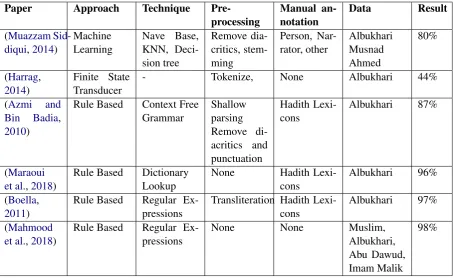
Surveying the literature, we found a number of attempts to detect Isnad patterns. Table 1 shows summaries of such work and the following para-graphs discuss these papers and their limitations.
Muazzam Siddiqui(2014) attempted to segment Isnad from Matn by using supervised machine learning (ML) algorithms that require an anno-tated corpus. Thus, a native Arabic speaker an-notated Hadith tokens extracted from Sahih Al-Bukhari2 into five classes (beginning of Person, inside Person, beginning of Narrator, inside Nar-rator, and Other) where Narrator corresponds to names in Isnad, and Person corresponds to names in Matn.
After annotating the corpus, they studied Hadith contextual patterns to identify features to be used in classification. For example, the word ’told us
-
A JKYg
’ is followed by a narrator’s name in Hadith Isnad, and the word ’son of -áK.
’ is part of a name. Another example is the honorific phrases that al-ways follows a person’s name. The classifier takes the training data and features in the form of ’fea-ture, class’ where each word is classified as ’be-ginning/inside Person, beginning/ inside Narrator, or Other’. Then the system classifies new Hadith tokens and segments the Hadith by finding the end of the consecutive list of narrators.Their system’s performance was measured based on two factors. First, its ability to assign each token the correct type irrespective of the 2Mohammad AlBukhari, Sahih AlBukhari (2002). Dam-ascus: Dar Ibn Kathir.
boundaries as long as there is an overlap. Sec-ond, its ability to correctly find the boundary of each name independent of type assigned (narrator or person). The system produced 90% accuracy in the testing phase. Then for evaluation, they used another manually labeled Hadith book titled ’Mus-nad Ahmed’ which contains 5K tokens that pro-duced 80% accuracy.
Harrag (2014) built a Finite State Transducers (FST) system to extract Hadith segments which include Num-Kitab, Kitab, Num-Bab, Title-Bab, Num-Hadith, Isnad, Matn, Taalik, and Atraf. He used the beginning of words like ’K’ for Kitab to identify the book title. Furthermore, he used punctuation to identify other parts of the Hadith assuming that all Matn is surrounded by paren-thesis. These features depend on the Hadith book used and how well and correctly it is punctuated. Thus, it cannot be applied to all kinds of Hadith books. His work measures the system’s perfor-mance to identify several components of Hadith that range from Isnad and going deeper into iden-tifying the narrator’s names. However, for the pur-pose of our study we only report the result of Isnad extraction which was 44% precision.
Azmi and Bin Badia(2010) built a system that aims to draw the tree of narrators, but first Isnad must be extracted. To extract Isnad, they identi-fied pre-processing steps which include removing diacritics and punctuation; apply shallow parsing to handle noise and leave out words which it is not able to parse. Using the shallow parsing output, Noun phrases were the candidate of being a nar-rator’s name. After pre-processing the data, they applied context free grammar to identify each seg-ment in the Hadith by comparing the tokens to the list of Hadith lexicon they compiled earlier. Since the goal of their study is to build the tree, their re-sult reflects the system’s success to draw the tree and not the segmentation part.
Maraoui et al.(2018) compiled a list of trigger words that come before, after, and between nar-rator’s names. Furthermore, they identified words that mark the termination of each Hadith which are ’
é
¯@Q£
@
’ or ’é
®m
'
’. Using these comprehensive lists of words, they were able to segment Isnad from Matn for Sahih Albukhari. However, it is not clear whether it can be used to segment other Hadith books.Paper Approach Technique Pre-processing
Manual an-notation
Data Result
(Muazzam Sid-diqui,2014)
Machine Learning
Nave Base, KNN, Deci-sion tree
Remove dia-critics, stem-ming
Person, Nar-rator, other
Albukhari Musnad Ahmed
80%
(Harrag, 2014)
Finite State Transducer
- Tokenize, None Albukhari 44%
(Azmi and Bin Badia, 2010)
Rule Based Context Free Grammar
Shallow parsing Remove di-acritics and punctuation
Hadith Lexi-cons
Albukhari 87%
(Maraoui et al.,2018)
Rule Based Dictionary Lookup
None Hadith Lexi-cons
Albukhari 96% (Boella,
2011)
Rule Based Regular Ex-pressions
Transliteration Hadith Lexi-cons
Albukhari 97%
(Mahmood et al.,2018)
Rule Based Regular Ex-pressions
None None Muslim,
Albukhari, Abu Dawud, Imam Malik
[image:3.595.74.528.61.339.2]98%
Table 1: Review of Previous Research on Hadith Segmentation
Hadith. First, it extracts each Hadith from the book by finding the number of each Hadith. Then the Arabic text is converted to its transliteration to find the words of transmission based on a list they compiled. It assumes any words between these transmission words are the narrator’s names. Once there are no transmission terms detected, the sys-tem marks the end of Isnad. However, the exact point of Hadith segmentation is sometimes am-biguous even for humans. To overcome this prob-lem, they have set a threshold of 100 characters which they picked based on trial and error. This threshold tells the system if no other transmission word is detected within the next 100 characters then Matn starts.
Mahmood et al.(2018) extracted Hadiths from different sources, but did not mention any Hadith lexicon list compiled to be used in the Regex. In fact, Hadith lexicons were encoded in the Regex which is not fit for re-usability.
2.1 Limitation of Previous Studies
In the previous research, Hadith segmentation was done using three approaches. First, rule-based that consists of whitelists (or gazetteers) to identify names and Isnad specific words, a filtration mech-anism (or Blacklists) to identify Matn words, and grammar rules (as a set of regular expressions) to
identify the segmentation point. Second is the ML approach which consists of data annotation, fea-ture and algorithm selection, training and classifi-cation. The third is the FST which depends on the degree of consistency in a well-structured text.
Looking at Table 1 above, it is evident that rule-based produced better results. However, it is not clear if the rule-based approach designed for one book can be applied to all Hadith books. In fact, researchers in Mahmood et al. (2018) cre-ated different regular expressions for the differ-ent Hadith books which imply that rule-based ap-proaches cannot be universal. In the other hand, the ML approach is no better since it requires training data that represent all kinds of Hadith to make its performance acceptable when applied to the different Hadith books. For example, the study presented inMuazzam Siddiqui(2014) reported a drop in performance by 10 points once the model was tested with a different book. Another problem is associated with FST, segmentation will not work if the Hadith book does not use unique punctua-tion that surrounds each segment e.g. parenthesis around Matn.
are different in terms of size and type. Second, the way system performance was measured is dif-ferent in every study. For example. The study inMuazzam Siddiqui(2014) measured the preci-sion of the system’s ability to annotate the person’s name as Narrator or not. That is whether each name is part of Isnad or Matn. Therefore, their system goal is not to segment but rather to iden-tify narrators. To sum up, the results column in the table above for papers (Harrag,2014)(Maraoui et al.,2018) (Boella,2011)(Mahmood et al.,2018) reflect the segmentation performance, while the other studies report the performance of named entity recognition(NER) of narrators in Hadith, which can be used in segmentation.
3 Data Preparation
Before building the segmenter, testing data must be prepared. There is a countless number of Ha-dith books with a varying degree of authenticity. For the purpose of our project, we include the six famous books, commonly referred toThe Authen-tic Six or canonical Hadith books. These books are Sahih Albukhari, Sahih Muslim, Sunan Abu Dawood, Sunan Altarmithi, andSunan Ibn Maja. From each book, 40 Hadiths were carefully cho-sen to form 240 Hadiths that include Hadiths with irregular patterns. This is to ensure we accomplish two goals. First, overcome the limitation of previ-ous studies that relied on one book; second, to pro-duce a realistic performance of a segmenter that can deal with all types of Hadith books.
[image:4.595.310.529.64.253.2]Then we gathered data required by our system to segment Hadith, which we refer to as training data. It is a list of Isand and Matn segments ex-tracted from a well-structured Hadith book ’Sahih Albukhari’. To automate this task, we scrutinize Hadith parts to find that Isnad consists of a closed set of words that includes narrators’ names and transmission words. The example of Isnad in Fig-ure 2 underlines the unique words in Isnad. A common pattern in Isnad is the narrator’s name which takes the form of ’first name - son of- fa-ther’s name’, so it is two names connected by a ’relation’ word. Narrator’s names are usually fol-lowed by ’transmission’ words that reflect how the Hadith was reported e.g. x ’heard’ y orx ’said’. Hence, transmission words will appear four words apart at most. Using this information, we cre-ated a list of Isnad lexicons that consists of ’trans-mission’ and ’relation’ words. Then we created
Figure 2: Isnad Example, Isnad lexicons underlined
a python script that tokenizes a Hadith and takes four words at a time to check if an Isnad lexicons is present. Once it detects a group of four words with no Isnad lexicons, it assumes the beginning of Matn text and separates the Hadith at that point. This approach will automatically detect Isnad with regular patterns only, so this step intends to collect the various names of narrators instead of segment-ing the Hadith.
We manually checked the result of this bootstrap-ping approach that produced a collection of more than four thousand Hadiths to form our gold stan-dard of Isnad and Matn segments.
4 Segmentation Model
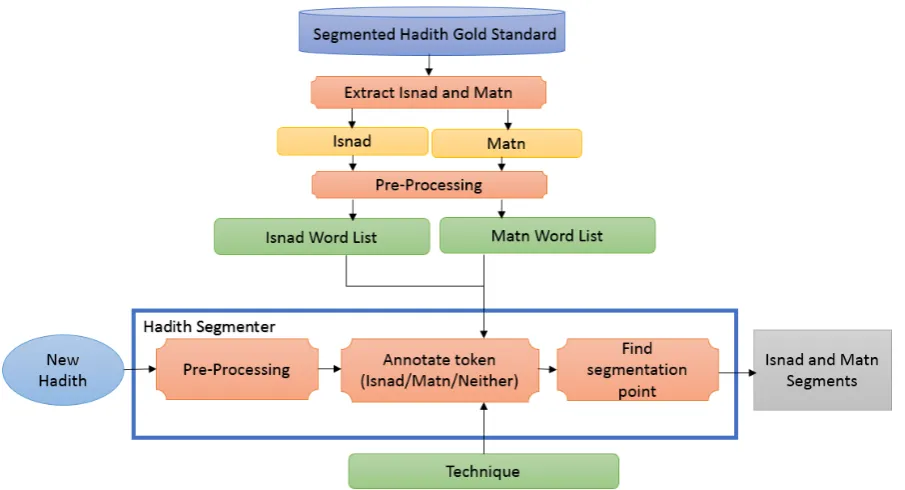
In this section, we discuss the techniques and algo-rithms used to build the Hadith segmenter. Figure 3shows the structure and components of the Ha-dith segmenter model which takes in a new HaHa-dith that goes through a preprocessing phase to remove diacritics and punctuations. Then Hadith is tok-enized into N-grams depending on the technique applied, next each token is labelled as Isnad, Matn or Neither by comparing it with pre-compiled lists obtained from the gold standard created earlier as explained in section 3. Once every token is la-belled, the model finds the best segmentation point of the Hadith. In the following lines, we give de-tails of the techniques used to annotate Hadith to-kens.
4.1 Tri-gram Technique
em-Figure 3: Hadith Segmenter Model
bedding technique does not perform well in Hadith segmentation. This is because such an approach relies on uni-grams that do not capture the unique pattern in Isnad. Furthermore, some words exist in both Isnad and Matn segments, Hence, in this ex-periment, we aim to capture Isnad patterns by us-ing the N-gram technique. As illustrated in Figure 3, Isnad and Matn segments are extracted from the gold standard of segmented Hadiths. Then they are pre-processed to remove diacritics and punc-tuations. Finally, tri-gram, bi-gram and uni-gram lists for Isnad and Matn are created to be the eval-uation lists in the annotation phase. The reason three lists are created is that a back-off approach can handle irregularity and missing information. For example, if an encountered tri-gram has no match in the tri-gram list of the training data, it can be annotated according to its components. Con-sider a narrator’s full name is not captured in the lists, then Hadith lexicons like ’
áK.
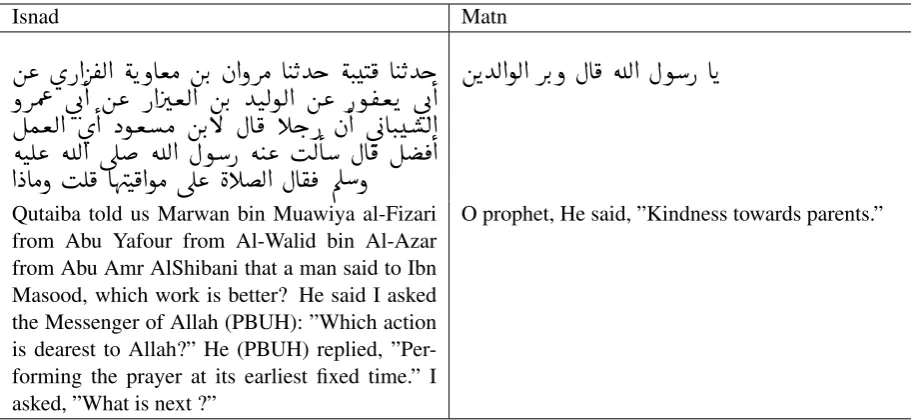
- son of’ will enable the system to identify this tri-gram as part of the narrator’s chain and label it ’Isnad’. This approach is detailed in Algorithm 1. Once every token is labelled, the system finds the segmenta-tion point as detailed in Algorithm2.This approach produced 48% accuracy where only 115 out of 240 Hadiths were correctly seg-mented. To understand this disappointing result, we inspect the incorrectly segmented Hadith and found that the system rarely used the tri-gram
fea-Algorithm 1Annotate Tri-gram tokens Tokenize Hadith into Tr-igramsT fort∈Tdo
ift∈IsnadT rigramListthen
LabeltIsnad
else ift∈M atnT rigramListthen
LabeltMatn else
Converttto Bigramsb
ifb∈IsnadBigramListthen
LabeltIsnad
else ifb∈M atnBigramListthen
LabeltMatn else
Converttto Unitgramu
ifu∈IsnadU nigramListthen
LabeltIsnad
else ifu∈M atnU nigramListthen
LabeltMatn else
LabeltNiether
Output:
[image:5.595.75.528.65.310.2]Isnad Matn
á« ø
P@
Q ®Ë@ éKðAªÓ áK. à@ðQÓ A JKYg
éJ.
J¯ A JKYg
ðQÔ« ú
G
.
@ á« P@ QªË@ áK. YJËñË@ á« Pñ
®ªK úG.
@
ÉÒªË@ ø
@ XñªÓ áK.B ÈA
¯ Cg.P
à
@ ú
GAJ. Ë@
éJÊ« é<Ë@ úÎ é<Ë@ ÈñP é
J« IË
A ÈA
¯ É
¯
@
@
XAÓð
IÊ
¯ Aî DJ
¯@ñÓ úΫ
èCË@ ÈA
®
¯ ÕÎð
áKYË@ñË@ QK.ð ÈA
¯ é<Ë@ ÈñP AK
Qutaiba told us Marwan bin Muawiya al-Fizari from Abu Yafour from Al-Walid bin Al-Azar from Abu Amr AlShibani that a man said to Ibn Masood, which work is better? He said I asked the Messenger of Allah (PBUH): ”Which action is dearest to Allah?” He (PBUH) replied, ”Per-forming the prayer at its earliest fixed time.” I asked, ”What is next ?”
[image:6.595.72.528.61.271.2]O prophet, He said, ”Kindness towards parents.”
Table 2: Example of incorrect segmentation when applying tri-gram technique.
Algorithm 2Find Segmentation point
forevery token inOutputListdo iflabelisMatnthen
iffollowed byMatnorNeitherthen
Mark it as Segmentation Point
Break
else iflabelisNeitherthen iffollowed by twolabelsMatn
orNeither then
Mark it as Segmentation Point
Break
ture, but rather relied on the bi-gram and uni-gram features to annotate tokens. Consider the exam-ple in Table 2, feeding this Hadith to the system produces 79 tri-grams, of which only 15 found a match in the tri-gram training set. The remaining 64 tri-grams relied on the bi-gram and uni-gram training set to be annotated. This dependency on bi-gram/uni-gram features to annotate Hadith tri-grams produced unreliable results as illustrated in the example. The phrase ’
ÈA
¯ Cg.P
à
@
-that a man said’ should mark the beginning of Matn, instead it was labelled as Isnad. This is because when the system did not find a match in the tri-gram training set, it applied the back-off approach and searched in the bi-gram and uni-gram lists. Since it found a match for the term ’ÈA
¯
said’ in the Isnad lists, it labelled the phrase accordingly. Therefore, us-ing tri-grams did not prove useful in our case for two reasons. First, the training data is not largeenough to cover all known narrators. Second, it is obtained from only one Hadith book which does not include all Hadith lexicons and patterns.
4.2 Bi-gram Technique
To improve the system performance, we omit tri-gram features and use bi-tri-grams and uni-tri-grams only.
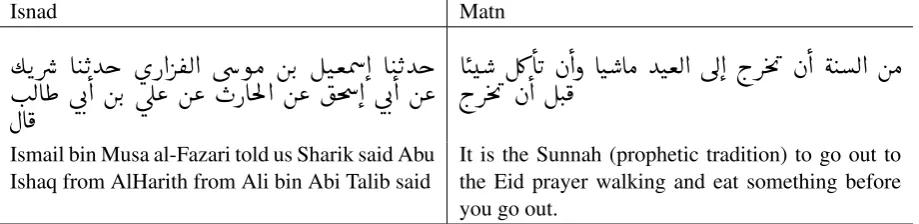
The bi-gram technique produced better results as expected with 222 Hadith out of 240 were cor-rectly segmented, showing 92.5% accuracy. In fact, it is able to segment Hadiths having differ-ent structures. For example, the traditional ones where a Matn start with a prophetic saying as shown in Table 3. Other Hadith structures in-clude those containing irregular patterns where Matn starts with an introductory phrase followed by the prophetic saying as shown in Table4, a di-alogue with the prophet as shown in Table5, or an explanation of a prophetic deed as in Table6.
Isnad Matn
áK. YÒm× A JKYg ú
æÒmÌ'@ YJJ.« áK. Q
J» A JKYg
H.PAm× á« ú
¯AñË@ YJËñË@ áK. é<Ë@ YJJ.« á« YËA
g
ÈA
¯ QÔ« áK. é<Ë@ YJ.« á« PAKX áK.
ÈCmÌ'@
ªK.@ ÕÎð éJÊ« é<Ë@ úÎ é<Ë@ ÈñP ÈA
¯
C¢Ë@ é<Ë@ úÍ@
Kathir bin Obeid Al-Homsi told us Mohammed bin Khalid from Obidallah bin Walid Al-Wasafi from Moharib bin dathar from Abdullah bin Omar said
[image:7.595.79.528.95.221.2]The prophet (PBUH) said, Of all the lawful acts the most detestable to Allah is divorce.
Table 3: Correct segmentation, regular pattern.
Isnad Matn
YJ.« á« HP@ñË@ YJ.« A
JKYg ÈA¯ QÒªÓ ñK.
@ A JKYg
@ ÈA
¯ QK QªË@
úÎ úæ.
JË@ à
@ @QJ» AJKYg ÕºKYg
@ à
@ ú
æª JÒJË é K@
@ñJ.
JÊ
¯ AK.
Y» ú
Ϋ YҪ
K áÓ ÈA¯ ÕÎð éJÊ« é<Ë@
PA JË@ áÓ èYª
®Ó
Abu Muammar told us that Abdul Warith told us from Abdul Aziz said that Anas said
[image:7.595.82.528.270.398.2]I refrain from telling you many things about the prophet because I heard the prophet (PBUH) said, ”He who deliberately forges a lie against me let him have his abode in the Hell.”.
Table 4: Correct segmentation, introductory statement.
Isnad Matn
ú
G
.
@ áK. YK QK á« IJÊË@ A
JKYg ÈA¯ éJ.J¯ A JKYg
ðQÔ« áK. é<Ë@ YJ.« á« Q
mÌ'@ ú
G
.
@ á« I
. J.k
ø@ ÕÎð éJÊ« é<Ë@ úÎ é<Ë@ ÈñP ÈA Cg.P
à@
úΫ ÐCË@ @Q
®Kð ÐAª¢Ë@ Ѫ¢
ÈA
¯ Q
g ÐCB@
¬QªK ÕË áÓð
I
¯Q« áÓ
Qaytibah told us Alith from Yazid ibn Abi Habib from Abi Al-Khair from Abdullah bin Amr
A man asked the Messenger of Allah (PBUH): ”Which act in Islam is the best?” He (PBUH) replied, ”To give food, and to greet everyone, whether you know or you do not.”
Table 5: Correct segmentation, conversation of the Prophet.
Isnad Matn
½KQå A
JKYg ø
P@
Q ®Ë@ úæ ñÓ áK. ÉJªÖÞ @ A JKYg
I
. ËA£ úG.
@ áK. ú
Ϋ á«
HPAmÌ'@ á«
m @ úG.
@ á«
ÈA
¯
AJ É¿
AK à
@ð AJ AÓ YJªË@ úÍ@ h.Q
m' à
@
é JË@ áÓ
h.Q
m' à
@ ÉJ.
¯
Ismail bin Musa al-Fazari told us Sharik said Abu Ishaq from AlHarith from Ali bin Abi Talib said
It is the Sunnah (prophetic tradition) to go out to the Eid prayer walking and eat something before you go out.
[image:7.595.79.528.447.575.2] [image:7.595.73.533.627.739.2]Isnad Matn
èXAJ
¯ á«
éJ.ª á« úæm
' A JKYg ÈA
¯ XYÓ A JKYg
ú
æ
.
JË@ á« é J« é<Ë@ ú
æ P
@ á«
A JKYg ÈA
¯ ÕΪÖÏ@ ák á«ð ÕÎð éJÊ« é<Ë@ úÎ
ÈA
¯ ÕÎð éJÊ« é<Ë@ úÎ úæ.
JË@ á«
@ á«
èXAJ
¯
® JË I
. m' AÓ éJ
k
B I
. m' ú
æk Õ»Yg
@ áÓ ñK B
Mosadad said Yahya told us Shoba heard Qatada from Anas may Allah be pleased with him, the Prophet
[image:8.595.75.527.432.613.2](PBUH), and from Husayn al-Muallim said Qatada told us from Anas that the Prophet (PBUH) said: ”No one of you becomes a true believer until he likes for his brother what he likes for himself”. Table 7: Incorrectly segmented, Parallel Isnad.
Isnad Matn
ú æªÖÏ@ð PAÔ« ñK.
@ð ù
Ò êm.Ì'@ ú
Ϋ áK. Qå
A JKYg
áK. àAJ
® A KQ.
g
@ BA
¯ PAÔ« ú
G
.
@
¡
®Ë
¡
®ÊË@ð Yg@ð
ú
G
.
@ á« áÔgQË@ YJ.« áK. YJÔg á« øQë
QË@ á« é JJ«
...
IºÊë é<Ë@ ÈñP AK ÈA
®
¯ Ég.P èA
K
@ ÈA
¯
èQKQë
Nasser bin Ali Juhadhmi and Abu Ammar told us and the meaning
Is the same but the words are of Ammar they said, Sufian bin Aayneh from Alzahri from Hamid bin Abdul Rahman on the authority of Abu Hurayrah said a man came and said, ”O Allah’s Apostle! I have been ruined.” ...
Table 8: Incorrectly segmented, Isnad contain Matn lexicons.
Isnad Matn
ÈA
¯ àAJ
® A JKYg ÈA
¯ Pñ JÓ áK. YÒm× A
KQ. g
@
Õç'QÓ úG.
@ áK. ÕÎÓ á« YJª áK. úæm
' A JKYg
ÈA
®
¯ qJ Ë@ IJ
® Ë Õç'
é J KYÖÏ@ Éë
@ á Ó qJ
úÍ@ IJÊ Èñ
®K áÔgQË@ YJ.« áK. ú
Ϋ
IªÖÞ
QÔ« áK.@ úÍ ÈA
®
¯ úæmÌ'@
IJ.Ê
®
¯ QÔ« áK.@ I. Jk.
àA¢J Ë@ áÓ úæmÌ'@ I.JÊ®K àA
¯ úæmÌ'@ I
. Ê
®K B
ÕÎð éJÊ« é<Ë@ úÎ é<Ë@ ÈñP IK
@P Aһ ɪ
¯@ð
éJÊ« é<Ë@ úÎ é<Ë@ ÈñP IK
@P
J»ð IÊ
¯ ɪ
®K
...
Yºë ÈA
¯ ɪ
®K ÕÎð
Muhammad bin Mansour told us, that Sufian said Yahya bin Said told us about Muslim bin Abi Maryam a Sheikh from Madinah then I met the Sheikh and he said he heard Ali bin Abdul Rah-man say I prayed beside Ibn Omar, while I turned the gravel he said
Do not fluctuate the gravel, turning the gravel is from the devil and do as I saw the Messenger of Allah peace be upon him do...
Table 9: Incorrectly segmented, names should be part of Matn.
5 Discussion
The findings of this study clearly show that us-ing bi-grams for Hadith segmentation works bet-ter than tri-grams specifically because our train-ing data is limited. Although the segmenter result is promising, not all Hadiths with irregular pat-terns were correctly segmented. In fact, this can be vague even for human annotators who are not
An-other example is a Hadith that starts a Matn seg-ment with a piece of introductory information con-taining names of people which was identified as Is-nad pattern by our segmenter as in Table9. Thus, we aim to make an enhancement to Algorithm 2 to enable the segmenter output several segments in-stead of two, then apply probabilistic measures to identify the exact point of segmentation.
6 Conclusion
In this paper, we demonstrate the need for Hadith common datasets and our initiative to bridge the gap by automatically annotating Hadith corpus us-ing NLP. The main objective of this study is to build a system that segments and annotates Ha-dith components, Isnad and Matn. Before build-ing our system, we evaluated previous attempts to segment Hadith and found that the successful techniques rely on hand-crafted tools that cannot be generalized to segment all Hadith types. Fur-thermore, these systems were tested on a limited number of Hadiths from a single book. To ad-dress these limitations, our segmenter rely on NLP techniques and tested with Hadiths extracted from six books to ensure coverage of all Hadith types. Although it was successful in segmenting Hadith with 92.5% accuracy, examining the incorrect re-sults points us to ways of improvements discussed in the paper.
References
Aqil Azmi and Nawaf Bin Badia. 2010. itree - au-tomating the construction of the narration tree of ha-diths (prophetic traditions). In Proceedings of the 6th International Conference on Natural Language Processing and Knowledge Engineering(NLPKE-2010), pages 1–7.
Marco Boella. 2011. Regular expressions for interpret-ing and cross-referencinterpret-ing hadith texts. Langues et Litt´eratures du Monde Arabe (LLMA), 9(3):25–39.
Ibrahim Bounhas. 2019. On the usage of a classi-cal arabic corpus as a language resource: related research and key challenges. ACM Transactions on Asian and Low-Resource Language Information Processing (TALLIP), 18(3):23.
Kais Dukes and Eric Atwell. 2012. Lamp: a mul-timodal web platform for collaborative linguistic analysis. InProceedings of the Eight International Conference on Language Resources and Evaluation (LREC12), pages 3268–3275. European Language Resources Association (ELRA).
Imane Guellil, Houda Saˆadane, Faical Azouaou, Bil-lel Gueni, and Damien Nouvel. 2019. Arabic nat-ural language processing: An overview. Journal of King Saud University-Computer and Information Sciences.
Fouzi Harrag. 2014. Text mining approach for knowl-edge extraction in sahˆıh al-bukhari. Computers in Human Behavior, 30:558–566.
Emha Taufiq Luthfi, Nanna Suryana, and Adbul-samad Hasan Basari. 2018. Digital hadith authen-tication: A literature review and analysis. Journal of Theoretical & Applied Information Technology, 96(15).
Ahsan Mahmood, Hikmat Ullah Khan, Fawaz K Alar-faj, Muhammad Ramzan, and Mahwish Ilyas. 2018. A multilingual datasets repository of the hadith con-tent. International Journal of Advanced Computer Science and Applications, 9(2):165–172.
Hajer Maraoui, Kais Haddar, and Laurent Romary. 2018. Segmentation tool for hadith corpus to gen-erate tei encoding. InInternational Conference on Advanced Intelligent Systems and Informatics, pages 252–260. Springer.
Abobakr Bagais Muazzam Siddiqui, Mostafa Saleh. 2014. Extraction and visualization of the chain of narrators from hadiths using named entity recogni-tion and classificarecogni-tion. Int. J. Comput. Linguist. Res, 5(1):14–25.