A logical and computational methodology for exploring systems of
phonotactic constraints
Dakotah Lambert Earlham College Richmond, Indiana, USA [email protected]
James Rogers Earlham College Richmond, Indiana, USA [email protected]
Abstract
We introduce a methodology built around a logical analysis component based on a hi-erarchy of classes of Subregular constraints characterized by the kinds of features of a string a mechanism must be sensitive to in or-der to determine whether it satisfies the con-straint, and a computational component built around a publicly-available interactive work-bench that implements, based on the equiv-alence between logical formulae and finite-state automata, a theorem prover for these logics (even algorithmically extracting certain classes of constraints), wherein the alternation between these logical and computational anal-yses can provide useful insight more easily than using either in isolation.
We demonstrate this methodology by explor-ing a series of examples drawn from the StressTyp2 database (Goedemans et al., 2015) of patterns of lexical (suprasegmental) stress. Along the way we provide justification for the underlying model-theoretic approach to for-malizing phonotactic patterns and demonstrate the ways in which this dual methodology can be applied to a range of phonological issues. 1 Introduction
In this paper, we introduce a set of logical (model-theoretic) and computational (automata-(model-theoretic) tools along with a methodology for exploring sys-tems of constraints on strings that combines them. We have incorporated these into a computational workbench, which we use to demonstrate the ap-plication of this methodology to the study of lexi-cal (suprasegmental) stress patterns obtained from StressTyp2 (Goedemans et al., 2015).
Although the formal tools we employ here are tailored to phonotactics, the methodology we are using — alternating between the logical and com-putational tools in exploring the data — is appli-cable, with suitably modified tools, to other
as-pects of phonology, syntax and semantics, as well as many non-linguistic applications.
In our specific application, the phenomena we must account for are phonotactic stress patterns of human languages. Our facts are descriptions of these patterns drawn from the literature, and our methods are intended to support identification and generalization of regularities and variations both within and across languages. When we say “constraints,” we are referring to these observed facts.1 Often there will be constraints that are true of some words in a language but not others. This variation will be listed among the observed facts. There may also be constraints true of all or most languages. The expected universality of these con-straints will also be among the observed facts.
With this notion of constraints, we identify the following desiderata for systems of phonotactic constraints:
1. The constraints should distinguish possible unmarked words from those that are not pos-sible. They must be complete, licensing all and only the unmarked words, and consistent in the logical sense.
2. The constraints should provide a useful foun-dation for generalizing across languages. A system should provide a means to compare phonotactic constraints across languages and, in particular, a means to identify potential universals. At the same time the system must provide a means of identifying unnecessary constraints. Consequently, a system must provide a means of determining if a set of 1Our use of the term ”constraint” here should not be con-fused with the formalized notion of constraint in Optimality Theoretic accounts of phonology, in which the violability of constraints is fundamental to the formal framework. In the sense we mean here, the constraints are the regularities of the surface structure of language that an OT account is intended to account for.
constraints implicitly satisfies constraints that are not explicitly stated. Finally, the system should, in principle, be capable of fully de-scribing the entire range of attested human languages in a uniform way.
3. The phenomena the constraints describe are a consequence of actual human behavior. Thus, there actually exists some physical mechanism that can, in principle, determine whether a given set of constraints are satisfied by a given word. Further, these mechanisms do this quickly. Hence the constraints must be feasible in the sense that they lie at a rela-tively low level of complexity with respect to some computational model (but not necessar-ily all such models). Finally, the constraints are learnable. There are physical mecha-nisms that in principle, given some (possibly empty) set of universal constraints and suffi-ciently many (possibly positive or negative) examples, can generalize to an equivalent set of constraints.
In the next section we sketch the model-theoretic foundations of our methodology. We then proceed, in Sections 3 and 4 to introduce the analytic component of the methodology by apply-ing it to examples drawn from StressTyp2.
In Section 5 we begin to explore the computa-tional component by looking at the computacomputa-tional and cognitive complexity of simple propositional systems of constraints based on adjacency. We fol-low that, in Section 6, with a similar exploration of simple constraints based solely on precedence (“long distance” constraints).
In Section 7 we describe the algorithmic mech-anisms underlying the computational component of the methodology. We then turn, in Section 8, to sketch the space of classes of stringsets definable with more powerful logical mechanisms beyond the propositional logic characterizing these simple classes.
In Sections 9 and 10 we lay out the full method-ology and sketch the results of its application to Yidin. Finally, we conclude by revisiting the desiderata we list in the introduction. We then summarize some of the results that have been ob-tained using this methodology and close by noting some of the ways the model-theoretic approach has been generalized beyond phonotactics, all of which are candidates for potential extensions of our computational tools.
2 Logical Foundations
We interpret the descriptions of phonotactic stress patterns collected in the StressTyp2 database as sets of strings over an alphabet, Σ, of symbols, each of which denotes a particular syllable type. In this paper, we takeΣto represent syllable weight:
light (L) or heavy (H);2 along with diacritics de-noting stress level: none (no mark), secondary stress (`), or primary stress (´). For our
log-ical formulae we include symbols denoting trary weight (σ) and stress marks denoting arbi-trary stress (∗), some stress (i.e., not unstressed) (+) and non-primary stress (i.e., either secondary or unstressed) ( ). So σHL`+ σ would denote a word consisting of an arbitrary unstressed syllable, followed by a heavy syllable with either primary or secondary stress, followed by a light syllable with either secondary or no stress and followed by any syllable with secondary stress.
The semantics of our logic is built on two re-lations between strings. The first, based on ad-jacency, is the substring relation. A string, v, is a substring of another, w, if and only if (iff) the symbols ofvoccur in order as a contiguous block inw. Formally
v!w ⇐⇒def w=w1vw2, w1, w2∈Σ∗
The second relation is based on precedence. A string, v, is a subsequence of another, w, iff the symbols ofvoccur inwin order but not necessar-ily contiguously. Formally
v⊑w ⇐⇒def v=v1v2· · ·vn, and
w=w1v1w2v2· · ·vnwn+1, vi, wi∈Σ∗
2.1 Logical formulae
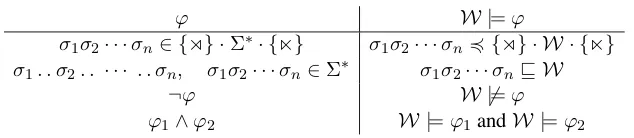
Our focus, in this paper, is on a propositional logic in which the atoms are either substrings or subse-quences of a string. The set of substrings occur-ring in a stoccur-ring is traditionally referred to as its set of factors. We extend this to subsequences, spec-ifying substring factor or subsequence factor only when necessary to avoid confusion.
ϕ W |=ϕ
σ1σ2· · ·σn∈ {!} ·Σ∗· {"} σ1σ2· · ·σn!{!} · W · {"}
σ1. . σ2. . · · · . . σn, σ1σ2· · ·σn∈Σ∗ σ1σ2· · ·σn⊑ W
¬ϕ W ̸|=ϕ
[image:3.612.150.467.57.126.2]ϕ1∧ϕ2 W |=ϕ1andW |=ϕ2
Figure 1: The semantics of our logical formulae
Note that we do not license atoms that mix sub-string and subsequence, although complex formu-lae may well include atoms of both types. In ad-dition, substring factors may include either a left-end marker (‘!’) or a right-end marker (‘"’) or both, in which case we say that they are anchored. In addition to these atoms the language includes the full set of Boolean connectives with their se-mantics derived from the sese-mantics of negation (‘¬’) and conjunction (‘∧’).
The model-theoretic semantics of this logic are given formally in Figure 1. An atom is true of a string iff it is a factor of the appropriate kind of that string. By augmenting the models with endmark-ers in defining the semantics of substring models, anchored substring factors are required to occur at the either the left end or right end of the string or to span the entire string, as appropriate. The semantics of subsequence factors is insensitive to string boundaries. The Boolean operators are de-fined canonically. We use the notation ‘W |=ϕ’
to denote the satisfaction relation between strings and formulae; a stringW satisfies a formulaϕiff ϕevaluates toTRUEwith respect to the stringW.
Note that, while our models (i.e., strings) have internal structure which come into play when we add quantifiers to the logic, that structure is only significant here in assigning truth values to the atoms. Each string is simply a Boolean valuation of the set of all atoms occurring in a formula; this is truly a propositional logic.
3 An example: Cambodian
Let us take for example the Cambodian language, as described in StressTyp2:
(1) a. In words of all sizes, primary stress falls on the final syllable.
b. In words of all sizes, secondary stress falls on all heavy syllables.
c. Light syllables occur only immedi-ately following heavy syllables. d. Light monosyllables do not occur.
We begin by examining Constraint 1a. Using our logical notation, we write this constraint as a pos-itive literal:
(1a) σ´" (Preliminary)
Let us now continue to Constraint 1b. Here, we may be tempted to say something like this:
(1b) H∗ →H` (Wrong)
However, this would mean “If a heavy syllable happens, then a heavy syllable with secondary stress also happens.” What Constraint 1b re-ally says is “No heavy syllable without secondary stress occurs,” which in turn implies “No un-stressed heavy syllable occurs, and no heavy syl-lable with primary stress occurs.” So we write in-stead a conjunction of two negative literals:
(1b) ¬H∧ ¬H´ (Preliminary)
However, this is still not quite the correct con-straint, as it would prevent primary stress on a heavy syllable, which Cambodian requires if it is final. As is not unusual, many of the descriptions of stress patterns rely on common phonological as-sumptions and are inconsistent or ambiguous in their absence. Indeed, the constraint we actually want is “No unstressed heavy syllables occur.”
(1b) ¬H (Final)
This is a single negative literal. In fact, we can rewrite Constraint 1a as a negative literal as well:
(1a) ¬σ" (Preliminary)
Note that, since the semantics ‘σ’ is disjunctive, this expands into a conjunction of four negative literals:
(1a) ¬L"∧¬L`"∧¬H"∧¬H`"(Preliminary)
(1c) ¬L∗L∗∧ ¬!L∗ (Final)
Finally, we have Constraint 1d, that light mono-syllables do not occur:
(1d) ¬!L∗" (Final)
It is clear at this point that any word satisfying Constraint 1c also satisfies Constraint 1d, so in-cluding the latter is logically unnecessary. There-fore the following conjunction suffices to describe these constraints:
(1) ¬σ"∧ ¬H∧ ¬L∗L∗∧ ¬!L∗ (Preliminary)
This will be refined again at the end of the next section.
As we will see shortly, this form, a conjunction of negative literals, is significant from a cognitive and complexity-theoretic perspective.
4 Phonotactic regularities
Constraint 1d is logically unnecessary in the de-scription of Cambodian, but it is still interesting phonologically. For example, the stress pattern of Alawa, a language with only one syllable weight and two levels of stress, is given in StressTyp2 as
(2) In words of all sizes, primary stress falls on the penultimate syllable.
This constraint, of course, cannot apply to mono-syllables, which have no penultimate syllable. Again, the description relies on common phono-logical assumptions; in this case the meaning is ambiguous. There are four distinct possibilities for what might happen to monosyllables in Alawa:
1. Monosyllables do not occur (similar to Con-straint 1d).
2. Monosyllables occur, and are always stressed.
3. Monosyllables occur, and are never stressed.
4. Monosyllables occur, and may or may not be stressed.
In the case of Alawa, monosyllables do occur and are always stressed, so Constraint 1d is not satis-fied by Alawa, even though the original descrip-tion suggests it would be.
This leads us naturally to consider what kinds of constraints do, in fact, occur universally across languages. One such putative universal is that
all words contain exactly one syllable with pri-mary stress (which we will call 1-Stress). Hyman (2009) argues, in the context of unifying the anal-ysis of stress and tone, that 1-Stress is better an-alyzed as the conjunction of two constraints, one of which is that every word contains some sylla-ble with primary stress (which, following Hyman, we will refer to as obligatoriness). The other is that no word containsmore than onesyllable with primary stress (culminativity).
Between the description of Alawa and our ob-servation regarding monosyllables, we see that Alawa satisfies this constraint. We also see that, in Cambodian, Constraint 1a logically implies obli-gatoriness for words of at least one syllable. If we wanted to be truly accurate, we might rule out words of less than one syllable:
(0) When a human says something, they actu-ally say something.
Formally:
(0) ¬!" (Final)
This may be overly pedantic, but it explicitly states that every word contains at least one syllable. Such things matter when using logical machinery to test hypotheses.
Looking at Cambodian’s English description, culminativity is a (pragmatic) implicature of Con-straint 1a, but it is neither explicitly stated nor log-ically implied. If this constraint says that primary stress falls on the final syllable and we assume cul-minativity, then primary stress may not occur on any non-final syllable. We obtain a complete de-scription by augmenting this constraint to account for obligatoriness and culminativity.
(1a) ¬σ"∧ ¬!"∧ ¬σ´σ∗ (Final) (1) ¬σ"∧ ¬!"∧ ¬σ´σ∗∧ ¬H∧ ¬L∗L∗∧ ¬!L∗
(Final)
5 Local constraints
classes corresponds to a ranking of cognitive com-plexity based on the nature of the information in a string: each class is characterized by the kinds of features of strings that a mechanism must be sen-sitive to in order to determine whether a string is in a given set.
Because the pattern of phonological stress in Cambodian is completely described by a conjunc-tion of finitely many negative atomic formulae, a mechanism that is able to make judgments as to whether a word satisfies each constraint only needs to be sensitive to whether certain substrings of some fixed length occur in the word.
Specifically, ‘¬H’ requires sensitivity only to single syllables in isolation while the other con-straints in Cambodian require a mechanism to be sensitive to pairs of consecutive syllables. Such a pattern is called “Strictly2-Local,” or “SL2”, The ‘2’ in “SL2” is a parameter giving the length of factors that a mechanism must necessarily be sen-sitive to in order to be able to make judgments about well-formedness.
From a procedural perspective, these judgments can be made by ascanner, a mechanism that sim-ply scans a window of a fixed size across the in-put, one symbol at a time, looking at each factor in sequence. SinceSLk stringsets are defined by
conjunctions of negative constraints, it suffices to look for unlicensed factors, rejecting the string if any are found.
This generalizes to any pattern completely de-scribed by a conjunction of finitely many negative literals: such a pattern isSLk, wherekis the length
of the longest factor. For example, Alawa isSL3: (2) ¬σσ"∧ ¬σ´σ∗σ∗∧ ¬σ∗σ´"∧ ¬!σ"∧ ¬!"
(Final)
Since eachk-factor can be extended to an equiv-alent(k+ 1)-factor by extending it with all
possi-ble next syllapossi-bles, a pattern that isSLkmust also
beSLk+1.
If we say ‘SL’ with no explicit factor length,
what we really mean is “SLkfor somek.” A
con-straint can be shown to beSLsimply by giving a formula that witnesses this. Of course, this merely gives an upper bound.
Generally, lower bounds can be found by ap-pealing to the abstract properties of classes of stringsets. In this case we can show that Alawa is notSL2 using the fact that SLk stringsets are
characterized by asuffix substitution closure prop-erty: if some(k−1)factor occurs in two strings
that satisfy the constraint then the results of swap-ping suffixes of the two strings that start with that factor will also satisfy the constraint. (Intuitively, recognizing the penult requires noting that it is fol-lowed by a single syllable and no more:!σσσσ´ "
and!σσσσ´ "share the same 2-factors, so a
mech-anism needs a window of size at least three.) InSLstringsets, each constraint must be
satis-fied at every position in the word. Since a single violation suffices to rule out a word, a mechanism only needs to be sensitive to factors in isolation. Logical complements of SL constraints (coSL),
which are defined by disjunctions of positive lit-erals, also only require sensitivity to factors in iso-lation (accepting if any required factor occurs) but combinations of positive and negative literal con-straints are not so simple: in order to verify that certain factors occur somewhere in the word while others do not a mechanism must be sensitive to the entire set of factors in the word. Constraints requiring sensitivity to this entire set are “Locally Testable,” or “LT”. Much as factor-width may be specified inSLstringsets, we may say a pattern or constraint isLTk, where the salient factors have a
length of at mostk. Again likeSLpatterns, every LTkpattern isLTk+1.
Since a mechanism capable of making judg-ments based on the set of factors in a word must necessarily be able to check these factors individ-ually, any constraint that is SLk or coSLk must
also beLTk. Further, since the entire set of
tors is available, any Boolean combination of fac-tors may be used as an LT constraint. Giving a
constraint in this form is sufficient to show that it isLT, and again we can use abstract properties of
theLTstringsets to show that a constraint is not in
the class.
Obligatoriness by itself is coSL1, hence LT1, as witnessed by its expression as a single positive atomic constraint: ‘σ’. It is not, in itself,´ SLk for
anyk. Obligatoriness can only be satisfied by a system ofSL constraints if they require primary
stress to fall within some fixed distance from either end of the word.
Similarly, culminativity is not SL. It can
only be satisfied by a system of SL constraints if they require all syllables with primary stress to occur within a fixed distance of either end of the word. Since satisfaction of an LT
be-tween strings that have the same factorization, thus we can see by example that culminativity is also notLT3, as ‘LL ´HLL’ and ‘LL ´HLL ´HLL’ contain the same set of substring 3-factors:
{!LL,LL ´H,L ´HL,HLL´ ,LL"}. This
counter-example generalizes to any factor-width, so cul-minativity is notLT(a fortiorialso notcoSL).
6 Piecewise constraints
All local constraints are given in terms of adja-cency. If we instead use precedence, then culmi-nativity is quite a simple constraint:
(3) ¬σ..´ σ´ (Final)
A constraint described by a negative atomic for-mula of length k is “Strictly k-Piecewise”, or “SPk”. A mechanism must be sensitive to
sub-sequences of lengthk in isolation in order to de-termine whether a string is in anSPkstringset.
Culminativity in particular isSP2. AnotherSP constraint comes from Nubian, this oneSP3. It is alsoLT2, but notSL:
(4) a. If a word contains a non-final heavy syllable, then no light syllable with primary stress occurs in that word.
(4a) ¬(H∗σ∗∧L)´ [or:H∗σ∗→ ¬L´] (Adjacency)
(4a) ¬L´..H∗..σ∗∧ ¬H∗..L´ (Precedence)
Although Constraint 4a is both LT andSP, It
is not the case that every LT constraint is SP.
If a string satisfies an SP constraint, then every
string formed by deleting finitely many symbols from that string also satisfies that same constraint (Rogers et al., 2010). Knowing that, it is impossi-ble for obligatoriness to be satisfied by a system of onlySPconstraints.
In order to capture obligatoriness using prece-dence, a mechanism must be sensitive to the set of all subsequences in a string. These constraints are “Piecewise Testable”, or “PT”. Just as Boolean combinations ofSL constraints areLT, Boolean combinations ofSP constraints arePT. As with
the local classes, stringsets that are the comple-ment ofSP stringsets (i.e., that arecoSP), while
properlyPTare effectively no harder to recognize
thanSPstringsets. Obligatoriness iscoSPas
wit-nessed by ‘σ’, the same formula that witnesses that´
it iscoSL;SLkandSPkconverge fork= 1.
L ´H
Σ− {L} L Σ
´ H L
Σ− {L,H´}
!L ´H
Σ ´ H L
!L ´H"
´ H L
L. .H´
Σ− {L} Σ− {H´} Σ
[image:6.612.338.500.56.173.2]´ H L
Figure 2: Automata for substring and subsequence fac-tors.
7 Computational Foundations
Our computational workbench is a theorem prover (written in Haskell) based on the equivalence between logical formulae for finite sequences (successor models) and finite state automata es-tablished originally by Medvedev (1964); B¨uchi (1960) and Elgot (1961). The underlying idea is quite simple. One constructs automata for each of the atomic formulae of the logic which accept ex-actly those strings which satisfy that atom. Since our logic (so far) is quantifier free and our models are simply strings, the automata work directly on the models.
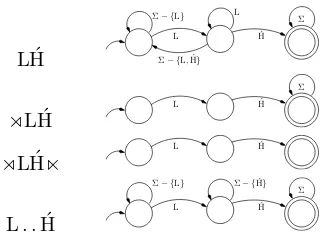
Examples of automata for anchored and unan-chored substring formulae and for a subsequence formula are given in Figure 2. The Boolean connectives are implemented via the correspond-ing automaton constructions: conjunction corre-sponds to intersection, negation to complement.
?
Prop
Strict FO
PT LT
MSO
Reg
SF
SL+SP
SP SL
SPL PLT
LT+PT LTT
coSL coSP
[image:7.612.131.261.56.191.2]▹ ▹, < <
Figure 3: A cognitive complexity hierarchy.
includes (overgenerates); the formula is correct if both sets are empty.
The automata from the database are use-ful in analysis as well. The workbench in-cludes algorithms that, given a finite state au-tomaton, can determine whether the stringset it recognizes is Strictly Local (Caron, 2000) or if it is Strictly Piecewise (Rogers et al., 2010) and, if it is, determines the factor width pa-rameter k. In addition, it includes the algo-rithms given by Rogers and Lambert (2017) and Rogers and Lambert (to appear) which can, given an automaton, extract the set of forbidden sub-string or subsequence factors which suffice to characterize the stringset recognized by that au-tomaton if it is SL or SP (or a conjunction of
SL + SP + coSL + coSPconstraints) and can
pro-duce an automaton that recognizes anSL + SP + coSL + coSPapproximation of that stringset if it
is not.
In each case the approximation, if it is not exact, overgenerates and, so, by taking the difference be-tween the approximation and the original automa-ton one gets a stringset that provides guidance in formulating the non-strict constraints necessary to completely characterize the original pattern. 8 Higher level constraints
Culminativity is neitherSLnorLT. It is possible
to enforce culminativity using only adjacency but in order to do so a mechanism must distinguish oc-currences of primary stress by their position in the string. The logic we are working with here is the propositional fragment of the hierarchy of logics explored by Rogers et al. (2012). The higher lev-els (i.e. regular stringsets that are notLT + PT)
represent strings as the same first-order models, with binary predicates for adjacency and
prece-dence, but also allow for quantification over po-sitions (first-order) or sets of popo-sitions (monadic second-order). Recognizing whether a string sat-isfies a quantified formula requires inferring in-formation that is not explicit in the string which changes the nature of the cognitive task, not just its magnitude.
First-order formulae that employ only adja-cency characterize the Locally Threshold Testable (LTTk,t) class. A mechanism recognizing such a
stringset can count occurrences of k-factors, but only up to a threshold: the second parameter,t. It cannot distinguishtor more distinct occurrences.
If, on the other hand, these first-order formu-lae make use of precedence (‘<’), then the result is something strictly stronger, the Star Free (SF) stringsets. Such stringsets are defined much like Regular stringsets, except they are closed under complement rather than the Kleene star.
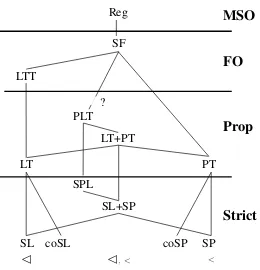
Finally, if we allow monadic second-order quantification we can define all and only the Reg-ular stringsets. This completes the sub-RegReg-ular hi-erarchy shown in Figure 3; the classes in the mid-dle of the diagram are the stringsets definable by combinations of local and piecewise constraints (conjunctions at the restricted level, any Boolean combinations at the full propositional level and atoms that mix adjacency and precedence in the PL classes).
Some of the constraints listed in StressTyp2 are most naturally expressed in terms of the quantified logics but these turn out to never be necessary for stress patterns.
9 Methodology
We explore patterns by alternating between anal-ysis based on linguistic and logical knowledge and computational analysis and synthesis using the tools of the workbench. In this paper, we began with an analytic phase, transforming the English description of a pattern into a logical description. During this translation process, one can use the ab-stract characterizations of the complexity classes as a guide to the form needed to express a given constraint. Assuming this translation is success-ful, these constraints provide an upper-bound on the complexity of the pattern as a whole.
those automata (Rogers and Lambert, to appear). If the pattern is not simplySL+SP+coSL+coSP
the result of these computational methods is an ap-proximation that is.
Another alternative is to work directly from a corpus of annotated examples using learning algo-rithms based on Chandlee et al. (2018), which are currently being incorporated into the workbench. Again, the result is a (possibly exact) approxima-tion that isSL + SP + coSL + coSP.
In all three cases, the workbench implements a computational synthesis phase which represents these systems of constraints as automata. If an automaton is provided for the pattern the correct-ness and completecorrect-ness of the constraints can be checked computationally against this automaton by constructing an automaton that recognizes the symmetric difference between the two, which can either be examined directly or used to generate ex-amples of strings that satisfy the constraints but should be excluded or those that should not be ex-cluded but fail to satisfy the constraints. If there is no existing automaton to work against, one can generate strings up to a given length-bound and look for inconsistencies. In any case, if there is under- or overgeneration the structures of these residues guide a return to the analytical phase, adding or modifying constraints in order to ac-count for the differences.
Once the conjunction of logical constraints cor-rectly describes the pattern in question, the work-bench can minimize the description by removing constraints that are logically implied by others. Because these subregular classes form a proper hi-erarchy and are all closed under intersection, the complexity of the stringset is simply the maximum of the complexity of the constraints that describe it.
Our workbench can find all of the minimal in-dependent subsets of a set of constraints con-straints that describe the same pattern as the full set. However, if a constraint of higher complexity is implied by a set of lower-complexity constraints a smaller subset in which the higher-complexity constraint is explicit will be not be an accurate in-dication of the complexity of the stringset, rather a larger set of lower-complexity constraints would be preferred. So the workbench can also check sets of constraints provided by the user, such as the constraints identified earlier in the process either from analysis of other patterns or from theoretical
▹ <
one´σ LTT1,2 PT2
obligatoriness coSL1 PT1 culminativity LTT1,2 SP2
noHbeforeH´ SF SP2
noH∗ withL´ LT1 SP2 nothing beforeL´ SL2 SP2
alternation SL2 SF
[image:8.612.334.500.58.184.2]no light monosyllables SL3 PT2
Table 1: Constraints in Yidin expressed locally and piecewise.
analysis of the linguistic phenomena under study, against the rest of the set and find independent subsets that are minimally complex. It should be noted that minimal descriptions from a linguistic perspective may well not be the same as the mini-mal descriptions from a complexity-theoretic per-spective. But as long as they are logically equiva-lent, the complexity result is still valid.
One can use this same mechanism to determine whether a pattern satisfies a putative universal con-straint by merely checking whether this concon-straint is implied by those that describe the pattern in question. When the corpus of patterns of Stress-Typ2 was tested for both obligatoriness and cul-minativity, it was discovered that while every lect satisfies culminativity, there are two that do not satisfy obligatoriness, namely Seneca and Cayuga. These are languages that Hyman identifies as not satisfying “the more accent-like properties of obli-gatoriness and culminativity” (Hyman, 2009).
When working with a set of lects, one will col-lect a library of non-strict constraints. The work-bench can use this to automatically determine if a new pattern can be completely described by a con-junction of strict constraints and some subset of this library. When the StressTyp2 corpus was ana-lyzed, only five non-strict constraints were needed to describe the entire set of patterns.
10 Yidin: An example Yidin is described as:
(5) a. In words of all sizes, primary stress falls on the left-most heavy syllable, else on the initial syllable.
stress.
c. Light monosyllables do not occur. Table 1 shows the constraints we derived from this description. The left column is an English gloss of the constraint, while the remaining two columns note the complexity class in which the constraint falls on both the local and piecewise branches of the hierarchy. Alternation, SFon the piecewise side, is onlySL2 on the local side. Similarly, “no
HbeforeH´” isSFon the local side, but onlySP2
on the piecewise side. Thus, considering either branch of the hierarchy in isolation brings the con-clusion that the pattern isSF, but using a mix of
constraints from both sides shows that the pattern isSL3+ coSL1+ SP2.
11 Conclusion
We have introduced an approach to formaliz-ing lformaliz-inguistic patterns that is based on a model-theoretic analysis of strings. We work primarily with propositional formulae for which satisfaction depends the substrings or subsequences that occur in a string. Definability of sets of strings in these logics characterizes the lowest classes of the local and piecewise subregular hierarchies.
This foundation fulfills all of the desiderata for systems of phonotactic constraints that we iden-tify in the introduction. The logical constraints are unambiguous and fully explicit. As we have seen, the process of translating constraints stated in English to an equivalent logical form can illumi-nate inconsistencies and ambiguities that are usu-ally resolved by pragmatic linguistic assumptions. By comparing systems of logical constraints along with the sets of their models one can gen-eralize across languages, identifying constraints that are common to classes of languages and testing putative universals against those classes. Again, using standard model-theoretic tools, one can identify minimal independent sets of con-straints, eliminating those that are logically im-plied by the others.
We have demonstrated the breadth of cover-age of this approach with respect to one range of phonotactic phenomena by using it to fully characterize the phonological stress patterns gath-ered in the StressTyp2 database. In Heinz (2018), Heinz argues that essentially all of phonotactics falls within the the classes of this subregular hi-erarchy. Moreover there is a growing body of work (Chandlee and Heinz, 2018; Chandlee et al.,
2015, 2014; Chandlee, 2014; Jardine, 2017, 2016a,b) that suggests that many phonological processes can be captured by functions based on these same sorts of logics.
Most importantly, all of these model-theoretic tools are effective in the sense of being com-putable. Moreover, the classes of the hierarchy correspond directly to the nature of the informa-tion about a string that any mechanism must be sensitive to in order to determine if it satisfies a constraint. Consequently, the hierarchy provides a measure of the relative complexity of constraints. They are also all learnable in the limit from posi-tive data by algorithms of low computational com-plexity.
Our analysis of StressTyp2 demonstrates that phonological stress is extremely simple. Our focus is the methodology itself, not the phonological re-sults that have been obtained using it. But we note that, as reported elsewhere, when this methodol-ogy was applied to a corpus of the 106 lects in StressTyp2 that have both English language and automata descriptions, it was found that all but eight (92.5%) were SL + SP + coSL, six more
needed some subset of a library ofLTconstraints
consisting of obligatoriness and three other con-straints, and the remaining two were properly Reg-ular, sharing a constraint based on hidden stress alternation. If secondary stress were to surface in these latter two then they would simply be SL. This means that, aside from the two patterns in-volving the properly Regular constraint, no pattern in the corpus requires a mechanism to infer addi-tional information beyond that which is present in the surface string. Moreover, the only piecewise constraints are SP, forbidding the co¨occurrence
of certain syllables as in the case of culmanitivity, confirming Heinz (2014).
It has been verified that all patterns in this cor-pus satisfy culminativity, and the two patterns that do not satisfy obligatoriness, as expected by Hyman (2009), have been identified.
References
J. R. B¨uchi. 1960. Weak second-order arithmetic and finite automata.Zeitschrift f¨ur mathematische Logik und Grundlagen der Mathematik6:66–92.
Pascal Caron. 2000. Families of locally testable lan-guages. Theoretical Computer Science 242:361– 376.
Jane Chandlee. 2014.Strictly Local Phonological Pro-cesses. Ph.D. thesis, The University of Delaware.
Jane Chandlee. 2017. Computational locality in mor-phological maps.Morphology27:599–641.
Jane Chandlee, R´emi Eryraud, Jeffery Heinz, Adam Jardine, and Jonathan Rawski. 2018. Learning with partially ordered representations. Submitted to ALT 2019.
Jane Chandlee, R´emi Eyraud, and Jeffrey Heinz. 2014. Learning strictly local subsequential func-tions. Transactions of the Association for Compu-tational Linguistics2:491–503.
Jane Chandlee, R´emi Eyraud, and Jeffrey Heinz. 2015. Output strictly local functions. In Marco Kuhlmann, Makoto Kanazawa, and Gregory M. Kobele, editors, Proceedings of the 14th Meeting on the Mathemat-ics of Language (MoL 2015). Chicago, USA, pages 112–125.
Jane Chandlee and Jeffrey Heinz. 2018. Strictly lo-cality and phonological maps. Linguistic Inquiry 49(1):23–60.
Calvin C. Elgot. 1961. Decision problems of finite au-tomata design and related arithmetics.Transactions of the American Mathematical Society98:21–51.
R. W. Goedemans, Jeffrey Heinz, and Harry van der Hulst. 2015.
http://st2.ullet.net/files/files/ st2-v1-archive-0415.tar.gz. Retrieved 24 Jun 2015.
Thomas Graf. 2014. Beyond the apparent: Cognitive parallels between syntax and phonology. In Car-son T. Sch¨utze and Linnaea Stockall, editors, Con-nectedness: Papers by and for Sarah van Wagenen. volume 18 ofUCLA Working Papers in Linguistics, pages 161–174.
Jeffrey Heinz. 2014. Culminativity times harmony equals unbounded stress. In Harry van der Hulst, editor,Word Stress: Theoretical and Typological Is-sues, Cambridge University Press, Cambridge, UK, chapter 8.
Jeffrey Heinz. 2018. The computational nature of phonological generalizations. In Larry Hyman and Frank Plank, editors,Phonological Typology, Mou-ton De Gruyter, volume 23 ofPhonetics and Phonol-ogy, chapter 5, pages 126–195.
Larry M. Hyman. 2009. How (not) to do phonolog-ical typology: the case of pitch-accent. Language Sciences31(2–3):213–238.
Adam Jardine. 2016a. Computationally, tone is differ-ent.Phonology32(2):247–283.
Adam Jardine. 2016b. Locality and non-linear repre-sentations in tonal phonology. Ph.D. thesis, Univer-sity of Delaware.
Adam Jardine. 2017. The local nature of tone-association patterns.Phonology34:385–405. Yu. T. Medvedev. 1964. On the class of events
rep-resentable in a finite automaton. In Edward F. Moore, editor, Sequential Machines; Selected Pa-pers, Addison-Wesley, pages 215–227. Originally published in Russian in Avtomaty, 1956, 385–401. James Rogers. 1998. A Descriptive Approach to
Language-Theoretic Complexity. (Monograph.) Studies in Logic, Language, and Information. CSLI/FoLLI.
James Rogers, Jeff Heinz, Margaret Fero, Jeremy Hurst, Dakotah Lambert, and Sean Wibel. 2012. Cognitive and sub-regular complexity. In Glyn Mor-rill and Mark-Jan Nederhof, editors,Formal Gram-mar 2012, Springer, volume 8036 ofLecture Notes in Computer Science, pages 90–108.
James Rogers, Jeffrey Heinz, Gil Bailey, Matt Edlef-sen, Molly Visscher, David Wellcome, and Sean Wibel. 2010. On languages piecewise testable in the strict sense. In Christian Ebert, Gerhard J¨ager, and Jens Michaelis, editors, The Mathematics of Lan-guage: 10th and 11th Biennial Conference, MOL 10, Los Angeles, CA, USA, July 28-30, 2007, and MOL 11, Bielefeld, Germany, August 20-21, 2009, Re-vised Selected Papers, Springer Berlin Heidelberg, Berlin, Heidelberg, pages 255–265.
James Rogers and Dakotah Lambert. 2017. Extracting forbidden factors from regular stringsets. In Proceedings of the 15th Meeting on the Mathematics of Language. Association for Computational Linguistics, pages 36–46. http://aclweb.org/anthology/W17-3404.
James Rogers and Dakotah Lambert. to appear. Extracting subregular constraints from regular stringsets. Under review.