Movie Script Summarization as Graph-based Scene Extraction
Philip John GorinskiandMirella Lapata Institute for Language, Cognition and Computation
School of Informatics, University of Edinburgh 10 Crichton Street, Edinburgh EH8 9AB
[email protected], [email protected]
Abstract
In this paper we study the task of movie script summarization, which we argue could enhance script browsing, give readers a rough idea of the script’s plotline, and speed up read-ing time. We formalize the process of gen-erating a shorter version of a screenplay as the task of finding an optimal chain of scenes. We develop a graph-based model that selects a chain by jointly optimizing its logical pro-gression, diversity, and importance. Human evaluation based on a question-answering task shows that our model produces summaries which are more informative compared to com-petitive baselines.
1 Introduction
Each year, about 50,000 screenplays are registered with the WGA1, the Writers Guild of America. Only a fraction of these make it through to be considered for production and an even smaller fraction to the big screen. How do producers and directors navigate through this vast number of scripts available? Typ-ically, production companies, agencies, and studios hire script readers, whose job is to analyze screen-plays that come in, sorting the hopeful from the hopeless. Having read the script, a reader will gen-erate a coverage report consisting of a logline (one or two sentences describing the story in a nutshell), a synopsis (a two- to three-page long summary of the script), comments explaining its appeal or prob-lematic aspects, and a final verdict as to whether the script merits further consideration. A script excerpt 1The WGA is a collective term representing US TV and film writers.
We can’t get a good glimpse of his face, but his body is plump, above average height; he is in his mid 30’s. Together they easily lift the chair into the truck.
MAN (O.S.)
Let’s slide it up, you mind? CUT TO:
INT. THE PANEL TRUCK - NIGHT
He climbs inside the truck, ducking under a small hand winch, and grabs the chair. She hesitates again, but climbs in after him.
MAN
Are you about a size 14? CATHERINE
(surprised) What?
Suddenly, in the shadowy dark, he clubs her over the back of her head with his cast.
Figure 1: Excerpt from “The Silence of the Lambs”. The scene heading INT. THE PANEL TRUCK - NIGHT
denotes that the action takes place inside the panel truck at night. Character cues (e.g.,MAN,CATHERINE) preface the lines the actors speak. Action lines describe what the camera sees (e.g.,We can’t get a good glimpse of his face, but his body...).
from “Silence of the Lambs”, an American thriller released in 1991, is shown in Figure 1.
Although there are several screenwriting tools for authors (e.g., Final Draft is a popular application which automatically formats scripts to industry stan-dards, keeps track of revisions, allows insertion of notes, and writing collaboratively online), there is a lack of any kind of script reading aids. Features of such a tool could be to automatically grade the qual-ity of the script (e.g., thumbs up or down), generate
synopses and loglines, identify main characters and their stories, or facilitate browsing (e.g., “show me every scene where there is a shooting”). In this pa-per we explore whether current NLP technology can be used to address some of these tasks. Specifically, we focus on script summarization, which we con-ceptualize as the process of generating a shorter ver-sion of a screenplay, ideally encapsulating its most informative scenes. The resulting summaries can be used to enhance script browsing, give readers a rough idea of the script’s content and plotline, and speed up reading time.
So, what makes a good script summary? Accord-ing to modern film theory, “all films are about noth-ing — nothnoth-ing but character” (Monaco, 1982). Be-yond characters, a summary should also highlight major scenes representative of the story and its pro-gression. With this in mind, we define a script sum-mary as achain of sceneswhich conveys a narrative and smooth transitions from one scene to the next. At the same time, a good chain should incorporate some diversity (i.e., avoid redundancy), and focus on important scenes and characters. We formalize the problem of selecting a good summary chain us-ing a graph-theoretic approach. We represent scripts as (directed) bipartite graphs with vertices corre-sponding to scenes and characters, and edge weights to their strength of correlation. Intuitively, if two scenes are connected, a random walk starting from one would reach the other frequently. We find a chain of highly connected scenes by jointly optimiz-ing logical progression, diversity, and importance.
Our contributions in this work are three-fold: we introduce a novel summarization task, on a new text genre, and formalize scene selection as the problem of finding a chain that represents a film’s story; we propose several novel methods for analyzing script content (e.g., identifying important characters and their interactions); and perform a large-scale human evaluation study using a question-answering task. Experimental results show that our method produces summaries which are more informative compared to several competitive baselines.
2 Related Work
Computer-assisted analysis of literary text has a long history, with the first studies dating back to the
1960s (Mosteller and Wallace, 1964). More re-cently, the availability of large collections of dig-itized books and works of fiction has enabled re-searchers to observe cultural trends, address ques-tions about language use and its evolution, study how individuals rise to and fall from fame, perform gender studies, and so on (Michel et al., 2010). Most existing work focuses on low-level analysis of word patterns, with a few notable exceptions. Elson et al. (2010) analyze 19th century British novels by con-structing a conversational network with vertices cor-responding to characters and weighted edges corre-sponding to the amount of conversational interac-tion. Elsner (2012) analyzes characters and their emotional trajectories, whereas Nalisnick and Baird (2013) identify a character’s enemies and allies in plays based on the sentiment of their utterances. Other work (Bamman et al., 2013, 2014) automat-ically infers latent character types (e.g., villains or heroes) in novels and movie plot summaries.
Although we are not aware of any previous ap-proaches to summarize screenplays, the field of computer vision is rife with attempts to summa-rize video (see Reed 2004 for an overview). Most techniques are based on visual information and rely on low-level cues such as motion, color, or audio (e.g., Rasheed et al. 2005). Movie summarization is a special type of video summarization which poses many challenges due to the large variety of film styles and genres. A few recent studies (Weng et al., 2009; Lin et al., 2013) have used concepts from so-cial network analysis to identify lead roles and role communities in order to segment movies into scenes (containing one or more shots) and create more in-formative summaries. A surprising fact about this line of work is that it does not exploit the movie script in any way. Characters are typically identified using face recognition techniques and scene bound-aries are presumed unknown and are automatically detected. A notable exception are Sang and Xu (2010) who generate video summaries for movies, while taking into account character interaction fea-tures which they estimate from the corresponding screenplay.
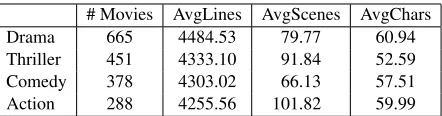
# Movies AvgLines AvgScenes AvgChars Drama 665 4484.53 79.77 60.94 Thriller 451 4333.10 91.84 52.59 Comedy 378 4303.02 66.13 57.51 Action 288 4255.56 101.82 59.99 Figure 2: ScriptBase corpus statistics. Movies can have multiple genres, thus numbers do not add up to 1,276.
social interactions, and interests. Lu and Grauman (2013) present a summarization model which ex-tracts subshot sequences while finding a balance of important subshots that are both diverse and provide a natural progression through the video, in terms of prominent visual objects (e.g., bottle, mug, televi-sion). We adapt their technique to our task, and show how to estimate character-scene correlations based on linguistic analysis. We also interpret movies as social networks and extract a rich set of fea-tures from character interactions and their sentiment which we use to guide the summarization process.
3 ScriptBase: A Movie Script Corpus
We compiled ScriptBase, a collection of 1,276 movie scripts, by automatically crawling web-sites which host or link entire movie scripts (e.g., imsdb.com). The retrieved scripts were then cross-matched against Wikipedia2 and IMDB3 and paired with corresponding user-written summaries, plot sections, loglines and taglines (taglines are short snippets used by marketing departments to promote a movie). We also collected meta-information regarding the movie’s genre, its actors, the production year, etc. ScriptBase contains movies comprising 23 genres; each movie is on average accompanied by 3 user summaries, 3 loglines, and 3 taglines. The corpus spans years 1909–2013. Some corpus statistics are shown in Figure 2.
The scripts were further post-processed with the Stanford CoreNLP pipeline (Manning et al., 2014) to perform tagging, parsing, named entity recogni-tion and coreference resolurecogni-tion. They were also an-notated with semantic roles (e.g., ARG0, ARG1), using the MATE tools (Bj¨orkelund et al., 2009). Our summarization experiments focused on come-dies and thrillers. We randomly selected 30 movies
2http://en.wikipedia.org
3http://www.imdb.com/
s1 s2 s3 s4 s5 s6 s7 ...
s1 s2 s3 s4 s5 s6 s7 ...
[image:3.612.318.530.60.141.2]//
Figure 3: Example of consecutive chain (top). Squares represent scenes in a screenplay. The bottom chain would not be allowed, since the connection betweens3 ands5 makes it non-consecutive.
for training/development and 65 movies for testing.
4 The Scene Extraction Model
As mentioned earlier, we define script summariza-tion as the task of selecting a chain of scenes rep-resenting the movie’s most important content. We interpret the term scene in the screenplay sense. A scene is a unit of action that takes place in one loca-tion at one time (see Figure 1). We therefore need not be concerned with scene segmentation; scene boundaries are clearly marked, and constitute the ba-sic units over which our model operates.
Let M= (S,C) represent a screenplay consist-ing of a setS={s1,s2,...,sn}of scenes, and a set
C={c1,...,cm}of characters. We are interested in
finding a listS0={si,...sk}ofordered, consecutive
scenes subject to a compression ratem(see the ex-ample in Figure 3). A natural interpretation ofmin our case is the percentage of scenes from the orig-inal script retained in the summary. The extracted chain should contain (a)importantscenes (i.e., crit-ical for comprehending the story and its develop-ment); (b) diverse scenes that cover different as-pects of the story; and (c) scenes which highlight the story’sprogressionfrom beginning to end. We therefore find the chainS0 maximizing the objective
functionQ(S0) which is the weighted sum of three
terms: the story progression P, scene diversity D, and scene importanceI:
S∗=argmax
S0⊂S Q(S
0) (1)
Q(S0) = λPP(S0) +λDD(S0) +λII(S0) (2)
scene 1 scene 2 scene 3 scene 4
char 1 char 2 char 3 char 4
0.3
0.1
0.2
0.04
0.1
0.05
0.07
0.01
0.11
0.2 0.04
0.3 0.07
[image:4.612.74.292.55.148.2]0.2
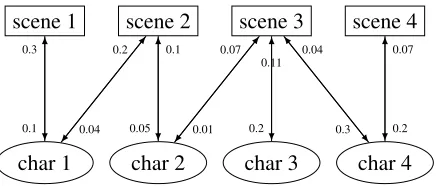
Figure 4: Example of a bipartite graph, connecting a movie’s scenes with participating characters.
Scene-to-scene Progression The first term in the objective is responsible for selecting chains repre-senting a logically coherent story. Intuitively, this means that if our chain includes a scene where a character commits an action, then scenes involving affected parties or follow-up actions should also be included. We operationalize this idea of progression in a story in terms of how strongly the characters in a selected scenesiinfluence the transition to the next
scenesi+1:
P(S0) =|S 0|−1
∑
i=0 c∈C∑
iINF(si,si+1|c) (3)
We represent screenplays as weighted, bipartite graphs connecting scenes and characters:
B= (V,E) :V =C∪S
E={(s,c,ws,c)|s∈S,c∈C,ws,c∈[0,1]} ∪
{(c,s,wc,s)|c∈C,s∈S,wc,s∈[0,1]}
The set of vertices V corresponds to the union of characters C and scenes S. We therefore add to the bipartite graph one node per scene and one node per character, and two directed edges for each scene-character and character-scene pair. An exam-ple of a bipartite graph is shown in Figure 4. We further assume that two scenessiandsi+1are tightly connected in such a graph if a random walk with restart (RWR; Tong et al. 2006; Kim et al. 2014) which starts in si has a high probability of ending
insi+1.
In order to calculate the random walk stationary distributions, we must estimate the weights between a character and a scene. We are interested in how important a character is generally in the movie, and
specifically in a particular scene. Forwc,s, we
con-sider the probability of a character being important, i.e., of them belonging to the set of main characters:
wc,s=P(c∈main(M)),∀(c,s,wc,s)∈E (4)
whereP(c∈main(M))is some probability score as-sociated withcbeing a main character in script M. Forws,c, we take the number of interactions a
char-acter is involved in relative to the total number of interactions in a specific scene as indicative of the character’s importance in that scene. Interactions re-fer to conversational interactions as well as relations between characters (e.g., who does what to whom):
ws,c=
∑
c0∈Csinter(c,c 0)
∑
c1,c2∈Cs
inter(c1,c2),∀(s,c,ws,c)∈E (5)
We defer discussion of how we model probabil-ityP(c∈Main(M))and obtain interaction counts to Section 5. Weightsws,candwc,sare normalized:
ws,c=∑ ws,c
(s,c0,w0s,c)w0s,c,∀(s,c,ws,c)∈E (6)
wc,s=∑( wc,s
c,s0,w0c,s)w0c,s,∀(c,s,wc,s)∈E (7)
We calculate the stationary distributions of a ran-dom walk on a transition matrixT, enumerating over all verticesv(i.e., charactersand scenes) in the bi-partite graphB:
T(i,j) =
(
wi,jif(vi,vj,wi,j ∈EB)
0 otherwise (8)
We measure theinfluenceindividual characters have on scene-to-scene transitions as follows. The sta-tionary distributionrk for a RWR walker starting at
nodekis a vector that satisfies:
rk= (1−ε)Trk+εek (9)
whereT is the transition matrix of the graph,ek is a
seed vector, with all elements 0, except for elementk
which is set to 1, andεis a restart probability param-eter. In practice, our vectorsrkandekare indexed by
the scenes and characters in a movie, i.e., they have length |S|+|C|, and their nth element corresponds
graphs are relatively small, we can compute r di-rectly4by solving:
rk=ε(I−(1−ε)T)−1ek (10)
The lth element of r then equals the probability of the random walker being in statelin the stationary distribution. Letrc
k be the same asrk, but with the
character nodecof the bipartite graph being turned into a sink, i.e., all entries for c in the transition matrix T are 0. We can then define how a single character influences the transition between scenessi
andsi+1as:
INF(si,si+1|c) =rsi[si+1]−rcsi[si+1] (11)
where rsi[si+1]is shorthand for that element in the
vector rsi that corresponds to scene si+1. We use
theINF score directly in Equation (3) to determine the progress score of a candidate chain.
Diversity The diversity term D(S0) in our
objec-tive should encourage chains which consist of more dissimilar scenes, thereby avoiding redundancy. The diversity of chainS0 is the sum of the diversities of
its successive scenes:
D(S0) =|S 0|−1
∑
i=1 d(si,si+1) (12)
The diversity d(si,si+1) of two scenes si and si+1 is estimated taking into account two factors: (a) do they have any characters in common, and (b) does the sentiment change from one scene to the next:
d(si,si+1) =dchar(si,si+1) +2 dsen(si,si+1) (13)
where dchar(si,si+1) and dsen(si,si+1) respectively denote character and sentiment similarity between scenes. Specifically, dchar(si,si+1) is the relative character overlap between scenessiandsi+1:
dchar(si,si+1) =1−||CCsi∩Csi+1|
si∪Csi+1|
(14)
dchar will be 0 if two scenes share the same
charac-ters and 1 if no characcharac-ters are shared. Analogously, 4We could also solve for r recursively which would be preferable for large graphs, since the performed matrix inver-sion is computationally expensive.
we definedsen, the sentiment overlap between two
scenes as:
dsen(si,si+1) =1−k−kk··di fdi f((ssii,,ssi+1)
i+1) +1 (15) di f(si,si+1) =1+|sen(s 1
i)−sen(si+1)| (16) where the sentimentsen(s) of scenes is the aggre-gate sentiment score of all interactions ins:
sen(s) =
∑
c,c0∈Cssen(inter(c,c
0)) (17)
We explain how interactions and their sentiment are computed in Section 5. Again,dsenis larger if two
scenes have a less similar sentiment. di f(si,si+1) becomes 1 if the sentiments are identical, and increasingly smaller for more dissimilar senti-ments. The sigmoid-like function in Equation (15) scalesdsenwithin range[0,1]to take smaller values
for larger sentiment differences (factorkadjusts the curve’s smoothness).
Importance The score I(S0) captures whether
a chain contains important scenes. We define
I(S0) as the sum of all scene-specific importance
scoresimp(si)of scenes contained in the chain:
I(S0) =|S
0|
∑
i=1imp(si) (18)
The importanceimp(si) of a scenesi is the ratio of
lead to support characters within that scene:
imp(si) =∑c:c∈Csi∧c∈main(M)
1
∑c:c∈Csi1
(19)
whereCsi is the set of characters present in scenesi,
subject to their weightsλ. We add a constraint corre-sponding to the compression rate, i.e., the number of scenes to be selected and enforce their linear order by disallowing non-consecutive combinations. We use GLPK6to solve the linear problem.
5 Implementation
In this section we discuss several aspects of the im-plementation of the model presented in the previous section. We explain how interactions are extracted and how sentiment is calculated. We also present our method for identifying main characters and estimat-ing the weightsws,candwc,sin the bipartite graph.
Interactions The notion of interaction underlies many aspects of the model defined in the previous section. For instance, interaction counts are required to estimate the weightsws,c in the bipartite graph of
the progression term (see Equation (5)), and in defin-ing diversity (see Equations (15)–(17)). As we shall see below, interactions are also important for identi-fying main characters in a screenplay.
We use the term interaction to refer to conversa-tionsbetween two characters, as well as their rela-tions (e.g., if a character kills another). For con-versational interactions, we simply need to iden-tify thespeakergenerating an utterance and the lis-tener. Speaker attribution comes for free in our case, as speakers are clearly marked in the text (see Figure 1). Listener identification is more involved, especially when there are multiple characters in a scene. We rely on a few simple heuristics. We as-sume that the previous speaker in the same scene, who is different from the current speaker, is the lis-tener. If there is no previous speaker, we assume that the listener is the closest character mentioned in the speaker’s utterance (e.g., via a coreferring proper name or a pronoun). In cases where we cannot find a suitable listener, we assume the current speaker is the listener.
We obtain character relations from the output of a semantic role labeler. Relations are denoted by verbs whose ARG0 and ARG1 roles are charac-ter names. We extract relations from the dialogue but also from scene descriptions. For example, in Figure 1 the descriptionSuddenly, [...] he
6https://www.gnu.org/software/glpk/
clubs her over the head contains the relation clubs(MAN,CATHERINE). Pronouns are resolved to their antecedent using the Stanford coreference res-olution system (Lee et al., 2011).
Sentiment We labeled lexical items in screenplays with sentiment values using the AFINN-96 lexi-con (Nielsen, 2011), which is essentially a list of words scored with sentiment strength within the range[−5,+5]. The list also contains obscene words (which are often used in movies) and some Internet slang. By summing over the sentiment scores of in-dividual words, we can work out the sentiment of an interaction between two characters, the sentiment of a scene (see Equation (17)), and even the sentiment between characters (e.g., who likes or dislikes whom in the movie in general).
Main Characters The progress term in our sum-marization objective crucially relies on characters and their importance (see the weight wc,s in
Equa-tion (4)). Previous work (Weng et al., 2009; Lin et al., 2013) extracts social networks where nodes correspond to roles in the movie, and edges to their co-occurrence. Leading roles (and their communi-ties) are then identified by measuring their centrality in the network (i.e., number of edges terminating in a given node).
It is relatively straightforward to obtain a so-cial network from a screenplay. Formally, for each movie we define aweightedandundirectedgraph:
G={C,E},:C={c1,...cn},
E={(ci,cj,w)|ci,cj∈C,w∈N>0}
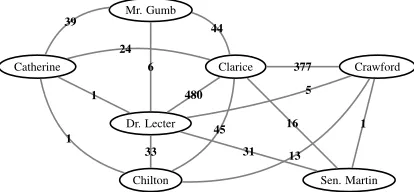
where vertices correspond to movie characters7, and edges denote character-to-character interac-tions. Figure 5 shows an example of a social net-work for “The Silence of the Lambs”. Due to lack of space, only main characters are displayed, how-ever the actual graph containsall characters (42 in this case). Importantly, edge weights are not nor-malized, but directly reflect the strength of associa-tion between different characters.
We do not solely rely on the social net-work to identify main characters. We esti-mateP(c∈main(M)), the probability of c being a leading character in movieM, using a Multi Layer
Mr. Gumb
Catherine
Dr. Lecter
Chilton
Clarice Crawford
Sen. Martin
480 5
31 33
1
6 377
16 45
44 24
1
13 1
[image:7.612.73.280.59.155.2]39
Figure 5: Social network for “The Silence of the Lambs”; edge weights correspond to absolute number of interac-tions between nodes.
Perceptron (MLP) and several features pertaining to the structure of the social network and the script text itself. A potential stumbling block in treating char-acter identification as a classification task is obtain-ing trainobtain-ing data, i.e., a list of main characters for each movie. We generate a gold-standard by assum-ing that the characters listed under Wikipedia’sCast
section (or an equivalent section, e.g., Characters) are the main characters in the movie.
Examples of the features we used for the clas-sification task include the barycenter of a ter (i.e., the sum of its distance to all other charac-ters), PageRank (Page et al., 1999), an eigenvector-based centrality measure, absolute/relative interac-tion weight (the sum of all interacinterac-tions a character is involved in, divided by the sum of all interactions in the network), absolute/relative number of sentences uttered by a character, number of times a charac-ter is described by other characcharac-ters (e.g., He is a monsterorShe is nice), number of times a char-acter talks about other charchar-acters, and type-token-ratio of sentences uttered by the character (i.e., rate of unique words in a character’s speech). Using these features, the MLP achieves an F1 of 79.0% on the test set. It outperforms other classification meth-ods such as Naive Bayes or logistic regression. Us-ing the full-feature set, the MLP also obtains perfor-mance superior to any individual measure of graph connectivity.
Aside from Equation (4), lead characters also ap-pear in Equation (19), which determines scene im-portance. We assume a characterc∈main(M)if it is predicted by the MLP with a probability≥0.5.
6 Experimental Setup
Gold Standard Chains The development and tuning of the chain extraction model presented in Section 4 necessitates access to a gold standard of key scene chains representing the movie’s most im-portant content. Our experiments concentrated on a sample of 95 movies (comedies and thrillers) from the ScriptBase corpus (Section 3). Performing the scene selection task for such a big corpus manually would be both time consuming and costly. Instead, we used distant supervision based on Wikipedia to automatically generate a gold standard.
Specifically, we assume that Wikipedia plots are representative of the most important content in a movie. Using the alignment algorithm presented in Nelken and Shieber (2006), we align script sen-tences to Wikipedia plot sensen-tences and assume that scenes with at least one alignment are part of the
gold chain of scenes. We obtain many-to-many alignments using features such as lemma overlap and word stem similarity. When evaluated on four movies8 (from the training set) whose content was manually aligned to Wikipedia plots, the aligner achieved a precision of.53 at a recall rate of.82 at deciding whether a scene should be aligned. Scenes are ranked according to the number of alignments they contain. When creating gold chains at differ-ent compression rates, we start with the best-ranked scenes and then successively add lower ranked ones until we reach the desired compression rate.
System Comparison In our experiments we com-pared our scene extraction model (SceneSum) against three baselines. The first baseline was based on the minimum overlap (MinOv) of characters in consecutive scenes and corresponds closely to the diversity term in our objective. The second base-line was based on themaximumoverlap (MaxOv) of characters and approximates the importance term in our objective. The third baseline selects scenes at random (averaged over 1,000 runs). Parameters for our models were tuned on the training set, weights for the terms in the objective were optimized to the following values: λP=1.0,λD=0.3, andλI=0.1.
1. Why does Trevor leave New York and where does he move to?
2. What is KOS, who is their leader, and why is he attending high school?
3. What happened to Cesar’s finger, how did he eventually die?
4. Who killed Benny and how does Ellen find out? 5. Who is Rita and what becomes of her?
Table 1: Questions for the movie “One Eight Seven”.
toε=0.5, and the sigmoid scaling factor in our di-versity term tok=−1.2.
Evaluation We assessed the output of our model (and comparison systems) automatically against the gold chains described above. We performed ex-periments with compression rates in the range of 10% to 50% and measured performance in terms of F1. In addition, we also evaluated the quality of the extracted scenes as perceived by humans, which is necessary, given the approximate nature of our gold standard. We adopted a question-answering (Q&A) evaluation paradigm which has been used previously to evaluate summaries and document compression (Morris et al., 1992; Mani et al., 2002; Clarke and Lapata, 2010). Under the assumption that the summary is to function as a replacement for the full script, we can measure the extent to which it can be used to find answers to questions which have been derived from the entire script and are rep-resentative of its core content. The more questions a hypothetical system can answer, the better it is at summarizing the script as a whole.
Two annotators were independently instructed to read scripts (from our test set) and create Q&A pairs. The annotators generated questions relating to the plot of the movie and the development of its charac-ters, requiring an unambiguous answer. They com-pared and revised their Q&A pairs until a common agreed-upon set of five questions per movie was reached (see Table 1 for an example). In addition, for every movie we asked subjects to name the main characters, and summarize its plot (in no more than four sentences). Using Amazon Mechanical Turk (AMT)9, we elicited answers for eight scripts (four comedies and thrillers) in four summarization
con-9https://www.mturk.com/
[image:8.612.316.535.56.123.2]10% 20% 30% 40% 50% MaxOv 0.40 0.50 0.58 0.64 0.71 MinOv 0.13 0.27 0.40 0.53 0.66 SceneSum 0.23 0.37 0.50 0.60 0.68 Random 0.10 0.20 0.30 0.40 0.50
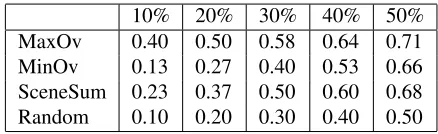
Table 2: Model performance on automatically generated gold standard (test set) at different compression rates.
ditions: using our model, the two baselines based on minimum and maximum character overlap, and the random system. All models were assessed at the same compression rate of 20% which seems realis-tic in an actual application environment, e.g., com-puter aided summarization. The scripts were prese-lected in an earlier AMT study where participants were asked to declare whether they had seen the movies in our test set (65 in total). We chose the screenplays which had received the least viewings so as to avoid eliciting answers based on familiar-ity with the movie. A total of 29 participants, all self-reported native English speakers, completed the Q&A task. The answers provided by the subjects were scored against an answer key. A correct an-swer was marked with a score of one, and zero oth-erwise. In cases where more answers were required per question, partial scores were awarded to each correct answer (e.g., 0.5). The score for a summary is the average of its question scores.
7 Results
Table 2 shows the performance of SceneSum, our scene extraction model, and the three comparison systems (MaxOv, MinOv, Random) on the auto-matic gold standard at five compression rates. As can be seen, MaxOv performs best in terms of F1, followed by SceneSum. We believe this is an ar-tifact due to the way the gold standard was cre-ated. Scenes with large numbers of main charac-ters are more likely to figure in Wikipedia plot sum-maries and will thus be more frequently aligned. A chain based on maximum character overlap will fo-cus on such scenes and will agree with the gold stan-dard better compared to chains which take additional script properties into account.
av-Beginning Middle End MaxOv 33.95 34.89 31.16 MinOv 34.30 33.91 31.80 SceneSum 35.30 33.54 31.16 Random 34.30 33.91 31.80
Table 3: Average percentage of scenes taken from the beginning, middle and ends of movies, on automatic gold standard test set.
erage percentage of scenes selected from the be-ginning, middle, and end of the movie (based on an equal division of the number of scenes in the screenplay). As can be seen, the number of se-lected scenes tends to be evenly distributed across the entire movie. SceneSum has a slight bias to-wards the beginning of the movie which is probably natural, since leading characters appear early on, as well as important scenes introducing essential story elements (e.g., setting, points of view).
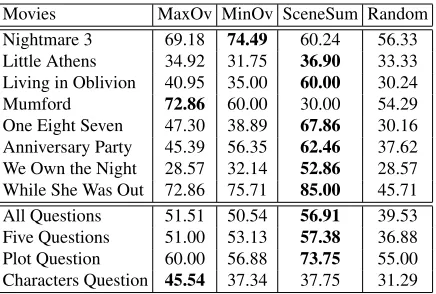
The results of our human evaluation study are summarized in Table 4. We observe that SceneSum summaries are overall more informative compared to those created by the baselines. In other words, AMT participants are able to answer more ques-tions regarding the story of the movie when reading SceneSum summaries. In two instances (“A Night-mare on Elm Street 3” and “Mumford”), the over-lap models score better, however, in this case the movies largely consist of scenes with the same char-acters and relatively little variation (“A Nightmare on Elm Street 3”), or the camera follows the main lead in his interactions with other characters (“Mum-ford”). Since our model is not so character-centric, it might be thrown off by non-character-based terms in its objective, leading to the selection of unfavor-able scenes. Tunfavor-able 4 also presents a break down of the different types of questions answered by our par-ticipants. Again, we see that in most cases a larger percentage is answered correctly when reading Sce-neSum summaries.
Overall, we observe that SceneSum extracts chains which encapsulate important movie content across the board. We should point out that al-though our movies are broadly classified as come-dies and thrillers, they have very different structure and content. For example, “Little Athens” has a very loose plotline, “Living in Oblivion” has
multi-Movies MaxOv MinOv SceneSum Random Nightmare 3 69.18 74.49 60.24 56.33 Little Athens 34.92 31.75 36.90 33.33 Living in Oblivion 40.95 35.00 60.00 30.24 Mumford 72.86 60.00 30.00 54.29 One Eight Seven 47.30 38.89 67.86 30.16 Anniversary Party 45.39 56.35 62.46 37.62 We Own the Night 28.57 32.14 52.86 28.57 While She Was Out 72.86 75.71 85.00 45.71 All Questions 51.51 50.54 56.91 39.53 Five Questions 51.00 53.13 57.38 36.88 Plot Question 60.00 56.88 73.75 55.00 Characters Question 45.54 37.34 37.75 31.29 Table 4: Percentage of questions answered correctly.
ple dream sequences, whereas “While She was Out” contains only a few characters and a series of im-portant scenes towards the end. Despite this variety, SceneSum performs consistently better in our task-based evaluation.
8 Conclusions
In this paper we have developed a graph-based model for script summarization. We formalized the process of generating a shorter version of a screenplay as the task of finding an optimal chain of scenes, which are diverse, important, and ex-hibit logical progression. A large-scale evaluation based on a question-answering task revealed that our method produces more informative summaries com-pared to several baselines. In the future, we plan to explore model performance in a wider range of movie genres as well as its applicability to other NLP tasks (e.g., book summarization or event ex-traction). We would also like to automatically deter-mine the compression rate which should presumably vary according to the movie’s length and content. Fi-nally, our long-term goal is to be able to generate loglines as well as movie plot summaries.
Acknowledgments We would like to thank Rik Sarkar, Jon Oberlander and Annie Louis for their valuable feedback. Special thanks to Bharat Am-bati, Lea Frermann, and Daniel Renshaw for their help with system evaluation.
References
[image:9.612.319.537.56.203.2]Film Characters. In Proceedings of the 51st Annual Meeting of the Association for Compu-tational Linguistics. Sofia, Bulgaria, pages 352– 361.
Bamman, David, Ted Underwood, and A. Noah Smith. 2014. A Bayesian Mixed Effects Model of Literary Character. InProceedings of the 52nd Annual Meeting of the Association for Computa-tional Linguistics. Baltimore, MD, USA, pages 370–379.
Bj¨orkelund, Anders, Love Hafdell, and Pierre Nugues. 2009. Multilingual Semantic Role La-beling. In Proceedings of the 13th Conference on Computational Natural Language Learning: Shared Task. Boulder, Colorado, pages 43–48. Clarke, James and Mirella Lapata. 2010. Discourse
Constraints for Document Compression. Compu-tational Linguistics36(3):411–441.
Elsner, Micha. 2012. Character-based kernels for novelistic plot structure. In Proceedings of the 13th Conference of the European Chapter of the Association for Computational Linguistics. Avi-gnon, France, pages 634–644.
Elson, David K., Nicholas Dames, and Kathleen R. McKeown. 2010. Extracting Social Networks from Literary Fiction. InProceedings of the 48th Annual Meeting of the Association for Computa-tional Linguistics. Uppsala, Sweden, pages 138– 147.
Kim, Jun-Seong, Jae-Young Sim, and Chang-Su Kim. 2014. Multiscale Saliency Detection Us-ing Random Walk With Restart. IEEE Transac-tions on Circuits and Systems for Video Technol-ogy24(2):198–210.
Lee, Heeyoung, Yves Peirsman, Angel Chang, Nathanael Chambers, Mihai Surdeanu, and Dan Jurafsky. 2011. Stanford’s Multi-Pass Sieve Coreference Resolution System at the CoNLL-2011 Shared Task. In Proceedings of the 15th Conference on Computational Natural Language Learning: Shared Task. Portland, OR, USA, pages 28–34.
Lin, C., C. Tsai, L. Kang, and Weisi Lin. 2013. Scene-Based Movie Summarization via Role-Community Networks. IEEE Transactions on Circuits and Systems for Video Technology
23(11):1927–1940.
Lu, Zheng and Kristen Grauman. 2013. Story-Driven Summarization for Egocentric Video. In
Proceedings of the 2013 IEEE Conference on Computer Vision and Pattern Recognition. Port-land, OR, USA, pages 2714–2721.
Mani, Inderjeet, Gary Klein, David House, Lynette Hirschman, Therese Firmin, and Beth Sundheim. 2002. SUMMAC: A Text Summarization Evalua-tion. Natural Language Engineering8(1):43–68. Manning, Christopher, Mihai Surdeanu, John Bauer,
Jenny Finkel, Steven Bethard, and David Mc-Closky. 2014. The Stanford CoreNLP Natural Language Processing Toolkit. InProceedings of 52nd Annual Meeting of the Association for Com-putational Linguistics: System Demonstrations. pages 55–60.
Michel, Jean-Baptiste, Yuan Kui Shen, aviva Presser Aiden, Adrian Veres, Matthew K. Gray, The Google Books Team, Joseph P. Pickett, Dale Hoiberg, Dan Clancy, Peter Norvig, Jon Orwant, Steven Pinker, Martin A. Nowak, and Erez Liber-man Aiden. 2010. Quantitative Analysis of Cul-ture Using Millions of Digitized Books. Science
331(6014):176–182.
Monaco, James. 1982. How to Read a Film: The Art, Technology, Language, History and Theory of Film and Media. OUP, New York, NY, USA. Morris, A., G. Kasper, and D. Adams. 1992.
The Effects and Limitations of Automated Text Condensing on Reading Comprehension Perfor-mance. Information Systems Research 3(1):17– 35.
Mosteller, Frederick and David Wallace. 1964. In-ference and Dispituted Authorship: The Federal-ists. Addison-Wesley, Boston, MA, USA.
Nalisnick, T. Eric and S. Henry Baird. 2013. Character-to-Character Sentiment Analysis in Shakespeare’s Plays. InProceedings of the 51st Annual Meeting of the Association for Computa-tional Linguistics. Sofia, Bulgaria, pages 479– 483.
Nielsen, Finn Arup. 2011. A new ANEW: Eval-uation of a word list for sentiment analysis in microblogs. In Proceedings of the ESWC2011 Workshop on ’Making Sense of Microposts’: Big Things Come in Small Packages. Heraklion, Crete, pages 93–98.
Page, Lawrence, Sergey Brin, Rajeev Motwani, and Terry Winograd. 1999. The pagerank citation ranking: Bringing order to the web. Technical Re-port 1999-66, Stanford InfoLab. Previous number SIDL-WP-1999-0120.
Rasheed, Z., Y. Sheikh, and M. Shah. 2005. On the Use of Computable Features for Film Classifica-tion. IEEE Transactions on Circuits and Systems for Video Technology15(1):52–64.
Reed, Todd, editor. 2004. Digital Image Sequence Processing. Taylor & Francis.
Sang, Jitao and Changsheng Xu. 2010. Character-based Movie Summarization. In Proceedings of the International Conference on Multimedia. Firenze, Italy, pages 855–858.
Tong, Hanghang, Christos Faloutsos, and Jia-Yu Pan. 2006. Fast Random Walk with Restart and Its Applications. InProceedings of the Sixth In-ternational Conference on Data Mining. Hong Kong, pages 613–622.