Unediting: Detecting Disfluencies Without Careful Transcripts
Victoria Zayats, Mari Ostendorf and Hannaneh Hajishirzi
Electrical Engineering Department University of Washington
Seattle, WA, USA
[vzayats, ostendor, hannaneh]@u.washington.edu
Abstract
Speech transcripts often only capture seman-tic content, omitting disfluencies that can be useful for analyzing social dynamics of a dis-cussion. This work describes steps in build-ing a model that can recover a large fraction of locations where disfluencies were present, by transforming carefully annotated text to match the standard transcription style, introducing a two-stage model for handling different types of disfluencies, and applying semi-supervised learning. Experiments show improvement in disfluency detection on Supreme Court oral ar-guments, nearly 23% improvement in F1.
1 Introduction
Many hearings, lectures, news broadcasts and other spoken proceedings are hand-transcribed and made available online for easier searching and increased accessability. For speed and cost reasons, standard transcription services aim at representing seman-tic content only; thus, filled pauses (uh, um) and many disfluencies (repetitions and self corrections) are omitted, though not all. Careful transcripts rep-resent all the words (and word fragments spoken), as shown below with disfluent regions underlined.
Careful:It is it is a we submit
Where there used to be um um um uh the decision
Standard:It is, it is, we submit Where there used to be the decision
These phenomena are quite common in spon-taneous speech, even in formal settings such as Supreme Court oral arguments and congressional hearings (Zayats et al., 2014).
While disfluencies may not be important for an-alyzing the topic of a discussion, the rate and type
of disfluencies provide an indication of other factors of interest in spoken language analysis, including cognitive load, emotion, and social cues (Shriberg, 2001). Further, predicting locations of disfluencies in standard transcripts would help to improve time alignments of transcripts to the audio signal, and to provide more useful text data for training language models for speech recognition. Since careful anno-tation of transcripts with this information is costly, this paper tackles the problem of recovering the dis-fluencies from clues in the standard orthographic transcripts, or “unediting” the transcripts.1
Here, unediting is treated as detection of the reparandum of the disfluencies. Following the struc-tural representation of (Shriberg, 1994), as in:
[ we would + which we would ] [ would + [ who + who ] wouldn’t ]
the task is to detect the words in the brackets preced-ing the ’+’ which marks the self-interruption point. Of course, here, some of the words in those regions may not be in the transcript, so location is more im-portant than extent. In addition, some cues used (i.e. filled pauses and word fragments) are not available in standard transcripts.
Three developments are combined to address the problem of unediting with the constraint of lim-ited hand-annotated training data in the target do-main: oral arguments from the Supreme Court of the United States (SCOTUS) available from the Oyez Project archive (oyez.org). First, we identify mech-anisms for transforming the careful transcripts of the Switchboard corpus (Godfrey et al., 1992) to be
1Thanks to Mark Liberman for the term “unediting.”
more similar to the Oyez transcripts. Second, we in-troduce a multi-stage model that accounts for differ-ences in the rates of repetitions and self-corrections in standard vs. careful transcripts. Lastly, we ap-ply semi-supervised learning to take advantage of the large amount of original Oyez transcripts. The system combining all these techniques, referred to here as UNEDITOR, leads to an improvement in F1 of nearly 23% compared to a baseline of training from the original disfluency-annotated Switchboard corpus.
2 Related work
This paper builds on prior work using conditional random field (CRF) models (Liu et al., 2006; Georgila, 2009; Ostendorf and Hahn, 2013; Zayats et al., 2014). More recent work has shown a benefit from Markov networks (Qian and Liu, 2013; Wang et al., 2014). Since our work is on the transcription style mismatch, this work adopts the simpler CRF approach, but can be easily extended to other classi-fication techniques.
In this work, we use only text features. While prosodic features have been shown to be useful (Shriberg, 1999; Kahn et al., 2005; Liu et al., 2006; Wang et al., 2014), the fact that the Oyez transcripts do not capture all the words means that forced time alignments are unreliable and the as-sociated prosodic features are too noisy to be use-ful. Other studies integrate disfluency detection with parsing, e.g. (Charniak and Johnson, 2001; Johnson and Charniak, 2004; Lease et al., 2006; Hale et al., 2006; Miller, 2009; Miller et al., 2009; Zwarts et al., 2010; Rasooli and Tetreault, 2013; Honnibal and Johnson, 2014), but parsers trained on standard tree-bank data sets are not effective on the very long and complex sentences in SCOTUS; parser adaptation is left for future work.
There are a few studies that have investigated dis-fluency detection using cross-domain training data (Georgila et al., 2010; Ostendorf and Hahn, 2013; Zayats et al., 2014), and many more that have used multi-domain data for other language processing tasks. What is different about the task addressed here is that both the domain (topic and speaking style) and the transcription protocol differ between the target and source domain. There have been some
attempts to transform written text to a more conver-sational style for training language models, e.g. Bu-lyko et al. (2007) inserted pause fillers and word rep-etitions, which led to reductions in perplexity though not word error rate. The work here differs in that the transformation is in the reverse direction (remov-ing fillers from conversational text) and punctuation cues are emphasized.
3 Transforming training data
Here we describe methods for generating training data for use with standard transcripts: i) transfer-ring labels from a small amount of carefully anno-tated data to corresponding standard transcripts, and ii) transforming the existing Switchboard training set to make it more similar to the target domain.
3.1 SCOTUS corpora
The Oyez Project at Chicago-Kent is a multime-dia archive containing audio and transcripts of the Supreme Court hearings since 1955. While OYEZ transcripts are consistent with the audio in general, they are not accurate when it comes to disfluen-cies. We notice that most simple disfluencies such as repetitions have been omitted by OYEZ anno-tators, while more complex ones are often present and annotators have used the ‘...’ symbol at loca-tions of filled pauses or repetiloca-tions. Having those explicit cues indicating interruption points in disflu-encies makes it possible to consider recovering the untranscribed disfluencies.
For CAREFUL SCOTUS annotation, we use the data provided by (Zayats et al., 2014), which in-cludes seven cases with carefully transcribed au-dio and hand-annotated disfluencies, with sepa-rately marked repetitions. We develop ANNOTATED OYEZ transcripts, by transferring disfluency labels for those seven cases fromCAREFULSCOTUSto the corresponding files in OYEZand dropping the dele-tion markers. As a result, those transcripts are iden-tical to the original OYEZtranscripts, but in addition contain disfluency annotation derived from CARE-FULSCOTUS.
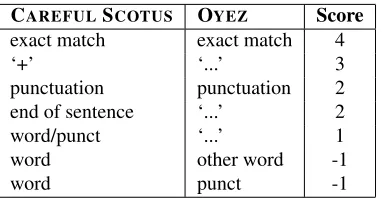
CAREFULSCOTUS OYEZ Score
exact match exact match 4
‘+’ ‘...’ 3
punctuation punctuation 2
end of sentence ‘...’ 2
word/punct ‘...’ 1
word other word -1
[image:3.612.92.283.53.152.2]word punct -1
Table 1: Matching scores used in dynamic programming transcript alignment.
cost of 1. Some examples of CAREFUL SCOTUS, OYEZ,ALIGNEDOYEZ(with deletions marked) and ANNOTATED OYEZ transcripts are shown below. The full corpus is available at https://ssli. ee.washington.edu/tial/data/oyez.
CAREFULSCOTUS:[ [S It is + it is ] a + ] we submit
Where there used to be um um um uh the decision OYEZ:It is, it is, we submit
Where there used to be the decision
ALIGNEDOYEZ:[ [S It is, + it is ], + ] we submit Where there used to be the decision ANNOTATEDOYEZ:[ [S It is, + it is ], + ] we submit
Where there used to be the decision
3.2 Switchboard transformation
The ANNOTATEDOYEZtraining set is a very small dataset, and other work has shown that Switchboard (SWBD) is useful for cross-domain training for S CO-TUS (Zayats et al., 2014). However, prior work has been with careful transcripts. SWBDtranscripts do not include ‘...’ symbols, and SWBDhas many more commas and other punctuation symbols. In order to make best use of the SWBDdata, we transform it to be more similar to the OYEZtranscripts in two steps. First, we add ‘...’ after interruption points in SWBD. Second, we remove all punctuations except ‘...’ in the middle of the sentence in both of the corpora.
4 Detecting disfluencies
In this section we describe the UNEDITOR system, which is a two-stage CRF model trained on trans-formed training data and takes advantage of a large pool of unlabeled data with a self-training technique. Baseline: CRF We use a conditional random field (CRF) model that labels each word in a sentence,
following a tagging approach with separate repeti-tion and non-repetirepeti-tion reparandum states, as in (Os-tendorf and Hahn, 2013). The feature set includes identity and pattern match features widely used in disfluency detection tasks, as well as distance-based and disfluency language model features from (Zay-ats et al., 2014).
4.1 Two-stage model
Using the same features as in the baseline, we in-troduce a two-stage CRF model motivated by our observation that many repetitions are omitted from the standard transcriptions. Thus, while 62% of dis-fluencies inCAREFULSCOTUSare repetitions, only 22% of all disfluencies in ANNOTATED OYEZ are repetitions. We find that training at two separate stages helps to overcome the difference in distribu-tions of two disfluency types between source and tar-get domains, and hence results in a better model for adaptation. In the first stage, we train a model to de-tect repetitions by only considering repetition states in the training data. In the second stage, we train a model to detect non-repetitions by removing all rep-etitions from the training data. Similarly at test time, we use the first-stage model to detect repetitions, then remove all the detected repetitions, and apply the second-stage model to detect non-repetitions. In evaluation, we report the disfluencies detected in both stages.
4.2 Self-training
A benefit of OYEZtranscripts is that there is a huge amount of unlabeled data available, which makes it natural to use semi-supervised learning. In this work, we use a simple self-training approach. First we apply a CRF model trained on the labeled data to the unlabeled data. Then we augment the training data with automatically labeled sentences that have been detected to contain a disfluency with a confi-dence score greater than 0.5, and retrain the model with the new augmented training set.
5 Experiments and discussion
Training set Prec Rec F1
CAREFULSCOTUS 66.1 16.7 26.7
ANNOTOYEZ 86.7 20.4 33.0
ORIGSWBD 62.2 29.1 39.7
CAREFULSCOTUS+ORIGSWBD 63.7 27.8 38.7
ANNOTOYEZ+ TRANSFSWBD 70.9 49.0 57.9
Table 2: Disfluency detection of ANNOT OYEZ with
different training sets.
5.1 Transforming training data
First, we assess the utility of different training sources and training data transformation using the baseline model. Note that the two SCOTUSsets are quite small (four cases, ∼64k words) compared to Switchboard (1.3M words). Because of the differ-ence in punctuation style between the original Oyez transcripts and the careful transcripts of both cor-pora, all sentence-internal punctuation is removed in the CAREFULSCOTUSand ORIGSWBD data.
Table 2 reports results on training the CRF model with the different sources and their combinations. As expected, detection with in-domain training data and transformed SWBD (ANNOT OYEZ+TRANSF SWBD) outperforms training on all other dataset combinations. Training on ANNOTOYEZalone sig-nificantly outperforms detection (especially preci-sion) when only trained on the carefully annotated data because of the matching transcription style. Training with ORIG SWBD outperforms training with ANNOT OYEZ alone mainly due to the avail-ability of more training data in the SWBD dataset, consistent with results in (Ostendorf and Hahn, 2013). Surprisingly, the CAREFUL SCOTUS data did not provide any benefit when added to the ORIG SWBD.
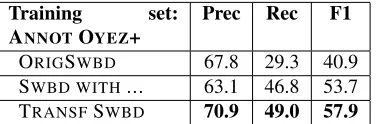
Next, we study the impact of adding ‘...’ sym-bols and removing punctuation for transforming the SWBD data. Table 3 reports results for training the CRF model with the combination of ANNOT OYEZ and SWBD with different transformation steps. We observe that roughly 30% of the interruption points in CAREFUL SCOTUS are associated with the ‘...’ symbol in the OYEZ transcripts; therefore, we add ‘...’ symbols after 1/3 of the interruption points in the SWBD. As expected, disfluency detection is im-proved by transforming SWBDwith adding ‘...’. The largest gain is obtained when we also remove
punc-Training set: ANNOTOYEZ+
Prec Rec F1
ORIGSWBD 67.8 29.3 40.9
SWBD WITH... 63.1 46.8 53.7
[image:4.612.335.524.54.116.2]TRANSFSWBD 70.9 49.0 57.9
Table 3: The combination of ANNOTOYEZand SWBD
with different SWBDtransformation steps.
Training set Prec Rec F1
CAREFULSCOTUS 57.8 21.2 31.0
ANNOTOYEZ 81.7 27.3 41.0
ORIGSWBD 59.0 31.7 41.2
CAREFULSCOTUS+ ORIGSWBD 64.6 33.7 44.3 ANNOTOYEZ+ TRANSFSWBD 71.7 52.8 60.8
Table 4: Self-training performance using different initial models.
tuation (the row TRANSFSWBD). All further exper-iments use this setting for training the models.
5.2 Self-training
Here we study the contribution of semi-supervised learning when applied on the baseline model (Ta-ble 5). For self-training, we use 1,765 OYEZ tran-scripts dated 1990 - 2011 as our unlabeled data (∼17.5M words), with a confidence threshold of 0.5 for augmenting the training data, as described pre-viously. We use each one of the baseline models in Table 2 as an initial model for the self-training for comparison to the results in Table 4. While adding a lot of in-domain data definitely helps, the quality of the initial model plays a major role in the overall performance.
5.3 Two-stage model
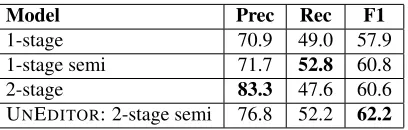
[image:4.612.76.309.55.126.2]im-Model Prec Rec F1
1-stage 70.9 49.0 57.9
1-stage semi 71.7 52.8 60.8
2-stage 83.3 47.6 60.6
[image:5.612.86.290.53.118.2]UNEDITOR: 2-stage semi 76.8 52.2 62.2
Table 5: Baseline, two-stages and self-training methods, comparison: baseline self-training method is trained on ...., all the rest methods are trained on ANNOTOYEZand TRANSFSWBD. Our method, UNEDITORcombines
self-training and two-stage models.
provement using the full UNEDITOR system com-paring to the model trained on the ORIG SWBD dataset.
6 Conclusion
In this paper we present a framework for disfluency detection in non-careful transcripts. Experiments are based on the OYEZ archive of transcriptions of Supreme Court oral arguments. To address the prob-lem of lack of annotated data, we first transfer dis-fluency annotations from careful transcripts of a few cases to the less precise OYEZ transcripts. Next, we transform Switchboard transcripts to make them more similar to the target domain. In addition, we introduce a two-stage model and self-training to fur-ther improve performance.
Experiments show improvement in disfluency de-tection on Supreme Court oral arguments. Start-ing from baselines of trainStart-ing from carefully anno-tated in-domain data (F1=26.1) or Switchboard data (F1=39.7), we achieve a substantial improvement to (F1=62.2) with our best case system UNEDITOR, which corresponds to an improvement of nearly 23% over the stronger baseline.
Possible extensions of this work include ex-ploring graph-based semi-supervised approaches (e.g., (Subramanya et al., 2010)) and combining the text-based approach with flexible ASR forced align-ment allowing optional insertion of filled pauses and words that are common as repetitions. In addition, the availability of the automatically annotated dis-fluencies makes it possible to study the variation in rates for different cases and speakers over an ex-tended time period.
Acknowledgments
This work was supported in part by DARPA grant FA8750-12-2-0347. The authors thank the anony-mous reviewers for their valuable feedback to im-prove the clarity of paper. The authors also thank Sangyun Hahn for his contribution in the two-stage model. The views and conclusions contained herein are those of the authors and should not be inter-preted as necessarily representing the official poli-cies or endorsements, either expressed or implied, of DARPA or the U.S. Government.
References
[Bulyko et al.2007] I. Bulyko, M. Ostendorf, M. Siu, T. Ng, A. Stolcke, and O. Cetin. 2007. Web resources for language modeling in conversational speech recog-nition.IEEE-TSLP, 5(1).
[Charniak and Johnson2001] E. Charniak and M. John-son. 2001. Edit detection and parsing for transcribed speech. InProc. NAACL, pages 118–126.
[Georgila et al.2010] K. Georgila, N. Wang, and J. Gratch. 2010. Cross-domain speech disflu-ency detection. InProc. Annual SIGdial Meeting on Discourse and Dialogue.
[Georgila2009] K. Georgila. 2009. Using integer lin-ear programming for detecting speech disfluencies. In Proc. NAACL-HLT.
[Godfrey et al.1992] J. J. Godfrey, E. C. Holliman, and J. McDaniel. 1992. Switchboard: Telephone speech corpus for research and development. InProc. ACL, volume I, pages 517–520.
[Hale et al.2006] John Hale, Izhak Shafran, Lisa Yung, Bonnie Dorr, Mary Harper, Anna Krasnyanskaya, Matthew Lease, Yang Liu, Brian Roark, Matthew Snover, and Robin Stewart. 2006. PCFGs with syn-tactic and prosodic indicators of speech repairs. In Proc. COLING-ACL.
[Honnibal and Johnson2014] Matthew Honnibal and Mark Johnson. 2014. Joint incremental disflu-ency detection and dependdisflu-ency parsing. TACL, 2(1):131–142.
[Johnson and Charniak2004] M. Johnson and E. Char-niak. 2004. A tag-based noisy channel model of speech repairs. InProc. ACL.
[Liu et al.2006] Y. Liu, E. Shriberg, A. Stolcke, D. Hillard, M. Ostendorf, and M. Harper. 2006. Enriching speech recognition with automatic de-tection of sentence boundaries and disfluencies. IEEE-TASLP, 14:1526–1540.
[Miller et al.2009] Tim Miller, Luan Nguyen, and William Schuler. 2009. Parsing speech repair without specialized grammar symbols. InProc. ACL-IJCNLP, pages 277–280.
[Miller2009] Tim Miller. 2009. Improved syntactic mod-els for parsing speech with repairs. InProc. NAACL-HLT.
[Ostendorf and Hahn2013] Mari Ostendorf and Sangyun Hahn. 2013. A sequential repetition model for im-proved disfluency detection. InProc. Interspeech. [Qian and Liu2013] Xian Qian and Yang Liu. 2013.
Dis-uency detection using multi-step stacked learning. In Proc. NAACL-HLT.
[Rasooli and Tetreault2013] Mohammad Sadegh Rasooli and Joel R Tetreault. 2013. Joint parsing and disflu-ency detection in linear time. InProc. EMNLP, pages 124–129.
[Shriberg1994] E. Shriberg. 1994.Preliminaries to a the-ory of speech disfluencies. Ph.D. thesis, Department of Psychology, University of California, Berkeley, CA. [Shriberg1999] E. Shriberg. 1999. Phonetic
conse-quences of speech disfluency. InProc. ICPhS, pages 619–622.
[Shriberg2001] Elizabeth Shriberg. 2001. To errrris human: ecology and acoustics of speech disfluen-cies. Journal of the International Phonetic Associa-tion, 31(01):153–169.
[Subramanya et al.2010] Amarnag Subramanya, Slav Petrov, and Fernando Pereira. 2010. Efficient graph-based semi-supervised learning of structured tagging models. InProc. EMNLP, pages 167–176. ACL. [Wang et al.2014] Xuancong Wang, Hwee Tou Ng, and
Khe Chai Sim. 2014. A beam-search decoder for dis-fluency detection. InProc. COLING.
[Zayats et al.2014] Victoria Zayats, Mari Ostendorf, and Hannaneh Hajishirzi. 2014. Multidomain disfluency and repair detection. InProc. Interspeech.