Topic Segmentation with a Structured Topic Model
Lan Du
Department of Computing Macquarie University
Sydney, Australia [email protected]
Wray Buntine Canberra Research Lab National ICT Australia
Canberra, Australia [email protected]
Mark Johnson Department of Computing
Macquarie University Sydney, Australia [email protected]
Abstract
We present a new hierarchical Bayesian model for unsupervised topic segmentation. This new model integrates a point-wise boundary sam-pling algorithm used in Bayesian segmenta-tion into a structured topic model that can cap-ture a simple hierarchical topic struccap-ture latent in documents. We develop an MCMC infer-ence algorithm to split/merge segment(s). Ex-perimental results show that our model out-performs previous unsupervised segmentation methods using only lexical information on Choi’s datasets and two meeting transcripts and has performance comparable to those pre-vious methods on two written datasets.
1 Introduction
Documents are usually comprised of topically co-herent text segments, each of which contains some number of text passages (e.g., sentences or para-graphs) (Salton et al., 1996). Within each topically coherent segment, one would expect that the word usage demonstrates more consistent lexical distri-butions (known as lexical cohesion (Eisenstein and Barzilay, 2008)) than that across segments. A linear partition of texts into topic segments may reveal in-formation about, for example, themes of segments and the overall thematic structure of the text, and can subsequently be useful for text analysis tasks, such as information retrieval (e.g., passage retrieval (Salton et al., 1996)), document summarisation and discourse analysis (Galley et al., 2003).
In this paper we consider how to automatically find a topic segmentation. It involves identifying
the most prominent topic changes in a sequence of text passages, and splits those passages into a sequence of topically coherent segments (Hearst, 1997; Beeferman et al., 1999). This task can be cast as an unsupervised machine learning problem: plac-ing topic boundaries in unannotated text.
Although a variety of cues in text can be used for topic segmentation, such as cue phases (Beeferman et al., 1999; Reynar, 1999; Eisenstein and Barzi-lay, 2008)) and discourse information (Galley et al., 2003), in this paper, we focus on lexical cohesion and use it as the primary cue in developing an un-supervised segmentation model. The effectiveness of lexical cohesion has been demonstrated by Text-Tiling (Hearst, 1997), c99 (Choi, 2000), MinCut (Malioutov and Barzilay, 2006), PLDA (Purver et al., 2006), Bayesseg (Eisenstein and Barzilay, 2008), TopicTiling (Riedl and Biemann, 2012),etc.
Our work uses recent progress in hierarchi-cal topic modelling with non-parametric Bayesian methods (Du et al., 2010; Chen et al., 2011; Du et al., 2012a), and is based on Bayesian segmentation methods (Goldwater et al., 2009; Purver et al., 2006; Eisenstein and Barzilay, 2008) using topic mod-els. This can also be viewed as a multi-topic exten-sion of hierarchical Bayesian segmentation (Eisen-stein, 2009), although our use of hierarchies is used to improve the performance of linear segmentation, rather than develop hierarchical segmentation.
Recently, topic models are increasingly used in various text analysis tasks including topic segmen-tation. Previous work (Purver et al., 2006; Misra et al., 2008; Sun et al., 2008; Misra et al., 2009; Riedl and Biemann, 2012) has shown that using
topic assignments or topic distributions instead of word frequency can significantly improve segmen-tation performance. Here we consider more ad-vanced topic models that model dependencies be-tween (sub-)sections in a document, such as struc-tured topic models (STMs) presented in (Du et al., 2010; Du et al., 2012b). STMs treat each text as a sequence of segments, each of which is a set of text passages (e.g., a paragraph or sentence). Text passages in a segment share the same prior distribu-tion on their topics. The topic distribudistribu-tions of seg-ments in a single document are then encouraged to be similar via a hierarchical prior. This gives a sub-stantial improvement in modelling accuracy. How-ever, instead of explicitly learning the segmentation, STMs just leverage the existing structure of docu-ments from the given segmentation.
Given a sequence of text passages, how can we automatically learn the segmentation? The word boundary sampling algorithm introduced in (Gold-water et al., 2009) uses point-wise sampling of word boundaries after phonemes in an utterance. Simi-larly, the segmentation method of PLDA (Purver et al., 2006) samples segment boundaries, but also jointly samples a topic model. This is different to other topic modelling approaches that run LDA as a precursor to a separate segmentation step (Misra et al., 2009; Riedl and Biemann, 2012). While con-ceptually similar to PLDA, our non-parametric ap-proach built on STM required new methods to im-plement, but the resulting improvement by the stan-dard segmentation scores is substantial.
This paper presents a new hierarchical Bayesian unsupervised topic segmentation model, integrating a point-wise boundary sampling algorithm with a structured topic model. This new model takes ad-vantage of the high modelling accuracy of structured topic models (Du et al., 2010) to produce a topic segmentation based on the distribution of latent top-ics. We show that this model provides high quality segmentation performance on Choi’s dataset, as well as two sets of meeting transcripts and written texts.
In the following sections we describe our topic segmentation model and an MCMC inference al-gorithm for the non-parametric split/merge pro-cess. The rest of the paper is organised as follows. In Section 2 we review recent related work in the topic segmentation literature. Section 3 presents the new
topic segmentation model, followed by the deriva-tion of a sampling algorithm in Secderiva-tion 4. We report the experimental results by comparing several re-lated topic segmentation methods in Section 5. Sec-tion 6 concludes the paper.
2 Related Work
We are interested in unsupervised topic segmenta-tion in either written or spoken language. There is a large body of work on unsupervised topic segmen-tation of text based on lexical cohesion. It can be characterised by how lexical cohesion is modelled.
One branch of this work represents the lexical hesion in a vector space by exploring the word co-occurrence patterns,e.g., TF or TF-IDF. Work fol-lowing this line includes TextTiling (Hearst, 1997), which calculates the cosine similarity between two adjacent blocks of words purely based on the word frequency; C99 (Choi, 2000), an algorithm based on divisive clustering with a matrix-ranking scheme; LSeg (Galley et al., 2003), which uses a lexical chain to identify and weight word repetitions; U00 (Utiyama and Isahara, 2001), a probalistic approach using dynamic programming to find a segmenta-tion with a minimum cost; MinCut (Malioutov and Barzilay, 2006), which casts segmentation as a graph cut problem, and APS (Kazantseva and Szpakowicz, 2011), which uses affinity propagation to learn clus-tering for segmentation.
The other branch of this work characterises the lexical cohesion using topic models, to which the model introduced in Section 3 belongs. Lexical co-hesion in this line of research is modelled by a probabilistic generative process. PLDA presented by Purveret al.(2006) is an unsupervised topic mod-elling approach for segmentation. It chains a set of LDAs (Blei et al., 2003) by assuming a Markov structure on topic distributions. A binary topic shift variable is attached to each text passage (i.e., an ut-terance in (Purver et al., 2006)). It is sampled to in-dicate whether thejthtext passage shares the topic distribution with the(j−1)thpassage.
in-formation. SITS further assumes speakers have dif-ferent topic change probabilities that work as pri-ors on topic shift variables. Instead of assuming documents in a dataset share the same set of top-ics, Bayesseg (Eisenstein and Barzilay, 2008) treats words in a segment generated from a segment spe-cific multinomial language model, i.e., it assumes each segment is generated from one topic, and a later hierarchical extension (Eisenstein, 2009) as-sumes each segment is generated from one topic or its parents. Other methods using as input the output of topic models include (Sun et al., 2008), (Misra et al., 2009), and (Riedl and Biemann, 2012).
In this paper we take a generative approach ly-ing between PLDA and SITS. In contrast to PLDA, which uses a flat topic model (i.e., LDA), we assume each text has a latent topic structure that can reflect the topic coherence pattern, and the model adapts its parameters to the segments to further improve per-formance. Unlike SITS that targets analysing multi-party meeting transcripts, where speaker identities are available, we are interested in more general texts and assume each text has a specific topic change probability, since (1) the identity information is not always available for all kinds of texts (e.g., continu-ous broadcast news transcripts (Allan et al., 1998)), (2) even for the same author, topic change probabil-ities for his/her different articles might be different.
3 Segmentation with Topic Models
In documents, topically coherent segments usually encapsulate a set of consecutive passages that are semantically related (Wang et al., 2011). However, the topic boundaries between segments are often un-availablea priori. Thus we treat all passage bound-aries (e.g., sentence boundaries, paragraph bound-aries or pauses between utterances) as possible topic boundaries. To recover the topic boundaries we de-velop a structured topic segmentation model by inte-grating ideas from the segmented topic model (Du et al., 2010, STM) and Bayesian segmentation models. The basic idea of our model is that each docu-ment consists of a set of segdocu-ments where text pas-sages in the same segment are generated from the same topic distribution, called segment level topic distribution. The segment level topic distribution is drawn from a topic distribution associated with the
whole document, called document level topic distri-bution. The relationships between the levels is man-aged using Bayesian non-parametric methods and a significant change in segment level topic distribution indicates a segment change.
Our unsupervised topic segmentation model is based on the premise that using a hierarchical topic model like the STM with a point-wise segment sampling algorithm should allow better detection of topic boundaries. We believe that (1) segment change should be associated with significant change in the topic distribution, (2) topic cohesion can be reflected in document topic structure, (3) the log-likelihood of a topically coherent segment is typi-cally higher than an incoherent segment (Misra et al., 2008).
Assume we have a corpus ofDdocuments, each documentd consists of a sequence ofUd text pas-sages, and each passage u contains a set of Nd,u words denoted bywd,u that are from a vocabulary W. Our model consists of:
Modelling topic boundary: We assume each
document has its own topic shift probability πd, a Beta distributed random variable, i.e., πd∼Beta(λ0, λ1). Then, we associate a bound-ary indicator variable ρd,u with u, like the topic shift variable in PLDA and SITS. ρd,u is Bernoulli distributed with parameter πd, i.e., ρd,u∼Bernoulli(πd). It indicates whether there is a topic boundary after text passageuor not. To sample ρd,u, we use a point-wise sampling algorithm. Con-sequently, a sequence of ρ’s defines a set of seg-ments,i.e., a topic segmentation ofd. For example, let aρvectorρ = (0, 0, 1, 0, 1,0, 0, 1)1, it gives us three segments, which are {1, 2, 3}, {4, 5} and
{6, 7, 8}.
Modelling topic structure: Following the idea of the STM, we assume each documentdis associated with a document level topic distributionµd, which is drawn from a Dirichlet distribution with param-eter α; and text passages in topic segment s in d are generated fromνd,s, a segment level topic dis-tribution. The number of segmentsSd can be com-puted asSd=1 +
PUd−1
u=1 ρd,u. Then, a Pitman-Yor
1
D
K
α
μ
γ
φ
ν
λ
π
U
s z w
S
U N
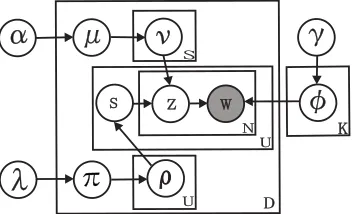
Figure 1: The topic segmentation model
process with a discount parametera and a concen-tration parameter bis used to link µd and νd,s by
νd,s∼PYP(a, b,µd), which forms a simple topic hierarchy. The idea here is that topics discussed in segments can be variants of topics of the whole document. Du et al. (2010) have shown that this topic structure can significantly improve the mod-elling accuracy, which should contribute to more ac-curate segmentation. This generative process is dif-ferent from PLDA. PLDA does not assume the docu-ment level topic distribution and each time generates the segment level topic distribution directly from a Dirichlet distribution.
The complete probabilistic generative process, shown as a graph in Figure 1 is as follows:
1. For each topick∈ {1, . . . , K}, draw a word distribution
φk∼DirichletW(γ).
2. For each documentd∈ {1, . . . , D},
(a) Draw topic shift probabilityπd∼Beta(λ0, λ1).
(b) Drawµd∼DirichletK(α).
(c) For each text passage (except last) u ∈
{1, . . . , Ud−1}, drawρd,u∼Bernoulli(πd).
(d) Compute Sd the number of segments as 1 + PUd−1
u=1 ρd,u.
(e) For each segments ∈ {1, . . . , Sd}, drawνd,s ∼
PYP(a, b,µd).
(f) For each text passageu∈ {1, . . . , Ud}, i. Set segmentsd,u= 1 +Pu−1
v=1ρd,v.
ii. For each word indexn∈ {1, . . . , Nd,u}, A. Draw topiczd,u,n∼DiscreteK νd,sd,u
. B. Draw wordwd,u,n∼DiscreteK(φzd,u,n).
where sd,u indicates which segment text passage u belongs to. We assume the dimensionality of the Dirichlet distribution (i.e., the number of topics) is known and fixed, and word probabilities are param-eterized with a K ×Wmatrix Φ = (φ1, . . . ,φK).
[image:4.612.99.275.62.169.2]In future work we plan to investigate replace the
Table 1: List of statistics
Mk,w total number of words with topick.
Mk a vector ofMk,w.
nd,s,k total number of words with topickin segment
sin documentd.
Nd,s total number of words in segments.
td,s,k table count of topickin the CRP for segment
sin documentd.
td,s a vector oftd,s,kfor segmentsind.
Td,s total table count in segments.
cd,1 total number of topic boundaries ind.
cd,0 total number of non-topic boundaries ind. Dirichlet priorαonµwith a Pitman-Yor prior (Pit-man and Yor, 1997) to make the model fully non-parametric, like SITS.
4 Posterior Inference
In this section we develop a collapsed Gibbs sam-pling algorithm to do an approximate inference by integrating out some latent variables (i.e., µ’s, ν’s and πd’s). The hierarchy in our model can be well explained with the Chinese restaurant franchise metaphor introduced in (Teh et al., 2006). For easier understanding, terminologies of the Chinese Restau-rant Process (CRP) will be used throughout this sec-tion, i.e., customers, dishes and restaurants, corre-spond to words, topics, and segments respectively. Statistics used are listed in Table 1.
To integrate out the νd,s’s generated from the PYP, we use the technique presented in (Chen et al., 2011), which computes the joint posterior for the PYP by summing out all the possible seating arrangements for a sequence of customers (Teh, 2006). In this technique an auxiliary binary variable, called table indicator (δd,u,n), is introduced to fa-cilitate computing table counttd,s,kfor topick. This method has two effects: (1) faster mixing of the sam-pler, and (2) elimination of the need for dynamic memory to store the populations/counts of each ta-ble in the CRP. In the CRP each wordwd,u,nin topic k(i.e., wherezd,u,n=k) contributes a count tond,s,k foru ∈ s; and, ifwd,u,n, as a customer, also opens a new table to the CRP, it leads to increasingtd,s,k by one. In this case,δd,u,n=1indicateswd,u,nis the first customer on the table, calledtable head. Thus,
td,s,k=
X
u∈s Nd,u
X
n=1
δd,u,n1zd,u,n=k. (1)
Note the two constraints on these two counts,i.e.,
can be replaced be a simpler constraint in the table indicator representation.
The sampler we develop is an MCMC sampler on the space θ = {z,δ,ρ} where z defines the topic assignments of words,δmaintains the needed CRP configuration (from whichtis derived) and ρ defines the segmentation. Moreover, it is not a tra-ditional Gibbs sampler changing one variable at a time, but is a block Gibbs sampler where two dif-ferent kinds of blocks are used. The first block is (zd,u,n, δd,u,n) (for each word wd,u,n), which can be sampled with a table indicator variant of a hier-archical topic sampler (Du et al., 2010), described in Section 4.1. This corresponds to Equation (6) in (Purver et al., 2006). The second kind of block is a boundary indicatorρd,u together with a particular constrained set of table counts designed to handle splitting and merging, which corresponds to Equa-tion (7) in (Purver et al., 2006). Sampling this sec-ond kind of block is harder in our non-parametric model requiring a potentially exponential summa-tion, a problem we overcome using symmetric poly-nomials, shown in Section 4.2.
4.1 Sampling Topics
One step in our model is to sample the assignments of topics to words conditioned on all ρ’s. As dis-cussed in Section 3, given the sequence of ρd,u’s,
ρd, one can figure out which segmentstext passage ubelongs to. Thus, conditioned on a set of segments sgiven byρ, the joint posterior distribution ofw,z andδis computed asp(z,w,δ|ρ, Φ, a, b, γ)
= Y
d
BetaK α+
P
std,s
BetaK(α)
Y
k
BetaW(γ+Mk)
BetaW(γ)
Y
d
Y
s∈s
(b|a)Td,s (b)Nd,s
Y
k Snd,s,k
td,s,k,a
nd,s,k
td,s,k
−1
, (3)
where BetaK(·) is a K-dimension Beta function, (x|y)nthe Pochhammer symbol2, andSt,an the gen-eralised Stirling number of the second kind (Hsu and Shiue, 1998)3 precomputed in a table so
cost-2
The Pochhammer symbol(x|y)ndenotes the rising
facto-rial with a specified increment,i.e.,y. It is defined as(x|y)n=
x(x+y)...(x+ (n−1)y).
3A Stirling number of the second kind is used to study the number of ways of partitioning a set of n objects into
k nonempty subsets. The generalised version given by Hsu and Shiue (1998) has a linear recursion which in our case is Sn+1
m,a =Smn−1,a+ (n−ma)Sm,an .
ing O(1) to use (Buntine and Hutter, 2012).Eq (3) is an indicator variant of Eq (1) in (Du et al., 2010) with applying Theorem 1 in (Chen et al., 2011).
Given the current segmentation and topic assign-ments for all other words, using Bayes rule, we can derive the following two conditionals from Eq (3):
1. The joint probability of assigning topickto word
wd,u,n and wd,u,n being a table head,p(zd,u,n =
k, δd,u,n= 1|θ0)
= γwi,j,n+Mk,wi,j,n
P
w(γw+Mk,w)
αk+Pstd,s,k
P
kαk+
P
s,ktd,s,k
b+aTd,s
b+Nd,s
Snd,s,k+1 td,s,k+1,a
Snd,s,k td,s,k,a
td,s,k+ 1
nd,s,k+ 1
(4)
2. The joint probability of assigning k to wd,u,n
and wd,u,n not being a table head, p(zd,u,n =
k, δd,u,n= 0|θ0)
= γwi,j,l+Mk,wi,j,l
P
wγw+Mk,w
1
b+Nd,s
Snd,s,k+1 td,s,k,a
Snd,s,k td,s,k,a
nd,s,k+ 1−td,s,k
nd,s,k+ 1
(5)
where θ0 = {z−zd,u,n,w,δ−δd,u,n,ρ,α, a, b,γ}.
From the two conditionals, we develop a blocked Gibbs sampling algorithm for(zd,u,n, δd,u,n).
4.2 Sampling Segmentation Boundaries
In our model, each segment corresponds to a Chinese restaurant in the CRP. Sampling topic boundaries corresponds to splitting/merging restau-rant(s). This is different from the split-merge process proposed by Jian and Neal (2004), where one actu-ally splits/merges table(s). To our knowledge, there has been no method developed to split/merge restau-rant(s). We tried different approximations, such as the minimum-path-assumption (Wallach, 2008), which in our case assumes one table for each topic k, and all words in k are placed in the same ta-ble. Although this simplifies the split-merge pro-cess, it yielded poor results. We instead developed a novel approximate block Gibbs sampling algorithm using symmetric polynomials. Its segmentation per-formance worked well in our development dataset.
segment,sm, whereuis is somewhere in the middle ofsm. The split-merge choice we sample is one to many, for a given split pair(sl, sr)we consider a set of merged statessm(represented by different possi-ble tapossi-ble counts). Then, to compute the Gibbs prob-ability for splitting/merging restaurant(s), we con-sider the probability of the single split, the probabil-ity of the corresponding set of merges, and then if a merge is selected, we have to sample from the set of merges. These are as follows:
[image:6.612.314.534.465.553.2]Splitting: split sm into sr and sl by placing a boundary afteru. Since passages have a fixed order in each document, all the words are put intosrand sl based on which passages they belong to. Then, given all the topic assignments, we first sample all table indicators δd,u0,n, for n ∈ {1, ..., Nd,u0} and
u0 ∈ sm using Bernoulli sampling without replace-ment. It runs as follows: 1) sampleδd,u0,naccording
to probabilitytd,sm,k/nd,sm,k; 2) decreasetd,sm,k if
δd,u0,n = 1, otherwise, just decrease nd,s
m,k.
Us-ing the sampledδd,u0,n’s we compute the inferred
ta-ble countstd,s,k(from Eq (1)) and customer counts nd,s,k respectively for segments s=sl and sr and topicsk. The computation may result in the follow-ing cases: for a given topick,
(I) Both sl andsr havend,s,k>0 andtd,s,k≥1, which
means both segments have words assigned tokand words being labelled with table head. According to constraints (2), after splitting, restaurants corre-sponding toslandsrare valid. We do not make any
change on table counts.
(II) Eithersl or sr hasnd,s,k=0and td,s,k=0. In this
case, for example, all the words assigned tokinsm
are insl after splitting, and all those labelled with
table headshould also be insl.sr has no words
as-signed tok. Thus, there is no need to change table counts.
(III) Eitherslorsrhasnd,s,k>0andtd,s,k=0. Both
seg-ments have words assigned tok, but those labelled with table headonly exist in one segment. For in-stance, if they only exist insl thensr has no table
head, which means the restaurant ofsrhas customers
eating a dish, but no tables serving that dish. Thus, we settd,sr,k=1to make the constraints (2) satisfied.
The Gibbs probability for splitting a segment is
p(ρd,u= 1|θ00)∝
λ1+cd,1
λ0+λ1+cd,0+cd,1
(6)
BetaK α+ Sd
X
s=1 td,s
Y
s∈{sl,sr}
(b|a)Td,s (b)Nd,s
Y
k Snd,s,k
td,s,k,a,
whereθ00={z,w,δ,ρ−ρd,u,α, a, b, λ
0, λ1}.
Merging: remove the boundary afteru, and merge sr and sl to one segment sm. For this case, both sr and sl satisfy constraints (2) for all k’s, and set nd,sm,k=nd,sr,k + nd,sl,k. The following cases are
considered: for a topick
(I) Bothsl andsr havend,s,k>0andtd,s,k>1. We
computetd,sm,kusing Eq (7). Thus table counts
before and after merging are equal.
(II) Eitherslorsrhasnd,s,k=0andtd,s,k=0. Similar
to the above case, we use Eq (7).
(III) Bothslandsrhavend,s,k>0, and either of them
hastd,s,k=1or both. We have to choose between
Eq (7) and Eq (8),i.e., to decide whether a table should be removed or not.
td,sm,k = td,sl,k+td,sr,k (7)
td,sm,k = td,sl,k+td,sr,k−1 (8)
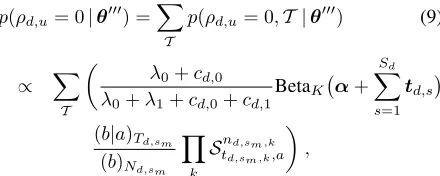
Note that choosing Eq (8) means we need to de-crease the table counttd,sm,k by one. The idea here is that we sample to decide whether the remove table was added due to splitting case (III) or not. Clearly, we have a one-to-many split-merge choice. To com-pute the probability of a set of possible merges, we use elementary symmetric polynomials as fol-lows: letKSbe a set of topic-segment combinations that satisfy the condition in merging case (III), for (k, s) ∈ KS, we sample either Eq (7) or Eq (8). LetT = {td,s,k : (k, s) ∈ KS}be the set of table counts affected by the changes of Eq (7) or Eq (8). The Gibbs probability for merging two segments is
p(ρd,u = 0|θ000) =
X
T
p(ρd,u = 0,T |θ000) (9)
∝ X
T
λ0+cd,0
λ0+λ1+cd,0+cd,1
BetaK α+ Sd
X
s=1 td,s
(b|a)Td,sm
(b)Nd,sm
Y
k
Snd,sm,k td,sm,k,a
,
whereθ000 ={z,w,t− T,ρ−ρd,u,α, a, b, λ
0, λ1}. This is converted to a sum on |T | booleans with independent terms and evaluated recursively in O(|T |2) by symmetric polynomials. If a merge is chosen, one then samples according to the terms in the sum using a similar recursion.
5 Experiments
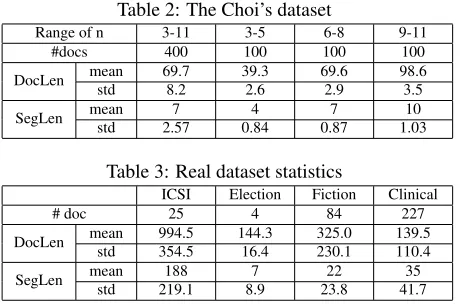
evaluate it on three different kinds of corpora4: a set of synthetic documents, two meeting transcripts and two sets of text books (see Tables 2 and 3); and compare TSM with the following methods: two baselines (the Random algorithm that places topic boundaries uniformly at random, and the Even al-gorithm that places a boundary after everymthtext passage, wheremis the average gold-standard seg-ment length (Beeferman et al., 1999)), C99, MinCut, Bayesseg, APS (Kazantseva and Szpakowicz, 2011), and PLDA.
Metrics: We evaluated the segmentation perfor-mance with PK (Beeferman et al., 1999) and Win-dowDiff (WDr) (Pevzner and Hearst, 2002), which are two common metrics used in topic segmenta-tion. Both move a sliding window of fixed size k over the document, and compare the inferred seg-mentation with the gold-standard segseg-mentation for each window. The window size is usually set to the half of the average gold-standard segment size (Pevzner and Hearst, 2002). In addition, we also used an extended WindowDiff proposed by Lam-prier et al.(2007), denoted by WDe. One problem of WDris that errors near the two ends of a text are penalised less than those in the middle. To solve the problem WDeaddskfictive text passages at the be-ginning and the end of the text when computing the score. We evaluated all the methods with the same Java code for the three metrics.
Parameter Settings: In order to make all the methods comparable, we chose for each method the parameter settings that give the gold-standard number of segments5. Specifically, we used a 11 × 11 rank mask for C99, as suggested by Choi (2000), the configurations included in the code (http://groups.csail.mit.edu/rbg/code) for Bayesseg and manually tuned parameters for MinCut. For APS, a greedy approach was used to search parameter settings that can approximately give the gold-standard number of segments. For PLDA, two randomly initialised Gibbs chains were used. Each chain ran for 75,000 burn-in iterations, then 1000 samples were drawn at a lag of 25 from each chain. For TSM, 10 randomly initialised
4For preprocessing, we only removed stop words. 5
[image:7.612.312.542.70.222.2]The segments learnt by those methods will differ, but just the segment count will be the same as the gold-standard count.
Table 2: The Choi’s dataset
Range of n 3-11 3-5 6-8 9-11 #docs 400 100 100 100
DocLen mean 69.7 39.3 69.6 98.6 std 8.2 2.6 2.9 3.5
SegLen mean 7 4 7 10
std 2.57 0.84 0.87 1.03
Table 3: Real dataset statistics
ICSI Election Fiction Clinical
# doc 25 4 84 227
DocLen mean 994.5 144.3 325.0 139.5 std 354.5 16.4 230.1 110.4
SegLen mean 188 7 22 35 std 219.1 8.9 23.8 41.7
Gibbs chains were used. Each chain ran for 30,000 iterations with 25,000 for burn-in, then 200 samples were drawn. The concentration parameterbin TSM was sampled using the Adaptive-Reject sampling scheme introduced in (Du et al., 2012b), the dis-count parametera = 0.2, andλ0 = λ1 = 0.1. To derive the final segmentation for PLDA and TSM, we first estimated the marginal probabilities of placing boundaries after text passages from the total of 2000 samples. These probabilities were then thresholded to give the gold-standard number of segments. Precisely, we apply a small amount of Gaussian smoothing to the marginal probabilities (except for Choi’s dataset), like Puerveret al.(2006) does. Finally, we used a symmetric Dirichlet prior in PLDA and STM, the one on topic distributions is α= 0.1, the other on word distributionsγ = 0.01.
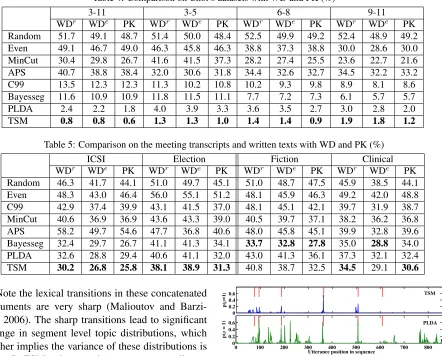
5.1 Evaluation on Choi’s Dataset
Table 4: Comparison on Choi’s datasets with WD and PK (%)
3-11 3-5 6-8 9-11
WDr WDe PK WDr WDe PK WDr WDe PK WDr WDe PK
Random 51.7 49.1 48.7 51.4 50.0 48.4 52.5 49.9 49.2 52.4 48.9 49.2 Even 49.1 46.7 49.0 46.3 45.8 46.3 38.8 37.3 38.8 30.0 28.6 30.0 MinCut 30.4 29.8 26.7 41.6 41.5 37.3 28.2 27.4 25.5 23.6 22.7 21.6 APS 40.7 38.8 38.4 32.0 30.6 31.8 34.4 32.6 32.7 34.5 32.2 33.2 C99 13.5 12.3 12.3 11.3 10.2 10.8 10.2 9.3 9.8 8.9 8.1 8.6 Bayesseg 11.6 10.9 10.9 11.8 11.5 11.1 7.7 7.2 7.3 6.1 5.7 5.7
PLDA 2.4 2.2 1.8 4.0 3.9 3.3 3.6 3.5 2.7 3.0 2.8 2.0
TSM 0.8 0.8 0.6 1.3 1.3 1.0 1.4 1.4 0.9 1.9 1.8 1.2
Table 5: Comparison on the meeting transcripts and written texts with WD and PK (%)
ICSI Election Fiction Clinical
WDr WDe PK WDr WDe PK WDr WDe PK WDr WDe PK
Random 46.3 41.7 44.1 51.0 49.7 45.1 51.0 48.7 47.5 45.9 38.5 44.1 Even 48.3 43.0 46.4 56.0 55.1 51.2 48.1 45.9 46.3 49.2 42.0 48.8 C99 42.9 37.4 39.9 43.1 41.5 37.0 48.1 45.1 42.1 39.7 31.9 38.7 MinCut 40.6 36.9 36.9 43.6 43.3 39.0 40.5 39.7 37.1 38.2 36.2 36.8 APS 58.2 49.7 54.6 47.7 36.8 40.6 48.0 45.8 45.1 39.9 32.8 39.6 Bayesseg 32.4 29.7 26.7 41.1 41.3 34.1 33.7 32.8 27.8 35.0 28.8 34.0 PLDA 32.6 28.8 29.4 40.6 41.1 32.0 43.0 41.3 36.1 37.3 32.1 32.4 TSM 30.2 26.8 25.8 38.1 38.9 31.3 40.8 38.7 32.5 34.5 29.1 30.6
Note the lexical transitions in these concatenated documents are very sharp (Malioutov and Barzi-lay, 2006). The sharp transitions lead to significant change in segment level topic distributions, which further implies the variance of these distributions is large. In TSM, a large variance causes a small con-centration parameter b. We observed that the sam-pledb’s (about 0.1) are indeed small for the four sub-sets, which shows there is no topic sharing among segments. Therefore, TSM is able to recognise the segments are unrelated text.
5.2 Evaluation on Meeting Transcripts
We applied our model to segmenting the two meet-ing transcripts, which are the ICSI meetmeet-ing tran-scripts (Janin et al., 2003) and the 2008 presidential election debates (Boydstun et al., 2011). The ICSI meeting has 75 transcripts, we used the 25 annotated transcripts provided by Galleyet al.(2003) for eval-uation. For the election debates, we used the four annotated debates used in (Nguyen et al., 2012). The statistics are shown in Table 3. PLDA and TSM were trained with 10 topics on the ICSI and 50 on the Election. In this set of experiments, we show that our model is robust to meeting transcripts.
0 0.2 0.4 0.6
p(
=1) TSM
0 100 200 300 400 500 600 700 800 0
0.2 0.4
0.6 PLDA
Utterance position in sequence
p(
= 1)
Figure 2: Probability of a topic boundary, compared with gold-standard segmentation (shown in red and at the top of each diagram) on one ICSI transcript.
Table 6: Sampled concentration parameters
Choi ICSI Election Fiction Clinical
b 0.1 5.2 5.4 18.4 4.8
203, 226, 361, 508, 860}respectively. Both models miss the boundary after the609thutterance, but put a boundary after the508thutterance. Note the bound-aries placed by TSM are always within 10 utterances with respect to the gold standard.
Although TSM still performs the best on the de-bates, all the methods have relatively worse perfor-mance than on the ICSI meeting transcripts. Nguyen et al.(2012) pointed out that the ICSI meetings are characterised by pragmatic topic changes, in con-trast, the debates are characterised by strategic topic changes with strong rewards for setting the agenda, dodging a question,etc. Thus, considering the prop-erties of debates might further improve the segmen-tation performance.
5.3 Evaluation on Written Texts
We further tested TSM on two written text datasets, Clinical (Eisenstein and Barzilay, 2008) and Fiction (Kazantseva and Szpakowicz, 2011). The statistics are shown in Table 3. Each document in the Clinical dataset is a chapter of a medical textbook. Section breaks are selected to be the true topic boundaries. For the Fiction dataset, each document is a fiction downloaded from Project Gutenberg, the true topic boundaries are chapter breaks. We trained PLDA and TSM with 25 topics on the Fiction and 50 on the Clinical. Results are shown in Table 5. TSM com-pares favourably with Bayesseg and outperforms the other methods on the Clinical dataset, but it does not perform as well as Bayesseg on the Fiction dataset.
In fiction books, the topic boundaries between sections are usually blurred by the authors for rea-sons of continuity (Reynar, 1999). We observed that the sampled concentration (or inverse variance) pa-rameterbin TSM is about 18.4 on Fiction, but 4.8 on Clinical, as shown in Table 6. This means the vari-ance of segment level topic distributionsν learnt by TSM is not large for the fiction, so chapter breaks may not necessarily indicate topic changes. For ex-ample, there is a document in the Fiction dataset where gold-standard topic boundaries are placed af-ter each block of text. In contrast, Bayesseg assumes
each segment has its own distribution over words, i.e., one topic per segment, which means topics are not shared among segments. We hypothesize that for certain kinds of documents where the change in topic distribution is subtle, such as fiction, assuming one topic per segment can capture subtle changes in word usage. This is an area for future investigation.
6 Conclusion
In this paper, we have presented a hierarchical Bayesian model for unsupervised topic segmen-tation. This new model takes advances of both Bayesian segmentation and structured topic mod-elling. It uses a point-wise boundary sampling al-gorithm to sample a topic segmentation, while con-currently building a structured topic model. We have developed a novel approximation to com-pute the Gibbs probabilities of spliting/merging seg-ment(s). Our model shows prominent segmentation performance on both written or spoken texts.
In future work, we would like to make the model fully nonparametric and investigate the effects of adding different cues in texts, such as cue phrases, pronoun usage, prosody, etc. Currently, our model uses marginal boundary probabilities to generate the final segmentation. Instead, we could develop a Metropolis-Hasting sampling algorithm to move one boundary at a time, given the gold-standard number of segments. To further study the effectiveness of our model, we would like to compare it with other methods, like SITS (Nguyen et al., 2012) and to run on more datasets, like email (Joty et al., 2010). For example, in order to compare with SITS, one can make an assumption that each document just has one speaker.
Acknowledgments
References
J. Allan, J. Carbonell, G. Doddington, J. Yamron, and Y. Yang. 1998. Topic detection and tracking pi-lot study: Final report. In Proceedings of the DARPA Broadcast News Transcription and Under-standing Workshop, pages 194–218.
Doug Beeferman, Adam Berger, and John Lafferty. 1999. Statistical models for text segmentation. Mach. Learn., 34(1-3):177–210.
David M. Blei, Andrew Y. Ng, and Michael I. Jordan. 2003. Latent Dirichlet allocation. J. Mach. Learn. Res., 3:993–1022.
A.E. Boydstun, C. Phillips, and R.A. Glazier. 2011. Its the economy again, stupid: Agenda control in the 2008 presidential debates.
W. Buntine and M. Hutter. 2012. A Bayesian review of the Poisson-Dirichlet process. Technical Report arXiv:1007.0296v2,ArXiv, Cornell.
Changyou Chen, Lan Du, and Wray Buntine. 2011. Sampling for the Poisson-Dirichlet process. In Euro-pean Conference on Machine Learning and Principles and Practice of Knowledge Discovery in Database, pages 296–311.
Freddy Y. Y. Choi. 2000. Advances in domain inde-pendent linear text segmentation. InProceedings of the 1st North American chapter of the Association for Computational Linguistics conference, NAACL 2000, pages 26–33.
Lan Du, Wray Buntine, and Huidong Jin. 2010. A segmented topic model based on the two-parameter Poisson-Dirichlet process.Mach. Learn., 81(1):5–19. Lan Du, Wray Buntine, and Huidong Jin. 2012a.
Mod-elling sequential text with an adaptive topic model. InProceedings of the 2012 Joint Conference on Em-pirical Methods in Natural Language Processing and Computational Natural Language Learning, pages 535–545.
Lan Du, Wray Buntine, Huidong Jin, and Changyou Chen. 2012b. Sequential latent Dirichlet allocation. Knowledge and Information Systems, 31(3):475–503. Jacob Eisenstein and Regina Barzilay. 2008. Bayesian
unsupervised topic segmentation. In Proceedings of the Conference on Empirical Methods in Natural Lan-guage Processing, EMNLP’08, pages 334–343. Jacob Eisenstein. 2009. Hierarchical text segmentation
from multi-scale lexical cohesion. In Human Lan-guage Technologies: Conference of the North Amer-ican Chapter of the Association of Computational Lin-guistics, pages 353–361. The Association for Compu-tational Linguistics.
Michel Galley, Kathleen R. McKeown, Eric Fosler-Lussier, and Hongyan Jing. 2003. Discourse segmen-tation of multi-party conversation. InProceedings of
the 41st Annual Meeting of the Association for Com-putational Linguistics, pages 562–569.
Sharon Goldwater, Thomas L. Griffiths, and Mark John-son. 2009. A Bayesian framework for word segmen-tation: Exploring the effects of context. Cognition, 112(1):21–53.
Marti A. Hearst. 1997. TextTiling: segmenting text into multi-paragraph subtopic passages. Comput. Lin-guist., 23(1):33–64.
Leetsch C. Hsu and Peter Jau-Shyong Shiue. 1998. A unified approach to generalized Stirling numbers.Adv. Appl. Math., 20:366–384, April.
Sonia Jain and Radford Neal. 2004. A split-merge Markov chain Monte Carlo procedure for the Dirichlet process mixture model.Journal of Computational and Graphical Statistics, 13(1):158–182.
A. Janin, D. Baron, J. Edwards, D. Ellis, D. Gelbart, N. Morgan, B. Peskin, T. Pfau, E. Shriberg, A. Stolcke, and C. Wooters. 2003. The ICSI Meeting Corpus. In Proceedings of 2003 IEEE International Conference on Acoustics, Speech, and Signal (ICASSP ’03), pages 364–367.
Shafiq Joty, Giuseppe Carenini, Gabriel Murray, and Raymond T. Ng. 2010. Exploiting conversation struc-ture in unsupervised topic segmentation for emails. InProceedings of the 2010 Conference on Empirical Methods in Natural Language Processing, pages 388– 398.
Anna Kazantseva and Stan Szpakowicz. 2011. Linear text segmentation using affinity propagation. In Pro-ceedings of the 2011 Conference on Empirical Meth-ods in Natural Language Processing, pages 284–293. Sylvain Lamprier, Tassadit Amghar, Bernard Levrat, and
Frederic Saubion. 2007. On evaluation methodologies for text segmentation algorithms. InProceedings of the 19th IEEE International Conference on Tools with Artificial Intelligence - Volume 02, ICTAI ’07, pages 19–26.
Igor Malioutov and Regina Barzilay. 2006. Minimum cut model for spoken lecture segmentation. In Pro-ceedings of the 21st International Conference on Com-putational Linguistics and the 44th annual meeting of the Association for Computational Linguistics, ACL-44, pages 25–32.
Hemant Misra, Olivier Cappe, and Francois Yvon. 2008. Using LDA to detect semantically incoherent docu-ments. InProceedings of CoNLL-08, pages 41–48. Hemant Misra, Franc¸ois Yvon, Joemon M. Jose, and
Olivier Cappe. 2009. Text segmentation via topic modeling: an analytical study. InProceedings of the 18th ACM conference on Information and knowledge management, CIKM ’09, pages 1553–1556.
model using speaker identity for topic segmentation in multiparty conversations. InProceedings of the 50th Annual Meeting of the Association for Computational Linguistics (Volume 1: Long Papers), pages 78–87. Lev Pevzner and Marti A. Hearst. 2002. A critique and
improvement of an evaluation metric for text segmen-tation.Comput. Linguist., 28(1):19–36.
J. Pitman and M. Yor. 1997. The two-parameter Poisson-Diriclet distribution derived from a stable subordina-tor.Annals Probability, 25:855–900.
Matthew Purver, Thomas L. Griffiths, Konrad P. K¨ording, and Joshua B. Tenenbaum. 2006. Unsupervised topic modelling for multi-party spoken discourse. In Pro-ceedings of the 21st International Conference on Com-putational Linguistics and the 44th annual meeting of the Association for Computational Linguistics, ACL-44, pages 17–24.
Jeffrey C. Reynar. 1999. Statistical models for topic seg-mentation. InProceedings of the 37th Annual Meet-ing of the Association for Computational LMeet-inguistics, pages 357–364.
Martin Riedl and Chris Biemann. 2012. How text seg-mentation algorithms gain from topic models. In Pro-ceedings of the 2012 Conference of the North Ameri-can Chapter of the Association for Computational Lin-guistics: Human Language Technologies.
Gerard Salton, Amit Singhal, Chris Buckley, and Mandar Mitra. 1996. Automatic text decomposition using text segments and text themes. InProceedings of the the seventh ACM conference on Hypertext, pages 53–65. Qi Sun, Runxin Li, Dingsheng Luo, and Xihong Wu.
2008. Text segmentation with LDA-based Fisher ker-nel. InProceedings of ACL-08: HLT, Short Papers, pages 269–272.
Y. W. Teh, M. I. Jordan, M. J. Beal, and D. M. Blei. 2006. Hierarchical Dirichlet processes.Journal of the Amer-ican Statistical Association, 101(476):1566–1581. Y. W. Teh. 2006. A Bayesian interpretation of
interpo-lated Kneser-Ney. Technical Report TRA2/06, School of Computing, National University of Singapore. Masao Utiyama and Hitoshi Isahara. 2001. A statistical
model for domain-independent text segmentation. In Proceedings of 39th Annual Meeting of the Associa-tion for ComputaAssocia-tional Linguistics, pages 499–506. H.M. Wallach. 2008. Structured topic models for
lan-guage.doctoral dissertation, Univ. of Cambridge. Hongning Wang, Duo Zhang, and ChengXiang Zhai.