Abu-MaTran at WMT 2016 Translation Task: Deep Learning,
Morphological Segmentation and Tuning on Character Sequences
V´ıctor M. S´anchez-Cartagena
Prompsit Language Engineering Av. Universitat s/n. Edifici Quorum III
E-03202 Elx, Spain [email protected]
Antonio Toral
ADAPT Centre School of Computing Dublin City University, Ireland
Abstract
This paper presents the systems submitted by the Abu-MaTran project to the English-to-Finnish language pair at the WMT 2016 news translation task. We applied mor-phological segmentation and deep learn-ing in order to address (i) the data scarcity problem caused by the lack of in-domain parallel data in the constrained task and (ii) the complex morphology of Finnish. We submitted a neural machine tion system, a statistical machine transla-tion system reranked with a neural lan-guage model and the combination of their outputs tuned on character sequences. The combination and the neural system were ranked first and second respectively ac-cording to automatic evaluation metrics and tied for the first place in the human evaluation.
1 Introduction
This paper presents the machine translation (MT) systems submitted by the Abu-MaTran project to the WMT 2016 news translation task. We partici-pated in the English-to-Finnish constrained task.
English-to-Finnish is a particularly challenging language pair for corpus-based MT because of the lack of in-domain parallel data (the only avail-able parallel corpus in the shared task isEuroparl) and the complex morphology of Finnish. The fact that the same root can be inflected in many dif-ferent ways and that nouns can be joined together in order to build compound words exacerbates the aforementioned lack of parallel data problem.
As in our last year’s submission (Rubino et al., 2015), we used morphological segmentation (Piri-nen, 2015) on the Finnish side in order to deal with data scarcity and reduce the size of the Finnish vo-cabulary. We also used character-level evaluation
metrics during the development of our systems, which correlate better than word-based ones with human judgements according to the results of last year’s metrics shared task (Stanojevi´c et al., 2015) for English-to-Finnish.
When a Finnish sentence is morphologically segmented, it becomes much longer (number of tokens) than its English counterpart. This results in the distance between the Finnish tokens that depend on each other to produce a correct trans-lation increasing too.1 We addressed this poten-tial issue by introducing deep learning in our sys-tems: we submitted a neural MT (NMT) system and a phrase-based statistical MT (SMT) system enhanced with a neural language model (LM). In the latter, we reduced the length of the Finnish seg-mented sentences by joining the most frequent se-quences of morphs. We also submitted a system that combines the outputs of our best NMT and SMT systems and is tuned on character sequences. The paper is organised as follows: the data and tools used are described in Section 2, while our NMT, SMT and combined submissions are pre-sented respectively in sections 3, 4 and 5. The paper ends with some concluding remarks.
2 Datasets and Tools
We preprocessed the training corpora with scripts included in the Moses toolkit (Koehn et al., 2007). We performed the following operations: punctu-ation normalispunctu-ation, tokenispunctu-ation, true-casing and escaping of problematic characters. The true-caser is lexicon-based and it was trained on all the monolingual data. In addition, we removed sen-tence pairs from the parallel corpora where either side is longer than80tokens.
1For instance, the distance between the morph that
repre-sents the case of an adjective and the morph that reprerepre-sents the case of the noun being modified by the adjective is in-creased. Morphs are the segments in which a word is split after applying morphological segmentation (see Section 3.1).
Corpus Sentences (k) Words (M)
Europarl v8 2 121 39.5
Common Crawl 113 995 2 416.7
[image:2.595.317.518.67.119.2]News Crawl 2014–15 6 741 83.1
Table 1: Finnish monolingual data, after prepro-cessing, used to train the LMs of our SMT sub-mission.
Corpus Sentences (k) Words (M)
Europarl v7 2 218 59.9
News Commentary v11 391 9.8
News Crawl 2007–15 117 446 2 713.2
News Discussions 57 804 983.2
Table 2: English monolingual data, after prepro-cessing, used to train the LM of the Finnish-to-English SMT system we used to backtranslate the FinnishNews Crawlmonolingual corpora into En-glish (see Section 3).
Since theCommon CrawlFinnish monolingual corpus was obtained by crawling websites, we ap-plied a set of additional preprocessing steps in or-der to remove as much noisy data as possible: (i) detecting sentences with an incorrect charac-ter encoding and re-encoding them with the right one; (ii) replacing XML entities with the charac-ters they represent; (iii) removing sentences with a low proportion of alphabetic characters (less than
50%); (iv) removing short sentences (less than 3
alphabetic tokens); and (v) removing sentences whose first18tokens are equal to those in another
sentence. The last filtering is necessary because it is relatively common in the corpus to find the same sentence with some segment missing at the end. If these lines were kept,n-gram counts from which
LM probabilities are estimated would be less re-liable. As a result of these preprocessing steps, around43million sentences were removed.
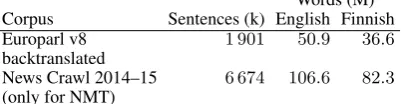
Table 1 shows the Finnish monolingual corpora we used together with their size and Table 3 shows the same information for the parallel corpora. We used an additional synthetic parallel corpus to train our NMT system, which was obtained by back-translating the Finnish News Crawl corpora into English with an SMT system (see Section 3).2 The monolingual corpora used for training its LM are listed in Table 2.
Throughout the paper we evaluate the sys-tems we build in terms on three automatic eval-uation metrics: BLEU (Papineni et al., 2002),
2The number of sentences inNews Crawldisplayed in
ta-bles 1 and 3 do not match because, due to time constraints, we did not backtranslate a few tens of thousands of sentences.
Words (M) Corpus Sentences (k) English Finnish
Europarl v8 1 901 50.9 36.6
backtranslated
6 674 106.6 82.3
News Crawl 2014–15 (only for NMT)
Table 3: Parallel data, after preprocessing, used to train our SMT and NMT systems.
TER (Snover et al., 2006) and chrF1 (Popovi´c, 2015). As the performance obtained in the de-velopment (newsdev2015) and validation ( new-stest2015) sets guides our decisions, we believe it is sensible to use three metrics with different un-derlying methodologies and that work on different elements (words and characters). Statistical signif-icance of the difference between systems is com-puted with paired bootstrap resampling (Koehn, 2004) (p≤0.05,1 000iterations).
3 Neural Machine Translation
NMT systems have been reported to outperform SMT systems for different language pairs (Sen-nrich et al., 2015a; Luong et al., 2015; Costa-Juss`a and Fonollosa, 2016; Chung et al., 2016a). Un-like SMT, in which different models are trained independently and their weights are tuned jointly, in NMT all the components are jointly trained to maximise translation quality. NMT systems have a strong generalisation power because they encode words as real-valued vectors (similar words are close to each other in that vector space) and they are able to model long-distance phenomena thanks to the use of LSTM (Hochreiter and Schmidhu-ber, 1997) or GRU (Chung et al., 2014) units. We followed the encoder-decoder architecture with at-tention proposed by Bahdanau et al. (2015).3
followed the set-up of the rule-based morphologi-cally segmented system from our last year’s con-strained submission (Rubino et al., 2015). It was trained on Europarland the concatenation of the English monolingual corpora listed in Table 2.
Most of the NMT architectures in the literature can only operate with a fixed TL vocabulary (that ranges from 30 000 to 80 000 words, according
to Jean et al. (2015)), since training and decod-ing computational complexity grows with its size. Although Jean et al. (2015) proposed an to re-duce that complexity and hence use larger vocab-ularies, Sennrich et al. (2015b) showed that seg-menting words into smaller units can also reduce complexity, increase effective vocabulary size and even improve translation quality. We followed the latter strategy. The evaluation of character-based NMT approaches (Ling et al., 2015; Costa-Juss`a and Fonollosa, 2016; Chung et al., 2016b) was left as future work.
In the remainder of this section, we present the segmentation approach we followed together with the alternatives we evaluated and we describe the training and decoding set-up of our NMT system, including the strategy followed to translate out-of-vocabulary words (OOVs).
3.1 Word Segmentation
Existing word segmentation approaches for NMT (Sennrich et al., 2015b) rely on frequencies of sequences of characters in the training corpus. We studied whether using linguistic information to segment the training corpus allows the neural network to generalise better: we applied the rule-based morphological segmentation provided
by Omorfi(Pirinen, 2015) for Finnish. It splits
words into morphs, that is, minimal segments carrying semantic or syntactic meaning.
We evaluated the segmentation schemes listed below.4 Table 4 depicts an example of the effect they produce on a Finnish sentence.
• No segmentation at all.
• Byte pair encoding (BPE) on both the source language (SL) and the TL. This is one of the best performing strategies proposed by Sen-nrich et al. (2015b). It consists of initially segmenting each word in characters, and iter-4We did not include unsupervised morphological
segmen-tation (Virpioja et al., 2013; Gr¨onroos et al., 2014) in our eval-uation since the results in our last year’s submission (Rubino et al., 2015, Table 4) showed that it was outperformed by rule-based morphological segmentation.
atively joining the most frequent pair of seg-ments in the training corpus. We applied it independently to the SL and TL sides of the parallel corpus. We performed 60 000 join
operations on each language.
• BPE only on the TL side of the parallel cor-pus, since Finnish is morphologically more complex than English.
• Morphological segmentation with Omorfi
on the TL.
• BPE on the TL using the morphs produced
byOmorfias the starting point. We
evalu-ated the effect of performing 1 000, 10 000, 25 000 and 50 000 join operations.
Mor-phological segmentation produces an average sentence length significantly higher than that of the English side of the parallel corpus. Af-ter performing1 000operations, average
sen-tence lengths are similar: we reduce vocabu-lary size without significantly increasing sen-tence length. As the number of operations in-creases, average sentence length is closer to that of the unsegmented approach.
For each of these segmentation schemes, we trained an NMT system onEuroparlduring5days
(a model was saved every3hours of training), we
chose the model that achieved the highest transla-tion quality onnewsdev20155and evaluated it on
newstest2015. The remainder of the training and decoding parameters were the same ones we used in our submission (described in Section 3.2).
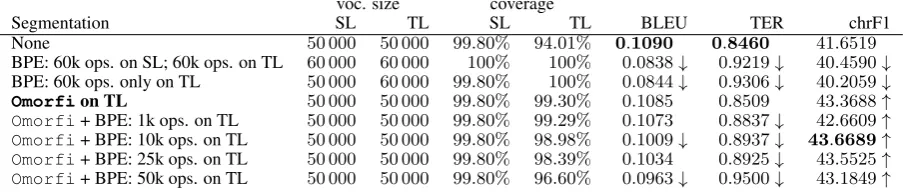
Table 5 depicts the results of the evaluation to-gether with the vocabulary size of the NMT sys-tem6 and the proportion of tokens in the training corpus that belong to the vocabulary. Results show that, despite the fact that the BPE-based systems have full coverage of the training corpus, their per-formance is below that of the unsegmented alter-native. These results are probably related to the fact that domains of the training and testing cor-pora do not match, and words in the test set that do not contain subsegments observed in the training 5Translation quality was measured by chrF1 in the
seg-mentation alternatives that included BPE, since segments were joined before performing the evaluation and this metric is reported to correlate better than BLEU with human judge-ments. For the evaluation of the segmentation scheme based solely onOmorfi, we chose the best model according to BLEU, as the evaluation was performed before joining the morphs (the TL side of the development corpus was also seg-mented withOmorfi).
6This size may represent words or subword units,
Segmentation Sentence
None haluaisimme , ett oppisimme tst yhden perusasian
BPE: 60k ops haluaisimme , ett opp→ ←isimme tst yhden perusasi→ ←an
Omorfi halua→ ←isi→ ←mme , ett opp→ ←isi→ ←mme tst yhde→ ←n perus→ ←asia→ ←n
Omorfi+ BPE: 1k ops. halua→ ←isimme , ett opp→ ←isimme tst yhden perus→ ←asian
Omorfi+ BPE: 50k ops. haluaisimme , ett opp→ ←isimme tst yhden perus→ ←asian
English there is one basic lesson I would like us to learn from this
Table 4: Example of the application of the different segmentation schemes described in Section 3.1 to a Finnish sentence. Arrows represent boundaries between the morphs in which a word is split. Note how the compound wordperusasianis segmented by the different schemes:Omorfisplits it intoperus
(“basic”), asia (“thing, affair”) and the case marker-n, while the application of BPE over it joins the marker to the second noun. The pure BPE scheme, however, fails to segmentperusasiancorrectly.
corpus are segmented into very long sequences.
The Omorfi-based approach, which is domain
agnostic, is close to the unsegmented alternative in terms of BLEU and TER (there is no statistically significant difference between them) and clearly outperforms it in terms of the character-level met-ric chrF1. This shows the effect of segmentation: the system is probably producing a better trans-lation for some parts of compound words and/or producing lemmas that can be found in the refer-ence, but inflected in a different way. Finally, the combination of BPE with morphological segmen-tation does not bring a clear improvement. In view of the results, we decided to segment the TL side of the training corpus with Omorfi in our sub-mission.
3.2 Training and Decoding Details
We generally followed the training set-up by Sen-nrich et al. (2015b). We defined a hidden layer size of1 000and an embedding layer size of620.
We used Adadelta (Zeiler, 2012) with a minibatch size of80, and reshuffled the training set between
epochs. We applied gradient clipping (Pascanu et al., 2013) with a cutoff of1.0. The vocabulary contained the50 000most frequent SL tokens and
the50 000most frequent TL tokens in the training
corpus.
We trained our system during 8days (a model
was saved every3hours).7We chose the4models
that produced the highest BLEU score on news-dev2015. The training of these 4models
contin-ued for12 hours without changing the values of the embedding layers. After that, we translated the test set with an ensemble of these4models.8
7Training was performed on a NVIDIA Tesla K20 GPU. 8We used a beam size of 12 for beam search and
nor-malised the probability by sentence length.
3.3 Dealing with Unknown Words
In order to translate OOVs,9 we followed an en-hanced version of the approach by Jean et al. (2015, Sec. 3.3). OOVs in the training corpus were replaced with the special tokenUNK, as were those in the SL sentences to be translated by the NMT system. As a result, the output contained someUNKtokens.
In order to replace theUNKtokens generated by the model, we identified the most likely SL word to which the unknown TL word was aligned. If the SL word started with an uppercase letter, we copied it to the output. Otherwise, we replaced the
UNKtoken with its translation according to a bilin-gual dictionary obtained from the parallel corpus
withfast align(Dyer et al., 2013).
For eachUNKtoken, Jean et al. (2015) selected the SL word with the highest alignment probablity according to the attention mechanism, while our enhanced approach combines the attention mech-anism and a heuristic that aims at preserving the named entities in the SL sentence. We consid-ered the top 5 SL words with the highest
atten-tion alignment probability for eachUNK token,10 and, for each sentence, we chose the set of SL words that ensured that the maximum number of words that start with an uppercase letter in the SL sentence were included in the translation.11 Ta-9We define OOVs as those words either not present in the
training corpus or present but not frequent enough to be part of the NMT system vocabulary.
10We ignored those SL words whose probability was 4
times lower than that of the most probable SL word.
11We relied on the capitalisation of the first character to
voc. size coverage
Segmentation SL TL SL TL BLEU TER chrF1
None 50 000 50 000 99.80% 94.01% 0.1090 0.8460 41.6519
BPE: 60k ops. on SL; 60k ops. on TL 60 000 60 000 100% 100% 0.0838↓ 0.9219↓ 40.4590↓ BPE: 60k ops. only on TL 50 000 60 000 99.80% 100% 0.0844↓ 0.9306↓ 40.2059↓
Omorfion TL 50 000 50 000 99.80% 99.30% 0.1085 0.8509 43.3688↑
[image:5.595.73.525.65.161.2]Omorfi+ BPE: 1k ops. on TL 50 000 50 000 99.80% 99.29% 0.1073 0.8837↓ 42.6609↑ Omorfi+ BPE: 10k ops. on TL 50 000 50 000 99.80% 98.98% 0.1009↓ 0.8937↓ 43.6689↑ Omorfi+ BPE: 25k ops. on TL 50 000 50 000 99.80% 98.39% 0.1034 0.8925↓ 43.5525↑ Omorfi+ BPE: 50k ops. on TL 50 000 50 000 99.80% 96.60% 0.0963↓ 0.9500↓ 43.1849↑
Table 5: Results of the evaluation of different word segmentation schemes on an NMT system trained on Europarl. The vocabulary size of the NMT system is depicted, as well as the proportion of tokens covered in the training copus. Scores displayed correspond to the evaluation on newstest2015. The best score for each metric is shown in bold. An arrow pointing upwards (↑) means that the corresponding system outperforms the system without segmentation by a statistically significant margin, while an arrow pointing downwards (↓) means the opposite: the system without segmentation wins.
System BLEU TER chrF1
best individual model 0.1568 0.7714 49.52 (most probable SL word)
ensemble 0.1819
↑ 0.7409↑ 52.21↑
(most probable SL word)
ensemble 0.1830
↑ 0.7411 52.43↑
(preserve named entities)
Table 6: Results of the evaluation onnewstest2016
of our NMT submission (in bold), the simpler strategy for translating unknown words by Jean et al. (2015, Sec. 3.3) (labelled as most proba-ble SL word) and our best individual NMT model. The best score for each metric is shown in bold. An arrow pointing upwards (↑) means that the
cor-responding system outperforms the system in the previous row by a statistically significant margin.
ble 6 shows the results of the automatic evalua-tion of our submitted NMT system (in bold; as described in the previous section, it is an ensem-ble of4models) onnewstest2016. We also
evalu-ated the simpler OOV translation strategy by Jean et al. (2015), and the best NMT individual model according to BLEU on the development set. Our enhanced strategy for OOV translation resulted in a statistically significant improvement in terms of BLEU and chrF1. Note also the huge impact of model ensembling.
4 Statistical Machine Translation
Our work on SMT systems built upon our last year’s best constrained individual system (Rubino et al., 2015). This was a phrase-based SMT sys-tem where the Finnish data was segmented to morphs withOmorfi(Pirinen, 2015). It also used two additional models: an Operation Sequence
words were named entities that do not need to be translated).
Model (Durrani et al., 2011) and a Bilingual Neu-ral Language Model (Devlin et al., 2014), as well as three reordering models: word- and phrase-based and hierarchical (Koehn et al., 2005; Galley and Manning, 2008).
This year’s SMT systems used the same models and datasets, except for the LMs, which this time were log-linearly interpolated and used the addi-tional corpus available (Common Crawl, cf. Table 1). We built three SMT systems, which share the same models and data, with the only difference be-ing the segmentation used in the Finnish data:
• No segmentation.
• Segmentation on morphs (Omorfi).
• Segmentation on morphs followed by join-ing the most frequent sequences (Omorfi+ BPE).
In the latter we joined the most frequent sequences (1 000operations) so that the length of the Finnish
System BLEU TER chrF1 No segmentation 0.1444 0.7775 49.63
Omorfi 0.1501↑ 0.7717↑ 51.13↑ Omorfi+ BPE 0.1536↑ 0.7679↑ 50.99↑
Table 7: Results of the evaluation onnewstest2016
of the SMT systems built. The best score for each metric is shown in bold. An arrow pointing up-wards (↑) means that the corresponding system
outperforms the system without segmentation by a statistically significant margin.
4.1 Reranking
We reranked the n-best list (top 500 distinct
translations) produced by our best SMT system
(Omorfi+ BPE) using two neural LMs:
left-to-right (i.e. trained in the same direction as the LMs included in the SMT system) and right-to-left (i.e. reverse direction). We hypothesise that the latter LM might bring a higher improvement as the se-quences this LM is trained on have not been used by the SMT decoder.12
Both neural LMs were trained on in-domain data (a subset of 4 million sentences13 randomly
selected from News Crawl) with the rwthlm
toolkit (Sundermeyer et al., 2014). The main pa-rameters we used are as follows: vocabulary lim-ited to the50 000 most frequent tokens, 2 layers
(linear and LSTM), both of size 200 and 1 000
word classes, generated withmkcls.
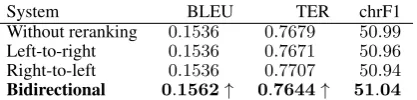
Table 8 shows the results of reranking using left-to-right and right-to-left neural LMs on their own and jointly (row bidirectional). Reranking with left-to-right or the right-to-left LMs on their own does not result in a substantial improvement. However, when both LMs are used jointly we ob-serve better scores for all the metrics: 1.7%
rela-tive improvement for BLEU,−0.5%for TER and 0.1%for chrF1.
5 System Combination
As we have seen in the previous two sections, our best NMT system outperforms by a wide margin our best SMT system. These two systems are ty-pologically different, and thus, despite the gap in performance, we might expect them to have plementary strengths. We therefore explored com-bining both systems in order to answer the fol-lowing question: whether SMT, despite the gap in performance, can still be useful, used jointly with
12Because of the way SMT decoders work they can use
left-to-right LMs but not reverse LMs.
13Due to time constraints.
System BLEU TER chrF1
Without reranking 0.1536 0.7679 50.99
Left-to-right 0.1536 0.7671 50.96
Right-to-left 0.1536 0.7707 50.94
[image:6.595.310.519.61.111.2]Bidirectional 0.1562↑ 0.7644↑ 51.04
Table 8: Results of the different reranking strate-gies applied to the best SMT system (Omorfi+ BPE) on newstest2016. The best score for each metric is shown in bold, as is the system submit-ted. An arrow pointing upwards (↑) means that the corresponding system outperforms the sys-tem without reranking by a statistically significant margin.
NMT, to improve upon NMT on its own.
We combined the outputs produced by the best NMT and SMT systems withMEMT(Heafield and Lavie, 2010). We used default settings, except for radius (5), following empirical results obtained on
newsdev2015. The LM used in the combination was built on the concatenation of all the Finnish monolingual corpora available, cf. Table 1.
As the systems combined use different seg-mentations (Omorfi in NMT and Omorfi fol-lowed by BPE in SMT), we joined the morphs before combining them. Therefore the tuning of the system combination was performed without segmentation. Since chrF1 was found to corre-late well with human evaluation for Finnish last year (Stanojevi´c et al., 2015), we explored tuning on this metric, alongside tuning on BLEU.
Finally, we reranked the n-best list of the
sys-tem combination (top 500 translations) with the
same procedure used to rerank the best SMT tem (cf. Section 4.1). While the best SMT sys-tem was reranked on segmented data (Omorfi+ BPE), the output of the system combination is not segmented. Therefore, similarly to what we did for system combination, we explored tuning the reranking on chrF1.
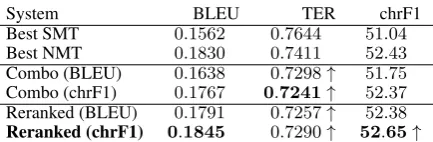
Table 9 shows the results of system combina-tion and its rerankings. In system combinacombina-tion, we observe that tuning on character sequences results in considerably better scores compared to tuning on BLEU. That said, the output produced by the best system combination system without rerank-ing (i.e. tuned on chrF1) is still worse than the one produced by the NMT system alone according the automatic metrics (−3.4%relative on BLEU and
−0.1% on chrF1) except for TER (2.3% relative improvement).
System BLEU TER chrF1
Best SMT 0.1562 0.7644 51.04
Best NMT 0.1830 0.7411 52.43
[image:7.595.75.292.60.131.2]Combo (BLEU) 0.1638 0.7298↑ 51.75 Combo (chrF1) 0.1767 0.7241↑ 52.37 Reranked (BLEU) 0.1791 0.7257↑ 52.38 Reranked (chrF1) 0.1845 0.7290↑ 52.65↑
Table 9: Results of the system combination exper-iments onnewstest2016. The best score for each metric is shown in bold, as is the system submit-ted. An arrow pointing upwards (↑) means that the corresponding system outperforms the best NMT system by a statistically significant margin.
yields better scores, tuning both on BLEU and chrF1, with the latter leading to the best results across all metrics (except TER). This system out-performs the NMT system in terms of TER and chrF1 and it is the system combination output that we submitted.
6 Conclusions
Our participation in WMT 2016 news transla-tion shared task focused on tackling data scarcity in English-to-Finnish translation with the help of morphological segmentation and deep learning.
Our experiments showed that rule-based mor-phological segmentation improves translation quality when applied to both NMT and SMT. In the latter, we had to adapt the segmentation strat-egy to avoid generating a training corpus with very different SL and TL sentence lengths. On the con-trary, difference in sentence length was not a rele-vant factor in NMT.
The use of deep learning approaches to MT al-lowed us to obtain a remarkable improvement over SMT. Our best NMT system outperforms our best SMT system by a huge margin and their combina-tion is only slightly better than the NMT system according to automatic evaluation. Our best SMT system also includes a neural LM but our results suggest that pure neural MT approaches constitute an important breakthrough.
Tuning on character sequences (chrF1 met-ric),15 used for system combination, resulted in better performance than tuning on the de facto
standard BLEU, corroborating the results seen in human evaluation, i.e. better correlation.
Our combined and NMT submissions were
best, i.e. the one tuned on chrF1.
15The code has been made available as part of Joshua
and can be found at https://github.com/apache/ incubator-joshua/pull/27
ranked first and second respectively (both in terms of BLEU and TER) in the English-to-Finnish news translation task automatic evaluation16 and they tied for the first place in the human evaluation.
Acknowledgments
The research leading to these results has re-ceived funding from the European Union Seventh Framework Programme FP7/2007-2013 under grant agreement PIAP-GA-2012-324414 (Abu-MaTran). We would like to thank the Irish Centre for High-End Computing (www.ichec.ie) for pro-viding computational infrastructure and Kazuki Irie for his help to our questions re RWTHLM.
References
Dzmitry Bahdanau, Kyunghyun Cho, and Yoshua Bengio. 2015. Neural Machine Translation by Jointly Learning to Align and Translate. arXiv preprint arXiv:1409.0473.
Junyoung Chung, Kyunghyun Cho, and Yoshua Bengio. 2016a. A character-level decoder with-out explicit segmentation for neural machine translation. arXiv preprint arXiv:1603.06147. Junyoung Chung, Kyunghyun Cho, and Yoshua
Bengio. 2016b. A character-level decoder with-out explicit segmentation for neural machine translation. arXiv preprint arXiv:1603.06147. Junyoung Chung, C¸aglar G¨ulc¸ehre, KyungHyun
Cho, and Yoshua Bengio. 2014. Empiri-cal evaluation of gated recurrent neural net-works on sequence modeling. arXiv preprint arXiv:1412.3555.
Marta R. Costa-Juss`a and Jos´e A. R. Fonollosa. 2016. Character-based neural machine transla-tion. arXiv preprint arXiv:1603.00810. Jacob Devlin, Rabih Zbib, Zhongqiang Huang,
Thomas Lamar, Richard Schwartz, and John Makhoul. 2014. Fast and Robust Neural Network Joint Models for Statistical Machine Translation. In Proceedings of the 52nd An-nual Meeting of the Association for Compu-tational Linguistics (Volume 1: Long Papers). Baltimore, Maryland, pages 1370–1380. Nadir Durrani, Helmut Schmid, and Alexander
Fraser. 2011. A Joint Sequence Translation
16The automatic evaluation scores reported in this paper
Model with Integrated Reordering. In Pro-ceedings of the 49th Annual Meeting of the As-sociation for Computational Linguistics: Hu-man Language Technologies. Portland, Oregon, USA, pages 1045–1054.
Chris Dyer, Victor Chahuneau, and Noah A. Smith. 2013. A Simple, Fast, and Effective Reparameterization of IBM Model 2. In Pro-ceedings of the 2013 Conference of the North American Chapter of the Association for Com-putational Linguistics: Human Language Tech-nologies. Atlanta, Georgia, pages 644–648. Michel Galley and Christopher D. Manning. 2008.
A simple and effective hierarchical phrase re-ordering model. In Proceedings of the Con-ference on Empirical Methods in Natural Lan-guage Processing. Honolulu, Hawaii, pages 848–856.
Stig-Arne Gr¨onroos, Sami Virpioja, Peter Smit, and Mikko Kurimo. 2014. Morfessor flatcat: An hmm-based method for unsupervised and semi-supervised learning of morphology. In
Proceedings of COLING 2014, the 25th Inter-national Conference on Computational Linguis-tics: Technical Papers. Dublin City University and Association for Computational Linguistics, Dublin, Ireland, pages 1177–1185.
Kenneth Heafield and Alon Lavie. 2010. Com-bining Machine Translation Output with Open Source: The Carnegie Mellon Multi-Engine Machine Translation Scheme. The Prague Bul-letin of Mathematical Linguistics93:27–36. Sepp Hochreiter and J¨urgen Schmidhuber. 1997.
Long short-term memory. Neural computation
9(8):1735–1780.
S´ebastien Jean, Kyunghyun Cho, Roland Memi-sevic, and Yoshua Bengio. 2015. On using very large target vocabulary for neural machine translation. InProceedings of the 53rd Annual Meeting of the Association for Computational Linguistics and the 7th International Joint Con-ference on Natural Language Processing (Vol-ume 1: Long Papers). Beijing, China, pages 1– 10.
Philipp Koehn. 2004. Statistical significance tests for machine translation evaluation. In Proceed-ings of the Conference on Empirical Methods in Natural Language Processing. Barcelona, Spain, volume 4, pages 388–395.
Philipp Koehn, Amittai Axelrod, Alexandra Birch, Chris Callison-Burch, Miles Osborne, David
Talbot, and Michael White. 2005. Edinburgh system description for the 2005 IWSLT speech translation evaluation. In Proceesings of the International Workshop on Spoken Language Translation. pages 68–75.
Philipp Koehn, Hieu Hoang, Alexandra Birch, Chris Callison-Burch, Marcello Federico, Nicola Bertoldi, Brooke Cowan, Wade Shen, Christine Moran, Richard Zens, Chris Dyer, Ondˇrej Bojar, Alexandra Constantin, and Evan Herbst. 2007. Moses: Open source toolkit for statistical machine translation. InProceedings of the 45th Annual Meeting of the ACL on Interactive Poster and Demonstration Sessions. Prague, Czech Republic, pages 177–180. Wang Ling, Isabel Trancoso, Chris Dyer, and
Alan W Black. 2015. Character-based neu-ral machine translation. arXiv preprint arXiv:1511.04586.
Minh-Thang Luong, Hieu Pham, and Christo-pher D. Manning. 2015. Effective approaches to attention-based neural machine translation. In
Proceedings of the 2015 Conference on Empir-ical Methods in Natural Language Processing. Lisbon, Portugal, pages 1412–1421.
Kishore Papineni, Salim Roukos, Todd Ward, and Wei-Jing Zhu. 2002. Bleu: a method for auto-matic evaluation of machine translation. In Pro-ceedings of 40th Annual Meeting of the Associ-ation for ComputAssoci-ational Linguistics. Philadel-phia, Pennsylvania, USA, pages 311–318. Razvan Pascanu, Tomas Mikolov, and Yoshua
Bengio. 2013. On the difficulty of training recurrent neural networks. In Sanjoy Das-gupta and David Mcallester, editors, Proceed-ings of the 30th International Conference on Machine Learning (ICML-13). JMLR Work-shop and Conference Proceedings, volume 28, pages 1310–1318.
Tommi A. Pirinen. 2015. Omorfi —free and open source morphological lexical database for finnish. InProceedings of the 20th Nordic Con-ference of Computational Linguistics (NODAL-IDA 2015). Vilnius, Lithuania, pages 313–315. Maja Popovi´c. 2015. chrF: character n-gram
F-score for automatic MT evaluation. In Proceed-ings of the Tenth Workshop on Statistical Ma-chine Translation. Lisbon, Portugal, pages 392– 395.
Vassilis Papavassiliou, Prokopis Prokopidis, and Antonio Toral. 2015. Abu-matran at wmt 2015 translation task: Morphological segmen-tation and web crawling. InProceedings of the Tenth Workshop on Statistical Machine Trans-lation. Lisbon, Portugal, pages 184–191. Rico Sennrich, Barry Haddow, and Alexandra
Birch. 2015a. Improving Neural Machine Translation Models with Monolingual Data.
arXiv preprint arXiv:1511.06709.
Rico Sennrich, Barry Haddow, and Alexandra Birch. 2015b. Neural machine translation of rare words with subword units. arXiv preprint arXiv:1508.07909.
Matthew Snover, Bonnie Dorr, Richard Schwartz, Linnea Micciulla, and John Makhoul. 2006. A study of translation edit rate with targeted hu-man annotation. InProceedings of the 7th bien-nial conference of the Association for Machine Translation in the Americas. Cambridge, USA, pages 223–231.
Miloˇs Stanojevi´c, Amir Kamran, Philipp Koehn, and Ondˇrej Bojar. 2015. Results of the WMT15 Metrics Shared Task. In Proceedings of the Tenth Workshop on Statistical Machine Trans-lation. Lisbon, Portugal, pages 256–273. Martin Sundermeyer, Ralf Schl¨uter, and Hermann
Ney. 2014. rwthlm – the RWTH Aachen univer-sity neural network language modeling toolkit. InProceedings of the 15th Annual Conference of the International Speech Communication As-sociation. Singapore, pages 2093–2097. Sami Virpioja, Peter Smit, Stig-Arne Gr¨onroos,
and Mikko Kurimo. 2013. Morfessor 2.0: Python implementation and extensions for mor-fessor baseline.