WBI-NER: The impact of domain-specific features on the performance of
identifying and classifying mentions of drugs
Tim Rockt¨aschel Torsten Huber Michael Weidlich Ulf Leser Humboldt-Universit¨at zu Berlin
Knowledge Management in Bioinformatics Unter den Linden 6
Berlin, 10099, Germany
{trocktae,thuber,weidlich,leser}@informatik.hu-berlin.de
Abstract
Named entity recognition (NER) systems are often based on machine learning tech-niques to reduce the labor-intensive devel-opment of hand-crafted extraction rules and domain-dependent dictionaries. Nevertheless, time-consuming feature engineering is often needed to achieve state-of-the-art performance. In this study, we investigate the impact of such domain-specific features on the performance of recognizing and classifying mentions of pharmacological substances. We compare the performance of a system based on general fea-tures, which have been successfully applied to a wide range of NER tasks, with a system that additionally uses features generated from the output of an existing chemical NER tool and a collection of domain-specific resources. We demonstrate that acceptable results can be achieved with the former system. Still, our ex-periments show that using domain-specific fea-tures outperforms this general approach. Our system ranked first in the SemEval-2013 Task 9.1: Recognition and classification of pharma-cological substances.
1 Introduction
The accurate identification of drug mentions in text is an important prerequisite for many applications, in-cluding the retrieval of information about substances in drug development (e.g.Roberts and Hayes(2008)), the identification of adverse drug effects (e.g. Lea-man et al.(2010)) and the recognition of drug-drug interactions (e.g.Thomas et al.(2011)). Given that most of the information related to drug research is
covered by medical reports and pharmacological pub-lications, computational methods for information ex-traction should be used to support this task.
The SemEval-2013 Task 9.1 competition1( Segura-Bedmar et al.,2013) aims at a fair assessment on the state-of-the-art of tools that recognize and classify mentions of pharmacological substances in natural language texts – a task referred to as drug named entity recognition (NER). The goal of participating teams is to recreate the gold annotation on a held-out part of an annotated corpus. Four classes of en-tities have to be identified:Drug,DrugN,Group
andBrand. Entities of classDrugdenote any kind of drug that is approved for use in humans, whereas
DrugN denotes substances that are not approved.
Groupare terms describing a group of drugs and
Brandstands for drug names introduced by a phar-maceutical company.
The aim of this study is to examine whether it is worthwhile to implement domain-specific features for supporting drug NER. The question we attempt to answer is whether such features really help in iden-tifying and classifying mentions of drugs or whether a mostly domain-independent feature set, which can be applied to many other tasks, achieves a compara-ble performance.
2 Related work
Various NER systems for identifying different classes of chemical entities, including mentions of drugs, trivial names and IUPAC terms, have been pro-posed.
1
http://www.cs.york.ac.uk/semeval-2013/task9/ (accessed 2013-04-29)
Klinger et al.(2008) trained a conditional random field (CRF) (Lafferty et al.,2001) for extracting men-tions of IUPAC and IUPAC-like entities. They report an F1measure of 85.6%on a hand-annotated corpus consisting of MEDLINE abstracts.
Segura-Bedmar et al. (2008) introduced Drug-NER, which is based on UMLS MetaMap Trans-fer (MMTx) and nomenclature rules by the World Health Organization International Nonproprietary Names (INNs). Their system extracts and classifies mentions of drugs and achieves a precision of 99.1%
and a recall of 99.8%on a silver-standard corpus. OSCAR (Open-Source Chemistry Analysis Rou-tines) (Corbett and Murray-Rust,2006;Jessop et al.,
2011) extracts mentions of a wide range of chemi-cals using a maximum entropy Markov model ( Mc-Callum et al.,2000). It achieves an F1of 83.2%on a corpus consisting of PubMed abstracts and 80.7%
on a corpus consisting of chemistry papers (Corbett and Copestake,2008).
Hettne et al.(2009) compiled Jochem (the joint chemical dictionary) from ChemIDplus, ChEBI, DrugBank, PubChem, HMDB, KEGG, MeSH and CAS Registry IDs. Jochem was used with Peregrine (Schuemie et al.,2007), a dictionary-based NER tool, achieving an F1of 50%on the SCAI corpus (Kol´arik et al.,2008).
We developed ChemSpot (Rockt¨aschel et al.,
2012), a system for extracting mentions of various kinds of chemicals from text. We applied a CRF for extracting mentions of IUPAC entities based on the work ofKlinger et al.(2008) and used Jochem (Hettne et al., 2009) with an adapted matching-mechanism for identifying trivial names, drugs and brands. ChemSpot v1.0 achieved an overall F1 of 68.1%on the SCAI corpus. In the meantime, we have worked on several enhancements (see Section 3.1).
The SemEval-2013 Task 9.1 poses new challenges on NER tools. Instead of targeting all kinds of chem-icals, it focuses on drugs,i.e., pharmacological sub-stances that affect humans and are used for adminis-tration. Moreover, entities need to be classified into the four categories mentioned above.
3 Methods
Our approach is based on a linear-chain CRF with mostly domain-independent features commonly
ap-plied to NER tasks. In addition, we employ vari-ous domain-specific features derived from the out-put of ChemSpot’s components, as well as Jochem, the PHARE ontology (Coulet et al.,2011) and the ChEBI ontology (De Matos et al., 2010). In the following, we first explain extensions to ChemSpot. Subsequently, we give a brief introduction to linear-chain CRFs before describing the general and domain-specific features used by our system. Finally, we explain the experimental setup and discuss our results.
3.1 Improvements of ChemSpot
To improve ChemSpot’s chemical NER performance, we extend it by two components and modify its match-expansion mechanism.
The first addition is a pattern-based tagger for chemical formulae. In its basic form it ex-tracts mentions matching the regular expression
(S N?(\+|-)?)+ where S denotes a chemical symbol andN a natural number greater one.2 This
pattern is augmented by filters to comply with other naming conventions, such as correct grouping of compounds with parentheses.
The second extension targets ambiguous ab-breviations. For example, the abbreviation “DAG” could denote “diacylglycerol” or “directed acyclic graph”. We use ABBREV, an algorithm proposed bySchwartz and Hearst(2003), for extracting such abbreviations and their definitions (e.g. “diacylglyc-erol (DAG)”). Note that the position of the long form (LF) and short form (SF) is interchangeable. To dis-ambiguate between chemical and non-chemical ab-breviations, we apply the following two rules to the mentions extracted by ChemSpot: (1) For a given pair of LF and SF, we check whether the LF was found to be a chemical but the SF was not. In this case we add a new annotation for every occurrence of the SF in the document. (2) Contrary to that, if only the SF was tagged as a chemical but the LF was not, we assume that the abbreviation does not refer to a chemical and remove all annotations of the SF in the document.
ChemSpot’s match-expansion often leads to the extraction of non-chemical suffixes corresponding to verbs,e.g., “-induced”, “-enriched” or “-mediated”.
2
yi yi−1
yi−2 yi+1 yi+2
Ψ
Ψ Ψ Ψ Ψ
[image:3.612.92.296.60.140.2]x
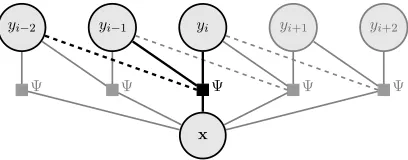
Figure 1: A factor graph for a 1st-order linear-chain CRF (2nd-order with dashed edges). Note that for each feature function fj in the factorΨ, the same
weightθj is used at all other positions (gray) in the
sequence (parameter tying).
To tackle this issue we stop the expansion at tokens whose part-of-speech tag refers to a verb form. Fur-thermore, we integrated OPSIN (Lowe et al.,2011) to normalize entity mentions to InChI strings.
The current v1.5 release of ChemSpot achieves an overall F1of 74.2%on the SCAI corpus, improving the performance by 6.1 percentage points (pp) F1 compared to ChemSpot v1.0.
3.2 Linear-chain conditional random fields
Contrary to the hybrid strategy used in ChemSpot, we follow a purely machine learning based approach for drug NER in this work. NER can be formulated as a sequence labeling task where the goal is to find a sequence of labelsy = {y1, . . . , yn}given a
se-quencex= {x1, . . . , xn}of observed input tokens.
Labels commonly follow theIOBformat, whereB
denotes a token at the beginning of an entity men-tion,Idenotes the continuation of a mention andO
corresponds to tokens that are not part of a mention. Extracting entity mentions from a tokenized textx
then amounts to findingy∗= arg maxyp(y|x).
Linear-chain CRFs are well-known discriminative undirected graphical models that encode the condi-tional probabilityp(y|x)of asetof input variables
xand asequenceof output variablesy(seeWallach
(2004) orKlinger and Tomanek(2007) for an intro-duction). In the case of NER,xis asequence ofn
tokens andya sequence ofncorresponding labels. Linear-chain CRFs of orderkfactorizep(y|x)into a product of factors Ψ, globally normalized by an input-dependent partition functionZ(x):
p(y|x) = 1 Z(x)
n Y
i=1
Ψ(yi−k, . . . , yi−1, yi,x, i).
A factorΨis commonly defined as the exponen-tial function of a sum of weighted feature functions
{f1, . . . , fm}:
1 Z(x)
n Y
i=1
exp
m X
j=1
θjfj(yi−k, . . . , yi−1, yi,x, i)
.
The feature function weights {θj} can be learned
from training data and are shared across all positions
i(parameter tying).
The factorization of a CRF can be illustrated by a factor graph (Kschischang et al.,2001). A factor graph is a bipartite graph, where one set of nodes corresponds to random variables and the other to fac-tors. Each factor is connected to the variables of its domain, making the factorization of the model ap-parent. Figure 1 shows a factor graph for a segment of a linear-chain CRF of order one and two respec-tively. In a linear-chain CRF of orderk, the label of a token at positioniis connected via feature func-tions of a factor to the input sequencexas well as the previousk labels. For example, in a first-order linear-chain CRF, one of the feature functions could bef[O→B,capital](yi−1, yi,x, i), which evaluates to1if
yi−1 = O,yi = Bandxi starts with a capital letter
(otherwise it yields0). Multiplication with the weight
θ[O→B,capital] yields an unnormalized local score that indicates how favorable a transition fromOtoBis provided that the token at positionistarts with a capi-tal letter. Note that the termsfeature functionand fea-tureare often used synonymously and the case differ-entiation for different labels is implicit. In this work a featurefcapitaldenotes its corresponding set of
first-order feature functions{f[s→t,capital](yi−1, yi,x, i)|
(s, t) ∈ {(B,B),(B,I),(B,O),(I,B),(I,I),(I,O), (O,B),(O,O)}}3(similarly for second-order).
We employ MALLET (McCallum,2002) as under-lying CRF implementation and use a second-order linear-chain CRF with offset conjunctions of order two. Offset conjunctions of orderk adds features around a window of k to the features at a partic-ular position, providing more contextual informa-tion. Akin toKlinger et al.(2008), we perform fine-grained tokenization, splitting at special characters and transitions from alphanumeric characters to dig-its. An exemplary tagging sequence is shown in Ta-ble 1.
3
i 0 1 2 3 4 5 6 7 8 9 10
y O B-DrugN O B-DrugN I-DrugN I-DrugN O B-Group O O O
[image:4.612.79.534.61.97.2]x Both ibogaine and 18 - MC ameliorate opioid withdrawal signs .
Table 1: Example label sequence for the tokenized sentence MedLine.d110.s4 of the training corpus.
Feature Class Description
FC
fCHEMSPOT part of a prediction by ChemSpot
fIUPAC part of an IUPAC entity
fFORMULA part of a chemical formula
fDICTIONARY part of a dictionary match
fABBREV part of a chemical abbreviation
FJ
fJOCHEM dictionaries in Jochem
fPREFIX frequent chemical prefix
fSUFFIX frequent chemical suffix
FO
fPHARE PHARE ontology
fCHEBDESCS #descendants in ChEBI ontology
fCHEBDEPTH average depth in ChEBI ontology
FG
fKLINGER seeKlinger et al.(2008)
fBANNER seeLeaman and Gonzalez(2008)
fABNER seeSettles(2005)
FF
fUPPERCASESENT. part of an upper-case sentence
fPREVWINDOW text of preceding four tokens
fNEXTWINDOW text of succeeding four tokens
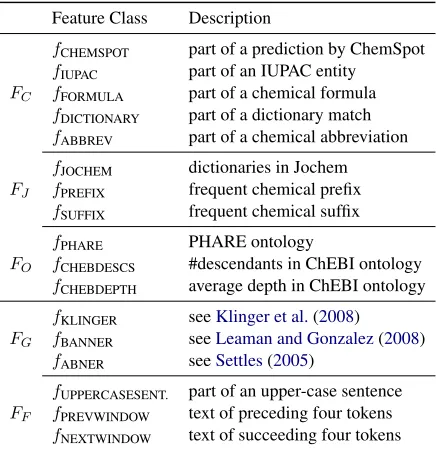
Table 2: Overview of features used for identifying and classifying mentions of pharmacological sub-stances.
Note that the sequence-labeling approach in the described form cannot cope with discontinuous en-tity mentions. Since only a tiny fraction (≈0.3%) of entities in the training corpus are discontinuous, we simply neglect these for training and tagging.
3.3 Feature sets
An overview of the features used by our system is shown in Table 2. Our first two submissions for the SemEval-2013 Task 9.1 differ only in that they use different subsets of these features. Run 1 employs a feature set assembled from common general features used for biomedical NER (FG∪FF), whereas Run
2 additionally uses features tailored for extracting mentions of chemicals (FC∪FJ∪FO).
3.3.1 Run 1: general featuresFGandFF
We employ a union of common, rather domain-independent features published by Klinger et al.
(2008), Settles (2005) and Leaman and Gonzalez
(2008). Note that these feature sets have been suc-cessfully applied to a wide range of different biomed-ical NER tasks,e.g., identifying mentions of DNA sequences, genes, diseases, mutations, IUPAC terms, cell lines and cell types. They encompass morpho-logical, syntactic and orthographic features, such as the text of the token itself, token charactern-grams of length 2 and 3, prefixes and suffixes of length 2, 3, and 4, characters left and right to a token and part-of-speech tags. Furthermore, they contain various regu-lar expressions that capture, for instance, whether a token starts with a capital letter or contains digits.
In addition, we employ features based on NER examples in FACTORIE (McCallum et al.,2009). Specifically, we use the text of the four preceding and succeeding tokens and whether a token is part of a sentence that contains only upper-case characters. The latter is commonly the case for headlines, which likely contain an entity mention.
3.3.2 Run 2: domain-specific features
In addition to the features of Run 1, we use pre-dictions of our improved version of ChemSpot, as well as features derived from Jochem, PHARE and ChEBI.
ChemSpot-based featuresFC: When a token is
part of a mention extracted by one of ChemSpot’s components (i.e. IUPAC entity, chemical formula, dictionary match or chemical abbreviation), we use the name of the respective component as feature. In addition, we determine whether a token is part of an entity predicted by ChemSpot after match-expansion, boundary-correction and resolution of overlapping entities. Using the output of ChemSpot as features for our system could be framed as stacking (see
Wolpert(1992)).
Jochem-based featuresFJ: For every dictionary
[image:4.612.79.298.138.363.2]a list of frequent chemical suffixes and prefixes of length three from Jochem.
Ontology-based features FO: It is often hard to
determine whether a mention refers to a specific chemical entity or rather an abstract term denoting a group of chemicals. To distinguish between these two cases, we calculate the average depth and the number of descendants of a term in the ChEBI on-tology and use the binned count as feature. The idea behind these features is that the specificity of an en-tity correlates positively with its depth in the ontol-ogy (e.g. leaf nodes are likely specific chemicals) and negatively with the number of descendants (i.e. having few descendants indicates a specific entity).
Further ontology-based features are derived from PHARE, which consists of 200 curated relations. If possible, we map a token to a term in that ontology and use its label as feature.
3.4 Experiments
We perform document-level 10-fold cross-validation (CV) on the training corpus to measure the impact of domain-specific features. To ensure comparability between Run 1 and Run 2, we use the same splits for evaluation. Furthermore, we train models on the com-plete training corpus and evaluate on the test corpus of DDI Task 9.1 for each run respectively. In addi-tion, we train a third model based on the best feature set determined with CV and use the entity mentions of the Task 9.2 test corpus, which also contains anno-tations of drug-drug interactions, as additional train-ing data (Run 3). Followtrain-ing the SemEval-2013 Task 9.1 metrics, we evaluateexactmatching performance (correct entity boundaries) andstrict matching per-formance (correct boundaries and correct type).
4 Results
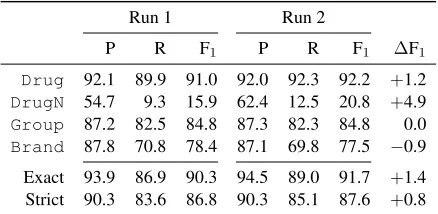
Table 3 shows micro-average CV results for identi-fying and classiidenti-fying mentions of pharmacological substances in the training corpus. The performance varies drastically between different entity classes re-gardless of the feature set,e.g., Run 1 achieves an F1 of 91.0%forDrug, but only 15.9%F1forDrugN.
Run 2 outperforms Run 1 for entities of class
Drug (+1.2 pp F1) andDrugN (+4.9 pp F1), but yields a lower performance for Brand (−0.9 pp F1) and no change forGroupentities. Overall, the
Run 1 Run 2
P R F1 P R F1 ∆F1
Drug 92.1 89.9 91.0 92.0 92.3 92.2 +1.2
DrugN 54.7 9.3 15.9 62.4 12.5 20.8 +4.9
Group 87.2 82.5 84.8 87.3 82.3 84.8 0.0
Brand 87.8 70.8 78.4 87.1 69.8 77.5 −0.9
[image:5.612.315.534.61.168.2]Exact 93.9 86.9 90.3 94.5 89.0 91.7 +1.4 Strict 90.3 83.6 86.8 90.3 85.1 87.6 +0.8
Table 3: Document-level 10-fold cross-validation micro-average results on the training corpus.
micro-average F1 measure increases by 0.8 pp for strict matching and 1.4 pp F1for exact matching.
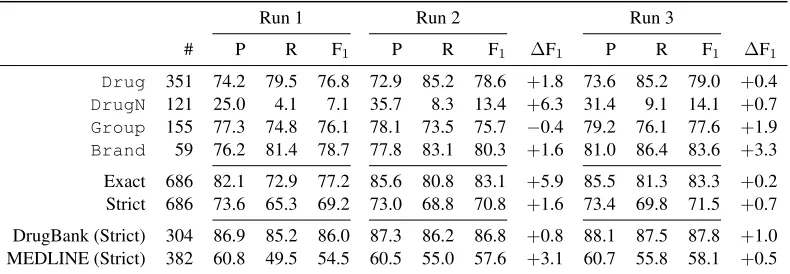
The performance on the test corpus (see Table 4) is drastically lower compared to CV results (e.g.17.6 pp F1for strict evaluation of Run 1). Except for enti-ties of classGroup, using domain-specific features leads to a superior performance for identifying and classifying mentions of pharmacological substances. Run 2 outperforms Run 1 by 1.6 pp F1for strict eval-uation and 5.9 pp F1for exact evaluation. Using en-tity mentions of the Task 9.2 test corpus as additional training data (Run 3) further boosts the performance by 0.7 pp F1for strict evaluation.
5 Discussion
Our results show a clear performance advantage when using domain-specific features tailored for identifying mentions of chemicals. CV results and results on the test corpus show an increase in preci-sion and recall for exact matching and an increase in recall for strict matching. The considerably higher recall for exact matching can be attributed to a higher coverage of chemical entities by features that exploit domain-knowledge.
It is striking that the performance forDrugN enti-ties is extremely low compared to the other classes. We believe that this might be due to two reasons. First, entities of this class are underrepresented in the training corpus (≈3%). Since machine learning based methods tend to favor the majority class, it is likely that manyDrugNentities were classified as mentions of one of the much larger classesDrug(≈
Run 1 Run 2 Run 3
# P R F1 P R F1 ∆F1 P R F1 ∆F1
Drug 351 74.2 79.5 76.8 72.9 85.2 78.6 +1.8 73.6 85.2 79.0 +0.4
DrugN 121 25.0 4.1 7.1 35.7 8.3 13.4 +6.3 31.4 9.1 14.1 +0.7
Group 155 77.3 74.8 76.1 78.1 73.5 75.7 −0.4 79.2 76.1 77.6 +1.9
Brand 59 76.2 81.4 78.7 77.8 83.1 80.3 +1.6 81.0 86.4 83.6 +3.3
Exact 686 82.1 72.9 77.2 85.6 80.8 83.1 +5.9 85.5 81.3 83.3 +0.2 Strict 686 73.6 65.3 69.2 73.0 68.8 70.8 +1.6 73.4 69.8 71.5 +0.7
[image:6.612.110.505.61.198.2]DrugBank (Strict) 304 86.9 85.2 86.0 87.3 86.2 86.8 +0.8 88.1 87.5 87.8 +1.0 MEDLINE (Strict) 382 60.8 49.5 54.5 60.5 55.0 57.6 +3.1 60.7 55.8 58.1 +0.5
Table 4: Results on the test corpus.∆F1denotes the F1pp difference to the preceding Run and # the number of annotated mentions
Second,DrugNdenotes substances that have an ef-fect on humans, but are not approved for medical use – a property that is rarely stated along with the entity mention and can thus often only be determined with domain-knowledge.
We think it is also important to point to the large difference between results obtained by 10-fold CV on the training corpus and test results (e.g.up to 17.6 pp F1for Run 1). One reason might be the large frac-tion (≈ 83%) of entity mentions that appear more than once in the training corpus compared to pre-sumably many unseen entities in the test corpus. For 10-fold CV this means that an entity in the evaluation fold has already been seen with a high probability in one of the nine training folds, yielding results that overestimate the generalization performance. More-over, our results indicate that identifying and clas-sifying pharmacological substances is much harder for MEDLINE documents than for DrugBank docu-ments with a difference of up to 31.5 pp F1 (cf.the last two rows of Table 4). Hence, another apparent reason for the performance differences is the sub-stantial skew in the ratio of DrugBank to MEDLINE documents in the training corpus (roughly 4:1) com-pared to the test corpus (roughly 1:1). Since both sets of documents stem from different resources, this can be referred to as domain-adaptation problem.
In additional experiments we found that the general-purpose chemical NER tool ChemSpot achieves an F1 of 65.5% for exact matching on the test corpus. This is 17.8 pp F1below our best results obtained with a machine learning based system (cf.
Run 3) that is able to exploit properties of the task-specific annotations of the corpora.
6 Conclusion
We described our contribution to the SemEval-2013 Task 9.1: Recognition and classification of pharma-cological substances. We found that a system based on rather general features commonly used for a wide range of biomedical NER tasks yields competetive results. Implementing this system needed no domain-adaptation and its performance could be sufficient for applications building upon drug NER. Nevertheless, adding domain-specific features boosts the perfor-mance considerably. Further improvements can be achieved by using entity annotations of the Task 9.2 test corpus as additional training data.
We identified two limitations of our approach. First, we found that entities of the minority class (DrugN) are very hard to classify correctly. Second, differences between DrugBank and MEDLINE docu-ments probably cause a domain-adaptation problem. For future work, one could investigate whether the latter can be addressed by domain-adaptation tech-niques (e.g. Satpal and Sarawagi (2007)). To cope withDrugNentities, one could implement features derived from those resources that were used by the annotators for deciding whether a substance is ap-proved for use in humans,e.g., Drugs@FDA4 and the WHO ATC5classification system.
4http://www.accessdata.fda.gov/scripts/cder/
drugsatfda/(accessed 2013-04-29)
5
Acknowledgements
We thank Philippe Thomas for preparing a simplified for-mat of the corpora. We thank him and Roman Klinger for fruitful discussions.
Funding:Tim Rockt¨aschel is funded by the German Fed-eral Ministry of Economics and Technology (BMWi) [KF2205209MS2], Torsten Huber and Michael Weidlich are funded by the German Federal Ministry of Education and Research (BMBF) [0315746].
References
Peter Corbett and Ann Copestake. 2008. Cascaded classi-fiers for confidence-based chemical named entity recog-nition.BMC Bioinf., 9(Suppl 11):S4.
Peter Corbett and Peter Murray-Rust. 2006. High-throughput identification of chemistry in life science texts. InProc. of CompLife 2006, pages 107–118. Adrien Coulet, Yael Garten, Michel Dumontier, Russ B.
Altman, Mark A. Musen, and Nigam H. Shah. 2011. In-tegration and publication of heterogeneous text-mined relationships on the Semantic Web.J. Biomed. Seman-tics, 2(Suppl 2):S10.
Paula De Matos, Rafael Alc´antara, Adriano Dekker, Mar-cus Ennis, Janna Hastings, Kenneth Haug, Inmaculada Spiteri, Steve Turner, and Christoph Steinbeck. 2010. Chemical Entities of Biological Interest: an update. Nu-cleic Acids Res., 38:D249–D254.
Kristina M. Hettne, Rob H. Stierum, Martijn J. Schuemie, Peter J.M. Hendriksen, Bob J.A. Schijvenaars, Erik M. Van Mulligen, Jos Kleinjans, and Jan A. Kors. 2009. A dictionary to identify small molecules and drugs in free text.Bioinformatics, 25(22):2983–2991.
David M. Jessop, Sam E. Adams, Egon L. Willighagen, Lezan Hawizy, and Peter Murray-Rust. 2011. OS-CAR4: a flexible architecture for chemical text-mining.
J. Cheminf., 3(1):41.
Roman Klinger, Corinna Kol´arik, Juliane Fluck, Martin Hofmann-Apitius, and Christoph M. Friedrich. 2008. Detection of IUPAC and IUPAC-like chemical names. In Proc. of ISMB. Bioinformatics, volume 24, pages i268–i276.
Roman Klinger and Katrin Tomanek. 2007. Classical Probabilistic Models and Conditional Random Fields.
Algorithm Engineering Report TR07-2-013. Depart-ment of Computer Science, Dortmund University of Technology. ISSN 1864-4503.
Corinna Kol´arik, Roman Klinger, Christoph M. Friedrich, Martin Hofmann-Apitius, and Juliane Fluck. 2008. Chemical names: terminological resources and corpora annotation. InProc. of the Workshop on Building and evaluating resources for biomedical text mining, pages 51–58.
Frank R. Kschischang, Brendan J. Frey, and Hans-Andrea Loeliger. 2001. Factor graphs and the sum-product algorithm.IEEE Trans. Inf. Theory, 47(2):498–519. John Lafferty, Andrew McCallum, and Fernando Pereira.
2001. Conditional Random Fields : Probabilistic Mod-els for Segmenting and Labeling Sequence Data. In
Proc. of ICML-2001, pages 282–289.
Robert Leaman and Graciela Gonzalez. 2008. BANNER: an executable survey of advances in biomedical named entity recognition. InProc. of Pac Symp Biocomput, pages 652–663.
Robert Leaman, Laura Wojtulewicz, Ryan Sullivan, An-nie Skariah, Jian Yang, and Graciela Gonzalez. 2010. Towards internet-age pharmacovigilance: extracting ad-verse drug reactions from user posts to health-related social networks. InProc. of Workshop BioNLP, pages 117–125. ACL.
Daniel M. Lowe, Peter T. Corbett, Peter Murray-Rust, and Robert C. Glen. 2011. Chemical name to structure: Opsin, an open source solution. J. Chem. Inf. Model., 51(3):739–753.
Andrew K. McCallum. 2002. MALLET: A Machine Learning for Language Toolkit. http://mallet.cs.umass.edu.
Andrew K. McCallum, Dayne Freitag, and Fernando. Pereira. 2000. Maximum entropy Markov models for information extraction and segmentation. InProc. of ICML-2000, pages 591–598.
Andrew K. McCallum, Karl Schultz, and Sameer Singh. 2009. FACTORIE: Probabilistic programming via im-peratively defined factor graphs. InProc. of Neural Information Processing Systems (NIPS).
Phoebe M. Roberts and William S. Hayes. 2008. Infor-mation needs and the role of text mining in drug de-velopment. InProc. of Pac Symp Biocomput, pages 592–603.
Tim Rockt¨aschel, Michael Weidlich, and Ulf Leser. 2012. ChemSpot: A Hybrid System for Chemical Named En-tity Recognition.Bioinformatics, 28(12):1633–1640. Sandeepkumar Satpal and Sunita Sarawagi. 2007.
Do-main adaptation of conditional probability models via feature subsetting. In Knowledge Discovery in Databases: PKDD 2007, pages 224–235. Springer. Martijn J. Schuemie, Rob Jelier, and Jan A. Kors. 2007.
Peregrine: Lightweight gene name normalization by dictionary lookup. InProc. of the Second BioCreative Challenge, volume 2, pages 131–133.
Ariel S. Schwartz and Marti A. Hearst. 2003. A sim-ple algorithm for identifying abbreviation definitions in biomedical text. InProc. of Pac Symp Biocomput, volume 8, pages 451–462.
Proc. of the 7th International Workshop on Semantic Evaluation (SemEval 2013).
Isabel Segura-Bedmar, Paloma Mart´ınez, and Mar´ıa Segura-Bedmar. 2008. Drug name recognition and clas-sification in biomedical texts. A case study outlining approaches underpinning automated systems. Drug Discovery Today, 13(17-18):816–823.
Burr Settles. 2005. ABNER: an open source tool for automatically tagging genes, proteins and other entity names in text.Bioinformatics, 21(14):3191–3192. Philippe Thomas, Mariana Neves, Ill´es Solt, Domonkos
Tikk, and Ulf Leser. 2011. Relation extraction for drug-drug interactions using ensemble learning. InProc. of the 1st Challenge Task on Drug-Drug Interaction Extraction 2011, pages 11–18.
Hanna M. Wallach. 2004. Conditional Random Fields: An Introduction.Technical Report MS-CIS-04-21. Depart-ment of Computer and Information Science, University of Pennsylvania.