Expanding the Range of Tractable Scope-Underspecified Semantic
Representations
Mehdi Manshadi and James Allen Department of Computer Science
University of Rochester Rochester, NY 14627
{mehdih,james}@cs.rochester.edu
Abstract
Over the past decade, several underspec-ification frameworks have been proposed that efficiently solve a big subset of scope-underspecified semantic representations within the realm of the most popular constraint-based formalisms. However, there exists a family of coherent natural language sentences whose underspecified representa-tion does not belong to this subset. It has remained an open question whether there ex-ists a tractable superset of these frameworks, covering this family. In this paper, we show that the answer to this question is yes. We define a superset of the previous frameworks, which is solvable by similar algorithms with the same time and space complexity.
1 Introduction
Scope ambiguity is a major source of ambiguity in semantic representation. For example, the sentence
1. Every politician has a website.
has at least two possible interpretations, one in which eachpoliticianmay have a different website
(i.e.,Everyhaswide scope) and one in which there is a uniquewebsitefor all thepoliticians(i.e.,Every
hasnarrow scope). Since finding the most preferred reading automatically is very hard, the most widely adopted solution is to use anUnderspecified Rep-resentation(UR), that is to encode the ambiguity in the semantic representation and leave scoping un-derspecified.
In an early effort, Woods (1986) developed an un-scoped logical form where the above sentence is rep-resented (roughly) as the formula:
2. Has(hEvery x P oliticiani,hA y W ebsitei)
To obtain a fully scoped formula, the quantifiers are pulled out one by one and wrapped around the formula. If we pull outEveryfirst, we produce the fully-scoped formula:
3. A(y, W ebsite(y),
Every(x, P olitician(x), Has(x, y))
If we had pulled out Afirst, we would have had the other reading, withEveryhaving wide scope.
Hobbs and Shieber (1987) extend this formalism to support operators (such as not) and present an enumeration algorithm that is more efficient than the naive wrapping approach.
Since the introduction of Quasi Logical Form (Al-shawi and Crouch, 1992), there has been a lot of work on designing constraint-based underspecifica-tion formalisms where the readings of a UR are not defined in a constructive fashion as shown above, but rather by a set of constraints. A fully-scoped struc-ture is a reading iff it satisfies all the constraints. The advantage of these frameworks is that as the pro-cessing goes deeper, new (say pragmatically-driven) constraints can be added to the representation in or-der to filter out unwanted readings. Hole Seman-tics (Bos, 1996; Bos, 2002), Constraint Language for Lambda Structures (CLLS) (Egg et al., 2001), and Minimal Recursion Semantics (MRS) (Copes-take et al., 2001) are among these frameworks.
In an effort to bridge the gap between the above formalisms, a graph theoretic model of scope under-specification was defined by Bodirsky et al. (2004), calledWeakly Normal Dominance Graphs. This
Figure 1: UG forEvery child of a politician runs.
framework and its ancestor, Dominance Con-straints(Althaus et al., 2003), are broad frameworks for solving constrained tree structures in general. When it comes to scope underspecification, some of the terminology becomes counter-intuitive. There-fore, here we first define (scope) Underspecifica-tion Graphs (UG), a notational variant of weakly normal dominance graphs, solely defined to model scope underspecification.1 Figure 1 shows a UG for the following sentence.
4. Every child of a politician runs.
The big circles and the dot nodes are usually re-ferred to as theholenodes (or simply holes) and the
labelnodes (or simply labels) respectively. The left and the right holes of each quantifier are placehold-ers for therestriction and the bodyof the quanti-fier. A fully scoped structure is built by plugging
labels into holes, as shown in Figure 2(a). The dot-ted edges represent the constraints. For example, the constraint from the restriction hole of Every(x)
to the node Politician(x) states that this label node must be within the scope of the restriction of Ev-ery(x) in every reading of the sentence. The con-straint edge fromEvery(x)toRun(x)forces the bind-ing constraint for variable x; that is variable x in
Run(x) must be within the scope of its quantifier. Figure 2(b) represents the other possible reading of the sentence. Now consider the sentence:
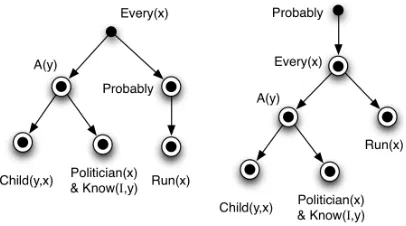
5. Every politician, whom I know a child of, prob-ably runs.
with its UG shown in Figure 3. This sentence con-tains a scopal adverbial (a.k.a. fixed-scopal; cf. Copestake et al. (2005)), the wordProbably. Since in general, quantifiers can move inside or outside a
1
[image:2.612.93.279.59.157.2]The main difference is in the concept of solution in the two frameworks. See Section 4.3 for details.
Figure 2: Solutions of the UG in Figure 1.
scopal operator, the scope ofProbablyis left under-specified, and hence represented by a hole. It is easy to verify that the corresponding UG has five possible readings, two of which are shown in Figure 4.
There are at least two major algorithmic problems that need to be solved for any given UGU: the sat-isfiabilityproblem; that is whether there exists any reading satisfying all the constraints inU, and the
enumeration problem; that is enumerating all the possible readings of a satisfiableU. Unfortunately, both problems are NP-complete for UG in its gen-eral form (Althaus et al., 2003). This proves that Hole Semantics and Minimal Recursion Semantics are also intractable in their general form (Thater, 2007). In the last decade, there has been a se-ries of interesting work on finding a tractable subset of those frameworks, broad enough to cover most structures occurring in practice. Those efforts re-sulted in two closely relatedtractableframeworks: (dominance)netandweak (dominance)net. Intu-itively, the net condition requires the following prop-erty. Given a UGU, for every label node inU with
nholes, if the node together with all its holes is re-moved fromU, the remaining part is composed of at mostn (weakly) connected components. A differ-ence between net and weak net is that in nets,
[image:2.612.327.524.570.677.2]Figure 4: Two of the solutions to the UG in Figure 3.
to-label constraints (e.g. the constraint between Ev-ery(x)andRun(x)in Figure 1) are not allowed.
Using a sample grammar for CLLS, Koller et al. (2003) conjecture that the syntax/semantics inter-face of CLLS only generates underspecified repre-sentations that follow the definition of net and hence can be solved in polynomial time. They also prove that the same efficient algorithms can be used to solve the underspecification structures of Hole Se-mantics which satisfy the net condition.
Unlike Hole Semantics and CLLS, MRS implic-itly carries label-to-label constraints; hence the con-cept of net could not be applied to MRS. In order to address this, Niehren and Thater (2003) define the notion of weak net and conjecture that it cov-ers all semantically complete MRS structures occur-ring in practice. Fuchss et al. (2004) supported the claim by investigating MRS structures in the Red-woods corpus (Oepen et al., 2002). Later coherent sentences were found in other corpora or suggested by other researchers (see Section 6.2.2 in Thater (2007)), whose UR violates the net condition, inval-idating the conjecture. However, violating the net condition occurs in a similar way in those examples, suggesting a family of non-net structures, character-ized in Section 4.2. Since then, it has been an open question whether there exists a tractable superset of weak nets, covering this family of non-net UGs.
In the rest of this paper, we answer this ques-tion. We modify the definition of weak net to de-fine a superset of it, which we callsuper net. Super net covers the above mentioned family of non-net structures, yet is solvable by (almost) the same al-gorithms as those solving weak nets with the same time and space complexity.
The structure of the paper is as follows. We de-fine our framework in Section 2 and present the
polynomial-time algorithms for its satisfiability and enumeration problems in Section 3. In Section 4, we compare our framework with nets and weak nets. Section 5 discusses the related work, and Section 6 summarizes this work and discusses future work.
2 Super net
We first give a formal definition of underspecifica-tion graph (UG). We then define super net as a sub-set of UG. In the following definitions, we openly borrow the terminology from Hole Semantics, Dom-inance Constraints, and MRS, in order to avoid in-venting new terms to name old concepts.
Definition 1 (Fragments). Consider L a set of la-bels,H a set of holes, andS a set of directedsolid
edges from labels to holes, such thatF = (L]H, S) is a forest of orderedtrees of depth at most 1, whose root and only the root is a label node. Each of these trees is called afragment.
Following this definition, the number of trees in F (including single-node trees) equals the number of labels. For example, if we remove all the dotted edges in Figure 1, we obtain a forest of 5 fragments.
Definition 2(Underspecification Graph). LetF = (L]H, S)be a forest of fragments andC be a set of directeddottededges fromL]HtoL, called the set ofconstraints.2 U = (L]H, S ]C)is called anunderspecification graphorUG.
Figures 1 and 3 each represent a UG.
Definition 3(Plugging). (Bos, 1996)
Given a UGU = (L]H, S]C), apluggingP is a total one-to-one function fromHtoL.
In Figure 1, if lA, lE, lP, lC, and lR represent
the nodes labeled by A(y), Every(x), Politician(y),
Child(x,y), andRun(x)respectively andhrA(hbA) and
hrE (hbE) represent the restriction (body) hole of A
andEveryrespectively, thenPin (6) is a plugging.
6. P ={(hrA, lP),(hbA, lC),(hrE, lA),(hbE, lR)}
We useTU,P to refer to the graph, formed fromU by removing all the constraints and pluggingP(h)
intohfor every holeh. For example ifU is the UG in Figure 1 andP is the plugging in (6), thenTU,P
is the graph shown in Figure 2(a).
2
Definition 4 (Permissibility/Solution). TU,P
satis-fiesthe constraint (u,v) inU, iff udominates3 vin TU,P.4 A pluggingPispermissible, iffTU,P is a
for-estsatisfying all the constraints inU.TU,P is called
asolutionofU iff P is a permissible plugging. In informal contexts, solutions are sometimes referred to asreadings.
It is easy to see that the plugging in (6) is a per-missible plugging for the UG in Figure 1, and hence Figure 2(a) is a solution of this UG. Similarly, ures 4(a,b) represent two solutions of the UG in Fig-ure 3. The solutions in FigFig-ures 2 and 4 are alltree
structures. This is because UGs in Figures 1 and 3 are weakly connected.5 Lemma 2 proves that this holds in general, that is:
Proposition 1. Every solution of a weakly con-nected UG is a tree.
Throughout the rest of this paper, unless other-wise specified, UGs are assumed to be weakly con-nected, hence solutions are tree structures.6
Lemma 2. (Bodirsky et al., 2004)
Given a UGU and a solutionT ofU, if the nodesu andv inU are connected using an undirected path p, there exists a node w on p such that w dominates bothuandvin T.
This Lemma is proved using induction on the length ofp. As mentioned before, satisfiabilityand
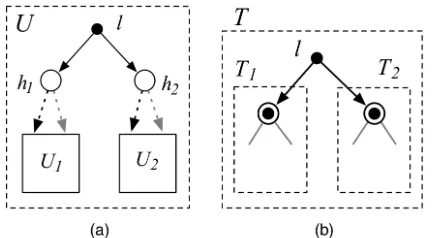
enumeration are two fundamental problems to be solved for a UG. A straightforward approach is de-picted in Figure 5. We pick a labell; remove it from
U; recursively solve each of the resulting weakly connected components(WCCs; cf. footnote 2) and
3udominatesvin the directed graphG, iffureachesvinG
by adirectedpath.
4
Here, we are referring to the nodes inTU,P by calling the nodesuandvinU. This is a sound strategy, as every node in
Uis mapped into a unique node inTU,P. The inverse is not true though, as every node (except the root) inTU,P corresponds to one hole and one label inU. AddressingTU,P’s nodes in this way is convenient, so we practice that throughout the paper.
5
Given a directed graphGand the nodesuandvinG,uis said to beweakly connectedtov(and vice versa), iffuandvare connected in the underlying undirected graph ofG. Aweakly connected graphis a graph in which every two nodes are weakly connected. Since weak connectedness is an equivalence rela-tion, it partitions a directed graph into equivalent classes each of which is called aweakly connected componentorWCC.
6
[image:4.612.318.534.55.174.2]Since fragments are ordered trees, solutions are ordered trees as well.
Figure 5: Recursively solving UGs.
plug the root of the returned trees into the corre-sponding holes of l. A problem to be addressed though is whether there exists any solution rooted atl. This leads us to the following definition.
Definition 5(Freeness). (Bodirsky et al., 2004)
A labellinU is called afree node, iff there exists some solution ofU rooted at l. The fragment rooted atlis called afree fragment.
The following proposition states the necessary conditions for a label (or fragment) to be free.7
Proposition 3. LetlinU be the root of a fragment F withmholes.lis a free node ofU, only if
P3a. lhas no incoming (constraint) edge;
P3b. Every distinct hole ofFlies in a distinct WCC inU−l;
P3c. U−F consists of at leastmWCCs.
Proof. The first condition is trivial. To see why the second condition must hold, letT be a solution rooted atl, and assume to the contrary that h1 and h2 lie in the same WCC inU−l. From Lemma 2,
all the nodes in this WCC must be in the scope of bothh1 andh2. But this is not possible, becauseT
is a tree. The third condition is proved similarly. As-sume to the contrary thatU−F hasm−1WCCs. From Lemma 2, all the nodes in a WCC must be in the scope of a single hole of F. But there are m
holes and onlym−1WCCs. It means that one of the holes inT is left unplugged. Contradiction!
The motivation behind defining super nets is to find a subset of UG for which these conditions are also sufficient. The following concept from Althaus et al. (2003) plays an important role.
7
Figure 6: UG forIllustration of hypernormal path.
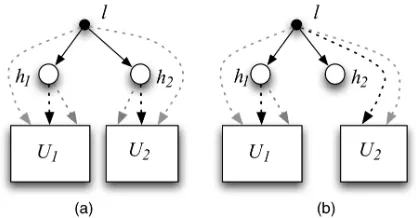
Definition 6 (Hypernormal Connectedness). Given a UGU, ahypernormal pathis an undirected path8 with no two consecutive constraint edges emanating from the same node. Nodeuishypernormally con-nectedto nodeviff there is at least one hypernormal path between the two. U is called hypernormally connectediff every pair of nodes inUare hypernor-mally connected.
For example, in Figure 2, p2 is a hypernormal path, butp1 is not. In spite of that, the whole graph is hypernormally connected.9 The following simple
notion will also come handy.
Definition 7(Openness). (Thater, 2007)
A nodeuof a fragmentF is called anopen nodeiff it has no outgoing constraint edge.
For example, l in Figure 5(a) is an open label node. In Figure 2(b), h2 is an open hole. We are finally ready to define super net.
Definition 8(Super net). A UGU is called asuper netif for every fragmentF rooted atl:
D8a. F has at most one open node.
D8b. If l1 andl2 are two dominance children of a holehof F, thenl1andl2 are hypernormally connected inU−h.
D8c. • Case 1:F has no open hole.
Everydominance child10 oflis hypernor-mally connected to some hole ofFinU−l.
• Case 2:F has an open hole.
All dominance children ofl, not hypernor-mally connected to a hole ofFinU−l, are hypernormally connected together.
8
Throughout this paper, by path we always mean a simple path, that is no node may be visited more than once on a path.
9
Note that even thoughp1is not a hypernormal path, there
is another hypernormal path connecting the same two nodes
10
[image:5.612.83.289.57.152.2]vis a dominance child ofuin a UGU, if(u, v)is a con-straint edge inU.
Figure 7: Illustration of super net conditions.
Definition 9(Types of fragment). Following Defini-tion 8, super net allows for three possible types of fragment:
D9a. Open-root: Only the root is open (Figure 5a) D9b. Open-hole: Only a hole is open (Figure 2b) D9c. Closed:FThere is no open node. (Figure 2a)
Definition 8 guarantees the following property.
Lemma 4. For a super netU and a fragment F of U with m holes, which satisfies the conditions in Proposition 3, U−F consists of exactly m WCCs, each of which is a super net.
Proof sketch. The detailed proof of this Lemma is long. Therefore, we sketch the proof here and leave the details for a longer paper. First, we show that
U−F consists of exactlymWCCs. Following con-ditions (D8b) and (D8c), no matter what structureF
has,U−Fconsists of at mostmWCCs. On the other hand, based on condition (P3c),U−F has at leastm
WCCs. Therefore,U−F has exactlymWCCs. To prove that each WCC inU−F is a super net, all we need to prove is that if two nodesuandv, which do not belong toF, are hypernormally connected inU, they are also hypernormally connected inU−F. This is proved by showing that there is no hypernormal path betweenuandvinU that visits some node of
F. Suppose thatF is an open-hole fragment rooted atl, as in Figure 2(b) (the two other cases are proved similarly) and assume to the contrary that there is a hypernormal pathpbetweenuandvthat visits some node ofF. One of the following three cases holds.
i. pvisits exactly one node ofF. ii. pvisits (at least) two holes ofF. iii. pvisitsland exactly one hole ofF.
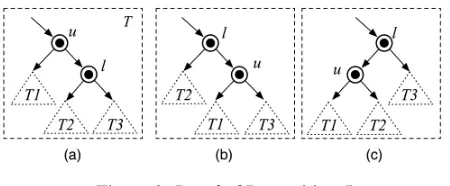
Figure 8: Proof of Proposition 5
is not a free fragment because it violates condition (P3b); and (iii) proves thatU is not a super net be-causeF violates condition (D8c).
Proposition 5. If U is a satisfiable super net, the necessary freeness conditions in Proposition 3 are also sufficient.
Proof sketch. LetF rooted atlbe a fragment satis-fying the three conditions in Proposition 3. Among all the solutions ofU, we pick a solutionT in which the depth dof l is minimal. Using proof by con-tradiction, we show that d = 0, which proves l is the root ofT. Ifd > 0, there is some nodeu that outscopesl(Figure 8(a)). Lemma 2 and 4 guarantee that at least one of the trees in Figures 8(b,c) is a so-lution ofU. SoU has a solution in which, the depth oflis smaller thand. Contradiction!
3 SAT and ENUM algorithms
Following Lemma 4 and Proposition 5, Table 1 gives the algorithms for the satisfiability (SAT), and the enumeration (ENUM) of super nets.
Theorem 6. ENUM and SAT are correct.
Proof sketch. Using Lemma 4 and induction on the depth of the recursion, it is easy to see that if ENUM or SAT returns a treeT, T is a solution of U. This proves that ENUM and SAT are sound. An induc-tive proof is used to prove the completeness as well. Consider a solutionT of depthnofU (Figure 5). It can be shown thatT1 andT2 must be the solutions toU1andU2. Therefore based on the induction
as-sumption they are generated bySolve(G), henceT
is also generated bySolve(G).
Let U = (L]H, S]C). The running time of the algorithms depends on the depth of the recursion which is equal to the number of fragments/labels, |L|. At each depth it takes O(|U|) to find the set of free fragments (Bodirsky et al., 2004) and also to compute U−F for some free fragmentF.
Solve(U)
1. IfU contains a single (label) node, returnU. 2. Pick a free fragmentF with m holes
rooted atl, otherwise fail. // For SAT: pick arbitrarily.
// For ENUM: pick non-deterministically. 3. LetU1, U2,· · ·, Umbe WCCs ofU−F.
4. LetTi=Solve(Ui)fori= 1· · ·m.
5. Lethibe the hole ofFconnected to
UiinU−l, fori= 1· · ·m.
(If for somek,Ukis not connected to any hole
ofF inU−l, lethkbe the open hole ofF.)
6. BuildT by plugging the root ofTi intohi,
fori= 1· · ·m. 7. ReturnT.
Table 1: ENUM and SAT algorithms
(|U| =def |V|+|E|, where|V| =def |L|+|H|,
and|E|=def |S|+|C|). Therefore SAT (and each
branch of ENUM) run(s) inO(|L|.|U|)step. There-fore the worst-case time complexity of SAT and each branch of ENUM is quadratic in the size ofU.
4 Super net versus weak net
Although net is a subset of weak net, to better un-derstand the three frameworks, we first define net.
4.1 Net
Net was first defined by Koller et al. (2003), in or-der to find a subset of Hole Semantics that can be solved in polynomial-time. Nets do not contain any label-to-label constraints. In fact, out of the three possible structures that super net allows for a frag-mentF (Definition 9), net only allows for the first one, that is open-root.
Definition 10(Net). (Thater, 2007)
LetUbe a UG with no label-to-label constraints.U is called anetiff for every fragmentF:
D10a. F has no open hole.
D10b. Ifl1,l2are two dominance children of a hole h of F, then l1 and l2 are hypernormally connected inU−h.
4.2 Weak net
Weak net was first introduced by Niehren and Thater (2003), in order to find a tractable subset of MRS. In order to model MRS, weak net allows for label-to-label constraints, but to stay a tractable framework it forces the following restrictions.
Definition 11(Weak net). (Thater, 2007)
A UGU is a weak net iff for every fragmentF:
D11a. F has exactly one open node.
D11b. If l1, l2 are two dominance children of a node u of F, then l1 and l2 are hypernor-mally connected inU−u.
Weak nets suffer from two limitations with re-spect to super nets.
First, out of the three possible types of frag-ment allowed by super net (Definition 9), weak net only allows for the first two; root and open-hole. In practice this becomes an issue only if new constraints are to be added to a UG after syn-tax/semantic interface. Since weak net requires one node of every fragment to be open, a constraint can-not be added if it violates this condition.11
Second, open-hole fragments in weak nets are more restricted than open-hole fragments in super nets. This is the Achilles’ heel of weak nets (D11b). To see why, consider the UG in Figure 3 for the sen-tenceEvery politician, whom I know a child of, runs
which we presented in Section 1. IfF is the frag-ment for the quantifierEveryandlis the root ofF, the two dominance children oflare not (hypernor-mally) connected in U−l. Therefore, U is not a weak net. All the non-net examples we have found so far behave similarly. That is, there is a quanti-fier with more than one outgoing dominance edge. Once you remove the quantifier node, the dominance children are no longer weakly (and hence hypernor-mally) connected, violating condition (D11b). In super net, however, we define case 2 of condition (D8c) such that it does not force dominance chil-dren oflto be (hypernormally) connected, allowing for non-net structures such as the one in Figure 3.12
11As discussed in Section 5, by defining the notion of
down-ward connectedness, Koller and Thater (2007) address this issue of weak nets, at the expense of cubic time complexity.
12
For simplicity, throughout this paper we have used the term non-net to refer to non-(weak net) UGs.
Proposition 7. Weak net is a strict subset of super net.
Proof. Consider an arbitrary weak netU, and letF
be an arbitrary fragment ofU rooted atl.
(i). Fhas exactly one open node, so it satisfies con-dition (D8a).
(ii). For every two holes of F, condition (D11b) guarantees that condition (D8b) holds.
(iii).• Case 1)F has no open hole:
Based on condition (D11a) the root of F is open, hence it has no dominance children. (D8c) trivially holds in this case.
• Case 2)F has an open hole:
Based on condition (D11b) every two dom-inance children of l are hypernormally con-nected, so (D8c) holds in this case too. Therefore, every fragmentF satisfies all the con-ditions in Definition 8, henceU is a super net. This and the fact that Figure 3 is a super net but not a weak net complete the proof.
4.3 Underspecification graph vs. weakly normal dominance graph
Dominance graphs and their ancestor, dominance constraints, are designed for solving constrained tree structures in general. Therefore, some of the ter-minology of dominance graph may seem counter-intuitive when dealing with scope underspecifica-tion. For example the notion ofsolutionin that for-malism is broader than what is known as solution in scope underspecification formalisms. As defined there (but translated into our terminology), a solu-tion may contain unplugged holes, or holes plugged with more than one label. This broad notion of so-lution is computationally less expensive such that an algorithm very similar to the one in Table 1 can be used to solve every weakly normal dominance graph (Bodirsky et al., 2004). Solution, as defined in this paper (Definition 4), corresponds to the notion of
5 Related work
We already compared our model with nets and weak nets. Koller and Thater (2007) present another ex-tension of weak nets, downward connected nets. They show that if adominance graphhas a subgraph which is a weak net, it can be solved in polynomial time. This addresses the first limitation of weak nets, discussed in Section 4.2, but it does not solve the second one, because the graph in Figure 3 neither is a weak net, nor has a weak-net subgraph.
Downward connected dominance graph, in its general form, goes beyond weakly normal domi-nance graph (and hence UG), incorporating label-to-hole constraints. It remains for future work to inves-tigate whether allowing for label-to-hole constraints adds any value to the framework within the context of scope underspecified semantics, or whether it is possible to model the same effect using hole-to-label and label-to-label constraints. In any case, the same extension can be applied to super nets as well, defin-ing downward connected super nets, a strict super set of downward connected nets, solvable using sim-ilar algorithms with the same time/space complexity. Another tractable framework presented in the past is our own framework, Canonical Form Under-specified Representation (CF-UR) (Manshadi et al., 2009), motivated by Minimal Recursion Semantics. CF-UR is defined to characterize the set of all MRS structures generated by the MRS semantic composi-tion process (Manshadi et al., 2008). CF-UR in its general form is not tractable. Therefore, we define a notion of coherence called heart-connectedness
and show that all heart-connected CF-UR struc-tures can be solved efficiently. We also show that heart-connected CF-UR covers the family of non-net structures, so CF-UR is in fact the first framework to address the non-net structures. In spite of that, CF-UR is quite restricted and does not allow for adding new constraints after semantic composition.
In recent work, Koller et al. (2008) suggest us-ing Regular Tree Grammars for scope underspeci-fication, a probabilistic version of which could be used to find the best reading. The framework goes beyond the formalisms discussed in this paper and is expressively complete in Ebert (2005)’s sense of completeness, i.e. it is able to describe any subset of the readings of a UR. However, this power comes
at the cost of exponential complexity. In practice, RTG is built on top of weak nets, benefiting from the compactness of this framework to remain tractable. Being a super set of weak net, super net provides a more powerful core for RTG.
Koller and Thater (2010) address the problem of finding the weakest readings of a UR, which are those entailed by some reading(s), but not entailing any other reading of the UR. By only considering the weakest readings, the space of solutions will be dramatically reduced. Note that entailment using the weakest readings is sound but not complete.
6 Summary and Future work
Weakly normal dominance graph brings many cur-rent constraint-based formalisms under a uniform framework, but its configurability is intractable in its general form. In this paper, we present a tractable subset of this framework. We prove that this sub-set, called super net, is a strict superset of weak net, a previously known tractable subset of the frame-work, and that it covers a family of coherent natural language sentences whose underspecified represen-tation are known not to belong to weak nets.
As mentioned in Section 5, another extension of weak nets, downward connected nets, has been pro-posed by Koller and Thater (2007), which addresses some of the limitations of weak nets, yet is unable to solve the known family of non-net structures. A thorough comparison between super nets and down-ward connected nets remains for future work.
Another interesting property of super nets to be explored is how they compare to heart-connected graphs. Heart-connectedness has been introduced as a mathematical criterion for verifying the coher-ence of an underspecified representation within the framework of underspecification graph (Manshadi et al., 2009). Our early investigation shows that super nets may contain all heart-connected UGs. If this conjecture is true, super net would be broad enough to cover every coherent natural language sentence (under this notion of coherence). We leave a detailed investigation of this conjecture for the future.
Acknowledgments
References
Hiyan Alshawi and Richard Crouch. 1992. Monotonic semantic interpretation. In Proceedings of ACL ’92, pages 32–39.
Ernst Althaus, Denys Duchier, Alexander Koller, Kurt Mehlhorn, Joachim Niehren, and Sven Thiel. 2003. An efficient graph algorithm for dominance con-straints. J. Algorithms, 48(1):194–219, August. Manuel Bodirsky, Denys Duchier, Joachim Niehren, and
Sebastian Miele. 2004. An efficient algorithm for weakly normal dominance constraints. In In ACM-SIAM Symposium on Discrete Algorithms. The ACM Press.
J. Bos. 1996. Predicate logic unplugged. InIn Proceed-ings of the 10th Amsterdam Colloquium, pages 133– 143.
J. Bos. 2002. Underspecification and Resolution in Dis-course Semantics. Saarbr¨ucken dissertations in com-putational linguistics and language technology. DFKI. Ann Copestake, Alex Lascarides, and Dan Flickinger. 2001. An algebra for semantic construction in constraint-based grammars. In Proceedings of ACL ’01, pages 140–147.
Christian Ebert. 2005. Formal investigations of un-derspecified representations. Technical report, King’s College, London, UK.
M. Egg, A. Koller, and J. Niehren. 2001. The constraint language for lambda structures. J. of Logic, Lang. and Inf., 10(4):457–485, September.
Ruth Fuchss, Alexander Koller, Joachim Niehren, and Stefan Thater. 2004. Minimal recursion semantics as dominance constraints: Translation, evaluation, and analysis. InProceedings of the 42nd Meeting of the Association for Computational Linguistics (ACL’04), Main Volume, pages 247–254, Barcelona, Spain, July. Jerry R. Hobbs and Stuart M. Shieber. 1987. An al-gorithm for generating quantifier scopings. Comput. Linguist., 13(1-2):47–63, January.
Alexander Koller and Stefan Thater. 2007. Solving unre-stricted dominance graphs. InProceedings of the 12th Conference on Formal Grammar, Dublin.
Alexander Koller and Stefan Thater. 2010. Computing weakest readings. In Proceedings of the 48th ACL, Uppsala.
Alexander Koller, Joachim Niehren, and Stefan Thater. 2003. Bridging the gap between underspecification formalisms: Hole semantics as dominance constraints. InProceedings of the 11th EACL, Budapest.
Alexander Koller, Michaela Regneri, and Stefan Thater. 2008. Regular tree grammars as a formalism for scope underspecification. In Proceedings of ACL-08: HLT, Columbus, Ohio.
Mehdi H. Manshadi, James F. Allen, and Mary Swift. 2008. Toward a universal underspecified semantic rep-resentation. InProceedings of the 13th Conference on Formal Grammar, Hamburg, Germany, August. Mehdi H. Manshadi, James F. Allen, and Mary Swift.
2009. An efficient enumeration algorithm for canon-ical form underspecified semantic representations. In
Proceedings of the 14th Conference on Formal Gram-mar, Bordeaux, France, July.
Joachim Niehren and Stefan Thater. 2003. Bridging the gap between underspecification formalisms: minimal recursion semantics as dominance constraints. In Pro-ceedings of the 41st Annual Meeting on Association for Computational Linguistics - Volume 1, ACL ’03, pages 367–374, Stroudsburg, PA, USA. Association for Computational Linguistics.
S. Oepen, K. Toutanova, S. Shieber, C. Manning, D. Flickinger, and T. Brants. 2002. The lingo red-woods treebank motivation and preliminary applica-tions. InProceedings of COLING ’02, pages 1–5. S. Thater. 2007. Minimal Recursion Semantics as
Dom-inance Constraints: Graph-theoretic Foundation and Application to Grammar Engineering. Saarbr¨ucken dissertations in computational linguistics and language technology. Universit¨at des Saarlandes.